
Psalm 35
28 verses · Individual lament
Draw the spear and javelin against my pursuers; say to my soul: “I am your salvation.”
Introduction
David, the Lawsuit, Book 1: The book of David, Poetry, Psalms Overview.
David wrote this psalm when men he had once befriended turned against him. The trouble is a lawsuit, with lying witnesses bringing charges at the town gate, where an accused man had almost no way to defend himself. So the psalm hands the case to God and asks Him to take the part the accused could not take. It was written for Israelites facing false witnesses with no means to answer them. Listen for three appeals, each closing with a promise of praise, and for the kindness he had once shown these same men when they lay sick.
Context
- Who
- Israelites facing false witnesses, with no way to answer the charge themselves
- What
- A prayer asking God to take up the case of a man accused by false witnesses who had once been his friends.
- Where
- A court where witnesses gave evidence, and the streets and sickrooms of the same town
- When
- The reign of David, about 1010 to 970 BC by the superscription, which names no event.
- Why
- To hand to God a case that could not be won in the town court, with praise promised at each stage.
Historical context
The psalm is David's by its title. Its enemies are described at verse 11 as hostile witnesses who come forward and ask him about things he knows nothing of, which places the trouble in a courtroom. In Israel a case was decided by witnesses at the gate of the town, and there was no advocate and no cross-examination of the modern kind. A man accused by witnesses who would lie had almost no defence, which is why the psalm's first request is that God contend for him. The law at Deuteronomy 19:16 to 19 set a penalty for a false witness, and the psalm asks for that outcome. Verses 2 and 3 hand God a soldier's kit: shield, buckler and spear. Verses 13 and 14 describe what David had done for these same men when they were ill.
Significance
For the first hearers, the psalm handed a case upward that could not be won downward. Every request for judgment in it is addressed to God, and the writer takes no action of his own. Each of its three appeals closes with a vow of praise, at verses 9, 18 and 28, so the psalm gave a man something to do with his mouth other than answer his accusers.
This chapter in Jewish lifeWhat this chapter is in Jewish life and reading.
How it is read
This is one of the psalms that ask God to deal with an enemy, and Rashi reads the enemy as the men around Saul. On the gnashing of teeth he names the table they were fed at:
Because of the flattery of scorn for food, they gnash, etc. Because of the flattery of scorn of eating and drinking, that they flatter Saul in order that he give them to eat and drink, they gnash their teeth against me. (Rashi on Psalms 35:16:1)
On the psalmist's mourning for the men who then turned on him he writes:
I walked about as though it were a friend or as though it were my own brother As though it were my brother or my friend; I walked about depressed because of their distress. (Rashi on Psalms 35:14:1)
He reads the prayer that returns to the bosom as a prayer taken back from men who read it as a curse:
and may my prayer return upon my bosom That is to say: If they say that I afflicted myself only for their detriment, that their illness should become more serious, may my prayer that I prayed for them return to me. (Rashi on Psalms 35:13:1)
On the call for God to rouse himself he writes:
Arouse Yourself and awaken the heavenly retinue to judge my cause from my enemies. (Rashi on Psalms 35:23:1)
Ibn Ezra stands on this chapter at Ibn Ezra on Psalms 35:2:1, 35:4:1, 35:5:1, 35:12:1, 35:18:1, 35:22:1 and 35:24:1, and Sefaria holds no English version of those references, so this card cites them and quotes none of them. This site's page on the imprecatory psalms carries the Christian side of the question this psalm raises, at /featured/the-imprecatory-psalms.
What the rabbis say
The corpus records 40 places where the rabbinic literature takes up a line of this psalm, 33 of them in the Midrash. The Midrash on the Psalms treats it at Midrash Tehillim 35:1, 7:7, 70:1, 119:24, 120:2, 26:1 and 119:21. Bereshit Rabbah takes it up at Bereshit Rabbah 42:2, 43:2, 53:15 and 54:1, and the Mekhilta of Rabbi Shimon ben Yochai at Mekhilta DeRabbi Shimon Ben Yochai 15:3 and Additions 10:2. The Talmud takes up lines of the psalm at Jerusalem Talmud Taanit 2:2:4, Avot DeRabbi Natan 33:2, Avot DeRabbi Natan, Recension B 35:15, Berakhot 25a:4, Berakhot 12b:8, Bava Metzia 59a:1 and Sanhedrin 52a:14. Each is a locator in this corpus, so the saying stands at its reference and is read there.
Sources: Rashi, Rashi on Psalms, in The Judaica Press complete Tanach with Rashi, translated by A. J. Rosenberg, under a CC-BY licence; Ibn Ezra, Ibn Ezra on Psalms, cited at Ibn Ezra on Psalms 35:2:1, 35:4:1, 35:5:1, 35:12:1, 35:18:1, 35:22:1 and 35:24:1; Midrash Tehillim, the Midrash on the Psalms, cited at Midrash Tehillim 35:1, 7:7, 70:1, 119:24, 120:2, 26:1 and 119:21; The Talmud, cited at Jerusalem Talmud Taanit 2:2:4, Avot DeRabbi Natan 33:2, Avot DeRabbi Natan, Recension B 35:15, Berakhot 25a:4, Berakhot 12b:8, Bava Metzia 59a:1 and Sanhedrin 52a:14; MannaFest, the imprecatory psalms, at /featured/the-imprecatory-psalms, 2026; MannaFest, the Sefaria corpus at scripts/data/sources/sefaria/psalms/35.json, fetched 2026-09-19, 2026.
Psalms 35:1-3
Contend with my opponents: Verse 1 asks for a legal plea and a fight in one breath, contend with my opponents and fight against those who fight against me. God is handed a soldier's kit, shield, buckler and spear. Verse 3 ends with a word for the soul, I am your salvation.
Psalms 35:1
"Plead my cause, O Lord, with them that strive with me." Plead against those who plead against me; strive with my strivers; contend with my contenders. If they urge their suit in the law-court, Lord, meet them there, and beat them at their own weapons. Every saint of God shall have this privilege: the accuser of the brethren shall be met by the Advocate of the saints. "Fight against them that fight against me." If my adversaries try force as well as fraud, be a match for them; oppose thy strength to their strength.
Charles Spurgeon · The Treasury of David, Vol. 2 (1870)Particular Baptist
1 more voice on this verseWhat preachers and commentators have said about this verse, in their own words.
Psalms 35:1
“Plead my cause, O Lord, with them that strive with me,.... Meaning Saul and his courtiers; concerning whom he elsewhere desires that the Lord would judge between them, plead his cause, and deliver him; as he accordingly did, and maintained it, and the righteousness of it, 1Sa 24:12. So Christ pleaded not his own cause as man, but committed himself to him that judgeth righteously; and his people leave their cause with him, who is their advocate, and is able to plead it thoroughly; and does plead it against wicked and ungodly men, who unrighteously charge them; against.”
Take up Your shield and buckler: Both weapons named in verse 2 are for defense, and Charles Spurgeon read the pair as the greater and lesser protections of providence. Adam Clarke said the arming of God is spoken after the manner of men. Albert Barnes read arise as a warrior standing firm against attack.
Psalms 35:2
"Take hold of shield and buckler, and stand up for mine help." In vivid metaphor the Lord is pictured as coming forth armed for battle, and interposing himself between his servant and his enemies. The greater and lesser protections of providence may be here intended by the two defensive weapons, find by the Lord's standing up is meant his active and zealous preservation of his servant in the perilous hour. This poetic imagery shows how the Psalmist realised the existence and power of God; and thought of him as a real and actual personage, truly working for his afflicted.
Charles Spurgeon · The Treasury of David, Vol. 2 (1870)Particular Baptist
Draw the spear and javelin: The Hebrew verb behind draw means to pour out or empty, and Albert Barnes noted it is used of drawing a sword from its sheath. Charles Spurgeon pictured a warrior with a long spear holding a narrow pass until weaker men escape.
Psalms 35:3
"Draw out also the spear, and stop the way against them that persecute me." Before the enemy comes to close quarters the Lord can push them off as with a long spear. To stave off trouble is no mean act of lovingkindness. As when some valiant warrior with his lance blocks up a defile, and keeps back a host until his weaker brethren have made good their escape, so does the Lord often hold the believer's foes at bay until the good man has taken breath, or clean fled from his foes.
Charles Spurgeon · The Treasury of David, Vol. 2 (1870)Particular Baptist
Psalms 35:4-8
be disgraced and put to shame: David asks that the men who seek his life be shamed, driven like chaff, and chased by the angel of the LORD. Verses 7 and 8 ask that the net and the pit they hid take those who dug them. The ground he gives is that they had no cause.
Psalms 35:4
“Let them be confounded, and put to shame, that seek after my soul,.... This petition, and what follows, which seem to be by way of imprecation, are to be considered as prophecies of what would be, and as expressions of faith that so it should be; and are not to be drawn into examples, and to be imitated by private persons; nor are they contrary to those evangelical rules, which require men to love their enemies, and pray for them; to give place to wrath, and not meditate vengeance, nor take it: and so it was with David's enemies.”
1 more voice on this verse
Psalms 35:4
"Let them be confounded and put to shame that seek after my soul." There is nothing malicious here, the slandered man simply craves for justice, and the petition is natural and justifiable. Guided by God's good spirit the Psalmist foretells the everlasting confusion of all the haters of the righteous.
Charles Spurgeon · The Treasury of David, Vol. 2 (1870)Particular Baptist
like chaff in the wind: Albert Barnes tied the chaff of verse 5 to Psalm 1:4 and to the winnowing of grain. He noted that angels often carry out God's punishments in Scripture, as against the Assyrians in 2 Kings 19:35. Charles Spurgeon asked that the swift attackers flee as swiftly.
Psalms 35:5
"Let them be as chaff before the wind." They were swift enough to attack, let them be as swift to flee. Let their own fears and the alarms of their consciences unman them so that the least breeze of trouble shall carry them hither and thither. Ungodly men are worthless in character, and light in their behaviour, being destitute of solidity and fixedness; it is but just that those who make themselves chaff should be treated as such.
Charles Spurgeon · The Treasury of David, Vol. 2 (1870)Particular Baptist
May their path be dark and slick: Augustine noted that a man on a dark and slick path might stand still and wait for light. The angel of the LORD pursuing behind him takes that choice away. He read the darkness as ignorance and the slipping as luxury.
Psalms 35:6
"Let their way be dark and slippery." What terrors are gathered here! No light, no foothold, and a fierce avenger at their heels! What a doom is appointed for the enemies of God! They may rage and rave today, but how altered will be their plight ere long! "And let the angel of the Lord persecute them." He will follow them hot-foot, as we say, never turning aside, but like a trusty pursuivant serving the writ of vengeance upon them, and arresting them in the name of unflinching justice.
Charles Spurgeon · The Treasury of David, Vol. 2 (1870)Particular Baptist
without cause they laid their net for me: Without cause and without reason stand side by side in verse 7, one for the net and one for the pit. Adam Clarke argued that the Hebrew should be read this way, with the pit in the second line. Albert Barnes named the image, a hunter's hidden net.
Psalms 35:7
“In this verse the Psalmist brings forward the gravamen of his charge against the servants of the devil. "For without cause"— without my having injured, assailed, or provoked them; out of their own spontaneous malice "have they hid for me their net in a pit, " even as men hunt for their game with cunning and deception. Innocent persons have often been ruined by traps set for them, into which they have fallen as guilelessly as beasts which stumble into concealed pits, and are taken as in a net.”
Charles Spurgeon · The Treasury of David, Vol. 2 (1870)Particular Baptist
may the net they hid ensnare them: Verse 8 speaks of one enemy in the Hebrew. John Gill reported that Kimchi took him to be Saul while some Christian readers saw Judas. Matthew Henry traced the fulfilment in Saul, who hoped David would fall to the Philistines in 1 Samuel 18:25, and Saul himself fell to them.
Psalms 35:8
“This was remarkably fulfilled in the ruin of Saul; for he had laid a plot to make David fall by the hand of the Philistines ( 1 Sam. xviii. 25 ), that was the net which he hid for him under pretence of doing him honour, and in that very net was he himself taken, for he fell by the hand of the Philistines when his day came to fall.”
Matthew Henry · Commentary on the Whole Bible (1707-1721)puritan
1 more voice on this verse
Psalms 35:8
"Let destruction come, upon him at unawares." This tremendous imprecation is frequently fulfilled. God's judgments are often sudden and signal. Death enter the persecutor's house without pausing to knock at the door. The thunderbolt of judgment leaps from its hiding-place, and in one crash the wicked are broken for ever. "And let his net that he hath hid catch himself: into that very destruction let him fall." There is a lex talionis with God which often works most wonderfully. Men set traps and catch their own fingers. They throw up stones, and they fall upon their own heads.
Charles Spurgeon · The Treasury of David, Vol. 2 (1870)Particular Baptist
Psalms 35:9-10
will rejoice in the LORD: The joy of verse 9 is claimed before rescue comes. Who is like You, O LORD is the wonder Israel sang at the Red Sea in Exodus 15:11. Verse 10 names the afflicted, the poor and needy, so the rescue asked is the kind God gives them all.
Psalms 35:9
"And my soul shall be joyful in the Lord." Thus rescued, David ascribes all the honour to the Judge of the right; to his own valorous arm he offers no sacrifice of boasting. He turns away from his adversaries to his God, and finds a deep unbroken joy in Jehovah, and in that joy his spirit revels. "It shall rejoice in his salvation." We do not triumph in the destruction of others, but in the salvation given to us of God. Prayer heard should always suggest praise. It were well if we were more demonstrative in our holy rejoicings.
Charles Spurgeon · The Treasury of David, Vol. 2 (1870)Particular Baptist
1 more voice on this verse
Psalms 35:9
“And my soul shall be joyful in the Lord,.... Not in the destruction of his enemies, but in the God of his salvation; the Targum is, "in the Word of the Lord"; the essential Word of God, the promised Messiah, Saviour, and Redeemer.”
All my bones will exclaim: The bones stand for the whole frame, and Albert Barnes set the verse beside Psalm 51:8 and its rejoicing bones. Charles Spurgeon noted that the very bones his enemies meant to break would now give the praise. Matthew Henry heard in it praise from the whole man.
Psalms 35:10
“As if the tongue were not enough to bless God with, David makes every limb vocal —"All my bones shall say, Lord, who is like unto thee?" His whole anatomy he would make resonant with gratitude. Those bones which were to have been broken by my enemies shall now praise God; every one of them shall bring its tribute, ascribing unrivalled excellence to Jehovah the Saviour of his people.”
Charles Spurgeon · The Treasury of David, Vol. 2 (1870)Particular Baptist
1 more voice on this verse
Psalms 35:10
“Note, It is no new thing for the most righteous men, and the most righteous cause, to meet with many mighty and malicious enemies: Christ himself is striven with and fought against, and war is made upon the holy seed; and we are not to marvel at the matter: it is a fruit of the old enmity in the seed of the serpent against the seed of the woman.”
Matthew Henry · Commentary on the Whole Bible (1707-1721)puritan
Psalms 35:11-16
Hostile witnesses come forward: The charges are ones he knows nothing about, and the return for his good is evil. He had worn sackcloth for these men when they were ill, fasted, and mourned as a man mourns a brother or his mother. When he stumbled, they gathered in glee and gnashed their teeth.
Psalms 35:11
"False witnesses did rise up." This is the old device of the ungodly, and we must not wonder if it be used against us as against our Master. To please Saul, there were always men to be found mean enough to impeach David. "they laid to my charge things that I knew not." He had not even a thought of sedition; he was loyal even to excess; yet they accused him of conspiring against the Lord's anointed. He was not only innocent, but ignorant of the fault alleged.
Charles Spurgeon · The Treasury of David, Vol. 2 (1870)Particular Baptist
1 more voice on this verse
Psalms 35:11
“When Saul would have David attainted of treason, in order to his being outlawed, perhaps he did it with the formalities of a legal prosecution, produced witnesses who swore some treasonable words or overt acts against him, and he being not present to clear himself (or, if he was, it was all the same), Saul adjudged him a traitor.”
Matthew Henry · Commentary on the Whole Bible (1707-1721)puritan
to the bereavement of my soul: The Hebrew behind bereavement means being forsaken, and Albert Barnes took it as abandonment by everyone he might have trusted. Matthew Henry saw Christ in the verse, repaid with stones for the good works He had shown. Adam Clarke read soul here as life.
Psalms 35:12
"They rewarded me evil for good." This is devilish; but men have learned the lesson well of the old Destroyer, and practise it most perfectly. "To the spoiling of my soul." They robbed him of comfort, and even would have taken his life had it not been for special rescues from the hand of God. The wicked would strip the righteous naked to their very soul: they know no pity. There are only such limits to human malice as God himself may see fit to place.
Charles Spurgeon · The Treasury of David, Vol. 2 (1870)Particular Baptist
2 more voices on this verse
Psalms 35:12
“Herein he was a type of Christ, to whom this wicked world was very ungrateful. Many good works have I shown you from my Father; for which of those do you stone me?”
Matthew Henry · Commentary on the Whole Bible (1707-1721)puritan
Psalms 35:12
“Though they rendered evil for good, he showed a tender sympathy in their affliction. spoiling--literally, "bereavement." The usual modes of showing grief are made, as figures, to express his sorrow.”
Jamieson, Fausset & Brown · Commentary Critical and Explanatory on the Whole Bible (1871)reformed
my prayers returned unanswered: The older rendering has the prayer returning into his own bosom. Jamieson, Fausset and Brown saw a bowed head or a secret prayer, and Diodorus of Tarsus a prayer sent back unanswered. Charles Spurgeon held that a prayer which fails to bless its object blesses the one who prayed.
Psalms 35:13
"But as for me, when they were sick, my clothing was sackcloth." David had been a man of sympathy; he had mourned when Saul was in ill health, putting on the weeds of sorrow for him as though he were a near and dear friend. His heart went into mourning for his sick master. "I humbled my soul with fasting." He prayed for his enemy, and made the sick man's case his own, pleading and confessing as if his own personal sin had brought on the evil.
Charles Spurgeon · The Treasury of David, Vol. 2 (1870)Particular Baptist
1 more voice on this verse
Psalms 35:13
“He discovered not only the tender affection of a man, but the pious affection of a saint. He was concerned for their precious souls, and, since he helped them with his prayers to God for mercy and grace; and the prayers of one who had so great an interest in heaven were of more value than perhaps they knew or considered.”
Matthew Henry · Commentary on the Whole Bible (1707-1721)puritan
I paced about as for my friend or brother: Paced about is literally walked in the Hebrew, as Albert Barnes noted, and Jamieson, Fausset and Brown took it as his habit. They read the bowing as grief so deep that he let his own appearance go. Charles Spurgeon thought of David playing the harp for Saul.
Psalms 35:14
"I behaved myself as though he had been my friend or brother:" I waited on him assiduously, comforted him affectionately, and sympathised with him deeply. This may refer to those days when David played on the harp, and chased away the evil spirit from Saul. "I bowed down heavily, as one that mourneth for his mother. He bowed his head as mourners do. The strongest natural grief was such as he felt when they were in trouble. The mother usually wins the deepest love, and her loss is most keenly felt; such was David's grief.
Charles Spurgeon · The Treasury of David, Vol. 2 (1870)Particular Baptist
But when I stumbled: Stumbled translates a Hebrew word for limping, and Charles Spurgeon pictured enemies delighted to see a good man limp. The word behind assailants has been read many ways. Albert Barnes noted that the Septuagint read scourges, and Adam Clarke took it as smiters, perhaps hired assassins.
Psalms 35:15
"But in mine adversity they rejoiced." In my halting they were delighted. My lameness was sport to them. Danger was near, and they sang songs over my expected defeat. How glad are the wicked to see a good man limp! "Now, " say they, "he will meet with his downfall." "And gathered themselves together, " like kites and vultures around a dying sheep. They found a common joy in my ruin, and a recreation in my sorrow, and therefore met together to keep the feast. They laid their heads together to devise, and their tongues to deceive.
Charles Spurgeon · The Treasury of David, Vol. 2 (1870)Particular Baptist
1 more voice on this verse
Psalms 35:15
“They were very unrighteous; they were his enemies wrongfully, for he never gave them any provocation: They hated him without a cause; nay, for that for which they ought rather to have loved and honoured him. This is quoted, with application to Christ, and is said to be fulfilled in him.”
Matthew Henry · Commentary on the Whole Bible (1707-1721)puritan
Like godless jesters at a feast: The Hebrew behind jesters at a feast is hard to render. Albert Barnes gave it as cake-jesters, buffoons who mock at a rich man's table for their food. John Wesley read them as men mocking David to win a place at great men's tables.
Psalms 35:16
"With hypocritical mockers in feasts, they gnashed upon me with their teeth." Like professional buffoons who grin around the banquet to make sport, so they made a business of jeering at the good man; not, however, out of mirth, but from violent, insatiable hatred. Like cake-scoffers, or men who will jeer for a bit of bread, these hireling miscreants persecuted David in order to get a bellyful for themselves from Saul's table: having moreover an inward grudge against the son of Jesse because he was a better man than themselves.
Charles Spurgeon · The Treasury of David, Vol. 2 (1870)Particular Baptist
2 more voices on this verse
Psalms 35:16
“Mockers - They made themselves buffoons and jesters, and accustomed themselves to mock and deride David, that thereby they might gain admittance to the tables of great men, which was all they sought for.”
John Wesley · Explanatory Notes upon the Old Testament (1765)evangelical
Psalms 35:16
“As for Saul himself, David, it is probable, knew that God had rejected him and had forbidden Samuel to mourn for him, 1 Sam. xvi. And these predictions look further, and read the doom of the enemies of Christ and his kingdom, as appears by comparing Rom. xi.”
Matthew Henry · Commentary on the Whole Bible (1707-1721)puritan
Psalms 35:17-18
How long, O Lord: How long asks why God is watching and doing nothing. My precious life renders the Hebrew yechidah, his only one, the single life he has, and Psalm 22:20 uses the same word. The vow he makes is public, thanks in the great assembly.
Psalms 35:17
"Lord, how long wilt thou look on?" Why be a mere spectator? Why so neglectful of thy servant? Art thou indifferent? Carest thou not that we perish? We may thus reason with the Lord. He permits us this familiarity. There is a time for our salvation, but to our impatience it often seems to be very slow in coming; yet wisdom has ordained the hour, and nothing shall delay it. "Rescue my soul from their destructions." From their many devices; their multiplied assaults, be pleased to set me free.
Charles Spurgeon · The Treasury of David, Vol. 2 (1870)Particular Baptist
2 more voices on this verse
Psalms 35:17
“Rescue my soul from the destructions they are plotting against it; rescue my darling, my only one, from the lions. My soul is my only one, and therefore the greater is the shame if I neglect it and the greater the loss if I lose it: it is my only one, and therefore ought to be my darling, ought to be carefully protected and provided for.”
Matthew Henry · Commentary on the Whole Bible (1707-1721)puritan
Psalms 35:17
“Look on - Without affording me pity or help. Darling - My soul, Hebrew. my only one; which is now left alone and forsaken by my friends, and hath none to trust in but God.”
John Wesley · Explanatory Notes upon the Old Testament (1765)evangelical
I will praise You among many people: The Hebrew behind many people carries the sense of strong, and Albert Barnes took it as strong in number. Augustine read it as a weighty people, the wheat that stays when the wind carries off the chaff. Adam Clarke placed the thanks at the tabernacle.
Psalms 35:18
"I will give thee thanks in the great congregation." Notable deliverances must be recorded, and their fame emblazoned. All the saints should be informed of the Lord's goodness. The theme is worthy of the largest assembly; the experience of a believer is a subject fit for an assembled universe to hear of. Most men publish their griefs, good men should proclaim their mercies. "I will praise thee among much people." Among friends and foes will I glorify the God of my salvation. Praise—personal praise, public praise, perpetual praise—should be the daily revenue of the King of heaven.
Charles Spurgeon · The Treasury of David, Vol. 2 (1870)Particular Baptist
1 more voice on this verse
Psalms 35:18
“I will give thee thanks in the great congregation - I hope to be able to attend at the tabernacle with thy followers, and there publicly express my gratitude for the deliverance thou hast given me.”
Adam Clarke · Commentary on the Bible (1810-1826)evangelical
Psalms 35:19-21
those who hate me without reason: At John 15:25 Jesus takes the words They hated Me without reason as written in their Law. The phrase stands here and at Psalm 69:4. Verse 20 says they do not speak peace and aim their schemes at people living quietly in the land.
Psalms 35:19
“He earnestly prays that as they have no cause for their enmity, they may have no cause for triumph either in his folly, sin, or overthrow. "Neither let them wink with the eye that hale me without a cause." The winking of the eye was the low-bred sign of congratulation at the ruin of their victim, and it may also have been one of their scornful gestures as they gazed upon him whom they despised. To cause hatred is the mark of the wicked, to suffer it causelessly is the lot of the righteous.”
Charles Spurgeon · The Treasury of David, Vol. 2 (1870)Particular Baptist
they devise deceitful schemes: Deceitful schemes is literally words of deceit, as Albert Barnes noted. Charles Spurgeon saw the old trick of branding quiet men as rebels, used on David, who wanted to be an orderly citizen. John Gill set beside it Joseph's brothers in Genesis 37:4.
Psalms 35:20
"For they speak not peace." They love it not; how can they speak it? They are such troublers themselves that they cannot judge others to be peaceable. Out of the mouth comes what is in the heart. Riotous men charge others with sedition. "They devise deceitful mailers against them that are quiet in the land." David would fain have been an orderly citizen, but they laboured to make him a rebel. He could do nothing aright, all his dealings were misrepresented. This is an old trick of the enemy to brand good men with S.
Charles Spurgeon · The Treasury of David, Vol. 2 (1870)Particular Baptist
1 more voice on this verse
Psalms 35:20
“For they speak not peace,.... Meaning to himself, or any good man; as Joseph's brethren could not to him, Gen 37:4; such were the men David had to do with, Psa 120:6; and such were the enemies of Christ, who could not give him a good word, nor speak one to him, Joh 10:20; and such are the enemies of his people, who breathe out nothing but threatenings and slaughter, and not anything that tends to peace, to promote and maintain it.”
They gape at me: Adam Clarke heard the Hebrew cry as a drawn-out guttural sound of insult and triumph together. Albert Barnes took our eyes have seen as the claim of men who have caught someone in the act and need no other witness. John Gill linked the gaping mouths to Psalm 22:7.
Psalms 35:21
“Yea, they opened their mouth wide against me,.... In laughter, scorn, and derision; see Psa 22:7; and said, Aha, aha: a word expressive of joy; and the doubling it shows the greatness of it; our eye hath seen it; what their heart wished for; namely, the distress of him, whose enemies they were.”
1 more voice on this verse
Psalms 35:21
"Yea, they opened their mouth wide against me." As if they would swallow him. Uttering great lies which needed wide mouths. They set no bounds to their infamous charges, but poured out wholesale abuse, trusting that if all did not stick, some of it would. "And said, Aha, aha, our eye hath seen it." Glad to find out a fault or a misfortune, or to swear they had seen evil where there was none. Malice has but one eye; it is blind to all virtue in its enemy. Eyes can generally see what hearts wish.
Charles Spurgeon · The Treasury of David, Vol. 2 (1870)Particular Baptist
Psalms 35:22-24
You have seen it: The enemies had just said their own eyes had seen, and verse 22 answers that God has seen it. Awake and rise to my defense asks God to take up the case as a judge takes a cause. Vindication is asked by Your righteousness.
Psalms 35:22
"This thou hast seen, O Lord." Here is comfort. Our heavenly Father knows all our sorrow. Omniscience is the saint's candle which never goes out. A father will not long endure to see his child abused. Shall not God avenge his own elect? "Keep not silence." Rebuke thine enemies and mine, O Lord. A word will do it. Clear my character, comfort my heart. "O Lord, be not far from me." Walk the furnace with me. Stand in the pillory at my side.
Charles Spurgeon · The Treasury of David, Vol. 2 (1870)Particular Baptist
1 more voice on this verse
Psalms 35:22
“This - Thou also hast seen, all their plots and threats, and all my distresses and calamities. Keep not - Be not deaf, to my prayers. The same word signifies, both to be silent, and to be deaf.”
John Wesley · Explanatory Notes upon the Old Testament (1765)evangelical
Awake and rise to my defense: Diodorus of Tarsus explained the call to awake: God's long patience gives the look of sleep. Albert Barnes compared Psalm 7:6 and Psalm 44:23. Charles Spurgeon heard in my God and my Lord a man holding God with both hands.
Psalms 35:23
“Stir up thyself and awake,.... Who seemed to be asleep in the apprehensions of the psalmist, and to take no notice of his distresses, and the insults of his enemies; see Psa 44:23; he adds, to my judgment, even to my cause; that is, to plead it and maintain it, and avenge him of his enemies, as in Psa 35:1; making use of his covenant interest in him as a plea for it to engage him to do it, saying, my God, and my Lord; see Psa 22:1.”
Vindicate me by Your righteousness: Thomas Aquinas noted that some texts read Your righteousness and others my righteousness. Augustine followed the second and asked God to judge the cause for which a man suffers. The pain alone, he said, falls on good and bad alike.
Psalms 35:24
“Judge me, O Lord my God - Pronounce judgment, or judge between me and my enemies. Compare the notes at Psa 26:1. According to thy righteousness - That is, “rightly.” Let there be a righteous judgment. The character of God, or the righteousness of God, is the highest standard of equity and justice, and the psalmist asks that he would manifest his real character as judge in interposing in behalf of an injured and oppressed man, and doing justice to him.”
1 more voice on this verse
Psalms 35:24
“The appeal is here repeated; the plaintiff feels that the joy of his accusers will be short-lived as soon as impartial justice rules. The oppressors' wrong, the proud man's contumely, the fool's grimace—all, all will cease when the righteous Lord sits down upon the judgment seat.”
Charles Spurgeon · The Treasury of David, Vol. 2 (1870)Particular Baptist
Psalms 35:25-26
The enemies' triumph is put into their own mouths so that it can be refused, We have swallowed him up. Verse 26 returns to the words of verse 4, shame and confusion asked on the men who gloat. Shame is asked as clothing they will wear.
Psalms 35:25
"Let them not say in their hearts, Ah, so would we have it: let them not say, We have swallowed him up." Disappoint them of their prey when their mouths are ready to swallow it. Saints are too dear a morsel for the powers of evil; God will not give his sheep over to the wolfish jaws of the persecutors. Just when they are tuning their pipes to celebrate their victory, they shall be made to laugh on the other side of their mouths.
Charles Spurgeon · The Treasury of David, Vol. 2 (1870)Particular Baptist
2 more voices on this verse
Psalms 35:25
“Let them not say in their hearts, ah, so would we have it,.... Or we have what our souls wished for and desired: the sense of the petition is the same with Psa 27:12; let them not say, we have swallowed him up; as roaring lions swallow down their prey, to which he had compared them, Psa 35:17; and as wicked men eat up the Lord's people as they eat bread, Psa 14:4.”
Psalms 35:25
“Let them not say in their hearts - Let them not congratulate themselves on the result; let them not feel that they have triumphed; let them not, under thy government, come off victorious in doing wrong. Ah, so would we have it - Margin, as in Hebrew, “Ah, our soul.” That is, It is just as we thought it was; just as we desired it should be; that is exactly our mind in the case. God has permitted us to triumph, and he has showed that we are right in the matter.”
those who exalt themselves over me: Exalt themselves over me describes men who hoped to rise on his ruin, in Albert Barnes's reading. Evagrius Ponticus set the clothing of shame against baptism, in which believers put on Christ. Theodoret of Cyrus called shame the fitting wage of mockery.
Psalms 35:26
“Let them be ashamed - This may be a prophetic declaration against Saul and his courtiers. They were ashamed, confounded, clothed with shame, and dishonored. All these took place in Saul’s last battle with the Philistines, where he lost his crown and his life, and came to a most dishonorable end.”
Adam Clarke · Commentary on the Bible (1810-1826)evangelical
2 more voices on this verse
Psalms 35:26
“Turba Remi sequitur fortunam, ut semper, et odit damnatos--The Roman crowd, varying their opinions with every turn of fortune, are sure to execrate the fallen. Thus, when the Son of David was run upon by the rulers, the people cried, Crucify him, crucify him.”
Matthew Henry · Commentary on the Whole Bible (1707-1721)puritan
Psalms 35:26
“Here is the eternal result of all the laborious and crafty devices of the Lord's enemies. God will make little of them, though they "magnified themselves;" he will shame them for shaming his people, bring them to confusion for making confusion, pull off their fine apparel and give them a beggarly suit of dishonour, and turn all their rejoicing into weeping and wailing, and gnashing of teeth. Truly, the saints can afford to wait.”
Charles Spurgeon · The Treasury of David, Vol. 2 (1870)Particular Baptist
Psalms 35:27-28
shout for joy and gladness: The shame asked on the enemies in verse 26 is matched here by shouting asked for the men who favor his vindication. What they are to say is Exalted be the LORD, who delights in the well-being of His servant.
Psalms 35:27
“Let them shout for joy - That is, Let me be delivered; let my friends see that God is on my side, and that they have occasion to rejoice in his merciful interposition in my behalf. That favor my righteous cause - Margin, as in Hebrew, “my righteousness.” The reference is to those who considered his cause a just one, and who were his friends.”
2 more voices on this verse
Psalms 35:27
“It is a great pleasure to all that are good to see an honest man, and an honest cause, prevail and prosper; and those that heartily espouse the interests of God's people, and are willing to take their lot with them even when they are run down and trampled upon, shall in due time shout for joy and be glad, for the righteous cause will at length be a victorious cause.”
Matthew Henry · Commentary on the Whole Bible (1707-1721)puritan
Psalms 35:27
"Let them shout for joy, and be glad, that favour my righteous cause." Even those who could not render him active aid, but in their hearts favoured him, David would have the Lord reward most abundantly. Men of tender heart set great store by the good wishes and prayers of the Lord's people. Jesus also prizes those whose hearts are with his cause. The day is coming when shouts of victory shall be raised by all who are on Christ's side, for the battle will turn, and the foes of truth shall be routed.
Charles Spurgeon · The Treasury of David, Vol. 2 (1870)Particular Baptist
Then my tongue will proclaim Your righteousness: Augustine asked who could praise God all day long, and answered that whatever is done well is praise. Theodoret of Cyrus warned readers at the psalm's close against taking its prayers as leave to curse their own enemies. Adam Clarke said the one who received most owes most.
Psalms 35:28
“And my tongue shall speak of thy righteousness,.... In vindicating his cause, and bringing his enemies to shame and confusion, as well as of the glory and excellency of that righteousness of his, by which he was justified in his sight, and from whence his inward peace and prosperity flowed: and of thy praise all the day long; for the many mercies, temporal and spiritual, he was every day favoured with.”
1 more voice on this verse
Psalms 35:28
“Unceasing praise is here vowed to the just and gracious God. From morning till evening the grateful tongue would talk and sing, and glorify the Lord. O for such a resolve carried out by us all!”
Charles Spurgeon · The Treasury of David, Vol. 2 (1870)Particular Baptist
How this psalm is built
The form: A prayer for God to plead the writer's cause, the first of the great imprecatory psalms, as Delitzsch classes it.
A They hid their net for him without cause
Psalm 35:7a
B They dug a pit for his soul without cause
Psalm 35:7b
C Let ruin come upon them by surprise
Psalm 35:8a
B′ Let them fall into that very pit
Psalm 35:8c
A′ Let the net they hid ensnare them
Psalm 35:8b
The patterns in this chapter
| Device | What it does | Where to see it |
|---|---|---|
| The lawsuit and the battle, asked for in one breath | Verse 1 puts a legal verb and a military verb side by side: contend with my opponents and fight against those who fight against me. God is then handed a soldier's kit at verse 2, shield, buckler and spear. The psalm never chooses between the courtroom and the field, and the double image runs to the end, where verse 24 asks for vindication by God's righteousness.Charles Spurgeon, The Treasury of David, Vol. 2, 1870, on Psalm 35:1. | Psalm 35:1, Psalm 35:2, Psalm 35:24 |
| Three appeals, each closed by a vow of praise | The psalm runs in three rounds. Verses 1 to 8 appeal and verses 9 and 10 vow joy. Verses 11 to 17 appeal and verse 18 vows thanks in the great assembly. Verses 19 to 26 appeal and verses 27 and 28 vow praise all day long. The shape is the psalm's answer to its own bitterness.Albert Barnes, Notes on the Book of Psalms, 1832 to 1869, on Psalm 35:18. | Psalm 35:9, Psalm 35:18, Psalm 35:28 |
| Without a cause, said three ways | Verse 7 says they hid their net without cause, verse 19 names those who hate me without reason, and the same ground is under the complaint at verse 12. The phrase is what makes the psalm an appeal rather than a grievance, and John 15:25 takes it as written in their Law.Matthew Henry, Commentary on the Whole Bible, 1710, on Psalm 35:19. | Psalm 35:7, Psalm 35:12, Psalm 35:19 |
| The net and the pit, turned on the men who dug them | Verses 7 and 8 set the trap and then hand it back. They hid their net and dug a pit for him at verse 7, and verse 8 asks that ruin come on them by surprise, that their own net catch them, and that they fall into the pit. The two verses mirror each other item for item.John Gill, Exposition of the Old Testament, 1748 to 1763, on Psalm 35:8. | Psalm 35:7, Psalm 35:8 |
| What he did when they were ill | Verses 13 and 14 list the mourning he kept for these men when they were sick: sackcloth, fasting, prayer returning to his own heart, walking about as for a friend or brother, bowed down as one mourning a mother. The list exists so that verse 15 can say what they did when he stumbled.Matthew Henry, Commentary on the Whole Bible, 1710, on Psalm 35:11 to 16. | Psalm 35:13, Psalm 35:14, Psalm 35:15 |
The New Testament's use
7 more paragraphs on the patterns
At John 15:25 Jesus says that the words They hated Me without reason are written in their Law, and the phrase stands here at verse 19 and again at Psalm 69:4. A student should read the psalm knowing that its central complaint was taken up by Christ about His own case.
Verse 10, who is like You, O LORD, is the wonder Israel sang at the Red Sea in Exodus 15:11, so the rescue the psalm asks for is put in the language of the exodus.
The enemies' own words are quoted twice so that they can be refused. At verse 21 they say Aha, aha, our eyes have seen it, and at verse 25 they say Aha, just what we wanted and We have swallowed him up. Verse 22 answers the first directly: You have seen it, O LORD. The psalm takes the enemy's verb and gives it to God.
Shame is the psalm's currency. It is asked on the enemies at verse 4 and again at verse 26, where it is asked as clothing they will wear, and it is refused for the writer throughout.
The debated concept
The imprecations of verses 4 to 8 and 26 are the psalm's difficulty, and the positions on them are long standing. Augustine read them as prophecy of what would come on the persecutors rather than as the church's wish, which lets the psalm be prayed without malice. John Calvin reads them as the prayer of a man acting in his office under the old covenant, asking God to execute a justice he has no right to take himself. Charles Spurgeon reads them as the righteous indignation of one who has left the case entirely with the judge, and points to the psalm's structure, where every request is addressed to God, as the evidence. Each of the three grants that the psalm asks for harm and none of them treats that as a fault in the text.
The site's feature page on the imprecatory psalms carries the fuller presentation; the summary here is thorough enough to read the psalm by.
Keep studying
Sources for this chapter
The summary
Jamieson, Fausset & Brown, Commentary Critical and Explanatory; John Calvin, Commentaries; John Wesley, Notes on the Old Testament and Matthew Henry, Complete Commentary.
The form and classifications
Albert Barnes, Notes on the Book of Psalms, 1832 to 1869, on Psalm 35:18; Charles Spurgeon, The Treasury of David, Vol. 2, 1870, on Psalm 35; Franz Delitzsch, Biblical Commentary on the Psalms, on Psalm 35 and Matthew Henry, Commentary on the Whole Bible, 1710, on Psalm 35.
The exposition
Adam Clarke, Commentary on the Bible; Albert Barnes; Augustine of Hippo, Exposition on Psalm 35; Charles Spurgeon, The Treasury of David; Diodorus of Tarsus, COMMENTARY ON PSALM 35; Evagrius Ponticus, NOTES ON THE PSALMS; Franz Delitzsch, Biblical Commentary on the Psalms; Jamieson, Fausset & Brown, Commentary Critical and Explanatory on the Whole Bible; John Gill, Exposition of the Old Testament; John Wesley, Explanatory Notes upon the Old Testament; Matthew Henry, Commentary on the Whole Bible; Theodoret of Cyrus, COMMENTARY ON THE PSALMS and Thomas Aquinas, Exposition on the Psalms of David.
The painting
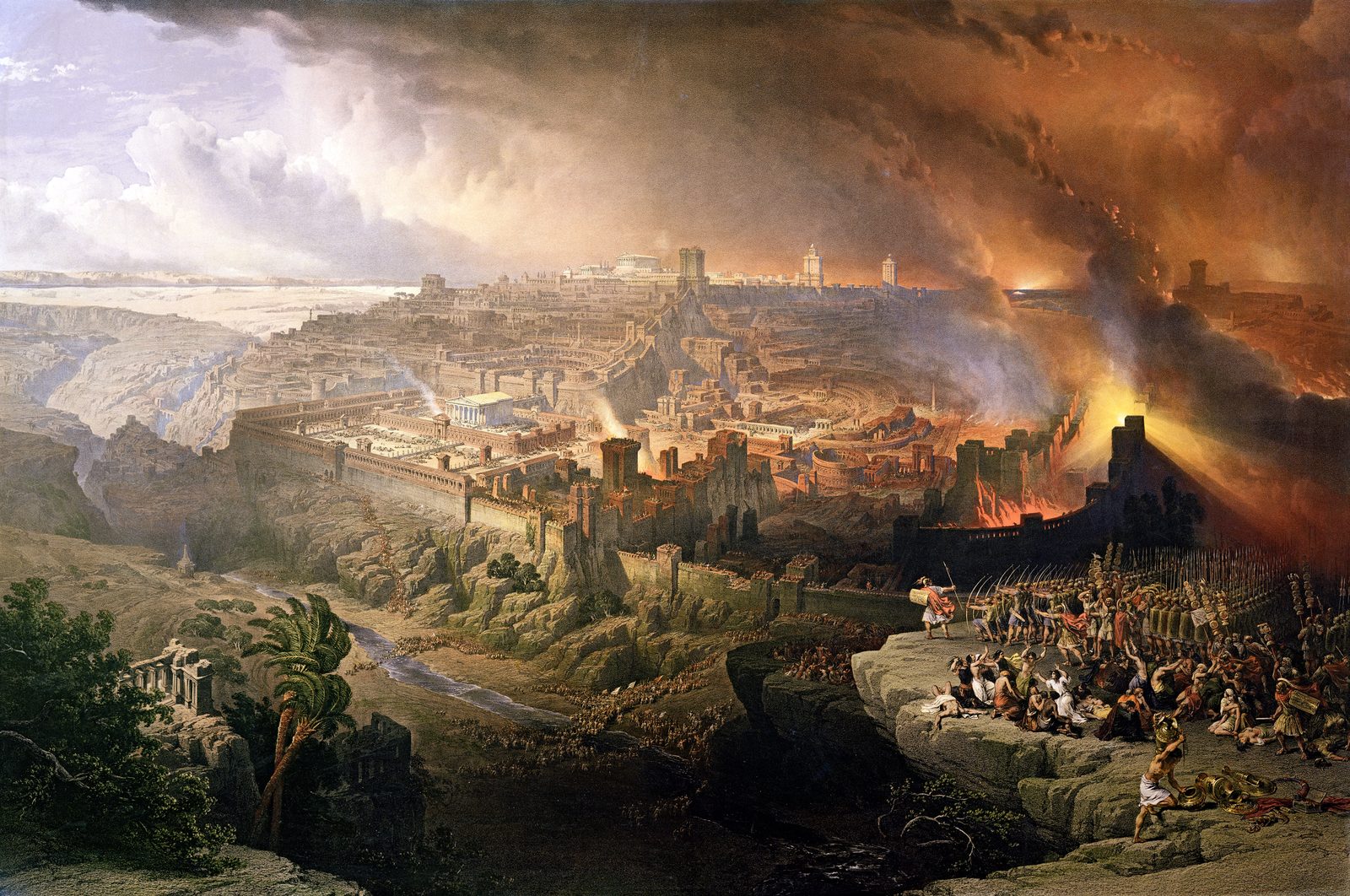
The Siege and Destruction of Jerusalem by the Romans Under the Command of Titus, A.D. 70. David Roberts, 1850. Wikimedia Commons. Public domain.