
Psalm 32
11 verses · Penitential psalm
Blessed is he whose transgressions are forgiven, whose sins are covered.
Introduction
David, the Hiding Place, Book 1: The book of David, Poetry, Psalms Overview.
David wrote this psalm after living through what it describes, and its title calls it an instruction. He speaks as a man who kept a wrong to himself for a long time and paid for the silence in his body. It was written for Israelites who knew that cost, so that the next man could learn quickly what he learned slowly. The psalm puts the outcome first and the road to it after. Listen for the words of the sacrificial law spoken by one man about himself, and for the three pauses marked Selah. Near the end, a voice begins to teach.
Context
- Who
- Israelites who knew what it cost to keep a fault unconfessed
- What
- A psalm of instruction in which one man tells how his silence about his sin ended in confession and pardon.
- Where
- Israel under the sacrificial law; the psalm names no place.
- When
- The reign of David, about 1010 to 970 BC by the superscription, which names no event.
- Why
- To teach the next hearer to confess quickly, so that he learns at once what the writer learned slowly.
Historical context
The psalm is David's by its title and is called a maskil, an instruction. The church has long read it beside Psalm 51 as the aftermath of the affair recorded at 2 Samuel 11 and 12, though the psalm names nothing. Verses 3 and 4 describe the cost of the silence in the body. The comparison is to the dry season in Judah, when the rains stop for months and the moisture goes out of everything. The four words the psalm uses for what is dealt with are the vocabulary of the sacrificial law. The three words for the dealing, forgiven, covered and not counted, are what an Israelite heard read over the offerings. The word Selah stands three times, after verses 4, 5 and 7, marking the end of the silence, the end of the confession, and the end of the shelter.
Significance
For the first hearers, the psalm made public what confession did. It put the result at the front, a man blessed and uncounted against, and then showed the road by which he arrived. Verse 6, telling the godly to pray while God may be found, made the psalm urgent. What the man learned slowly was written down so the next Israelite could learn it quickly.
This chapter in Jewish lifeWhat this chapter is in Jewish life and reading.
How it is read
Rashi reads this psalm as David's own confession after the prophet Nathan came to him, and he says so at Rashi on Psalms 32:5:1, where he names Nathan and the answer given at II Samuel 12:13. He opens the psalm with a rabbinic note on its heading:
Of David, a maskil The Sages said (Pes. 117a): Every Psalm in which “maskil” is mentioned was said through an interpreter. (Rashi on Psalms 32:1:1)
On the blessing of the first line he writes:
Praiseworthy is he whose transgression is forgiven Whose transgression the Holy One, Blessed Be He, forgives, and He conceals his sins. (Rashi on Psalms 32:1:2)
He holds the forgiveness to a condition:
to whom the Lord ascribes no iniquity provided that in his spirit there is no guile, thinking to revert to his “vomit.” (Rashi on Psalms 32:2:1)
And he reads the wasting of the body in the psalm as what silence did:
When I was silent When I was silent, [when I refrained] from confessing my transgressions before You. (Rashi on Psalms 32:3:1)
The long comment at Rashi on Psalms 32:9:1 turns the horse and the mule into a lesson about a creature that cannot tell a kindness from an injury. Ibn Ezra stands on this chapter at Ibn Ezra on Psalms 32:2:1, 32:5:1, 32:6:1, 32:10:1 and 32:11:1 and Radak at Radak on Psalms 32:2:1, 32:10:1 and 32:11:1, and Sefaria holds no English version of those references, so this card cites them without quotation. The Christian reading parts from this one at the point where Paul takes the psalm's first two lines as his proof that God credits righteousness apart from works, at Romans 4:6 to 8.
What the rabbis say
The corpus records 40 places where the rabbinic literature takes up a line of this psalm, 37 of them in the Midrash. Each is a locator, so the saying stands at its reference. Rashi reports one of them himself at Rashi on Psalms 32:1:1, where the Sages are cited from the tractate Pesachim on what the word maskil marks in a psalm's heading. The Midrash on the Psalms treats the psalm at Midrash Tehillim 118:2, 140:1 and 30:4. Aggadat Bereshit takes it up at Aggadat Bereshit 11:1, 7:3 and 73:2 and Shemot Rabbah at Shemot Rabbah 30:19, 47:9 and 19:7. The Talmud takes up lines of the psalm at Berakhot 34b:31, Berakhot 8a:9 and Jerusalem Talmud Shabbat 16:1:4.
Sources: Rashi, Rashi on Psalms, in The Judaica Press complete Tanach with Rashi, translated by A. J. Rosenberg, under a CC-BY licence; Ibn Ezra, Ibn Ezra on Psalms, cited at Ibn Ezra on Psalms 32:2:1, 32:5:1, 32:6:1, 32:10:1 and 32:11:1; Radak, Radak on Psalms, cited at Radak on Psalms 32:2:1, 32:10:1 and 32:11:1; Midrash Tehillim, the Midrash on the Psalms, cited at Midrash Tehillim 118:2, 140:1 and 30:4; The Talmud, cited at Berakhot 34b:31, Berakhot 8a:9 and Jerusalem Talmud Shabbat 16:1:4; MannaFest, the Sefaria corpus at scripts/data/sources/sefaria/psalms/32.json, fetched 2026-09-19, 2026.
Psalms 32:1-2
whose transgressions are forgiven: Paul quotes these two verses at Romans 4:6 to 8, where David speaks of the man to whom God credits righteousness apart from works. Blessed stands twice, once over the forgiven and once over the man the LORD does not count against.
Psalms 32:1
“Blessed is he whose transgression is forgiven,.... Or "lifted up" (m); bore and carried away: sin is a transgression of the law; the guilt of it charged upon the conscience of a sinner is a heavy burden, too heavy for him to bear, and the punishment of it is intolerable: forgiveness is a removal of sin, guilt, and punishment.”
1 more voice on this verseWhat preachers and commentators have said about this verse, in their own words.
Psalms 32:1
“For some sins Thou dost wash away in the blood of Thy Son, others Thou dost remit unto us, that by good works and confession we may cover our errors. The expression therefore "that pardoneth iniquities", appertains to remission; because He takes them away altogether, so that the things which He remembers not are as though they did not exist.”
Ambrose of Milan · written before 397 · Letter 70, To Horontianuspatristic
Cross references
Psalms 32:1
- Quoted inRomans 4:7“Blessed are they whose lawless acts are forgiven, whose sins are covered.
'Blessed are they whose iniquities are forgiven' (David on imputed righteousness)
the LORD does not count against him: Charles Spurgeon noted that blessed is plural in the Hebrew, a cry of many blessings. He counted three words for wrong in verses 1 and 2: transgression, sin and iniquity. Jamieson, Fausset and Brown read no deceit as no false estimate of oneself before God.
Psalms 32:2
“Blessed is the man unto whom the Lord imputeth not iniquity. The word blessed is in the plural, oh, the blessednesses! the double joys, the bundles of happiness, the mountains of delight! Note the three words so often used to denote our disobedience: transgression, sin, and iniquity, are the three headed dog at the gates of hell, but our glorious Lord has silenced his barkings for ever against his own believing ones. The trinity of sin is overcome by the Trinity of heaven.”
Charles Spurgeon · The Treasury of David, Vol. 2 (1870)Particular Baptist
1 more voice on this verse
Psalms 32:2
“The righteousness of Christ being imputed to us, and we being made the righteousness of God in him, our iniquity is not imputed, God having laid upon him the iniquity of us all and made him sin for us. Observe, Not to impute iniquity is God's act, for he is the Judge.”
Matthew Henry · Commentary on the Whole Bible (1707-1721)puritan
Psalms 32:3-4
When I kept silent: The silence of verse 3 is a refusal to confess, and the body pays for it, bones brittle and groaning all day long. Verse 4 pictures strength drained as in the summer heat. Your hand was heavy upon me names who pressed him.
Psalms 32:3
“When I kept silence. When through neglect I failed to confess, or through despair dared not do so, my bones, those solid pillars of my frame, the stronger portions of my bodily constitution, waxed old, began to decay with weakness, for my grief was so intense as to sap my health and destroy my vital energy. What a killing thing is sin! It is a pestilent disease! A fire in the bones! While we smother our sin it rages within, and like a gathering wound swells horribly and torments terribly. Through my roaring all the day long.”
Charles Spurgeon · The Treasury of David, Vol. 2 (1870)Particular Baptist
1 more voice on this verse
Psalms 32:3
“When God has pardoned our sins, if he leaves us to ourselves, we shall soon run as far in debt again as ever and plunge ourselves again into the same gulf; and therefore, when we have received the comfort of our remission, we must fly to the grace of God to be preserved from returning to folly again, and having our hearts again hardened through the deceitfulness of sin.”
Matthew Henry · Commentary on the Whole Bible (1707-1721)puritan
Your hand was heavy upon me: Behind strength stands the Hebrew leshad, which Albert Barnes explained as the sap of a tree and then as a man's vigor. John Gill thought the heavy hand might be a real illness, perhaps a fever. Barnes held that God kept the guilt before his mind.
Psalms 32:4
“For day and night thy hand was heavy upon me,.... Meaning the afflicting hand of God, which is not joyous, but grievous, and heavy to be borne; especially without his gracious presence, and the discoveries of his love: this continued night and day, without any intermission; and may design some violent distemper; perhaps a fever; since it follows, my moisture is turned into the drought of summer.”
1 more voice on this verse
Psalms 32:4
“For day and night thy hand was heavy upon me. God's finger can crush us—what must his hand be, and that pressing heavily and continuously! Under terrors of conscience, men have little rest by night, for the grim thoughts of the day dog them to their chambers and haunt their dreams, or else they lie awake in a cold sweat of dread. God's hand is very helpful when it uplifts, but it is awful when it presses down: better a world on the shoulder, like Atlas, than God's hand on the heart, like David.”
Charles Spurgeon · The Treasury of David, Vol. 2 (1870)Particular Baptist
I acknowledged my sin to You: Speech undoes what the silence of verses 3 and 4 did. He acknowledged the sin, kept back no iniquity, and resolved to confess his transgressions to the LORD. You forgave the guilt of my sin comes in the same verse, with nothing in between.
Psalms 32:5
“I acknowledged my sin unto thee. After long lingering, the broken heart bethought itself of what it ought to have done at the first, and laid bare its bosom before the Lord. The lancet must be let into the gathering ulcer before relief can be afforded. The least thing we can do, if we would be pardoned, is to acknowledge our fault; if we are too proud for this we double deserve punishment. And mine iniquity have I not hid. We must confess the guilt as well as the fact of sin.”
Charles Spurgeon · The Treasury of David, Vol. 2 (1870)Particular Baptist
1 more voice on this verse
Psalms 32:5
“We must confess the fact of sin, and be particular in it ( Thus and thus have I done ), confess the fault of sin, aggravate it, and lay a load upon ourselves for it ( I have done very wickedly ), confess the justice of the punishment we have been under for it ( The Lord is just in all that is brought upon us ), and that we deserve much worse-- I am no more worthy to be called thy son.”
Matthew Henry · Commentary on the Whole Bible (1707-1721)puritan
Psalms 32:6-7
while You may be found: What David went through becomes instruction, and the godly are told to pray while You may be found. Great waters rise in verse 6 and do not come near, and verse 7 sets songs of deliverance all round him. The groaning of verse 3 has become singing.
Psalms 32:6
“For this shall every one that is godly pray unto thee in a time when thou mayest be found. If the psalmist means that on account of God's mercy others would become hopeful, his witness is true. Remarkable answers to prayer very much quicken the prayerfulness of other godly persons. Where one man finds a golden nugget others feel inclined to dig. The benefit of our experience to others should reconcile us to it.”
Charles Spurgeon · The Treasury of David, Vol. 2 (1870)Particular Baptist
1 more voice on this verse
Psalms 32:6
“As soon as ever Paul was converted, Behold, he prays, Acts ix. You may as soon find a living man without breath as a living Christian without prayer. The instructions given us concerning the happiness of those whose sins are pardoned, and the easiness of obtaining the pardon, should engage and encourage us to pray, and particularly to pray, God be merciful to us sinners.”
Matthew Henry · Commentary on the Whole Bible (1707-1721)puritan
You are my hiding place: Charles Spurgeon observed that the God whose hand lay heavy on David in verse 4 is now his hiding place. Adam Clarke heard an allusion to the city of refuge, where the avenger of blood could not overtake the one who fled.
Psalms 32:7
“He caused a light to shine at the prayer of the psalmist, who said, "My Joy, deliver me from those who surround me"; this being indeed true rejoicing, this being a true feast, even deliverance from wickedness, to which a person attains by thoroughly adopting an upright conversation and being approved in his mind of godly submission toward God.”
Athanasius of Alexandria · written before 373 · Festal Letters 14:1patristic
1 more voice on this verse
Psalms 32:7
“Thou art my hiding place. Terse, short sentences make up this verse, but they contain a world of meaning. Personal claims upon our God are the joy of spiritual life. To lay our hand upon the Lord with the clasp of a personal "my" is delight at its full. Observe that the same man who in the fourth verse was oppressed by the presence of God, here finds a shelter in him. See what honest confession and full forgiveness will do! The gospel of substitution makes him to be our refuge who otherwise would have been our judge.”
Charles Spurgeon · The Treasury of David, Vol. 2 (1870)Particular Baptist
Psalms 32:8-9
I will instruct you: The speaker of verse 8 is read two ways, the LORD answering the prayer of verse 7 and David teaching the godly. Verse 9 gives the animal that has to be forced, the horse or mule controlled with bit and bridle. The difference the verse names is understanding.
Psalms 32:8
“I will instruct thee and teach thee in the way which thou shalt go. Here the Lord is the speaker, and gives the psalmist an answer to his prayer. Our Saviour is our instructor. The Lord himself deigns to teach his children to walk in the way of integrity, his holy word and the monitions of the Holy Spirit are the directors of the believer's daily conversation. We are not pardoned that we may henceforth live after our own lusts, but that we may be educated in holiness and trained for perfection.”
Charles Spurgeon · The Treasury of David, Vol. 2 (1870)Particular Baptist
1 more voice on this verse
Psalms 32:8
“I will - This and the next verse seems to be the words of God, whom David brings in as returning this answer to his prayers. Mine eye - So Christ did St. Peter, when he turned and looked upon him.”
John Wesley · Explanatory Notes upon the Old Testament (1765)evangelical
Do not be like the horse or mule: Albert Barnes pictured the horse as wild and unbroken, held only by force. Adam Clarke read the bit and bridle as the afflictions God sends when a man will not serve willingly, the pressure verse 4 described. For Matthew Henry, renewing grace leaves no need of a bridle.
Psalms 32:9
“Fools then are not free, for it is said to them, Be ye not like to horse and mule, which have no understanding, whose mouths must be held with bit and bridle lest they fall upon thee. Great plagues remain for the ungodly; for they have need of these, in order that their folly may be restrained. It is good discipline which requires this, not severity. Further, he that spareth his rod hateth his son: for a man's own sins scourge him still more severely.”
Ambrose of Milan · written before 397 · Letter 37, To Simplician, 41patristic
1 more voice on this verse
Psalms 32:9
“Be ye not as the horse, or as the mule, which have no understanding. Understanding separates man from a brute—let us not act as if we were devoid of it. Men should take counsel and advice, and be ready to run where wisdom points them the way. Alas! we need to be cautioned against stupidity of heart, for we are very apt to fall into it. We who ought to be as the angels, readily become as the beasts. Whose mouth must be held in with bit and bridle, lest they come near unto thee.”
Charles Spurgeon · The Treasury of David, Vol. 2 (1870)Particular Baptist
Psalms 32:10-11
the sorrows of the wicked: Loving devotion surrounds the man who trusts, the same verb that put songs of deliverance around him in verse 7. Verse 11 stacks three commands of praise, be glad, rejoice, shout for joy. The silence of verse 3 ends in noise.
Psalms 32:10
“Many sorrows shall be to the wicked. Like refractory horses and mules, they have many cuts and bruises. Here and hereafter the portion of the wicked is undesirable. Their joys are evanescent, their sorrows are multiplying and ripening. He who sows sin will reap sorrow in heavy sheaves. Sorrows of conscience, of disappointment, of terror, are the sinner's sure heritage in time, and then for ever sorrows of remorse and despair. Let those who boast of present sinful joys, remember the shall be of the future and take warning.”
Charles Spurgeon · The Treasury of David, Vol. 2 (1870)Particular Baptist
Be glad in the LORD and rejoice: Albert Barnes took the righteous ones as those who confess their sins and come without the bit and bridle of verse 9. Thomas Aquinas noted that the penitential psalms begin in weeping and end in joy. Adam Clarke thought this verse first opened Psalm 33.
Psalms 32:11
“Let them be so transported with this holy joy as not to be able to contain themselves; and let them affect others with it, that they also may see that a life of communion with God is the most pleasant and comfortable life we can live in this world. This is that present bliss which the upright in heart, and they are only, are entitled to and qualified for.”
Matthew Henry · Commentary on the Whole Bible (1707-1721)puritan
How this psalm is built
The form: The second of the seven penitential psalms, and a maskil, a psalm that teaches, as Delitzsch classes it.
The patterns in this chapter
| Device | What it does | Where to see it |
|---|---|---|
| Four words for sin and three for its removal | Verses 1, 2 and 5 name what is dealt with by four Hebrew terms, transgression, sin, iniquity and guile, and they name the dealing three ways, forgiven, covered, and not counted against. The psalm is thorough about both halves, and the completeness is the comfort.Albert Barnes, Notes on the Book of Psalms, 1832 to 1869, on Psalm 32:1. | Psalm 32:1, Psalm 32:2, Psalm 32:5 |
| Blessed, said twice at the front | Verse 1 opens with blessed over the man whose transgressions are forgiven, and verse 2 says it again over the man the LORD does not count against. The doubling puts the whole result at the start, before the psalm says anything about how it was reached.Matthew Henry, Commentary on the Whole Bible, 1710, on Psalm 32:1 and 2. | Psalm 32:1, Psalm 32:2 |
| The silence and the noise, one turned into the other | Verse 3 is a man who kept silent while his bones wasted away and he groaned all day long, and verse 11 is three commands to make noise: be glad, rejoice, shout for joy. The psalm begins in a closed mouth and ends in an open one, and the hinge is the speech of verse 5.Charles Spurgeon, The Treasury of David, Vol. 2, 1870, on Psalm 32:3. | Psalm 32:3, Psalm 32:5, Psalm 32:11 |
| The horse and the mule, put in as the counter-example | Verse 9 sets an animal beside the reader: the horse or mule with no understanding, which has to be held by bit and bridle. The word the verse turns on is understanding, and the instruction of verse 8 promises an eye guiding rather than a jaw pulled.John Calvin, Commentary on the Book of Psalms, 1557, on Psalm 32:9. | Psalm 32:8, Psalm 32:9 |
| The three Selahs, set at the ends of the three movements | Selah stands after verse 4, after verse 5 and after verse 7, which puts a pause at the end of the silence, at the end of the confession, and at the end of the shelter. The last four verses carry none, because they are the teaching rather than the account.Franz Delitzsch, Biblical Commentary on the Psalms, on Psalm 32:4. | Psalm 32:4, Psalm 32:5, Psalm 32:7 |
The New Testament's use
5 more paragraphs on the patterns
Paul quotes verses 1 and 2 at Romans 4:6 to 8. He uses them to show that David speaks of the blessedness of the man to whom God credits righteousness apart from works, and the quotation is the reason this psalm sits under the doctrine of justification in Christian teaching.
The psalm's own images answer each other. The great waters of verse 6 rise and do not reach the man, and the songs of deliverance of verse 7 surround him. The verb behind surround comes back at verse 10, where loving devotion surrounds the man who trusts in the LORD. What is round about him changes from water to song to mercy.
Heat runs the other way. Verse 4 dries him out as the summer heat drains moisture, and verse 5 ends the drought in one sentence. Nothing in the psalm is slow except the silence.
The debated concept
The speaker of verse 8 is not named, and the two readings change what the psalm is. John Gill reads it as the LORD answering the prayer of verse 7, which makes the second half divine instruction. Matthew Henry and others read it as David teaching the godly of verse 6, which makes it the testimony's natural conclusion. John Calvin allows either and holds that the counsel is the same in both mouths. Nothing in the Hebrew settles it, and the psalm reads coherently under both.
Keep studying
Studies8
Sources for this chapter
The summary
Jamieson, Fausset & Brown, Commentary Critical and Explanatory; John Calvin, Commentaries; John Wesley, Notes on the Old Testament and Matthew Henry, Complete Commentary.
The form and classifications
Charles Spurgeon, The Treasury of David, Vol. 2, 1870, on Psalm 32; Franz Delitzsch, Biblical Commentary on the Psalms, on Psalm 32; John Gill, Exposition of the Old Testament, 1748 to 1763, on Psalm 32:8 and Matthew Henry, Commentary on the Whole Bible, 1710, on Psalm 32.
The exposition
Adam Clarke, Commentary on the Bible; Albert Barnes; Athanasius of Alexandria, Festal Letters; Augustine of Hippo, Exposition on Psalm 32; Charles Spurgeon, The Treasury of David; Franz Delitzsch, Biblical Commentary on the Psalms; Jamieson, Fausset & Brown, Commentary Critical and Explanatory on the Whole Bible; John Calvin, Commentary on the Book of Psalms; John Gill, Exposition of the Old Testament; John Wesley, Explanatory Notes upon the Old Testament; Matthew Henry, Commentary on the Whole Bible and Thomas Aquinas, Exposition on the Psalms of David.
The painting
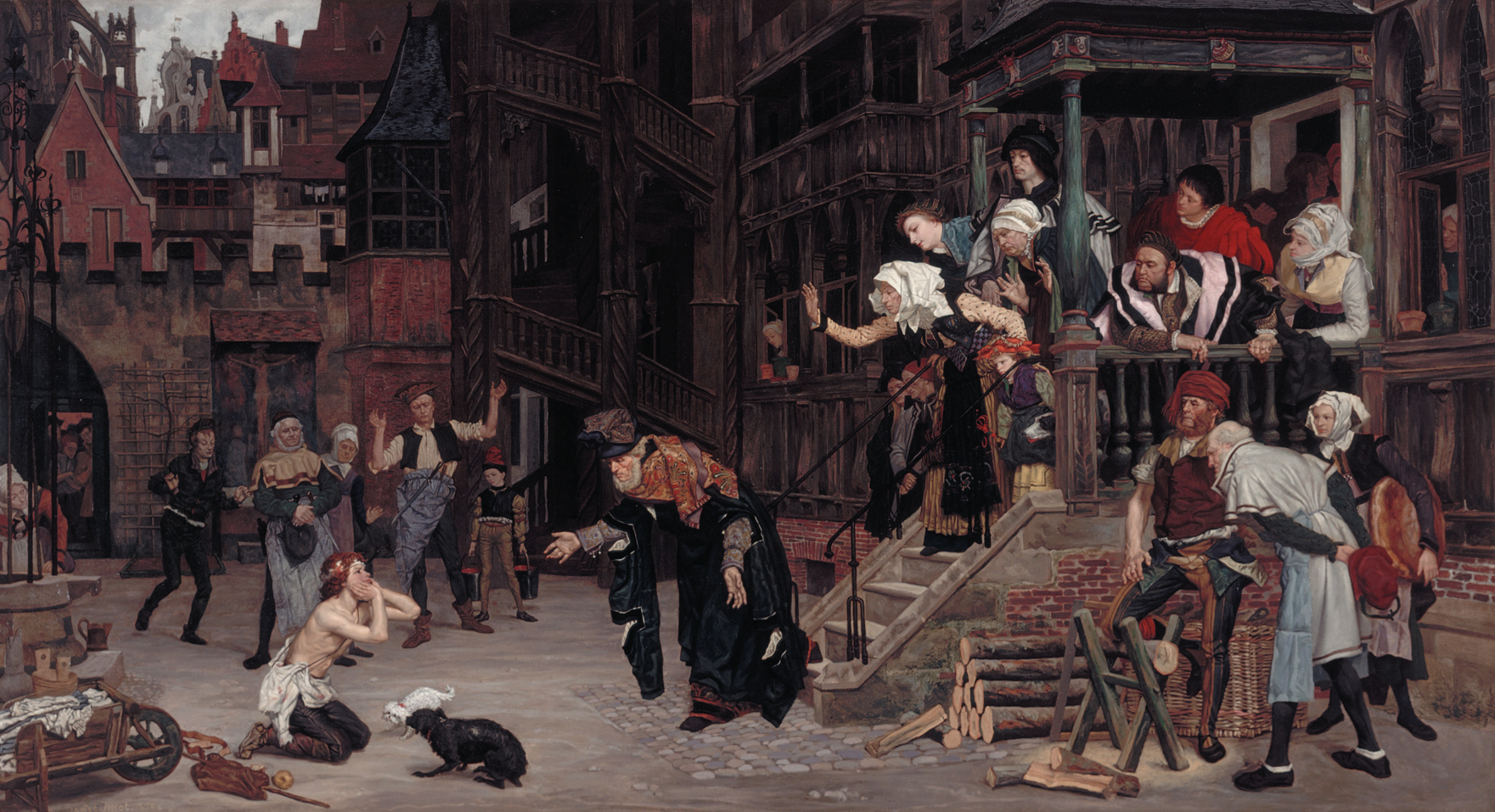
The Return of the Prodigal Son. James Tissot, 1862. Wikimedia Commons. Public domain.