
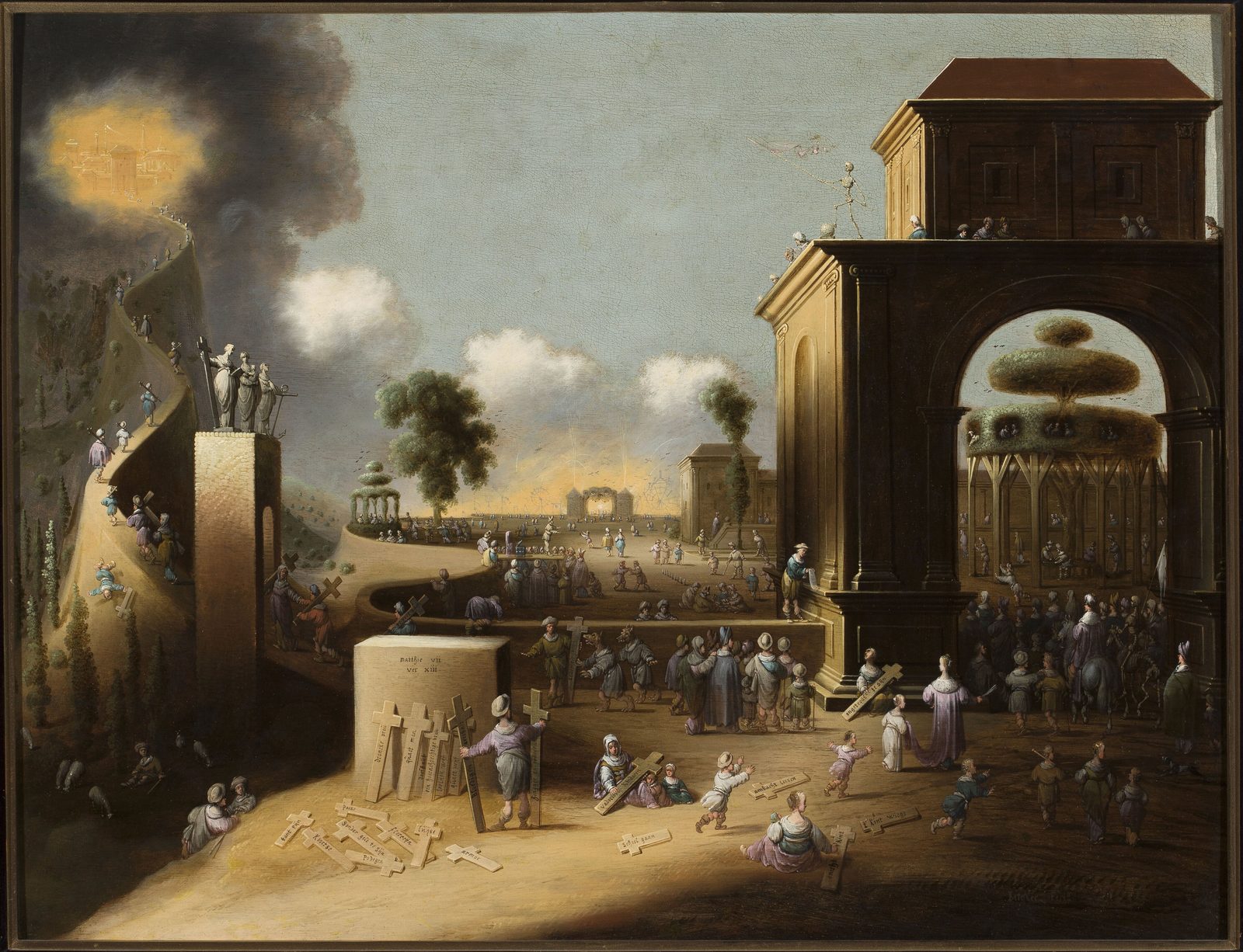
Psalm 14
7 verses · Wisdom psalm
The fool says in his heart, “There is no God.” They are corrupt; their acts are vile. There is no one who does good.
Introduction
David, the Fool, Book 1: The book of David, Poetry, Psalms Overview.
David wrote this psalm about a whole society living as though God were absent. It reads like a wisdom teacher's verdict, and it looks at mankind from heaven before it looks at Israel. A near copy stands later in the Psalter as Psalm 53, and Paul draws on its verdict in Romans 3 to show that every person needs rescue. Listen for the inspection from above, and for the sudden fear that falls on the oppressors in the middle of the psalm. It closes with a longing for rescue to come from Zion, the place God had chosen.
Context
- Who
- Israelites living among neighbours who behaved as though God were not watching
- What
- A verdict on a whole society that lives as though there were no God, followed by a longing for rescue from Zion.
- Where
- Israel under David, with Zion in Jerusalem as the place rescue is awaited.
- When
- The reign of David, about 1010 to 970 BC by the superscription.
- Why
- To show that corruption runs through the whole human race and that rescue must come from God.
Historical context
The fool of verse 1 is a moral judgment. The Hebrew word describes a man coarse, stubborn and closed, and it stands as the name of Nabal in 1 Samuel 25. His statement that there is no God describes a way of living, since nobody in that world doubted that gods existed and plenty of men behaved as though none of them were paying attention. The looking down from heaven at verse 2 uses the language of Genesis, where God comes down to see Babel and Sodom, and this inspection comes back empty. Bread was eaten at every meal without a thought, and powerful men absorbed poor households with as little thought as that. The wish of verse 7 puts the rescue at Zion, where in David's day the tent that housed the ark stood on the ridge of Jerusalem.
Significance
For Israelites the psalm said that the corruption around them was the condition of the whole race, since God looked and found no one who does good, not even one. That left the last line as the only line, since salvation has to come out of Zion from God Himself.
This chapter in Jewish lifeWhat this chapter is in Jewish life and reading.
How it is read
Rashi opens this psalm by pairing it with another, and the pairing is the first thing a Christian reader should carry away. He is quoted here from the Judaica Press Tanach with Rashi. He observes that David "recited two psalms in this Book, in one manner", meaning in almost the same words. He assigns the first to Nebuchadnezzar and the second, which stands as the fifty-third psalm, to Titus (Rashi on Psalms 14:1:1). So the classical reading takes the doubling as deliberate, with one text for the destroyer of the first Temple and one for the destroyer of the second. The site treats the two psalms side by side, and the pairing is owed a page of its own under the twin psalms row of docs/lanes/FEATURE-PAGES-OWED.md.
On that reading the fool of the first verse is a named king rather than a type of man. Rashi has him prophesied against because he "was destined to enter the Temple and to destroy it, with not one man of all his armies protesting against him" (Rashi on Psalms 14:1:1). He puts the boast of Isaiah's king of Babylon into the fool's mouth at the same verse (Rashi on Psalms 14:1:2). The turning away of the third verse he then reads as the silence of the army: "Not one man of his armies protested against him" (Rashi on Psalms 14:3:1). The devourers of the fourth verse are "the seed of Nebuchadnezzar". The bread of that verse is the feast of Belshazzar, where the vessels of the Temple were used and God went unremembered (Rashi on Psalms 14:4:2 and 14:4:4). The great fear of the fifth verse is the king's terror in that hall (Rashi on Psalms 14:5:1).
This is the sharpest parting in the first thirty psalms, and it deserves to be stated plainly. Paul quotes the second and third verses of this psalm to prove that no one is righteous, at Romans 3:10 to 12, and he applies them to the whole human race, Jew and Gentile together. Rashi applies the same verses to one Babylonian army in one hour of history. Neither reading is a misreading of the words, and the difference is over how far the psalm's "all" reaches. Rashi himself keeps a faithful remnant inside the psalm, and reads the righteous generation of the fifth verse as "the generation of Jeconiah, who were righteous" (Rashi on Psalms 14:5:2). Paul reads no exception at all. The site sets the two readings beside each other at this verse and leaves the reader able to see both.
Rashi also reports a reading of the Sages that has nothing to do with Babylon. On the fourth and fifth verses they taught that whoever does not rob Israel finds no pleasant taste in his food, so the devourers tasted bread because they had devoured (Rashi on Psalms 14:5:1). He names the places, and one of them stands among this chapter's own locators at Sanhedrin 104b:12. Ibn Ezra, Radak and Metzudat David all comment on this chapter, and the corpus carries their refs without English text. They stand here cited and unquoted at Ibn Ezra on Psalms 14:1:1 to 14:7:1, at Radak on Psalms 14:2:1, 14:3:1, 14:6:1 and 14:7:1, and at Metzudat David on Psalms 14:2:1. Rashi ends the psalm on the salvation still to come out of Zion (Rashi on Psalms 14:7:1).
What the rabbis say
The corpus carries forty locators on this psalm and the text of none, so each is cited and linked here rather than quoted. Two are Talmudic, at Berakhot 12b:22 on the first verse and Sanhedrin 104b:12 on the fourth.
The first verse carries the heaviest weight. On it the corpus holds Bereshit Rabbah 34:10 and 67:8, Esther Rabbah 10:3 and 10:4, and Kohelet Rabbah 7:1:4. Beside them stand Midrash Lekach Tov on Genesis 27:41:2 and on Deuteronomy 32:21:1, Midrash Sekhel Tov on Genesis 27:41:2, Midrash Tannaim on Deuteronomy 32:21:4, and Midrash Tanchuma Buber, Toldot 9:1. Three entries of Ein Yaakov stand on the same verse, at Yevamot 6:13 in the Glick Edition, and at Berakhot 2:1 and Yevamot 6:15.
The seventh verse, where the salvation comes out of Zion, carries the next largest share. On it the corpus holds Midrash Tehillim 14:7 and 14:8, Aggadat Bereshit 54:1, Eikhah Rabbah 2:7, Pesikta Rabbati 41:1, Pirkei DeRabbi Eliezer 9:4 and Vayikra Rabbah 24:4. Beside them stand Midrash Tanchuma on Lech Lecha 15:3 and Vayakhel 4:3, with Lech Lecha 19:2 in the Buber recension. Two more stand at Midrash Lekach Tov on Lamentations 2:3:1, and two entries of Yalkut Shimoni on Torah at 737:5 and 831:3. On the third verse the corpus carries Mekhilta DeRabbi Yishmael, Vayehi Beshalach 3:8, Midrash Lekach Tov on Exodus 9:14:1 and Midrash Sekhel Tov on Exodus 9:14:3. On the fourth it carries Shemot Rabbah 27:1, Midrash Tanchuma, Yitro 5:4 and Midrash Tehillim 14:5. Two more stand at Midrash Tehillim 14:6 and 53:3 on the fifth and sixth verses. What each of them teaches is a saying of the rabbis, and is reported as theirs wherever this site quotes one. The quotations wait on a fetch that carries the text.
Sources: Rashi, Rashi on Psalms 14:1:1 to 14:7:1, the Judaica Press complete Tanach with Rashi, translated by A. J. Rosenberg; Ibn Ezra, Ibn Ezra on Psalms 14:1:1 to 14:7:1, cited by ref because the corpus carries no English text; Radak, Radak on Psalms 14:2:1, 14:3:1, 14:6:1 and 14:7:1, cited by ref because the corpus carries no English text; Metzudat David, Metzudat David on Psalms 14:2:1, cited by ref because the corpus carries no English text; MannaFest, the twin psalms row of docs/lanes/FEATURE-PAGES-OWED.md; The Sefaria corpus, scripts/data/sources/sefaria/psalms/14.json, the 2 Talmud and 38 Midrash locators of this chapter.
The fool says in his heart: that there is no God, and the corrupt and vile deeds follow that denial in the same verse. The line closes with no one who does good. Henry reads the denial as a heart persuading itself.
Psalms 14:1
“This statement [about fools] is directly followed by one pointing out that their actions correspond with their thoughts: "They are corrupt, and their behavior is evil." The unrighteous person corrupts his body in every possible way: stealing, committing adultery, cursing, getting drunk, and doing similar things.… Count on it: those who are fools in their thoughts will do wicked deeds. As the Lord said [to the Pharisees], "How can you speak good things when you are evil?" And they truly were evil, because their thoughts were wicked.”
Athanasius of Alexandria · written before 373 · Festal Letters 9:8, 12:6patristic
Cross references
Psalms 14:1
- Quoted inRomans 3:10“As it is written: “There is no one righteous, not even one.”
'There is none righteous, no, not one', head of Paul's catena of universal sin
ConnectionsRomans 3:10
Psalms 14:2-3
The LORD looks down from heaven: on the sons of men, looking for one who understands and seeks God. All have turned away and together become corrupt, and no one does good. Paul quotes these verses at Romans 3:10 to 12 to put Jews and Greeks alike under sin.
Psalms 14:2
“The Lord looked down from heaven upon the children of men,.... As he did when all flesh had corrupted its way, and before he brought a flood upon the world of the ungodly, Gen 6:12. This is said in direct opposition to the atheistic thoughts and reasonings of wicked men, in Psa 14:1. There is a God, and he takes notice of the children of men, and of what is done by them; though his throne is in the heavens, and his dwelling there, yet he looks down from thence, and takes cognizance of all human affairs.”
2 more voices on this verse
Psalms 14:2
"The Lord looked down from heaven upon the children of men." As from a watchtower, or other elevated place of observation, the Lord is represented as gazing intently upon men. He will not punish blindly, nor like a tyrant command an indiscriminate massacre because a rumour of rebellion has come up to his ears. What condescending interest and impartial justice are here imaged! The case of Sodom, visited before it was overthrown, illustrates the careful manner in which Divine Justice beholds the sin before it avenges it, and searches out the righteous that they perish not with the guilty.
Charles Spurgeon · The Treasury of David, Vol. 1 (1869)Particular Baptist
Psalms 14:2
“Looked - God knoweth all things without any enquiry: but he speaks after the manner of men. Upon - Upon the whole Israelitish nation, and upon all mankind for he speaks of all except his people, and the righteous ones, who are opposed to these, ver. 4, 5.”
John Wesley · Explanatory Notes upon the Old Testament (1765)evangelical
All have turned away: Spurgeon read the Hebrew as the sons of men taken together as one whole, all turned away and corrupt. Gill likened those who turned away to bankrupts who have run through their stock and hide, as Adam hid. Aquinas saw men turned from God and from good.
Psalms 14:3
“They are all gone aside,.... As bankrupts, having run out their whole stock, and into debt, and have nothing to pay, nor make composition with, and are obliged to abscond, as Adam, Gen 3:8. The words in Psa 53:3 are, "everyone of them is gone back"; from God; have revolted from him, and turned their backs upon him, and have gone back from his commandment, despised his law, and cast away his word.”
2 more voices on this verse
Psalms 14:3
“It was right to show openly the magnitude of the disease that lingered with sinister purpose for all people before the advent of the Savior: as it was manifested to all, his sojourn on earth became straightforwardly necessary. As all have sinned, all lacked the glory of God, and now they are all justified by his grace.”
Eusebius of Caesarea · written before 339 · Commentary on Psalms 14:3patristic
Psalms 14:3
“They have gone aside from the right of their duty, the way that leads to happiness, and have turned into the paths of the destroyer. In singing this let us lament the corruption of our own nature, and see what need we have of the grace of God; and, since that which is born of the flesh is flesh, let us not marvel that we are told we must be born again.”
Matthew Henry · Commentary on the Whole Bible (1707-1721)puritan
the workers of iniquity: devour my people like bread, so the oppression is as regular as a meal. The same verse says they refuse to call upon the LORD, which ties the cruelty to the denial of verse 1. Spurgeon notes that bread is the commonest of foods.
Psalms 14:4
“Hatred of God and corruptness of life are the motive forces which produce persecution. Men who having no saving knowledge of divine things, enslave themselves to become workers of iniquity, have no heart to cry to the Lord for deliverance, but seek to amuse themselves with devouring the poor and despised people of God.”
Charles Spurgeon · The Treasury of David, Vol. 1 (1869)Particular Baptist
Psalms 14:5-6
overwhelmed with dread: Dread overwhelms them where they stand, because God stands in the company of the righteous. Verse 6 has sinners frustrating the plans of the oppressed while the LORD shelters them. Gill reads the dread as a guilty conscience meeting the God the fool denied.
Psalms 14:5
“Oppressors have it not all their own way, they have their fits of trembling and their appointed seasons of overthrow. There —where they denied God and hectored against his people; there —where they thought of peace and safety, they were made to quail. "There were they" —these very loud-mouthed, iron-handed, proud-hearted Nimrods and Herods, those heady, high-minded sinners— "there were they in great fear." A panic terror seized them: "they feared a fear, " as the Hebrew puts it; an undefinable, horrible, mysterious dread crept over them.”
Charles Spurgeon · The Treasury of David, Vol. 1 (1869)Particular Baptist
1 more voice on this verse
Psalms 14:5
“There were they in great fear,.... This, shows that they had some knowledge of God, and consciousness of guilt, which they endeavoured to banish out of their minds by their fears of punishment; and these fears men of the most atheistic principles cannot get rid of. In Psa 53:5 it is added, "where no fear was": that is, any cause or reason for it: such men are often frightened at their own shadows, afraid to be in the dark alone, as Hobbes the atheist was.”
frustrate the plans of the oppressed: Gill took the plans of the oppressed as their counsel to trust the LORD and make Him their shelter, the best counsel there is. Barnes read the frustrating as sinners mocking that trust. Spurgeon heard the taunt, what their God can do for them now.
Psalms 14:6
“You have shamed the counsel of the poor,.... The poor saints, the Lord's people, the generation of the righteous, who are generally the poor of this world; poor in spirit, and an afflicted people: and the counsel of them intends not the counsel which they give to others, but the counsel which they receive from the Lord, from the Spirit of counsel, which rests upon them, and with which they are guided; and this is to trust in the Lord, and to make him their refuge; and which is good advice, the best of counsel.”
1 more voice on this verse
Psalms 14:6
“Notwithstanding their real cowardice, the wicked put on the lion's skin and lord it over the Lord's poor ones. Though fools themselves, they mock at the truly wise as if the folly were on their side; but this is what might be expected, for how should brutish minds appreciate excellence, and how can those who have owl's eyes admire the sun? The special point and butt of their jest seems to be the confidence of the godly in their Lord. What can your God do for you now? Who is that God who can deliver out of our hand?”
Charles Spurgeon · The Treasury of David, Vol. 1 (1869)Particular Baptist
Oh, that the salvation of Israel: The last verse widens from the fool of verse 1 to the whole nation. The prayer is for the salvation of Israel to come from Zion, and for the LORD to restore His captive people. Jacob will rejoice and Israel be glad when He does.
Psalms 14:7
“Natural enough is this closing prayer, for what would so effectually convince atheists, overthrow persecutors, stay sin, and secure the godly, as the manifest appearance of Israel's great Salvation? The coming of Messiah was the desire of the godly in all ages, and though he has already come with a sin-offering to purge away iniquity, we look for him to come a second time, to come without a sin-offering unto salvation. O that these weary years would have an end! Why tarries he so long?”
Charles Spurgeon · The Treasury of David, Vol. 1 (1869)Particular Baptist
How this psalm is built
The form: Lament and trust, with the complaint made over the whole race rather than over one enemy, as Psalter classes it.
The patterns in this chapter
| Device | What it does | Where to see it |
|---|---|---|
| The verdict said twice | Verse 1 closes with the line that there is no one who does good, and verse 3 says it again with the words not even one added. Charles Spurgeon holds that the original speaks of the race as a whole, as a totality, so that humanity as a whole has become depraved in heart and defiled in life. The repetition is what Paul takes up when he quotes the psalm.Charles Spurgeon, The Treasury of David, Vol. 1, 1869, on Psalm 14:3. | Psalm 14:1, Psalm 14:3 |
| The search and the result of it | Verse 2 is the looking and verse 3 is what the looking found. Charles Spurgeon reads the LORD as gazing intently on men from a watchtower, and takes the visit to Sodom as the picture of it, divine justice beholding the sin before it avenges it and searching out the righteous so that they do not perish with the guilty. John Wesley adds that God knows all things without any enquiry and that the psalm speaks after the manner of men.Charles Spurgeon, The Treasury of David, Vol. 1, 1869, on Psalm 14:2. | Psalm 14:2, Psalm 14:3 |
| The denial and the deeds that follow it | Athanasius of Alexandria observes that the statement about the fool is directly followed by one pointing out that their actions correspond with their thoughts. The psalm then lists the deeds in order: they are corrupt, their acts are vile, none does good, they devour my people like bread, and they refuse to call upon the LORD.Athanasius of Alexandria, Festal Letters 9:8 and 12:6, 373. | Psalm 14:1, Psalm 14:4 |
| The word there, pointing at the place | Verse 5 opens by pointing rather than by naming. Charles Spurgeon reads the word there twice over, as the place where they denied God and hectored against His people, and as the place where they thought of peace and safety and were made to quail. John Gill reads the dread of the same verse as evidence that they had some knowledge of God and a conscience of guilt which their fears would not let them banish.Charles Spurgeon, The Treasury of David, Vol. 1, 1869, on Psalm 14:5. | Psalm 14:5 |
The psalm that stands twice
This psalm is printed again as Psalm 53, in the second book of the Psalter, and the two copies differ. This site's published account of the books notes that Book II uses Elohim, God, where the same psalm in Book I uses the LORD, and that this substitution is why Book II is called the Elohistic Psalter. John Gill notes a difference in the wording as well, that where Psalm 14:3 reads that they are all gone aside, Psalm 53:3 reads that every one of them is gone back.
3 more paragraphs on the patterns
Paul's use of the psalm
The published exposition of this chapter states that Paul quotes verses 2 and 3 at Romans 3:10 to 12, and that he uses them to put Jews and Greeks alike under sin. The apostle reads the psalm as a verdict rather than as a complaint about one generation of enemies, and he puts it at the head of his proof that none is righteous, so the search of verse 2 and the report of verse 3 become the court's finding on every man. Eusebius of Caesarea reads verse 3 the same way and draws the same conclusion, that it was right to show openly the magnitude of the disease before the coming of the Savior, since all have sinned and all lacked the glory of God and are now justified by His grace.
The debate over not even one
The commentators divide over how far the verdict reaches. Charles Spurgeon holds that it reaches every man without exception, since the Hebrew speaks of the race as a totality, and he compares stubborn heifers refusing the yoke and sheep that have found a gap. John Wesley holds that the looking is upon the whole nation of Israel and upon all mankind, and that the psalmist speaks of all except God's own people and the righteous ones, who stand opposite these men in verses 4 and 5. Augustine of Hippo reads verse 2 of the Jews in particular, taking the more honourable name sons of men as given them for their worship of the one God. John Gill reads the search as the one God made when all flesh had corrupted its way before the flood at Genesis 6:12, which keeps the verdict general and historical at once.
The salvation asked for from Zion
Verse 7 asks for a salvation that comes out of Zion and for the restoring of a captive people. Thomas Aquinas reads the wish as the expectation of all the ancients, tying it to the scepter that would not depart from Judah in Genesis 49 and to the word in John 4 that salvation is from the Jews. John Gill reads the salvation of Israel as the Messiah Himself, called by that name because the saving of His people was put into His hands. Charles Spurgeon reads the prayer as the natural close of such a psalm, since the appearance of Israel's great Salvation is what would convince the deniers and secure the godly.
Keep studying
Words8
Sources for this chapter
The summary
Jamieson, Fausset & Brown, Commentary Critical and Explanatory; John Calvin, Commentaries; John Wesley, Notes on the Old Testament and Matthew Henry, Complete Commentary.
The form and classifications
Charles Spurgeon, The Treasury of David, Vol. 1, 1869, on Psalm 14:7; This site's published exposition of Psalm 14, the note on Psalm 14:2 and 14:3, drawn from Albert Barnes, Notes on the Book of Psalms, and Franz Delitzsch, Biblical Commentary on the Psalms and This site's published structure of the Psalter, src/components/book/dossier-content/psalms-structure.ts, the psalm types table.
The exposition
Albert Barnes; Charles Spurgeon, The Treasury of David; Franz Delitzsch, Biblical Commentary on the Psalms; John Calvin, Commentary on the Book of Psalms; John Gill, Exposition of the Old Testament; Matthew Henry, Commentary on the Whole Bible and Thomas Aquinas, Exposition on the Psalms of David.
The painting
Narrow Road of Virtue and Wide Road of Sin. Jan Micker, not stated on the file page. National Museum in Warsaw. Public domain.