
Psalm 142
7 verses · Lament psalm
Look to my right and see; no one attends to me. There is no refuge for me; no one cares for my soul.
Introduction
David, the Cave, Book 5: The return and the great Hallelujah, Poetry, Psalms Overview.
The heading places David in a cave, hiding from Saul with no army and no court to plead his case. This is the prayer of a hunted man before he became a king, kept so that later readers would learn from it. Listen for how alone he says he is, and for the one sentence where his complaint turns into a claim on God. Read it beside the chapters of First Samuel that tell of those years, and it becomes the private side of a public story.
Context
- Who
- Israelites who knew what it was to have no protector and nowhere to appeal
- Where
- A limestone cave in the Judean wilderness, with the entrance watched
- When
- David's years as a fugitive from Saul. The heading reads An Instruction of David, a Prayer when he is in the cave, which places it in his years on the run, about 1015 BC
Historical context
This heading names a situation rather than a use. David is a wanted man with a price on him, and the psalm is labelled an instruction, which means it was kept to be learned from. The hill country of Judah is honeycombed with limestone caves, and Scripture ties two of them to these years, the cave of Adullam at 1 Samuel 22:1 and the cave by the sheepfolds at 1 Samuel 24:3. A cave held a large group out of the weather, could be defended at a narrow mouth, and had one exit. The right hand was where a defender or a witness stood, so a man who looks to the right and finds no one is reporting that nobody would testify for him. The word he uses for prison at the end may be the cave itself.
Significance
Israel's greatest king spent years hiding in holes in the ground, and this psalm was kept so that nobody could pretend otherwise. Portion is an inheritance word, the share a man received when the land was divided among the tribes. Having lost house, position and country, he says God is the piece of ground he still holds.
This chapter in Jewish lifeWhat this chapter is in Jewish life and reading.
What is done
Psalm 142 stands in the third Davidic collection, which the book's structure file gives as Psalms 108 to 110 and 138 to 145. Its heading places it in the cave, and Rashi fixes which cave: the one "where he severed the skirt of Saul's robe" (Rashi on Psalms 142:1:1, the Judaica Press complete Tanach with Rashi, translated by A. J. Rosenberg, CC-BY). The corpus holds no liturgical locator for this chapter, so this site records the collection and the reading rather than a custom.
How it is read
The classical reading keeps the psalm inside the story its heading names. Rashi reads the line about no one recognizing the speaker as a line about Saul's court: among all Saul's servants there is not one who protests against him. Metzudat David reads the same verse as a man looking to right and left for anyone who will think of him for good before Saul, and adds on the next clause that there is no one left to flee to for help (Metzudat David on Psalms 142:5:1 and 142:5:2, Sefaria Community Translation, CC0). On the fourth verse Rashi reads God's knowledge of the path as knowledge of how many snares are in it. On the last verse he reads the crowning of God by the righteous as thanksgiving, given because God supports those who fear Him. Ibn Ezra comments on seven verses and Radak on six, with Malbim on one and Metzudat David on four more, and the corpus holds no English version of those under a licence permitting quotation, so they stand as citations: Ibn Ezra on Psalms 142:1:1, Radak on Psalms 142:1:1, Malbim on Psalms 142:2:1, Metzudat David on Psalms 142:2:1.
What the rabbis say
The corpus records thirty locators on this chapter, twenty-eight Midrash and two Talmud, and Midrash Tehillim works through the psalm verse by verse, at 142:1 through 142:6. The pouring out of complaint is taken up at Pirkei DeRabbi Eliezer 16:11 and Midrash Tehillim 142:2. The fainting spirit of the third verse is taken up at Bereshit Rabbah 68:9, Midrash Tehillim 102:2, Mekhilta DeRabbi Yishmael, Tractate Vayehi Beshalach 3:8 and Avodah Zarah 7b:15. The cry that no one cares for the speaker's soul is taken up at Jerusalem Talmud Berakhot 9:2:9, and the closing verse about the righteous surrounding the speaker at Bereshit Rabbah 34:1, Aggadat Bereshit 7:3 and four passages of Midrash Tanchuma on Noah. Each is a locator without text in the corpus.
Sources: Rashi, Rashi on Psalms 142:1:1, 142:4:1, 142:5:1 and 142:8:1, the Judaica Press complete Tanach with Rashi, translated by A. J. Rosenberg, CC-BY; Metzudat David, Metzudat David on Psalms 142:5:1 and 142:5:2, Sefaria Community Translation, CC0; Ibn Ezra, Ibn Ezra on Psalms 142:1:1, cited only, no English version in the corpus; Radak, Radak on Psalms 142:1:1, cited only; Malbim, Malbim on Psalms 142:2:1, cited only; Midrash, Midrash Tehillim 142:1 through 142:6, 63:1 and 102:2, Pirkei DeRabbi Eliezer 16:11 and 23:10, Bereshit Rabbah 68:9, 74:1 and 34:1, Aggadat Bereshit 7:3, Mekhilta DeRabbi Yishmael, Tractate Vayehi Beshalach 3:8; Babylonian Talmud, Avodah Zarah 7b:15; Jerusalem Talmud, Berakhot 9:2:9; MannaFest, the collections of the Psalter, src/components/book/dossier-content/psalms-structure.ts, 2026.
Psalms 142:1-2
I cry aloud to the LORD: Verse 1 says my voice to the LORD twice, once as a cry and once as a plea for mercy. Verse 2 pours out complaint and trouble in front of Him, and Spurgeon noted David took care where he poured it. Henry read the record as David owning his fright.
Psalms 142:1
“I cried unto the Lord with my voice. It was a cry of such anguish that he remembers it long after, and makes a record of it. In the loneliness of the cave he could use his voice as much as he pleased; and therefore he made its gloomy vaults echo with his appeals to heaven. When there was no soul in the cavern seeking his blood, David with all his soul was engaged in seeking his God. He felt it a relief to his heart to use his voice in his pleadings with Jehovah.”
Charles Spurgeon · The Treasury of David, Vol. 7 (1885)Particular Baptist
3 more voices on this verseWhat preachers and commentators have said about this verse, in their own words.
Psalms 142:1
“When the danger was over he was not ashamed to own (as great spirits sometimes are) the fright he had been in and the application he had made to God. Let no men of the first rank think it any diminution or disparagement to them, when they are in affliction, to cry to God, and to cry like children to their parents when any thing frightens them.”
Matthew Henry · Commentary on the Whole Bible (1707-1721)puritan
Psalms 142:1
“The intelligence of David when he was in the cave, a prayer. This title is prescribed according to history, indeed, when David was fleeing from the face of Saul in the desert of Engaddi, hidden in a cave; and Saul entered, unaware, as if on his own account. But since it has in its heading "The intelligence of David," we ought to understand the psalm spiritually.”
Jerome · written before 420 · Homily 52, on Psalm 141patristic
Psalms 142:1
“I cried to Jehovah, etc. It showed singular presence of mind in David that he was not paralyzed with fear, or that he did not in a paroxysm of fury take vengeance upon his enemy, as he easily might have done; and that he was not actuated by despair to take away his life, but composedly addressed himself to the exercise of prayer.”
John Calvin · Commentaries (1554)reformed
I pour out my complaint before Him: The Hebrew word behind complaint is literally meditation, and Albert Barnes read it as the thoughts that filled David's mind, spoken aloud. The Septuagint and the Vulgate render it prayer. Jerome likened it to a sick man telling a doctor every pain so the cure can be applied.
Psalms 142:2
“I poured out my complaint before him. His inward meditation filled his soul: the bitter water rose up to the brim; what was to be done? He must pour out the wormwood and the gall, he could not keep it in; he lets it run away as best it can, that so his heart may be emptied of the fermenting mixture. But he took care where he outpoured his complaint, lest he should do mischief, or receive an ill return.”
Charles Spurgeon · The Treasury of David, Vol. 7 (1885)Particular Baptist
1 more voice on this verse
Psalms 142:2
“I pour out my prayer in his sight. He said it more expressively: I pour out my whole heart in the sight of the Lord — just as someone might confess his wound to a doctor, and tell him all the sufferings he has, so that the doctor may thus apply the cure to him. I declare my tribulation before him. This is the tribulation which the Apostle enumerates, which, when counted with the rest, produces hope, and hope does not confound.”
Jerome · written before 420 · Homily 52, on Psalm 141patristic
Psalms 142:3-4
my spirit grows faint within me: The spirit grows faint, and the LORD knows the path. A snare lies hidden on that path, and the word behind no refuge in verse 4 is manos, a place to escape to. Gill read the look to the right as a look every way, right and left, for help.
Psalms 142:3
“When my spirit was failing within me. If the evil spirit that was choking Saul does not fail from us, the Lord cannot know our paths. And what are the paths of the righteous? Righteousness, good works, an upright life, chastity, self-restraint, and other things like these.”
Jerome · written before 420 · Homily 52, on Psalm 141patristic
3 more voices on this verse
Psalms 142:3
“When my spirit was overwhelmed within me, then thou knewest my path. The bravest spirit is sometimes sorely put to it. A heavy fog settles down upon the mind, and the man seems drowned and smothered in it; covered with a cloud, crushed with a load, confused with difficulties, conquered by impossibilities. David was a hero, and yet his spirit sank: he could smite a giant down, but he could not keep himself up. He did not know his own path, nor feel able to bear his own burden.”
Charles Spurgeon · The Treasury of David, Vol. 7 (1885)Particular Baptist
Psalms 142:3
“Complainants must be suppliants, for God will be sought unto. What he complained of: " In the way wherein I walked, suspecting no danger, have they privily laid a snare for me, to entrap me." Saul gave Michal his daughter to David on purpose that she might be a snare to him, 1 Sam. xviii. This he complains of to God, that every thing was done with a design against him.”
Matthew Henry · Commentary on the Whole Bible (1707-1721)puritan
Psalms 142:3
“The figure which he uses of his spirit being perplexed, aptly represents the state of the mind in alternating between various resolutions when there was no apparent outgate from danger, and increasing its distress by resorting to all kinds of devices.”
John Calvin · Commentaries (1554)reformed
Look to my right and see: Look and see are commands in the Hebrew, and Albert Barnes heard David calling on those around him to search for a friend. A defender stood at the right hand. Matthew Henry saw Christ in this verse, forsaken by all in his sufferings, his own disciples included.
Psalms 142:4
“I looked on my right hand, and beheld,.... On the left, so Kimchi supplies it, and after him Piscator; he looked about him every way to the right and left, to see if he could get any help, or find out any way of deliverance.”
3 more voices on this verse
Psalms 142:4
“I looked to the right hand and saw: and there was no one who knew me. If we make this psalm refer to the Lord, the Lord himself is speaking. All my disciples abandoned me, and fled. One had remained, Peter, who had promised himself, saying, "If I must die for you, I will not abandon you": and he too denied me. Therefore he said, I looked to him on the right hand, and he did not say on the left, because Peter did penance.”
Jerome · written before 420 · Homily 52, on Psalm 141patristic
Psalms 142:4
“I looked on my right hand, and beheld, but there was no man that would know me. He did not miss a friend for want of looking for him, nor for want of looking in a likely place. Surely some helper would be found in the place of honour; some one would stand at his right hand to undertake his defence. He looked steadily, and saw all that could be seen, for he "beheld"; but his anxious gaze was not met by an answering smile. Strange to say, all were strange to David.”
Charles Spurgeon · The Treasury of David, Vol. 7 (1885)Particular Baptist
Psalms 142:4
“David's life was exceedingly precious, and yet, when he was unjustly proscribed, no man cared for it, nor would move a hand for the protection of it. Herein he was a type of Christ, who, in his sufferings for us, was forsaken of all men, even of his own disciples, and trod the wine-press alone, for there was none to help, none to uphold, Isa. lxiii.”
Matthew Henry · Commentary on the Whole Bible (1707-1721)puritan
Psalms 142:5-6
The LORD is named refuge and portion, and cheleq is the word for an allotted share of land. The allotment claimed here is the LORD himself in the land of the living. Verse 6 asks rescue from pursuers too strong for him.
Psalms 142:5
“I cried unto thee, O Lord. As man would not regard him, David was driven to Jehovah, his God. Was not this a gain made out of a loss? Wealth gained by a failure? Anything which leads us to cry unto God is a blessing to us. This is the second time that in this short psalm we find the same record, "I cried unto thee, O Lord": the saintly man is evidently glad to remember his cry and its results.”
Charles Spurgeon · The Treasury of David, Vol. 7 (1885)Particular Baptist
for I am brought quite low: Each request in this verse carries its reason, and Charles Spurgeon saw David make his low state the argument for a hearing. Albert Barnes took brought quite low as the language of a man reduced from better days to want. The weakness itself becomes the plea.
Psalms 142:6
“Attend unto my cry. Men of God look upon prayer as a reality, and they are not content without having an audience with God; moreover, they have such confidence in the Lord's condescending grace, that they hope he will even attend to that poor broken prayer which can only be described as a cry. For I am brought very low, and therefore all the prayer I can raise is a mournful cry. This is his argument with God: he is reduced to such a sad condition that if he be not rescued he will be ruined.”
Charles Spurgeon · The Treasury of David, Vol. 7 (1885)Particular Baptist
1 more voice on this verse
Psalms 142:6
Attend to my supplication, for I have been humbled exceedingly. Unless someone has been humbled, he is not heard by the Lord. For what does it profit anyone to pray with words and to keep his neck held erect? But if we understand it of the Lord: "Learn from me, for I am gentle and humble of heart."
Jerome · written before 420 · Homily 52, on Psalm 141patristic
Free my soul from prison: The soul asks to be let out of prison to praise the LORD's name. The verb for the righteous gathering round is kathar, to enclose, used of crowning a man and of besieging him. Spurgeon noted that freed prisoners praise whoever freed them.
Psalms 142:7
“Bring my soul out of prison, that I may praise thy name. That God may be glorified is another notable plea for a suppliant. Escaped prisoners are sure to speak well of those who give them liberty; Soul emancipation is the noblest form of liberation, and calls for the loudest praise: he who is delivered from the dungeons of despair is sure to magnify the name of the Lord. We are in such a prison that only God himself can bring us out of it, and when he does so he will put a new song into our mouths.”
Charles Spurgeon · The Treasury of David, Vol. 7 (1885)Particular Baptist
1 more voice on this verse
Psalms 142:7
“Bring my soul out of custody, that it may confess to your name. That is, out of this body. To confess, that is, to glorify, as he says: "I confess to you, Father." The righteous await me, until you reward me. The Lord says: The apostles await me, until I rise again from the dead.”
Jerome · written before 420 · Homily 52, on Psalm 141patristic
How this psalm is built
The form: A maskil of David and a prayer, headed by the situation it was prayed in rather than by an occasion of worship, as Jerome classes it.
The patterns in this chapter
| Device | What it does | Where to see it |
|---|---|---|
| Four verbs of crying, stacked | The first two verses use four verbs for the same act: I cry aloud, I lift my voice, I pour out my complaint, I reveal my trouble. Barnes notes that the word rendered complaint is literally meditation, what so much occupied his thoughts that it came out aloud. Spurgeon reads the pouring out as the only thing left to do when the bitter water has risen to the brim.Albert Barnes, Notes, Explanatory and Practical, on the Old and New Testaments, 1832 to 1869, on Psalm 142:2. | Psalm 142:1, Psalm 142:2 |
| Look to my right and see | Verse 4 turns from describing to commanding, telling God to look at the place where a defender or a witness should stand and to see that it is empty. Spurgeon says the singer did not miss a friend for want of looking for one. Matthew Henry notes the scandal in it, that David's life was precious and yet when he was proscribed no man would move a hand for it.Charles Spurgeon, The Treasury of David, Vol. 7, 1885, on Psalm 142:4. | Psalm 142:4 |
| No refuge, then my refuge | The same word turns the psalm around. Verse 4 says there is no refuge for the singer. Verse 5 says to God, You are my refuge. Nothing has changed outside the cave between the two verses, and the psalm treats that as the answer rather than as a consolation.Charles Spurgeon, The Treasury of David, Vol. 7, 1885, on Psalm 142:5. | Psalm 142:4, Psalm 142:5 |
| Alone at the start, surrounded at the close | The psalm opens with one voice crying where no one attends to him and closes at verse 7 with the righteous gathering around him. The loneliest psalm in the Psalter ends in company, and the reason given is God's goodness rather than a change in his circumstances.Matthew Henry, Commentary on the Whole Bible, 1710, on Psalm 142:5. | Psalm 142:4, Psalm 142:7 |
The structure
7 more paragraphs on the patterns
Seven verses in three moves. Verses 1 and 2 are the crying, stated four ways. Verses 3 and 4 are the situation, the hidden snare and the empty right hand. Verses 5 to 7 are the turn, the refuge, the request and the company at the end. The psalm's hinge is a single repeated word: there is no refuge for me at verse 4, and You are my refuge at verse 5.
The prophecy and the New Testament's use
No New Testament writer quotes Psalm 142. The early readers applied it to Christ by analogy rather than by citation. Jerome reads verse 4 of the Lord deserted by His disciples, and Clarke records the same application while keeping David's own case as the plain sense. A reader should hold those apart. The psalm is about a man in a cave, and the church has heard another voice in it.
The debate
Which cave the heading means is open. Adullam at 1 Samuel 22 and En-gedi at 1 Samuel 24 are both candidates, and the psalm does not name one. Clarke argues for the second from the pressure described in verse 3. The question matters only for the picture, since nothing in the psalm turns on it, and the honest answer is that Scripture records two caves and the heading names neither.
Where to go next
Psalm 142 is one of the thirteen psalms whose headings name an event in David's life. The site owes a page setting each of those psalms beside the passage in Samuel it names, on one timeline.
Keep studying
Sources for this chapter
The summary
Jamieson, Fausset & Brown, Commentary Critical and Explanatory; John Calvin, Commentaries; John Wesley, Notes on the Old Testament and Matthew Henry, Complete Commentary.
The form and classifications
Jerome, Homily 58, on Psalm 142, on Psalm 142:1; John Calvin, Commentaries, 1554, on Psalm 142:1 and Matthew Henry, Commentary on the Whole Bible, 1710, on Psalm 142:1.
The exposition
Albert Barnes; Charles Spurgeon, The Treasury of David; Franz Delitzsch, Biblical Commentary on the Psalms; Jerome, Homily 52, on Psalm 141; John Gill, Exposition of the Old Testament and Matthew Henry, Commentary on the Whole Bible.
The painting
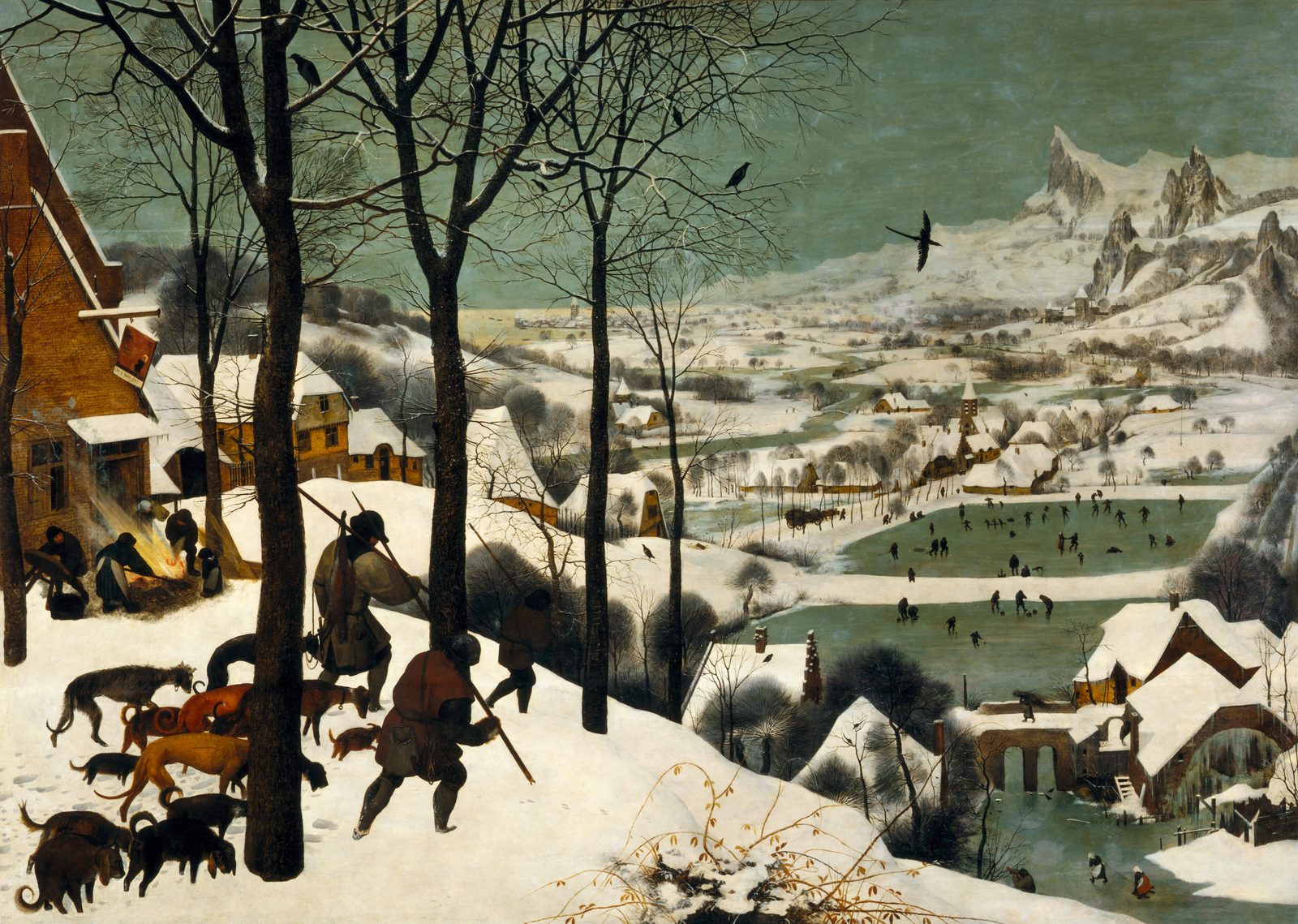
The Hunters in the Snow. Pieter Brueghel the Elder, 1565. Wikimedia Commons. Public domain.