
Psalm 110
7 verses · Royal psalm
The LORD said to my Lord: “Sit at My right hand until I make Your enemies a footstool for Your feet.”
Introduction
David, the Priest King, Book 5: The return and the great Hallelujah, Poetry, Psalms Overview.
The heading gives this psalm to David. It is seven verses long, and its first line is the verse of the Old Testament that the New Testament quotes and echoes most often. It reports two solemn words from God to a king whom David himself calls his Lord, a promise of rule and an oath of priesthood. In Israel those two offices belonged to different tribes, and this psalm joins them in one person. Listen for the two words spoken from heaven, and for the ancient king and priest of Jerusalem whose name the psalm brings back from Genesis.
Context
- Who
- Israelites for whom kingship and priesthood belonged to two different tribes and could not be held by one man
- What
- A royal psalm reporting God's promise of rule and His oath of priesthood to David's Lord.
- Where
- Zion in Jerusalem, the city of Melchizedek.
- When
- The reign of David, about 1010 to 970 BC by the superscription.
- Why
- To declare a king who reigns at God's right hand and serves as priest forever.
Historical context
The psalm turns on two Hebrew words that English prints almost alike: the first is the covenant name of God, and the second is adon, lord or master, the word for a superior. So the first line reports God speaking to someone the psalmist himself calls his lord. Israel's law kept kingship and priesthood apart, a king from Judah and a priest from Levi, and 2 Chronicles 26:16 to 21 records King Uzziah struck with a skin disease for burning incense in the temple. That is why the psalm swears the grant of priesthood by an oath, on the pattern of Melchizedek, who was king and priest in Salem in Genesis 14. The dew of the dawn at verse 3 is a picture from the land, where the dry season's only moisture lies on the whole field at first light.
Significance
To Israel the psalm said that their king's authority came from a grant made in heaven and would hold until his enemies were underfoot. The oath about the priesthood claimed for one man an office Israel's law placed elsewhere, and that claim stood open in Israel's book for a thousand years before the letter to the Hebrews took it up.
This chapter in Jewish lifeWhat this chapter is in Jewish life and reading.
How it is read
This is the psalm where the Jewish and the Christian readings part most widely, and the corpus shows the parting in Rashi's own words. This site reads Psalm 110 of Christ, with Psalms 2 and 45, as the New Testament reads it (src/components/book/dossier-content/psalms-structure.ts). Rashi reads it of Abraham.
He says so on the first verse, and he says whose reading it is. He writes that "our Rabbis interpreted it as referring to Abraham our father", and that he will explain it according to their words, citing Midrash Tehillim 110:1 and the men of Hebron who called Abraham my lord at Genesis 23:6 (Rashi on Psalms 110:1:1, Rashi on Psalms, The Judaica Press complete Tanach with Rashi, translated by A. J. Rosenberg, CC-BY).
The rest follows from that decision. The enemies of verse 1 are Amraphel and his allies, the staff sent from Zion in verse 2 is Melchizedek coming out with bread and wine after the battle of Genesis 14, and the volunteers of verse 3 are Aner, Eshkol and Mamre, who went to Abraham's aid of their own accord (Rashi on Psalms 110:1:4, 110:2:2 and 110:3:1, same edition).
Verse 4 carries the weight for a Christian reader, and Rashi turns it around. Where the New Testament reads an everlasting priesthood after the order of Melchizedek, Rashi reads a priesthood given because of the speech of Melchizedek, passing from Shem through Abraham to his children, and he notes that the Hebrew word for priest carries rulership as well as priesthood (Rashi on Psalms 110:4:3, same edition). The site holds its own reading and reports his without flattening it, and the two are named here so a reader can see where the argument actually lies.
Rashi then offers a second reading of the whole psalm, of David rather than of Abraham, beginning from Saul as the master of verse 1 (Rashi on Psalms 110:7:2, same edition). The corpus holds twenty two comments of Rashi on this short psalm, the fullest bench in these thirty chapters, and only two comments from any other commentator, both without an English version (Radak on Psalms 110:5:1 and Ibn Ezra on Psalms 110:6:1).
What the rabbis say
The corpus records forty places where the Midrash and the Talmud cite this psalm, thirty five under Midrash and five under Talmud, and it carries the locator for each one with no text. Aggadat Bereshit, a midrash on Genesis, reads the first verse six times, at 18:1, 19:2, 21:1, 24:1, 27:1 and 30:1, which shows how firmly the Abraham reading held.
Verse 4, on the priesthood of Melchizedek, draws Bereshit Rabbah three times at 46:5, 55:6 and 55:7, with Devarim Rabbah 2:7, Avot DeRabbi Natan 34:4 and two places in Midrash Aggadah on Genesis 14. The Babylonian Talmud cites verse 7 at Pesachim 117a:23, and the Jerusalem Talmud cites verse 3 at Berakhot 5:2:4 and Taanit 1:1:6 and verse 7 at Terumot 11:2:6. The site reports where the rabbis cite the verse and reports no saying, because the locator carries none.
Sources: Rashi, Rashi on Psalms 110, in The Judaica Press complete Tanach with Rashi, translated by A. J. Rosenberg, CC-BY; Midrash Tehillim, Midrash Tehillim 110:1, as Rashi cites it at Rashi on Psalms 110:1:1; MannaFest, the royal psalms the New Testament reads of Christ, at src/components/book/dossier-content/psalms-structure.ts, 2026; Radak and Ibn Ezra, their comments on Psalms 110, cited by reference; Sefaria holds no English version; The Midrash and the Talmud, the forty locators on Psalms 110 in scripts/data/sources/sefaria/psalms/110.json.
The LORD said to my Lord: The LORD speaks to my Lord. Jesus pressed it at Matthew 22:45, asking how the Christ can be David's son if David calls Him Lord. The one addressed sits at God's right hand until His enemies are a footstool, and Peter reads that of the risen Jesus at Acts 2:34.
Psalms 110:1
“The Lord said unto my Lord,.... The Targum is, "the Lord said in his Word.'' Galatinus (q) says the true Targum of Jonathan has it, "the Lord said to his Word;'' and produces an authority for it.”
2 more voices on this verseWhat preachers and commentators have said about this verse, in their own words.
Psalms 110:1
“The Lord said--literally, "A saying of the Lord," (compare Ps 36:1), a formula, used in prophetic or other solemn or express declarations. my Lord--That the Jews understood this term to denote the Messiah their traditions show, and Christ's mode of arguing on such an assumption (Mt 22:44) also proves.”
Jamieson, Fausset & Brown · Commentary Critical and Explanatory on the Whole Bible (1871)reformed
Psalms 110:1
“The Hebrew word Adon is one of God's titles, signifying his power and authority over all things, and therefore is most fitly given to the Messiah, to whom God hath delegated all his power Matt. xxviii, 18.”
John Wesley · Explanatory Notes upon the Old Testament (1765)evangelical
Cross references
Psalms 110:1
- Quoted inActs 2:34“For David did not ascend into heaven, but he himself says: ‘The Lord said to my Lord, “Sit at My right hand”
'The Lord said unto my Lord, Sit thou on my right hand' (ascension proof)
- Quoted inHebrews 1:13“Yet to which of the angels did God ever say: “Sit at My right hand until I make Your enemies a footstool for Your feet”?”
'Sit on my right hand, until I make thine enemies thy footstool'
- Quoted inLuke 20:42“For David himself says in the book of Psalms: ‘The Lord said to my Lord, “Sit at My right hand”
'The Lord said unto my Lord' (Davidic-sonship question)
- Quoted inMark 12:36“Speaking by the Holy Spirit, David himself declared: ‘The Lord said to my Lord, “Sit at My right hand until I put Your enemies under Your feet.”’”
'The Lord said to my Lord' ('David himself said by the Holy Ghost')
- Quoted inMark 14:62“I am,” said Jesus, “and you will see the Son of Man sitting at the right hand of Power and coming with the clouds of heaven.”
'on the right hand of power' (before the high priest, w/ Dan 7:13)
- Quoted inMatthew 22:44“‘The Lord said to my Lord, “Sit at My right hand until I put Your enemies under Your feet.”’”
'The Lord said unto my Lord', the Davidic-sonship question (most-cited OT verse in NT)
- Quoted inMatthew 26:64“You have said it yourself,” Jesus answered. “But I say to all of you, from now on you will see the Son of Man sitting at the right hand of Power and coming on the clouds of heaven.”
'sitting on the right hand of power', before the Sanhedrin (w/ Dan 7:13)
ConnectionsActs 2:34, Hebrews 1:13, Mark 12:36, Mark 14:62, Matthew 22:44, Matthew 26:64, Psalms 2:1
Psalms 110:2-3
Your mighty scepter from Zion: The LORD sends the scepter out from Zion. The rule runs in the middle of the enemies, and the people come willing on the day of battle, arrayed in holy splendor. Gill and Barnes read the dew of the dawn as a host as fresh and countless as morning dew.
Psalms 110:2
“The Lord shall send forth the rod of your power out of Sion. "The rod." In the Hebrew it has not so much "rod" as "scepter," that is, the emblem of royal power. The Lord shall send forth the rod of your power out of Sion. "For out of Sion shall go forth the law, and the word of the Lord out of Jerusalem." Rule in the midst of your enemies. He did not say, Kill your enemies. But what? Rule in the midst of your enemies. Make your enemies, who had been strangers, begin to be yours.”
Jerome · written before 420 · Homily 36, on Psalm 109patristic
3 more voices on this verse
Psalms 110:2
“The Lord shall send the rod of thy strength out of Zion,.... His royal and powerful sceptre, called the sceptre of righteousness, Psa 45:6 and is no other than the Gospel, the power of God unto salvation; and which is mighty through him, for the reducing souls to the obedience of Christ; when it comes with power, and works effectually.”
Psalms 110:2
“The Lord shall send the rod of thy strength out of Zion. It is in and through the church that for the present the power of the Messiah is known. Jehovah has given to Jesus all authority in the midst of his people, whom he rules with his royal sceptre, and this power goes forth with divine energy from the church for the ingathering of the elect, and the subduing of all evil. We have need to pray for the sending out of the rod of divine strength.”
Charles Spurgeon · The Treasury of David, Vol. 5 (1878)Particular Baptist
Psalms 110:2
“The rod - Thy strong or powerful rod, and the rod is put for his scepter, or kingly power: but as the kingdom of Christ is not carnal, but spiritual, so this scepter is nothing else but his word.”
John Wesley · Explanatory Notes upon the Old Testament (1765)evangelical
Your people shall be willing: Willing translates nedavot, the word for freewill offerings, as when the people brought gifts to the LORD for the tabernacle at Exodus 35:29. On the day of battle the people offer themselves. Holy splendor is close to the phrase of Psalm 29:2 and suits the priest of verse 4.
Psalms 110:3
“Thy people shall be willing in the day of thy power, in the beauties of holiness from the womb of the morning: thou hast the dew of thy youth. In consequence of the sending forth of the rod of strength, namely, the power of the gospel, out of Zion, converts will come forward in great numbers to enlist under the banner of the Priest King.”
Charles Spurgeon · The Treasury of David, Vol. 5 (1878)Particular Baptist
4 more voices on this verse
Psalms 110:3
“But since there are poorly instructed people who, while resisting the doctrine of a Son, think little of the words "from the womb before the morning star I begat you," as if this referred to his relation to Mary, alleging that he was born of Mary "before the morning star." Since to say that "womb" could not refer to his relation toward God, we must address the issue briefly here. If then, because the "womb" is human, therefore it is foreign to God; "heart" too clearly has a human meaning, for that which has heart has womb also.”
Athanasius of Alexandria · written before 373 · Discourses Against the Arians 4.27patristic
Psalms 110:3
“The day - When thou shalt take into thy hands the rod of thy strength, and set up thy kingdom in the world. In the beauties - Adorned with the beautiful and glorious robes of righteousness and true holiness. The dew - That is, thy offspring (the members of the Christian church) shall be more numerous than the drops of the morning dew.”
John Wesley · Explanatory Notes upon the Old Testament (1765)evangelical
Psalms 110:3
“The Messiah, then, as leading His people, is represented as continually in the vigor of youth, refreshed and strengthened by the early dew of God's grace and Spirit. Thus the phrase corresponds as a member of a parallelism with "the day of thy power" in the first clause.”
Jamieson, Fausset & Brown · Commentary Critical and Explanatory on the Whole Bible (1871)reformed
Psalms 110:3
“And there is also a particular power, the power of the Spirit, going along with the power of the word, to the people of Christ, which is effectual to make them willing. The former leaves sinners without matter of excuse; this leaves saints without matter of boasting. Whoever are willing to be Christ's people, it is the free and mighty grace of God that makes them so.”
Matthew Henry · Commentary on the Whole Bible (1707-1721)puritan
The priesthood rests on a sworn oath. The LORD will not change His mind, and the order is Melchizedek's, priest of God Most High at Genesis 14:18. Hebrews 7:3 says he has no father, mother or genealogy and remains a priest for all time, and Hebrews 7:17 quotes this clause.
Psalms 110:4
“The Lord has sworn, and he will not repent. "The Lord has sworn." In what he says, "he has sworn," it is not to the one who was begotten before the morning star, but he swore to the one who after the morning star was born of the Virgin. You are a priest forever according to the order of Melchizedech. It is superfluous for us to wish to interpret this little verse, since the holy Apostle argued about it most fully to the Hebrews. For this Melchizedech himself is without father, without mother, without lineage.”
Jerome · written before 420 · Homily 36, on Psalm 109patristic
1 more voice on this verse
Psalms 110:4
“We have now reached the heart of the psalm, which is also the very centre and soul of our faith. Our Lord Jesus is a Priest King by the ancient oath of Jehovah: "he glorified not himself to be made an high priest, "but was ordained there unto from of old, and was called of God an high priest after the order of Melchizedek.”
Charles Spurgeon · The Treasury of David, Vol. 5 (1878)Particular Baptist
Cross references
Psalms 110:4
- Quoted inHebrews 5:6And in another passage God says: “You are a priest forever in the order of Melchizedek.”
'Thou art a priest for ever after the order of Melchisedec'
- Quoted inHebrews 7:17For it is testified: “You are a priest forever in the order of Melchizedek.”
'Thou art a priest for ever after the order of Melchisedec' (eternal priesthood)
ConnectionsHebrews 5:6
Psalms 110:5-6
in the day of His wrath: The right hand changes place. In verse 1 the king sits at the LORD's right hand; here the Lord stands at the king's. He will judge the nations, heap up the dead, and crush kings and leaders in the day of His wrath.
Psalms 110:5
“The Lord at thy right hand shall strike through kings in the day of his wrath. Now that he has come into the field of action, the infinite Jehovah comes with him as the strength of his right hand. Eternal power attends the coming of the Lord, and earthly power dies before it as though smitten through with a sword. In the last days all the kingdoms of the earth shall be overcome by the kingdom of heaven, and those who dare oppose shall meet with swift and overwhelming ruin.”
Charles Spurgeon · The Treasury of David, Vol. 5 (1878)Particular Baptist
1 more voice on this verse
Psalms 110:5
“The Lord at your right hand. I see a new thing. It is said at the beginning: The Lord said to my Lord, Sit at my right hand; and now it is said to him: The Lord at your right hand. If he himself sits at the right hand of the Father, how in turn does the Father sit at the right hand of the Son? For when it is said, The Lord said to my Lord, Sit at my right hand, it is said most plainly that the Son sits at the right hand of the Father.”
Jerome · written before 420 · Homily 36, on Psalm 109patristic
He will crush the leaders: Crush is the verb of verse 5, used for the kings, and Balaam's oracle at Numbers 24:17 gives it to the star out of Jacob. Leaders is rosh, head, a singular in the Hebrew. Revelation 19:15 shows the King who will judge and rule the nations.
Psalms 110:6
“He shall judge among the heathen, or, among the nations. All nations shall feel his power, and either yield to it joyfully or be crushed before it. He shall fill the places with the dead bodies. In the terrible battles of his gospel all opponents shall fall till the field of fight is heaped high with the slain. This need not be understood literally, but as a poetical description of the overthrow of all rebellious powers and the defeat of all unholy principles.”
Charles Spurgeon · The Treasury of David, Vol. 5 (1878)Particular Baptist
2 more voices on this verse
Psalms 110:6
“He shall judge among the nations. See the differences: kings are shattered, nations are judged. He shall fill up the ruins. Our Lord ascended upon the cross, and many ruins came about. "This one is set for the ruin and resurrection of many, and for a sign that shall be contradicted." He shall fill up the ruins: of those who do not believe, who did not believe the scouts, the apostles. For Moses too sent scouts into the world; and because the people did not believe the scouts, therefore they fell in the desert.”
Jerome · written before 420 · Homily 36, on Psalm 109patristic
Psalms 110:6
“The Messiah's conquests are described, though His work and God's are the same. As after a battle, whose field is strewn with corpses, the conqueror ascends the seat of empire, so shall He "judge," or "rule," among many nations, and subdue the head--or (as used collectively for "many") "the heads," over many lands. wound--literally, "smite," or "crush" (compare Ps 110:5).”
Jamieson, Fausset & Brown · Commentary Critical and Explanatory on the Whole Bible (1871)reformed
drink from the brook by the road: The last picture is a brook by the road. He drinks there, and therefore He lifts up His head. The lifted head answers the seat at the right hand in verse 1, so the psalm closes where it opened.
Psalms 110:7
“He shall drink of the brook in the way. So swiftly shall he march to conquest that he shall not stay for refreshment, but drink as he hastens on. Like Gideon's men that lapped, he shall throw his heart into the fray and cut it short in righteousness, because a short work will the Lord make in the earth. "Therefore shall he lift up the head." His own head shall be lifted high in victory, and his people, in him, shall be upraised also.”
Charles Spurgeon · The Treasury of David, Vol. 5 (1878)Particular Baptist
3 more voices on this verse
Psalms 110:7
“He shall drink from the torrent in the way. Who shall drink from the torrent in the way? This one, to whom it was said, The Lord said to my Lord, Sit at my right hand: this one who heard, You are a priest forever according to the order of Melchizedech: this one who shattered kings in the day of his wrath, who judges the nations, shall fill up the ruins, shall crush the heads in the land of many: what else will this one do? He shall drink from the torrent in the way.”
Jerome · written before 420 · Homily 36, on Psalm 109patristic
Psalms 110:7
“Waters in scripture frequently signify sufferings. To drink of them, signifies to feel or bear them. Therefore - He shall be exalted to great glory and felicity.”
John Wesley · Explanatory Notes upon the Old Testament (1765)evangelical
Psalms 110:7
“Christ drank of this brook when he was made a curse for us, and therefore, when he entered upon his suffering, he went over the brook Kidron, John xviii. He drank deeply of this black brook (so Kidron signifies), this bloody brook, so drank of the brook in the way as to take it out of the way of our redemption and salvation.”
Matthew Henry · Commentary on the Whole Bible (1707-1721)puritan
How this psalm is built
The form: A royal and messianic psalm, whose opening formula marks it as a solemn declaration of the LORD, as Jamieson, Fausset and Brown classes it.
A The LORD seats him at His right hand until the enemies are a footstool
Psalm 110:1
B The scepter goes out from Zion and a willing people come in holy splendor
Psalm 110:2-3
C The LORD has sworn and will not change His mind, a priest forever in the order of Melchizedek
Psalm 110:4
B′ He judges the nations and crushes the leaders of the whole earth
Psalm 110:6
A′ The Lord at his right hand crushes kings in the day of His wrath
Psalm 110:5
The patterns in this chapter
| Device | What it does | Where to see it |
|---|---|---|
| Two oracles, two thrones | The psalm is built on two divine speeches. Verse 1 gives the seat at the right hand and verse 4 gives the sworn priesthood, and each is introduced by its own formula, the LORD said and the LORD has sworn. Kingship and priesthood are granted to one man in one psalm.Jamieson, Fausset and Brown, Commentary Critical and Explanatory on the Whole Bible, 1871, on Psalm 110:1. | Psalm 110:1, Psalm 110:4 |
| The right hand that changes place | In verse 1 the king sits at the LORD's right hand. In verse 5 the Lord stands at the king's right hand. The psalm turns the same phrase round its own centre, and the two halves answer each other across the oath of verse 4.Charles Spurgeon, The Treasury of David, Vol. 5, 1878, on Psalm 110:5. | Psalm 110:1, Psalm 110:5 |
| The dew of the dawn | Verse 3 gives the willing people in the language of morning dew. Gill and Barnes read the figure as a host as fresh and as countless as the dew that appears on a whole field at once.John Gill, Exposition of the Old Testament, 1748 to 1763, on Psalm 110:3. | Psalm 110:3 |
| The order of Melchizedek | The oath of verse 4 names an order older than Aaron's. Melchizedek is king of Salem and priest of God Most High at Genesis 14:18, and he takes a tenth from Abram. Hebrews 7:3 says he has no recorded father, mother or genealogy and remains a priest for all time.Matthew Henry, Commentary on the Whole Bible, 1710, on Psalm 110:4. | Psalm 110:4 |
| The brook by the road | The psalm ends on a man stopping to drink from a brook by the road and lifting up his head. The lifted head answers the seat at the right hand in verse 1, so the psalm closes where it opened, with the same figure raised.Charles Spurgeon, The Treasury of David, Vol. 5, 1878, on Psalm 110:7. | Psalm 110:1, Psalm 110:7 |
The two offices Israel's law kept apart
7 more paragraphs on the patterns
A king of Judah was of the tribe of Judah and a priest was of the tribe of Levi, and 2 Chronicles 26:16 to 21 records what happened when King Uzziah tried to burn incense. This psalm swears one man into both offices, and it reaches past Aaron to Melchizedek to do it, which is precisely the argument Hebrews 7 builds on.
The prophecy and the New Testament's use
Verse 1 is the New Testament's most quoted Old Testament sentence. Jesus uses it at Matthew 22:44, Peter at Acts 2:34 of the risen Jesus, and the letter to the Hebrews returns to it at 1:13 and at 10:12 and 13. Verse 4 is quoted at Hebrews 5:6, 6:20 and 7:17, and Hebrews 7:21 takes the oath itself as the difference between this priesthood and the Levitical one, since the Levites were made priests without an oath.
The debated concept
The authorship and the reference of the psalm are both contested, and the positions should be stated at their strongest. The traditional reading takes the heading at its word: David wrote it, and he is quoting God's word to a Lord greater than himself, which is the assumption Jesus argues from and the reading the apostles use throughout. A second reading takes the psalm as a court poem addressed by a temple singer to a reigning king of Judah, with my Lord meaning the king and the Melchizedek oath grounding the Jerusalem monarchy in the city's older priest kings. On that reading the New Testament's use is a later and fuller application rather than the psalm's first sense. The force of the first reading is that the argument at Matthew 22 depends on David being the speaker; the force of the second is that royal psalms elsewhere address a living king. The church has held the first, and a student should know the second exists and why.
The line most often passed over
Verse 7 is the psalm's quietest and hardest. He drinks from the brook by the road, and therefore He lifts up His head. A man on a campaign stops at a stream and goes on, and the psalm makes that the last thing it says about him. Spurgeon reads the lifted head as answering the seat at the right hand in verse 1, so the psalm closes where it opened.
Keep studying
Studies15
People and groups1
Places1
Subjects1
Sources for this chapter
The summary
Jamieson, Fausset & Brown, Commentary Critical and Explanatory; John Calvin, Commentaries; John Wesley, Notes on the Old Testament and Matthew Henry, Complete Commentary.
The context
Albert Barnes, Notes on the Book of Psalms and Charles Spurgeon, The Treasury of David on Psalm 110.
The form and classifications
Jamieson, Fausset and Brown, Commentary Critical and Explanatory on the Whole Bible, 1871, on Psalm 110:1; John Wesley, Explanatory Notes upon the Old Testament, 1765, on Psalm 110:1 and Matthew Henry, Commentary on the Whole Bible, 1710, on Psalm 110:5.
The exposition
Albert Barnes, Notes on the Book of Psalms; Charles Spurgeon, The Treasury of David; Franz Delitzsch, Biblical Commentary on the Psalms; Jamieson, Fausset and Brown, Commentary Critical and Explanatory on the Whole Bible; John Gill, Exposition of the Old Testament and Matthew Henry, Commentary on the Whole Bible.
The painting
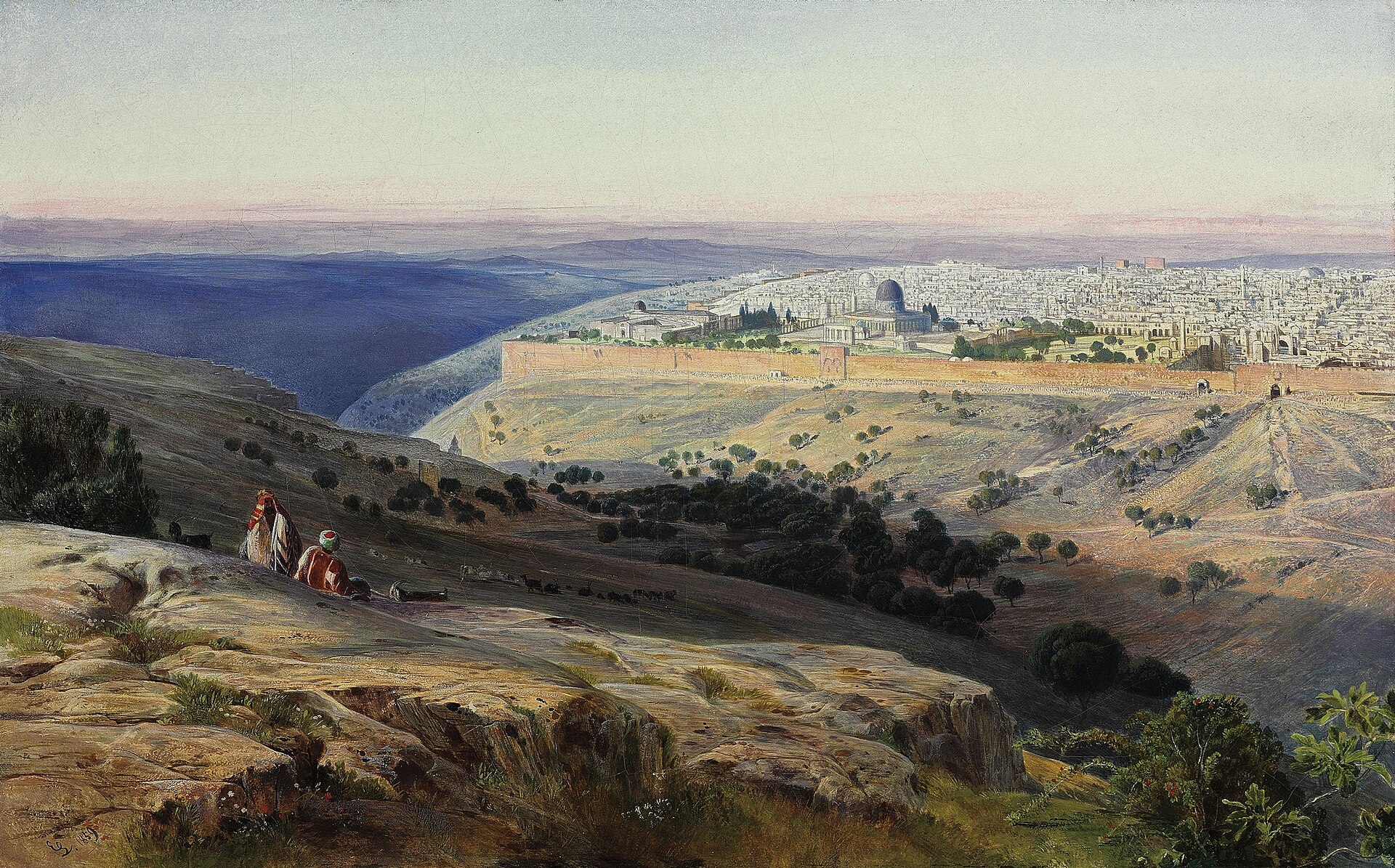
Jerusalem from the Mount of Olives, Sunrise. Edward Lear, 1859. Wikimedia Commons. Public domain.