
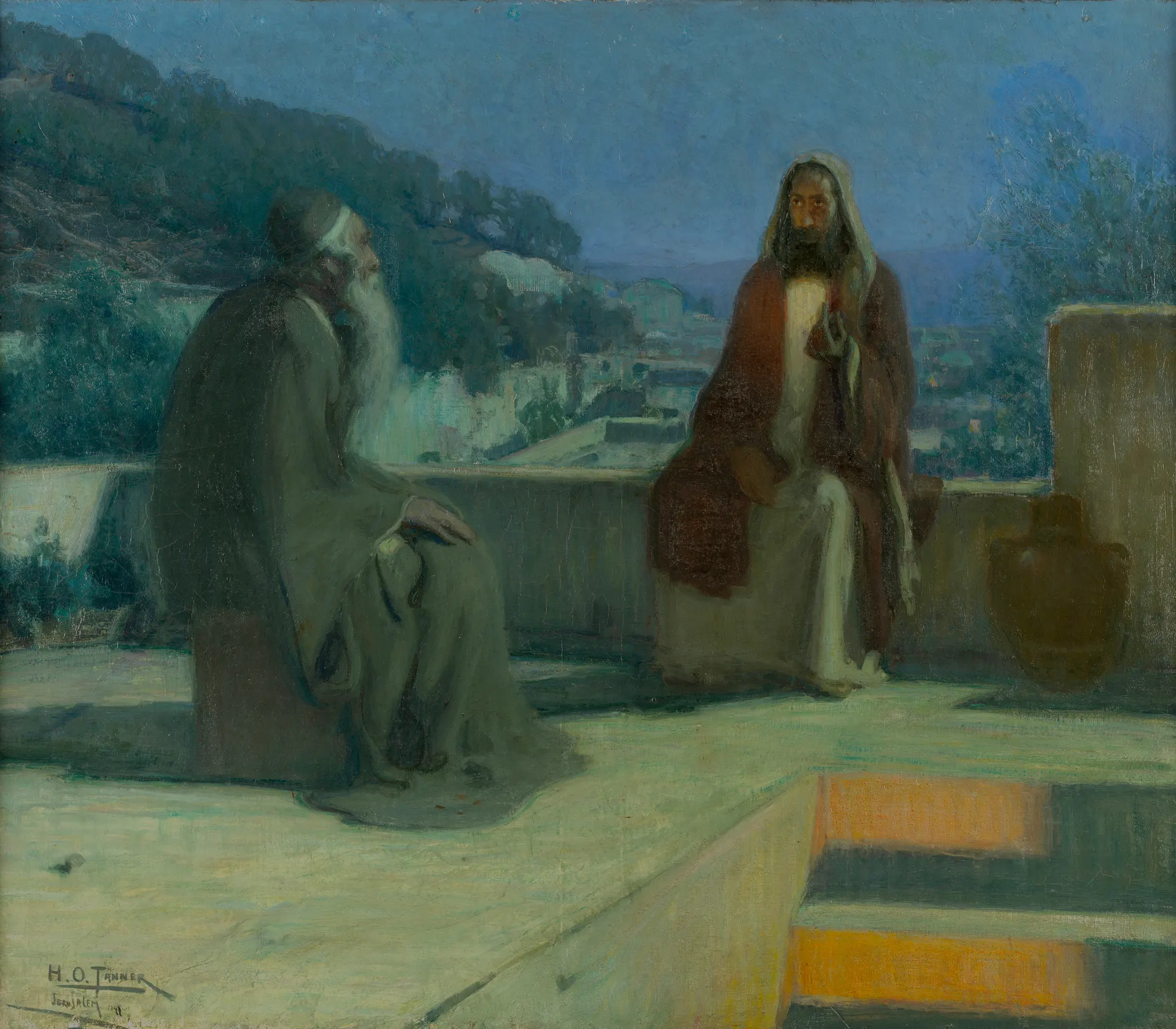
Johnchapter 9
41 verses · John, by tradition · AD 85 to 95 · The Gospels
and His disciples asked Him, “Rabbi, who sinned, this man or his parents, that he was born blind?”
Introduction
John, by tradition, The Gospels, John Overview.
John wrote this chapter for readers who had been put out of the synagogue for confessing Christ. It is the story of one man, told in scenes like a play, and Jesus is absent from most of them. The man is questioned again and again, and his answers grow clearer each time. Listen for what he says about who Jesus is in each scene. Notice also who in the story claims to know and who admits they do not. Read it as a chapter about seeing.
Context
- Who
- Readers who had themselves been thrown out of a synagogue
- What
- The healing of a man blind from birth on the Sabbath and the inquiry that follows until he is cast out and worships Jesus.
- Where
- A street in Jerusalem near the temple, the pool of Siloam, and the place where the authorities questioned him.
- When
- A Sabbath in Jerusalem, in the months after Tabernacles, about AD 29.
- Why
- To show Jesus as the light of the world and to contrast the growing sight of the healed man with the blindness of those who judge him.
Historical context
Blindness meant begging. There was no work a blind man could do in that economy and no provision beyond family and alms, so a blind adult sat at a gate or a busy corner for life. The disciples' opening question, who sinned, this man or his parents, reflects a common assumption that a specific affliction traced back to a specific sin, an assumption the book of Job had already fought.
Show the rest of the historical context, 3 more paragraphs
Making mud was a legal problem. Kneading is one of the thirty-nine categories of work forbidden on the Sabbath, and mixing spittle with dust to form clay fell under it in the strict reading. Jesus did not have to do it that way, which is part of why John records that he did.
The pool of Siloam is at the bottom of the city, fed by Hezekiah's tunnel, which carried water from the Gihon spring under the ridge, a tunnel you can still walk, with the workmen's own inscription describing the moment the two digging teams met. The pool itself, a large stepped basin, was uncovered in 2004 during drainage work. So the man walked downhill through the city, blind, with mud on his eyes, in front of everyone.
The threat that hangs over the chapter is exclusion from the synagogue, and it was devastating. The synagogue was the school, the court, the welfare office, and the social centre of a Jewish community; being put out of it cut a family off from work, marriage, and burial. His parents' careful non-answer, he is of age, ask him, is a portrait of fear.
Significance
The man's testimony gets simpler as the pressure increases, until it reaches the line the whole chapter is built on: one thing I know, that though I was blind, now I see. He wins the argument by refusing to argue.
Show the rest of the significance, 1 more paragraph
For readers who had been expelled themselves, this chapter was their own story with a hopeful ending. He is thrown out, and Jesus goes and finds him. The last exchange turns the theme around: it is those who insist they see who are left in the dark.
The heads below are this chapter's scenes. The numbered points under each are its verses.
Clay, Spittle, and Sight for a Man Born Blind
John 9:1-3
a man blind from birth: The disciples ask whose sin caused the blindness, the man's or his parents'. Rabbis of that day argued whether a child could sin in the womb, a debate Lightfoot traced through the rabbinic writings. Jesus names a purpose: the works of God displayed in him.
John 9:1
“As Jesus passed by - As he was leaving the temple, Joh 8:59. This man was in the way in which Jesus was going to escape from the Jews.”
2 more voices on this verseWhat preachers and commentators have said about this verse, in their own words.
John 9:1
“When God is about to work deliverance, he is said to see the affliction; so Christ saw this poor man. Others saw him, but not as he did. This poor man could not see Christ, but Christ saw him, and anticipated both his prayers and expectations with a surprising cure.”
Matthew Henry · Commentary on the Whole Bible (1707-1721)puritan
John 9:1
“The chapter we now begin records one of the few great works of Christ which John has reported. It tell us how our Lord gave sight to a man who had been "blind from his birth." Here, as elsewhere in this Gospel, we find the circumstances of the miracle narrated with peculiar fullness, minuteness, and particularity. Here too, as elsewhere, we find the narrative rich in spiritual lessons. We should observe, first, in this passage, how much sorrow sin has brought into the world. A sorrowful case is brought before us.”
who sinned, this man or his parents: Wesley and Clarke hear in the question a belief that the man might have sinned in a life before birth. Clarke ties it to a doctrine of souls passing between bodies. Henry faults the disciples for debating the man's case instead of moving Christ to heal him.
John 9:2
“Christ's compassion should kindle ours. It is probable that Christ told them this poor man was born blind, or they knew it by common fame; but they did not move Christ to heal him. Instead of this, they started a very odd question concerning him: Rabbi, who sinned, this man or his parents, that he was born blind?”
Matthew Henry · Commentary on the Whole Bible (1707-1721)puritan
3 more voices on this verse
John 9:2
“That not from sins of the soul prior to birth do bodily sufferings befal any, nor yet does God bring the sins of their fathers upon any, punishing those who have nothing sinned, but brings righteous doom upon all. Being desirous (and not without good reason) that the mystery should be explained, or rather being Divinely guided, the most wise disciples were urged to ask instruction on the subject. And they are inquisitive with profit, by this means furnishing an advantage not so much for themselves as for us.”
Cyril of Alexandria · written before 444 · Commentary on the Gospel of John, Book 6patristic
John 9:2
“Who did sin, this man, or his parents - The doctrine of the transmigration of souls appears to have been an article in the creed of the Pharisees, and it was pretty general both among the Greeks and the Asiatics. The Pythagoreans believed the souls of men were sent into other bodies for the punishment of some sin which they had committed in a pre-existent state. This seems to have been the foundation of the disciples question to our Lord. Did this man sin in a pre-existent state, that he is punished in this body with blindness?”
Adam Clarke · Commentary on the Bible (1810-1826)evangelical
John 9:2
“Who sinned, this man or his parents, that he was born blind? - That is, was it for his own sins, or the sins of his parents? They suppose (as many of the Jews did, though without any ground from Scripture) that he might have sinned in a pre-existent state, before he came into the world.”
John Wesley · Explanatory Notes upon the New Testament (1755)evangelical
the works of God would be displayed: Barnes limits the answer to the question: Jesus denies this blindness came from sin, while leaving the man and his parents sinners like everyone else. Spurgeon draws the rule never to charge a special sorrow to a special sin. Henry agrees that suffering is unevenly shared.
John 9:3
“Jesus answered, Neither hath this man sinned, nor his parents - It was not the manner of our Lord to answer any questions that were of no use, but to gratify an idle curiosity. Therefore he determines nothing concerning this. The scope of his answer is, It was neither for any sins of his own, nor yet of his parents; but that the power of God might be displayed.”
John Wesley · Explanatory Notes upon the New Testament (1755)evangelical
3 more voices on this verse
John 9:3
“Neither hath this man sinned ... - That is, his blindness is not the effect of his sin, or that of his parents. Jesus did not, evidently, mean to affirm that he or his parents were without any sin, but that this blindness was not the effect of sin. This answer is to be interpreted by the nature of the question submitted to him.”
John 9:3
“NEVER attribute any special sorrow endured by men to some special sin. There is a tendency to consider that those on whom the tower in Siloam fell must have been sinners above all men that dwelt in Jerusalem. And if any have met with a very sudden death, we are apt to suppose that they must have been exceedingly guilty—but it is not so. Very godly men have been burned to death in a train. I remember one who came to that terrible end.”
Charles Spurgeon · written before 1892 · The Metropolitan Tabernacle Pulpit, Sermon No. 2309: “God's Works Made Manifest” (lightly modernized text, CCEL edition)Particular Baptist
John 9:3
“The sinfulness of the whole race of mankind does indeed justify God in all the miseries of human life; so that those who have the least share of them must say that God is kind, and those who have the largest share must not say that he is unjust; but many are made much more miserable than others in this life who are not at all more sinful.”
Matthew Henry · Commentary on the Whole Bible (1707-1721)puritan
John 9:4-5
While it is daytime: Jesus measures the work by daytime and names a night when no one can work. Verse 4 puts the disciples inside the task, we must do the works. The light of the world speaks just before the sign.
John 9:4
“While it is day - Though I plainly perceive that the cure of this man will draw down upon me the malice of the Jewish rulers, yet I must accomplish the work for which I came into the world whole it is day - while the term of this life of mine shall last. It was about six months after this that our Lord was crucified. It is very likely that the day was now declining, and night coming on; and he took occasion from this circumstance to introduce the elegant metaphor immediately following.”
Adam Clarke · Commentary on the Bible (1810-1826)evangelical
2 more voices on this verse
John 9:4
“The night is coming - Christ is the light. When the light is withdrawn night comes, when no man can work - No man can do any thing toward working out his salvation after this life is ended. Yet Christ can work always.”
John Wesley · Explanatory Notes upon the New Testament (1755)evangelical
John 9:4
“Thirdly, He was pleased to lay himself under the strongest obligations to do the business he was sent about: I must work. He engaged his heart, in the covenant of redemption, to draw near, and approach to God as Mediator, Jer. xxx. Shall we be willing to be loose, when Christ was willing to be bound?”
Matthew Henry · Commentary on the Whole Bible (1707-1721)puritan
Jamieson, Fausset and Brown, quoting Alford, compare John 11:25: before each sign He names what it shows. Here that is the true light, of which the man's new sight is only a symbol. Barnes pictures a sun still shining as it sets.
John 9:5
“As long as I am in the world ... - As the sun is the natural light of the world, even while it sinks away to the west, so am I, although my days are drawing to a close, the light of the spiritual world. What a sublime description is this!”
4 more voices on this verse
John 9:5
“I am the light of the world - I teach men inwardly by my Spirit, and outwardly by my preaching, what is the will of God; and I show them, by my example, how they must do it.”
John Wesley · Explanatory Notes upon the New Testament (1755)evangelical
John 9:5
“Shall we then think that Christ is now not at all in the world, or do we believe that He, having ascended to heaven after His restoration to life from the dead, no longer dwells among those in this present life? And yet being very God, He fills and tends not only the heavens and what is beyond the firmament, but also the world which we inhabit.”
Cyril of Alexandria · written before 444 · Commentary on the Gospel of John, Book 6patristic
John 9:5
“We partake of the sun's light, and so we may of Christ's grace, without money and without price. Secondly, A good example of usefulness in the world. What Christ saith of himself, he saith of his disciples: You are lights in the world, and, if so, Let your light shine.”
Matthew Henry · Commentary on the Whole Bible (1707-1721)puritan
John 9:5
"As before the raising of Lazarus (Joh 11:25), He announces Himself as the Resurrection and the Life, so now He sets Himself forth as the source of the archetypal spiritual light, of which the natural, now about to be conferred, is only a derivation and symbol" [ALFORD].
Jamieson, Fausset & Brown · Commentary Critical and Explanatory on the Whole Bible (1871)reformed
John 9:6-7
made some mud: Jesus spits, works the dust into mud, and puts it on the man's eyes, the same dust God shaped man from in Genesis 2:7. John stops his own sentence to translate the pool's name: Siloam means Sent. The man washes and comes back seeing.
John 9:6
“Anointed the eyes of the blind man - It would be difficult to find out the reason which induced our Lord to act thus. It is certain, this procedure can never be supposed to have been any likely medical means to restore sight to a man who was born blind; this action, therefore, had no tendency to assist the miracle. If his eye-lids had been only so gummed together that they needed nothing but to be suppled and well washed, it is not likely that this could possibly have been omitted from his birth until now.”
Adam Clarke · Commentary on the Bible (1810-1826)evangelical
2 more voices on this verse
John 9:6
“He anointed the eyes of the blind man with the clay - This might almost have blinded a man that had sight. But what could it do toward curing the blind? It reminds us that God is no farther from the event, when he works either with, or without means, and that all the creatures are only that which his almighty operation makes them.”
John Wesley · Explanatory Notes upon the New Testament (1755)evangelical
John 9:6
“The design of the gospel is to open men's eyes, Acts xxvi. Now the eye-salve that does the work is of Christ's preparing; it is made up, not as this, of his spittle, but of his blood, the blood and water that came out of his pierced side; we must come to Christ for the eye-salve, Rev. iii.”
Matthew Henry · Commentary on the Whole Bible (1707-1721)puritan
Jamieson, Fausset and Brown set go and wash beside 2 Kings 5:10, and with Wesley and Henry they say the name Sent points to Jesus. Gill says the Jews drew water at Siloam at the Feast of Tabernacles. Irenaeus sees the hand that formed Adam opening the man's eyes.
John 9:7
“Go, wash in the pool of Siloam, . . . Sent, &c.--(See 2Ki 5:10, 14). As the prescribed action was purely symbolical in its design, so in connection with it the Evangelist notices the symbolical name of the pool as in this case bearing testimony to him who was sent to do what it only symbolized.”
Jamieson, Fausset & Brown · Commentary Critical and Explanatory on the Whole Bible (1871)reformed
4 more voices on this verse
John 9:7
“And said unto him, go wash in the Pool of Siloam,.... A fountain of this name is called Siloah, Isa 8:6, and according to the Jewish writers, sometimes Gihon (e); and this, they say (f), was without Jerusalem, though near unto it: hither the Jews went at the feast of tabernacles (g), and drew water with great rejoicing, and brought it, and poured it on the altar; the waters thereof also the priests drank for digestion, when they had eaten too much flesh (h); and this was likewise made use of to wash in, in case of uncleanness.”
John 9:7
“As, therefore, we are by the Word formed in the womb, this very same Word formed the visual power in him who had been blind from his birth; showing openly who it is that fashions us in secret, since the Word Himself had been made manifest to men: and declaring the original formation of Adam, and the manner in which he was created, and by what hand he was fashioned, indicating the whole from a part. For the Lord who formed the visual powers is He who made the whole man, carrying out the will of the Father.”
Irenaeus · written before 202 · Against Heresies Book Vpatristic
John 9:7
“From the fountain of Siloam, which was without the walls of Jerusalem, a little stream flowed into the city, and was received in a kind of basin, near the temple, and called the pool of Siloam. Which is, by interpretation, Sent - And so was a type of the Messiah, who was sent of God.”
John Wesley · Explanatory Notes upon the New Testament (1755)evangelical
John 9:7
“Christ is often called the sent of God, the Messenger of the covenant ( Mal. iii. 1 ); so that when Christ sent him to the pool of Siloam he did in effect send him to himself; for Christ is all in all to the healing of souls.”
Matthew Henry · Commentary on the Whole Bible (1707-1721)puritan
John 9:8-12
The neighbors argue over whether this is the beggar they knew, and the man settles it by claiming himself. He tells them the man they call Jesus made mud, anointed his eyes, and sent him to Siloam to wash. Asked where that man is, he says he does not know.
John 9:8
“This controversy was soon decided by the man himself: He said, I am he, the very man that so lately sat and begged; "I am he that was blind, and was an object of the charity of men, but now see, and am a monument of the mercy and grace of God." We do not find that the neighbours appealed to him in this matter, but he, hearing the debate, interposed, and put an end to it.”
Matthew Henry · Commentary on the Whole Bible (1707-1721)puritan
1 more voice on this verse
John 9:8
“That he was blind - Ὁτι τυφλος ην: but, instead of this, προσαιτης, when he begged, or was a beggar, is the reading of ABC*DKL, seven others, both the Syriac, both the Arabic, later Persic, Coptic, Ethiopic, Armenian, Sahidic, Gothic, Slavonic, Vulgate, eight copies of the Itala, and some of the primitive fathers. This is in all probability the true reading, and is received by Griesbach into the text. Beggars in all countries have a language peculiar to themselves.”
Adam Clarke · Commentary on the Bible (1810-1826)evangelical
Some said he was the man and others said he just looks like him. Clarke says all knew he had been born blind and all could see that he now saw. Only the man's identity was in question, so the sign was done in the open.
John 9:9
“Some said, This is he - This miracle was not wrought in private - nor before a few persons - nor was it lightly credited. Those who knew him before were divided in their opinion concerning him: not whether the man who sat there begging was blind before - for this was known to all; nor, whether the person now before them saw clearly - for this was now notorious; but whether this was the person who was born blind, and who used in a particular place to sit begging.”
Adam Clarke · Commentary on the Bible (1810-1826)evangelical
1 more voice on this verse
John 9:9
“Hard indeed to be believed are such surpassing wonders, and that [which exceeds man's experience], from whatever source it comes, finds the intellect to be intolerant of it, and is scarcely treated with honour when convincingly forced upon people's minds. For the attempt to investigate what is beyond the grasp of reason indicates a state of mind akin to insanity. Hence, I think, the unbelief of some who had previously known the blind man haunting the cross-roads, and who were astonished afterwards when they beheld him unexpectedly able to discern objects with clear vision.”
Cyril of Alexandria · written before 444 · Commentary on the Gospel of John, Book 6patristic
Gill finds the question fair, since no one born blind had ever been known to see. He compares it with the new birth, as great a mystery to the natural man. Henry marks how weak the means were.
John 9:10
“Therefore said they unto him,.... When the case was clear, and it was out of question that he was the man: how were thine eyes opened? or made to see: they might well ask this question, since such a thing was never known before, that one born blind received his sight; and as great a miracle it is in grace, and as great a mystery to a natural man, how one should be born again, or be spiritually enlightened.”
1 more voice on this verse
John 9:10
“It is good to observe the way and method of God's works, and they will appear the more wonderful. We may apply it spiritually; it is strange that blind eyes should be opened, but more strange when we consider how they are opened; how weak the means are that are used, and how strong the opposition that is conquered.”
Matthew Henry · Commentary on the Whole Bible (1707-1721)puritan
Clarke finds it artless: the man had never seen Jesus, so he reports what he felt and heard, mud on his eyes and a command. Cyril notes he speaks of Jesus as a man, knowing Him so far only by common report. His knowledge grows through the chapter.
John 9:11
“A man that is called Jesus - The whole of this relation is simple and artless in the highest degree. The blind man had never seen Jesus, but he had heard of his name - he felt that he had put something on his eyes, which he afterwards found to be clay - but how this was made he could not tell, because he could not see Jesus when he did it; therefore he does not say, he made clay of spittle - but simply, he made clay, and spread it upon my eyes.”
Adam Clarke · Commentary on the Bible (1810-1826)evangelical
2 more voices on this verse
John 9:11
“He appears still to be ignorant that the Saviour is by nature God, for otherwise he would not have spoken of him so unworthily. He probably thought of Him and esteemed Him as a holy Man, forming this opinion perhaps from the somewhat indistinct rumour concerning Him that went about all Jerusalem, and was repeated everywhere in the common talk. Moreover we may observe that those afflicted of body and struggling with abject poverty never feel overmuch zeal in occupying themselves about making acquaintance, their unmitigated poverty exhausting as it were their mental faculties.”
Cyril of Alexandria · written before 444 · Commentary on the Gospel of John, Book 6patristic
John 9:11
“Note, Those who have experienced special instances of God's power and goodness, in temporal or spiritual things, should be ready upon all occasions to communicate their experiences, for the glory of God and the instruction and encouragement of others.”
Matthew Henry · Commentary on the Whole Bible (1707-1721)puritan
Clarke reads Where is He as the start of a hunt. The questioners meant to seize Jesus and hand Him to the council as a Sabbath breaker. The man cannot help them, since he had never yet seen the face of the one who healed him.
The Pharisees Interrogate; His Parents Dodge
John 9:13-17
They brought to the Pharisees: The inquiry opens on a Sabbath, and the mud is the offense. Kneading was one of the labors the Sabbath rules forbade, a rule Lightfoot draws from the rabbis. The Pharisees split, one side calling Him a Sabbath breaker, the other asking how a sinner could work such signs.
John 9:13
“These verses show us how little the Jews of our Lord's time understood the right use of the Sabbath day. We read that some of the Pharisees found fault because a blind man was miraculously healed on the Sabbath. They said, "This man is not of God, because He keeps not the Sabbath day." A good work had manifestly been done to a helpless fellow-creature. A heavy bodily infirmity had been removed. A mighty act of mercy had been performed. But the blind-hearted enemies of Christ could see no beauty in the act.”
2 more voices on this verse
John 9:13
“They bring the man to the rulers, not that they might learn what had been done to him, and admire it; for it was not likely that men travailing with extreme envy against our Saviour Christ could ever be pleased by any such thing; but that they might publicly convict Jesus, as they thought, of a transgression of the law, and accuse Him of being a wrong-doer in having made clay on the sabbath.”
Cyril of Alexandria · written before 444 · Commentary on the Gospel of John, Book 6patristic
John 9:13
“Note, Those rulers that are of a persecuting spirit shall never want ill instruments about them, that will blow the coals, and make them worse. The ground which was pretended for this information, and the colour given to it. That which is good was never maligned but under the imputation of something evil.”
Matthew Henry · Commentary on the Whole Bible (1707-1721)puritan
was a Sabbath: Cyril hears John holding the charge up to ridicule by naming the day only after the cure is told. Clarke adds that some rabbis counted spittle a remedy for the eyes and forbade its use on the Sabbath. Henry thinks Christ chose the day on purpose.
John 9:14
“When the blessed Evangelist is making it manifest to us that they were immoderately vexed at the making of clay on the sabbath, he fitly hints at the absurdity of the thing, by adding: Now it was the sabbath on the day when Jesus made the clay.”
Cyril of Alexandria · written before 444 · Commentary on the Gospel of John, Book 6patristic
2 more voices on this verse
John 9:14
“It was the Sabbath - Some of the ancient rabbins taught, and they have been followed by some moderns, not much better skilled in physic than themselves, that the saliva is a cure for several disorders of the eyes; but the former held this to be contrary to the law, if applied on the Sabbath. See Lightfoot’s Hor. Talm.”
Adam Clarke · Commentary on the Bible (1810-1826)evangelical
John 9:14
“Works of necessity and mercy are allowed, and the sabbath-rest to be kept, not so much for its own sake as in order to the sabbath-work. Christ chose to work his cures on the sabbath day to dignify and sanctify the day, and to intimate that spiritual cures should be wrought mostly on the Christian sabbath day.”
Matthew Henry · Commentary on the Whole Bible (1707-1721)puritan
Barnes says the Pharisees asked how he received his sight when the right question was whether it was done. He sees the same fault in questions about how the Spirit makes a man new. His answer is now three steps: mud, wash, see.
John 9:15
“The Pharisees asked him how ... - The proper question to have been asked in the case was whether he had in fact done it, and not in what way. The question, also, about a sinner’s conversion is whether in fact it has been done, and not about the mode or manner in which it is effected; yet it is remarkable that no small part of the disputes and inquiries among men are about the mode in which the Spirit renews the heart, and not about the evidence that it is done.”
1 more voice on this verse
John 9:15
“One would think, when a man in these circumstances was brought before them, they would have been so taken up in admiring the miracle, and congratulating the happiness of the poor man, that they could not have been peevish with him. But their enmity to Christ had divested them of all manner of humanity, and divinity too.”
Matthew Henry · Commentary on the Whole Bible (1707-1721)puritan
there was division among them: Clarke faults the first party, for the Sabbath law forbade only servile and needless work. Cyril credits the second party with setting the sign above their reading of the Sabbath, though they still think of a mere man. Wesley takes sinner to mean one living in wilful sin.
John 9:16
“But others said, How can a man that is a sinner do such signs? And there was a division among them. Even these still think too meanly, speaking and reckoning as of a mere man; only, being convinced by the marvellous deed, they give the palm to Christ rather than to the law; and, putting the proof afforded by the Divine sign in opposition to the sabbath rest on this occasion, they appear in a better light as just judges.”
Cyril of Alexandria · written before 444 · Commentary on the Gospel of John, Book 6patristic
2 more voices on this verse
John 9:16
“This man is not of God - He can neither be the Messiah, nor a prophet, for he has broken the Sabbath. The Jews always argued falsely on this principle. The law relative to the observation of the Sabbath never forbade any work but what was of the servile and unnecessary kind.”
Adam Clarke · Commentary on the Bible (1810-1826)evangelical
John 9:16
“This man is not of God - Not sent of God. How can a man that is a sinner - That is, one living in wilful sin, do such miracles?”
John Wesley · Explanatory Notes upon the New Testament (1755)evangelical
Barnes reads the question as what the man thinks of the One who gave him sight, and prophet as one sent from God. Cyril says the court hoped for an answer to feed its malice. The man sided with the party that doubted the charge.
John 9:17
“And he said, He is a prophet. They receive a sharp arrow into their hearts, who do not admit fair and just reasoning, and are eager to seek that only which gratifies their malice. For, as it is written, the crafty man shall not meet with prey. For their zealous design is upset, contrary to their expectation; and they are greatly disappointed of their hope when to their surprise they receive the reply: He is a prophet. For the man who had been healed, judging very rightly, agrees with the opinion of the other party.”
Cyril of Alexandria · written before 444 · Commentary on the Gospel of John, Book 6patristic
1 more voice on this verse
John 9:17
“What sayest thou of him? ... - The translation here expresses the sense obscurely. The meaning is, “What sayest thou of him for giving thee sight?” (Campbell); or, “What opinion of him hath this work of power and mercy to thee wrought in thee?” (Hammond). He is a prophet - That is “I think that the power to work such a miracle proves that he is sent from God.”
John 9:18-23
until they summoned his parents: The leaders summon the parents, and the parents certify the two facts only they could: he is their son, and he was born blind. The third question they hand back to their son, who is old enough to speak for himself. Fear of expulsion from the synagogue governs the room.
John 9:18
“They prevaricated, however, in saying they "knew not who had opened his eyes," for "they feared the Jews," who had come to an understanding (probably after what is recorded, Joh 7:50, &c.; but by this time well known), that whoever owned Him as the Christ would be put out of the synagogue--that is, not simply excluded, but excommunicated.”
Jamieson, Fausset & Brown · Commentary Critical and Explanatory on the Whole Bible (1871)reformed
Bonaventure counts three questions put to the parents: the person, his condition at birth, and the change. The words the one you say was born blind show a court that still doubts the blindness itself. Barnes says they answered two without hesitation.
we know he was born blind: His parents confirm that he is their son and was born blind. Cyril says they confirm only what no one could doubt and what cost them nothing. Barnes says they had not seen how his eyes were opened, so they could not be witnesses to it.
John 9:20
“His parents answered ... - To the first two questions they answered without hesitation. They knew that he was their son, and that he was born blind. The third question they could not positively answer, as they had not witnessed the means of the cure, and were afraid to express their belief. It appears that they had themselves no doubt, but they were not eye-witnesses, and could not be therefore legal evidence. He is of age - He is of sufficient age to give testimony. Among the Jews this age was fixed at thirteen years.”
1 more voice on this verse
John 9:20
“They acknowledge as true that which was in no wise doubtful and for which it was hardly likely they would suffer anything disagreeable; for they say that they recognise their own offspring, and do not deny what really was the case at his birth, but distinctly affirm that he was born with the affliction. Nevertheless they shrink from relating the miracle, leaving the nature of the deed to speak for itself, and maintaining that it would be much more suitable to put the question as to how he had been healed to their son himself.”
Cyril of Alexandria · written before 444 · Commentary on the Gospel of John, Book 6patristic
He is old enough to speak: Clarke renders old enough as he has stature. Clarke puts that age among the Jews at thirty, while Barnes puts the age to speak for oneself at thirteen. Origen says the parents spoke falsely when they said we do not know, and put their son in harm's way.
John 9:21
“Besides having spoken falsely, they committed another sin by exposing their son to obvious harm. But I think this also has a reason. When the Savior opened the eyes of the blind man, he did not open those of a child but of one full grown so that he might see as a full-grown man. But such was also the case with other blind men who received sight. However, it is true that he being of full age can speak for himself, and especially so when Jesus makes him receive his sight.”
Origen of Alexandria · written before 253 · Fragment 67 on the Gospel of Johnpatristic
1 more voice on this verse
John 9:21
“He is of age - Ἡλικιαν εχει, literally, he has stature, i.e. he is a full-grown man; and in this sense the phrase is used by the best Greek writers. See Kypke and Raphelius. Mature age was fixed among the Jews at thirty years.”
Adam Clarke · Commentary on the Bible (1810-1826)evangelical
put out of the synagogue: Clarke says being put out of the synagogue was the lesser ban, called nidui, cutting a man off from worship. The heavier ban came only after the resurrection. To confess Jesus as the Christ now cost something.
John 9:22
“But Christianity teaches another lesson, 1 Cor. x. Here is, ( a. ) The late law which the sanhedrim had made. It was agreed and enacted by their authority that, if any man within their jurisdiction did confess that Jesus was Christ, he should be put out of the synagogue.”
Matthew Henry · Commentary on the Whole Bible (1707-1721)puritan
1 more voice on this verse
John 9:22
“Put out of the synagogue - That is, excommunicated - separated from all religious connection with those who worshipped God. This was the lesser kind of excommunication among the Jews and was termed nidui. The cherem, or anathema, was not used against the followers of Christ till after the resurrection.”
Adam Clarke · Commentary on the Bible (1810-1826)evangelical
When the parents answer that he is old enough, Theophylact says fear made them unsteady and fainthearted. Their son was becoming a fearless witness to the truth. He had begun to see with the eyes of his mind.
John 9:23
“They were unsteady and more fainthearted than their son. But he was becoming a fearless witness of the truth; he had begun to see well with the eyes of his mind also.”
Theophylact of Ohrid · written before 1107 · Commentary on Johnpatristic
One Thing I Know: I Was Blind, Now I See
John 9:24-25
Give glory to God was the courtroom oath to tell the truth, the words Joshua used with Achan at Joshua 7:19. Here it is pressure to recant, and the verdict is announced ahead of the testimony. The man holds his one fact, blind once and seeing now.
John 9:24
“Give God the praise; we know that this man is a sinner--not wishing him to own, even to the praise of God, that a miracle had been wrought upon him, but to show more regard to the honor of God than ascribe any such act to one who was a sinner.”
Jamieson, Fausset & Brown · Commentary Critical and Explanatory on the Whole Bible (1871)reformed
Barnes weighs the man's I do not know: it may be the modesty of an unlearned man. But verses 30 to 33 show he did not think Jesus a sinner, so the words may be irony. He holds to what he knows.
John 9:25
“Whether he be a sinner or no, I know not - The man had just said that he believed Jesus to be a prophet, Joh 9:17. By his saying that he did not know whether he was a sinner may be meant that though he might be a prophet, yet that he might not be perfect; or that it did not become him, being an obscure and unlearned man, to attempt to determine that question. What follows shows that he did not believe that he was a sinner, and these words were probably spoken in irony to deride the Pharisees.”
1 more voice on this verse
John 9:25
“The benefit which the man formerly blind had received from Christ appears to have been twofold: his understanding was in some way enlightened at the same time as his bodily eyes, and as he possesses the, light of the physical sun in his fleshly eyes, so the intellectual beam, I mean the illumination by the Spirit, takes up its abode within him, and he receives it into his heart. For hear how he resists the abominable conduct of the magistrates out of his great love towards Christ, and how cleverly he reproaches them as being well-nigh intoxicated and beside themselves.”
Cyril of Alexandria · written before 444 · Commentary on the Gospel of John, Book 6patristic
John 9:26-29
They put the same questions again, hoping repetition will crack the account. The man offers them a place among the disciples, and they answer with insults and with Moses, whose disciples they claim to be. John 5:46 answers that claim: Moses wrote of Jesus.
John 9:26
“How opened he thine eyes? - The reason why they asked this so often was doubtless to attempt to draw him into a contradiction; either to intimidate him, or throw him off his guard, so that he might be detected in denying what he had before affirmed. But God gave to this poor man grace and strength to make a bold confession of the truth, and sufficient common sense completely to confound his proud and subtle examiners.”
1 more voice on this verse
John 9:26
We see in these verses how much wiser the poor sometimes are than the rich. The man whom our Lord healed of his blindness was evidently a person of very humble condition. It is written that he was one who "sat and begged." (See v. 8.) Yet he saw things which the proud rulers of the Jews could not see, and would not receive. He saw in our Lord's miracle an unanswerable proof of our Lord's divine commission. "If this Man were not of God," he cries, "He could do nothing."
Cyril hears a confession in the word also: the man counts himself a disciple already, taught by the miracle more than by argument. Clarke thinks he asked it knowing it would end the debate. He had told them once at verse 15.
John 9:27
“I have told you already - So he did, Joh 9:15. And did ye not hear? Ye certainly did. Why then do you wish to hear it again? Is it because ye wish to become his disciples? The poor man continued steady in his testimony; and, by putting this question to them, he knew he should soon put an end to the debate.”
Adam Clarke · Commentary on the Bible (1810-1826)evangelical
1 more voice on this verse
John 9:27
“Would ye also become His disciples? He has now confessed distinctly, and without any evasion, that he has been made a disciple, if not by argument yet in consequence of the marvellous deed; and has become a believer, accepting his miraculous sight in the place of instruction. For when he said to them: Would ye also become His disciples? he as it were revealed his own condition of mind, that he was not only willing to become, but actually had already become, a disciple.”
Cyril of Alexandria · written before 444 · Commentary on the Gospel of John, Book 6patristic
we are disciples of Moses: They heaped insults on him, and Clarke cites Eustathius, who derived the Greek word for these insults from word and spear. Cyril almost sees John smile as men of high office make an insult of being a disciple of Jesus. They set the disciples of Moses against His disciple.
John 9:28
“We almost see the Evangelist smile as he says this. For he beholds those whose lot it was to hold sacred offices degraded in mental stupor so far as to make an object of reviling that which was so excellent, namely discipleship under Christ; smitten with a worthy love of which, some of the saints say: How sweet are Thy words unto my throat, sweeter than honey and honeycomb unto my mouth.”
Cyril of Alexandria · written before 444 · Commentary on the Gospel of John, Book 6patristic
1 more voice on this verse
John 9:28
“Then they reviled him - Ελοιδορησαν. Eustathius derives λοιδορια from λογος, a word, and δορυ, a spear: - they spoke cutting, piercing words. Solomon talks of some who spoke like the piercings of a sword, Pro 12:18. And the psalmist speaks of words that are like drawn swords, Psa 55:21, words which show that the person who speaks them has his heart full of murderous intentions; and that, if he had the same power with a sword as he has with his tongue, he would destroy him whom he thus reproaches.”
Adam Clarke · Commentary on the Bible (1810-1826)evangelical
God spoke to Moses: Barnes says they were right that God spoke to Moses, yet they took their own reading of the law as beyond error. Cyril says they honor Moses and still do not keep what he commanded. Jesus had told them as much at 8:14.
John 9:29
“Boldly do they speak again, armed with that folly which is so familiar and dear to them; and in undiminished shamelessness they once more boastfully exclaim: We know. And when they add: that God hath spoken unto Moses, thereby recognising that he deserved great honour, they in another way again insult him, seeing that they take no account of his precepts.”
Cyril of Alexandria · written before 444 · Commentary on the Gospel of John, Book 6patristic
John 9:30-34
The beggar argues from ground the whole room holds, that God listens to the worshipper who does His will. No one had ever heard of eyes born blind being opened, so this healer comes from God. The court answers with his birth and throws him out.
John 9:30
“Why herein is a marvellous thing - As if he had said, This is wonderful indeed! Is it possible that such persons as you are, whose business it is to distinguish good from evil, and who pretend to know a true from a false prophet, cannot decide in a case so plain? Has not the man opened my eyes? Is not the miracle known to all the town; and could any one do it who was not endued with the power of God?”
Adam Clarke · Commentary on the Bible (1810-1826)evangelical
2 more voices on this verse
John 9:30
“And with what strength and clearness of reason! So had God opened the eyes of his understanding, as well as his bodily eyes. Why, herein is a marvelous thing, that ye - The teachers and guides of the people, should not know, that a man who has wrought a miracle, the like of which was never heard of before, must be from heaven, sent by God.”
John Wesley · Explanatory Notes upon the New Testament (1755)evangelical
John 9:30
“So irresistible was his argument that their rage burst forth in a speech of intense Pharisaism, "Thou wast altogether born in sins, and dost thou teach us?"--thou, a base-born, uneducated, impudent youth, teach us, the trained, constituted, recognized guides of the people in the things of God!”
Jamieson, Fausset & Brown · Commentary Critical and Explanatory on the Whole Bible (1871)reformed
God does not listen to sinners: Gill and Barnes limit sinners here: all people sin, and God hears the penitent, so the word means impostors and those who live in sin. Barnes adds that the man's point concerns prayer for a miracle. God answers no false prophet's call for one.
John 9:31
“Now we know that God heareth not sinners,.... All mankind are sinners, even God's elect; yea, such who are truly gracious and righteous persons; for there is no man without sin; and God hears such who cry unto him day and night; such Christ came to save; for such he died; and these he calls to repentance; and every penitent sinner God hears: but by "sinners" are meant notorious sinners, such in whom sin reigns, who live in sin, and particularly impostors.”
1 more voice on this verse
John 9:31
“Nor would it be strange if such thoughts should arise in the youth's own mind. But if they did, it is certain, from what follows, that they made no lodgment there, conscious as he was that "whereas he was blind, now he saw," and satisfied that if his Benefactor "were not of God, He could do nothing" (Joh 9:33).”
Jamieson, Fausset & Brown · Commentary Critical and Explanatory on the Whole Bible (1871)reformed
Never before has anyone heard: Clarke and Gill say neither Moses nor any prophet had given sight to a man born blind. Spurgeon says the claim held true when spoken, and that a surgeon first gave sight to a man blind from his youth in 1728. The beggar argues from that silence.
John 9:32
“Since the world began,.... εκ του αιωνος, "from eternity", or never: the phrase answers to מעולם, frequently used by the Jews (m), for never; and so the Arabic version renders it, "it was never heard", &c.”
2 more voices on this verse
John 9:32
“Since the world began - Εκ του αιωνος, From the age - probably meaning from the commencement of time. Neither Moses nor the prophets have ever opened the eyes of a man who was born blind: if this person then were not the best of beings, would God grant him a privilege which he has hitherto denied to his choicest favorites?”
Adam Clarke · Commentary on the Bible (1810-1826)evangelical
John 9:32
“THAT was quite true—there was no instance recorded in Scripture or in profane history at the time when this man spoke, of any person who was born blind having obtained his sight. I believe it was in the year 1728 that the celebrated Dr. Cheselden, of St. Thomas's Hospital, for the first time in the world's history achieved the marvel of giving sight to a man who had been blind from his youth up. And since then the operation of couching the eyes has been several times successfully performed upon persons who were born blind.”
If this man were not from God: Barnes calls the reasoning conclusive, since one such miracle proves a commission from God. Gill notes that the Syriac and Persic versions narrow the claim to works like this one, the opening of eyes born blind. The unlearned man has out-argued the council.
John 9:33
“If this man were not of God,.... If he had not his mission, commission, and credentials from God; if he had not been sent by him, and had not authority from him, and was not assisted by him, as man, or God was not with him, he could do nothing; or "not do these things", as the Syriac version reads; that is, such miraculous works; or, as the Persic version, "he could not do this miracle": open the eyes of a man born blind. His doing this is a full proof that he is of God, and comes from him.”
1 more voice on this verse
John 9:33
“Could do nothing - Could do no such work as this. This reasoning was conclusive. The fact that Jesus could perform miracles like this was full proof that he was commissioned by God - proof that never has been and never can be refuted. One such miracle proves that he was from God. But Jesus gave many similar proofs, and thus put his divine mission beyond the possibility of doubt.”
Clarke says they read his blindness as proof of sin from birth, the question of verse 2. Gill says they had no answer to a blind beggar's reasoning, so they threw him out. Clarke takes this as putting him out of the synagogue.
John 9:34
“Thou wast altogether born in sins - Thou hast not only been a vile wretch in some other pre-existent state, but thy parents also have been grossly iniquitous; therefore thou and they are punished by this blindness: Thou wast altogether born in sins - thou art no other than a sinful lump of deformity, and utterly unfit to have any connection with those who worship God. And they cast him out - They immediately excommunicated him, as the margin properly reads - drove him from their assembly with disdain, and forbade his farther appearing in the worship of God.”
Adam Clarke · Commentary on the Bible (1810-1826)evangelical
1 more voice on this verse
John 9:34
“They answered and said unto him,.... Being nettled, and stung at what he said, and not able to confute his reasoning; and it is amazing that a man that could never read the Scriptures, who had had no education, was not only blind, but a beggar from his youth, should be able to reason in so strong and nervous a manner, and should have that boldness and presence of mind, and freedom of speech before the whole sanhedrim.”
Jesus Finds Him; the Seeing Are Made Blind
John 9:35-38
The synagogue throws him out, and Jesus comes to him with a question about the Son of Man. Jesus answers in the language of sight, you have already seen Him, to eyes opened that morning. He says Lord, I believe, then worships Jesus.
John 9:35
“And finding him, He said unto him, Dost thou believe on the Son of God? The man who had been blind has been cast out by the Pharisees, but after no long interval of time Christ seeks him, and finding him, initiates him. in mysteries. Therefore this also shall be a sign to us that God keeps in mind those who are willing to speak on His behalf and who do not shrink from peril through faith in Him.”
Cyril of Alexandria · written before 444 · Commentary on the Gospel of John, Book 6patristic
2 more voices on this verse
John 9:35
“Dost thou believe on the Son of God? - Hitherto he had understood little of the true character of Jesus. He believed that he had power to heal him, and he inferred that he must be a prophet, Joh 9:17. He believed according to the light he had, and he now showed that he was prepared to believe all that Jesus said. This is the nature of true faith. It believes all that God has made known, and it is premiered to receive all that he will teach. The phrase Son of God here is equivalent to the Messiah.”
John 9:35
“THE eyes of the Lord Jesus are always on His chosen and He knows every circumstance which occurs to them. "Jesus heard that they had cast him out." Our Lord had done too much for this man to forget him. Where Divine Grace has worked a great work its memory lingers. As it is written, "You will have a desire to the work of your hands." In this let us take comfort—if anything has happened to grieve us—Jesus has heard of it and will act accordingly. Our Lord sought for the outcast one. Unasked, He had opened his eyes.”
Clarke says the man had never seen Jesus and may not have known who was speaking. Wesley and Stier, cited by Jamieson, Fausset and Brown, hear faith already present in the reply. He promises belief once the Son of Man is named.
John 9:36
“He answered and said, Who is he, Lord, that I may believe on him?--"His reply is affirmative, and believing by anticipation, promising faith as soon as Jesus shall say who He is" [STIER].”
Jamieson, Fausset & Brown · Commentary Critical and Explanatory on the Whole Bible (1871)reformed
2 more voices on this verse
John 9:36
“Who is he, that I may believe? - This implies some degree of faith already. He was ready to receive whatever Jesus said.”
John Wesley · Explanatory Notes upon the New Testament (1755)evangelical
John 9:36
“Who is he, Lord? - It is very likely that the blind man did not know that it was Jesus the Christ who now spoke to him; for it is evident he had never seen him before this time; and he might now see him without knowing that he was the person by whom he was cured, till our Lord made that discovery of himself, mentioned in the following verse.”
Adam Clarke · Commentary on the Bible (1810-1826)evangelical
Cyril notes that Jesus names Himself by the two things the man can now use, the face he sees and the voice he hears. Cyril says the aim was a faith free from error. Wesley admires a man so sharp in argument and yet so teachable.
John 9:37
“Being asked upon whom it was proper to believe, Jesus points to Himself, and not simply by saying "It is I," but by saying that the Person Whom the other was looking at and by Whom he was being addressed, was the Son of God; in every way consulting beforehand our advantage, and in divers manners constructing aids towards a faith both free from error and unperverted, lest while thinking ourselves pious we might fall into the meshes of the net of the devil, by foolishly turning aside from the truth of the mystery.”
Cyril of Alexandria · written before 444 · Commentary on the Gospel of John, Book 6patristic
1 more voice on this verse
John 9:37
“Lord, I believe - What an excellent spirit was this man of! Of so deep and strong an understanding; (as he had just shown to the confusion of the Pharisees,) and yet of so teachable a temper!”
John Wesley · Explanatory Notes upon the New Testament (1755)evangelical
And he worshiped Jesus: Clarke traces the steps: the man had first thought Jesus a holy man and a prophet, and now he believes and worships. Gill reads the worship as honor due to God alone. Basil gives the order: worship follows faith, and faith is confirmed by power.
John 9:38
“And he said, Lord, I believe,.... He immediately found faith in his soul, and that in exercise, moving towards, and acting upon Christ, as the Son of God, and true Messiah, for everlasting life and salvation; and as soon as he did perceive it, he made an open and hearty profession of it: and he worshipped him: as God, with religious worship and adoration, not only trusting in him, but ascribing honour, glory, and blessing to him, which are due to God only, and not a creature.”
2 more voices on this verse
John 9:38
“And he said, Lord, I believe - That is, I believe thou art the Messiah; and, to give the fullest proof of the sincerity of his faith, he fell down before and adored him. Never having seen Jesus before, but simply knowing that a person of that name had opened his eyes, he had only considered him as a holy man and a prophet; but now that he sees and hears him he is convinced of his divinity, and glorifies him as his Savior.”
Adam Clarke · Commentary on the Bible (1810-1826)evangelical
John 9:38
“Worship follows faith, and faith is confirmed by power. But if you say that believers also know, they know from what they believe; and vice versa, they believe from what they know. We know God from his power. We, therefore, believe in him who is known, and we worship him who is believed.”
Basil of Caesarea · written before 379 · LETTER 234.3patristic
John 9:39-41
The saying gathers the chapter into one line, the beggar and the Pharisees changing places. Judgment here is the sorting that light performs by shining, which John 3:17 states from the other side. The claim to see is what keeps the guilt.
John 9:39
“For judgment am I come into the world - That is, the consequence of my coming will be, that by the just judgment of God, while the blind in body and soul receive their sight, they who boast they see, will be given up to still greater blindness than before.”
John Wesley · Explanatory Notes upon the New Testament (1755)evangelical
2 more voices on this verse
John 9:39
“THE great Day of Judgment is not as yet. God, in infinite long-suffering, waits to be gracious, giving men space wherein to repent and to be reconciled to Him. Jesus has come into the world for judgment, but not for that last and eternally unchangeable judgment which awaits us all. That hour and that advent will arrive—we have the declaration of God's Word for it.”
John 9:39
“Christ, when explaining to us by the voice of Isaiah the cause of His manifestation, I mean in this world, says: The Spirit of the Lord is upon Me, because He anointed Me: He hath sent Me to preach good tidings unto the poor to proclaim deliverance to the captives, and recovery of sight to the blind. Moreover he saith somewhere in another place: Hear, ye deaf; and receive your sight O blind, that ye may see.”
Cyril of Alexandria · written before 444 · Commentary on the Gospel of John, Book 6patristic
Clarke says these Pharisees understood that He spoke of blindness of the mind, and they asked whether He meant them. Gill hears indignation in the question, from learned men offended at being ranked with the unlearned crowd. They had come along to watch Him.
John 9:40
“And some of the Pharisees which were with him,.... Who had followed him, and were watching him, and observing what he said and did, in order to take all advantages, and every opportunity against him, they could, heard these words, and said unto him, are we blind also? they perceived he pointed at them, and therefore with indignation ask this question, taking it as a great affront unto them, to put such wise, learned, and knowing men as they in company with the ignorant and unlearned common people; see Isa 42:19.”
1 more voice on this verse
John 9:40
“Are we blind also? - These Pharisees understood Christ as speaking of blindness in a spiritual sense, and wished to know if he considered them in that state.”
Adam Clarke · Commentary on the Bible (1810-1826)evangelical
Wesley reads blind as ignorance they could not help, and he takes no sin to mean little sin by comparison. Barnes states the principle that guilt is measured by capacity and by the opportunity to know the truth. They had every opportunity.
John 9:41
“If ye were blind--wanted light to discern My claims, and only waited to receive it. ye should have no sin--none of the guilt of shutting out the light. ye say, We see; therefore your sin remaineth--Your claim to possess light, while rejecting Me, is that which seals you up in the guilt of unbelief.”
Jamieson, Fausset & Brown · Commentary Critical and Explanatory on the Whole Bible (1871)reformed
1 more voice on this verse
John 9:41
“If ye had been blind - Invincibly ignorant; if ye had not had so many means of knowing: ye would have had no sin - Comparatively to what ye have now. But now ye say - Ye yourselves acknowledge, Ye see, therefore your sin remaineth - Without excuse, without remedy.”
John Wesley · Explanatory Notes upon the New Testament (1755)evangelical
Keep studying
Studies7
People and groups1
Words12
Subjects1
Sources for this chapter
The summary
Jamieson, Fausset & Brown, Commentary Critical and Explanatory; John Calvin, Commentaries; John Wesley, Explanatory Notes Upon the New Testament and Matthew Henry, Complete Commentary.
The exposition
Adam Clarke, Commentary on the Bible; Albert Barnes, Notes, Explanatory and Practical, on the Old and New Testaments (1832-1869); Alexander Maclaren, Expositions of Holy Scripture, John; Basil of Caesarea, LETTER 234.3; Bonaventure, Commentary on John, Chapter 9; Brooke Foss Westcott, The Gospel according to St. John; Charles Spurgeon; Cyril of Alexandria, Commentary on the Gospel of John, Book 6; Irenaeus, Against Heresies Book V; J. C. Ryle, Expository Thoughts on the Gospels, John; Jamieson, Fausset & Brown, Commentary Critical and Explanatory on the Whole Bible; John Gill; John Lightfoot, Horae Hebraicae et Talmudicae on John; John Wesley, Explanatory Notes upon the New Testament; Matthew Henry, Commentary on the Whole Bible; Origen of Alexandria, FRAGMENT 67 ON THE GOSPEL OF JOHN and Theophylact of Ohrid, Commentary on John.