
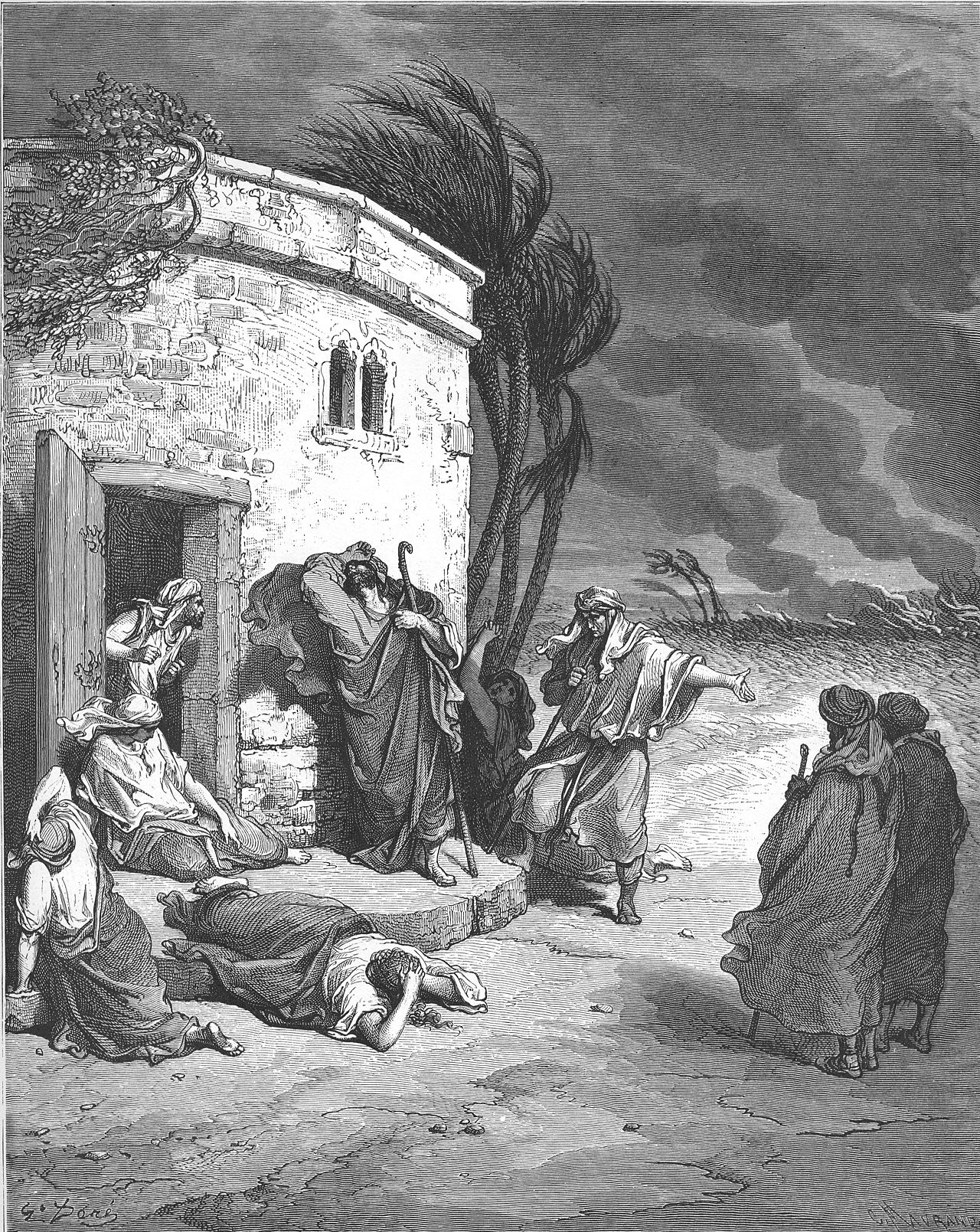
Jobchapter 6
30 verses · unknown · 10th century BC · Wisdom and poetry
Is tasteless food eaten without salt, or is there flavor in the white of an egg?
Introduction
unknown, Wisdom and poetry, Job Overview.
Job answers Eliphaz, and for the first time he speaks to his friends directly. He is a sick and ruined man replying to counsel he did not ask for. His hearers traveled the caravan roads and knew what it was to reach a stream bed and find it dry. Listen for the pictures he draws from trade, from food and from the desert, and for what each one says about the friends. Listen also for what he asks of them, which is small, and for what they give him instead. The chapter shows what a sufferer needs from a friend.
Context
- Who
- Hearers who had been let down by the people they counted on
- What
- Job's reply to Eliphaz, in which he defends the weight of his complaint, wishes for death, and charges his friends with failing him.
- Where
- The ash heap outside Job's town, with the caravans of Tema and Sheba drawn from the Arabian trade roads.
- When
- Immediately after Eliphaz's speech, in the first round of the debate.
- Why
- To answer the friends' first case and to name the loyalty a suffering man is owed by those who come to comfort him.
Historical context
Job asks that his grief be weighed in the balances, a merchant's image. Trade in that world ran on a beam scale and a set of stone weights, and the picture is of loading his misery onto one pan against the sand of the sea on the other.
Show the rest of the historical context, 3 more paragraphs
His complaint about food is domestic and exact: nobody eats tasteless food without salt, or the white of an egg, and the loathsome things he now refuses are what his sickness has made of his meals. He is answering Eliphaz's smooth words by saying that they go down the same way.
The strongest picture in the chapter is a desert wadi. These watercourses run black with meltwater and ice in the cold season and vanish completely in the heat. Caravans planned their routes around them. Job describes the companies of Tema and Sheba, real trading peoples of north and south Arabia, turning aside from the road toward a known watercourse, finding nothing, and dying of the disappointment. That, he says, is what his friends have been.
He also makes clear what he never asked for. He did not ask them for money, or to buy him out of an enemy's hand, the ordinary things a man in trouble asked of his network. He asked only that they teach him where he had gone wrong, and they have brought accusation instead of instruction.
Significance
The chapter names a specific failure that first hearers would have recognised in their own villages: friends who arrive, look at the size of the trouble, and quietly change sides to protect their own view of how the world works.
Show the rest of the significance, 1 more paragraph
Job's demand is modest and impossible to answer, show me my error and I will be quiet. Nobody in the book ever can.
This chapter in Jewish lifeWhat this chapter is in Jewish life and reading.
What is done
Job's reply to Eliphaz has no reading in the site's table. The site's own table in src/lib/hebraic/readings.ts printed parashot total 0 and haftarah uses total 0 for Job, and no festival reading.
The chapter is met in study, and the corpus names the settings. In the Talmud it carries Bava Batra 16a:15 under the second verse, Yevamot 62b:14 under the thirteenth, Eruvin 65a:6 under the fifteenth and Avodah Zarah 5a:4 under the eighteenth. Four entries of the Jerusalem Talmud stand under the tenth. Midrash named for Torah portions appears at Midrash Tanchuma Buber, Bo 8:1 on the eleventh verse and Bereshit Rabbati, Parashat Toldot 1 on the nineteenth.
How it is read
Malbim's Job, translated by Jeremy I. Pfeffer (Ktav, 2003), which Sefaria reports as CC-BY, heads the chapter "The Third Oration - Job's Reply To Eliphaz's First Speech" (Malbim on Job 6:1:1). The debate is now under way in his count.
Rashi is quoted from The Judaica Press complete Tanach with Rashi, translated by A. J. Rosenberg, which Sefaria reports as CC-BY. He reads Job's rash words as stammering, the speech of a man with no strength to say a word properly, as a drunkard stammers (Rashi on Job 6:3:1). The arrows of the Almighty carry poison. Rashi explains the image from the practice of a people: "It was the custom of the Persians to apply snake venom to their arrows" (Rashi on Job 6:4:1).
The wild donkey and the ox are Job's defence of his crying. Rashi puts it as Job's question, whether he cries out for nothing. A beast does not bray while it has food, and an ox does not low unless it lacks fodder (Rashi on Job 6:5:1). The bland food is food that needed salt and was never salted, and Rashi gives the Mishnaic term with places in Shabbath 128a, Hullin 113a and Nedarim 51a (Rashi on Job 6:6:1). Job has more cause to cry because he must now touch what he once refused (Rashi on Job 6:7:1).
Rashi reads the turn to the friends as a complaint of betrayal. Job asks whether this too must come upon him, that he has no help. "Those friends that I had to help me are not helping me" (Rashi on Job 6:13:1). His brethren are those who defend him (Rashi on Job 6:15:1).
The stream that fails is read at length across six notes. Ice makes the waters wrinkle like boards, and the sun's heat warms them (Rashi on Job 6:16:1 and 6:17:1). Rashi takes Tema as the land of Ishmael, which lies low, where the water flows (Rashi on Job 6:19:1). Those who come to drink are ashamed because all had hoped to drink (Rashi on Job 6:20:1). Then the point is made plain: the friends are compared to that stream (Rashi on Job 6:21:1). Job never asked them for a bribe from their wealth (Rashi on Job 6:22:1).
Malbim sets out the rule of argument Job lays down near the end. Job insists that the debate rest on objective statements and not on suppositions. "His companions cannot infer from his suffering that he must have been wicked; independent proof must be brought" (Malbim on Job 6:24:1). They must accept his reputation as a righteous man, or show that he knowingly lied or could not recognise wrong.
The corpus carries three further notes on this chapter without an English text, each marked linked because Sefaria holds no English version of the ref. They stand cited and unquoted at Metzudat David on Job 6:8:1, 6:12:1 and 6:23:1.
What the rabbis say
The corpus carries forty rabbinic locators on this chapter and the text of none, so each is cited here by ref. On the second verse it holds Bava Batra 16a:15, Ein Yaakov, Bava Batra 1:38 and Esther Rabbah 7:11. On the third it holds Midrash Lekach Tov, Genesis 25:30:2 and Midrash Sekhel Tov at Shemot 8:20:2, 9:18:2 and 18:18:6. On the fifth it holds Jerusalem Talmud Yoma 8:7:9. On the tenth it holds four places in the Jerusalem Talmud: Maasrot 1:4:10, Sanhedrin 7:9:1, and Shabbat 3:1:3 and 3:4:3.
The loss of help draws the next run. On the eleventh verse the corpus holds Midrash Tanchuma Buber, Bo 8:1. On the twelfth it holds Ein Yaakov (Glick Edition), Sanhedrin 3:7. On the thirteenth it holds Yevamot 62b:14, Ein Yaakov (Glick Edition), Yevamot 6:6 and Ein Yaakov, Yevamot 6:10. On the fourteenth it holds Bereshit Rabbah 76:9 and 80:4 and Ein Yaakov (Glick Edition) at Ketubot 11:1 and Shabbat 6:6.
The failing stream draws the most. On the fifteenth verse the corpus holds Eruvin 65a:6, Ein Yaakov, Eiruvin 6:10, Midrash Lekach Tov, Deuteronomy 21:4:1 and Tractate Kallah Rabbati 8:13. On the sixteenth it holds Midrash Sekhel Tov, Bereshit 30:32:5. On the seventeenth it holds Bereshit Rabbah 28:9, Jerusalem Talmud Sanhedrin 10:3:3 and Kohelet Rabbah 9:1:2. On the eighteenth it holds Avodah Zarah 5a:4 and Ein Yaakov (Glick Edition) at Avodah Zarah 1:11 and Sotah 1:5. On the nineteenth it holds Bereshit Rabbati, Parashat Toldot 1, and on the twentieth Midrash Sekhel Tov, Shemot 7:24:1.
The close carries the rest. On the twenty-second verse the corpus holds Midrash Lekach Tov, Genesis 27:36:4 and 29:15:1 and Midrash Sekhel Tov, Bereshit 27:36:1. On the twenty-eighth it holds Midrash Shmuel 16:2 and Midrash Tannaim on Deuteronomy 1:5:3. On the thirtieth it holds Midrash Tehillim 12:2.
What each of them teaches is a saying of the rabbis, and is reported as theirs wherever this site quotes one. The quotations wait on a fetch that carries the text.
Sources: Rashi, Rashi on Job 6:2:1 to 6:22:1, The Judaica Press complete Tanach with Rashi, translated by A. J. Rosenberg, reported CC-BY; Malbim, Malbim on Job 6:1:1 and 6:24:1, Malbim's Job, trans. Jeremy I. Pfeffer, Ktav, 2003, reported CC-BY; Metzudat David, Metzudat David on Job 6:8:1, 6:12:1 and 6:23:1, cited by ref because the corpus carries no English text; The Sefaria corpus, scripts/data/sources/sefaria/job/6.json, the 40 Talmud and Midrash locators of this chapter; The site's own files, src/lib/hebraic/readings.ts, printing no portion, no Haftarah and no festival reading for this book.
The heads below are this chapter's scenes. The numbered points under each are its verses.
Job: Oh That My Grief Were Weighed in the Balances
Job 6:1-3
Then Job replied: Job answers Eliphaz by asking that "my grief could be weighed and placed with my calamity on the scales". He wants his suffering measured. He says "it would outweigh the sand of the seas," stating his case in words of weight and quantity that recur through the chapter.
1 more voice on this verseWhat preachers and commentators have said about this verse, in their own words.
Job 6:1
“This is what Job means, you show wisdom in the misfortunes of other people. Since you are far away from my misfortunes, you admonish me while you experience a peaceful life. This remark is an answer to the words that were said earlier, "You have instructed many." "You have strengthened the feeble knees." "But now misfortune has come to you, and you are impatient; it touches you, and you are dismayed." Why does he say, "You are dismayed"? I wanted my affliction to become evident, so you would understand that nobody has ever suffered such tribulations.”
John Chrysostom · written before 407 · Commentary on Job 6:2a-3apatristic
Barnes gives the Hebrew for grief as ka'as, a word that can also mean vexation or anger, and the Septuagint rendered it anger. Job wants his complaint and his calamity weighed together. Clarke reads the wish as a plea for justice, sure the complaint would prove the lighter load.
Job 6:2
“O that my grief were thoroughly weighed - Job wished to be dealt with according to justice; as he was willing that his sins, if they could be proved, should be weighed against his sufferings; and if this could not be done, he wished that his sufferings and his complainings might be weighed together; and it would then be seen that, bitter as his complaint had been, it was little when compared with the distress which occasioned it.”
Adam Clarke · Commentary on the Bible (1810-1826)evangelical
1 more voice on this verse
Job 6:2
“He excuses the passionate expressions he had used when he cursed his day. Though he could not himself justify all he had said, yet he thought his friends should not thus violently condemn it, for really the case was extraordinary, and that might be connived at in such a man of sorrows as he now was which in any common grief would by no means be allowed.”
Matthew Henry · Commentary on the Whole Bible (1707-1721)puritan
Clarke finds two ideas in the sand of the seas, grief past counting and a weight no scales could hold. Job then owns that his words have been rash. Henry hears him excusing the passion of his curse on his birth in chapter 3.
Job 6:3
“Heavier than the sand of the sea - That is, they would be found to be insupportable. Who could bear up the sands of the sea? So Job says of his sorrows. A comparison somewhat similar is found in Pro 27:3. Heavy is a stone, and weighty the sand of the Sea, But a fool’s wrath is heavier than them both. My words are swallowed up - Margin, “I want words to express my grief.” This expresses the true sense - but not with the same poetic beauty.”
For the arrows of the Almighty: Job names his affliction as God's archery for the first time: "the arrows of the Almighty have pierced me; my spirit drinks in their poison". The line "the terrors of God are arrayed against me" is a military image and places Job under siege from God himself.
Job 6:4
“The arrows of the Almighty - There is an evident reference here to wounds inflicted by poisoned arrows; and to the burning fever occasioned by such wounds, producing such an intense parching thirst as to dry up all the moisture in the system, stop all the salivary ducts, thicken and inflame the blood, induce putrescency, and terminate in raging mania, producing the most terrifying images, from which the patient is relieved only by death. This is strongly expressed in the fine figure: The Poison Drinketh Up my Spirit; the Terrors of God Set Themselves in Array against me.”
Adam Clarke · Commentary on the Bible (1810-1826)evangelical
2 more voices on this verse
Job 6:4
“Herein he was a type of Christ, who, in his sufferings, complained most of the sufferings of his soul. Now is my soul troubled, John xii. My soul is exceedingly sorrowful, Matt. xxvi.”
Matthew Henry · Commentary on the Whole Bible (1707-1721)puritan
Job 6:4
“Here the arrows are poisoned. Peculiarly appropriate, in reference to the burning pains which penetrated, like poison, into the inmost parts--("spirit"; as contrasted with mere surface flesh wounds) of Job's body. set themselves in array--a military image (Jud 20:33). All the terrors which the divine wrath can muster are set in array against me (Isa 42:13).”
Jamieson, Fausset & Brown · Commentary Critical and Explanatory on the Whole Bible (1871)reformed
Job 6:5-7
Does a wild donkey bray over fresh grass: Job defends his complaint with two animal proverbs: "Does a wild donkey bray over fresh grass, or an ox low over its fodder". A creature cries out only when it lacks what it needs, so his crying out proves real want. His suffering becomes food he cannot swallow.
Job 6:5
“Neither wild animals, as the wild ass, nor tame, as the ox, are dissatisfied when well-supplied with food. The braying of the one and the lowing of the other prove distress and want of palatable food. So, Job argues, if he complains, it is not without cause; namely, his pains, which are, as it were, disgusting food, which God feeds him with (end of Job 6:7).”
Jamieson, Fausset & Brown · Commentary Critical and Explanatory on the Whole Bible (1871)reformed
the white of an egg?: Jamieson, Fausset and Brown note that the Hebrew for the white is literally spittle, the word 1 Samuel 21:13 uses for saliva on David's beard. Henry applies the tasteless food to the comfort the friends had offered, as bland as egg white. Spurgeon hears Job firing back at Eliphaz.
Job 6:6
“Can that which is unsavoury - Mr. Good renders this verse as follows: Doth insipid food without a mixture of salt, yea, doth the white of the egg give forth pungency? Which he thus illustrates: “Doth that which hath nothing of seasoning, nothing of a pungent or irritable power within it, produce pungency or irritation?”
Adam Clarke · Commentary on the Bible (1810-1826)evangelical
1 more voice on this verse
Job 6:6
“THIS is a question which Job asked of his friends who turned out to be so unfriendly. Thus he battles with those "miserable comforters" who inflamed his wounds by pouring in salt and vinegar instead of oil and wine. The first of them had just opened fire upon him and Job, by this question, was firing a return shot. He wanted the three stern watchers to understand that he did not complain without cause. If he had spoken bitterly, it was because he suffered grievously.”
My soul refuses to touch them: Soul here stands for Job himself, as Barnes reads it. The food his soul once refused to touch is now all he is given, and the loathsome meal is his own sickness. What he refused has become his portion.
Job 6:7
“To "touch" is contrasted with "meat." "My taste refused even to touch it, and yet am I fed with such meat of sickness." The second clause literally, is, "Such is like the sickness of my food." The natural taste abhors even to touch insipid food, and such forms my nourishment.”
Jamieson, Fausset & Brown · Commentary Critical and Explanatory on the Whole Bible (1871)reformed
1 more voice on this verse
Job 6:7
“Note, It is wisdom not to use ourselves or our children to be nice and dainty about meat and drink, because we know not how we or they may be reduced, nor how that which we now disdain may be made acceptable by necessity.”
Matthew Henry · Commentary on the Whole Bible (1707-1721)puritan
Job 6:8-10
If only my request were granted: Job's wish turns toward death, "that God would be willing to crush me". The friends will treat the request as scandalous, though the book never rebukes it. His comfort is "that I have not denied the words of the Holy One," his claim that the wish comes from honest suffering.
Job 6:8
“Oh that I might have my request, and that God would grant me the thing that I long for! Even that He That hath begun would destroy me. Let him let loose His hand, and cut me off! Let this be my comfort; that He should afflict me with sorrow, and not spare. But perchance he entreats such things through stubbornness, perchance, in that he wishes to be entirely annihilated, he charges the injustice of the smiter. Far be the thought!”
Gregory the Dialogist · written before 604 · Morals on the Book of Job, Book VIIpatristic
1 more voice on this verse
Job 6:8
“To desire death is no necessary proof of fitness for death. The ungodly sometimes desire it, so as to escape troubles, without thought of the hereafter.”
Jamieson, Fausset & Brown · Commentary Critical and Explanatory on the Whole Bible (1871)reformed
that God would be willing to crush me: Crush is dakka, to break in pieces, as Barnes explains. Clarke hears an archer in the hand of God cut loose, the arrows of the Almighty in verse 4. Job asks God to be willing to crush him and cut him off, and Henry calls that request a fault.
Job 6:9
“Even that it would please God to destroy me - To put me to death, and to release me from my sorrows; compare Job 3:20-21. The word rendered “destroy” here (דכא dâkâ') means properly to break in pieces, to crush, to trample under foot, to make small by bruising. Here the sense is, that Job wished that God would crush him, so as to take his life. The Septuagint renders it “wound” - τρωσάτω trōsatō.”
1 more voice on this verse
Job 6:9
“It was his sin so passionately to desire the hastening of his own death, and offering up that desire to God made it no better; nay, what looked ill in his wish looked worse in his prayer, for we ought not to ask any thing of God but what we can ask in faith, and we cannot ask any thing in faith but what is agreeable to the will of God.”
Matthew Henry · Commentary on the Whole Bible (1707-1721)puritan
that I have not denied the words of the Holy One: Job's comfort through unrelenting pain is that he has denied none of the words of the Holy One. Jamieson, Fausset and Brown hear an answer to Eliphaz, who had hinted that Job was a hypocrite. His record toward God still stands.
Job 6:10
“Then should I yet have comfort - Instead of עוד od, Yet, three of Kennicott’s and De Rossi’s MSS. have זאת zoth, This. And This should be my comfort. The expectation that he will speedily make an end of me would cause me to rejoice with great joy. This reading is supported by the Vulgate and the Chaldee. I would harden myself in sorrow - To know that I should shortly have an end put to my miseries would cause me to endure the present with determinate resolution.”
Adam Clarke · Commentary on the Bible (1810-1826)evangelical
1 more voice on this verse
Job 6:10
“JOB'S dire distress was aggravated by the remarks of his friends. Eliphaz the Temanite opened fire against him in such words as these—"Behold, you have instructed many and you have strengthened the weak hands. Your words have upheld him that was falling and you have strengthened the feeble knees. But now it is come upon you and you faint; it touches you, and you are troubled." As much as to say, you can preach but you cannot practice. Where are your sermons and advice to others now?”
Job 6:11-13
What strength do I have: Job asks: "What strength do I have, that I should still hope". His question, "Is my strength like that of stone, or my flesh made of bronze," denies the very endurance Eliphaz has assumed he has. With "success is driven from me," he finds no help left within himself.
Job 6:11
“What is my strength, that I should hope?.... For a perfect restoration of health, suggested by Eliphaz; since it was so sadly weakened by the present affliction, which made death more desirable than life lengthened out in so much weakness, pain, and sorrow; or "that I should bear" (w), such a weight and heavy load that lay upon him, and crushed him, and to which his strength was not equal; or continue and endure (x): what is mine end, that I should prolong my life? what end can be answered by living, or desiring a long life?”
Is my strength like that of stone: Eliphaz had promised restoration at Job 5:11, and Job answers by pointing to his flesh. Only strength like stone and flesh of bronze could bear such pain, as Jamieson, Fausset and Brown observe. His flesh is only flesh.
Job 6:12
“Disease had so attacked him that his strength would need to be hard as a stone, and his flesh like brass, not to sink under it. But he has only flesh, like other men. It must, therefore, give way; so that the hope of restoration suggested by Eliphaz is vain (see on Job 5:11).”
Jamieson, Fausset & Brown · Commentary Critical and Explanatory on the Whole Bible (1871)reformed
2 more voices on this verse
Job 6:12
“Neither is my strength the strength of stones, nor is my flesh of brass? For what have we here denoted by 'brass' and 'stones' save the hearts of the insensate, who oftentimes even receive the strokes of the Most High, and yet they are not softened by any strokes of discipline? Contrary whereunto, it is said to the Elect through the Prophet, by promise from the Lord, I will take the stony heart out of you, and will give you a heart of flesh.”
Gregory the Dialogist · written before 604 · Morals on the Book of Job, Book VIIpatristic
Job 6:12
“Is my strength the strength of stones? - I am neither a rock, nor is my flesh brass, that I can endure all these calamities. This is a proverbial saying, and exists in all countries. Cicero says, Non enim est e saxo sculptus, aut e Robore dolatus Homo; habet corpus, habet animum; movetur mente, movetur sensibus. “For man is not chiselled out of the rock, nor hewn out of the oak; he has a body, and he has a soul; the one is actuated by intellect, the other by the senses.” Quaest. Acad. iv.”
Adam Clarke · Commentary on the Bible (1810-1826)evangelical
Is there any help within me now: The word rendered success is tushiyah, which Clarke explains as whatever is solid and lasting. Job has lost it and finds no resource left in himself. Gregory reads the confession as the point where hope turns from self to God.
Job 6:13
Is not my help in me?--The interrogation is better omitted. "There is no help in me!" For "wisdom," "deliverance" is a better rendering. "And deliverance is driven quite from me."
Jamieson, Fausset & Brown · Commentary Critical and Explanatory on the Whole Bible (1871)reformed
1 more voice on this verse
Job 6:13
“Is not my help in me? - This would be better rendered in an affirmative manner, or as an exclamation. The interrogative form of the previous verses need not be continued in this. The sense is, “alas! there is no help in me!” That is, “I have no strength; I must give up under these sorrows in despair.” So it is rendered by Jerome, Rosenmuller, Good, Noyes, and others.”
Job: My Brethren Are as a Brook That Dries Up
A despairing man should have the kindness: Job states the book's ethic: "A despairing man should have the kindness of his friend, even if he forsakes the fear of the Almighty". The book gives its clearest statement on comfort to the sufferer himself, and to none of his friends.
Job 6:14
“To him that is afflicted pity should be showed from his friend; but he forsaketh the fear of the Almighty - The Vulgate gives a better sense, Qui tollit ab amico suo misericordiam, timorem Domini dereliquit, “He who takes away mercy from his friend, hath cast off the fear of the Lord.” The word למס lammas, which we render to him who is Afflicted, from מסה masah, to dissolve, or waste away, is in thirty-two of Dr. Kennicott’s and De Rossi’s MSS.”
Adam Clarke · Commentary on the Bible (1810-1826)evangelical
Job 6:15-17
But my brothers are as faithless as wadis: Job turns the friendship into a figure: "my brothers are as faithless as wadis". The streams run dark with ice and melting snow when no one needs water, failing when the dry season makes them necessary. These are wadis of the Arabian desert, torrents in winter and dust in summer.
Job 6:15
“Those whom I regarded as "my brethren," from whom I looked for faithfulness in my adversity, have disappointed me, as the streams failing from drought--wadies of Arabia, filled in the winter, but dry in the summer, which disappoint the caravans expecting to find water there.”
Jamieson, Fausset & Brown · Commentary Critical and Explanatory on the Whole Bible (1871)reformed
1 more voice on this verse
Job 6:15
“Note, It is fraud and deceit not only to violate our engagements to our friends, but to frustrate their just expectations from us, especially the expectations we have raised. Note, further, It is our wisdom to cease from man.”
Matthew Henry · Commentary on the Whole Bible (1707-1721)puritan
darkened because of the ice: Barnes gives the Hebrew as qoderim, turbid or dark, the word used at Job 30:28 of skin darkened by the sun. In spring the wadi runs full and muddy with snowmelt. Henry compares that swollen show to the friends' early promise of comfort.
Job 6:16
“Over those that fear the frost, the snow rushes down. For the frost congeals below, but the snow falls down from above. And often there are persons, who, while they fear temporal adversities, expose themselves to the severity of everlasting visitation. Concerning whom it is rightly declared by the Psalmist, There were they in great fear where no fear was.”
Gregory the Dialogist · written before 604 · Morals on the Book of Job, Book VIIpatristic
1 more voice on this verse
Job 6:16
“Which are blackish by reason of the ice,.... When frozen over, they look of a blackish colour, and is what is called a black frost; and these either describe Job and his domestics, as some (h) think whom Eliphaz and his two friends compared to the above streams water passed away from, or passed by and neglected, and showed no friendship to; who were in black, mournful and rueful circumstances, through the severe hand of God upon them.”
but ceasing in the dry season: One verb in this line occurs nowhere else, as Barnes notes, and Gesenius took it to mean shrinking. The wadis that overflow with melting snow are vanishing from their channels by the dry season. The brothers of verse 15 are those streams.
Job 6:17
“What time - In the time; or after a time. They wax warm - Gesenius renders this word (יזרבו yezorebû) when they became narrow, and this version has been adopted by Noyes. The word occurs nowhere else.”
Job 6:18-20
Caravans turn aside from their routes: The figure continues: "Caravans turn aside from their routes; they go into the wasteland and perish". Job names trading peoples of Arabia, Tema and Sheba, counting on water that fails. "They are confounded because they had hoped" names the shame Job feels from friends who promised comfort and delivered accusation.
Job 6:18
“The paths of their way - They sometimes forsake their ancient channels, which is a frequent case with the river Ganges; and growing smaller and smaller from being divided into numerous streams, they go to nothing and perish - are at last utterly lost in the sands.”
Adam Clarke · Commentary on the Bible (1810-1826)evangelical
1 more voice on this verse
Job 6:18
“When those who are rich and high are sunk and impoverished, and stand in need of comfort, then those who before gathered about them stand aloof from them, those who before commended them are forward to run them down.”
Matthew Henry · Commentary on the Whole Bible (1707-1721)puritan
The caravans of Tema look for water: Barnes links Tema with the homeland of Eliphaz, so Job draws the picture from ground his friend knew. The caravans turn aside to the wadis to find water and find the channels dry. Their hope ends in the wasteland.
Job 6:19
“The troops of Tema looked - That is, looked for the streams of water. On the situation of Tema, see Notes, Job 2:11. This was the country of Eliphaz, and the image would be well understood by him. The figure is one of exquisite beauty. It means that the caravans from Tema, in journeying through the desert, looked for those streams. They came with an expectation of finding the means of allaying their thirst. When they came there they were disappointed, for the waters had disappeared.”
They are confounded because they had hoped: Confounded carries the sense of shame, as Barnes explains it. The travelers feel foolish for trusting a stream that was bound to fail, and Gill notes they blame themselves for the vain hope. Job's hope in his friends ended the same way.
Job 6:20
“They were confounded because they had hoped - The caravans of Tema and Sheba. The word “confounded” here means ashamed. It represents the state of feeling which one has who has met with disappointment. He is perplexed, distressed, and ashamed that he had entertained so confident hope; see the notes at Isa 30:5. They were downcast and sad that the waters had failed, and they looked on one another with confusion and dismay.”
Job 6:21-23
For now you are of no help: Job applies the brook figure: "For now you are of no help; you see terror, and you are afraid". He never asked them to "offer me a bribe from your wealth", so his complaint was no demand for money. He asked only for the kindness named in verse 14.
Job 6:21
“For now ye are come, to see my stroke, and are afraid. As though he said in plain words, 'I feared God then, when, buoyed up with prosperity, I felt no hurts of the scourge. But ye, who fear not God from love, dread Him from the stroke of the rod alone.”
Gregory the Dialogist · written before 604 · Morals on the Book of Job, Book VIIpatristic
1 more voice on this verse
Job 6:21
“As the dried-up brook is to the caravan, so are ye to me, namely, a nothing; ye might as well not be in existence [UMBREIT]. The Margin "like to them," or "to it" (namely, the waters of the brook), is not so good a reading. ye see, and are afraid--Ye are struck aghast at the sight of my misery, and ye lose presence of mind.”
Jamieson, Fausset & Brown · Commentary Critical and Explanatory on the Whole Bible (1871)reformed
Have I ever said: Job never asked his friends to give him anything or offer a bribe from their wealth. Barnes notes they came of their own will, which makes their harsh words worse. All Job asked was kindness.
Job 6:22
“Did I say, Bring unto me? - Job proceeds to state that their conduct in this had been greatly aggravated by the fact that they had come voluntarily. He had not asked them to come. He had desired no gift; no favor. He had not applied to them in any way or form for help. They had come of their own accord, and when they came they uttered only the language of severity and reproach. If he had asked them to aid him, the case would have been different.”
4 more voices on this verse
Job 6:22
“Did I say, Bring unto me? or, Give me of your substance? or, Deliver me from the enemy's hand? or, Redeem me from the hand of the mighty? ALLEGORICAL INTERPRETATION If these words are referred to the person of Holy Church, as we have said that blessed Job's friends bear the likeness of heretics, he rightly declares that he does not 'want their substance.'”
Gregory the Dialogist · written before 604 · Morals on the Book of Job, Book VIIpatristic
Job 6:22
“28 Now therefore be content, look upon me; for it is evident unto you if I lie. 29 Return, I pray you, let it not be iniquity; yea, return again, my righteousness is in it. 30 Is there iniquity in my tongue? cannot my taste discern perverse things?”
Matthew Henry · Commentary on the Whole Bible (1707-1721)puritan
Job 6:22
“And yet I did not ask you to "bring me" a gift; or to "pay for me out of your substance a reward" (to the Judge, to redeem me from my punishment); all I asked from you was affectionate treatment.”
Jamieson, Fausset & Brown · Commentary Critical and Explanatory on the Whole Bible (1871)reformed
Job 6:22
“Did I say, Bring unto me? - Why do you stand aloof? Have I asked you to bring me any presents? or to supply my wants out of your stores?”
Adam Clarke · Commentary on the Bible (1810-1826)evangelical
deliver me from the hand of the enemy: The enemy and the ruthless recall the Sabeans and Chaldeans who took Job's herds in chapter 1. Gill notes Job never asked the friends to ride after them, as Abraham rode after the kings to bring back Lot. He owed them nothing.
Job 6:23
“Or, deliver me from the enemies' hand?.... Or, "out of the hand of straitness" (c); out of tribulation and difficulties with which he was pressed on every side: or redeem me from the hand of the mighty? fetch back his cattle out of the hands of the Sabeans and Chaldeans, either by force of arms, as Abraham brought back Lot, and all his goods, when taken and carried away by the four king's, or by giving a ransom price for them.”
1 more voice on this verse
Job 6:23
“Or, Deliver me out of the enemy’s hand? - At no time have I called on you to rescue me from a foe. Or, Redeem me? - That is, rescue me from the hand of robbers. The meaning is, that he was in no way beholden to them; he had never called on them for assistance; and there was therefore no claim which they could now have to afflict him further by their reflections. There seems to be something peevish in these remarks; and we need not attempt to justify the spirit which dictated them.”
Job 6:24-27
Teach me, and I will be silent: Job invites correction, "Teach me, and I will be silent," and asks to be shown "how I have erred". "How painful are honest words" grants that true words carry force. They would "cast lots for an orphan and barter away your friend," turning comfort into harm.
Job 6:24
“Teach me, and I will hold my tongue, and cause me to understand wherein I have erred. It seems doubtful under the scale of what pointing this should hang, whether it be joined to what he had brought in, Did I say, or whether the sentence is spoken disjoined from the preceding, so that it is said thereby in reproach, Teach me, and I will hold my tongue, and cause me to understand wherein I have erred. Which same however agrees with either pointing, for by neither does he depart from the path of sound meaning.”
Gregory the Dialogist · written before 604 · Morals on the Book of Job, Book VIIpatristic
How painful are honest words!: Job grants that honest words carry force and would silence him. Jamieson, Fausset and Brown put the weight of the second line on the friends themselves, men who stand outside his suffering and still correct it. Clarke says their reasoning fails at its premise, that suffering proves sin.
Job 6:25
“How forcible are right words! - How weighty and impressive are words of truth! Job means that he was accustomed to feel their power, and to admit it on his soul. If their words were such, he would listen to them with profound attention, and in silence. The expression has a proverbial cast. But what doth your arguing reprove? - Or rather, what doth the reproof from you reprove? or what do your reproaches prove?”
1 more voice on this verse
Job 6:25
“Wherefore have ye detracted from the words of truth; when there is none of you that is able to convict them? He must himself be pure from evil, who makes it his concern to correct the evil practices of other men, so as not to be taken up with earthly imaginations, not to give way to grovelling desires, in order that he may the more clearly see what things others ought to avoid, in proportion as he himself the more thoroughly eschews them by knowledge and by practice.”
Gregory the Dialogist · written before 604 · Morals on the Book of Job, Book VIIpatristic
treat as wind my cry of despair?: The friends seize on Job's words and pass over the despair that produced them. Clarke says they make him an offender for a word, catching at phrases spoken under unprecedented pain. A cry wrung out by suffering counts to them as wind.
Job 6:26
“Do ye imagine to reprove words - Is it some expressions which in my hurry, and under the pressure of unprecedented affliction, I have uttered, that ye catch at? You can find no flaw in my conduct; would ye make me an Offender for a Word? Why endeavor to take such advantage of a man who complains in the bitterness of his heart, through despair of life and happiness?”
Adam Clarke · Commentary on the Bible (1810-1826)evangelical
1 more voice on this verse
Job 6:26
“UMBREIT not so well takes the Hebrew for "as wind," as "sentiments"; making formal "sentiments" antithetical to mere "speeches," and supplying, not the word "reprove," but "would you regard," from the first clause.”
Jamieson, Fausset & Brown · Commentary Critical and Explanatory on the Whole Bible (1871)reformed
You would even cast lots for an orphan: Job says his friends would gamble over an orphan and barter away a friend. Barnes reads the orphan as Job himself. The verb for barter returns at Job 41:6, where it can mean to feast on a prey.
Job 6:27
“Yea ye overwhelm the fatherless, and ye strive to overthrow your friend. For he shews what great weakness he considers himself to be of, who calls himself 'fatherless.' But because charity even when wounded cannot quit love, he at once complains that they would have him overthrown, and yet witnesses that he is their friend. Whose words, as we have often said already, in such wise specially apply to himself, that yet by them, in the Spirit of Prophecy, we have at the same time set forth the sentiment of the faithful People, in the voice of the Church Universal.”
Gregory the Dialogist · written before 604 · Morals on the Book of Job, Book VIIIpatristic
1 more voice on this verse
Job 6:27
“UMBREIT from the Syriac, and answering to his interpretation of the first clause, has, "Would you be indignant against your friend?" The Hebrew in Job 41:6, means to "feast upon." As the first clause asks, "Would you catch him in a net?" so this follows up the image, "And would you next feast upon him, and his miseries?" So the Septuagint.”
Jamieson, Fausset & Brown · Commentary Critical and Explanatory on the Whole Bible (1871)reformed
Job 6:28-30
But now, please look at me: Job asks to be looked at, "But now, please look at me," and offers his visible integrity as evidence: "Would I lie to your face". The chapter closes with his confidence in his own moral discernment, "Can my mouth not discern malice," a claim the book's ending leaves standing.
Job 6:28
“But fulfil what ye have begun; give ear, and see if I lie. For because he does not fear to endure adversities, let him say, But fulfil what ye have begun; and because he does not withhold the announcements of the Truth from his very persecutors themselves, let him add, Give ear, and see if I lie.”
Gregory the Dialogist · written before 604 · Morals on the Book of Job, Book VIIIpatristic
Reconsider; do not be unjust: Jamieson, Fausset and Brown read reconsider as a call to take back the charges. Job's righteousness, his right in the case, hangs on their verdict. Barnes hears a plea for the friends to stay and hear the argument through.
Job 6:29
“Return--rather, "retract" your charges: let it not be iniquity--that is, (retract) that injustice may not be done me. Yea retract, "my righteousness is in it"; that is, my right is involved in this matter.”
Jamieson, Fausset & Brown · Commentary Critical and Explanatory on the Whole Bible (1871)reformed
Is there iniquity on my tongue?: The mouth that tasted food without salt in verse 6 now tests words. Barnes reads the palate here as the sense that can discern malice, and Job asks his friends to trust it. His tongue has spoken no iniquity.
Job 6:30
“And ye shall not find iniquity in my tongue, nor shall foolishness sound through my jaws. As if it were expressed in plain words, 'The more exactly ye weigh your own words, the more truly ye estimate those of others, and when what ye say begins to be right, ye will recognise what ye hear to be just. For my tongue never sounds of folly to you, unless it be what comes from your own inward thoughts.'”
Gregory the Dialogist · written before 604 · Morals on the Book of Job, Book VIIIpatristic
1 more voice on this verse
Job 6:30
“Will you say that my guilt lies in the organ of speech, and will you call it to account? or, Is it that my taste (palate) or discernment is not capable to form a judgment of perverse things? Is it thus you will explain the fact of my having no consciousness of guilt? [UMBREIT].”
Jamieson, Fausset & Brown · Commentary Critical and Explanatory on the Whole Bible (1871)reformed
Keep studying
Studies2
People and groups1
Sources for this chapter
The summary
Jamieson, Fausset & Brown, Commentary Critical and Explanatory; John Wesley, Notes on the Old Testament and Matthew Henry, Complete Commentary.
The exposition
Adam Clarke, Commentary on the Bible; Albert Barnes; Charles Spurgeon, The Metropolitan Tabernacle Pulpit; Franz Delitzsch, Biblical Commentary on the Book of Job; Gregory the Dialogist, Morals on the Book of Job; Jamieson, Fausset & Brown, Commentary Critical and Explanatory on the Whole Bible; John Gill, Exposition of the Old Testament; John Wesley, Explanatory Notes upon the Old Testament and Matthew Henry, Commentary on the Whole Bible.