
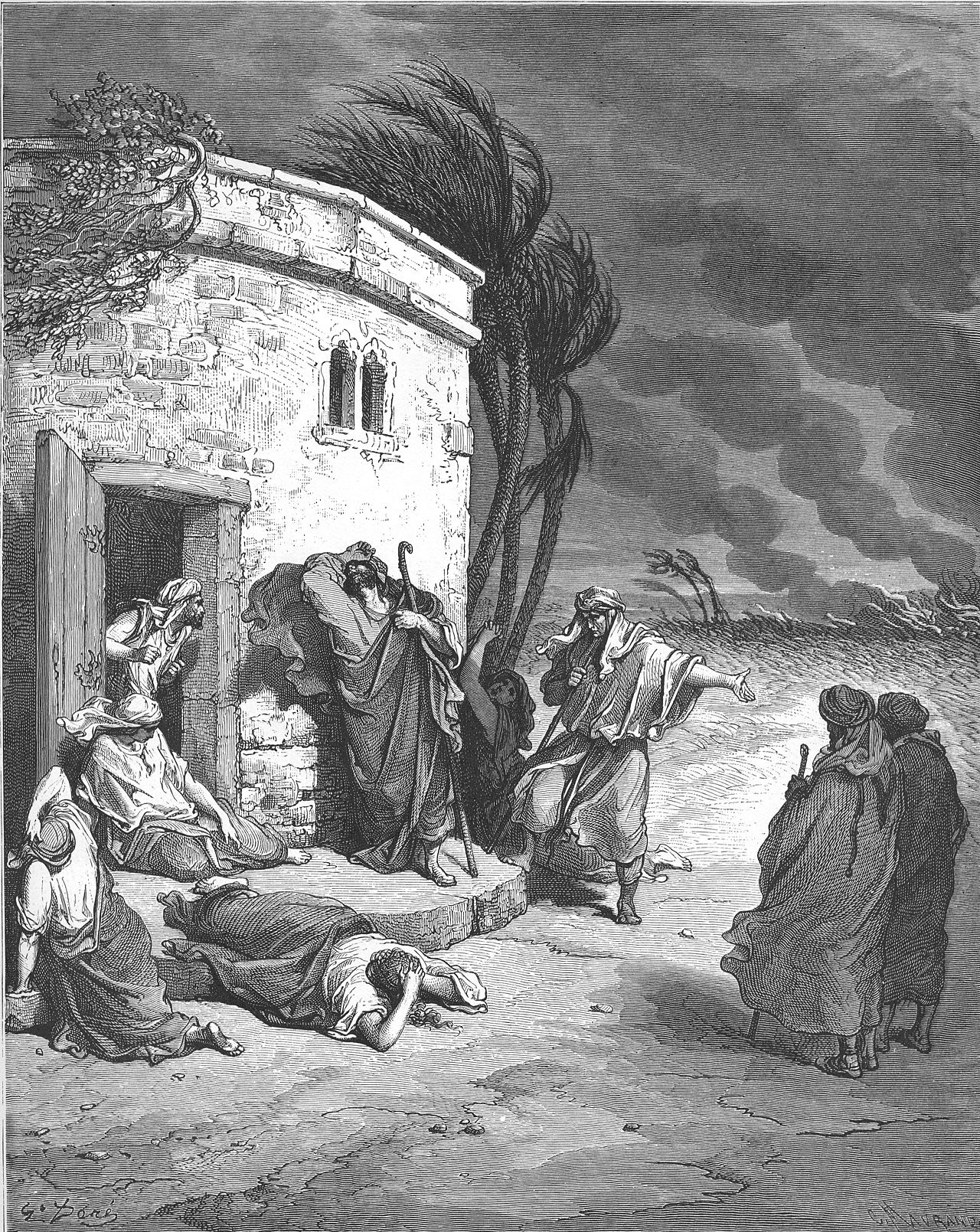
Jobchapter 34
37 verses · unknown · 10th century BC · Wisdom and poetry
Should God repay you on your own terms when you have disavowed His? You must choose, not I; so tell me what you know.
Introduction
unknown, Wisdom and poetry, Job Overview.
Elihu turns in this chapter from Job to the men standing around them and asks them to judge with him. His hearers lived under rulers no one could bring to court, and the chapter speaks of princes and kings. He quotes Job's own complaints and answers them one by one. The chapter defends the justice of God on the ground that God has nothing to gain from injustice. Listen for the picture of life as breath that God could gather back to Himself. Weigh the charge Elihu lays on Job at the close against what the first chapter of the book says of him.
Context
- Who
- Hearers who lived under rulers who could not be sued
- What
- Elihu's second speech, a defence of God's justice addressed to the onlookers as a jury.
- Where
- The ash heap, with Elihu speaking to the wise men gathered there.
- When
- The book sets Job in the age of the patriarchs, commonly placed about 2000 to 1800 BC, and it gives no date.
- Why
- To answer Job's claim that God has denied him justice, by arguing that God has no motive to be unjust.
Historical context
Elihu turns from Job to the other men present and asks them to judge between them: 'let us choose to us judgment: let us know among ourselves what is good.' He puts it in the language of tasting, the ear tries words as the mouth tastes food, a proverb of discernment used elsewhere in Israel's wisdom writing.
Show the rest of the historical context, 3 more paragraphs
The charge he brings against Job is a quotation, and it is fair: Job has said 'I am righteous, and God hath taken away my judgment', and that it profits a man nothing to delight himself with God. Elihu's answer is that God cannot be corrupt because he has nothing to gain, nobody appointed him over the earth and nobody can impeach him, so there is no one for him to be partial toward.
His strongest image is about breath. If God set his heart on man and gathered to himself his spirit and his breath, all flesh would perish together and man would turn again to dust. Life is not a possession men hold; it is on loan, moment by moment.
Then the political section, and hearers under kings would have felt it. God accepts not the persons of princes, nor regards the rich more than the poor, for they are all the work of his hands. He breaks in pieces mighty men without number and sets others in their place. In a moment they die; the people are troubled at midnight and pass away; the mighty are taken away without hand, that is, without human agency. It is the picture of a palace coup or a plague that no one can trace to a human author. And nowhere is there darkness deep enough for workers of iniquity to hide in.
Significance
Elihu is defending something Job never actually denied, that God is just, and he does it by pressing further than the three friends dared: God has no motive to be unjust, because there is nothing anyone could offer him.
Show the rest of the significance, 1 more paragraph
But he ends by wishing Job tried to the end for answering like a wicked man, and that is where he overreaches. Hearers who knew chapter 1 could see that the young man is closer than the elders and still on the wrong side of the truth.
This chapter in Jewish lifeWhat this chapter is in Jewish life and reading.
What is done
This chapter has no place in the synagogue year. The site's own table in src/lib/hebraic/readings.ts printed parashot total 0 and haftarah uses total 0 for the book of Job, and no festival reading.
The corpus joins it to the study of the Torah portions through the Midrash arranged by them. Under the nineteenth verse it carries Bereshit Rabbati, Parashat Vayechi 21.
How it is read
Rashi and Malbim are the two commentators on this chapter whose English the corpus carries. Rashi is quoted from The Judaica Press complete Tanach with Rashi, translated by A. J. Rosenberg, which Sefaria reports as CC-BY. Malbim is quoted from Malbim's Job, trans. Jeremy I. Pfeffer. Ktav, 2003, which Sefaria reports as CC-BY. Malbim sets Elihu's speech against an argument Job made in the Fifth Oration (Malbim on Job 34:2:1).
Job had argued that the suffering of the righteous would be an injustice if God governed individuals. So God had handed that governance to the Cosmos, which treats the righteous and the wicked alike (Malbim on Job 34:2:1). Bildad answered that handing governance to such a power is itself an injustice. Job replied that on the scale of all existence the Earth is a speck of dust. Its destruction with all its people would do no injustice to the balance of nature (Malbim on Job 34:2:1).
Elihu sets out to demolish this argument, and Malbim has him break in midway. "Elihu interjects that Job’s thesis is scandalous, for it emboldens the wicked, assuring them that they have nothing to fear." (Malbim on Job 34:7:2). He then returns to his summary of Job's thesis (Malbim on Job 34:10:1, Malbim on Job 34:12:1). At the twenty-first verse Malbim turns to Job's second argument, from the prosperity of the wicked. Human justice avoids delay in punishment because it lacks knowledge and ability (Malbim on Job 34:21:1).
Rashi reads Job's words as Elihu reports them. The ear tests words as the palate tastes food (Rashi on Job 34:3:1). Job accuses his Judge of being a liar, since He did not judge him fairly (Rashi on Job 34:6:1). A man derives no benefit if he perfects his ways (Rashi on Job 34:9:1).
Rashi then gives Elihu's answer. No one rules over God to ask why He acted, and He need find no pretexts for His creatures (Rashi on Job 34:13:1). If He set His heart to destroy a man, He could gather in the spirit and soul He blew into him, and all flesh would perish together (Rashi on Job 34:14:1).
Elihu asks whether Job could condemn One who is very righteous (Rashi on Job 34:17:1), and whether it is proper to call a king a scoundrel (Rashi on Job 34:18:1). The King of the world shows no favoritism (Rashi on Job 34:19:1). At the twenty-third verse Rashi sets Elihu's reply against Job's words in the twenty-third chapter. Job said God would lay on him only his sins, and Elihu answers that God adds no accusations beyond a creature's transgression (Rashi on Job 34:23:1).
The corpus carries six further notes on this chapter without an English text, each marked linked because Sefaria holds no English version of the ref. They stand cited by ref and unquoted. Five stand at Metzudat David on Job 34:1:1, 34:4:1, 34:8:1, 34:11:1 and 34:22:1. One stands at Ibn Ezra on Job 34:15:1.
What the rabbis say
The corpus carries forty rabbinic locators on this chapter and the text of none, so each is cited and linked here rather than quoted. On the seventh verse it holds Eikhah Rabbah 3:1, Midrash Lekach Tov on Lamentations 3:1:1 and Midrash Lekach Tov on Lamentations, Introduction 1. On the tenth verse it holds Aggadat Bereshit 22:2, Bereshit Rabbah 87:3 and Mekhilta DeRabbi Shimon Ben Yochai 14:24. On the eleventh verse it holds Aggadat Bereshit 81:1, Sifrei Aggadah on Esther, Midrash Panim Acherim, Version II 6:25 and Tanna DeBei Eliyahu Rabbah 7:1. On the fourteenth verse it holds Bereshit Rabbah 14:9.
On the fifteenth verse it holds Midrash Lekach Tov, Numbers 16:1:3. On the seventeenth verse it holds Mekhilta DeRabbi Shimon Ben Yochai 18:22 and Otzar Midrashim, Midrash Gadol u'Gedolah 28. On the nineteenth verse it holds Aggadat Bereshit 41:2, Bamidbar Rabbah 19:33 and Bereshit Rabbati, Parashat Vayechi 21. On the twentieth verse it holds Pesikta Rabbati, Supplement A 2:5 and Pirkei DeRabbi Eliezer 48:19. On the twenty-first verse it holds Midrash Tehillim 53:2.
On the twenty-second verse it holds Learning to Read Midrash, Appendix; Hebrew Sources 5:3. It also holds Learning to Read Midrash, Chapter 5; Engaging the Reader in Dialogue; The Servant in the Graveyard 18. On the twenty-third verse it holds Tractate Soferim 4:8. On the twenty-fourth verse it holds Bamidbar Rabbah 15:21 and Bereshit Rabbah 36:2. On the twenty-fifth verse it holds Bereshit Rabbah 28:1 and Midrash Lekach Tov, Exodus 11:3:2. On the twenty-sixth verse it holds Kohelet Rabbah 7:2:4 and Midrash Tehillim 10:6. On the twenty-ninth verse it holds Bamidbar Rabbah 9:1 and Bereshit Rabbah 36:1.
On the thirtieth verse it holds Devarim Rabbah 5:9 and Esther Rabbah, Petichta 8. On the thirty-first verse it holds Bereshit Rabbah 49:10 and Tractate Sefer Torah 4:8. On the thirty-second verse it holds Midrash Sekhel Tov, Bereshit 41:16:2. On the thirty-third verse it holds Bamidbar Rabbah 14:1 and Ein Yaakov (Glick Edition), Sanhedrin 11:90. On the thirty-fifth verse it holds Bava Batra 16b:3 and Ein Yaakov, Bava Batra 1:39. On the thirty-seventh verse it holds Vayikra Rabbah 4:6. What each of them teaches is a saying of the rabbis, and is reported as theirs wherever this site quotes one. The quotations wait on a fetch that carries the text.
Sources: Malbim, Malbim on Job 34:2:1 to 34:21:1, Malbim's Job, trans. Jeremy I. Pfeffer. Ktav, 2003, reported CC-BY; Rashi, Rashi on Job 34:3:1 to 34:24:1, The Judaica Press complete Tanach with Rashi, translated by A. J. Rosenberg, reported CC-BY; Metzudat David, Metzudat David on Job 34:1:1, 34:4:1, 34:8:1, 34:11:1 and 34:22:1, cited by ref because the corpus carries no English text; Ibn Ezra, Ibn Ezra on Job 34:15:1, cited by ref because the corpus carries no English text; The Sefaria corpus, scripts/data/sources/sefaria/job/34.json, the 40 Talmud and Midrash locators of this chapter; The site's own files, src/lib/hebraic/readings.ts, printing no portion, no Haftarah and no festival reading for this book.
The heads below are this chapter's scenes. The numbered points under each are its verses.
Elihu: Far Be It From God That He Should Do Wickedness
Job 34:1-4
Then Elihu continued: “Then Elihu continued” opens his second speech, addressed to a wider audience. His maxim, “the ear tests words as the mouth tastes food”, weighs speech by discernment whatever the speaker's age, as he claimed at 32:9. His appeal, “let us learn together what is good”, asks for a shared verdict.
Job 34:1
“Furthermore, Elihu answered and said - That is, evidently, after a pause to see if Job had anything to reply. The word answered in the Scriptures often means “to begin a discourse,” though nothing had been said by others; see Job 3:2; Isa 14:10; Zec 1:10; Zec 3:4; Zec 4:11-12. Sometimes it is used with reference to a subject, meaning that one replied to what could be suggested on the opposite side.”
O men of learning: Albert Barnes takes the wise men here as the three friends, since chapter 33 was spoken to Job and he gave no reply. Elihu still calls them wise. Matthew Henry counts that courtesy a fair act from a man who disagreed with them.
Job 34:2
“Hear my words, O ye wise men - Addressing particularly the three friends of Job. The previous chapter had been addressed to Job himself. He had stated to him his views of the design of affliction, and he had nothing to reply. He now addresses himself to his friends, with a particular view of examining some of the sentiments which Job had advanced, and of showing where he was in error.”
the ear tests words: Albert Barnes reads the ear here as the whole power of hearing, which weighs what words mean as the mouth judges food. Adam Clarke adds that Eastern poets prized sound joined to sense. He suspected Elihu worked for both.
Job 34:3
“For the ear trieth words - Ascertains their meaning, and especially determines what words are worth regarding. The object of this is, to fix the attention on what he was about to say; to get the ear so that every word should make its proper impression. The word ear in this place, however, seems not to be used to denote the external organ, but the whole faculty of hearing. It is by hearing that the meaning of what is said is determined, as it is by the taste that the quality of food is discerned.”
1 more voice on this verse
Job 34:3
“For the ear trieth words,.... Not only the musical sound of them, the goodness of the language and diction, and the grammatical construction of them, but the sense of them, and whether the matter of them is good or not; that they are sound speech, which cannot be condemned, or unsound; whether they are right or wrong, agreeably to right reason, sound doctrine, and the word of God; for there are words and words, some the words of men, others the words of God.”
let us learn together what is good: Adam Clarke hears a call to give up the contest for applause and victory and to seek what is right. Gregory the Dialogist tests the call by the words that follow. He found little humility in them.
Job 34:4
“Let us choose to us judgment, and let us see among ourselves what is the best. But we easily learn, by considering the words which follow, whether he sought for this judgment from humility of heart.”
Gregory the Dialogist · written before 604 · Morals on the Book of Job, Book XXIVpatristic
2 more voices on this verse
Job 34:4
“Let us choose to us judgments,.... Take the part of the question or controversy in which truth and justice lie, and he doubtless has respect to the present controversy with Job; let us know among ourselves what is good; agree upon that which is best to be done in the present case, what judgment to be made of the dealings of God with Job, and his behaviour under them, and what the best advice to give to him.”
Job 34:4
“Let us choose to us judgment - Let us not seek the applause of men, nor contend for victory. Let our aim be to obtain correct views and notions of all things; and let us labor to find out what is good.”
Adam Clarke · Commentary on the Bible (1810-1826)evangelical
Job 34:5-9
Elihu tightens Job's complaints into one claim, “I am righteous, yet God has deprived me of justice”. Barnes notes that the man who “drinks up derision like water”, and the saying of verse 9, go further than anything Job said. Clarke calls verses 8 and 9 Elihu's weakest move.
Job 34:5
“For Job hath said, I am righteous - see Job 13:18, “I know that I shall be justified;” compare Job 23:10-11, where he says, if he was tried he would come forth as gold. Elihu may have also referred to the general course of remark which he had pursued as vindicating himself. And God hath taken away my judgment - This sentiment is found in Job 27:2; see the notes at that place.”
1 more voice on this verse
Job 34:5
“For Job hath said, I am just, and God hath subverted my judgment. For in judging me there is falsehood: and mine arrow is violent without any sin. He complains that Job had spoken these things, [See chap. 27, 2] which the words of the sacred history prove on examination that he had never said. But he, who had sought for a judgment on equal terms, proceeds to promulgate a sentence from a fault of his own invention.”
Gregory the Dialogist · written before 604 · Morals on the Book of Job, Book XXIVpatristic
My wound is incurable: The Hebrew word behind wound is literally arrow, the shaft by which Job is pierced, according to Jamieson, Fausset and Brown. John Gill hears Job 27:4 behind the whole verse. Job had refused there to call himself wicked against his own conscience.
Job 34:6
“Should I lie against my right? - Should I acknowledge myself the sinner which they paint me, and thus lie against my right to assert and maintain my innocence? My wound is incurable without transgression - If this translation is correct, the meaning of the place is sufficiently evident. In the tribulation which I endure, I am treated as if I were the worst of culprits; and I labor under incurable maladies and privations, though without any cause on my part for such treatment.”
Adam Clarke · Commentary on the Bible (1810-1826)evangelical
1 more voice on this verse
Job 34:6
“Should I lie against my right?.... No; I ought not: this though Job had not said in so many words, yet this seems to be his sense in Job 27:4; that should he own and say that he was a wicked man, a hypocrite, and destitute of the grace of God, he should not only speak against himself, but, contrary to his conscience, say an untruth, and not do justice to his character.”
who drinks up derision like water?: Albert Barnes and Adam Clarke trace the image to Job 15:16, where Eliphaz first used it. Barnes reads it as a man who takes in words of derision against God as freely as he drinks water. Elihu brings the old charge back against Job.
Job 34:7
“Calmness is a thing which, of all other things, is most to be prized. As an example of this, the word proposes to us the blessed Job. For it is said of him, "What man is like Job, who drinks up scorning like water?" For truly enviable, and, in my judgment, worthy of all admiration, a man is, if he has attained to such a degree of long-suffering as to be able with ease to grapple with the pain, truly keen, and not easily conquered by everybody, which arises from being wronged.”
Clement of Alexandria · written before 215 · Nicetas Bishop of Heracleapatristic
1 more voice on this verse
Job 34:7
“What man is like Job, who drinketh up scorning like water? - A similar image occurs in Job 15:16. The idea is, that he was full of reproachful speeches respecting God; of the language of irreverence and rebellion. He indulged in it as freely as a man drinks water; gathers up and imbibes all the language of reproach that he can find, and indulges in it as if it were perfectly harmless.”
He keeps company with evildoers: Elihu means company in opinion, says Albert Barnes. Job had taken up the sayings of the wicked about how God rules, and Jamieson, Fausset and Brown point to Job 9:22 and 21:7-15. Adam Clarke pictures a caravan, where a holy man could travel alongside the profligate.
Job 34:8
“Job virtually goes in company (makes common cause) with the wicked, by taking up their sentiments (Job 9:22, 23, 30; 21:7-15), or at least by saying, that those who act on such sentiments are unpunished (Mal 3:14). To deny God's righteous government because we do not see the reasons of His acts, is virtually to take part with the ungodly.”
Jamieson, Fausset & Brown · Commentary Critical and Explanatory on the Whole Bible (1871)reformed
1 more voice on this verse
Job 34:8
“Which goeth in company with the workers of iniquity - This is an allusion to a caravan: all kinds of persons are found there; but yet a holy and respectable man might be found in that part of the company where profligates assembled.”
Adam Clarke · Commentary on the Bible (1810-1826)evangelical
Albert Barnes finds the nearest words at Job 9:22. Gregory the Dialogist and Thomas Aquinas charge Elihu with inventing the claim that it profits a man nothing to delight in God. Matthew Henry grants that delight in God is a present good.
Job 34:9
“For he hath said, It profiteth a man nothing that he should delight himself in God - That is, there is no advantage in piety, and in endeavoring to serve God. It will make no difference in the divine dealings with him. He will be treated just as well if he lives a life of sin, as if he undertakes to live after the severest rules of piety. Job had not used precisely this language, but in Job 9:22, he had expressed nearly the same sentiment.”
2 more voices on this verse
Job 34:9
“For he hath said, A man will not please God, even though he run with Him. But that he never said so, every one acknowledges who reads the words of blessed Job. But yet what wonder, that he who speaks for the sole purpose of proudly setting himself off, invents something to find fault with in another person? For how can he adhere to 'truth in his words of reproof, whom pride of mind within removes far away from the same truth? It follows, Therefore hearken unto me, Ye men of understanding.”
Gregory the Dialogist · written before 604 · Morals on the Book of Job, Book XXIVpatristic
Job 34:9
“It is granted that there is a present pleasure in religion; for what is it but to delight ourselves with God, in communion with him, in concurrence with him, in walking with him as Enoch did? this is a true notion of religion, and bespeaks its ways to be pleasantness.”
Matthew Henry · Commentary on the Whole Bible (1707-1721)puritan
Job 34:10-12
Far be it from God to do wrong: “Far be it from God to do wrong, and from the Almighty to act unjustly” is the thesis of Elihu's second speech. Verse 11 grounds it in recompense. Wesley holds the claim true and reverent in itself, whatever the reader judges of Elihu's use of it against Job.
Job 34:10
“Far be it from God - Rather, Wickedness, far be that from God; and from iniquity, the Almighty. The sense is sufficiently evident without the paraphrase in our version.”
Adam Clarke · Commentary on the Bible (1810-1826)evangelical
according to a man’s deeds: Albert Barnes calls this repaying of each man by his deeds the essence of justice, and nobody in the debate disputed it. Elihu leaves Job's name out. Barnes still reads the verse as aimed at Job, who had said God brought on him woes he never deserved.
Job 34:11
“For the work of a man will he render unto him,.... The reward of his work, as Ben Gersom interprets it, whether the work of a wicked man or of a good man: and cause every man to find according to his ways.”
2 more voices on this verse
Job 34:11
“For the work of a man shall he render unto him - He shall treat each man as he deserves - and this is the essence of justice. Of the truth of this, also, there could have been no question. Elihu does not, indeed, apply it to the case of Job, but there can be little doubt that he intended that it should have such a reference. He regarded Job as having accused God of injustice, for having inflicted woes on him which he by no means deserved.”
Job 34:11
“Say to the righteous, it shall be well with them; woe to the wicked, it shall be ill with them. If services persevered in now go unrewarded, and sins persisted in now go unpunished, yet there is a day coming when God will fully render to every man according to his works, with interest for the delay. How warmly it is asserted, 1.”
Matthew Henry · Commentary on the Whole Bible (1707-1721)puritan
the Almighty does not pervert justice: Albert Barnes notes that Elihu repeats verse 10 with the Hebrew word surely. God does no wickedness, and the Almighty never perverts justice. Gregory the Dialogist weighs this against Job 2:3, where Job was afflicted without cause, and says God may afflict a man without condemning him.
Job 34:12
“For truly God will not condemn without cause, nor will the Almighty subvert judgment. The Lord said to the devil, Thou hast moved Me against him to afflict him without cause. [Job 2, 3] But Eliu says, That the Lord will not condemn without cause. A statement which is believed to be at variance with the words of Truth, unless weighed with careful consideration. For to condemn is one thing, to afflict another. He afflicts therefore in some respect without cause, but does not condemn without cause.”
Gregory the Dialogist · written before 604 · Morals on the Book of Job, Book XXIVpatristic
1 more voice on this verse
Job 34:12
“Yea, surely God will not do wickedly - So important does Elihu hold this principle to be, that he repeats it, and dwells upon it. He says, “it surely (אמנם 'omnâm) must be so.” The principle must be held at all hazards, and no opinion which contravenes this should be indulged for one moment. His ground of complaint against Job was, that he had not held fast to this principle, but, under the pressure of his sufferings, had indulged in remarks which implied that God might do wrong.”
Job 34:13-15
Who gave Him charge over the earth?: The question “Who gave Him charge over the earth” grounds God's justice in His place as Creator. If He were to “withdraw His Spirit and breath”, “all flesh would perish together”. Davidson notes that Elihu anticipates the Lord's answer, an argument from unaccountable power Job will meet from another mouth.
Job 34:13
“Who hath given him a charge over the earth? - That is, he is the great original Proprietor and Ruler of all. He has derived his authority to govern from no one; he is under subjection to no one, and he has, therefore, an absolute right to do his own pleasure. Reigning then with absolute and original authority, no one has a right to call in question the equity of what he does. The argument of Elihu here, that God would do right, is derived solely from his independence.”
1 more voice on this verse
Job 34:13
“Shall not he that disposes of the whole world dispose of us and our concerns? (2.) It is as certain that he does not derive his power from any, nor is it a dispensation that is committed to him, but his power is original, and, like his being, of himself; and therefore, if he were not perfectly just, all the world and the affairs of it would soon be in the utmost confusion.”
Matthew Henry · Commentary on the Whole Bible (1707-1721)puritan
withdraw His Spirit and breath: Adam Clarke reads the verse as a promise. On whomever God sets His love, that person's soul is gathered to Him while the body returns to dust. Gregory the Dialogist takes spirit as the inward thoughts and breath as the outward acts.
Job 34:14
“If he hath directed his heart towards Him, He will gather to Himself his spirit, and his breath. The heart is crooked, when it seeks for things below. It is made straight when it is raised to things above. If a man therefore direct his heart to the Lord, the Lord draws to Himself his spirit and his breath. He uses, namely, spirit for inward thoughts, but breath, which is drawn through the body, for outward actions.”
Gregory the Dialogist · written before 604 · Morals on the Book of Job, Book XXIVpatristic
1 more voice on this verse
Job 34:14
“If he set his heart upon man - I think this and the following verse should be read thus: - “If he set his heart upon man, he will gather his soul and breath to himself; for all flesh shall perish together, and man shall turn again unto dust.” On whomsoever God sets his heart, that is, his love, though his body shall perish and turn to dust, like the rest of men, yet his soul will God gather to himself.”
Adam Clarke · Commentary on the Bible (1810-1826)evangelical
mankind would return to the dust: John Gill hears all flesh perishing together as one stroke on the whole race, as at the flood. Albert Barnes draws the lesson for Job. If God may take life from all, a man has no ground to charge Him with injustice over lost health, comfort or friends.
Job 34:15
“All flesh shall perish together,.... Not one by one, or one after another, as they generally do, but all together; as when the flood swept away the world of the ungodly.”
1 more voice on this verse
Job 34:15
“All flesh shall perish together - If God chose, he would have a right to cut down the whole race. How then shall people complain of the loss of health, comforts, and friends, and presume to arraign God as if he were unjust?”
Elihu: Shall Even He That Hateth Justice Govern?
Job 34:16-18
If you have understanding, hear this: The question “Could one who hates justice govern” turns the axiom of verse 10 on Job's own complaint. To charge God with injustice is to imagine Him hating the justice He governs by. The next question, “Will you condemn the just and mighty One”, puts that charge to Job himself.
Job 34:16
“If now thou hast understanding hear this - This appears to be addressed to Job. The discourse before this had been directed to his three friends, but Elihu appears here to have turned to Job, and to have made a solemn appeal to him, whether this were not so. In the subsequent verses he remonstrates with him about his views, and shows him that what he had said implied severe reflections on the character and government of God.”
Could one who hates justice govern?: Albert Barnes and Jamieson, Fausset and Brown give the Hebrew behind govern as bind, a ruler binding by law. Gregory the Dialogist calls the question just. He faults Elihu for pressing it on Job, a man who loved justice.
Job 34:17
“Can he be healed that loveth not judgment? How dost thou so much condemn him that is just? He uttered a proper sentiment, but it ought not to have been uttered to blessed Job. For in every thing which is said we must by all means consider, what is said, to whom it is said, where it is said, how it is said. But Eliu considered only what he was saying, but did not consider to whom he was saying it. For blessed Job loved judgment, since he knew how to weigh his causes carefully with the Lord.”
Gregory the Dialogist · written before 604 · Morals on the Book of Job, Book XXIVpatristic
1 more voice on this verse
Job 34:17
“Shall even he that hateth right govern? - Margin, as in Hebrew “bind.” That is, shall he bind by laws. The argument in this verse seems to be an appeal to what must be the conviction of mankind, that God, the Great Governor of the universe, could not be unjust. This conviction, Elihu appears to have supposed, was so deep in the human mind, that he might appeal even to Job himself for its truth. The question here asked implies that it would be impossible to believe that one who was unjust could govern the universe.”
The Hebrew word behind worthless is Belial, as Adam Clarke notes. The Berean follows the reading of the Septuagint and Vulgate, which Jamieson, Fausset and Brown give through Maurer. It speaks of a God who calls kings wicked and punishes the great and the small alike.
Job 34:18
“Is it fit to say to a king, Thou art wicked? - The sentence is very short, and is thus translated by the Vulgate: Qui dicit regi, Apostata? Qui vocat duces impios? “Who says to a king, Apostate? Who calls leaders impious?” Literally, Who calls a king Belial? Who calls princes wicked? Civil governors should be treated with respect; no man should speak evil of the ruler of the people. This should never be permitted. Even where the man cannot be respected, because his moral conduct is improper, even there the office is sacred, and should be reverenced.”
Adam Clarke · Commentary on the Bible (1810-1826)evangelical
1 more voice on this verse
Job 34:18
“Literally, (Is it fit) to be said to a king? It would be a gross outrage to reproach thus an earthly monarch, much more the King of kings (Ex 22:28). But MAURER with the Septuagint and Vulgate reads, (It is not fit to accuse of injustice Him) who says to a king, Thou art wicked; to princes, Ye are ungodly; that is, who punishes impartially the great, as the small.”
Jamieson, Fausset & Brown · Commentary Critical and Explanatory on the Whole Bible (1871)reformed
Job 34:19-20
who is not partial to princes: Elihu carries the argument from earthly kings to the Creator, “who is not partial to princes and does not favor rich over poor”. Barnes reads “without human hand” as a claim that God's justice needs no human agent, a point Elihu presses in the verses that follow.
Job 34:19
“How much less to him that accepteth not the person of princes - To accept the person of anyone is to treat him with special favor on account of his rank, his wealth, or from favoritism and partiality. This God often disclaims in respect to himself; (compare Gal 2:6; Act 10:34; 2Ch 19:7; Rom 2:11; Eph 6:9; Col 3:25), and solemnly forbids it in others; see Jas 2:1, Jas 2:3,Jas 2:9; Lev 19:15; Deu 1:17; Deu 16:19. The meaning here is, that God is entirely impartial in his administration, and treats all as they ought to be treated.”
in the middle of the night: Jamieson, Fausset and Brown picture the night as an attack on a camp, citing Exodus 12:29. Matthew Henry recalls the night the firstborn of Egypt died. The mighty and the people pass away in the same instant, while they feel secure.
Job 34:20
“Suddenly shall they die, and the people shall bow down at midnight, and pass away. However long it be before the ungodly are taken out of this life, they are taken away suddenly, and at an instant, since they know not how to foresee their end by thinking on it. That is sudden to any one, which he has not been able to think of beforehand. That rich man was taken away suddenly, who left the barns which he was preparing, and found the place of hell, which he was not looking for.”
Gregory the Dialogist · written before 604 · Morals on the Book of Job, Book XXVpatristic
2 more voices on this verse
Job 34:20
“In a moment shall they die,.... Princes as well as the common people, rich men as well as poor; all must and do die, great and small, high and low, kings and peasants, rich and poor men, and sometimes suddenly; are struck dead at once, and without any previous notice, that night, that hour, that moment their souls are required of them. The Targum interprets this of the men of Sodom.”
Job 34:20
“In a moment shall they die - Both are equally dependent on the Almighty for their breath and being; the mighty as well as the poor. If the great men of the earth have abused their power, he sometimes cuts them off by the most sudden and unexpected death; and even at midnight, when in security, and least capable of defense, they are cut off by the people whom they have oppressed, or by the invisible hand of the angel of death. This appears to be spoken in reference to Eastern tyrants, who seldom die a natural death.”
Adam Clarke · Commentary on the Bible (1810-1826)evangelical
Job 34:21-25
His eyes are on the ways of a man: “For His eyes are on the ways of a man” answers Job's complaint of a hidden God. Elihu shows justice in history, where “He shatters the mighty without inquiry and sets up others in their place”. “He recognizes their deeds”, and so “He overthrows them in the night”.
Job 34:21
“For His eyes are over the ways of men, and He considers all their steps. For He was then believed not to observe them, while this man of violence was committing, unpunished, all the wickedness he could. God was supposed not to behold the deeds of the ungodly, because He was delaying to condemn them justly; and His great forbearance was regarded as a kind of carelessness. The wicked also himself believed that he was not observed by God in the commission of sin, as often as he sinned without being punished.”
Gregory the Dialogist · written before 604 · Morals on the Book of Job, Book XXVpatristic
no darkness or deep shadow: Deep shadow renders the Hebrew for the shadow of death, which Albert Barnes explains at Job 3:5 as the deepest darkness. Gregory the Dialogist reads darkness as ignorance and the shadow as forgetting. God sees the wicked through both.
Job 34:22
“There is no darkness, and there is no shadow of death, where they who work iniquity may be hid. What did he intend to designate by darkness but ignorance, and what by the shadow of death, except oblivion?”
Gregory the Dialogist · written before 604 · Morals on the Book of Job, Book XXVpatristic
1 more voice on this verse
Job 34:22
“The day is coming when mighty men, and chief captains, will call to the rocks and mountains to hide them. [2.] They would gladly be hid even by the shadow of death, be hid in the grave, and lie for ever there, rather than appear before the judgment-seat of Christ. (3.) It is in vain to think of flying from God's justice, or absconding when his wrath is in pursuit of us.”
Matthew Henry · Commentary on the Whole Bible (1707-1721)puritan
God need not examine a man further: Albert Barnes reports many rival renderings of this verse. Umbreit, cited by Jamieson, Fausset and Brown, gives the sense the Berean follows, that God needs no long scrutiny of a man before judgment. They read verse 24 the same way, where the mighty fall without any searching out.
Job 34:23
“Better, as UMBREIT, "He does not (needs not to) regard (as in Job 34:14; Isa 41:20) man long (so Hebrew, Ge 46:29) in order that he may go (be brought by God) into judgment." Literally, "lest his (attention) upon men" (Job 11:10, 11). So Job 34:24, "without number" ought to be translated, "without [needing any] searching out," such as has to be made in human judgments.”
Jamieson, Fausset & Brown · Commentary Critical and Explanatory on the Whole Bible (1871)reformed
1 more voice on this verse
Job 34:23
“For he will not lay upon man more than right - Very various translations have been given of this verse. According to our common version, it means that God will not deal with man in such a manner as to give him just reason for calling in question the rectitude of the divine dealings. He shall in no case receive more than his sins deserve, so as to give him cause for complaint. This is undoubtedly a correct sentiment; but it may be doubted whether it is the sense conveyed by the original.”
He shatters the mighty without inquiry: Albert Barnes gives the Hebrew word here as chêqer, a searching out, the margin's reading in place of without number. God needs no drawn-out trial. Matthew Henry adds that the new rulers set in their place show God ends tyranny without leaving anarchy.
He overthrows them in the night: The Hebrew word for therefore can mean because, says Albert Barnes, so God strikes since He already knows the deeds. Jamieson, Fausset and Brown tie the night here to verse 20 and to verse 22, where the wicked hoped to hide in darkness. They are overthrown in the same dark.
Job 34:25
“Therefore he knoweth their works - Or, “Because he knoweth their works.” The word (לכן lākên) here rendered “therefore” is evidently used as denoting that since or because he was intimately acquainted with all which they did, he could justly bring vengeance upon them without long investigation. And he overturneth them in the night - literally, “he turneth night;” meaning, probably, he turns night upon them; that is, he brings calamity upon them. The word “night” is often used to denote calamity, or ruin.”
1 more voice on this verse
Job 34:25
“He knows their works, without a formal investigation (Job 34:24). in the night--suddenly, unexpectedly (Job 34:20). Fitly in the night, as it was in it that the godless hid themselves (Job 34:22). UMBREIT, less simply, for "overturneth," translates, "walketh"; that is, God is ever on the alert, discovering all wickedness.”
Jamieson, Fausset & Brown · Commentary Critical and Explanatory on the Whole Bible (1871)reformed
Job 34:26-30
He strikes them for their wickedness: “He strikes them for their wickedness in full view” answers the charge of a hidden justice. Because “they turned aside from Him”, they caused “the cry of the poor to come before Him”, so the argument turns to mercy. Henry reads verse 29 as the hardest line for a sufferer.
Job 34:26
“God is omniscient, and can discover that which is most secret. As the strongest cannot oppose his arm, so the most subtle cannot escape his eye; and therefore, if some are punished either more or less than we think they should be, instead of quarrelling with God, it becomes us to ascribe it to some secret cause known to God only.”
Matthew Henry · Commentary on the Whole Bible (1707-1721)puritan
no regard for any of His ways: Adam Clarke reads the verse of corrupt rulers who turned aside from God in heart, conduct and government, with no regard for His ways. Gregory the Dialogist names three roots of sin, ignorance, weakness and set purpose. He counts turning aside from God on purpose as the worst.
Job 34:27
“Because they turned back from him - Margin, “from after him.” That is, they receded, or went away from God. And would not consider any of his ways - They would not regard or attend to any of his commands. The word way, in the Scriptures, is often used to denote “religion.” A “way” denotes the course of life which one leads; the path in which he walks.”
1 more voice on this verse
Job 34:27
“This is at the bottom of all the wickedness of the wicked, they turn back from God; and it is because they do not consider, not because they cannot, but because they will not.”
Matthew Henry · Commentary on the Whole Bible (1707-1721)puritan
the cry of the poor: The oppressors of verse 27 bring about their judgment. Matthew Henry, citing Exodus 22, warns that the cry of the oppressed draws vengeance on the oppressor in the end. Adam Clarke calls the tears and groans of the poor the gravest evidence in heaven against a cruel man of power.
Job 34:28
“That they might cause the cry of the needy to come to Him, and that He might hear the voice of the poor. For when these men are proud, they who are oppressed by their pride, cry aloud to God. Or certainly, it is said that they have caused the cry of the poor to come to God, because, on their fall, the poor, that is, the humble in spirit, are appointed in their room.”
Gregory the Dialogist · written before 604 · Morals on the Book of Job, Book XXVpatristic
1 more voice on this verse
Job 34:28
“Their case is bad who have the prayers and tears of the poor against them; for the cry of the oppressed will, sooner or later, draw down vengeance on the heads of the oppressors, and no one can say that this is more than right, Exod. xxii.”
Matthew Henry · Commentary on the Whole Bible (1707-1721)puritan
when He remains silent: The Hebrew verb behind remains silent covers every kind of rest and ease, says Albert Barnes. The next verb means to condemn or hold guilty. When God grants rest to a man or a nation, no one can overturn it.
Job 34:29
“When he giveth quietness - That is, when God designs to give rest, comfort, ease, or prosperity in any way to a man. The Hebrew word used here may refer to any kind of ease, rest, or peace. The idea which Elihu intends to convey is, that God has all things under his control, and that he can bring prosperity or adversity upon an individual or a nation at his own pleasure. Who then can make trouble? - literally, “Who can condemn, or hold guilty” - ירשׁע yarâsha‛.”
1 more voice on this verse
Job 34:29
“Who can make him show his face when he resolves to hide it, or see through the clouds and darkness which are round about him? Or, Who can behold a disquieted sinner, so as to give him effectual relief? Who can stand a friend to him to whom God is an enemy?”
Matthew Henry · Commentary on the Whole Bible (1707-1721)puritan
godless men should not rule: Albert Barnes reads the verse as the purpose of all Elihu has described, God humbling princes to keep the wicked from oppressing the people. Matthew Henry warns that power held by a pretender ensnares a people in sin and trouble. The Vulgate reads it otherwise, says Adam Clarke.
Job 34:30
“That the hypocrite reign not,.... These words seem to be connected with Job 34:24, "he breaketh in pieces mighty men", &c. the whole of Job 34:29 being read in a parenthesis; or with the phrase "he hideth his face"; as God is said to be in the destruction of mighty wicked men, who oppress the poor, and cause their cry to come to God, to prevent the reign of an hypocrite, or however to shorten it.”
1 more voice on this verse
Job 34:30
“That the hypocrite reign not - The Vulgate translates, Who causes a wicked man to reign because of the sins of the people. This was precisely the defense which Hegiage, the oppressive ruler of the Babylonian Irak, under the caliph Abdul Malec, made when he found the people in a state of insurrection. See at the end of the chapter, Job 34:37 (note).”
Adam Clarke · Commentary on the Bible (1810-1826)evangelical
Elihu: Job Multiplieth Words Against God
Job 34:31-33
Suppose someone says to God: “Suppose someone says to God” frames a model confession for Job's case. Elihu turns to Job with an edge, “Should God repay you on your own terms”. Clarke reads the unit as Elihu's clearest statement of what he thinks Job owes God, offered as counsel where the friends had accused.
Job 34:31
“UMBREIT and MAURER lose this by translating, as the Hebrew will bear, "Has any a right to say to God, I have borne chastisement and yet have not sinned?" (so Job 34:6). borne--namely, the penalty of sin, as in Le 5:1, 17. offend--literally, "to deal destructively or corruptly" (Ne 1:7).”
Jamieson, Fausset & Brown · Commentary Critical and Explanatory on the Whole Bible (1871)reformed
2 more voices on this verse
Job 34:31
“To humble himself before God for his sins, and to accept the punishment of them: " I have borne chastisement. What I suffer comes justly upon me, and therefore I will bear it, and not only justify God in it, but acknowledge his goodness." Many are chastised that do not bear chastisement, do not bear it well, and so, in effect, do not bear it at all.”
Matthew Henry · Commentary on the Whole Bible (1707-1721)puritan
Job 34:31
“Surely it is meet to be said unto God - It is evident that this verse commences a new strain of remark, and that it is designed particularly to bring Job to proper reflections in view of what had occurred. There has been, however, much diversity of opinion about the meaning of this and the following verses. Schultens enumerates no less than “fifteen” different interpretations which have been given of this verse. The “general” meaning seems to be, that a man who is afflicted ought to submit to God, and not to murmur or complain.”
Teach me what I cannot see: Albert Barnes calls this prayer fitting for anyone who suffers without seeing why. Matthew Henry adds that a good man wants to know the worst of himself. Under affliction he asks why God contends with him.
Job 34:32
“That which I see not, teach thou me - That is, in regard to my errors and sins. No prayer could be more appropriate than this. It is language becoming every one who is afflicted, and who does not see clearly the reason why it is done. The sense is, that with a full belief that he is liable to error and sin, that he has a wicked and deceitful heart, and that God never afflicts without reason, he should go to him and ask him to show him “why” he has afflicted him.”
You must choose, not I: Charles Spurgeon notes how ancient and terse the Hebrew is here. Jamieson, Fausset and Brown give Maurer's sense, that Job rejected God's way of repaying, so the task of showing a better way falls to Job. John Wesley hears Elihu offering to listen to Job's defense.
Job 34:33
“Rather, "should God recompense (sinners) according to thy mind? Then it is for thee to reject and to choose, and not me" [UMBREIT]; or as MAURER, "For thou hast rejected God's way of recompensing; state therefore thy way, for thou must choose, not I," that is, it is thy part, not mine, to show a better way than God's.”
Jamieson, Fausset & Brown · Commentary Critical and Explanatory on the Whole Bible (1871)reformed
2 more voices on this verse
Job 34:33
“Should it be - Doth God need thy advice how to govern the world, and whom, and when to reward or punish? Refuse - To submit as is expressed, ver. 32. Therefore - If thou canst say any thing for thyself, I am ready to hear thy defense.”
John Wesley · Explanatory Notes upon the Old Testament (1765)evangelical
Job 34:33
“ELIHU thought that Job had spoken too boastfully and that there was too much of self about him and, therefore, he reproved him by asking this question, "Should it be according to your mind?" It is a question which, in the original, has a great wealth of meaning in it and, as the language of the Book of Job is extremely ancient and very terse, it is not easy to get the fullness of Elihu's meaning.”
Charles Spurgeon · written before 1892 · The Metropolitan Tabernacle Pulpit, Sermon No. 2834: “Conceit Rebuked” (lightly modernized text, CCEL edition)Particular Baptist
Job 34:34-37
Men of understanding will declare to me: Elihu puts “Job speaks without knowledge” in the mouths of the wise. The wish “If only Job were tried” is his overreach, where the commentators see zeal for God's justice outrun charity. The closing charge, “he claps his hands among us”, is harsher than anything the friends said so plainly.
Job 34:34
“Let men of understanding speak to me, and let a wise man hear me. But Job hath spoken foolishly, and his words sound not of discipline. Lo, how he lays open that, which he was cherishing within, when, as if humbly, he allows blessed Job to speak; saying, Let men of understanding speak to me. For if blessed Job were to presume to speak, he would have disdained him, as though he could not understand his words.”
Gregory the Dialogist · written before 604 · Morals on the Book of Job, Book XXVIpatristic
The quotation marks show Elihu putting this verdict in the mouths of the wise men of verse 34. Thomas Aquinas reads the charge as speaking against wisdom, as Job seemed to deny the justice of God's judgments. Adam Clarke calls Job self-willed here.
Job 34:35
“To speak, though but one word, against God, by whom we speak and for whom we ought to speak, is a great sin; what is it then to multiply words against him, as if we would out-talk him? What is it to repeat them, instead of unsaying them? Those that have sinned, and, when they are called to repent, thus go on frowardly, add rebellion to their sin and make it exceedingly sinful.”
Matthew Henry · Commentary on the Whole Bible (1707-1721)puritan
If only Job were tried: Clarke reports the opening word, abi, can be read as a cry to God as Father, and the Vulgate reads it so. Jamieson, Fausset and Brown prefer a wish that Job be tried by calamity, and tie answering like a wicked man to verse 8. Clarke calls the wish harsh.
Job 34:36
“My desire is that Job may be tried unto the end - אבי יבחן איוב abi yibbachen Aiyob, “My father, let Job be tried.” So the Vulgate, Pater mi, probetur Job. But it may be as in the common translation, I wish Job to be tried; or, as Mr. Good renders it, Verily, let Job be pursued to conquest for replying like wicked men. This is a very harsh wish: but the whole chapter is in the same spirit; nearly destitute of mildness and compassion.”
Adam Clarke · Commentary on the Bible (1810-1826)evangelical
2 more voices on this verse
Job 34:36
“My Father, let Job be tried even to the end. Lo! how he lifts up even in words of cursing, that which he had before conceived of the swellings of arrogance. But he would perhaps wish for the force of a merciful probation, if he had believed that he had stood firm in probation. In order then that the malice of his cruelty may openly appear, he prays, that he may still be tried by scourges, who he complains had already fallen during his scourges.”
Gregory the Dialogist · written before 604 · Morals on the Book of Job, Book XXVIpatristic
Job 34:36
“Margin, not so well, "My father," Elihu addressing God. This title does not elsewhere occur in Job. tried--by calamities. answers for wicked men--(See on Job 34:8). Trials of the godly are not removed until they produce the effect designed.”
Jamieson, Fausset & Brown · Commentary Critical and Explanatory on the Whole Bible (1871)reformed
he claps his hands among us: Clapping the hands is a gesture of scorn, as Jamieson, Fausset and Brown show from Job 27:23. Gregory the Dialogist answers Elihu from the book's end. The Lord gave Job double after his trials, and Gregory takes that as proof Job spoke without sin.
Job 34:37
“For he addeth rebellion unto his sin - To the sin which he has formerly committed and which bas brought these trials upon him, he now adds the sin of complaining and rebellion against God. Of Job, this was certainly not true to the extent which Elihu intended, but it is a very common case in afflictions. A man is visited with calamity as a chastisement for his sins.”
2 more voices on this verse
Job 34:37
“Who hath added blasphemy upon his sins. He accuses him of having deserved scourges for his sins, and of having sinned after the scourges. But the Lord judges far otherwise, Who both asserts that he was scourged without reason, and conferred on him double goods, after his scourges. Blessed Job, then, is proved to have spoken without sin, whom rewards follow after his speech. Because, therefore, Eliu, when speaking in the Lord's defence, thinks of blessed Job differently from the Lord, he is at variance with the truth, while multiplying, as it were, his words in behalf of the truth.”
Gregory the Dialogist · written before 604 · Morals on the Book of Job, Book XXVIpatristic
Job 34:37
“Addeth - He sinned before, by impatience under his afflictions, now he is grown obstinate, and instead of humbling himself for his sins, justifies himself, and accuses the blessed God.”
John Wesley · Explanatory Notes upon the Old Testament (1765)evangelical
Keep studying
Studies1
People and groups1
Words12
Subjects1
Sources for this chapter
The summary
Jamieson, Fausset & Brown, Commentary Critical and Explanatory; John Wesley, Notes on the Old Testament and Matthew Henry, Complete Commentary.
The exposition
A. B. Davidson, The Book of Job, Cambridge Bible; Adam Clarke, Commentary on the Bible; Albert Barnes; Charles Spurgeon, The Metropolitan Tabernacle Pulpit, Sermon No. 2834: “Conceit Rebuked” (lightly modernized text, CCEL edition); Franz Delitzsch, Biblical Commentary on the Book of Job; Gregory the Dialogist; Jamieson, Fausset & Brown, Commentary Critical and Explanatory on the Whole Bible; John Gill; John Wesley, Explanatory Notes upon the Old Testament; Matthew Henry, Commentary on the Whole Bible and Thomas Aquinas, Commentary on Job.