
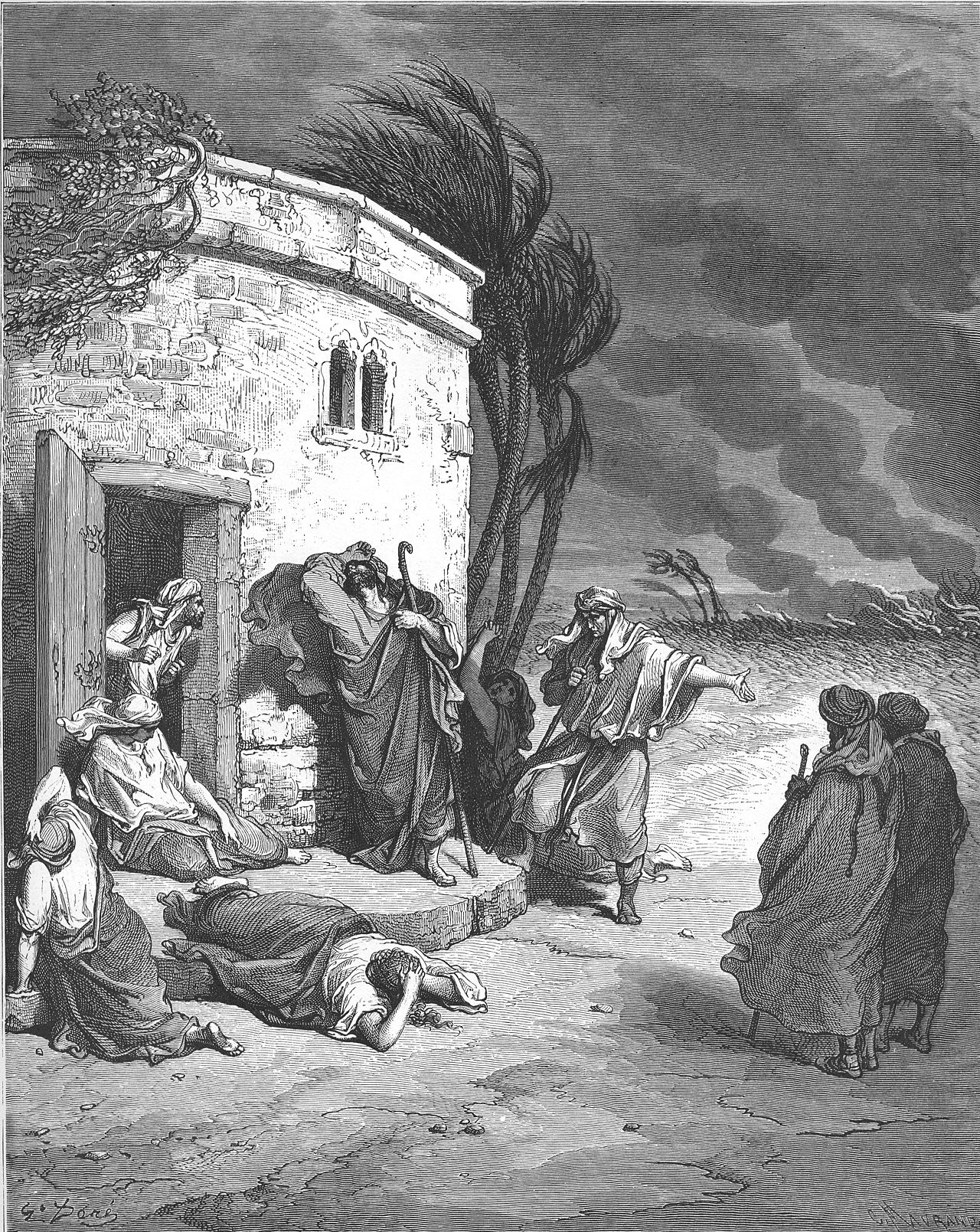
Jobchapter 29
25 verses · unknown · 10th century BC · Wisdom and poetry
When I went out to the city gate and took my seat in the public square,
Introduction
unknown, Wisdom and poetry, Job Overview.
This chapter opens the last speech Job makes in the book. He speaks from the ash heap after his three friends have run out of answers. He had been a leading man of his town, and his hearers knew how an elder was honoured at the gate on a court day. The chapter is memory, set out as evidence for his defence. Listen for the picture of a man the poor could reach, and for how it answers the charges Eliphaz made in chapter 22. Read it with chapter 30, which tells the other half.
Context
- Who
- Hearers who had watched the elders take their seats at the gate on a court day
- What
- Job's memory of the years when God watched over him and his town honoured him at the gate.
- Where
- The ash heap outside the town, with the city gate and its seats for the elders remembered.
- When
- The book sets Job in the age of the patriarchs, commonly placed about 2000 to 1800 BC, and it gives no date.
- Why
- To set out, as evidence, the life Job led before his losses, against the charges of his friends.
Historical context
The gate of an ancient town was its courthouse, its council chamber, and its marketplace. The gateway was a deep structure with benches built into recesses on either side, and the elders sat there to hear cases, witness contracts, and settle disputes in public where anyone could listen. Archaeologists have excavated gate complexes with exactly these stone benches.
Show the rest of the historical context, 3 more paragraphs
Job describes his arrival at that place. The young men saw him and hid themselves; the aged rose and stood. Princes stopped talking and laid a hand on their mouth, the standard gesture of deliberate silence before a superior. The voice of the nobles was hushed and their tongue stuck to the roof of their mouth. This is not vanity; it is the ordinary protocol of rank in a face-to-face society, and it tells hearers exactly how high Job stood.
What he did there is the answer to Eliphaz's invented charges in chapter 22, point for point. He delivered the poor that cried, and the fatherless who had no helper; the blessing of the man ready to perish came upon him; he caused the widow's heart to sing. He was eyes to the blind and feet to the lame, and a father to the poor. He searched out the case he did not know, that is, he investigated rather than taking the first story. And he broke the jaws of the wicked and plucked the spoil out of his teeth, the image of a shepherd forcing a predator's mouth open to take back a lamb.
His picture of his own security is the imagery of a well-watered tree and a settled household: I shall die in my nest and multiply my days as the sand; my root was spread out by the waters, and the dew lay all night on my branch; my glory was fresh in me and my bow renewed in my hand. The bow stood for a man's strength, and dew on the branch was the difference between life and death in a dry country.
Significance
The chapter is Job's evidence for the defence, delivered as memory rather than argument. He was not the wealthy man who ignored the poor; he was the one the poor went to when nobody else would hear them.
Show the rest of the significance, 1 more paragraph
First hearers were being given the standard by which a powerful man is measured, not what he owned, but who could get his attention at the gate.
This chapter in Jewish lifeWhat this chapter is in Jewish life and reading.
What is done
This chapter has no place in the synagogue year. The site's own table in src/lib/hebraic/readings.ts printed parashot total 0 and haftarah uses total 0 for the book of Job, and no festival reading.
The corpus joins it to the study of the Torah portions through the Midrash arranged by them. Under the second verse it carries Midrash Tanchuma Buber, Tazria 1:1. Under the second verse it carries Midrash Tanchuma Buber, Tazria 1:3. Under the third verse it carries Midrash Tanchuma Buber, Tazria 1:2. Under the fourteenth verse it carries Bereshit Rabbati, Parashat Vayechi 19. Under the sixteenth verse it carries Midrash Tanchuma Buber, Shoftim 3:1. Under the sixteenth verse it carries Midrash Tanchuma, Shoftim 2:1.
How it is read
Rashi is the one commentator on this chapter whose English the corpus carries, quoted here from The Judaica Press complete Tanach with Rashi, translated by A. J. Rosenberg, which Sefaria reports as CC-BY. Job is the speaker, and Rashi reads the chapter as his memory of his former greatness. The early months of the second verse are the early days when he was great (Rashi on Job 29:2:1). The lit candle of the third verse is an expression of light and joy (Rashi on Job 29:3:1).
Several notes are close glosses. The Hebrew word for early days in the fourth verse Rashi explains as an Aramaism, from the Aramaic pair for early and late crops (Rashi on Job 29:4:1). The young men of the fifth verse are Job's servants (Rashi on Job 29:5:1). In the sixth verse he glosses one Hebrew word as my feet (Rashi on Job 29:6:1). In the seventh he reads the ceiling as a high place prepared for a chair on which the elders of the city sat (Rashi on Job 29:7:1).
The honour Job remembers is told through the conduct of others. Youths would see him and hide, and old men stood in his presence (Rashi on Job 29:8:1). Princes waited until he opened the conversation (Rashi on Job 29:9:1). Those who heard his words waited to see them fulfilled, and they were fulfilled, since the tradition of wisdom was in his hand (Rashi on Job 29:21:1). At the twenty-second verse Rashi reads the verb as an expression of prophecy, citing Amos 7:16. "That is to say that my word was like prophecy." (Rashi on Job 29:22:1).
Rashi also reads Job's righteousness and his hopes. Job pursued righteousness and it stayed with him like a coat and a turban, so that his judgment was beautiful and pure (Rashi on Job 29:14:1). At the thirteenth verse the one whose blessing came to Job is the lost man, who died because of his iniquity and was banished (Rashi on Job 29:13:1). Because of the propriety of his traits, Job expected to die with his house established with him (Rashi on Job 29:18:1).
He told himself that his root would never dry up nor his branches die, and Rashi ties the image to the branch of the fourteenth chapter (Rashi on Job 29:19:1). He thought his honour would be renewed constantly (Rashi on Job 29:20:1). The men around him spoke after a long time, because they spent most of it in silence waiting for his words (Rashi on Job 29:23:1). In the last note they would not believe he was jesting with them, because of his esteemed position (Rashi on Job 29:24:1).
The corpus carries six further notes on this chapter without an English text, each marked linked because Sefaria holds no English version of the ref. They stand cited by ref and unquoted. Six stand at Metzudat David on Job 29:1:1, 29:10:1, 29:12:1, 29:15:1, 29:16:1 and 29:17:1.
What the rabbis say
The corpus carries forty rabbinic locators on this chapter and the text of none, so each is cited and linked here rather than quoted. On the second verse it holds Midrash Aggadah, Leviticus 12:2:5, Midrash Lekach Tov, Deuteronomy 33:25:1, Midrash Tanchuma Buber, Tazria 1:1 and Midrash Tanchuma Buber, Tazria 1:3. On the third verse it holds Ein Yaakov, Niddah 3:6, Midrash Tanchuma Buber, Tazria 1:2, Niddah 30b:19 and Vayikra Rabbah 14:2. On the fourth verse it holds Niddah 30b:21.
On the eighth verse it holds Jerusalem Talmud Berakhot 2:1:16, Jerusalem Talmud Moed Katan 3:1:5, Jerusalem Talmud Moed Katan 3:7:18 and Jerusalem Talmud Shekalim 2:5:4. On the ninth verse it holds Ketubot 51b:10. On the twelfth verse it holds Midrash Tehillim 7:5. On the thirteenth verse it holds Bava Batra 16a:14, Bereshit Rabbah 60:13 and Ein Yaakov (Glick Edition), Bava Batra 1:36. On the fourteenth verse it holds Bamidbar Rabbah 23:6, Bereshit Rabbati, Parashat Vayechi 19, Devarim Rabbah 2:37 and Midrash Lekach Tov, Exodus 25:11:1. On the fifteenth verse it holds Aggadat Bereshit 56:1.
On the sixteenth verse it holds Midrash Tanchuma Buber, Shoftim 3:1 and Midrash Tanchuma, Shoftim 2:1. On the seventeenth verse it holds Pesikta Rabbati 33:1. On the eighteenth verse it holds Bereshit Rabbah 19:5, Ein Yaakov (Glick Edition), Sanhedrin 11:118 and Midrash Lekach Tov on Lamentations, Introduction 1. On the nineteenth verse it holds Aggadat Bereshit 44:1, Bereshit Rabbah 66:1 and Midrash Aggadah, Exodus 1:1:1. On the twenty-third verse it holds Midrash Tehillim 119:32 and Otzar Midrashim, Midrash on Psalms, Addendum to Psalm 118 69.
On the twenty-fourth verse it holds Midrash Sekhel Tov, Bereshit 20:16:3, Midrash Sekhel Tov, Bereshit 34:20:2 and Midrash Sekhel Tov, Bereshit 40:6:2. On the twenty-fifth verse it holds Ein Yaakov (Glick Edition), Ketubot 6:9, Ein Yaakov, Ketubbot 6:9 and Ketubot 69b:2. What each of them teaches is a saying of the rabbis, and is reported as theirs wherever this site quotes one. The quotations wait on a fetch that carries the text.
Sources: Rashi, Rashi on Job 29:2:1 to 29:24:1, The Judaica Press complete Tanach with Rashi, translated by A. J. Rosenberg, reported CC-BY; Metzudat David, Metzudat David on Job 29:1:1, 29:10:1, 29:12:1, 29:15:1, 29:16:1 and 29:17:1, cited by ref because the corpus carries no English text; The Sefaria corpus, scripts/data/sources/sefaria/job/29.json, the 40 Talmud and Midrash locators of this chapter; The site's own files, src/lib/hebraic/readings.ts, printing no portion, no Haftarah and no festival reading for this book.
The heads below are this chapter's scenes. The numbered points under each are its verses.
Job: Oh That I Were as in the Months of Old
Job 29:1-3
Job continued his discourse: The word behind “discourse” is the mashal, which Gill takes as a weighty discourse. His longing for “the months gone by” rests on one evidence, the days when “His lamp shone above my head”. Henry reads that lamp as the sense of God's favor, which made Job's darkest paths bright.
Job 29:1
“Moreover, Job continued his parable - See the notes at Job 27:1. It is probable that Job had paused to see if anyone would attempt a reply. As his friends were silent, he resumed his remarks and went into a more full statement of his sufferings. The fact that Job more than once paused in his addresses to give his friends an opportunity to speak, and that they were silent when they seemed called upon to vindicate their former sentiments, was what particularly roused the wrath of Elihu and induced him to answer; Job 32:2-5.”
the months gone by: Adam Clarke reads the longing as Job's apology for his complaints, a look back at a prosperity now lost through no misuse of his. Spurgeon hears a deeper loss. He thinks Job grieved most for the days when God watched over him and his joy in the Lord ran high.
Job 29:2
“O that I were as in months past - Job seems here to make an apology for his complaints, by taking a view of his former prosperity, which was very great, but was now entirely at an end. He shows that it was not removed because of any bad use he had made of it; and describes how he behaved himself before God and man, and how much, for justice, benevolence, and mercy, he was esteemed and honored by the wise and good. Preserved me - Kept, guarded, and watched over me.”
Adam Clarke · Commentary on the Bible (1810-1826)evangelical
2 more voices on this verse
Job 29:2
“Even then he saw himself exposed, and did not make his wealth his strong city nor trust in the abundance of his riches, but the name of the Lord was his strong tower; in that only he thought himself safe, and to that he ascribed it that he was then safe and that his comforts were preserved to him.”
Matthew Henry · Commentary on the Whole Bible (1707-1721)puritan
Job 29:2
“FOR THE MOST part the gracious Shepherd leads his people beside the still waters, and makes them to lie down in green pastures; but at times they wander through a wilderness, where there is no water, and they find no city to dwell in. Hungry and thirsty, their soul fainteth within them, and they cry unto the Lord in their trouble.”
His lamp shone above my head: Barnes pictures His lamp hanging above Job's head, as lamps hung from the ceiling in wealthy homes. Aquinas reads the lamp as God's providence. By that light Job walked through the darkness toward good he had never planned.
Job 29:3
“When his candle shined upon my head - Margin, or, “lamp;” compare notes Job 18:6. It was remarked in the note on that place, that it was common to have lamps or lights always burning in a house or tent. When Job speaks of the lamps shining “on his head,” the allusion is probably to the custom of suspending a lamp from the ceiling - a custom which prevails among the wealthy Arabs. “Scott.” Virgil speaks of a similar thing in the palace of Dido: - Dependent lychni laquearibus aureis Incensi. Aeneid i.”
Job 29:4-6
when I was in my prime: The first loss Job names is closeness with God, when “the friendship of God rested on my tent”. Gill reads that friendship as friendly counsel shared in confidence, the intimacy of Psalm 25:14. Delitzsch takes “my steps were bathed in cream” and “streams of oil” as pastoral hyperbole for abundance.
Job 29:4
“He knew God's mind, and was not in the dark about it, as, of late, he had been. The secret of the Lord is said to be with those that fear him, for he shows them that in his covenant which others see not, Ps. xxv. God communicates his favour and grace to his people, and receives the return of their devotion in a way secret to the world.”
Matthew Henry · Commentary on the Whole Bible (1707-1721)puritan
1 more voice on this verse
Job 29:4
“The days of my youth - The original word rather means in the days of my winter, חרפי charpi, from חרף charaph, “to strip or make bare.” Mr. Harmer supposes the rainy season is intended, when the fields, etc., parched up by long drought, are revived by the plentiful showers. Mr. Good thinks the word as found in the Arabic, which means top or summit, and which he translates perfection, is that which should be preferred. Others think the autumnal state is meant, when he was loaded with prosperity, as the trees are with ripe fruit.”
Adam Clarke · Commentary on the Bible (1810-1826)evangelical
the Almighty was still with me: Barnes marks the word still. Job now counts God as withdrawn and looks back to the time when God dwelt with him. Thomas Aquinas pairs the two clauses, the Almighty working with Job and his children around him, so both halves name what the present has taken.
Job 29:5
“When the Almighty was yet with me - Job regarded God as withdrawn from him. He now looked back with deep interest to the time when he dwelt with him.”
1 more voice on this verse
Job 29:5
“When the Almighty was yet with me; and when my servants were about me. Now all that stand in awe of the divine precepts become God's 'tabernacle.' Hence as we have already said above, 'Truth' saith by Himself of the man that keeps His commandments, I and My Father will come and make Our abode with him. Contrariwise the wicked severally, whereas they do not aim at the things within, pour themselves forth without in the thoughts of their hearts. Whence it is said to them by the Prophet, Turn back to the heart within, O ye transgressors.”
Gregory the Dialogist · written before 604 · Morals on the Book of Job, Book XIXpatristic
my steps were bathed in cream: The Hebrew word for cream is curdled milk, says Barnes. Cream bathed Job's steps and oil poured from the rock, a picture of plenty. Aquinas adds that ancient wealth lay in cattle, the source of the cream.
Job 29:6
“When I washed my steps with butter - On the word rendered “butter,” see the notes at Isa 7:15. It properly means curdled milk. Umbreit renders it, Sahne; cream. Noyes, milk, and so Wemyss. The Septuagint, “When my ways flowed with butter” - βουτύρῳ bouturō. So Coverdale, “When my ways ran over with butter.” Herder, “And where I went a stream of milk flowed on.” The sense may be, that cream or butter was so plenty that he was able to make use of it for the most common purposes - even for that of washing his feet.”
1 more voice on this verse
Job 29:6
“Image from pastoral life. When I washed my steps--Literal washing of the feet in milk is not meant, as the second clause shows; Margin, "with me," that is, "near" my path, wherever I walked (De 32:13).”
Jamieson, Fausset & Brown · Commentary Critical and Explanatory on the Whole Bible (1871)reformed
Job 29:7-10
I went out to the city gate: The city gate was the seat of the elders, the setting of Ruth 4:1 and Proverbs 31:23. Delitzsch and Barnes read the scene as a court before its judge. The nobles fell silent for his word, the authority Eliphaz had charged Job with abusing in chapter 22.
Job 29:7
“When I went out to the gate - The “gate” of a city was a place of public concourse, and where courts were usually held. Job speaks here as a magistrate, and of the time when he went forth to sit as a judge, to try causes. When I prepared my seat in the street - That is, to sit as a judge. The seat or tribunal was placed in the street, in the open air, before the gate of the city, where great numbers might be convened, and hear and see justice done.”
1 more voice on this verse
Job 29:7
“When I went out to the gate of the city, and in the street they prepared me a chair. It was the custom of the ancients, that the elders should sit together in the gates, and judge the cases of those entering in, that so the people of the city might be the more peaceful, in proportion as it was not allowed to those at variance to enter in.”
Gregory the Dialogist · written before 604 · Morals on the Book of Job, Book XIXpatristic
the young men saw me: The young men withdrew in reverence. The old men were already seated, and they rose to their feet and stood until Job took his seat. Clarke names them the elders who sat with the judge.
Job 29:8
“The young men saw me and hid themselves, and the old men rose up and stood. If we give heed to the history, the things that he said we believe, if to the allegory, we see the things that he foretold; for those use to be called 'young men' who are not burdened with any weightiness of counsels. But Holy Scripture is used to call those 'elders,' not who are ripe by amount of years alone, but by ancientness of character.”
Gregory the Dialogist · written before 604 · Morals on the Book of Job, Book XIXpatristic
1 more voice on this verse
Job 29:8
“The young men saw me, and hid themselves - From all classes of persons I had the most marked respect. The Young, through modesty and bashfulness, shrunk back, and were afraid to meet the eye of their prince; and the Aged rose from their seats when I entered the place of judgment. These were the elders of the people, who also sat with the judge, and assisted in all legal cases.”
Adam Clarke · Commentary on the Bible (1810-1826)evangelical
covered their mouths with their hands: Gill pictures the princes already in session, talking among themselves or giving their views on a case before them. They broke off when Job came in and held their words until they had heard his opinion. Gill cites Judges 18:19 for the hand over the mouth.
Job 29:9
“The princes refrained talking,.... Who were in court before Job came in, and were either talking with one another about indifferent matters, or were giving their opinion in a case before them; but no sooner did Job make his appearance, but they left off talking, and would not proceed any further; they laid a restraint upon their words, and curbed themselves from speaking any more till they had heard his opinion: and laid their hand on their mouth; as a token of silence, Jdg 18:19.”
The voices of the nobles were hushed: Adam Clarke separates two ranks here. The princes are sarim, rulers of a district, and the nobles are negidim, from a word meaning before, men who stood before the chief ruler. Barnes gives the Hebrew literally as the voice of the nobles was hidden.
Job 29:10
“The nobles held their peace - Princes שרים sarim, and Nobles, נגידים negidim, must have been two different classes of the great men of Idumea. שר sar, Prince, director, or ruler, was probably the head of a township, or what we would call a magistrate of a particular district. נגיד nagid, a Noble, or one of those who had the privilege of standing before, or in the presence of, the chief ruler. The participle נגד neged is frequently used to signify before, in the presence of, publicly, openly.”
Adam Clarke · Commentary on the Bible (1810-1826)evangelical
Job 29:11-13
those who heard me called me blessed: Two witnesses praise Job for rescuing “the poor who cried out and the fatherless who had no helper”. Henry notes that these are the very sufferers Eliphaz had accused Job of sending away empty in 22:9.
Job 29:11
“The ear hearing me, blessed me; and the eye seeing, gave witness to me. [HISTORICAL INTERPRETATION] Whereas blessed Job avouches himself to be 'blessed by those that heard him,' and to 'have witness given to him by those that saw him,' what he was in speech and what in practice, we have shewn us. For neither is he henceforth perfect in practice, whom wickedness of the tongue still withstands, or praiseworthy in speech who does not exhibit in practice the thing that he utters.”
Gregory the Dialogist · written before 604 · Morals on the Book of Job, Book XIXpatristic
2 more voices on this verse
Job 29:11
“Darkness - I passed safely through many difficulties, and dangers, and common calamities. Seat - When I caused the seat of justice to be set for me. By this, and several other expressions, it appears that Job was a magistrate.”
John Wesley · Explanatory Notes upon the Old Testament (1765)evangelical
Job 29:11
“Many a good word they said of him, and many a good prayer they put up for him. He did not think it an honour to make every body fear him ( Oderint dum metuant--Let them hate, provided they also fear ) nor to be arbitrary, and to have his own will and way, not caring what people said of him; but, like Mordecai, to be accepted of the multitude of his brethren, Esth. x.”
Matthew Henry · Commentary on the Whole Bible (1707-1721)puritan
Job: I Was Eyes to the Blind and Feet to the Lame
I rescued the poor who cried: Barnes hears Job speaking as a magistrate. The poor man had no means to hire counsel, so Job heard his cause himself and freed him from the oppressor's grasp. Jamieson, Fausset and Brown set the line beside Psalm 72:12 and read the fatherless as those with none to help them.
Job 29:12
“Because I delivered the poor that cried - This appears to be intended as a refutation of the charges produced by Eliphaz, Job 22:5-10, to confute which Job appeals to facts, and to public testimony.”
Adam Clarke · Commentary on the Bible (1810-1826)evangelical
1 more voice on this verse
Job 29:12
The grounds on which Job was praised (Job 29:11), his helping the afflicted (Ps 72:12) who cried to him for help, as a judge, or as one possessed of means of charity. Translate: "The fatherless who had none to help him."
Jamieson, Fausset & Brown · Commentary Critical and Explanatory on the Whole Bible (1871)reformed
The dying man blessed me: The dying man, says Barnes, was one falsely accused and near death, or one dying of want. Ephrem pictures a poor man without a coat whom Job clothed. Henry notes such men and widows could never repay Job.
Job 29:13
“The blessing of him that was ready to perish ... - Of the man who was falsely accused, and who was in danger of being condemned, or of him who was exposed to death by poverty and want. And I caused the widow’s heart to sing for joy - By becoming her patron and friend; by vindicating her cause, and saving her from the oppressive exactions of others; compare Isa 1:17.”
Job 29:14-17
put on righteousness: Job says “I put on righteousness, and it clothed me”, an image Gill notes Isaiah gives to salvation at Isaiah 61:10. Delitzsch reads “I shattered the fangs of the unjust and snatched the prey from his teeth” as a shepherd's language, justice pictured as rescue.
Job 29:14
“I put on righteousness - Or “justice” - as a magistrate, and in all his transactions with his fellow-men. It is common to compare moral conduct or traits of character with various articles of apparel; compare Isa 11:5, note; Isa 61:10, note. And it clothed me - It was my covering; I was adorned with it. So we speak of being “clothed with humility;” and so, also, of the “garments of salvation.” My judgment - Or rather justice - particularly as a magistrate.”
eyes to the blind: Henry reads eyes to the blind as counsel for the perplexed. Feet to the lame were money and friends for those who knew the way yet lacked the means. Clarke pictures desert guides and camels.
Job 29:15
“I was eyes to the blind - An exceedingly beautiful expression, whose meaning is obvious. He became their counsellor and guide. And feet was I to the lame - I assisted them, and became their benefactor. I did for them, in providing a support, what they would have done for themselves if they had been in sound health.”
1 more voice on this verse
Job 29:15
“I was an eye to the blind, and a foot was I to the lame. I was a father to the poor, and the cause which I knew not I searched out. [HISTORICAL INTERPRETATION] Herein the mind of the reader might perchance put the question, wherefore it is that blessed Job reckons up his own virtue with so much particularity. For it is a mark of holy men to conceal the good things they may have done, lest it chance that they bring upon themselves the downfall of exaltation.”
Gregory the Dialogist · written before 604 · Morals on the Book of Job, Book XIXpatristic
a father to the needy: This line answers Job 22:9, where Eliphaz charged Job with harming the fatherless. Job was a father to the needy. He took up the case of the stranger, one he did not know, and Henry says he heard both sides before judgment.
Job 29:16
“So far was I from "breaking the arms of the fatherless," as Eliphaz asserts (Job 22:9), I was a "father" to such. the cause which I knew not--rather, "of him whom I knew not," the stranger (Pr 29:7 [UMBREIT]; contrast Lu 18:1, &c.).”
Jamieson, Fausset & Brown · Commentary Critical and Explanatory on the Whole Bible (1871)reformed
2 more voices on this verse
Job 29:16
“I was a father of the poor, and the cause, which I knew not, I searched out. [HISTORICAL INTERPRETATION] For very often men give much to the poor, not because they love those poor, but because if they do not give, they dread the indignation of the Judge Above; which persons, if they were not afraid of God, would have had no mind to give the things they possess.”
Gregory the Dialogist · written before 604 · Morals on the Book of Job, Book XIXpatristic
Job 29:16
“The cause which I knew not I searched out - When any thing difficult occurred, I did not give it a slight consideration; I examined it to the bottom, whatever pain, time, and trouble it cost me, that I might not pronounce a hasty judgment.”
Adam Clarke · Commentary on the Bible (1810-1826)evangelical
I shattered the fangs: Barnes traces fangs to a Hebrew word meaning to bite. The unjust are pictured as wild beasts, and Job snatched the prey from their teeth like a lamb from a lion. He broke the oppressor's power to hurt again.
Job 29:17
“And I brake the jaws of the wicked - Margin, “jaw-teeth, or, grinders.” The Hebrew word מתלעה methalle‛âh, the same, with the letters transposed, as מתלעות, is from לתע, to “bite” - and means “the biters,” the grinders, the teeth. It is not used to denote the jaw. The image here is taken from wild beasts, with whom Job compares the wicked, and says that he rescued the helpless from their grasp, as he would a lamb from a lion or wolf.”
Job 29:18-20
Job recalls what he told himself, “I will die in my nest and multiply my days as the sand”. Barnes reads the nest and the sand as permanence, a home undisturbed and days beyond counting. Gill takes “my bow is renewed in my hand” as the archer's figure for strength.
Job 29:18
“However, in the bosom of my family, gives a good sense (Nu 24:21; Use "nest" for a secure dwelling. sand-- (Ge 22:17; But the Septuagint and Vulgate, and Jewish interpreters, favor the translation, "the phÅ“nix bird." "Nest" in the parallel clause supports the reference to a bird.”
Jamieson, Fausset & Brown · Commentary Critical and Explanatory on the Whole Bible (1871)reformed
My roots will spread out: Barnes gives the Hebrew for spread out as opened, the roots open to the waters. Such a tree never lacks water, and the dew rests on its branches. The same tree stands in Psalm 1:3, Clarke notes.
Job 29:19
“My root was spread out by the waters - Margin, as the Hebrew, “opened.” The meaning is, that it was spread abroad or extended far, so that the moisture of the earth had free access to it; or it was like a tree planted near a stream, whose root ran down to the water. This is an image designed to denote great prosperity. In the East, such an image would be more striking than with us. Here green, large, and beautiful trees are so common as to excite little or no attention.”
The closing quotation mark ends the words Job once said to himself, which began in 29:18. Gregory the Dialogist read the three verses as one continuous thought. Spurgeon hears in ever new a renown that grew each morning Job walked to the gate, kept fresh by the providence of God.
Job 29:20
“My glory was fresh in me - My vegetative power was great; my glory - my splendid blossom, large and mellow fruit, was always in season, and in every season. My bow was renewed - I was never without means to accomplish all my wishes. I had prosperity everywhere.”
Adam Clarke · Commentary on the Bible (1810-1826)evangelical
2 more voices on this verse
Job 29:20
“Glory - My reputation was growing every day. Bow - My strength which is signified by a bow, Gen. xlix, 24; 1 Sam. ii, 4, because in ancient times the bow and arrows were the principal instruments of war.”
John Wesley · Explanatory Notes upon the Old Testament (1765)evangelical
Job 29:20
“THE first text tells us of the renown of Job and of the way in which the Providence of God continued to maintain the glory of his estate, his bodily health and his prosperity. He was for many days, months, years, continuously prospered of God. Everything to which he set his hand succeeded. God had set a hedge about him and all that he had, so that none broke through to molest him. He grew richer, he grew more influential, he had more honor in the sight of his fellow men each morning that he walked to the gate.”
Job 29:21-23
Men listened to me with expectation: “Men listened to me with expectation, waiting silently for my counsel”, so Job's word carried weight in real decisions. The line “my speech settled on them like dew” borrows the figure Moses uses of his own teaching at Deuteronomy 32:2. Delitzsch takes the Hebrew verb as dew settling gently.
Job 29:21
“Unto me men gave ear - Job here returns to the time when he sat in the assembly of counsellors, and to the respectful attention which was paid to all that he said. They listened when he spoke; they waited for him to speak before they gave their opinion; and they were then silent. They neither interrupted him nor attempted a reply.”
2 more voices on this verse
Job 29:21
“They that heard me awaited my sentence, and listening kept silence at any counsel. For this awe of those under him we unquestionably believe to have been towards blessed Job. But as we have already often said, Holy Church being driven to extremities by the inflictions of heretics or carnal persons, remembers the times past, in which all that is spoken by her is listened to with fear by the faithful, and lamenting the frowardness of her adversaries, she says, They that heard me awaited my sentence, and listening kept silence at my counsel.”
Gregory the Dialogist · written before 604 · Morals on the Book of Job, Book XXpatristic
Job 29:21
“Unto me men gave ear - The same idea as in Job 29:9-11.”
Adam Clarke · Commentary on the Bible (1810-1826)evangelical
my speech settled on them: Barnes calls the silence after Job's words the highest mark of deference. His speech settled on them, and they spoke no more. Aquinas says they dared add nothing to his words, so highly did they value his counsel.
Job 29:22
“His servants that stood continually before him to hear his wisdom would not have envied Solomon's. Those are wise, or are likely to be so, that know how to value wise discourse, that wish for it, and wait for it, and drink it in as the earth does the rain that comes often upon it, Heb. vi.”
Matthew Henry · Commentary on the Whole Bible (1707-1721)puritan
They waited for me as for rain: The spring showers are the latter rain of March, which brings the harvest forward. The early rain falls in autumn at sowing. Clarke pictures men waiting for Job's words as dry ground waits for rain.
Job 29:23
“And they waited for me as for the rain - That is, as the dry and thirsty earth waits for the rain. This is a continuation of the beautiful image commenced in the previous verse, and conveys the idea that his counsel was as necessary in the assemblies of people as the rain was to give growth to the seed, and beauty to the landscape.”
1 more voice on this verse
Job 29:23
“Oriental image (Ps 119:131). The "early rain" is in autumn and onwards, while the seed is being sown. The "latter rain" is in March, and brings forward the harvest, which ripens in May or June.”
Jamieson, Fausset & Brown · Commentary Critical and Explanatory on the Whole Bible (1871)reformed
Job 29:24-25
If I smiled at them: Henry notes that “as a comforter of the mourners” folds even Job's highest office back into the compassion the chapter has listed. The honor Job recites is measured in what he gave away, the record that the charges of Eliphaz in chapter 22 tried to invert.
Job 29:24
“I laughed on them, they believed it not - Similar to that expression in the Gospel, Luk 24:41: And while they believed not for joy, and wondered, he said - . Our version is sufficiently perspicuous, and gives the true sense of the original, only it should be read in the indicative and not in the subjunctive mood: I laughed on them - they believed it not. We have a similar phrase: The news was too good to be true. The light of my countenance - This evidence of my benevolence and regard.”
Adam Clarke · Commentary on the Bible (1810-1826)evangelical
1 more voice on this verse
Job 29:24
“When I relaxed from my wonted gravity (a virtue much esteemed in the East) and smiled, they could hardly credit it; and yet, notwithstanding my condescension, they did not cast aside reverence for my gravity. But the parallelism is better in UMBREIT'S translation, "I smiled kindly on those who trusted not," that is, in times of danger I cheered those in despondency.”
Jamieson, Fausset & Brown · Commentary Critical and Explanatory on the Whole Bible (1871)reformed
a comforter of the mourners: Barnes reads I chose their course as Job guiding them in counsel. Wesley sees a king whose presence heartens his troops. Jamieson, Fausset and Brown hear in a comforter of the mourners a foreshadowing of Jesus Christ.
Job 29:25
“I chose out their way - That is, I became their guide and counsellor. Rosenmuller and Noyes explain this as meaning, “When I came among them;” that is, when I chose to go in their way, or in their midst. But the former interpretation better agrees with the Hebrew, and with the connection.”
2 more voices on this verse
Job 29:25
“Sat - As a prince or judge, while they stood waiting for my counsel. A king - Whose presence puts life, and courage, into the whole army. As one - As I was ready to comfort any afflicted persons, so my consolations were always welcome to them.”
John Wesley · Explanatory Notes upon the Old Testament (1765)evangelical
Job 29:25
“I know not but we may look upon Job as a type and figure of Christ in his power and prosperity. Our Lord Jesus is such a King as Job was, the poor man's King, who loves righteousness and hates iniquity, and upon whom the blessing of a world ready to perish comes; see Ps. lxxii.”
Matthew Henry · Commentary on the Whole Bible (1707-1721)puritan
Keep studying
Studies2
People and groups1
Sources for this chapter
The summary
Jamieson, Fausset & Brown, Commentary Critical and Explanatory; John Wesley, Notes on the Old Testament and Matthew Henry, Complete Commentary.
The exposition
Adam Clarke, Commentary on the Bible; Albert Barnes; Charles Spurgeon; Ephrem the Syrian, COMMENTARY ON JOB 29:13; Franz Delitzsch, Biblical Commentary on the Book of Job; Gregory the Dialogist, Morals on the Book of Job, Book XIX; Jamieson, Fausset & Brown, Commentary Critical and Explanatory on the Whole Bible; John Gill; John Wesley, Explanatory Notes upon the Old Testament; Matthew Henry, Commentary on the Whole Bible and Thomas Aquinas, Commentary on Job.