
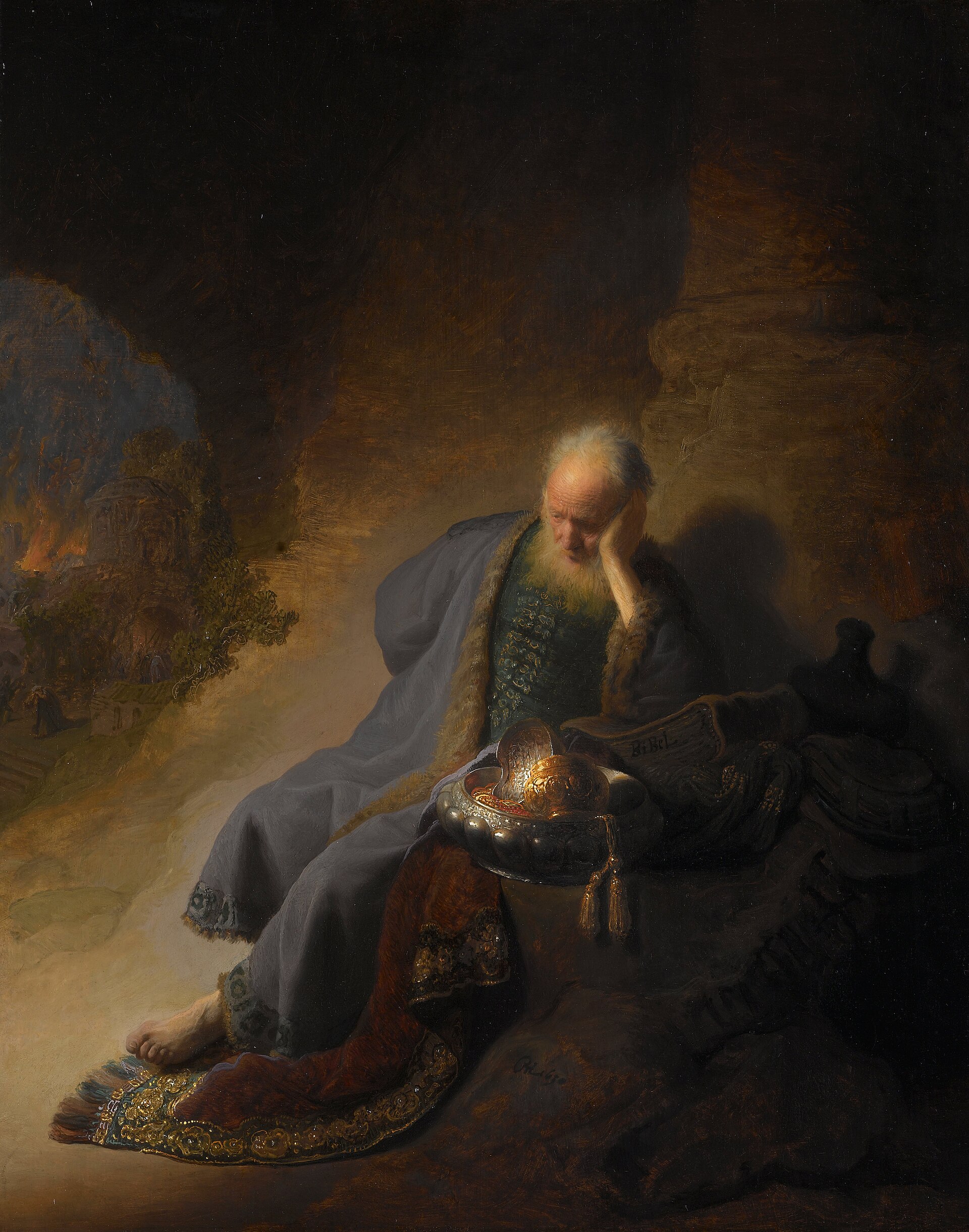
Jeremiahchapter 52
34 verses · Jeremiah, written by Baruch · 7th to 6th century BC · The Prophets
On the tenth day of the fifth month, in the nineteenth year of Nebuchadnezzar’s reign over Babylon, Nebuzaradan captain of the guard, a servant of the king of Babylon, entered Jerusalem.
Introduction
Jeremiah, written by Baruch, The Prophets, Jeremiah Overview.
This chapter was added after the words of Jeremiah had been closed, and it tells the fall of Jerusalem once more in the plain style of a royal record. Most of it matches the end of 2 Kings. An editor has set that account at the end of the prophet's book. The effect is to show a reader that what Jeremiah warned of for forty years came to pass. Listen for the dates given to the day, for the careful list of what was taken from the temple, and for the small kindness recorded in the book's last lines.
Context
- Who
- Exiles decades on, who needed the accounts closed and one door left open
- What
- A historical appendix recounting Zedekiah's reign, the siege and burning of Jerusalem, the deportations, and the release of King Jehoiachin in Babylon.
- Where
- Jerusalem, Riblah in Syria where Nebuchadnezzar judged the king, and Babylon where Jehoiachin was released.
- When
- From Zedekiah's accession in 597 BC through the fall of Jerusalem in 586 BC to Jehoiachin's release in the thirty-seventh year of his exile, about 561 BC.
- Why
- To show that Jeremiah's warnings were fulfilled, and to close the book with a sign that the line of David still lived in exile.
Historical context
This closing chapter is an appendix rather than a sermon, and it runs almost parallel to the end of 2 Kings. It reads like an official record: dates, the length of the siege, the day the food ran out, the breach in the wall, the burning of the temple, the palace and every great house.
Show the rest of the historical context, 3 more paragraphs
The temple inventory is the work of a man with a list. The two bronze pillars are measured, eighteen cubits high, twelve cubits around, hollow, with bronze capitals, and the network of pomegranates is counted: ninety-six on the sides, a hundred on the network all round. Bronze was valuable and the pillars, the great basin called the sea, and the stands were broken up and carried off as metal.
The deportation figures are given in three groups totalling four thousand six hundred, and they differ from the numbers in 2 Kings. The likeliest reason is that these count adult men from a particular reckoning while the other figures count differently, but the text does not explain itself, and it is more honest to note the difference than to smooth it over.
The last paragraph jumps twenty-five years. In the thirty-seventh year of Jehoiachin's exile, Evil-merodach, Amel-Marduk, Nebuchadnezzar's successor, released him from prison, spoke kindly to him, gave him a seat above the other kings, changed his prison clothes, and gave him a daily allowance for the rest of his life. Cuneiform ration tablets excavated in Babylon, listing oil and barley issued to Yaukin king of Judah and his sons, record the same man being fed at the same court.
Significance
For readers in exile the inventory mattered. Somebody counted the pomegranates. The loss was not a rumour or a blur; it was written down item by item, which is how a people keeps from either forgetting or exaggerating what happened to them.
Show the rest of the significance, 1 more paragraph
And then the book ends on a man eating at a king's table. David's heir is out of prison, in ordinary clothes, with a daily allowance. It is not a restoration, and the writer does not pretend otherwise, but the line is not extinct, and after fifty-two chapters of judgment that is where the record stops.
This chapter in Jewish lifeWhat this chapter is in Jewish life and reading.
What is done
The site's own table in src/lib/hebraic/readings.ts, probed for this lane, printed no weekly portion and no Haftarah from this chapter, and no festival reading for the book. That table carries the Haftarah of each of the fifty-four weekly portions and the books read whole at the feasts, and it carries nothing for the special Sabbaths or the fast days. This card therefore names no public reading of the chapter and leaves that question to a source that holds those readings.
The corpus joins the chapter to the weeks of the Torah portions through the works arranged by portion. Under the seventh verse it carries Midrash Tanchuma Buber, Bamidbar 9:1. Under the tenth verse it carries Midrash Tanchuma Buber, Vaetchanan 1:1.
How it is read
The corpus carries twenty-four notes on this chapter and English for none of them. Each is marked linked because Sefaria holds no English version of the ref, so each is cited here and none is quoted or paraphrased. The notes of Radak are cited at Radak on Jeremiah 52:1:1 and 52:12:1. The note of Malbim is cited at Malbim on Jeremiah 52:2:1. The notes of Rashi are cited at Rashi on Jeremiah 52:3:1, 52:4:1, 52:7:1, 52:9:1, 52:10:1, 52:11:1, 52:13:1, 52:15:1, 52:16:1, 52:17:1, 52:18:1, 52:19:1, 52:20:1, 52:21:1, 52:22:1, 52:23:1, 52:24:1, 52:25:1 and 52:28:1. The notes of Metzudat David are cited at Metzudat David on Jeremiah 52:5:1 and 52:8:1.
What the rabbis say
The corpus carries forty rabbinic locators on this chapter and the text of none, so each is cited and linked here rather than quoted. On the sixth verse it holds Eikhah Rabbah 1:39, Ein Yaakov (Glick Edition), Rosh Hashanah 1:22, Ein Yaakov, Rosh Hashanah 1:25 and Ein Yaakov, Taanit 4:10. On the seventh verse it holds Midrash Lekach Tov on Lamentations 3:11:1, Midrash Tanchuma Buber, Bamidbar 9:1 and Midrash Tanchuma, Bamidbar 9:1. On the eighth verse it holds Pesikta Rabbati 29:1. On the tenth verse it holds Midrash Tanchuma Buber, Vaetchanan 1:1 and Yalkut Shimoni on Torah 735:12. On the eleventh verse it holds Midrash Tanchuma, Vaetchanan 1:1 and Shemot Rabbah 15:26.
On the twelfth verse it holds Ein Yaakov (Glick Edition), Sanhedrin 11:38, Ein Yaakov, Taanit 4:11 and Sanhedrin 96a:15. On the thirteenth verse it holds Midrash Lekach Tov on Esther, Introduction 2, Midrash Tanchuma Buber, Behar 2:1 and Midrash Tanchuma Buber, Chukat 28:1. On the sixteenth verse it holds Ein Yaakov, Shabbat 2:17, Otzar Midrashim, The Ten Exiles 1:10 and Otzar Midrashim, The Ten Exiles, The Travails of R' Jacob 23. On the twenty-fourth verse it holds Jerusalem Talmud Sanhedrin 1:2:4 and Jerusalem Talmud Sanhedrin 1:2:5. On the twenty-fifth verse it holds Bamidbar Rabbah 11:3, Jerusalem Talmud Sanhedrin 1:2:6 and Sanhedrin 10b:10.
On the twenty-seventh verse it holds Eikhah Rabbah 1:28. On the twenty-eighth verse it holds Megillah 11b:8, Seder Olam Rabbah 25:1 and Sifrei Devarim 43:32. On the thirty-first verse it holds Avot DeRabbi Natan, Recension B 17:3, Learning to Read Midrash, Chapter 14; The Meaning of a Chronological Problem; Connecting Yosef and Yehuda 154 and Megillah 11b:9. On the thirty-second verse it holds Bereshit Rabbati, Parashat Lech Lecha 5. On the thirty-third verse it holds Midrash Tannaim on Deuteronomy 11:17:11, Sifrei Devarim 43:30 and Yalkut Shimoni on Torah 869:2.
On the thirty-fourth verse it holds Bamidbar Rabbah 23:13, Ein Yaakov, Sanhedrin 6:19 and Midrash Tanchuma Buber, Masei 9:1. What each of them teaches is a saying of the rabbis, and is reported as theirs wherever this site quotes one. The quotations wait on a fetch that carries the text.
Sources: Radak, Radak on Jeremiah 52:1:1 and 52:12:1, cited by ref because the corpus carries no English text; Malbim, Malbim on Jeremiah 52:2:1, cited by ref because the corpus carries no English text; Rashi, Rashi on Jeremiah 52:3:1, 52:4:1, 52:7:1, 52:9:1, 52:10:1, 52:11:1, 52:13:1, 52:15:1, 52:16:1, 52:17:1, 52:18:1, 52:19:1, 52:20:1, 52:21:1, 52:22:1, 52:23:1, 52:24:1, 52:25:1 and 52:28:1, cited by ref because the corpus carries no English text; Metzudat David, Metzudat David on Jeremiah 52:5:1 and 52:8:1, cited by ref because the corpus carries no English text; The Sefaria corpus, scripts/data/sources/sefaria/jeremiah/52.json, the 40 Talmud and Midrash locators of this chapter; The site's own files, src/lib/hebraic/readings.ts, printing no portion and no Haftarah for this chapter and no festival reading for this book.
The heads below are this chapter's scenes. The numbered points under each are its verses.
Zedekiah's Rebellion and the Fall of Jerusalem
Zedekiah was twenty-one years old when he became king: The opening gives Zedekiah’s age, reign, and mother as 2 Kings 24:18-20 does, almost word for word. Hamutal was the “daughter of Jeremiah,” a different man from the prophet. Verse 3 records that “Zedekiah also rebelled against the king of Babylon,” the course chapters 27 to 29 warned against.
Jeremiah 52:1
“Zedekiah was one and twenty years old when he began to reign,.... Whose name was Mattaniah; and who was set on the throne by the king of Babylon, in the room of his brother's son Jehoiachin, 2Ki 24:17; and he reigned eleven years in Jerusalem; so that he was thirty two years of age when he was taken and carried captive into Babylon: and his mother's name was Hamutal the daughter of Jeremiah of Libnah; see 2Ki 24:18.”
Jeremiah 52:2
“And he did that which was evil in the eyes of the Lord,.... Though we do not read of any idolatry he was guilty of; yet he was disobedient to the word of the Lord, and did not humble himself before Jeremiah the prophet of the Lord, that spoke in his name; and particularly he rebelled against the king of Babylon, and violated the oath he made to him, 2Ch 36:12; according to all that Jehoiakim had done; an elder brother of his, who reigned after Josiah, and before Jehoiachin.”
1 more voice on this verse
Jeremiah 52:2
“Zedekiah - It is generally thought that this chapter was not penned by Jeremiah, who, it is not probable, would have so largely repeated what he had related before; and could not historically relate what happened after his time, as some things did which are mentioned towards the end of the chapter.”
John Wesley · Explanatory Notes upon the Old Testament (1765)evangelical
Jeremiah 52:3
“Through the anger of the Lord - Here is a king given to a people in God’s anger, and taken away in his displeasure.”
Adam Clarke · Commentary on the Bible (1810-1826)evangelical
1 more voice on this verse
Jeremiah 52:3
“Note, Those that are banished from God's ordinances have reason to complain that they are in some degree cast out of his presence; yet none are cast out from God's gracious presence but those that by sin have first thrown themselves out of it. This fruit of sin we should therefore deprecate above any thing, as David ( Ps. li.”
Matthew Henry · Commentary on the Whole Bible (1707-1721)puritan
So in the ninth year of Zedekiah’s reign: The siege begins “on the tenth day of the tenth month” of Zedekiah’s ninth year. A year and a half later “the people of the land had no food.” The men of war flee “by night by way of the gate between the two walls near the king’s garden.”
Jeremiah 52:4
“Ninth year - tenth month - Answering nearly to our January.”
Adam Clarke · Commentary on the Bible (1810-1826)evangelical
Jeremiah 52:6
“And in the fourth month - See the notes on Jer 39:1, etc. The fourth month answers nearly to our July.”
Adam Clarke · Commentary on the Bible (1810-1826)evangelical
1 more voice on this verse
Jeremiah 52:6
“We may easily imagine, or rather cannot imagine, what a sad time it was with Jerusalem, during this year and half that it was besieged, when all provisions were cut off from coming to them and they were ever and anon alarmed by the attacks of the enemy, and, being obstinately resolved to hold out to the last extremity, nothing remained but a certain fearful looking for of judgment.”
Matthew Henry · Commentary on the Whole Bible (1707-1721)puritan
Jeremiah 52:7
“Then the city was broken up, and all the men of war fled, and went forth out of the city by night by the way of the gate between the two walls, which was by the king's garden; (now the Chaldeans were by the city round about:) and they went by the way of the plain.”
John Calvin · Commentaries (1554)reformed
the army of the Chaldeans pursued the king: Zedekiah is overtaken and judged at Riblah, where his sons are killed “before his eyes.” Then his eyes are put out, after the word of 34:3 that he would see the king of Babylon eye to eye. He is kept in custody in Babylon “until his dying day.”
Jeremiah 52:8
“But the army of the Chaldeans pursued after the king,.... Not finding him in his palace, and being informed of his flight, and which way he took: and overtook Zedekiah in the plains of Jericho: See Gill on Jer 39:5; and all his army was scattered from him; when they saw the enemy pursuing them, and near unto them, they left him, as Josephus (q) says, and shifted for themselves. (q) Ibid. (Antiqu. l. 10. c. 8. sect. 2. Ed. Hudson.)”
Jeremiah 52:9
“Then they took the king,.... King Zedekiah, being left alone, excepting some few with him: and carried him up unto the king of Babylon to Riblah in the land of Hamath; which is supposed to be Antioch in Syria: where he gave judgment upon him; or "spake with him judgments" (r): chided and reproached him for his perfidy and ingratitude; expostulated and reasoned with him upon this subject, exposing his iniquity; and then passed sentence upon him, which was after executed; See Gill on Jer 39:5. (r) וידבר אתו משפטים "qui cum eo locutus est judicia", Schmidt. So Cocceius.”
Jeremiah 52:10
“And the king of Babylon slew the sons of Zedekiah before his eyes,.... Or, however, ordered them to be slain; See Gill on Jer 39:6; he slew also all the princes of Judah in Riblah; who, together with the king's sons, were taken with him; or, however, were taken in Jerusalem, and brought to Riblah; which of them is not certain, very probably the former.”
Jeremiah 52:11
“Then he put out the eyes of Zedekiah,.... After he had seen his children and princes executed, which must be very terrible to him; See Gill on Jer 39:7; and the king of Babylon bound him in chains, and carried him to Babylon; in Jer 39:7; it is said, he bound him, "to carry him" there; here it is affirmed he did carry him thither: and it is added, and put him in prison till the day of his death; from this place only we learn that King Zedekiah was put into a prison, and died a prisoner.”
2 more voices on this verse
Jeremiah 52:11
“Eze 12:13: "I will bring him to Babylon . . . yet shall he not see it." prison--literally, "the house of visitations," or "punishments," that is, where there was penal work enforced on the prisoners, such as grinding. Hence the Septuagint renders it "the house of the mill." So Samson, after his eyes were put out, "ground" in the Philistine prison-house (Jud 16:21).”
Jamieson, Fausset & Brown · Commentary Critical and Explanatory on the Whole Bible (1871)reformed
Jeremiah 52:11
“Put him in prison ... - Not found in 2 Kings, for in the contemporaneous history what befell Zedekiah at Riblah would alone be known. It was no doubt added by the same hand which inserted the account of the deportations to Babylon.”
The House of the LORD Burned and the Pillars Broken Up
On the tenth day of the fifth month: The burning is dated “On the tenth day of the fifth month,” and Jewish tradition mourns it on the ninth of Av. Nebuzaradan “burned down the house of the LORD, the royal palace, and all the houses of Jerusalem.” Some of the poorest are left, as 39:10 records.
Jeremiah 52:12
“Now in the fifth month - Answering nearly to our August.”
Adam Clarke · Commentary on the Bible (1810-1826)evangelical
Jeremiah 52:13
“And burned the house of the Lord - Thus perished this magnificent structure, after it had stood four hundred and twenty-four years three months and eight days. It was built A.M. 2992, and destroyed A.M. 3416.”
Adam Clarke · Commentary on the Bible (1810-1826)evangelical
Jeremiah 52:14
“And all the army of the Chaldeans, that were with the captain of the guard,.... Which he brought with him from Riblah, or were left at Jerusalem by those that pursued after Zedekiah when the city was taken, which the captain of the guard now had the command of: broke down all the walls of Jerusalem round about: See Gill on Jer 39:8.”
Jeremiah 52:15
“Certain of the poor of the people, and - Omit (as in 2Ki 25:11), being inserted through some confusion with Jer 52:16. Multitude - Possibly workmen. The object of Nebuchadnezzar was to people Babylon, not with paupers, but with men of a better class, artisans and workmen, who would enrich it.”
Jeremiah 52:16
“But Nebuzaradan the captain of the guard left certain of the poor of the land,.... Of the land of Judea, who lived in the country, and had not been concerned in defending the city against the Chaldeans: for vinedressers, and for husbandmen; to look after the vineyards and fields, and dress and manure them, that the king of Babylon might receive some advantage by the conquest he had made; See Gill on Jer 39:10.”
2 more voices on this verse
Jeremiah 52:16
“The poor of the land - See on Jer 39:1 (note).”
Adam Clarke · Commentary on the Bible (1810-1826)evangelical
Jeremiah 52:16
“Husbandmen - Men who tilled little plots of ground with the mattock.”
the Chaldeans broke up the bronze pillars: The Chaldeans break up “the bronze pillars and stands and the bronze Sea”, with the twelve bulls “that King Solomon had made.” The pillars, named Jachin and Boaz in 1 Kings 7:21, are measured again: “eighteen cubits tall.” The list runs as an inventory of bronze, gold, and silver.
Jeremiah 52:17
“Fulfilling the prophecy (Jer 27:19). See 1Ki 7:15, 23, 27, 50. Nothing is so particularly related here as the carrying away of the articles in the temple.”
Jamieson, Fausset & Brown · Commentary Critical and Explanatory on the Whole Bible (1871)reformed
Jeremiah 52:18
“In reference to these verses see the parallel texts Exo 27:3 (note); 2Ki 25:14-16 (note); 1Ki 7:47 (note); 1Ki 7:15 (note); 2Ch 3:15 (note); 1Ki 7:20 (note), and the notes.”
Adam Clarke · Commentary on the Bible (1810-1826)evangelical
Jeremiah 52:19
“But most of the temple-prey that was now seized was of brass, which, being of less value, was carried off last. When the gold was gone, the brass soon went after it, because the people repented not, according to Jeremiah's prediction, ch. xxvii.”
Matthew Henry · Commentary on the Whole Bible (1707-1721)puritan
Jeremiah 52:20
“Seraiah the chief priest is put first, whose sacred character could not exempt him from this stroke; how should it, when he himself had profaned it by sin? Seraiah the prince was a quiet prince ( ch. li. 59 ), but perhaps Seraiah the priest was not so, but unquiet and turbulent, by which he had made himself obnoxious to the king of Babylon.”
Matthew Henry · Commentary on the Whole Bible (1707-1721)puritan
Jeremiah 52:21
“And concerning the pillars, the height of one pillar was eighteen cubits,.... As in 1Ki 7:15; said to be thirty five, 2Ch 3:15; of the reconciliation of which; see Gill on 2Ch 3:15, and a fillet of twelve cubits did compass it; a thread or line of that measure encompassed each of the pillars, 1Ki 7:15; and the thickness thereof was four fingers; either of the pillar, or the fillet about it; that is, the brass of it was four fingers thick: it was hollow; that is, the pillar was hollow.”
1 more voice on this verse
Jeremiah 52:21
“The fillet means a measuring line; the pillars were 12 cubits, i. e., 18 feet, in circumference, and thus the diameter would be 5 feet 9 inches. As the brass was four fingers, i. e., scarcely four inches thick, the hollow center would be more than five feet in diameter.”
Jeremiah 52:22
“But 2Ki 25:17 has "three cubits." There were two parts in the chapiter: the one lower and plain, of two cubits; the other, higher and curiously carved, of three cubits. The former is omitted in 2Ki 25:17, as belonging to the shaft of the pillar; the latter alone is there mentioned. Here the whole chapiter of five cubits is referred to.”
Jamieson, Fausset & Brown · Commentary Critical and Explanatory on the Whole Bible (1871)reformed
Jeremiah 52:23
“On a side - The 96 were toward the four winds, 24 toward the north, 24 toward the east, and so on. Add one at each corner, and the whole 100 is made up.”
Priests Slain at Riblah; the Captives Numbered
The captain of the guard also took away Seraiah the chief priest: Judah’s leaders are taken: “Seraiah the chief priest, Zephaniah the priest of second rank, and the three doorkeepers,” “seven trusted royal advisers,” and sixty men. At Riblah they are all put to death. The summary, “So Judah was taken into exile, away from its own land,” matches 2 Kings 25:21.
Jeremiah 52:24
“The second priest - See the note on 2Ki 25:18. The three keepers - The priests who stood at the door to receive the offerings of the people, see 2Ki 20:9, and 2Ki 23:4.”
Adam Clarke · Commentary on the Bible (1810-1826)evangelical
Jeremiah 52:26
“So Nebuzaradan captain of the guard took them,.... In the city, and made them captives: and brought them to the king of Babylon to Riblah; to knew his mind concerning them; how they should be disposed of; and for him to pass sentence on them: as he had done on the king of Judah, his sons, and his princes, in the same place.”
in the seventh year, 3,023 Jews: Three deportations are counted by Nebuchadnezzar’s years: “So in all, 4,600 people were taken away.” This is smaller than the ten thousand of 2 Kings 24:14. Gill and Barnes give two explanations without deciding: a different count of regnal years, or a list of adult men alone.
Jehoiachin Lifted from Prison to the King's Tablevv. 31-34
the thirty-seventh year of the exile of Jehoiachin: Verses 31 to 34 match 2 Kings 25:27-30 almost word for word: in “the thirty-seventh year of the exile,” Evil-merodach releases Jehoiachin. A king of David’s line now eats at the king’s table, before any decree of Cyrus. The book closes with the exile still running.
Jeremiah 52:31
“In the twelfth month - Answering nearly to our twenty-fifth of April, A.M. 3442. Lifted up the head of Jehoiachin - This phrase is taken from Gen 40:13. It is founded on the observation that those who are in sorrow hold down their heads, and when they are comforted, or the cause of their sorrow removed, they lift up their heads. The Hebrew phrase, lift up the head, signifies to comfort, cheer, make happy.”
Adam Clarke · Commentary on the Bible (1810-1826)evangelical
Connections2 Kings 24:6
Jeremiah 52:32
“Spake kindly - Conversed freely with him. Set his throne - Gave him a more respectable seat than any of the captive princes, or better than even his own princes had, probably near his person.”
Adam Clarke · Commentary on the Bible (1810-1826)evangelical
Jeremiah 52:33
“And changed his prison garments - That is, Jehoiachin changed his own garments, that he might be suited in that respect to the state of his elevation. Kings also, in token of favor, gave caftans or robes to those whom they wish to honor. And he did continually eat bread before him - Was a constant guest at the king’s table.”
Adam Clarke · Commentary on the Bible (1810-1826)evangelical
Jeremiah 52:34
“And - there was a continual diet given him - This was probably a ration allowed by the king for the support of Jehoiachin’s household. For other particulars, see the note on 2Ki 25:30. All the days of his life - I believe these words have been by mistake added from the preceding verse. There, they are proper; here, they are tautological. They are wanting in the Septuagint and in the Arabic. The preceding words, עד יום מותו ad yom motho, “to the day of his death,” are wanting in two of De Rossi’s and one of Kennicott’s MSS.”
Adam Clarke · Commentary on the Bible (1810-1826)evangelical
1 more voice on this verse
Jeremiah 52:34
“All the days of his life - Here ends the history of the kingdom of Judah. I shall only observe the severe judgment of God upon this people, whose kingdom was made up of the two tribes of Judah and Benjamin, and half the tribe of Manasseh.”
John Wesley · Explanatory Notes upon the Old Testament (1765)evangelical
Keep studying
Studies2
Sources for this chapter
The summary
Jamieson, Fausset & Brown, Commentary Critical and Explanatory; John Calvin, Commentaries; John Wesley, Notes on the Old Testament and Matthew Henry, Complete Commentary.
The form and classifications
Carl Friedrich Keil, with Matthew Henry, The Prophecies of Jeremiah and Commentary on the Whole Bible, 1710, cited together by the site's exposition notes on Jeremiah 52:1 to 3 and 52:31 to 34.
The exposition
Albert Barnes, Notes on the Old Testament; Carl Friedrich Keil, The Prophecies of Jeremiah; John Gill, Exposition of the Old Testament and Matthew Henry, Commentary on the Whole Bible.