
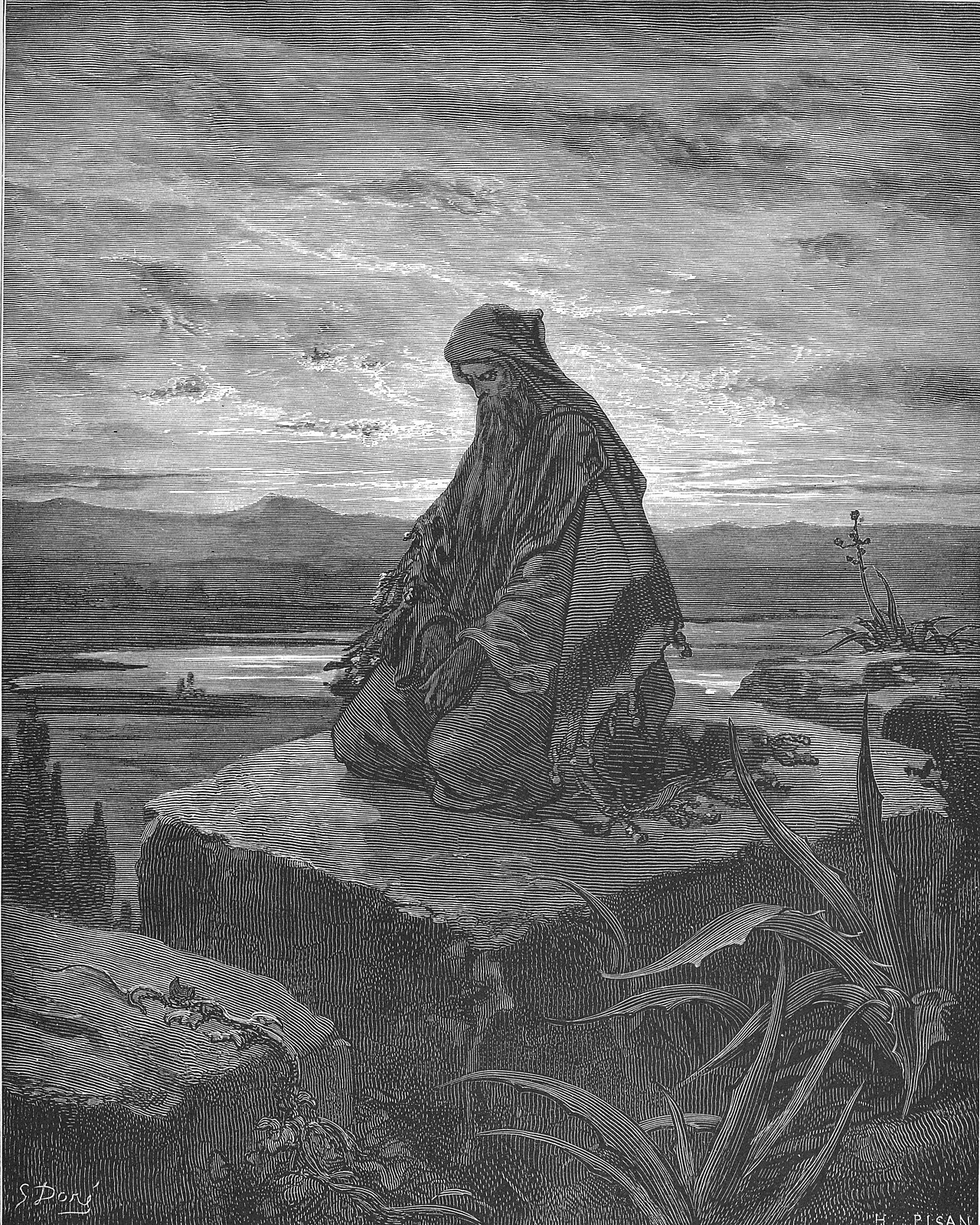
Isaiahchapter 55
13 verses · Isaiah · 8th century BC · The Prophets
“Come, all you who are thirsty, come to the waters; and you without money, come, buy, and eat! Come, buy wine and milk without money and without cost!
Introduction
Isaiah, The Prophets, Isaiah Overview.
Isaiah wrote this chapter in the voice of a market seller calling to a crowd, and his hearers knew that voice from every street. It follows the promise to the barren city and opens the book's offer to anyone who will come. The prophet speaks to people who have spent their money and their days on what never satisfied. Listen for the price the seller names, and for the promise to David that is extended to the crowd. Listen too for the picture of rain and seed near the close. It is the book's plainest invitation.
Context
- Who
- Anyone within earshot, with no qualification asked
- What
- An open invitation to come to the LORD, receive His covenant freely and turn back while He may be found.
- Where
- A market street with sellers calling, and the rain-fed fields of Judah.
- When
- Spoken about 700 to 690 BC on the site's reading, addressed to a people who would come home from Babylon.
- Why
- To call the thirsty and the wicked alike to return and receive mercy on the LORD's terms.
Historical context
The chapter opens with a street cry. In an eastern market the water-seller and the wine-seller worked the crowd by shouting, ho, everyone who thirsts, and the shout was always followed by a price. This one names the goods, water, wine, and milk, and then breaks the pattern: come, buy without money and without price. A vendor who says that is not selling.
Show the rest of the historical context, 4 more paragraphs
The complaint that follows is an economic one anybody could feel. Why do you spend money for what is not bread, and your wages for what does not satisfy? Wages in that world were often paid daily, and a man who came home with nothing to eat had wasted the day itself.
The offer is then given a legal shape: I will make an everlasting covenant with you, the sure mercies of David. That refers to the grant God made to David's house, a covenant of the kind a great king made to a favored servant, where the obligation rests on the giver. Here it is extended to the whole crowd in the street.
The rain picture is the Levantine farming year in one sentence. Rain and snow come down and do not return, but water the earth and make it bring forth and bud, so that it gives seed to the sower and bread to the eater. In that land the rains came in two seasons, and everything depended on them; a farmer kept back seed grain from his own harvest to plant the next year, so seed for the sower and bread for the eater are two different piles from the same crop.
The closing image is a replanted landscape: instead of the thorn shall come up the cypress, and instead of the brier the myrtle. Thorn and brier are what grows on abandoned land; cypress and myrtle are what someone plants on purpose.
Significance
To exiles who had spent seventy years wondering whether they had exhausted God's patience, the terms were startling: let the wicked forsake his way and the unrighteous man his thoughts, and let him return to the LORD, and he will have mercy, and to our God, for he will abundantly pardon.
Show the rest of the significance, 1 more paragraph
And the gap between God's thinking and theirs is measured, not insulted: as the heavens are higher than the earth, so are my ways higher than your ways. That was said to people who assumed his patience worked like theirs.
This chapter in Jewish lifeWhat this chapter is in Jewish life and reading.
What is done
The site's own table in src/lib/hebraic/readings.ts sets this chapter in three prophetic readings of the annual cycle. It is read as the Haftarah of Noach, Isaiah 54:1 to 55:5, in Ashkenazi use only, on the Sabbath of the portion Genesis 6:9 to 11:32. It is read as the Haftarah of Re'eh, Isaiah 54:11 to 55:5, in both rites, on the Sabbath of the portion Deuteronomy 11:26 to 16:17. It is read as the Haftarah of Vayelech, Isaiah 55:6 to 56:8, in both rites, on the Sabbath of the portion Deuteronomy 31:1 to 31:30. A congregation keeping that cycle hears the verses of each reference read aloud after the Torah portion of its Sabbath.
The corpus joins the chapter to the weeks of the Torah portions through the works arranged by portion. Under the eleventh verse it carries Bereshit Rabbati, Parashat Bereshit 24 and Midrash Tanchuma Buber, Bechukotai 5:1.
How it is read
Two commentators on this chapter carry English in the corpus. Rashi is quoted from The Judaica Press complete Tanach with Rashi, translated by A. J. Rosenberg, which Sefaria reports as CC-BY, and every quotation of it is held to fifty words or fewer because the translation is modern. Ibn Ezra is quoted from the version Sefaria titles Commentary of Ibn Ezra on Isaiah - trans. by M. Friedlander, 1873, which it reports as Public Domain.
Rashi reads the water of the first verse as Torah, in two words (Rashi on Isaiah 55:1:2). Ibn Ezra reads the money spent for what is not bread in the next verse as labour spent in profane science, which is of no use (Ibn Ezra on Isaiah 55:2:1).
The third and fourth verses carry a clear difference between the two. Rashi reads the sure mercies of David as a repayment: "For I will repay David for his mercies". The witness to the peoples he reads as a prince who reproves the nations to their faces. Ibn Ezra names the one given: "namely, Messiah" (Rashi on Isaiah 55:3:1 and 55:4:1; Ibn Ezra on Isaiah 55:4:1).
The call to seek the Lord while He may be found is read in two directions. Rashi reads it as a warning of time: "Before the verdict is promulgated", while God still says Seek Me. Ibn Ezra reads it as addressed to the prophet's contemporaries in Babylon, who knew they would be redeemed (Rashi on Isaiah 55:6:1; Ibn Ezra on Isaiah 55:6:1). On the eighth verse Rashi reports the Midrash of Tanhuma Buber, Vayeshev 11. Among men, whoever confesses in judgment is found guilty, "but, as for Me, whoever confesses and gives up his evil way, is granted clemency" (Rashi on Isaiah 55:8:2). The word that does not return empty he reads as the word spoken through the prophets, which "will not return empty, but will do good to you if you heed them" (Rashi on Isaiah 55:11:1).
What the rabbis say
The corpus carries forty rabbinic locators on this chapter and the text of none, so each is cited and linked here rather than quoted. On the first verse it holds Aggadat Bereshit 44:1, Avodah Zarah 5b:3, Avot DeRabbi Natan 41:1 and Bamidbar Rabbah 1:7. On the second verse it holds Ein Yaakov (Glick Edition), Khagigah 1:16, Pesikta DeRav Kahana 27:1 and Vayikra Rabbah 30:1. On the third verse it holds Aggadat Bereshit 74:3, Devarim Rabbah 10:1, Midrash Lekach Tov, Deuteronomy 32:1:2 and Pesikta DeRav Kahana 14:2. On the fourth verse it holds Midrash Tehillim 40:3 and Midrash Tehillim 51:3.
On the fifth verse it holds Midrash Mishlei 11:5. On the sixth verse it holds Bamidbar Rabbah 11:7, Ein Yaakov (Glick Edition), Rosh Hashanah 1:18, Ein Yaakov (Glick Edition), Yevamot 12:2 and Ein Yaakov (Glick Edition), Yevamot 4:2. On the seventh verse it holds Aggadat Bereshit 9:3, Jerusalem Talmud Berakhot 2:4:10, Megillah 17b:11 and Midrash Aggadah, Deuteronomy 1:1:12. On the eighth verse it holds Aggadat Bereshit 50:3, Ein Yaakov (Glick Edition), Sotah 1:5, Midrash Lekach Tov, Genesis 45:3:3 and Midrash Mishlei 1:9. On the tenth verse it holds Bereshit Rabbah 12:11, Ein Yaakov, Taanit 1:18, Ein Yaakov, Taanit 1:32 and Jerusalem Talmud Berakhot 9:2:23.
On the eleventh verse it holds Bereshit Rabbati, Parashat Bereshit 24, Midrash Lekach Tov, Exodus 1:13:1, Midrash Sekhel Tov, Shemot 1:12:1 and Midrash Tanchuma Buber, Bechukotai 5:1. On the twelfth verse it holds Ein Yaakov, Sukkah 4:13, Midrash Tehillim 13:7 and Otzar Midrashim, Midrash Gadol u'Gedolah 42. On the thirteenth verse it holds Bamidbar Rabbah 21:22, Ein Yaakov (Glick Edition), Megillah 1:10 and Ein Yaakov, Megillah 1:16. What each of them teaches is a saying of the rabbis, and is reported as theirs wherever this site quotes one. The quotations wait on a fetch that carries the text.
Sources: Rashi, Rashi on Isaiah 55:1:1 to 55:13:1, The Judaica Press complete Tanach with Rashi, translated by A. J. Rosenberg, reported CC-BY; Ibn Ezra, Ibn Ezra on Isaiah 55:2:1 to 55:11:1, Commentary of Ibn Ezra on Isaiah - trans. by M. Friedlander, 1873, reported Public Domain; The Sefaria corpus, scripts/data/sources/sefaria/isaiah/55.json, the 40 Talmud and Midrash locators of this chapter; The site's own files, src/lib/hebraic/readings.ts, the Haftarah entries for Noach (Isaiah 54:1 to 55:5), Re'eh (Isaiah 54:11 to 55:5) and Vayelech (Isaiah 55:6 to 56:8).
The heads below are this chapter's scenes. The numbered points under each are its verses.
Ho, Every One That Thirsteth: Buy Without Money
Isaiah 55:1-2
The invitation is open to all who thirst, whether they can pay or not, to “buy wine and milk without money and without cost”. “Listen carefully to Me, and eat what is good” carries forward the free offer that follows the servant's work in chapters 52 and 53.
spend money on that which is not bread: Barnes notes that spend money is weigh silver in the Hebrew, from the days before coins, as at Genesis 23:16. Jamieson, Fausset & Brown read listen and eat as cause and result, so the one who listens will eat. Wesley reads the soul's delight as the gospel's good things.
Isaiah 55:3-5
Incline your ear and come to Me: “Incline your ear and come to Me” leads to “My loving devotion promised to David”, which Paul quotes at Acts 13:34 of the resurrection. Verse 5 widens the promise to “a nation you do not know”, because the LORD “has bestowed glory on you”.
Cross references
Isaiah 55:3
- Quoted inActs 13:34“In fact, God raised Him from the dead, never to see decay. As He has said: ‘I will give you the holy and sure blessings promised to David.’”
'the sure mercies of David' (resurrection, no more to corruption)
a leader and commander of the peoples: Gill reads this witness as the Messiah, with the medieval Jewish commentators he cites. Barnes reads David of verse 3 as a name for the Messiah, as at Ezekiel 34:23-24 and Hosea 3:5, and renders commander as lawgiver. Wesley has this leader confirm God's promised call to the nations.
you will summon a nation: Barnes hears the verse addressed to the Messiah, and reads the run of the nations as their haste to share the gospel. Matthew Henry takes the Holy One as true to His promise, and ties the glory to John 12, where Greeks seek Jesus. Wesley names that glory His resurrection.
My Thoughts Are Not Your Thoughts
Isaiah 55:6-7
Seek the LORD while He may be found: “Seek the LORD while He may be found; call on Him while He is near” gives the offer a time and presses its urgency. Verse 7 names what seeking means. The promise that answers it is plain, that the one who returns will find compassion, “for He will freely pardon”.
Let the wicked man forsake his own way: Jamieson, Fausset & Brown read a step inward, from the open sin of the wicked in his way to the hidden sin of the thoughts. Thomas Aquinas divides them as sins against God and sins against a neighbour. Fulgentius reads the thoughts to forsake as despair of pardon.
Isaiah 55:8-9
not your thoughts: “For My thoughts are not your thoughts, neither are your ways My ways” follows directly on the promise of free pardon in verse 7. Verse 9 gives the measure: “as the heavens are higher than the earth, so My ways are higher than your ways”.
Isaiah 55:8
Marcus Brown
The Lord God is Holy Holy Holy. His being is above our own. He is the Creator and we are the creation. It is self-ambition within us that perceives our ways to similar. It is in pride that we assume our likeness to God. With humility and reverence let us commit to remember this verse and position our hearts to question and to recive his thoughts above our own. It is His Holy Spirit that searches the mind of God and reveals to us the Word. We ought to be even more humble still to accept the thoughts of God and action upon them through faith. It is a precious gift to lay down our will before the Lord and just as dignified to lay down our mind before him as well.
Isaiah 55:8
“For - If any man injure you, especially if he do it greatly and frequently, you are slow and backward to forgive him. But I am ready to forgive all penitents, how many, and great, and numberless soever their sins be.”
John Wesley · Explanatory Notes upon the Old Testament (1765)evangelical
Isaiah 55:8
“Do not want to be more merciful than God, or rather, if you wish it, you will not be able, not even in the least degree. How should you? As far as the heaven is from the earth, Scripture says, so far are My counsels from your counsels: and again, If ye, He says, being evil, know how to give good gifts unto your children, how much more your heavenly Father? But in fact this talk is mere pretext and subterfuge. Let us not prevaricate with God's commandments.”
John Chrysostom · written before 407 · Homily on Acts 50patristic
as the heavens are higher than the earth: Clarke holds that the Hebrew has lost its word for as, which all the ancient versions supply. Barnes and Clarke set the verse beside Psalm 103:11, where the heavens above the earth measure the loving devotion of the LORD. Gill reads those higher ways as heavenly, eternal and excellent.
The Rain, the Word, and a Myrtle for the Brier
Isaiah 55:10-11
For just as rain and snow fall from heaven: Rain and snow “do not return without watering the earth”. In verse 11 they become the figure for the word of God. The certainty of the harvest is set beside the certainty of a spoken promise, which covers the promises of the whole book.
My word that proceeds from My mouth: Wesley reads the word as the promise to pardon the greatest sinners. Jamieson, Fausset & Brown hold rain on a desert does what God sends it to do, and so does the word on a hard heart. They set its full accomplishment in the final restoration of Israel.
Isaiah 55:12-13
go out with joy: The people “will indeed go out with joy and be led forth in peace”, a second exodus without the haste of the first. Creation joins in, as “all the trees of the field will clap their hands”, and verse 13 puts the cypress for the thornbush.
Instead of the thornbush, a cypress will grow: Barnes notes that the Hebrew word for thornbush occurs only here and at 7:19. Theodoret sees the nations, once useless weeds, grow into the height of the cypress and the fragrance of the myrtle. Clarke cites an Aramaic reading, the righteous where the wicked stood.
Keep studying
People and groups1
Words12
Subjects4
Sources for this chapter
The summary
Jamieson, Fausset & Brown, Commentary Critical and Explanatory; John Calvin, Commentaries; John Wesley, Notes on the Old Testament and Matthew Henry, Complete Commentary.
The exposition
Adam Clarke, Commentary on the Bible; Albert Barnes; Franz Delitzsch, Biblical Commentary on the Prophecies of Isaiah; Fulgentius of Ruspe, LETTER 6; Jamieson, Fausset & Brown, Commentary Critical and Explanatory on the Whole Bible; John Gill; John Wesley, Explanatory Notes upon the Old Testament; Matthew Henry, Commentary on the Whole Bible; Theodoret of Cyrus, COMMENTARY ON ISAIAH 17:55.13 and Thomas Aquinas, Commentary on Isaiah.
The writing
Marcus Brown wrote what stands in his name on this page.