
Estherchapter 7
10 verses · KJVEsther book hub →
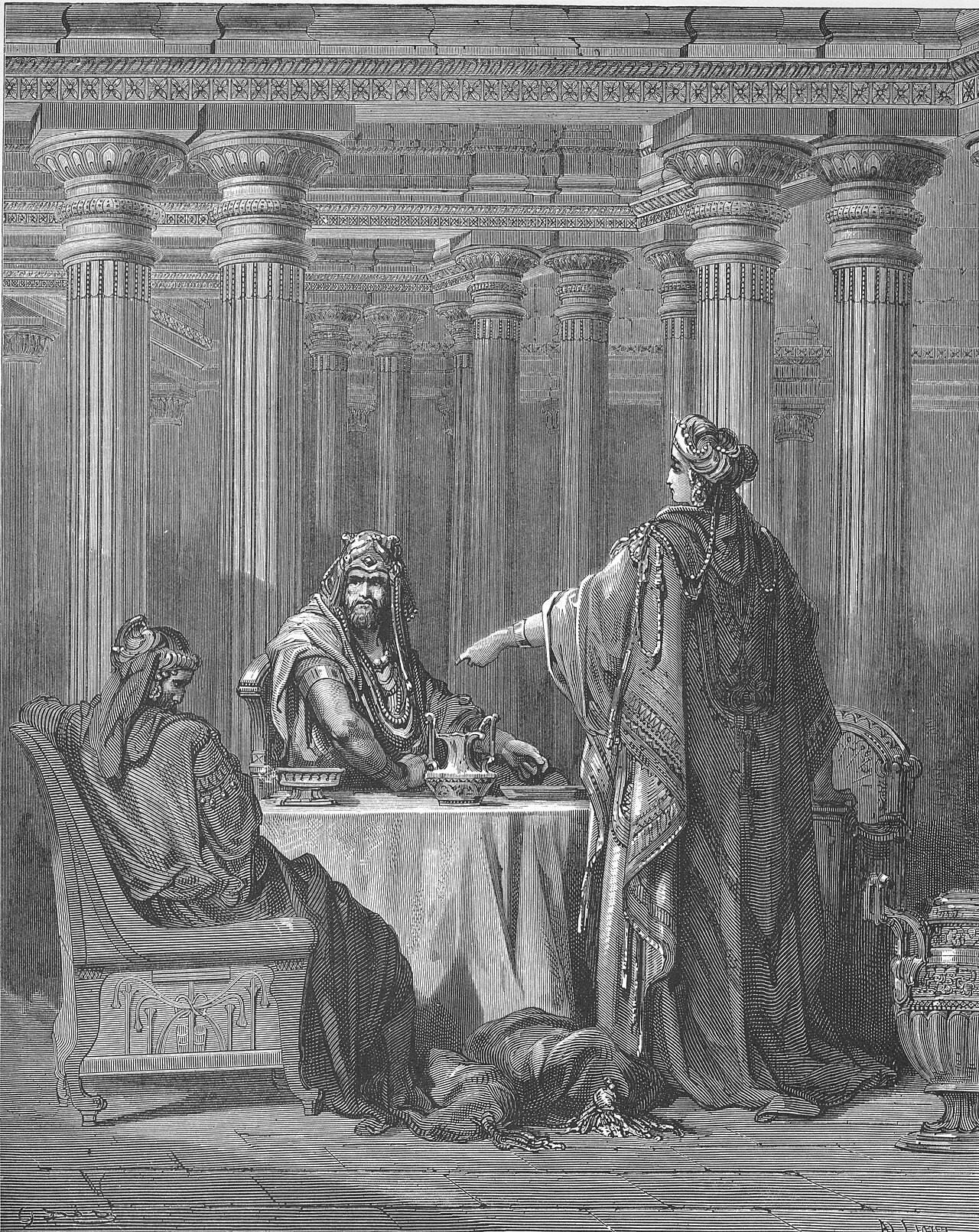
Esther Accuses Haman, Gustave Doré, Doré's English Bible (1866), public domain
Key verse
And the king arising from the banquet of wine in his wrath went into the palace garden: and Haman stood up to make request for his life to Esther the queen; for he saw that there was evil determined against him by the king.
It stands in scene B of the chapter, verses 7 to 10.
The chapter
Chapter summary
At the second banquet the king asks a third time, and Esther answers at last for herself and her nation: 'let my life be given me at my petition, and my people at my request: for we are sold, I and my people, to be destroyed, to be slain, and to perish.' Who is he that durst presume?: 'An adversary and an enemy, even this wicked Haman.' The king rises in wrath into the palace garden; Haman falls upon Esther's couch to beg his life, and the king returning takes it for assault. They cover his face. Harbonah points out the fifty-cubit gallows built for Mordecai, and Haman is hanged upon it, and the king's wrath was pacified.
Context
History · Mordecai · Esther overview
Where the chapter sits
Esther 7 falls in The reversal (chapters 5–7). Esther's two banquets; Haman's gallows and the night the king cannot sleep; Mordecai honoured; Haman hanged on his own gallows.
Haman hanged. The second banquet; ‘this wicked Haman’; the gallows that was for Mordecai.
Before it: The queen and the plot, chapters 1–4. After it: The deliverance and Purim, chapters 8–10.
The whole shape of Esther→The world behind this chapter
Esther 7The history
Diners at a Persian banquet reclined on couches rather than sitting on chairs, propped on the left elbow with the food low in front of them. That single fact explains the chapter's most violent misunderstanding: when Haman throws himself onto the couch where Esther is reclining to beg for his life, the king walks back in and sees a man lying across his wife.
The rest of the history, and what it meant to them
Esther's request is put in the language of the slave market on purpose. She says that if her people had merely been sold as slaves she would have kept quiet, the loss would not have been worth troubling the king. The word Haman used in his decree was not 'sell' but 'destroy', and she throws his own word back across the table.
Covering a condemned man's face was a recognised gesture in the ancient world, done the moment sentence was passed and before the man was taken out. In this scene the servants do it as soon as the king speaks, without waiting for a formal order, a court reads its master fast.
Harbona, one of the eunuchs, then supplies the last detail: the stake already standing at Haman's own house. Persian officials survived by knowing which way to jump, and volunteering that particular piece of information at that particular moment is a small masterpiece of self-preservation.
What it meant to them
The reversal is total and it is exact. The man who built the stake dies on it; the man he wanted humiliated already wore the king's robe that morning. Hearers who had prayed the psalms about the wicked falling into the pit they dug would have recognised the shape immediately.
But the chapter does not end the danger. Haman is dead and the decree is still sealed and running. That gap is where the next chapter has to work, and it is the honest note in the story, because getting the accuser is not the same as getting the people out.
Sources cited
- John H. Walton, Victor H. Matthews & Mark W. Chavalas, The IVP Bible Background Commentary: Old Testament
- Herodotus, The Histories
- Flavius Josephus, The Antiquities of the Jews (Whiston translation)
A. The adversary and enemy is this wicked Haman
1. (vv. 1-2)
a.banquet with Esther the queen: The second banquet opens on the same formula the king used at the first, to the half of the kingdom, and Esther is finally asked the petition she has twice deferred. Two banquets and one sleepless night stand between this verse and 5:8, and the narrator has let the reader watch what filled the space.
Esther 7:1, 1 voiceWhat preachers and commentators have said about this verse, in their own words.
Esther 7:1
“So the king and Haman came to banquet with Esther the queen. Or, "to drink with her" (e), that is, wine; for in the next verse it is called a banquet of wine; so they did according to the invitation the queen had given them, Est 5:8. (e) לשתות "ut biberent", V. L. Tigurine version; "ad bibendum", Pagninus, Montanus, Drusius, Vatablus.”
Esther 7:2, 2 voices
Esther 7:2
“At the banquet of wine - Postquam vino incaluerat, after he had been heated with wine, says the Vulgate. In such a state the king was more likely to come into the measures of the queen.”
Adam Clarke· Commentary on the Bible (1810-1826)evangelical
Esther 7:2
“If the king had now forgotten that Esther had an errand to him, and had not again asked what it was, she could scarcely have known how to renew it herself; but he was mindful of it, and now was bound with the threefold cord of a promise thrice made to favour her.”
Matthew Henry· Commentary on the Whole Bible (1707-1721)puritan
2. (vv. 3-4)
a.let my life be given me at my petition: Esther names the price Haman set at 3:9, we are sold, I and my people, to be destroyed, to be slain, and to perish, bringing his exact bargain back into the king's own hearing. Her aside, that mere slavery she would have borne in silence, marks how far past ordinary loss the decree reaches. She measures her petition against the king's own damage rather than her grief alone, the argument most likely to move him.
Esther 7:3, 1 voice
Esther 7:3
“Let my life be given me - This was very artfully, as well as very honestly, managed; and was highly calculated to work on the feelings of the king. What! is the life of the queen, whom I most tenderly love, in any kind of danger?”
Adam Clarke· Commentary on the Bible (1810-1826)evangelical
Esther 7:4, 1 voice
Esther 7:4
“To be destroyed, to be slain - She here repeats the words which Haman put into the decree. See Est 3:13. Could not countervail the king’s damage - Even the ten thousand talents of silver could not be considered as a compensation to the state for the loss of a whole nation of people throughout all their generations.”
Adam Clarke· Commentary on the Bible (1810-1826)evangelical
3. (vv. 5-6)
a.Who is he, and where is he: The king's question gives Esther the opening she has waited for since 4:16, and she answers in five words: the adversary and enemy is this wicked Haman. He sits at the same table where he has twice been the sole guest of honor and is named to the king's face before he can speak a word in his own defense.
Esther 7:5, 1 voice
Esther 7:5
“Who is he, and where is he - There is a wonderful abruptness and confusion in the original words, highly expressive of the state of mind in which the king then was: מי הוא זה ואי זה הוא אשר מלאו לבו לעשות כן mi hu zeh veey zeh hu asher melao libbo laasoth ken. “Who? He? This one? And where? This one? He? Who hath filled his heart to do thus?” He was at once struck with the horrible nature of a conspiracy so cruel and diabolic.”
Adam Clarke· Commentary on the Bible (1810-1826)evangelical
Esther 7:6, 1 voice
Esther 7:6
“Haman is soon apprehensive of his danger: He was afraid before the king and queen; and it was time for him to fear when the queen was his prosecutor, the king his judge, and his own conscience a witness against him; and the surprising operations of Providence against him that same morning could not but increase his fear.”
Matthew Henry· Commentary on the Whole Bible (1707-1721)puritan
B. Falling on the queen's couch, and hanged on his own gallows
1. (v. 7)
a.went into the palace garden: The king leaves in wrath for the palace garden, and Haman, seeing the sentence already decided, turns to beg his life from the very person he meant to have killed. The scene inverts every posture the book has shown so far: the man who could not bear one seated commoner now kneels before the queen he plotted against.
Esther 7:7, 2 voices
Esther 7:7
“Went - As disdaining the company and sight of so audacious a person: to cool and allay his troubled and inflamed spirits, and to consider what punishment was fit to be inflicted upon him.”
John Wesley· Explanatory Notes upon the Old Testament (1765)evangelical
Esther 7:7
“When we are angry we should pause awhile before we come to any resolution, as those that have a rule over our own spirits and are governed by reason. Haman becomes a humble petitioner to the queen for his life. He might easily perceived by the king's hastily flying out of the room that there was evil determined against him.”
Matthew Henry· Commentary on the Whole Bible (1707-1721)puritan
2. (v. 8)
a.Will he force the queen also before me in the house?: The king returns to find Haman fallen upon the couch where Esther reclines, a suppliant's posture the king reads as an assault. The misreading seals him; as the word left the king's mouth they covered Haman's face, the customary sign that a man stands already condemned.
Esther 7:8, 2 voices
Esther 7:8
“Will he force the queen - On the king’s return he found him at the queen’s knees; and, professing to think that he intended to do violence to her honor, used the above expressions; though he must have known that, in such circumstances, the thought of perpetrating an act of this kind could not possibly exist. They covered Haman’s face - This was a sign of his being devoted to death: for the attendants saw that the king was determined on his destruction.”
Adam Clarke· Commentary on the Bible (1810-1826)evangelical
Esther 7:8
“Haman was fallen upon the bed whereon Esther was--We do not know the precise form of the couches on which the Persians reclined at table. But it is probable that they were not very different from those used by the Greeks and Romans.”
Jamieson, Fausset & Brown· Commentary Critical and Explanatory on the Whole Bible (1871)reformed
3. (v. 9)
a.Harbonah, one of the chamberlains: Harbonah, a chamberlain otherwise unnamed anywhere else in the story, supplies the detail that ends it: the gallows fifty cubits high, built for Mordecai who had spoken good for the king, standing that very hour in Haman's own house. The king's answer is four words, hang him thereon, and the instrument built for another closes on its builder first.
Esther 7:9, 3 voices
Esther 7:9
“It is written in Proverbs: "He who digs a pit will fall into it; and when one starts a stone rolling it will roll back upon him" (Proverbs 26). So too Haman was forced to suffer the cross he had prepared for Mordecai. We might, …”
Rabanus Maurus· written before 856· Commentary on Estherpatristic
Esther 7:9
“And Harbonah, one of the chamberlains, said before the king,.... One of the seven chamberlains, see Est 1:10, his name, with Josephus (y), is Sabouchadas. Behold also, the gallows fifty cubits high, which Haman had made for Mordecai, who had spoken good for the king, standeth in the house of Haman. This man, perhaps, had seen it there, when he went with others to fetch Haman to the banquet, Est 6:”
Esther 7:9
“The information he now volunteered, as well it may be from abhorrence of Haman's cold-blooded conspiracy as from sympathy with his amiable mistress, involved with her people in imminent peril.”
Jamieson, Fausset & Brown· Commentary Critical and Explanatory on the Whole Bible (1871)reformed
4. (v. 10)
a.So they hanged Haman on the gallows that he had prepared for Mordecai: the reversal engine's cleanest stroke, the very structure Haman built for his enemy's death receiving his own instead. Commentators set Psalm 7:15-16 beside it, he made a pit, and digged it, and is fallen into the ditch which he made, the same law of retribution completing itself in Shushan's palace.
Esther 7:10, 2 voices
Esther 7:10
“So they hanged Haman on the gallows that he had prepared for Mordecai--He has not been the only plotter of mischief whose feet have been taken in the net which they hid (Ps 9:15). But never was condemnation more just, and retribution more merited, than the execution of that gigantic criminal.”
Jamieson, Fausset & Brown· Commentary Critical and Explanatory on the Whole Bible (1871)reformed
Esther 7:10
“The enemies of God's church have often been thus taken in their own craftiness. In the morning Haman was designing himself for the robes and Mordecai for the gallows; but the tables are turned: Mordecai has the crown, Haman the cross. The Lord is known by such judgments.”
Matthew Henry· Commentary on the Whole Bible (1707-1721)puritan
Threads running through this chapter
- Turned to the contraryPattern, v. 10
The text of this chapter
This page carries no textual note on Esther 7. Where this site has examined a place the manuscripts differ, the examination is in the manuscripts room. Every place this site examines →
This page draws on 9 works. Open for the list.
This page draws on Adam Clarke; Jamieson Fausset and Brown, Commentary Critical and Explanatory on the Whole Bible; Jamieson, Fausset & Brown, Commentary Critical and Explanatory on the Whole Bible (1871); John Gill; John Wesley; Keil, The Books of Ezra, Nehemiah, and Esther; Matthew Henry; Rabanus Maurus, Commentary on Esther and W. F. Adeney, Ezra, Nehemiah and Esther (Expositor's Bible).
Keep studying
On this page
Studies3
On this book