
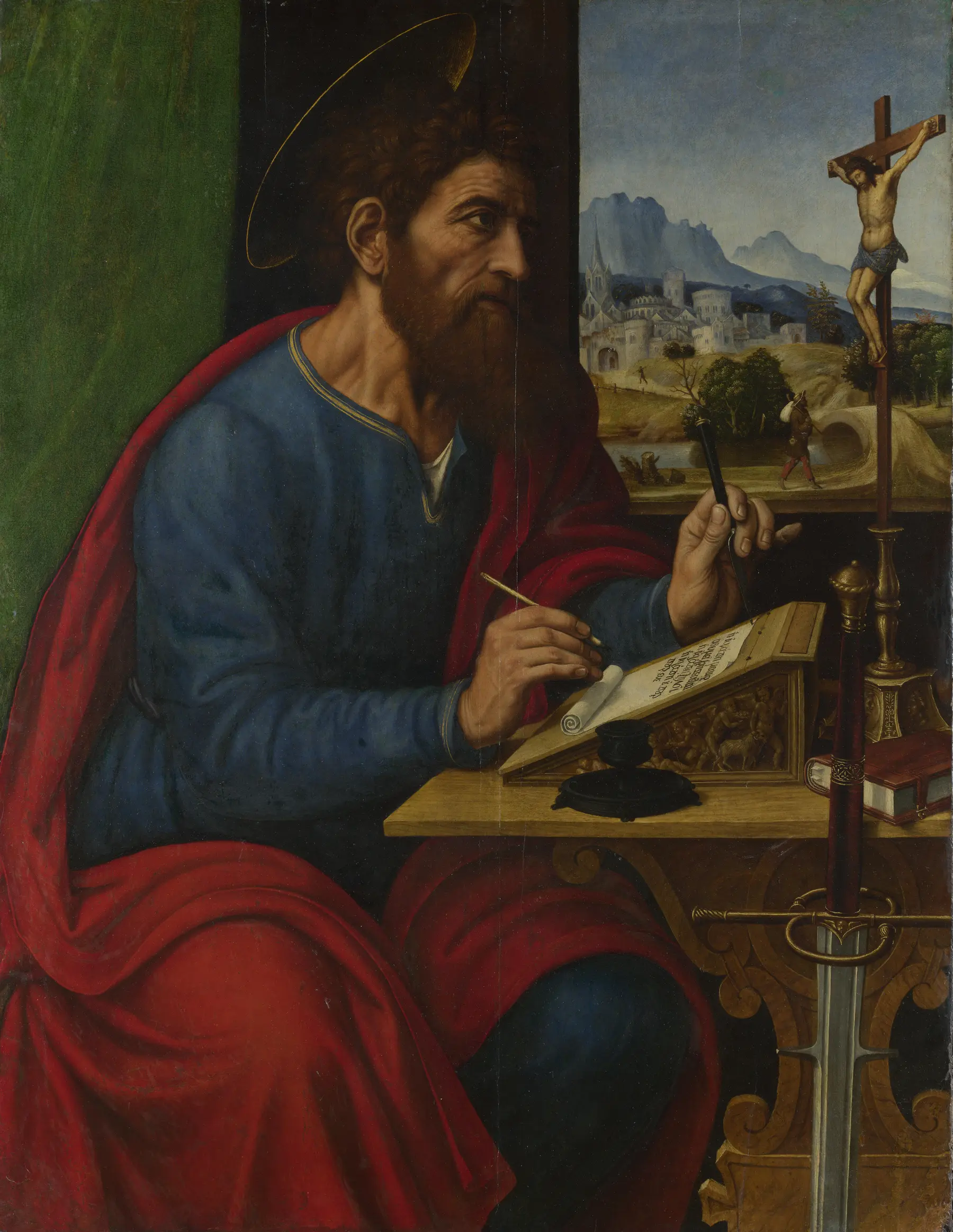
1 Timothychapter 2
15 verses · Paul, by tradition · AD 63 to 65 · Paul's letters
For there is one God, and there is one mediator between God and men, the man Christ Jesus,
Introduction
Paul, by tradition, Paul's letters, 1 Timothy Overview.
Paul now turns from the teachers to the gathered church. He writes about what should happen when believers meet to pray, and who should do what in that room. The first hearers met in houses in a large pagan city, under an emperor who did not favour them. The chapter reaches from the widest scope, every person and every ruler, down to the dress and conduct of each worshipper. Listen for the reasons Paul gives, since each command rests on a claim about God. One of those claims is among the plainest statements of the gospel in the letter. Read it as instruction for a church at prayer.
Context
- Who
- A congregation of men and women, slave and free, meeting in houses under a hostile emperor
- What
- Instructions for the church's gathered worship: prayer for all people and for rulers, the conduct of men in prayer, and the dress, learning and role of women.
- Where
- The house churches of Ephesus, a city dominated by the temple of Artemis.
- When
- About AD 62 to 64, during the reign of Nero.
- Why
- To set the church's worship in order and to ground its prayer for everyone in the one God and the one Mediator who gave Himself for all.
Historical context
Praying for the emperor was already Jewish practice. A daily sacrifice was offered in the Jerusalem temple on behalf of Rome and its ruler, and when that sacrifice was stopped in AD 66 it was understood as a declaration of war. Telling Christians to pray for kings put them on the same ground: loyal subjects, not rebels.
Show the rest of the historical context, 3 more paragraphs
The ruler in question was Nero. Praying for a quiet life under him was not sentimental; it was asking for room to live.
The description of women's dress is a description of a specific fashion. Elite Roman women built towered hairstyles threaded with gold and pearls, and moralists of the period, pagan ones included, complained about the expense as a display of status. In a room where slaves and poor widows also sat, that display did something ugly.
Ephesus was the city of Artemis, whose great temple was staffed by women in prominent roles and whose cult shaped what everyone assumed about women and the divine. The chapter's restriction on a woman teaching and holding authority over a man is read by many as a standing order and by others as a measure aimed at untaught women in that specific situation; the wording is disputed and the reasons given reach back to Genesis, so the debate is named here rather than settled.
Significance
For the first hearers, the striking instruction may be the one addressed to men: lift hands without anger and arguing. The church was quarreling, and the quarrel was in the prayers.
Show the rest of the significance, 1 more paragraph
The line about one God and one mediator cut across everything Ephesus sold. In a city stacked with priesthoods and go-betweens, there was one, and he was a man who gave himself as the ransom price.
The heads below are this chapter's scenes. The numbered points under each are its verses.
Pray for Kings: One God, One Mediator
1 Timothy 2:1-2
First of all: The church's first business is prayer, offered for everyone: petitions, prayers, intercessions, and thanksgiving, four words the older commentators distinguish. Kings and all those in authority head the list while Nero holds the throne. The aim is that we may lead tranquil and quiet lives in all godliness and dignity.
1 Timothy 2:1
“I think that supplication is a prayer offered with a special request for something a person lacks. From this is distinguished prayer which is more plainly offered with simple praise, not to obtain a request but simply to praise the nobility of great things.”
Origen of Alexandria · written before 253 · LETTERS 149.2.16patristic
3 more voices on this verseWhat preachers and commentators have said about this verse, in their own words.
1 Timothy 2:1
“Some professing Christians looked down on all not Christians, as doomed to perdition; but Paul says all men are to be prayed for, as Christ died for all (1Ti 2:4-6). supplications--a term implying the suppliant's sense of need, and of his own insufficiency. prayers--implying devotion. intercessions--properly the coming near to God with childlike confidence, generally in behalf of another.”
Jamieson, Fausset & Brown · Commentary Critical and Explanatory on the Whole Bible (1871)reformed
1 Timothy 2:1
“Observe, The design of the Christian religion is to promote prayer; and the disciples of Christ must be praying people. Pray always with all prayer, Eph. vi. There must be prayers for ourselves in the first place; this is implied here.”
Matthew Henry · Commentary on the Whole Bible (1707-1721)puritan
1 Timothy 2:1
“I exhort, therefore - Margin, “desire.” The word exhort, however, better expresses the sense of the original. The exhortation here is not addressed particularly to Timothy, but relates to all who were called to lead in public prayer; 1Ti 2:8. This exhortation, it may be observed, is inconsistent with the supposition that a liturgy was then in use, or with the supposition that there ever would be a liturgy - since, in that case, the objects to be prayed for would be prescribed.”
Paul asks prayer for rulers at a time when the emperor and his governors were pagans. Tertullian told the Roman authorities that Christians prayed for the emperor's welfare because their Scriptures commanded it.
1 Timothy 2:2
"He is peaceable (Greek) who makes no disturbance; he is quiet (Greek) who is himself free from disturbance" [TITTMANN]. in all godliness--"in all (possible . . . requisite) piety" [ALFORD].
Jamieson, Fausset & Brown · Commentary Critical and Explanatory on the Whole Bible (1871)reformed
3 more voices on this verse
1 Timothy 2:2
“If you think that we have no interest in the emperor's welfare, look into our literature, read the Word of God. We ourselves do not keep it concealed, and in fact it is in some cases by chance handed over to outsiders. Learn from this literature that it has been enjoined upon us, that our charity may more and more abound, to pray to God even for our enemies and to beg for blessings for our persecutors.”
Tertullian · written before 220 · APOLOGY 31.1-2patristic
1 Timothy 2:2
“But true prayer is the vehemency of holy zeal, the ardour of divine love, arising from a calm, undisturbed soul, moved upon by the Spirit of God. Intercession is prayer for others. We may likewise give thanks for all men, in the full sense of the word, for that God "willeth all men to be saved," and Christ is the Mediator of all.”
John Wesley · Explanatory Notes upon the New Testament (1755)evangelical
1 Timothy 2:2
“For kings - As it is a positive maxim of Christianity to pray for all secular governors, so it has ever been the practice of Christians. When St. Cyprian defended himself before the Roman proconsul, he said: Hunc (Deum) deprecamur-pro nobis et pro omnibus hominibus; et pro incolumitate ipsorum Imperatorum. “We pray to God, not only for ourselves, but for all mankind, and particularly for the emperors.” Tertullian, in his Apology, is more particular: Oramus pro omnibus Imperatoribus, vitam illis prolixam, imperium securum, domum tutam, exercitus fortes, senatum fidelem, populum probum, orbem quietum, et quaecunque hominis et Caesaris vota sunt.”
Adam Clarke · Commentary on the Bible (1810-1826)evangelical
1 Timothy 2:3-4
good and pleasing in the sight of God: The warrant for praying so widely is the will of God our Savior, who wants everyone to be saved. The word everyone is read two ways: all without exception with Wesley, and all without distinction with Calvin.
1 Timothy 2:3
“Prayer for all, both unbelievers and heretics, is what the word "this" points to. This is also "good" by nature, because we are all of one and the same nature, and it is also "pleasing" to God.”
Theophylact of Ohrid · written before 1107 · Commentary on 1 Timothypatristic
2 more voices on this verse
1 Timothy 2:3
“For this is good and acceptable - That is, it is good and acceptable to God that we should pray for all people. The reason is, that he desires their salvation, and hence it is agreeable to him that we should pray for it. If there were no provision made for their salvation, or if he was unwilling that they should be saved, it could not be agreeable to him that we should offer prayer for them.”
1 Timothy 2:3
“Do you ask, "Why are not more converted?" We do not pray enough. Is acceptable in the sight of God our saviour - Who has actually saved us that believe, and willeth all men to be saved. It is strange that any whom he has actually saved should doubt the universality of his grace!”
John Wesley · Explanatory Notes upon the New Testament (1755)evangelical
the knowledge of the truth: God's desire reaches past rescue to understanding. Jamieson, Fausset and Brown read knowledge here as full recognition of the saving truth found in Jesus. Ambrose notes that God is good to all, yet only those who seek Him find the healing He brings.
1 Timothy 2:4
“Our prayers ought to include all, as God's grace included all. to come--They are not forced. unto the knowledge--Greek, "the full knowledge" or "recognition" (See on 1Co 13:12; Php 1:9). the truth--the saving truth as it is in, and by, Jesus (Joh 17:3, 17).”
Jamieson, Fausset & Brown · Commentary Critical and Explanatory on the Whole Bible (1871)reformed
4 more voices on this verse
1 Timothy 2:4
“Is God not good to everyone then? Indeed, He is good to everyone, because He is the Savior of all, especially the faithful; and for this reason the Lord Jesus came, to save what was lost: He came to take away the sin of the world, to heal our wounds. But because not everyone seeks the medicine, but many refuse it, lest the force of the ulcer be aggravated by the remedies, He who desires to heal does not compel the unwilling.”
Ambrose of Milan · written before 397 · Interrogation of Job and David, Book 3, Chapter 2patristic
1 Timothy 2:4
“Who willeth seriously all men - Not a part only, much less the smallest part. This is treated of, ver. 5, 6. And, in order thereto, to come - They are not compelled.”
John Wesley · Explanatory Notes upon the New Testament (1755)evangelical
1 Timothy 2:4
“Who will have all men to be saved - Because he wills the salvation of all men; therefore, he wills that all men should be prayed for. In the face of such a declaration, how can any Christian soul suppose that God ever unconditionally and eternally reprobated any man? Those who can believe so, one would suppose, can have little acquaintance either with the nature of God, or the bowels of Christ.”
Adam Clarke · Commentary on the Bible (1810-1826)evangelical
1 Timothy 2:4
“One reason why all men are to be prayed for is because there is one God, and that God bears a good will to all mankind.”
Matthew Henry · Commentary on the Whole Bible (1707-1721)puritan
one mediator between God and men: The creed is counted on two fingers: one God, and one mediator, the man Christ Jesus. He is named in His manhood because a mediator stands on both sides He joins. He gave Himself as a ransom for all, antilutron, a price paid in exchange.
1 Timothy 2:5
“But what is he who is at once the Most High and man, what but "the Mediator between God and man, the man Christ Jesus who gave himself as a ransom for us"? This text indeed refers properly to his incarnation, for our redemption was made by his blood, our pardon comes through his power, our life is secured through his grace. He gives as the Most High; he prays as man. The one is the office of the Creator; the other of a redeemer.”
Ambrose of Milan · written before 397 · Exposition of the Christian Faith 3.2.8patristic
2 more voices on this verse
1 Timothy 2:5
“For - The fourth verse is proved by the fifth; the first, by the fourth. There is one God - And they who have not him, through the one Mediator, have no God. One mediator also - We could not rejoice that there is a God, were there not a mediator also; one who stands between God and men, to reconcile man to God, and to transact the whole affair of our salvation.”
John Wesley · Explanatory Notes upon the New Testament (1755)evangelical
1 Timothy 2:5
“For there is one God - This is a reason for offering prayer for all people, and for the declaration 1Ti 2:4 that God desires that all people should be saved. The reason is founded in the fact that he is the common Father of all the race, and that he must have the same desire for the welfare of all his children, He has made them of one blood Act 17:26, and he must have the same interest in the happiness of all; compare Eph 4:6 note; Rom 3:30 note.”
1 Timothy 2:6
“Who gave himself a ransom for all - Such a ransom, the word signifies, wherein a like or equal is given; as an eye for an eye, or life for life: and this ransom, from the dignity of the person redeeming, was more than equivalent to all mankind.”
John Wesley · Explanatory Notes upon the New Testament (1755)evangelical
a faithful and true teacher of the Gentiles: For this reason I was appointed ties Paul's office to the ransom of verse 6. A ransom for all grounds a mission to all, which is why Paul is a teacher of the Gentiles.
1 Timothy 2:7
“Whereunto - Greek, “Unto which;” that is, to the bearing of which testimony I am appointed. I am ordained - Greek, “I am placed or constituted” - ἐτέθην etethēn. The word “ordain” has now acquired a technical signification, meaning to set apart solemnly to a sacred office by the imposition of hands; but it has not that meaning here.”
Holy Hands, Modest Dress, and a Quiet Learning
lifting up holy hands: I want the men everywhere to pray widens prayer beyond fixed places. The posture is the ancient one of standing with hands spread upward, as the orant figures of the catacombs show.
1 Timothy 2:8
“I will therefore that men pray everywhere,.... In this declaration of the apostle's will concerning prayer, he only takes notice of "men"; not but that it is both the duty and privilege of women, as well as men, to pray in their houses and closets; but because he is speaking of public prayer in the church, which only belongs to men, he speaks only of them; and his will is, that prayer should be performed by them everywhere, or in any place, in any part of the world where they lived.”
3 more voices on this verse
1 Timothy 2:8
“I will therefore - Seeing the apostle had his authority from Christ, and spoke nothing but what he received from him, his βουλομαι, I will, is equal to I command. That men pray - That is, for the blessings promised in this testimony of God. For, although God has provided them, yet he will not give them to such as will not pray. See the note on 1Ti 2:1, the subject of which is here resumed. Everywhere - Εν παντι τοπῳ· In every place. That they should always have a praying heart, and this will ever find a praying place.”
Adam Clarke · Commentary on the Bible (1810-1826)evangelical
1 Timothy 2:8
“And doubting - Which is contrary to faith. And wrath, or unholy actions, or want of faith in him we call upon, are the three grand hindrances of God's hearing our petitions. Christianity consists of faith and love, embracing truth and grace: therefore the sum of our wishes should be, to pray, and live, and die, without any wrath or doubt.”
John Wesley · Explanatory Notes upon the New Testament (1755)evangelical
1 Timothy 2:8
“Now, under the gospel, prayer is not to be confined to any one particular house of prayer, but men must pray every where: no place is amiss for prayer, no place more acceptable to God than another, John iv. We must pray in our closets, pray in our families, pray at our meals, pray when we are on journeys, and pray in the solemn assemblies, whether more public or private.”
Matthew Henry · Commentary on the Whole Bible (1707-1721)puritan
1 Timothy 2:9-10
respectable apparel: The ban on braided hair or gold or pearls or expensive clothes describes the display wardrobe of wealthy Ephesus. The alternative is good deeds, as is proper for women who profess to worship God.
1 Timothy 2:9
“Not with curled hair, not with gold - Worn by way of ornament. Not with pearls - Jewels of any kind: a part is put for the whole. Not with costly raiment - These four are expressly forbidden by name to all women (here is no exception) professing godliness, and no art of man can reconcile with the Christian profession the wilful violation of an express command.”
John Wesley · Explanatory Notes upon the New Testament (1755)evangelical
2 more voices on this verse
1 Timothy 2:9
“Let us then hold fast modesty and that moderation which adds to the beauty of the whole of life. For it is no light thing in every matter to preserve due measure and to bring about order, wherein that is plainly conspicuous which we call "decorum," or what is seemly. This is so closely connected with what is virtuous that one cannot separate the two.… This seemliness which we offer to God we may believe to be far better than other things.”
Ambrose of Milan · written before 397 · On the Duties of the Clergy 1.45.219, 220patristic
1 Timothy 2:9
“In like manner also - That is, with the same propriety; with the same regard to what religion demands. The apostle had stated particularly the duty of men in public worship 1Ti 2:8, and he now proceeds to state the duty of women. All the directions here evidently refer to the proper manner of conducting public worship, and not to private duties; and the object here is to state the way in which he would have the different sexes appear.”
good deeds: Jamieson, Fausset and Brown note a change of preposition here, so that women are adorned by means of good deeds. Chrysostom names the adornment of the soul as gentleness, humility and patience.
1 Timothy 2:10
“But (which becometh women professing god likeness),.... By which is meant not any particular grace, was it, the fear of God might be designed, and so the Syriac version renders it; nor the whole of internal religion only; nor the form of godliness, or the whole scheme of Gospel truth, which is according to godliness; nor only outward holiness of life and conversation; but the whole of all this, all religion, internal and external, the whole of godliness, both in a doctrinal and in a practical way.”
1 more voice on this verse
1 Timothy 2:10
“But (which becometh, etc. - That is: Good works are the only ornaments with which women professing Christianity should seek to be adorned. The Jewish matrons were accustomed to cry to the bride: “There is no need of paint, no need of antimony, no need of braided hair; she herself is most beautiful.” The eastern women use a preparation of antimony, which they apply both to the eyes and eyelids, and by which the eye itself acquires a wonderful lustre.”
Adam Clarke · Commentary on the Bible (1810-1826)evangelical
1 Timothy 2:11-12
A woman must learn in quietness: The verb behind to exercise authority over a man, authentein, occurs nowhere else in Scripture. Some read the verse as a standing ordinance for the assembly. Others read it as Paul's ruling on the false teaching of 1:3-7 spreading among untaught Ephesian women.
1 Timothy 2:11
I think the prohibition in the law against a man wearing female garments refers not so much to clothing as to manners and to our habits and actions, since one act is becoming to a man, another to a woman. Therefore, the apostle, as the interpreter of the law, says, "Let your women keep silence in the churches, for it is not permitted them to speak, but to be submissive, as the law says. But if they wish to learn anything, let them ask their husbands at home."
Ambrose of Milan · written before 397 · Letter 69: To Irenaeuspatristic
2 more voices on this verse
1 Timothy 2:11
“Let the woman learn in silence - Listen attentively to instruction, without attempting to teach in public; see the notes on 1Co 14:35. With all subjection - With due subjection to those who are in authority, and who are appointed to minister in holy things; notes, 1Co 14:34.”
1 Timothy 2:11
“She should not even put questions in the public assembly (1Co 14:35). with all subjection--not "usurping authority" (1Ti 2:12). She might teach, but not in public (Ac 18:26). Paul probably wrote this Epistle from Corinth, where the precept (1Co 14:34) was in force.”
Jamieson, Fausset & Brown · Commentary Critical and Explanatory on the Whole Bible (1871)reformed
to teach or to exercise authority over a man: Gill holds that women may teach at home and are told to teach younger women in Titus 2:3. So he reads the bar as public teaching in the church.
1 Timothy 2:12
“Nor to usurp authority - A woman should attempt nothing, either in public or private, that belongs to man as his peculiar function. This was prohibited by the Roman laws: In multis juris nostri articulis deterior est conditio foeminarum quam masculorun,; l. 9, Pap. Lib. 31, Quaest. Foeminoe ab omnibus officiis civilibus vel publicis remotae sunt; et ideo nec judicis esse possunt, nec magistratum gerere, nec postulare, nec pro alio invenire, nec procuratores existere; l. 2, de Reg. Juris. Ulp. Lib. i. Ad Sab. - Vid. Poth. Pand.”
Adam Clarke · Commentary on the Bible (1810-1826)evangelical
1 Timothy 2:13-14
Adam was formed first: Paul grounds his ruling in Genesis twice, in the order of creation and in the order of the fall. Adam was formed first, and then Eve, and it was the woman who was deceived and fell into transgression.
1 Timothy 2:13
“For--reason of the precept; the original order of creation. Adam . . . first--before Eve, who was created for him (1Co 11:8, 9).”
Jamieson, Fausset & Brown · Commentary Critical and Explanatory on the Whole Bible (1871)reformed
1 more voice on this verse
1 Timothy 2:13
“It was said, moreover, that it was not good for man to be alone. Yet we know that Adam did not commit sin before woman was created. However, after creation, she was the first to disobey the divine command and even allured her husband to sin. If, therefore, the woman is responsible for the sin, how then can her coming be considered a good?”
Ambrose of Milan · written before 397 · On Paradise 10.47patristic
the woman who was deceived: Wesley and Clarke note that the serpent deceived Eve, while Adam took the fruit from her hand knowing he sinned. Gill adds that Adam is nowhere in Scripture said to have been deceived.
1 Timothy 2:14
“And Adam was not deceived - The serpent deceived Eve: Eve did not deceive Adam, but persuaded him. "Thou hast hearkened unto the voice of thy wife," Gen. iii, 17. The preceding verse showed why a woman should not "usurp authority over the man." this shows why she ought not "to teach." She is more easily deceived, and more easily deceives.”
John Wesley · Explanatory Notes upon the New Testament (1755)evangelical
2 more voices on this verse
1 Timothy 2:14
“Adam was not deceived--as Eve was deceived by the serpent; but was persuaded by his wife. Ge 3:17, "hearkened unto . . . voice of . . . wife." But in Ge 3:13, Eve says, "The serpent beguiled me." Being more easily deceived, she more easily deceives [BENGEL], (2Co 11:3). Last in being, she was first in sin--indeed, she alone was deceived.”
Jamieson, Fausset & Brown · Commentary Critical and Explanatory on the Whole Bible (1871)reformed
1 Timothy 2:14
“And Adam was not deceived,.... There is no need to say with interpreters, that he was not deceived first; and that he was not deceived immediately by the serpent, but by Eve; and that he is never said in Scripture to be deceived, as Melchizedek is never said to have a father or mother.”
saved through childbearing: Women will be saved through childbearing has drawn many readings, and the Greek carries the article, through the childbearing. The readings are preservation through the dangers of childbirth, salvation lived in an ordinary calling, and the birth of the promised Seed of Genesis 3:15.
1 Timothy 2:15
“Yet she - That is, women in general, who were all involved with Eve in the sentence pronounced, Gen. iii, 16. Shall be saved in childbearing - Carried safe through the pain and danger which that sentence entails upon them for the transgression; yea, and finally saved, if they continue in loving faith and holy wisdom.”
John Wesley · Explanatory Notes upon the New Testament (1755)evangelical
4 more voices on this verse
1 Timothy 2:15
“The present book of Scripture, then, speaks of this love with which the blessed soul burns and is on fire with regard to the blessed Word of God. And she sings this wedding song through the Spirit, by which the church is joined and united with its heavenly bridegroom Christ, desiring to be mingled with him through the Word so that she may conceive from him and be enabled to be saved through this chaste bearing of children.”
Origen of Alexandria · written before 253 · Commentary on the Song of Songs, Prologue.2.46patristic
1 Timothy 2:15
“In this home sphere, not ordinarily in one of active duty for advancing the kingdom of God, which contradicts the position assigned to her by God, she will be saved on the same terms as all others, namely, by living faith. Some think that there is a reference to the Incarnation "through THE child-bearing" (Greek), the bearing of the child Jesus.”
Jamieson, Fausset & Brown · Commentary Critical and Explanatory on the Whole Bible (1871)reformed
1 Timothy 2:15
“Notwithstanding she shall be saved,.... Not Eve, though no doubt she is saved; since she had a sense of her sin, and shame for it, a revelation of the Messiah to her, and faith in him; see Gen 3:7. But rather any woman, particularly such as profess godliness, who shall be saved in childbearing; which is to be understood not of a temporal salvation, or being saved through childbearing, through the perilous time, and be delivered out of it; for though this is generally the case, yet not always, nor always the case of good women.”
1 Timothy 2:15
“Though in sorrow, yet she shall bring forth, and be a living mother of living children; with this proviso, that they continue in faith, and charity, and holiness, with sobriety: and women, under the circumstance of child-bearing should by faith lay hold of this promise for their support in the needful time.”
Matthew Henry · Commentary on the Whole Bible (1707-1721)puritan
How this psalm is built
The form: Instructions for the church's gathered prayer, grounded in a short confession of one God and one Mediator at verses 5 and 6, as 6 classes it.
The patterns in this chapter
| Device | What it does | Where to see it |
|---|---|---|
| Four words for prayer | Verse 1 names four kinds of prayer, petitions, prayers, intercessions and thanksgiving. The site's published exposition of verses 1 and 2 notes that the older writers loved to distinguish them. The list sets the breadth of the church's prayer before its scope.This site's published exposition of 1 Timothy 2:1 to 2, The exposition_notes row on 1 Timothy 2:1 to 2, citing Matthew Henry, Commentary on the Whole Bible, and Adam Clarke, Commentary on the Bible. | 1 Timothy 2:1 |
How this chapter is built
1 more paragraph on the patterns
Verses 1 to 7 call for prayer for all people and ground it in God's desire to save all and in the one Mediator who gave Himself for all. Verse 8 turns to the men of the church at prayer. Verses 9 to 15 turn to the women, their adornment, their learning and their role, and Paul grounds that section in Genesis 2 and 3.
Keep studying
Studies11
People and groups1
Sources for this chapter
The summary
Jamieson, Fausset & Brown, Commentary Critical and Explanatory; John Calvin, Commentaries; John Wesley, Explanatory Notes Upon the New Testament and Matthew Henry, Complete Commentary.
The form and classifications
This site's published exposition of 1 Timothy 2:5 to 6, The exposition_notes row on 1 Timothy 2:5 to 6, citing John Calvin, Commentary on 1 Timothy, and Albert Barnes, Notes on the New Testament.
The exposition
Adam Clarke, Commentary on the Bible; Albert Barnes, Notes on the New Testament; Ambrose of Milan, Interrogation of Job and David, Book 3, Chapter 2; Jamieson, Fausset & Brown, Commentary Critical and Explanatory on the Whole Bible; John Calvin, Commentary on 1 Timothy; John Chrysostom; John Gill; John Wesley, Explanatory Notes upon the New Testament; Matthew Henry, Commentary on the Whole Bible; Tertullian, APOLOGY 31.1-2 and Theophylact of Ohrid, Commentary on 1 Timothy.