
Korea, October 1909 to 1911 · Story · Featured Study
The Million Souls Movement
The missions' own journal reported in 1911 that the million souls the missions had asked for could not be found in their churches.
A council of missionaries at Seoul resolved to ask God for a million souls in one year.
- Where
- Seoul, Hamheung, Pyongyang
- Who
- The General Council of Missions, Robert Harkness, William Newton Blair, Louise McCully
- When
- October 1909 to 1911
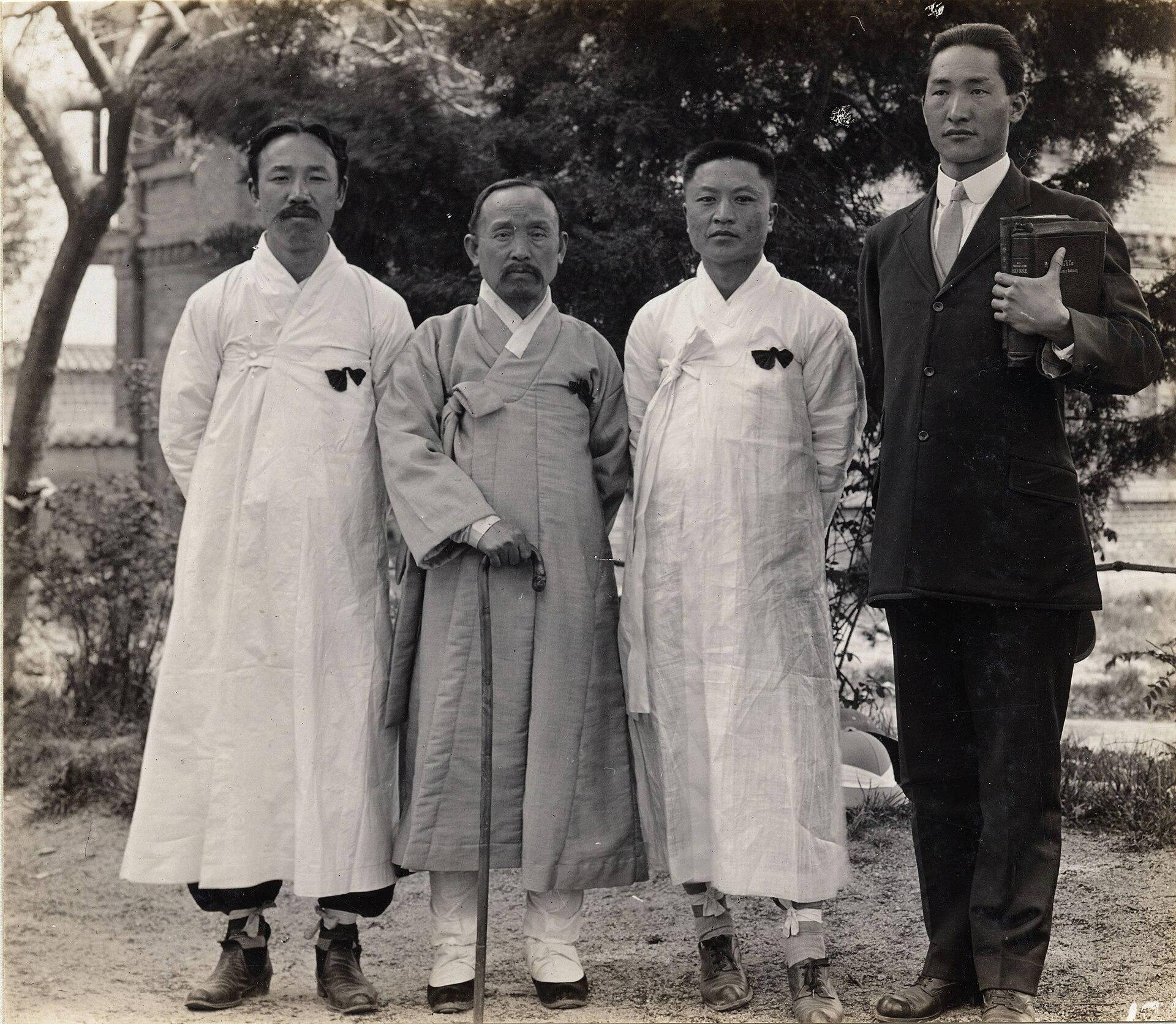
Four Korean preachers, Korea, 1908 to 1922. Public domain.
so My word that proceeds from My mouth will not return to Me empty, but it will accomplish what I please, and it will prosper where I send it.
Summary
The General Council of Missions in Korea made that request its watchword. Korean Christians then gave days of preaching and took gospels of Mark from house to house.
- Within a week of the vote the watchword had a hymn and a Korean form.
- One mission's returns grew by thousands in the eighteen months that followed.
- Writers differ over whether it failed and over what it meant in the year Japan annexed Korea.
The Texts of the Campaign
A verse stood over the hymn, and Jesus's promise to His witnesses stands beside the campaign's work.
William Newton Blair and the journal both answered the count from Isaiah 55:11.
“If You can?” echoed Jesus. “All things are possible to him who believes!”
The journal set this verse, in an older English, over Robert Harkness's hymn on the watchword.
Mark 9:23BSB
But you will receive power when the Holy Spirit comes upon you, and you will be My witnesses in Jerusalem, and in all Judea and Samaria, and to the ends of the earth.”
Jesus promises His witnesses power, and the campaign put its weight on the personal work of Korean Christians.
Acts 1:8BSB
What the Missions Counted
The journal printed a count of all the missions before the vote and one mission's column after it.
The one mission's column grew by thousands, and the watchword asked for a million.
| Who counted | As of | Baptized members | Probationers and catechumens | Adherents |
|---|---|---|---|---|
| All the missions, by the statistician Mr. Collyer, with the Australian returns incomplete | Summer 1909 | 42,254 | 50,526 | 87,298 |
| The Northern Presbyterian mission | 1909 | 25,053 | 23,892 | 96,668 |
| The Northern Presbyterian mission | 30 November 1910 | 32,509 | 26,981 | 110,362 |
From the Vote to the Count
A committee's suggestion at Seoul became a watchword, a hymn and a winter of work from house to house.
The General Council of Missions held its annual meeting on Friday and Saturday, 8 and 9 October 1909. A committee named to report on a watchword told of missionaries and Koreans fasting and praying at Pyongyang, Song Do, Seoul and other places. It "suggested, that we ask of God 1000000 souls in Korea this year".
The journal says the proposal was adopted unanimously, "while many were trembling at what seemed like temerity".
On 11 October Harkness wrote a hymn on the watchword at Seoul. On 13 October, at another meeting of the Council, a man named Lee offered a Korean form of it, "Keum-yunie pak man myeng". The journal gives this as "This year a million souls".
The same meeting adopted a Bible Committee resolution for a gospel at no more than one sen a copy. Koreans were to furnish the money, and the use of foreign money was discouraged.
Hamheung's share1 paragraph
Louise McCully reported that the Hamheung field of six counties set itself a quota of 25,000 out of 380,000 people, "almost ten times our present 2,778 members and adherents".
In May 1910 the journal printed another text under the hymn's title. Its chorus runs, "And ere the million all are in, We’ll ask for millions more". The next month it asked, "Did we mean a million souls, and were we expecting to receive such a stupendous blessing without extraordinary effort?"
The journal later reckoned that Koreans had given "at least 100,000 days of work in all". Of these, "76,000 days of earnest personal work" came the winter before. It says several hundred workers gave a whole month in the fall of that year.
Korean Christians bought "Many millions of tracts and 700,000 gospels of Mark" and gave them to unbelievers. The journal says "nearly every home in Korea has been visited".
Blair told his mission that "before it was more than well started Annexation came and Korea ceased to be a separate country".
Korea Before the Vote
The missions came to the vote after two revivals.
The revival at Wonsan had begun in 1903, and the revival at Pyongyang had come in 1907.
A writer in the journal the next February joined the vote to the division of mission fields, which "was carried through without a discord". He says that "a few daring young missionaries suggested that a million converts this year should be our watchword".
What Is Not Known
No later count of all the missions has been found, so the number gained is not known.
The journal in the next two years gives partial returns only.
The Northern Presbyterian report is one mission's. The journal's footnote says five other missions of the Council and five outside it were yet to be heard from.
The journal's report that attendance at the churches doubled is an impression, with no return beside it. It is not known whether Harkness's hymn was sung in Korean.
What the Journal Reported
The missions' own press gave its verdict and then argued over it.
An unsigned column of January 1911 says that "neither the million, nor any large part of them can to-day be found in our churches, or even reckoned among the adherents, in our statistics". Its sentence goes on, "yet nevertheless we are by no means sure that God has not them all written in His Book of Life".
The same column says that "many if not most, of the churches in Korea have doubled or more than doubled in the number of attendants on services".
A missionary's letter of that February says the movement had not added "a million new adherents or attendants, indeed not a tenth of that number". Its writer calls "the disappointment we all felt" God's way of showing "that as a Church we are not ready for the Million to come in".
The Northern Presbyterian report covers eighteen months and counts "12,691 souls added". That is the report's own figure, and the rise between its two totals, from 48,945 to 59,490, is smaller, with no reason given.
The journal said of these returns, "While these figures do not seem to show that the million movement was a success, they do not tell the real story".
How the Key Verse Was Taught
Commentaries from 1710 to 1871 on the word God sends out.
Matthew Henry (1662 to 1714)
Commentary on the Whole Bible, on Isaiah 55:10
Matthew Henry began where the prophet begins, with the weather.
“The efficacy of God's word in the kingdom of nature. He saith to the snow, Be thou on the earth; he appoints when it shall come, to what degree, and how long it shall lie there; he saith so to the small rain and the great rain of his strength”
Puritan
John Wesley (1703 to 1791)
Explanatory Notes upon the Old Testament, on Isaiah 55:11
John Wesley named what God sends out.
“My promises, concerning the pardon of the greatest sinners.”
Evangelical
Jamieson, Fausset & Brown (1802 to 1910)
Commentary Critical and Explanatory on the Whole Bible, Isaiah 55:11
Jamieson, Fausset and Brown took up the word that seems wasted.
“Rain may to us seem lost when it falls on a desert, but it fulfils some purpose of God. So the gospel word falling on the hard heart; it sometimes works a change at last; and even if so, it leaves men without excuse.”
Evangelical
In Their Own Words
Harkness wrote for the campaign, McCully reported its coming to Hamheung, and Blair answered those who called it a failure.
Robert Harkness
"A Million Souls for Jesus", The Korea Mission Field 5:11, p. 181
Lord, this can surely be
“A million souls for Jesus! Lord, this can surely be! A million souls for Jesus! 'Tis not too much for Thee!”
Protestant
About this saying1 paragraph
The journal set the hymn at the head of its issue of November 1909.
Louise McCully
"Extract from Ham Heung Annual Report", The Korea Mission Field 6:11, p. 273
Our quiet corner
“In our quiet corner away from railway or newspaper, the news was not so quickly heard, but when it did come set to the martial music of a Harkness hymn, Ham Heung, like all the rest of Korea, was quickened, and we sought to know our share of the blessed work.”
Other
About this saying1 paragraph
Louise McCully wrote this in her annual report from Hamheung, printed in November 1910.
William Newton Blair
"Report of an Address to the Presbyterian Mission on the Million Movement", The Korea Mission Field 7:11, p. 310
Date their interest
“We do not know how many were saved, but we do know that a great multitude was persuaded to enter the churches and express a desire to believe. Personally, I believe that when all is known, more than a million souls will be found to date their interest in the Kingdom from this Million Year.”
Presbyterian missionary
About this saying1 paragraph
Blair said this in his address to the Presbyterian mission, printed in November 1911.
Did It Fail, and What Did It Serve
Writers of the time and historians since read the same shortfall in different ways.
Was it a failure?2 paragraphs
Blair asked, "But how could it be a failure?" He answered that the word sown would bear its harvest and that the church came through the annexation "stronger and more eager than ever".
He had first "heard of the great undertaking with many misgivings", and the million he names is his own belief.
Did it use a nation's despair?3 paragraphs
S. C. H. Kim and K. Kim write that the Council's campaign "openly took advantage of this moment of 'supreme national hopelessness' to proselytise". They say it "inaugurated the pattern of revivalism that was to become characteristic of the Korean church".
They add that its activities "antagonised the Japanese authorities, who were suspicious that this was some kind of revolutionary movement".
Kim and Kim date the decision to 1910 and give a million copies of Mark, against the dates and figures the journal printed at the time.
Books to Read Next
The Korea Mission Field 5:11
Robert Harkness and others · 1909
This issue holds the Council's minutes, the count and the hymn.
Free at the Internet ArchiveThe Korea Mission Field 7:1
An unsigned column and other writers · 1911
The column on the movement and its results stands at pages 5 and 6.
Free at the Internet ArchiveThe Korea Mission Field 7:11
William Newton Blair and others · 1911
The report of Blair's speech stands at page 310.
Free at the Internet ArchiveWhat the Count Left
The count left the missions with a shortfall they printed themselves and an argument over what a year of work had done.
Sources
Scripture is the Berean Standard Bible.
- The Holy Bible, Berean Standard Bible (read 2026)
- The Korea Mission Field 5:11 (Seoul, 15 November 1909), the hymn at page 181 and the minutes of the General Council of Missions.
- The Korea Mission Field 6:2 (Seoul, February 1910)
- The Korea Mission Field 6:5 (Seoul, May 1910), page 124.
- The Korea Mission Field 6:6 (Seoul, June 1910)
- Louise H. McCully, "Extract from Ham Heung Annual Report", The Korea Mission Field 6:11 (Seoul, November 1910)
- "The Million Movement and Its Results", The Korea Mission Field 7:1 (Seoul, January 1911), pages 5 and 6, unsigned.
- "Statistics for 1910", page 107, and "A Missionary Letter", pages 114 and 115, The Korea Mission Field 7:4 (Seoul, April 1911)
- William Newton Blair, "Report of an Address to the Presbyterian Mission on the Million Movement", The Korea Mission Field 7:11 (Seoul, November 1911), page 310.
- S. C. H. Kim and K. Kim, A History of Korean Christianity (Cambridge, 2014), chapter 4.
- 이덕주 (Lee Deok-ju), "원산부흥운동", Encyclopedia of Korean Culture, article E0076578 (2015, revised 17 July 2023), in Korean.
- Matthew Henry, Commentary on the Whole Bible, on Isaiah 55:10.
- John Wesley, Explanatory Notes upon the Old Testament, on Isaiah 55:11.
- Jamieson, Fausset and Brown, Commentary Critical and Explanatory on the Whole Bible (1871), on Isaiah 55:11.
Keep Studying
People and groups8
Church history7
Values1