
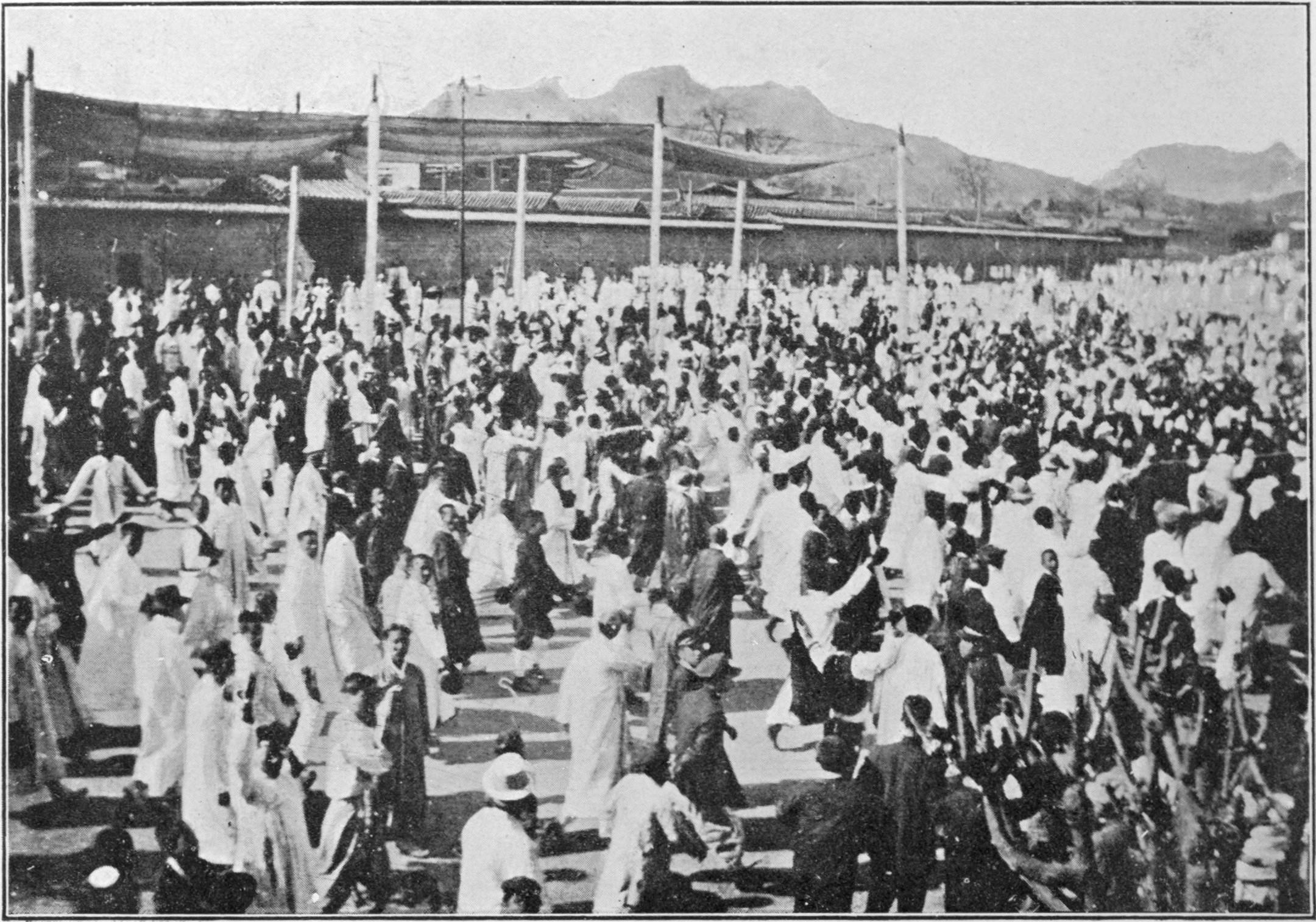
A demonstration in Seoul, March 1919, in Bureau d'information coréen, L'indépendance de la Corée et la paix, public domain
Korea, 1 March to 16 April 1919 · Story · Featured Study
The March First Movement of 1919
Thirty-three men signed a declaration of Korean independence in 1919, and about half of them were Christians.
- Where
- Seoul, Balan market, Jeam-ri
- Who
- Gil Seon-ju, Son Byeong-hui, Horace H. Underwood, Arita Toshio, Taro Utsunomiya
- When
- 1 March to 16 April 1919
Pastors signed a declaration of independence beside the leaders of two other faiths, and that April soldiers burned a village church.
But Peter and the other apostles replied, “We must obey God rather than men.
Summary
The declaration of 1 March set off protests across Korea under Japan. The reprisals fell hard on the churches.
- Christians bore more than their share of the arrests.
- The missionaries had not been told, and they moved from staying out to speaking out.
- Historians differ on who led it and on what the revival of 1907 had done.
The Texts Beside the Declaration
John's sight of those slain stands beside the killing at the village church.
The declaration, in an English of the time, speaks of "the clear leading of God", and its signers held three faiths.
And when the Lamb opened the fifth seal, I saw under the altar the souls of those who had been slain for the word of God and for the testimony they had upheld.
This verse stands beside the Christians who died at Jeam-ri, and it is no verdict on everyone who died that spring.
The Counts by Witness
The signers, the arrests and the dead each stand here with the witness who gave the figure.
The Christian signers number fifteen or sixteen, and the dead at Jeam-ri run from 23 to 29.
| What was counted | The figure | The witness |
|---|---|---|
| The signers, in a report of 1919 | Fifteen Chuntokyo (Cheondogyo, an indigenous Korean religion), fifteen Christian and three Buddhist | The Korean Situation, 1919 |
| The signers, by the roll of names now given | Fifteen Cheondogyo, sixteen Protestant and two Buddhist | Encyclopedia of Korean Culture |
| The arrested | 19,525, with Christians almost 20 percent | A Japanese military police report of 1919, as Timothy S. Lee gives it in 2019 |
| The killed and injured across Korea | Over 7,500 killed and 15,000 injured | Timothy S. Lee, 2019, who names no counting body |
| The men gathered in the church at Jeam-ri | Estimated at thirty | The correspondent of The Japan Advertiser, from survivors, 1919 |
| The dead at Jeam-ri | 29, children among them | The Hankyoreh, 2007 |
| The dead at Jeam-ri | 28, with 22 in the church and 6 outside it; the same article opens with about 20 | Encyclopedia of Korean Culture |
| The dead at Jeam-ri | 23, two wives among them | Seoul Shinmun, 2022 |
The dead at Jeam-ri
From Seoul to Jeam-ri
The declaration was read on 1 March, and the church at Jeam-ri burned on 15 April.
The Encyclopedia of Korean Culture says that Cheondogyo leaders, Son Byeong-hui among them, began the plan from the end of 1918 and agreed to bring in Christians and Buddhists. Timothy S. Lee writes that Christians and Cheondogyo joined forces by 22 February, and Buddhists five days later.
Thirty-three men signed, and the encyclopedia says the Cheondogyo press printed 21,000 copies. The Korean Situation, a pamphlet of the Federal Council of the Churches of Christ in America, prints two reports of that day. The second says, "The head of the Chun Do Kyo signed first and Pastor Kil second". Its Chun Do Kyo is Cheondogyo, and Pastor Kil was Gil Seon-ju of Pyongyang.
On Saturday 1 March, the first report says, "a large number of the signers" met at a Korean hotel, telephoned the authorities to say where they were, and were arrested. The second says all thirty-three met. Korean Wikipedia puts twenty-nine at the Taehwagwan, with four Christians absent: Gil, Yu Yeo-dae, Kim Byeong-jo and Jeong Chun-su.
At Pagoda Park a young man read the declaration at two in the afternoon, Lee writes. The first report says the crowd "walked along in an orderly way" through Seoul, calling "Mansei", the cry of "ten thousand years", and that "No single act of violence was done". It also says mounted gendarmes charged the crowd "and inflicted some sabre cuts".
Lee writes that the rising reached all but seven of Korea's 281 counties. He says the gendarmes "indiscriminately beat and shot demonstrators", and that some demonstrations "turned into violent riots".
The encyclopedia says that about 1,000 people held an independence meeting at Balan market on 31 March and set fire to a Japanese primary school. It says a few people of Jeam-ri took part, and that squads sent to make arrests began the reprisals.
On the afternoon of 15 April Lieutenant Arita Toshio came to Jeam-ri with 11 infantry and 2 police. The encyclopedia says he announced a lecture and called Christian and Cheondogyo men into the church, and the correspondent of The Japan Advertiser says "all the male Christians".
The soldiers shot those inside and set fire to the church, and the encyclopedia tells of two women killed outside it and 31 houses burned.
The next day Horace H. Underwood made the drive from Seoul. With him went Curtice of the American Consulate and the correspondent. A farmer near the market town told Underwood that soldiers had burned the smoking village and said, "that is a Christian village". The farmer called it "Chay amm ni", which is Jeam-ri.
What the commander decided2 paragraphs
The Hankyoreh reported in 2007 on the diary of Taro Utsunomiya, the commander of the Japanese forces in Korea. He and the officials decided to say that "they were killed because they resisted us, and we decided against admitting the arson and massacre".
The Hankyoreh says the diary gave the lieutenant thirty days' disciplinary confinement. The encyclopedia says a court martial sat from 17 July and acquitted him.
The signers afterward2 paragraphs
Korean Wikipedia says Kim Byeong-jo escaped to Shanghai and Yang Han-muk died in custody. It says Gil was held about two years and found not guilty, and that the others were sentenced to between one and a half and three years.
It also says that three signers, Choe Rin, Pak Hui-do and Jeong Chun-su, later stood on the list of collaborators drawn up by a Korean research institute, 민족문제연구소. Two of the three are among the sixteen Protestants of the roll, and Korean Wikipedia is the one source for this.
Korea in 1919
Japan had ruled the country since 1910, and Korean students abroad were already moving.
The declaration speaks of "the agony of ten years of foreign oppression".
The pamphlet's second report dates the first demonstration to two days before the funeral of the former emperor. Its first report says Korean students in Japan had started a movement for self-determination that February.
Lee writes that President Wilson's Fourteen Points of January 1918 moved Korean nationalists, and that Koreans abroad sent representatives home to urge peaceful demonstrations.
Gil Seon-ju had been the leading Korean preacher of the revival at Pyongyang in 1907.
What Is Not Known
Several first-hand records stand behind these counts, and each figure here comes through a later witness.
Timothy S. Lee gives the police report, and The Hankyoreh gives Utsunomiya's diary. Other tallies of the dead and the arrested exist, among them those of the Japanese colonial government and of Park Eun-sik, and their figures do not stand here.
A roll of those killed in the village would settle the number. It is not known who the third Buddhist in the pamphlet's reports was.
The words of the declaration here are the English F. A. McKenzie printed in 1920. The Federal Council warned its own readers, "Many exaggerations have been circulated".
What the Church Bore
Arrests, destroyed churches and the missionaries' change of stance show what the rising cost.
Lee writes that Protestants were "a little over 1 percent of the population". He says that "More than half of the 6,310 religious arrestees were Protestants", with nearly half of the 489 arrested clergy and two-thirds of the 471 arrested women. He gives 47 churches substantially destroyed.
The pamphlet's first report says of the arrests that there was "scarcely a city church which has not its minister locked up".
Lee writes that Koreans had not told the missionaries, who denied the charge of stirring them up and reaffirmed their neutrality. Many tried to dissuade their converts from taking part.
After the atrocities, he says, they changed their slogan to "no neutrality for brutality" and sent reports abroad. The Federal Council published a selection that July.
How the Key Verse Was Taught
Three writers, from the ancient church to the nineteenth century, on the apostles' answer to the council.
John Chrysostom (died 407)
Homilies on the Acts of the Apostles, Homily 13, on Acts 5:29
John Chrysostom noted the tone of the reply.
“Again in the way of exhortation and advice, and with much mildness, they make answer.”
Patristic
John Gill (1697 to 1771)
Exposition of the New Testament, on Acts 5:29
John Gill drew the line for obedience to rulers.
“men, civil magistrates, and ecclesiastical rulers, are to be obeyed in things which are not repugnant to the will of God; but in things that are, God is to be obeyed, and not men.”
Reformed Baptist
Adam Clarke (1762 to 1832)
Commentary on the Bible, on Acts 5:29
Adam Clarke gave the apostles' ground for refusing.
“We have received our commission from God; we dare not lay it down at the desire or command of men.”
Methodist
In Their Own Words
McKenzie gives the declaration in English, and The Korean Situation gives Underwood's statement from Jeam-ri.
The Thirty-Three Signers of the Korean Declaration
"The Proclamation of Korean Independence", in F. A. McKenzie, Korea's Fight for Freedom, p. 247
We herewith proclaim
“We herewith proclaim the independence of Korea and the liberty of the Korean people.”
Other
About this saying1 paragraph
The declaration of 1919 opens with this sentence.
The Thirty-Three Signers of the Korean Declaration
"Three Items of Agreement", in F. A. McKenzie, Korea's Fight for Freedom, p. 249
Let no violence be done
“This work of ours is in behalf of truth, religion and life, undertaken at the request of our people, in order to make known their desire for liberty. Let no violence be done to any one.”
Other
About this saying1 paragraph
The first of the items of agreement at the end of the declaration of 1919 gave this order to those who rose.
Horace H. Underwood
"First Account of Massacres and Burning of Villages", in The Korean Situation, p. 70
In dumb despair
“We saw groups of women, children and old men sitting on the hillside above the village watching the ruins in dumb despair. We walked the entire length of the village, and about halfway up we saw a corpse of a young man, horribly burned, lying just outside of a building, which we learned later had been the church.”
Other
About this saying1 paragraph
Underwood wrote this in his statement on the trip of 16 April 1919.
Who Led It, and What the Revival Had Done
Historians read the Christians' part in different ways.
Who led it?3 paragraphs
Timothy S. Lee reads the arrests as the measure of Protestant leadership, and writes that Protestants "took the lion’s share of leadership in the movement".
The reports of 1919 and the encyclopedia give the first signature and the start of the plan to Cheondogyo.
Young-Hoon Lee writes that the church "planned and processed the Declaration of Independence on March 1 in 1919, independently of the missionaries".
Had the revival turned the church from politics?2 paragraphs
Min Kyung-bae argued in 1974, as Young-Hoon Lee cites him, that the revival of 1907 served a missionary policy of turning the church from politics.
Young-Hoon Lee grants this as "a negative outcome" and answers that "other churches were still involved in political matters and took part in the independence movement as actively as before".
Books to Read Next
The Korean Situation: Authentic Accounts of Recent Events by Eye Witnesses
The Federal Council of the Churches of Christ in America · 1919
The reports of 1 March and the statements from Jeam-ri stand in this pamphlet.
Free at the Internet ArchiveKorea's Fight for Freedom
F. A. McKenzie · 1920
The book gives the declaration in English from page 247.
Free at the Internet ArchiveWhat the Signers Left
The signers left a declaration and a record of arrests, and the argument over who led the rising has not ended.
Sources
Scripture is the Berean Standard Bible.
- The Holy Bible, Berean Standard Bible (read 2026)
- The Korean Situation: Authentic Accounts of Recent Events by Eye Witnesses (New York: Federal Council of the Churches of Christ in America, 1919), pages 11 to 13, 19 to 21 and 68 to 77, the last reprinted from The Japan Advertiser, 29 April 1919.
- F. A. McKenzie, Korea's Fight for Freedom (New York: Fleming H. Revell, 1920), pages 247 to 249.
- Timothy S. Lee, "The Struggle for Korean Independence and the Missionaries Caught in the Middle", Christianity Today, 15 August 2019.
- Encyclopedia of Korean Culture, article E0026764, on the declaration of independence (written 1995, revised 7 February 2023), in Korean.
- Encyclopedia of Korean Culture, article E0031610, on the Jeam-ri massacre (written 1995), in Korean; Arita's name is printed there as 아리다 도시오 [有田俊夫].
- "Diary entry reveals Japanese cover-up of massacre", The Hankyoreh, 1 March 2007.
- 류재민 (Ryu Jae-min), Seoul Shinmun, 10 October 2022, in Korean.
- Korean Wikipedia, 민족대표 33인, in Korean.
- Young-Hoon Lee, "Korean Pentecost: The Great Revival of 1907", Asian Journal of Pentecostal Studies 4:1 (2001), pages 73 to 83.
- John Chrysostom, Homilies on the Acts of the Apostles, Homily 13, on Acts 5:29.
- John Gill, Exposition of the New Testament, on Acts 5:29.
- Adam Clarke, Commentary on the Bible, on Acts 5:29.
Keep Studying
People and groups6
Church history8
Trials of life1