
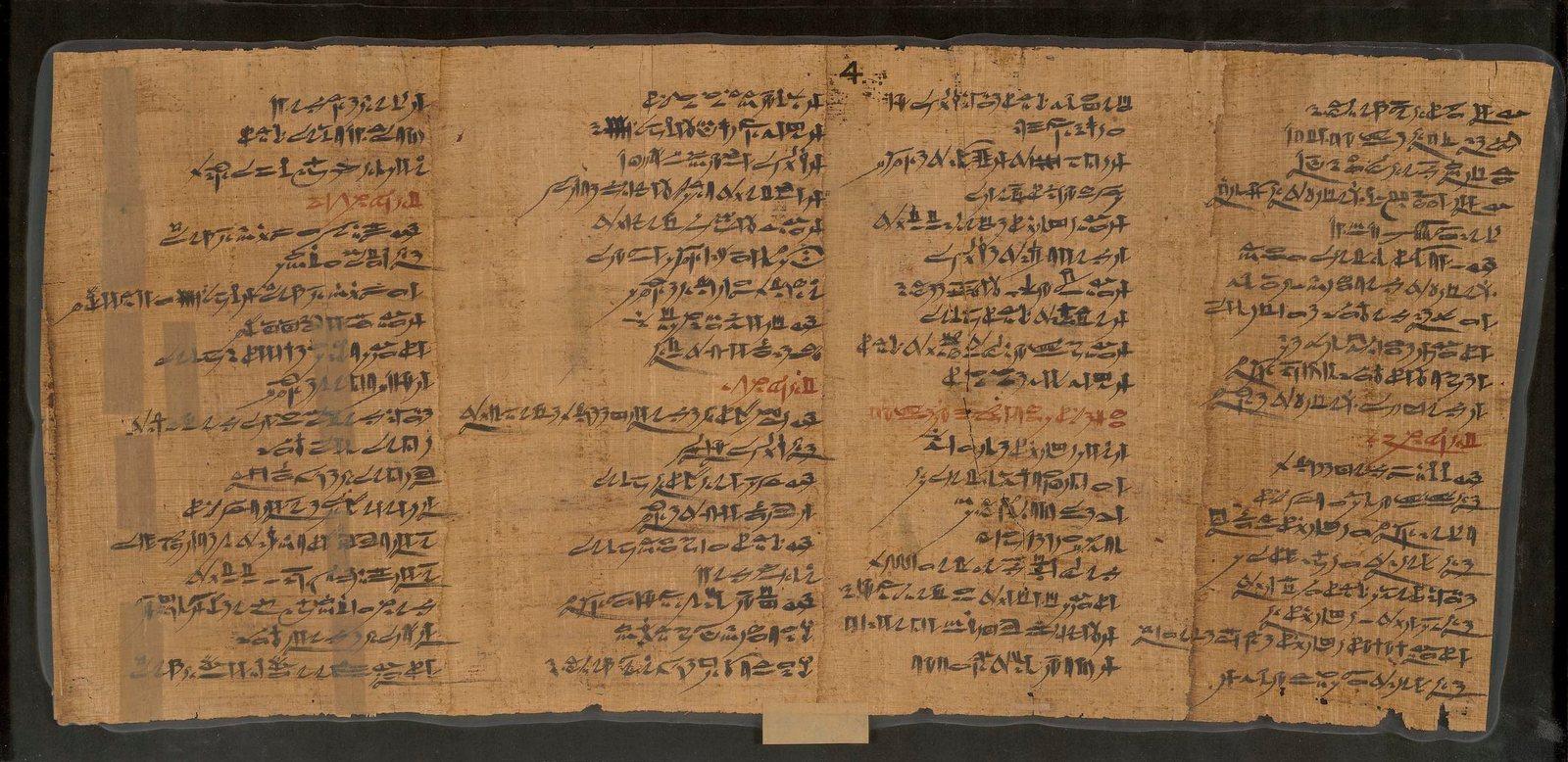
Senu, son of Pemu, The Instruction of Amenemope, 1077 to 664 BC. Public domain.
Proverbs 22:17 to 24:22 · Subject · Featured Study
Proverbs and the Instruction Books of Egypt
The Instruction of Amenemope is an Egyptian book of counsel that runs close to Proverbs 22 and 23.
So that your trust may be in the LORD, I instruct you today—yes, you.
- Book
- Proverbs
- Hold in memory
- Proverbs 1:7
The only complete copy of Ptahhotep's instruction is a papyrus about 23 feet long.
Summary
Egypt had books of advice for a young man, and Proverbs has the same form. Scholars since 1924 have asked which came first, Proverbs or the Egyptian book that is most like it.
- Ptahhotep's instruction survives whole on one papyrus in Paris.
- The Hebrew word in Proverbs 22:20 has been read in four ways.
- Proverbs sets its sayings under the fear of the LORD.
A Father to His Son
Proverbs opens as a father's teaching, and the words of the wise open with a call to listen.
What did Israel's wise men share with the teachers of Egypt? Both wrote their counsel as a father speaking to his son. Proverbs gives that form in its first chapter.
Listen, my son, to your father’s instruction, and do not forsake the teaching of your mother.The book's first call to the son names both parents as teachers.
A new collection opens at Proverbs 22:17 with the words of the wise. Albert Barnes called it a new and distinct section that begins with a general call and then gives its rules one by one. It runs to Proverbs 24:22, and Proverbs 24:23 begins, “These also are sayings of the wise.”
Sayings Side by Side
Oesterley set sayings of Proverbs 22 and 23 beside the lines of Amenemope they resemble.
Five sayings of Proverbs 22 and 23 have a near match in the Instruction of Amenemope.
| Proverbs, in the Berean text | Amenemope, as Oesterley translated it | Chapter of Amenemope |
|---|---|---|
| “Incline your ear and hear the words of the wise” (Proverbs 22:17) | “Give thine ears, hear (the words) that are said, Give thine heart to interpret them.” | Chapter 1 |
| “Have I not written for you thirty sayings about counsel and knowledge” (Proverbs 22:20) | “Consider these thirty chapters; They delight (and) they instruct” | Chapter 30 |
| “Do not make friends with an angry man, and do not associate with a hot-tempered man” (Proverbs 22:24) | “Consort not with a passionate man” | Chapter 9 |
| “Do not move an ancient boundary stone which your fathers have placed.” (Proverbs 22:28) | “Remove not the landmark from the bounds of the field.” | Chapter 6 |
| “it makes wings for itself and flies like an eagle to the sky” (Proverbs 23:5) | “they have made for themselves wings like geese, And have flown into the heavens.” | Chapter 7 |
The Word in Proverbs 22:20
The word has four readings, from the translators, the written text and an emendation.
The Berean text reads the word as thirty. The Hebrew text gives it as shalishim, which James Strong numbers H7991. He defines it as a triple, a threefold measure, and an officer of the third rank, the highest. Barnes and the Cambridge Bible take it to mean excellent or princely things, from the chief of the three warriors in a chariot.
The Cambridge Bible notes that the Septuagint, the Greek translation of the Old Testament, and the Vulgate read “thrice”, or in threefold form. The Pulpit Commentary notes that the written Hebrew text has a word for “formerly”. Oesterley reports that Adolf Erman, by a very slight change in the Hebrew word, read “thirty”, in the light of Amenemope's thirty chapters. Origen, in his Homilies on Joshua, took the verse as counsel that what we read be written on the heart in a threefold way.
Two Instruction Books of Egypt
Ptahhotep and Amenemope each wrote counsel for a son, and each survives on papyrus.
Battiscombe Gunn translated the Instruction of Ptahhotep in 1906. Its opening says Ptahhotep lived in the reign of King Isosi, whom Gunn places as the last king but one of the Fifth Dynasty. The only complete copy is the Prisse Papyrus in Paris. Gunn judged its writing no earlier than the Eleventh Dynasty and probably of the Twelfth.
Ptahhotep asks the king's leave to teach his son, and his sayings follow. One holds that silence is more profitable than abundance of speech. Another says that “a son that hearkeneth” grows old and reaches honour.
The Instruction of Amenemope stands on papyrus EA 10474,1 in the British Museum. The Museum's record says it was bought through E. A. Wallis Budge in 1888. It gives Thebes as the findspot and dates the papyrus only as Third Intermediate, with a question mark. Oesterley wrote that it came from Akhmim.
Budge published the whole text in photographs in 1923 and an English translation in 1924. Scholars dated the book far apart. Oesterley reports that Budge put the work in the fifteenth or sixteenth century BC, and that the Egyptologist Griffith inclined to about 600 BC.
The Fear of the LORD at the Head
Proverbs gives the reason for its sayings in the name of the LORD.
The fear of the LORD is the beginning of knowledge, but fools despise wisdom and discipline.The motto of the whole book stands before any saying of the father.
for the LORD will take up their case and will plunder those who rob them.The saying on robbing the poor ends with the LORD as the poor man's advocate.
Oesterley set Proverbs 22:23 beside Amenemope and found nothing there that answers to it. He called the verse a very natural addition for a Hebrew sage.
Who Borrowed from Whom?
Each answer has its holders and its objection.
Proverbs drew on AmenemopeAdolf Erman; Keimer
Erman set the Egyptian book beside Proverbs in an article of May 1924 in the proceedings of the Prussian Academy. Kevin reports that Keimer laid it down that one must hold fast to the clear dependence of Proverbs 22:17 to 23:14 on the Egyptian original.
The objection: R. O. Kevin argued in 1931 that the influence ran the other way, on evidence of shared thought and of language.
Amenemope drew on a Hebrew bookRobert Oliver Kevin
Kevin, in the Journal of the Society of Oriental Research (1931), held that Amenemope was profoundly influenced by the Hebrew scriptures. He held that the Egyptian wrote his book when a little book of thirty Hebrew proverbs, the words of the wise, fell into his hands.
The objection: Oesterley reports that H. O. Lange asked whether Amenemope used an older Hebrew writing, and asked it only to reject the idea.
Both drew on older wisdomW. O. E. Oesterley
Oesterley concluded that the writers of both books were partly indebted to the common stock of wisdom in the East. For Proverbs 22:17 to 23:14 he asked that the idea of an older Hebrew collection used by both be given more serious thought.
The objection: Oesterley wrote that most who had studied the matter took Amenemope's book as the source of the collection in Proverbs.
So That Your Trust May Be in the LORD
Whatever the debt between the two books, the words of the wise name the reason they were written.
Sources
Scripture is the Berean Standard Bible.
- James Strong, Exhaustive Concordance of the Bible, entry H7991, with the tagged Hebrew text of Proverbs 22:20 (STEP Bible, Tyndale House, CC BY 4.0)
- W. O. E. Oesterley, The Wisdom of Egypt and the Old Testament in the Light of the Newly Discovered Teaching of Amen-em-ope (London: SPCK, 1927)
- Battiscombe G. Gunn, The Instruction of Ptah-hotep and the Instruction of Ke'gemni, Wisdom of the East (1906)
- Robert Oliver Kevin, The Wisdom of Amen-em-apt and Its Possible Dependence upon the Hebrew Book of Proverbs, Journal of the Society of Oriental Research (1931)
- The British Museum, collection record of papyrus EA10474,1, registration number 1888,0515.3.1.
- On Proverbs 22:20: the Cambridge Bible for Schools and Colleges and the Pulpit Commentary; the King James Version of the verse.
- Albert Barnes, Notes on the Old Testament, on Proverbs 22:17 and 22:20; Origen of Alexandria, Homilies on Joshua 21.
Keep Studying
Studies1
People and groups1
Go further2