
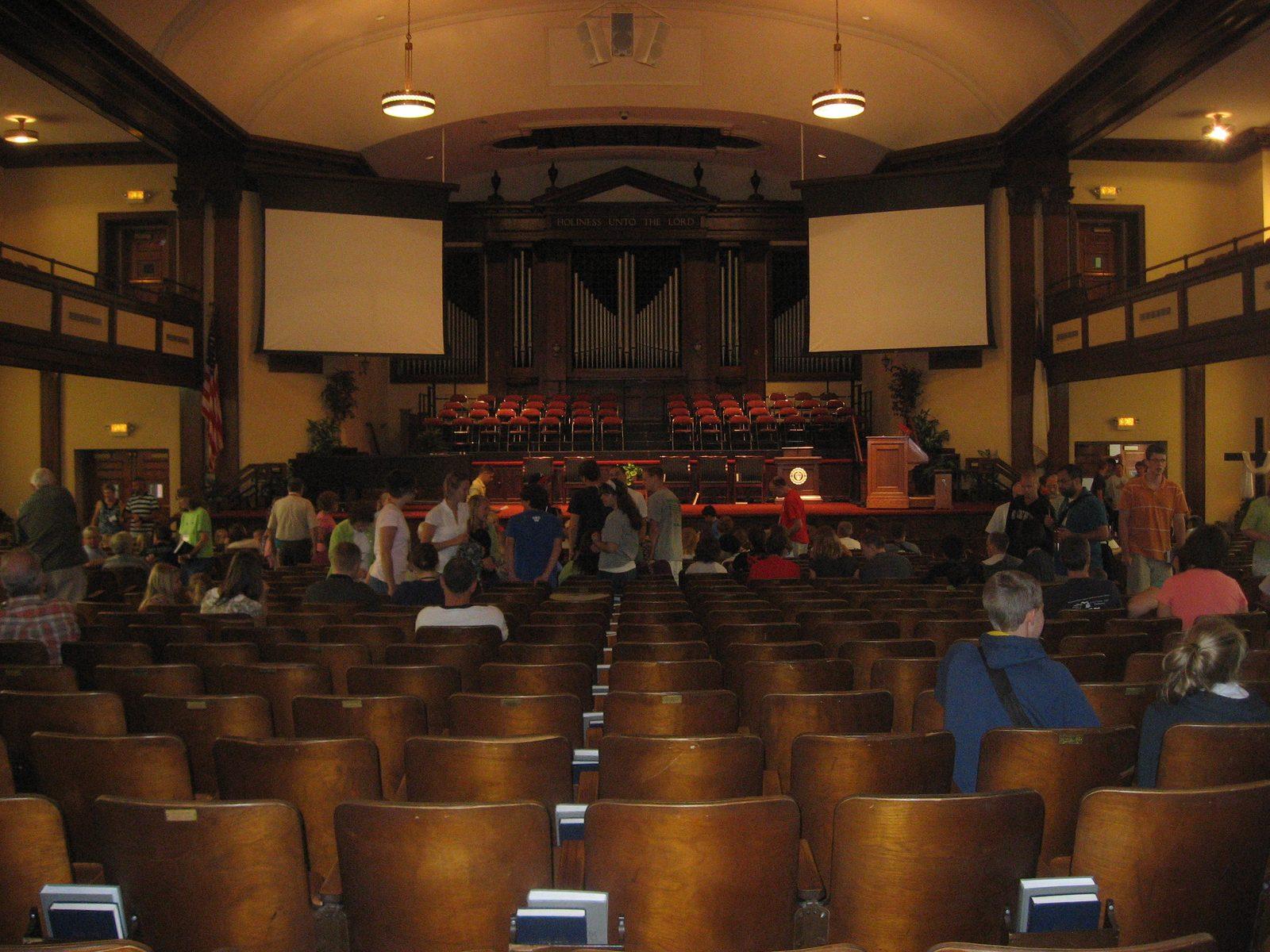
Interior of Hughes Auditorium, Asbury University, Nyttend, 2010. Public domain.
Wilmore, Kentucky, February 1970 · Story · Featured Study
Asbury, 1970
A reporter for Christianity Today wrote of the week within the month and went back to Wilmore a year later.
- Where
- Hughes Auditorium, Wilmore, Kentucky, Asbury Theological Seminary
- Who
- Custer B. Reynolds, Clarence Hunter, David Seamands, Frank Stanger
- When
- From 3 February 1970
The academic dean did not leave the auditorium for the first two days except for food, and his wife prayed and sang for thirty-six hours.
Therefore confess your sins to each other and pray for each other so that you may be healed. The prayer of a righteous man has great power to prevail.
Summary
On 3 February 1970 a morning chapel at Asbury College in Wilmore, Kentucky, did not end at its hour. People stayed to confess and to testify, and the hall stayed open day and night. Teams from the college and the seminary across the street then told of it at other schools and churches.
- The college had about 1,000 students from thirty-eight states and twenty-four foreign countries.
- Slightly more than half of them were Methodist, and the rest came from twenty other church bodies.
- Wilmore then held 2,800 people, fifteen miles south of Lexington.
The Texts of the Confession
Neither report of the time names a verse for the week, and these match what the reports describe.
This study asks what happened at Wilmore in February 1970, who wrote it down and what the people there said had lasted a year later. It gives the three records side by side, the chapel and the days after it as the dean told them, the revivals the school remembered and the way the news travelled. It then gives the words of those who were there. Three questions stay open: what the chapel was meant to be, whether it was planned or prayed for, and what it left behind.
Blessed are those who hunger and thirst for righteousness, for they will be filled.
The professor who gave the invitation spoke of hungry hearts, and this beatitude uses the same figure.
Matthew 5:6BSB
Then Peter stood up with the Eleven, lifted up his voice, and addressed the crowd: “Men of Judea and all who dwell in Jerusalem, let this be known to you, and listen carefully to my words.
The pastor at Wilmore compared his wife's testimony to Peter on the day of Pentecost.
Acts 2:14BSB
The Three Records
Two press reports and the school's archive differ on how long it ran and how far it went.
None of the three records shows a tally, so each figure stands as its source's own.
| The record | The length | The reach |
|---|---|---|
| Christianity Today, 27 February 1970 | Classes resumed on the eighth day | Invitations to at least fifty-nine colleges and churches in sixteen states in the first six days |
| Christianity Today, 12 February 1971 | 185 hours | As many as 600 students and teachers in teams |
| Asbury University's archive guide, as updated in 2026 | 144 hours | Some 2,000 witness teams, to churches and at least 130 college campuses |
The Chapel and the Week After It
Custer Reynolds, the academic dean, is the main witness to the first hour.
The chapel was one of three held each week, set for fifty minutes. Reynolds presided and gave his own testimony, and several students spoke.
Shortly before dismissal, Reynolds said, Clarence Hunter, professor of religion and philosophy, walked to the platform. He spoke in a quiet voice and asked whether any there with hungry hearts would come and accept Christ.
Students came to the altar rail, and two lines formed at the sides of the auditorium. Regular classes were suspended then and there for an indefinite period.
Both presidents were away when it began, Dennis Kinlaw of the college and Frank Stanger of the seminary. By the second day it had reached the seminary.
The first report says people confessed secret hates, frustrations and weaknesses, asked forgiveness and forgave. David Seamands, the United Methodist pastor at Wilmore, publicly confessed his dislike of two faculty members. His wife confessed an aversion, kept buried for years, to the town, its people and his ministry there.
At times the auditorium's 1,500 seats were full, and at others only a few people were in the room. A college official said uncounted hundreds of students gave testimony or made some commitment to Christ that week.
By the sixth day, a Sunday, church groups were coming to the college by the busload. When classes resumed, Reynolds said, "we cannot live at the mountain top". The auditorium stayed open around the clock for weeks, with a service each night at six o'clock.
The Revivals the School Remembered
The school's archive gives five revivals before 1970.
The archive's first is February 1905, when a prayer meeting in the men's dormitory during a blizzard spilled out to the campus and the town. In February 1908 a revival lasted two weeks, and in February 1921 the last service of a planned revival ran until six in the morning.
February 1950 ran for 118 hours by the archive's reckoning, and March 1958 for 63. The report of 1970 says the new revival outlasted both.
College and seminary were close, the report says, but independent of each other, and the report of 1971 places both in the Wesleyan tradition.
How the News Travelled
The teams, a radio net and the college's own publicity carried it beyond Kentucky.
A short-wave radio prayer net linked Asbury each day with sixteen colleges, from Wenham in Massachusetts to Azusa in California. The teams went out during the revival and on the weekends after it.
Stanger called this spread "The greatest phenomenon of this revival", and said he could not explain from a human viewpoint how a group of students could start it elsewhere by telling of it.
By the time students returned from summer vacation, said Arthur Lindsay, the college's director of public relations, it had touched every continent. That is the college's report of itself. The people at Wilmore told the reporter there was no way to determine accurately how many lives had changed.
How the Key Verse Was Taught
Three writers of three centuries read the verse on confessing to one another.
John Wesley (1703 to 1791)
Explanatory Notes upon the New Testament, on James 5:16
A note of 1755 takes confession out of the elders' hands alone.
“He does not say, to the elders: this may, or may not, be done; for it is nowhere commanded. We may confess them to any who can pray in faith: he will then know how to pray for us, and be more stirred up so to do.”
Evangelical
Adam Clarke (1762 to 1832)
Commentary on the Bible, on James 5:16
A commentary of 1832 names what the practice does to the soul.
“This is a good general direction to Christians who endeavor to maintain among themselves the communion of saints. This social confession tends much to humble the soul, and to make it watchful.”
Methodist
Dietrich Bonhoeffer (1906 to 1945)
Life Together
A book of 1939 on life in community says who is heard when a brother hears a confession.
“He hears the confession of our sins in Christ's stead, and he forgives our sins in Christ's name. He keeps the secret of our confessions as God keeps it. When I go to my brother to confess, I am going to God.”
on James 5:16Confessing Church
In Their Own Words
A dean and two presidents gave these words to the press of the time, and a seminary student gave his fifty years on.
Custer B. Reynolds
Quoted in John Nelson, "Revival at Asbury", Christianity Today, 27 February 1970, the paragraph on the eighth day
A witnessing revival
“It was a witnessing, not a preaching, revival”
Methodist layman
About this saying1 paragraph
The dean drew this line between the week and a preacher's mission in February 1970.
Frank Stanger
Quoted in John Nelson, "Revival at Asbury", Christianity Today, 27 February 1970, the closing paragraph
Thirty days from now
“Don’t ask me about the revival now. Ask me thirty days from now. If it’s genuine, this will show in what happens in the weeks ahead.”
Wesleyan
About this saying1 paragraph
The seminary's president gave this answer in February 1970, when he was first asked for his judgment.
Dennis F. Kinlaw
Quoted in John F. Nelson, "Asbury Revisited", Christianity Today, 12 February 1971, the paragraph on the college's administration
The little things
“the cleaning out of the little things that kill your academic, spiritual, and administrative efficiency.”
Wesleyan
About this saying1 paragraph
In 1971 the college's president, speaking as an administrator, named this as the most significant result.
Joe Culumber
Stories from the 1970 Revival, Asbury University, for the fiftieth anniversary, his memory of Greenville College
Streaming to the altar
“After a few of us shared what we had witnessed in Wilmore, students spontaneously began streaming to the altar.”
Wesleyan
About this saying1 paragraph
A seminary senior of 1970 remembered this visit to Greenville College, in Illinois, for the fiftieth anniversary.
What the Records Leave Open
The people of the school hold most of the reserve on record, since neither report quotes a critic from outside it.
What was the chapel meant to be?1 paragraph
The archive guide says Reynolds was scheduled to speak and felt led to invite testimony instead. The report of 1970, taken from Reynolds within the month, calls singing and testimony the program itself, a type of service held from time to time.
Was it planned or prayed for?1 paragraph
Harold Spann, the dean of students, said there was "no recruiting to sing or testify" at any time, and he felt it was a genuine movement of the Holy Spirit. The archive guide adds that many on campus had been praying for spiritual renewal and were in an expectant mood.
What did it leave behind?2 paragraphs
Seamands reported the finest consistent attendance of his nine years at Wilmore, and over $17,500 given on one Sunday morning against a goal of $10,000 for missions. An unnamed resident credited the revival with saving the college.
Seamands also reported deep depression among people who expected their personal problems to be erased. The reporter found some at the school yearning for the past rather than striving to grow.
Books to Read Next
Revival at Asbury
John Nelson, Christianity Today · 1970
Nelson's first report gives the chapel as the dean told it.
Read the report at Christianity TodayAsbury Revisited
John F. Nelson, Christianity Today · 1971
The second report holds the doubts of the people of Wilmore as well as the gains.
Read the second report at Christianity TodayRevivals at Asbury
Asbury University Library Archives · 2026
The guide holds the school's own account of every revival, with its references.
Read the archive's guideWhat the Week Left
A year on, a junior from Florida told the reporter that "Asbury today is no utopia", and most students, he wrote, agreed with her.
Sources
Scripture is the Berean Standard Bible.
- The Holy Bible, Berean Standard Bible (read 2026)
- John Nelson, "Revival at Asbury", Christianity Today, 27 February 1970.
- John F. Nelson, "Asbury Revisited", Christianity Today, 12 February 1971.
- Asbury University Library Archives, guide to the revivals, updated 21 September 2026.
- Asbury University, Stories from the 1970 Revival, alumni memories for the fiftieth anniversary.
Keep Studying
People and groups6
Subjects1
Go further2