
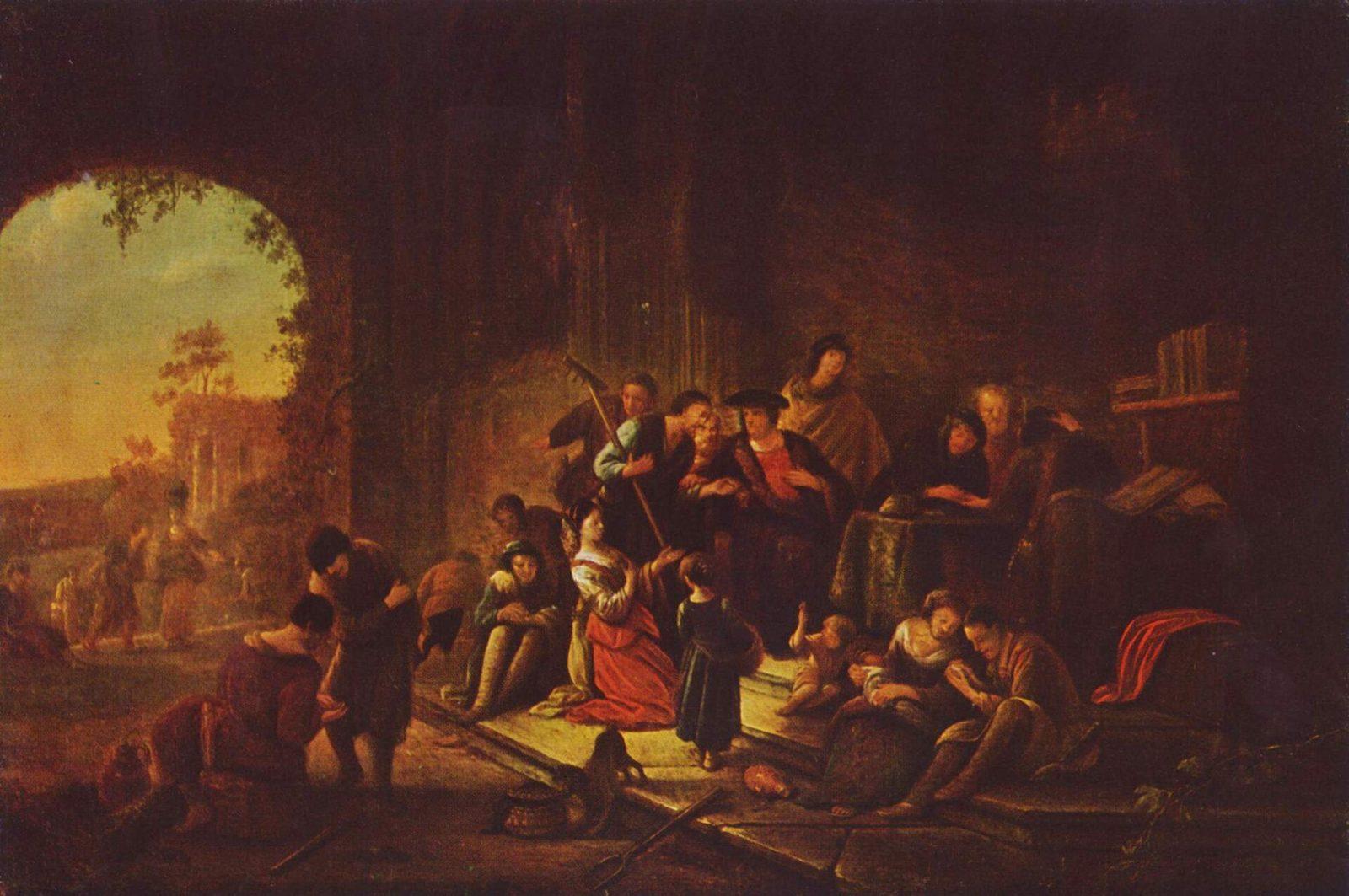
Jacob Willemsz de Wet, The Labourers in the Vineyard, 17th century. Public domain.
Matthew 20:1 to 16 · Passage · Featured Study
The Workers in the Vineyard
Jesus told this parable after Peter asked what the disciples would receive for leaving everything.
Do I not have the right to do as I please with what is mine? Or are you envious because I am generous?’
- The passage
- Matthew 20:1 to 16
- Book
- Matthew
- Hold in memory
- Matthew 20:15, Matthew 20:16
A man who worked one evening hour is paid the same as men who worked through the heat of the day.
Summary
A landowner hired workers for his vineyard at dawn and agreed to pay them a denarius. He hired more at the third, sixth, ninth and eleventh hours. At evening he paid every worker a denarius, beginning with the last. The first workers grumbled, and the owner answered that he had the right to be generous with what was his.
- The first workers received the wage they had agreed to.
- The last workers were hired late because no one had hired them.
- Readers take the hours as the ages of the world, as the stages of a life, or as one lesson.
Peter's Question
Matthew 19 ends with a rich man's departure and a promise to those who left everything.
A rich young man asked Jesus what good thing he must do to obtain eternal life, and he went away in sorrow (Matthew 19:16 to 22).
“Look,” Peter replied, “we have left everything to follow You. What then will there be for us?”Peter speaks for men who had done what the rich young man would not do.
Jesus promised a hundredfold to everyone who had left home and family for His name. He then said that many who are first will be last (Matthew 19:29 to 30), and He began the parable with the word "For".
The Hours Worked for One Denarius
The owner went out five times in one day, from early morning to the eleventh hour.
The first workers gave twelve hours to the vineyard and the last gave one, and each received one denarius.
- one denarius, as agreed
- one denarius
The five counts as a table
| Hired | Hours worked | Paid | Verse |
|---|---|---|---|
| Early in the morning | 12 | one denarius, as agreed | Matthew 20:1 to 2 |
| About the third hour | 9 | one denarius | Matthew 20:3 to 4 |
| About the sixth hour | 6 | one denarius | Matthew 20:5 |
| About the ninth hour | 3 | one denarius | Matthew 20:5 |
| About the eleventh hour | 1 | one denarius | Matthew 20:6 to 7 |
Each bar counts the hours a group worked before evening. The text says only that the first group was hired early, so its bar begins at the first hour.
Evening and the Pay
The first workers saw the last ones paid before their own turn came.
When evening came, the owner of the vineyard said to his foreman, ‘Call the workers and pay them their wages, starting with the last ones hired and moving on to the first.’ The workers who were hired about the eleventh hour came and each received a denarius. So when the original workers came, they assumed they would receive more. But each of them also received a denarius.The grumbling that follows grows out of what these verses show.
On receiving their pay, they began to grumble against the landowner. ‘These men who were hired last worked only one hour,’ they said, ‘and you have made them equal to us who have borne the burden and the scorching heat of the day.’The grumblers state their own case, and it rests on the length and the heat of their day.
The Marketplace and the Evening Wage
Day labourers waited to be hired in the town's market, and the Law required their wage before night.
Albert Barnes explained that the Jews divided the day into twelve hours from sunrise to sunset. The third hour therefore fell about nine in the morning. He wrote that the men in the marketplace were waiting in the proper place to find an employer. Adam Clarke wrote that he had often seen labourers standing in the market places of large towns, waiting to be hired.
Barnes and Clarke both placed the eleventh hour about five in the afternoon, with one working hour left.
You are to pay his wages each day before sunset, because he is poor and depends on them. Otherwise he may cry out to the LORD against you, and you will be guilty of sin.The Law set the time of payment the owner keeps when he pays at evening.
The Owner's Answer
The owner's answer turns on what he promised and what is his to give.
But he answered one of them, ‘Friend, I am not being unfair to you. Did you not agree with me on one denarius? Take your pay and go. I want to give this last man the same as I gave you.The answer stands here because it meets the grumblers' charge of unfairness.
Gregory the Great explained where a just complaint would lie.
“Hence the same householder says: ‘I wish to give to this last one even as to you.’ And because the very reception of the kingdom is the goodness of His will, He rightly adds: ‘Or is it not lawful for me to do what I wish?’ For it is a foolish complaint of man against the kindness of God. For there would be no cause for complaint if He does not give what He does not owe, but only if He did not give what He owed.”
Gregory the Dialogist · Forty Gospel Homilies, Homily 19 · on Matthew 20:14Patristic
So the last will be first, and the first will be last.”Jesus closes the parable with the saying He spoke before it, in the reverse order.
Read The Last Will Be First, the parable studied for the value of servanthood
Matthew Henry on the Owner's Generosity
Matthew Henry read the evening pay as a lesson about grace.
Matthew Henry (1662 to 1714)
Henry set the full day's wage beside the crowds that Christ fed, where everyone ate and was filled.
“Those whom Christ fed miraculously, though of different sizes, men, women, and children, did all eat, and were filled. The giving of a whole day's wages to those that had not done the tenth part of a day's work, is designed to show that God distributes his rewards by grace and sovereignty, and not of debt.”
Matthew Henry · Commentary on the Whole Bible · on Matthew 20:9 to 10Puritan
He drew from the owner's answer a rule for the one who receives and for the one who does not.
“Because it is free grace, that is given to those that have it, boasting is for ever excluded; and because it is free grace, that is withheld from those that have it not, murmuring is for ever excluded.”
Matthew Henry · Commentary on the Whole Bible · on Matthew 20:13 to 14Puritan
What the Hours Stand For
Teachers from Gregory the Great to Charles Spurgeon have read the five hirings in three ways.
The ages of the world, with the Gentiles called lastGregory the Great, Forty Gospel Homilies, Homily 19 (604); John Wesley, Explanatory Notes upon the New Testament (1755), on Matthew 20:9
Gregory read the morning and the third, sixth and ninth hours as the Hebrew people from the beginning of the world, and the eleventh hour as the Gentiles. He gave the last workers' answer as the Gentiles' own, since no patriarch and no prophet had come to them. Wesley gave the Gentiles as the first of his two readings of the eleventh hour.
The objection: the story was spoken to men who had already left everything to follow Him (Matthew 19:27).
The stages of one life, with some called in old ageGregory the Great, Forty Gospel Homilies, Homily 19 (604); John Gill, Exposition of the New Testament (1746 to 1748), on Matthew 20:9; John Wesley, Explanatory Notes upon the New Testament (1755), on Matthew 20:9
Gregory also read the hours as the ages of each person, from childhood at the morning to old age at the eleventh hour. John Gill named those called in old age as one meaning of the last workers. Wesley named those who heard the gospel call late in their day of life.
The objection: the last workers stood idle because no one hired them (Matthew 20:7). A man who heard the call young and put it off does not fit their answer.
A single lesson about grace and rewardCharles Spurgeon, The Metropolitan Tabernacle Pulpit, Sermon No. 2517 (1897) and Sermon No. 664, Early and Late (1865)
Spurgeon taught that no parable teaches all sides of the truth, and that a parable conveys one lesson. In Early and Late he named that lesson as a rebuke to the spirit that calculates reward in a kingdom whose reward is of grace.
The objection: Spurgeon himself went on in the same sermon to teach from the different hours of the hiring.
The Last Hired, Paid First
Gregory the Great saw the owner's order of pay in the thief who was crucified beside Jesus.
“Did not the thief come at the eleventh hour, who, even if he did not have time through age, yet had it late through punishment, who confessed God on the cross, and breathed out the spirit of life almost with the voice of his sentence? The householder began to give the denarius from the last, because he led the thief to the rest of paradise before Peter.”
Gregory the Dialogist · Forty Gospel Homilies, Homily 19 · on Matthew 20:8Patristic
Then he said, “Jesus, remember me when You come into Your kingdom!” And Jesus said to him, “Truly I tell you, today you will be with Me in Paradise.”The promise of Paradise that day is the payment Gregory had in mind.
Sources
Scripture is the Berean Standard Bible.
- Albert Barnes, Notes, Explanatory and Practical, on the New Testament (1832 to 1869), on Matthew 20:3 and Matthew 20:6.
- Adam Clarke, Commentary on the Bible (1832), on Matthew 20:3 and Matthew 20:6.
- Gregory the Great, Forty Gospel Homilies, Homily 19 (604), on Matthew 20:3 to 14.
- John Wesley, Explanatory Notes upon the New Testament (1755), on Matthew 20:9.
- John Gill, Exposition of the New Testament (1746 to 1748), on Matthew 20:9.
- Charles Spurgeon, The Metropolitan Tabernacle Pulpit, Sermon No. 664, Early and Late (1865), and Sermon No. 2517, From Twenty-five to Thirty-five (1897)
- Matthew Henry, Commentary on the Whole Bible (1710), on Matthew 20:9 to 14.
Keep Studying
Studies5
People and groups2
Symbols1
Go further7