
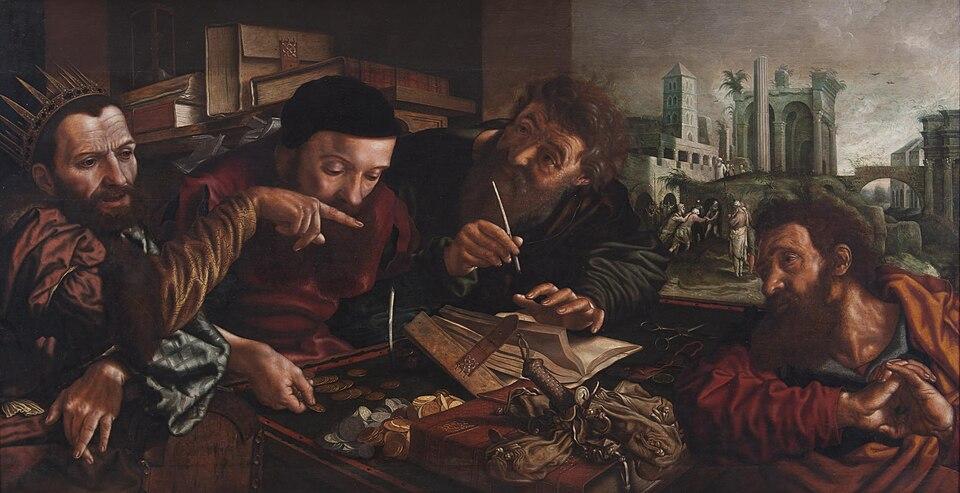
Jan Sanders van Hemessen, The Parable of the Unmerciful Servant, about 1556. Public domain.
Matthew 18:23 to 35 · Passage · Featured Study
The Unforgiving Servant
The parable closes the teaching of Matthew 18 on how the disciples treat one another.
Shouldn’t you have had mercy on your fellow servant, just as I had on you?’
- The passage
- Matthew 18:23 to 35
- Book
- Matthew
- Hold in memory
- Matthew 18:33, Matthew 18:35
A servant forgiven a debt he could never pay chokes his fellow servant over a small one.
Summary
A king forgave a servant who owed him ten thousand talents. The same servant then had a fellow servant thrown into prison over a hundred denarii. When the king heard of it, he handed the first servant over to the jailers. Jesus ended the parable with a warning about forgiving a brother from the heart.
- Both debtors fall down and beg for patience, and only the king shows mercy.
- The king forgave the whole debt, though the servant asked only for time.
- Readers differ over whether the parable teaches that a forgiven debt can be called back.
The Question Behind the Parable
Matthew 18 moves from a brother who sins to the number of times he is forgiven.
Jesus had just told His disciples how to go to a brother who sins against them (Matthew 18:15 to 17).
Then Peter came to Jesus and asked, “Lord, how many times shall I forgive my brother who sins against me? Up to seven times?” Jesus answered, “I tell you, not just seven times, but seventy-seven times!Peter's question and the answer to it are the reason the parable is told.
Read Seventy Times Seven, on Peter's question and the number
The Two Debtors Side by Side
The servant meets the king and then meets his fellow servant, and each meeting has the same four parts.
The servant receives mercy in the first scene and refuses the same plea in the second.
| The step | The king and the servant | The servant and his fellow |
|---|---|---|
| The debt | ten thousand talents | a hundred denarii |
| The demand | the debtor to be sold with his wife and children | the debtor grabbed and choked |
| The plea | the servant on his knees, begging for patience and promising to repay everything | the fellow servant on the ground, begging for patience and promising to repay |
| The answer | compassion, the debt forgiven and the man released | a refusal, and the man thrown into prison |
From the King's Table to the Prison
The parable moves from the king's table to the street and back to the king.
Origen of Alexandria noticed a difference in how the two debtors fall down before their creditors.
“Observe the exactness of Scripture; the servant who owed many talents fell down, and worshipped the king; he who owed the hundred denarii falling down, did not worship, but besought his fellow servant, saying, Have patience. But the ungrateful servant did not even respect the very words which had saved himself, for it follows, but he would not.”
Origen of Alexandria · Catena Aurea by Aquinas · on Matthew 18:29 to 30Patristic
When his fellow servants saw what had happened, they were greatly distressed, and they went and recounted all of this to their master.The other servants are grieved by what they see, and their report brings the case back to the king.
Then the master summoned him and declared, ‘You wicked servant! I forgave all your debt because you begged me.The king's charge rests on the mercy he had already shown.
Talents, Denarii and Debtors Sold
The two debts are named in two different coins, and the first debt carries the threat of slavery.
Albert Barnes explained a talent as a weight of silver or gold equal to three thousand shekels. Adam Clarke wrote that ten thousand, a myriad, was the highest number known in Greek arithmetical notation.
Barnes described the denarius as a Roman silver coin in common use. He judged the hundred denarii a very small sum beside the debt the first servant had been forgiven.
John Wesley noted that creditors in several countries once had the power to sell an insolvent debtor.
But if it happens after sunrise, there is guilt for his bloodshed. A thief must make full restitution; if he has nothing, he himself shall be sold for his theft.This verse shows that Israel's own law knew the sale of a man who could not pay what he owed.
In the days of Elisha a widow's creditor came to take her two children as slaves for her dead husband's debt (2 Kings 4:1).
From Your Heart
Jesus gives the parable's lesson Himself in its last verse.
That is how My heavenly Father will treat each of you unless you forgive your brother from your heart.”The last verse applies the story to every disciple and names the heart as the place of forgiveness.
Jerome held that the words "from your heart" were added to rule out every forgiveness that is only pretended. John Chrysostom drew a lesson from the words "My heavenly Father".
“What then means the parable? ‘So likewise shall my Father do also unto you,’ He saith, ‘if ye from your hearts forgive not every one his brother their trespasses.’ He saith not ‘your Father,’ but ‘my Father.’ For it is not meet for God to be called the Father of such a one, who is so wicked and malicious. Two things therefore doth He here require, both to condemn ourselves for our sins, and to forgive others; and the former for the sake of the latter, that this may become more easy (for he who considers his own sins is more indulgent to his fellow-servant); and not merely to forgive with the lips, but from the heart. Let us not then thrust the sword into ourselves by being revengeful. For what grief hath he who hath grieved thee inflicted upon thee, like thou wilt work unto thyself by keeping thine anger in mind, and drawing upon thyself the sentence from God to condemn thee? For if indeed thou art watchful, and keepest thyself under control, the evil will come round upon his head, and it will be he that will suffer harm; but if thou shouldest continue indignant, and displeased, then thyself wilt undergo the harm not from him, but from thyself. Say not then that he insulted thee, and slandered thee, and did unto thee ills beyond number; for the more thou tellest, so much the more dost thou declare him a benefactor. For he hath given thee an opportunity to wash away thy sins; so that the greater the injuries he hath done thee, so much more is he become to thee a cause of a greater remission of sins. For if we be willing, no one shall be able to injure us, but even our enemies shall advantage us in the greatest degree. And why do I speak of men? For what can be more wicked than the devil; yet nevertheless, even hence have we a great opportunity of approving ourselves; and Job showeth it. […]”
John Chrysostom · Homily on the Gospel of Matthew 61 · on Matthew 18:35Patristic
The same link between the forgiveness a disciple receives and the forgiveness he gives stands in the prayer Jesus taught.
For if you forgive men their trespasses, your heavenly Father will also forgive you. But if you do not forgive men their trespasses, neither will your Father forgive yours.Jesus' comment on His own prayer states in plain words what the parable shows in a story.
A Preacher on Matthew 18:33
A Pentecostal evangelist turned the king's question on the preachers themselves.
David Wilkerson (1931 to 2011)
“Some of us have been so busy preaching John 3:16 that we had forgotten Matthew 18:33.”
David Wilkerson · If We Lose This Generation, the World Pentecostal Conference, 1970, in the Pentecostal Evangel, 27 December 1970, as Assemblies of God News reproduced it, This Week in AG History, December 1970Pentecostal
Is a Forgiven Debt Called Back?
Four readings of verse 34 are held: two on the forgiven debt and two on the length of the sentence.
God calls back the debt of one who will not forgiveAugustine of Hippo, Sermon 83, in Thomas Aquinas, Catena Aurea, on Matthew 18:35; John Chrysostom, Homily on the Gospel of Matthew 61
Augustine has God say that He forgave first, and that He will call back and require again all He remitted from one who does not forgive. Chrysostom retold the end of the parable as the servant cast again into prison until he paid off the whole.
The objection: verse 35 draws its lesson for the disciple's own conduct, and verse 34 belongs to the story's world of kings and debtors.
The parable teaches the one lesson Jesus gives itAlbert Barnes, Notes on the New Testament, on Matthew 18:35
Barnes held that when Christ explains His own parable, the reader receives it as He explained it and draws no doctrine from the parts He left unexplained. He found three truths in verse 35: our sins are great, God forgives them freely, and the wrongs done to us are small by comparison.
The objection: verse 35 says the Father will treat the unforgiving in the same way, and verse 34 is the treatment it names.
The debt is never paid, so the sentence has no endRemigius of Rheims, in Thomas Aquinas, Catena Aurea, on Matthew 18:34; Theophylact of Ohrid, Commentary on Matthew (1107)
Remigius of Rheims read the jailers who torture the servant as the demons of eternal punishment. He held that the word "until" stands for no end, so the debtor is ever paying and never clear of the debt. Theophylact of Ohrid read them as the powers of eternal punishment.
The objection: the story ends at verse 34 and says nothing of what follows the imprisonment.
The jailers keep a debtors' prisonAlbert Barnes, Notes on the New Testament, on Matthew 18:34
Barnes held that the men who receive the servant were keepers of the prison. He argued that torture was inflicted on criminals and that the servant was punished by imprisonment until the debt was paid.
The objection: the Berean text says the servant was turned over "to be tortured", and Adam Clarke read the word as torture added to captivity.
As God Forgave You
Paul taught the churches to forgive by the measure of what God had forgiven them.
Be kind and tenderhearted to one another, forgiving each other just as in Christ God forgave you.Paul sets the same measure as the king of the parable, the forgiveness God gave in Christ.
On the cross Jesus prayed for the men who crucified Him (Luke 23:34).
Sources
Scripture is the Berean Standard Bible.
- Origen of Alexandria (253), on Matthew 18:29 to 30, in Thomas Aquinas, Catena Aurea (1264)
- Albert Barnes, Notes, Explanatory and Practical, on the New Testament (1832 to 1869), on Matthew 18:24, 18:28, 18:34 and 18:35.
- Adam Clarke, Commentary on the Bible (1832), on Matthew 18:24 and 18:34.
- John Wesley, Explanatory Notes upon the New Testament (1755), on Matthew 18:25.
- Jerome (420), on Matthew 18:35, in Thomas Aquinas, Catena Aurea (1264)
- John Chrysostom, Homily on the Gospel of Matthew 61 (407), on Matthew 18:23 to 35.
- Augustine of Hippo, Sermon 83 (430), on Matthew 18:35, in Thomas Aquinas, Catena Aurea (1264)
- Remigius of Rheims (533), on Matthew 18:34, in Thomas Aquinas, Catena Aurea (1264)
- Theophylact of Ohrid, Commentary on Matthew (1107), on Matthew 18:34.
- David Wilkerson, If We Lose This Generation, the World Pentecostal Conference, 1970, in the Pentecostal Evangel, 27 December 1970.
Keep Studying
Studies7
People and groups2
Doctrines1
Go further7
Values2