
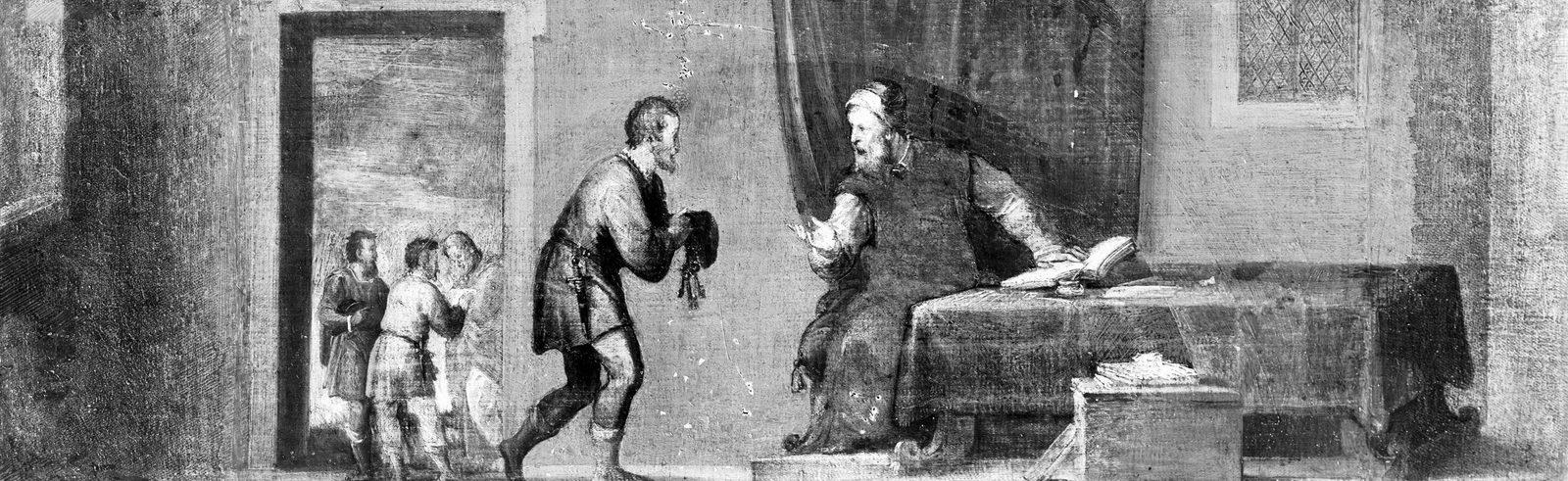
Andrea Schiavone, Die Parabel vom ungerechten Haushalter, 1550 to 1560. Public domain.
Luke 16:1 to 13 · Passage · Featured Study
The Shrewd Manager
Jesus told His disciples of a manager who was about to lose his post and cut his master's debts to win friends.
I tell you, use worldly wealth to make friends for yourselves, so that when it is gone, they will welcome you into eternal dwellings.
- The passage
- Luke 16:1 to 13
- Book
- Luke
- Hold in memory
- Luke 16:9, Luke 16:13
Jesus drew a lesson for His disciples from the conduct of a dishonest man.
Summary
A rich man learned that his manager was wasting his goods and told him he would lose his post. The manager called in his master's debtors and cut their bills. He hoped they would take him into their homes. The master praised him for acting shrewdly.
- Adam Clarke gave a bath of oil as about seven and a half gallons and a cor of wheat as about seventy-five.
- Readers differ over whether the manager cheated his master again or gave up a share that was his own.
- Teachers from Augustine to Wesley praise the manager's foresight and condemn his fraud.
The Manager's Plan
The parable follows the three parables of the lost in Luke 15:3 to 32.
Jesus told this parable to His disciples (Luke 16:1). The lost sheep, the lost coin and the lost son had been told to the Pharisees and scribes who grumbled at Him (Luke 15:2 to 3).
The manager said to himself, ‘What shall I do, now that my master is taking away my position? I am too weak to dig and too ashamed to beg. I know what I will do, so that after my removal from management, people will welcome me into their homes.’The manager thinks aloud, and his plan for his future drives the rest of the story.
A manager, or steward, ran a household's business for its owner.
Two Bills Rewritten
The manager told each debtor to take his bill and write a smaller sum.
The oil bill fell from 100 measures to 50, and the wheat bill from 100 to 80.
- As owed
- As rewritten
The four counts as a table
Each bar is one bill as owed or as rewritten, in the measures Luke names: baths of oil and cors of wheat.
Friends by Worldly Wealth
Jesus turned the manager's plan into a charge for His disciples.
Ambrose of Milan read the friends as the poor, who are made friends by giving. Augustine warned that the saying gives no leave to take from others in order to give alms.
Faithful with Very Little
Four sayings follow the parable, and the last names the choice between God and money.
Jesus moved from the manager to a rule of trust (Luke 16:10 to 12). Whoever handles worldly wealth faithfully will be trusted with true riches.
No servant can serve two masters. Either he will hate the one and love the other, or he will be devoted to the one and despise the other. You cannot serve both God and money.”The last saying sets the parable's wealth against God as a master to serve.
Debts Paid in Kind
Albert Barnes and Adam Clarke agree on who the debtors were.
Albert Barnes took the debtors to be people who rented land from the rich man and owed him part of its produce. Adam Clarke read them the same way, as tenants who paid their rents in wheat, oil and other produce.
Why the Master Praised Him
Jesus compared the people of this age with the sons of light.
The master commended the dishonest manager because he had acted shrewdly. For the sons of this age are more shrewd in dealing with their own kind than are the sons of light.The verse names the one quality that wins approval.
Albert Barnes noted that the praise comes from the master in the story, who praised the manager's wisdom while the verse still calls him dishonest. John Wesley called the dishonesty detestable and the foresight worth copying in the weightier affairs of another life.
What the Discounts Were
Readers explain the reduced bills in three ways, and each way changes what the master praised.
A further fraud against the masterAugustine of Hippo, Sermon 359A; J. C. Ryle, Expository Thoughts on the Gospels: Luke (1858)
Augustine called the manager a cheat who stole from his master and then caused him further loss to secure his own future. Ryle wrote that the steward cheated his master and broke the eighth commandment.
The objection, as Mathewson sets it out: a master who praises a steward who has cheated him is hard to explain, and the newer readings were put forward to explain it.
The interest the law forbade, taken offJ. D. M. Derrett, Fresh Light on Luke XVI, New Testament Studies 7 (1961)
Dave L. Mathewson reports that Derrett read the bills as holding usurious interest, which the manager removed. The law of Moses forbade an Israelite to charge his brother interest on food or money (Deuteronomy 23:19).
The objection: Mathewson reports that J. S. Kloppenborg compared Egyptian loan documents and found that the usual rates of interest do not match the amounts the parable takes off.
The manager's own commission, given upJ. A. Fitzmyer, The Story of the Dishonest Manager, Theological Studies 25 (1964)
In Mathewson's account, Fitzmyer took each bill to carry the manager's own commission, so he cut only his own share. On this reading he was not acting unjustly in the cuts at all.
The objection: Mathewson reports Kloppenborg's case, from literary sources, that household agents were paid in no single fixed way, and the parable never mentions a commission.
Dave L. Mathewson, writing in the Journal of the Evangelical Theological Society in 1995, judged that none of the newer readings overturns the old one.
The Pharisees Scoffed
The next story in Luke answers the scorn of the parable's hearers.
Luke records that the Pharisees heard all of this and scoffed at Jesus, because they loved money (Luke 16:14). Tertullian read their scorn as the sign that they understood mammon to mean money.
Sources
Scripture is the Berean Standard Bible.
- Adam Clarke, Commentary on the Bible (1832), on Luke 16:4, Luke 16:6 and Luke 16:7.
- Albert Barnes, Notes, Explanatory and Practical, on the New Testament (1832 to 1869), on Luke 16:6 and Luke 16:8.
- Augustine of Hippo, Sermon 359A (about 430), on Luke 16:8, and Sermon 113 on Luke 16:9, in Thomas Aquinas, Catena Aurea (1264)
- J. C. Ryle, Expository Thoughts on the Gospels: Luke (1858), on Luke 16:1 to 12.
- Dave L. Mathewson, an article on Luke 16:1 to 13, Journal of the Evangelical Theological Society 38/1 (March 1995) 29 to 39, reporting J. D. M. Derrett, New Testament Studies 7 (1961) 198 to 219, J. A. Fitzmyer, Theological Studies 25 (1964) 23 to 42, and J. S. Kloppenborg, Biblica 70 (1989)
- John Wesley, Explanatory Notes upon the New Testament (1755), on Luke 16:8.
- Ambrose of Milan, Exposition of the Gospel of Luke (397), on Luke 16:9.
- Tertullian, Against Marcion, Book 4, on Luke 16:13 to 14.
Keep Studying
Studies6
People and groups2
Doctrines1
Go further7