
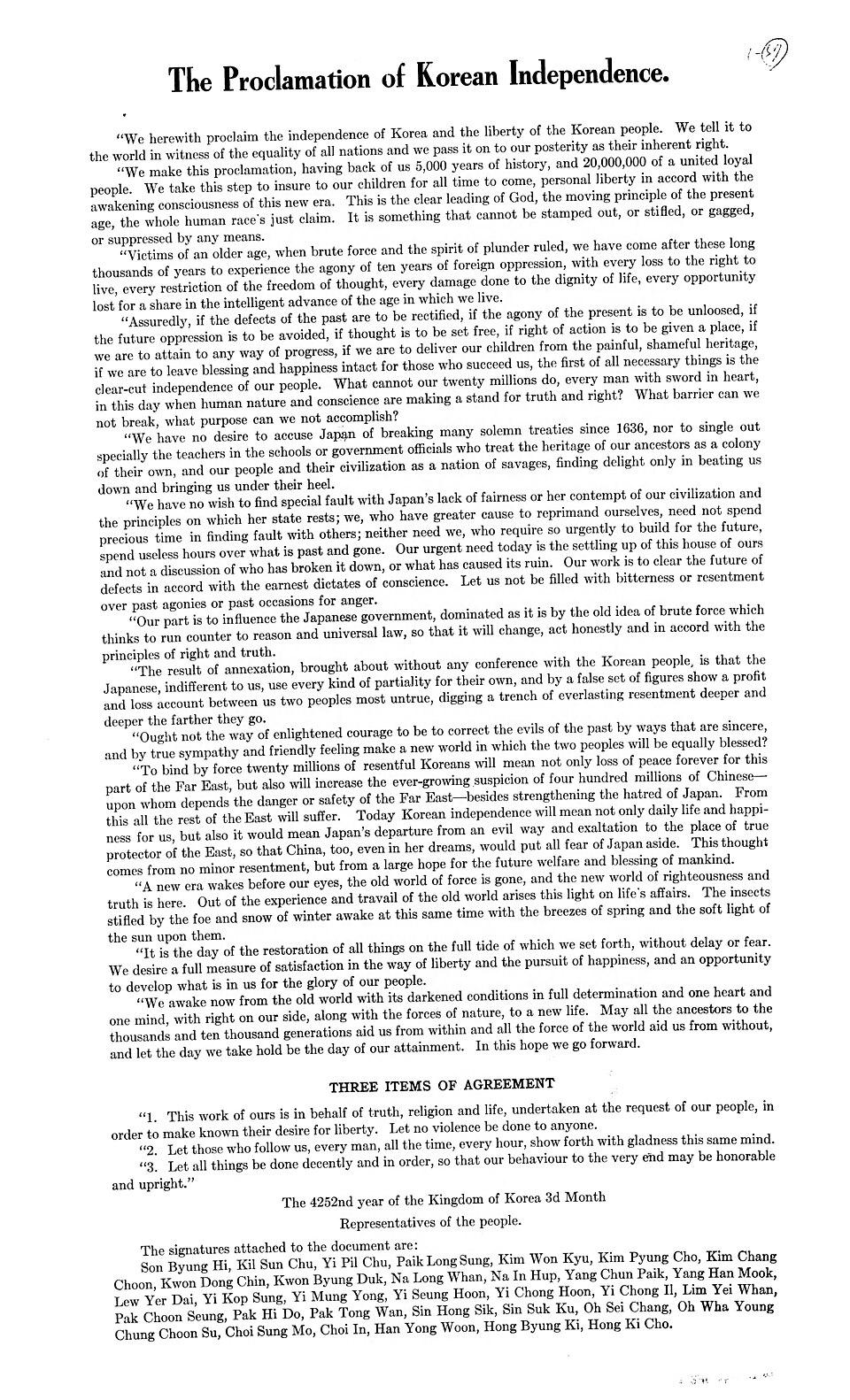
Unknown printer, Proclamation of Korean Independence in English, 1919. Public domain.
1906 to 2026 · Subject · Featured Study
The Korean Church
The church grew from a revival at Pyongyang through Japan's rule to the persecuted church of the North.
More than fifteen hundred men met for the evening meetings of a Bible class at Pyongyang, and the meetings turned to public confession of sin.
Therefore confess your sins to each other and pray for each other so that you may be healed. The prayer of a righteous man has great power to prevail.
Therefore confess your sins to each other and pray for each other so that you may be healed. The prayer of a righteous man has great power to prevail.
- Books
- 1 Corinthians, Acts, James
- Hold in memory
- 1 Corinthians 12:26, James 5:16
Summary
Korea's Protestant church was shaped by a revival at Pyongyang in January 1907. That same year its Presbyterian church passed into Korean hands. The church kept the faith under Japan's rule. It kept it again when the land was split after the Second World War. Its people in the North have been persecuted ever since.
- The revival led about 50,000 Christians into a new life, by the count of two Methodist missionaries.
- Christians made up nearly half of the signers of the declaration of independence of 1919.
- Pyongyang was once called the Jerusalem of the East.
- Open Doors ranks North Korea first on its World Watch List of 2026, with a score of 97.
The Verses of the Pyongyang Meetings
Blair preached from 1 Corinthians 12, and the night of confession recalled Acts 2 to him.
William Newton Blair, a Presbyterian missionary at Pyongyang, wrote his account three years after the revival. He names the text he preached two nights before the outbreak and the verse the night itself brought to his mind.
Blair's sermon at the General Class
Now you are the body of Christ, and each of you is a member of it.
Blair preached on it to show that discord in the church was like sickness in the body.
If one part suffers, every part suffers with it; if one part is honored, every part rejoices with it.
Blair used it to show how hate in a brother's heart brought pain to the whole church and to Christ its Head.
The night of confession
Suddenly a sound like a mighty rushing wind came from heaven and filled the whole house where they were sitting.
Blair quotes this verse to describe the sound of the whole audience praying aloud at once.
Acts 2:2BSB
Acts 2:2
From Pyongyang to the North
The dated steps run from the missionaries' conference at Pyongyang to the World Watch List that ranks North Korea first.
The line runs from a week of Bible study at Pyongyang to North Korea's first place on the World Watch List, a span of 120 years.
- A conference for the deepening of spiritual lifeAugust 1906Graham Lee, How the Spirit Came to Pyeng Yang, page 33
- The evening meetings of the General Class begin6 January 1907Blair, The Korea Pentecost, page 44
- The Korean Presbyterian Church is set upThe same yearBlair, The Korea Pentecost, pages 38 to 39
- Japan formally annexes Korea1910Arthur Judson Brown, The Mastery of the Far East, pages 203 to 204
- The declaration of independence is read in Seoul1 March 1919The Korean Situation, pages 20 to 21
- North Korea stands first on the World Watch List2026Open Doors, the table of ranks
A timeline of dated steps, each row naming the record that fixes its date.
The era page of the church under fire holds the wider story of these years.
The Revival at Pyongyang
A missionaries' conference and months of prayer came before a Bible class that turned to confession.
In August 1906 the Pyongyang missionaries held a week of Bible study. Graham Lee wrote the next spring that Dr. Hardie of Wonsan came and helped them greatly.
Jones and Noble record that hundreds of Korean Christians then covenanted to pray an hour a day for the outpouring of the Holy Spirit. They write that in the first week of the new year the Spirit was poured out on the people.
Blair describes the General Class for men, held each January, with eight hundred to a thousand men who walked in at their own cost. Its evening meetings began on 6 January at the Central Church, with more than fifteen hundred present.
After Blair's sermon on the body of Christ, many confessed a lack of love for others, especially for the Japanese. On the Monday night Graham Lee called for prayers, and the whole audience began to pray aloud together.
Under Korean Hands, Under Japan, and in the North
The church came into Korean hands, lived under Japan's rule and its crackdown, and was divided with the peninsula.
The Presbyterian missionaries set the founding of the Korean Presbyterian Church for the year the seminary would graduate its first class. Blair writes that the first presbytery would hold more Korean voting members than missionaries.
A Seoul newspaper, as Jones and Noble report, counted over 80,000 converts in the six months from November 1909.
Arthur Judson Brown records that Japan formally announced the annexation of Korea in 1910.
The Federal Council of Churches printed eyewitness accounts of the Korean rising for independence. Fifteen of the thirty-three signers of the declaration were Christians, among them Pastor Kil Sun Chu of Pyongyang, who signed second.
A farmer told a newspaper correspondent at the burned village of Cheamni in April that it had a Christian church and many Christians.
Thomas S. Kidd writes that the north, split off after the Second World War, became officially atheist and has persecuted its Christians ever since.
In Their Own Words
Graham Lee
his account of the revival, as William Newton Blair prints it in The Korea Pentecost, p. 45
Graham Lee saw men confess and weep.
“Man after man would rise, confess his sins, break down and weep, and then throw himself to the floor and beat the floor with his fists in perfect agony of conviction.”
Presbyterian missionary
About this saying1 paragraph
Blair prints Lee's account of the Monday night of January 1907, which Lee wrote at the time.
Graham Lee
How the Spirit Came to Pyeng Yang, as William Newton Blair quotes it in The Korea Pentecost, p. 44
Lee found the noon prayer meetings a Bethel.
“These noon prayer-meetings were a very Bethel to us.”
Presbyterian missionary
About this saying1 paragraph
Lee wrote this in March 1907 of the daily noon prayer meetings the missionaries held during the January class.
William Newton Blair
The Korea Pentecost and Other Experiences on the Mission Field, p. 39
Blair wanted a church in Korean hands.
“We wanted a Korean church, not an American church.”
Presbyterian missionary
About this saying1 paragraph
Blair wrote this in 1910 of the plan to found the Korean Presbyterian Church in 1907.
The Spirit or the Old Religion?
Some observers called the revival syncretistic, and Kidd answers from its confession of hatred.
Kidd reports that some observers later faulted the revival's Pentecostal marks and said it drew on Korean shamanism and its spirit world.
Kidd answers that its grief and its confession of sin, above all the sin of ethnic hatred, show that the Holy Spirit was moving.
MannaFest's Wesleyan-Pentecostal tradition reads the confession and the prayer of Pyongyang as the Spirit's work, as the witnesses at the meetings recorded it.
Books to Read Next
The Korea Pentecost and Other Experiences on the Mission Field
William Newton Blair · about 1910
Blair gives the General Class and the nights that followed, from his own place in the meetings.
Free at the Internet ArchiveThe Korean Revival
George Heber Jones and W. Arthur Noble · 1910
Two Methodist missionaries give the months of prayer before the revival and its counts.
Free at the Internet ArchiveThe Korean Situation
The Federal Council of the Churches of Christ in America · 1919
It gathers the reports that missionaries and correspondents sent from Korea during the rising.
Free at the Internet ArchiveWhat the Korean Church Carried
The church that confessed its sins at Pyongyang in January began to govern itself before the year was out. Twelve years later its pastors signed Korea's call for freedom, and its northern believers now suffer the worst persecution Open Doors records.
Sources
Scripture is the Berean Standard Bible.
- The Holy Bible, Berean Standard Bible (read 2026)
- Graham Lee, How the Spirit Came to Pyeng Yang, The Korea Mission Field 3:3 (Seoul, March 1907), page 33.
- George Heber Jones and W. Arthur Noble, The Korean Revival (New York: Board of Foreign Missions of the Methodist Episcopal Church, printed September 1910), pages 5 to 6 and 42.
- William Newton Blair, The Korea Pentecost and Other Experiences on the Mission Field (New York: Board of Foreign Missions of the Presbyterian Church in the U.S.A., about 1910), pages 38 to 46.
- James S. Gale, Korea in Transition (New York: Young People's Missionary Movement, 1909), page 201.
- Arthur Judson Brown, The Mastery of the Far East (New York: Scribner's, 1919), pages 203 to 204.
- The Korean Situation: Authentic Accounts of Recent Events by Eye Witnesses (New York: The Commission on Relations with the Orient of the Federal Council of the Churches of Christ in America, 1919), pages 20 to 21 and 74 to 75.
- Thomas S. Kidd, Prayer Like the Falling of Many Waters, Christian History 153, Global Outpouring (Christian History Institute, 2024), page 44.
- Open Doors, World Watch List 2026, the table of scores and ranks (reporting period 1 October 2024 to 30 September 2025), in the Swiss edition Weltverfolgungsindex 2026.
Keep Studying
Studies1
Church history6
Trials of life1
Values2