
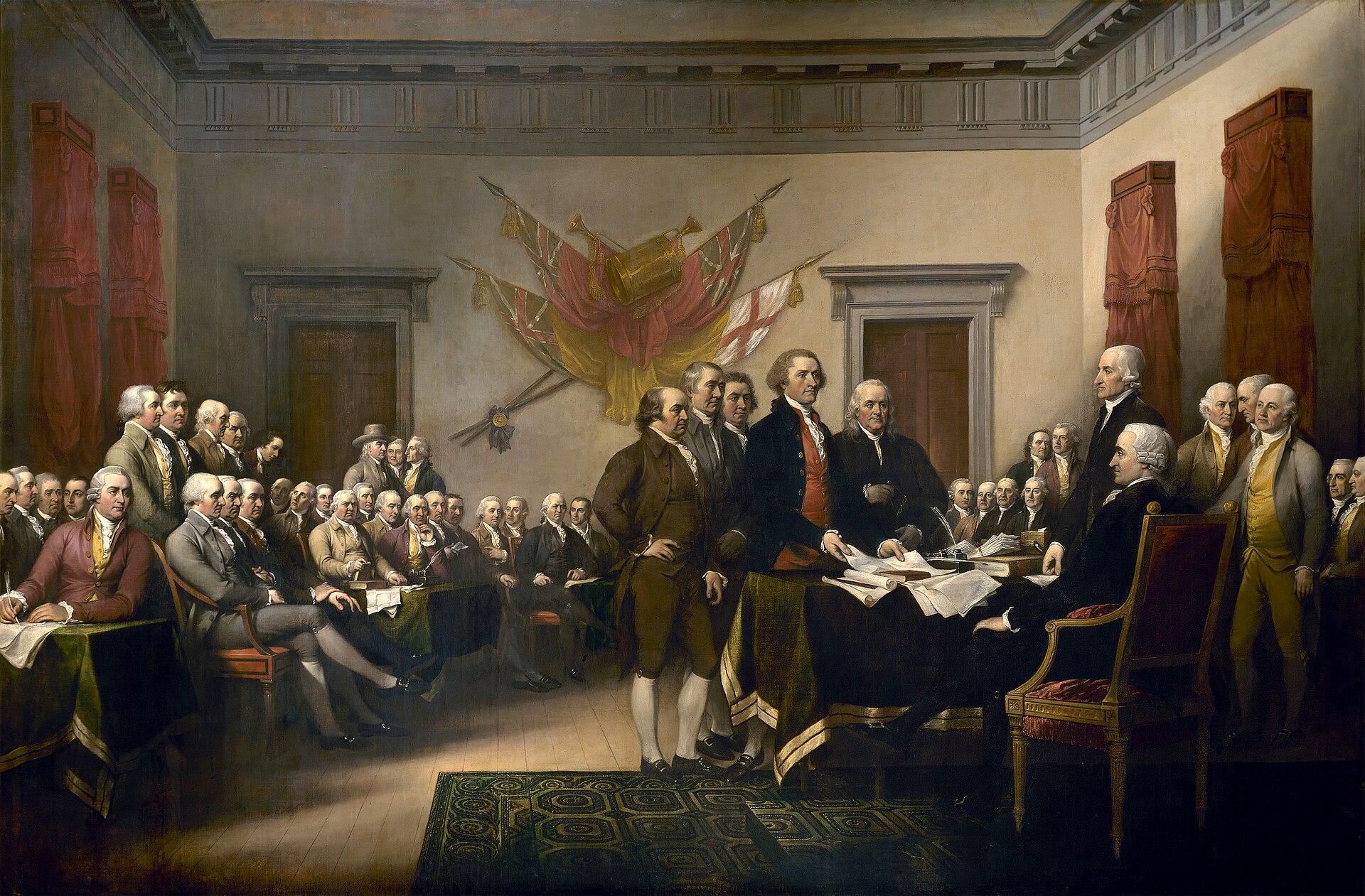
John Trumbull, Declaration of Independence, 1819. Public domain.
John 3:3 and Romans 13:1 · Debate · Featured Study
Did the Awakening Make the Revolution?
Historians still divide over whether the preaching of Whitefield's day helped bring American independence.
- The question
- Did the preaching of the Great Awakening prepare the American colonies for the Revolution of 1776?
- The texts
- John 3:3, Romans 13:1
On 11 June 1776 Congress chose five men to prepare the Declaration, and Benjamin Franklin was one of them.
Jesus replied, “Truly, truly, I tell you, no one can see the kingdom of God unless he is born again.”
Summary
Alan Heimert wrote in 1966 that the revival of the 1740s made the colonies think in a new and radical way. Jon Butler said in 1982 that the name Great Awakening is wrong. It binds the colonies into one story that leads to the war.
- Thomas Kidd wrote in 2010 that the revival pointed ahead to the war.
- Franklin printed Whitefield's sermons, and he called their friendship a civil one.
- Whitefield died in 1770, six years before the Declaration.
The Texts Both Sides Read
The revival preached the new birth, and the pulpit of the Revolution argued over Romans 13.
The historians read two kinds of sermon: the revival's call to the new birth and the political sermons of the years before 1776.
The political sermons' text
Everyone must submit himself to the governing authorities, for there is no authority except that which is from God. The authorities that exist have been appointed by God.
Jonathan Mayhew expounded this chapter in 1750 to set the limits of the submission owed to rulers.
Romans 13:1BSB
The Two Readings Side by Side
Three questions, each answered by the historians who see a link and by Butler.
Heimert and Kidd see the revival preparing the Revolution, and Butler doubts that the revival was one event at all.
| The question | A link (Heimert, Kidd) | No link (Butler) |
|---|---|---|
| Was there one Great Awakening? | Kidd calls the Awakening of the 1730s and 1740s the most profound social upheaval in colonial America. | Butler holds that the term distorts the religious life of the century and should be given up. |
| What did the revival give the colonies? | Heimert holds that Calvinism and Edwards gave them “a radical, even democratic” social and political ideology. | Butler holds that the term makes one movement out of many unlike ones. |
| Did it prepare the Revolution? | Kidd writes that the Awakening would herald the political revolution of 1776. | Butler writes that the idea falsely unites the colonies in “slick preparation for the Revolution.” |
Each Reading in Its Own Words
Heimert, Butler and Kidd argued their readings in print.
Heimert, in Religion and the American Mind, held that evangelical religion inspired a thrust toward American nationalism. He judged the Liberalism of his period to be profoundly conservative, politically as well as socially.
Butler's article in the Journal of American History called the Great Awakening an interpretative fiction. He held that the term falsely makes one thing of many unlike movements.
Kidd, in God of Liberty, traced five religious ideas that connected Americans in the Revolution, the first of them the disestablishment of state churches.
Harry S. Stout, writing on Heimert, called notorious his rule that the sources must be read through and beyond their lines.
What the Documents Show of Whitefield and Franklin
Franklin's account, the journals of Congress and Thornton's sermons show the record.
Whitefield came to Philadelphia in 1739. Franklin wrote that the clergy soon refused him their pulpits and that he preached in the fields, and Franklin was one of the crowds who heard him.
Franklin printed Whitefield's sermons and journals. He called theirs a mere civil friendship, sincere on both sides, which lasted to Whitefield's death, and added that they had no religious connection.
Whitefield died at Newburyport in Massachusetts early on Sunday 30 September 1770.
The journals of Congress list the members of that committee as Thomas Jefferson, John Adams, Franklin, Roger Sherman and Robert R. Livingston.
Franklin's account of his life stops at 1757, and the journals of Congress name the committee without any word of Whitefield. Neither record shows that the friendship of the two men was used to write the founding documents.
The pulpit of the Revolution, as Thornton collected it3 paragraphs
John Wingate Thornton's collection of 1860 opens with Jonathan Mayhew's sermon of 30 January 1750, which Thornton called the morning gun of the Revolution.
Its second sermon is by Charles Chauncy of the First Church in Boston, who had written against the revival's disorders in his Seasonable Thoughts of 1743.
So the preachers Thornton collected for the Revolution include Chauncy, who had opposed the revival.
In Their Own Words
Benjamin Franklin
Autobiography, the passage on Whitefield that opens In 1739 arrived among us
Franklin called theirs a civil friendship.
“He us'd, indeed, sometimes to pray for my conversion, but never had the satisfaction of believing that his prayers were heard. Ours was a mere civil friendship, sincere on both sides, and lasted to his death.”
Philadelphia printer
About this saying1 paragraph
Franklin wrote of the prayers Whitefield offered for his conversion in the years after 1739.
Benjamin Franklin
Autobiography, the same passage, on the change in the manners of the town
Franklin saw the town change after Whitefield came.
“It was wonderful to see the change soon made in the manners of our inhabitants. From being thoughtless or indifferent about religion, it seem'd as if all the world were growing religious, so that one could not walk thro' the town in an evening without hearing psalms sung in different families of every street.”
Philadelphia printer
About this saying1 paragraph
Franklin wrote of Philadelphia in the months after Whitefield's arrival in 1739.
John Wingate Thornton
The Pulpit of the American Revolution, the editor's note to Discourse I, page 43
Thornton called Mayhew's sermon the morning gun.
“this celebrated sermon may be considered as the morning gun of the Revolution, the punctum temporis when that period of history began.”
Congregational
About this saying1 paragraph
Thornton set this judgement in his editor's note of 1860, before the text of the discourse.
Where the Readings Are Contested
The historians divide over the link, and the documents show the friendship.
The question is a historians' argument, and the site sets out each reading with the work that holds it.
Books to Read Next
The Pulpit of the American Revolution
John Wingate Thornton · 1860
Its discourses run from 1750 to the peace of 1783.
Free at the Internet ArchiveAutobiography of Benjamin Franklin
Benjamin Franklin, edited by Frank Woodworth Pine · 1916
Read the passage that opens In 1739 arrived among us.
Free at Project GutenbergA Revival and a Revolution
The friendship of Whitefield and Franklin is in the record, and the bearing of the revival on the Revolution is an argument among historians. The page keeps the two apart.
Sources
Scripture is the Berean Standard Bible.
- The Holy Bible, Berean Standard Bible (read 2026)
- Autobiography of Benjamin Franklin, ed. Frank Woodworth Pine (New York: Henry Holt, 1916), the passage on Whitefield.
- Journals of the Continental Congress, 1774 to 1789, volume V, ed. Worthington C. Ford (Washington: Government Printing Office, 1906), page 431, 11 June 1776.
- Luke Tyerman, The Life of the Rev. George Whitefield, volume 2 (London: Hodder and Stoughton, 1876), pages 599 and 618 to 619.
- John Wingate Thornton, The Pulpit of the American Revolution (Boston: Gould and Lincoln, 1860), the contents, page 43 and pages 65 to 66.
- Charles Chauncy, Seasonable Thoughts on the State of Religion in New-England (Boston: Rogers and Fowle, 1743), the title page.
- Alan Heimert, Religion and the American Mind from the Great Awakening to the Revolution (Cambridge, Massachusetts: Harvard University Press, 1966), the preface.
- Jon Butler, Enthusiasm Described and Decried: The Great Awakening as Interpretative Fiction, Journal of American History 69 (1982), pages 305 to 325, read in its reprint in Jon Butler and Harry S. Stout, eds., Religion in American History: A Reader (Oxford University Press), page 119.
- Thomas S. Kidd, God of Liberty: A Religious History of the American Revolution (New York: Basic Books, 2010)
- Harry S. Stout, on Heimert, in Jon Butler and Harry S. Stout, eds., Religion in American History: A Reader (Oxford University Press)