
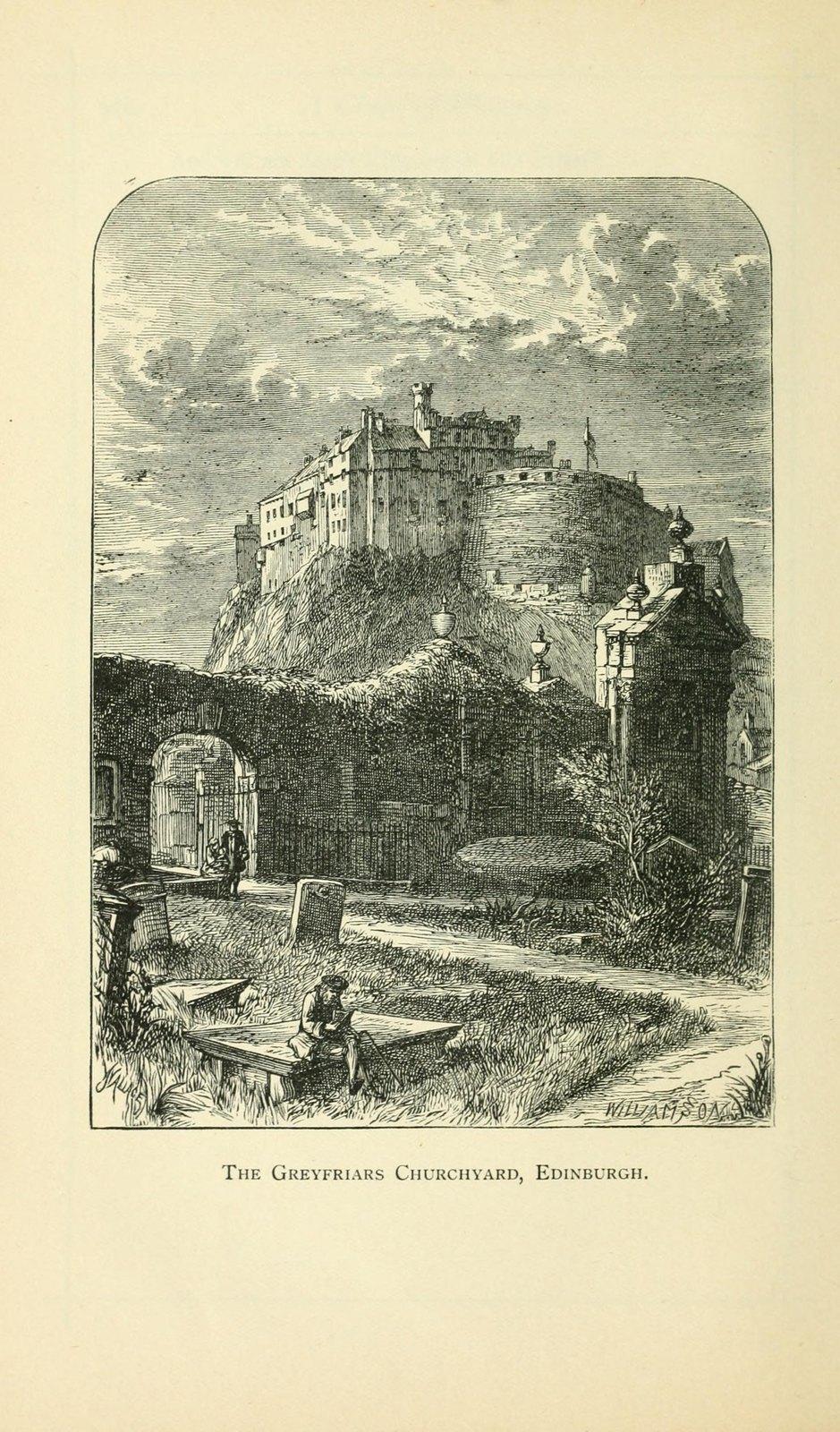
The Greyfriars Churchyard, Edinburgh, 1871. Public domain.
Milton to the Covenanters · Subject · Featured Study
Poems of the Persecuted
Milton wrote a sonnet on the Piedmont massacre of 1655, and the Covenanters' monument in Edinburgh carries verse on their dead.
A tomb raised in Edinburgh in 1706 tells every passer-by what its dead died for.
And when the Lamb opened the fifth seal, I saw under the altar the souls of those who had been slain for the word of God and for the testimony they had upheld. And they cried out in a loud voice, “How long, O Lord, holy and true, until You avenge our blood and judge those who dwell upon the earth?” Then each of them was given a white robe and told to rest a little while longer, until the full number of their fellow servants, their brothers, were killed, just as they had been killed.
And when the Lamb opened the fifth seal, I saw under the altar the souls of those who had been slain for the word of God and for the testimony they had upheld. And they cried out in a loud voice, “How long, O Lord, holy and true, until You avenge our blood and judge those who dwell upon the earth?” Then each of them was given a white robe and told to rest a little while longer, until the full number of their fellow servants, their brothers, were killed, just as they had been killed.
- Book
- Revelation
- Hold in memory
- Revelation 6:9 to 11, Revelation 2:10
Summary
Two sets of verse from the 1600s speak for Protestants killed for their faith, one set for the Alpine valleys and one for Scotland.
- Milton's sonnet asks God to avenge the Waldensians killed in Piedmont.
- The Covenanters' monument in Edinburgh dates from 1706.
- Its verse was printed with the martyrs' own last words.
- The sonnet and the monument both echo the martyrs' cry for justice in Revelation.
The Cry Under the Altar
The Edinburgh monument carves verses of Revelation on a stone Bible, with a crown and a promise at its foot.
Milton's sonnet makes the same cry as the souls under the altar, that God avenge His saints.
On the monument's open Bible
“Sir,” I answered, “you know.” So he replied, “These are the ones who have come out of the great tribulation; they have washed their robes and made them white in the blood of the Lamb.
The monument sets beside them those who came out of the great tribulation.
At the monument's foot and in Milton's last lines
Do not fear what you are about to suffer. Look, the devil is about to throw some of you into prison to test you, and you will suffer tribulation for ten days. Be faithful even unto death, and I will give you the crown of life.
The monument sets these words under a crown at its foot.
Still other seed fell on good soil and produced a crop—a hundredfold, sixtyfold, or thirtyfold.
Milton prays that from the martyrs' ashes a hundredfold may grow, the yield of the good soil in the parable.
Matthew 13:8BSB
Revelation 2:10, Matthew 13:8
From Piedmont to A Cloud of Witnesses
The dated steps run from the massacre in Piedmont to the printing of the Covenanters' book.
The sonnet and the monument mourn deaths that ran from 1655 to 1688.
- The massacre in the valleys of Piedmont1655The title page of Morland's history, which relates the late bloody massacre, 1655
- Morland's history1658Its title page
- The first of the executions the monument mourns, the Marquis of Argyle27 May 1661The monument's prose, in Thomson's reprint of 1871, page 564
- Milton's Poems1673Its title page
- The last of them, James Renwick17 February 1688The monument's prose, Thomson, page 564
- The Martyrs' Monument erected1706The monument's prose, Thomson, page 564
- A Cloud of Witnesses printed1714Its title page
A timeline of dated steps, each row naming the record that fixes its date.
Where the Martyrs Lie
The monument's verse says the martyrs' dust lies mixed with murderers', and a later tradition says the grave-diggers kept them apart.
The monument and an Edinburgh tradition differ on where the martyrs were laid.
| The account | What it says |
|---|---|
| The monument's verse, 1706 | Their dust lies mixed with that of murderers and other criminals whom justice put to death. |
| William Goold, minister in Edinburgh from 1804 to 1844, as Thomson reports him | The grave-diggers were ordered to bury the martyrs among criminals, but laid them in a part of the corner where no criminal lay. |
Thomson says the monument seems to state the opposite of Goold's account, and he trusts Goold as a man who had sifted the traditions.
Milton's Sonnet on the Massacre in Piedmont
Milton wrote of the Waldensians of the Alpine valleys, whose deaths Morland recorded for Cromwell.
John Milton was born in London in 1608 and died there in 1674. His sonnet On the late Massacher in Piemont stands as number XV, on pages 58 and 59, of his Poems, &c. upon Several Occasions, printed in London in 1673.
The sonnet asks God to remember the saints whose bones lie on the Alpine mountains cold. It tells of mothers and infants rolled down the rocks, and of moans the valleys sent back to the hills and the hills to heaven.
Samuel Morland's history of the valleys was printed in London in 1658 by one of the Lord Protector's printers, with a dedication to Oliver Cromwell. The book prints a letter of Cromwell's sending a commissioner extraordinary to the Duke of Savoy over the slaughter, and Morland wrote as a servant of that government.
Morland records an old man of Angrogna, Pietro Simond, tied neck and heels and hurled down a precipice. The site's page on the Waldensians tells the massacre and its record at length.
The Covenanters' Monument and A Cloud of Witnesses
The verse on the Greyfriars monument names the Covenanters' cause, and a book of their last words printed it.
A Cloud of Witnesses, printed in 1714, gathers the last speeches and testimonies of those who suffered for the truth in Scotland since 1680. Among its additions are the epitaphs on the martyrs' tombstones.
The verse on the Martyrs' Monument in Greyfriars churchyard says the men buried there died for the Covenants, constant and steadfast for the prerogatives of Christ their King.
It traces their cause from Guthrie's head to Renwick's blood, and its prose counts about a hundred noblemen, gentlemen, ministers and others executed at Edinburgh from 1661 to 1688.
John H. Thomson reprinted the book at Edinburgh in 1871. He places the monument at the north-east corner of the churchyard, near the ground once kept for the bodies of criminals.
In Their Own Words
John Milton (1608 to 1674)
On the late Massacher in Piemont, sonnet XV, in Poems, &c. upon Several Occasions, page 58, lines 1 to 4 (the page image read 2026-11-09, leaf n73)
Milton opened his sonnet with a prayer for the slaughtered saints.
“Avenge O Lord thy slaughter'd Saints, whose bones Lie scatter'd on the Alpine mountains cold, Ev'n them who kept thy truth so pure of old When all our Fathers worship't Stocks and Stones,”
English Puritan
About this saying1 paragraph
Milton printed the sonnet's opening prayer for the slaughtered saints in 1673.
John Milton
On the late Massacher in Piemont, sonnet XV, in Poems, &c. upon Several Occasions, page 59, lines 4 to 8 of that page (the page image read 2026-11-09, leaf n74)
Milton closed with a prayer that a hundredfold might grow.
“Their martyr'd blood and ashes so O're all th'Italian fields where still doth sway The triple Tyrant: that from these may grow A hunder'd-fold, who having learnt thy way Early may fly the Babylonian wo.”
English Puritan
About this saying1 paragraph
Milton ended the sonnet, printed in 1673, with these lines.
The Martyrs' Monument, Greyfriars churchyard, Edinburgh
The epitaph on the Martyrs' Monument, in A Cloud of Witnesses for the Royal Prerogatives of Jesus Christ, ed. John H. Thomson, page 563, lines 1 to 4 of the verse
The monument's verse opens in the voice of the stone.
“Halt, passenger, take heed what thou dost see: This tomb doth shew for what some men did die. Here lies interred the dust of those who stood 'Gainst perjury, resisting unto blood;”
Scottish Covenanters
About this saying1 paragraph
The verse on the Martyrs' Monument opens with these lines, as Thomson printed them in 1871.
How the Record Is Read
Both records come from one side, and each is read as its side's witness.
Morland wrote for Cromwell, whose government pressed the Waldensians' cause, so his history is an interested witness to the massacre. The court of Savoy's own account is not among the sources read.
Milton's last lines speak of the triple Tyrant who still sways the Italian fields, and pray that the martyrs' heirs may fly the Babylonian woe. They are the words of a Protestant polemicist of his age, and the page gives them as his.
The monument's verse calls the bishops' party prelatists abjured and names the Covenants as the cause. It is the Covenanters' own memorial and speaks for their cause.
Books to Read Next
Poems, &c. upon Several Occasions
John Milton · 1673
It is the collection that holds the sonnet, read here on its page images.
Free at the Internet ArchiveThe History of the Evangelical Churches of the Valleys of Piemont
Samuel Morland · 1658
It is the Protestant record of the massacre, written for Cromwell.
Free at the Internet ArchiveA Cloud of Witnesses for the Royal Prerogatives of Jesus Christ
Edited by John H. Thomson · 1871
Its notes give the history of each martyr and of the monument.
Free at the Internet ArchiveWhat the Poems Handed On
The two poems turned two persecutions into lasting words, the one printed in a book and the other cut in stone. Both answer the cry of the martyrs under the altar in Revelation 6, the monument by carving it and Milton by praying it.
Sources
Scripture is the Berean Standard Bible.
- The Holy Bible, Berean Standard Bible (read 2026)
- John Milton, Poems, &c. upon Several Occasions (London, 1673), sonnet XV, On the late Massacher in Piemont, pages 58 to 59.
- John Julian, A Dictionary of Hymnology, second revised edition (London: John Murray, 1907), volume 1, Milton, John, pages 736 to 737.
- Samuel Morland, The History of the Evangelical Churches of the Valleys of Piemont (London: Henry Hills, 1658), the title page, the dedication to Oliver, Lord Protector, book II, page 342, and book IV, Cromwell's letter to the King of France.
- A Cloud of Witnesses for the Royal Prerogatives of Jesus Christ (1714), the title page and the contents, The Epitaphs upon the Tomb Stones of the Martyrs.
- A Cloud of Witnesses for the Royal Prerogatives of Jesus Christ, reprinted with notes by John H. Thomson (Edinburgh: Oliphant, Anderson and Ferrier, 1871), Epitaphs or Inscriptions, pages 563 to 565.
Keep Studying
Studies1
People and groups1
Trials of life1