
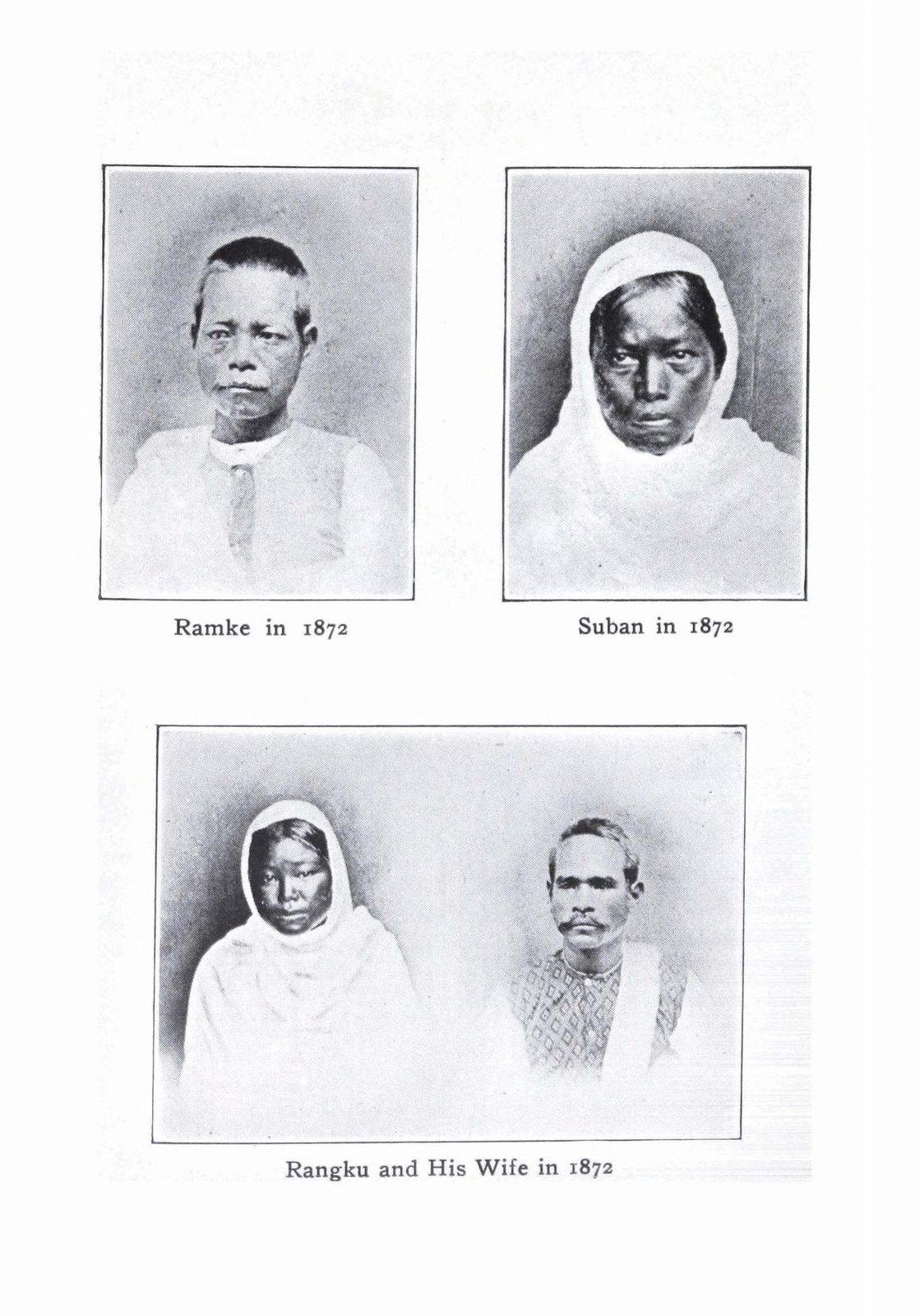
Ramke, Suban, Rangku and his wife, 1872. Public domain.
From Assam to the songbooks · Subject · Featured Study
I Have Decided to Follow Jesus
Its words come from the churches of Assam, and the tale of their first singer was printed long after the hymn.
The Baptist Hymnal of 1991 credits the words to the Garo Christians, and the hymn's own arranger wrote that its source and circumstances are unknown.
Then Jesus declared, “No one who puts his hand to the plow and then looks back is fit for the kingdom of God.”
Then Jesus declared, “No one who puts his hand to the plow and then looks back is fit for the kingdom of God.”
- Books
- Luke, Matthew
- Hold in memory
- Luke 9:62, Matthew 16:24
Summary
I Have Decided to Follow Jesus is a hymn of north-east India that reached English-language songbooks with a copyright of 1949. A story of its writer's martyrdom is often told, and no record of it before the year 2000 has been found.
- The earliest printing found is a book printed at Lahore.
- Two arrangements carried it into English songbooks.
- Its arranger held that no one knows who first sang it.
- The Garo mission named its own martyrs, and its history says nothing of the hymn.
The Verses Behind the Hymn
The hymn's refrain and its cross stand close to the Lord's words on following Him.
The hymn's first line names a choice to follow Jesus, and its refrain says there is no turning back. The verses below speak of that choice in the Lord's own words and in Paul's.
The call to follow
Then Jesus told His disciples, “If anyone wants to come after Me, he must deny himself and take up his cross and follow Me.
The hymn sings the choice this call sets before every disciple.
And whoever does not carry his cross and follow Me cannot be My disciple.
This is the cost of following that the hymn's refrain accepts.
Luke 14:27BSB
No turning back
Brothers, I do not consider myself yet to have taken hold of it. But one thing I do: Forgetting what is behind and straining toward what is ahead, I press on toward the goal to win the prize of God’s heavenly calling in Christ Jesus.
Paul forgets what is behind and presses on toward the goal, as the hymn leaves the world behind.
Philippians 3:13 to 14
Where the Hymn Appears in Print
The dated steps run from the Garo mission of 1864 to the first printed telling of the story.
The hymn is in print from 1946, and the story of its origin reached print eighty years after the Garo mission's own history.
- The first Garo preachers namedOctober 1864A Baptist magazine
- A Garo Jungle Book1919Its copyright page
- The first lines in a book1946The catalogue's date
- An arrangement copyrighted1949A songbook's copyright line
- The tune Assam set1959A hymnal's copyright line
- The arranger's note1990Songs of Glory
- The story of the family toldApril 2000Why God Why
A timeline of dated steps, each row naming the record that fixes its date.
The Story and the Record
The story of the hymn's writer is told at length, and the earlier records do not carry it.
Each part of the story of the hymn's origin stands beside what the earlier record shows.
| The story says | What the record shows |
|---|---|
| A Welsh missionary converted the man and his family | The mission to the Garos was the American Baptists', as their magazine of 1864 shows. |
| The man made up the hymn as he faced death | Reynolds, who arranged it, wrote in 1990 that its source and circumstances are unknown. |
| The chief had his wife and children shot for their faith | Carey names Garo teachers who died for their faith, and no such family and no hymn. |
A missing record proves only that the record is missing. The story may be true and unwritten, so it is told here as a story with its teller and its year.
The Garo Mission of Assam
American Baptists worked among the Garos of Assam from the 1860s, and their history records Garo martyrs.
In October 1864 the Missionary Magazine of the American Baptist Missionary Union reported that two Garo believers, Omed and Ramkhe, wished to go out and teach their countrymen.
William Carey's history of the mission, printed at Philadelphia in 1919, calls Omed and Ramke the first apostles of the Garo tribe.
Carey records that one early convert went as a teacher to Chokpotgiri, in the south of the Garo Hills, and was killed there. Carey adds that two teachers were martyred at their work.
Carey's book names no family killed for its faith and does not print the hymn. A search of its full text for the hymn's words finds nothing.
How the Hymn Reached the Hymnbooks
The hymn passed from India into English songbooks within a few years.
S. J. Imam-ud-din's Gandhi and Christianity, printed at Lahore and catalogued under 1946, quotes the first lines in a passage on men and women who left all to follow Christ. No earlier printing turned up in the search.
Youth Favorites, a songbook compiled by Cliff Barrows, prints the hymn on page 116 under the line An Indian Prince, arranged by Norman Johnson, with a copyright of 1949 held by Paul B. Smith.
That hymnal gives the first two stanzas to the Garo Christians and the third to John Clark. It sets them to the tune Assam in William J. Reynolds's arrangement, copyrighted in 1959 and renewed in 1987.
The stanzas and both arrangements carry copyright notices, so none of them is printed here.
In Their Own Words
William Carey, missionary to the Garos
A Garo Jungle Book, or the Mission to the Garos of Assam, page 160
Carey recorded a Garo teacher who died for his faith.
“one ventured as a school-teacher to settle at Chokpotgiri, in the south of the hills, and soon sealed his testimony with his blood, a martyr to the cause.”
American Baptist
About this saying1 paragraph
Carey wrote this in 1919 of one of the first converts baptized at the new mission station.
William J. Reynolds
Songs of Glory: Stories of 300 Great Hymns and Gospel Songs, the entry I Have Decided to Follow Jesus (the full-text passage; the page number not seen)
Reynolds wrote that the hymn's source is unknown.
“Its source and circumstances are unknown other than that it seems to have originated in Assam”
Southern Baptist
About this saying1 paragraph
Reynolds wrote this in 1990, thirty-one years after arranging the hymn's tune.
P. P. Job
Why God Why, page 113
Job told the story as the convert's song in the face of death.
“Moved by the Holy Spirit, the man instantly composed and sang these celebrated lines”
Other
About this saying1 paragraph
P. P. Job set the story down at New Delhi in 2000 with these words.
Where the Hymn's Origin Is Placed
One reading gives the hymn to a martyred convert, and another leaves its writer unnamed.
P. P. Job, writing at New Delhi in 2000, tells the hymn as the dying words of a convert whose wife and two children were shot before him. Job sets the story in north-east India, names no tribe and no village, and cites no source.
Reynolds held the hymn's source unknown beyond Assam. The hymnal that prints the arrangement names a people and no single writer.
Books to Read Next
A Garo Jungle Book, or the Mission to the Garos of Assam
William Carey · 1919
It tells of the first converts and their teachers in the hills.
Free at the Internet ArchiveSongs of Glory: Stories of 300 Great Hymns and Gospel Songs
William J. Reynolds · 1990
The hymn's arranger gives what was known of its origin.
In print: find it wherever books are sold.
Why God Why
P. P. Job · 2000
It is the earliest dated telling found.
In print: find it wherever books are sold.
What the Hymn Asks of the Singer
The record shows a song of the churches of Assam that crossed into the hymnals of other lands. Whoever first sang it, its words ask each singer to make the choice Jesus set before His disciples in Matthew 16.
Sources
Scripture is the Berean Standard Bible.
- The Holy Bible, Berean Standard Bible (read 2026)
- S. J. Imam-ud-din, Gandhi and Christianity (Lahore: Northern India Printing and Publishing Co., catalogued 1946), the full-text passage, the page number not seen.
- Youth Favorites: Gospel Songs and Choruses, compiled by Cliff Barrows (catalogued 1963), page 116.
- The Baptist Hymnal (Nashville: Convention Press, 1991), I Have Decided to Follow Jesus, the words and music credits.
- William J. Reynolds, Songs of Glory: Stories of 300 Great Hymns and Gospel Songs (Grand Rapids: Zondervan, 1990), the entry on the hymn.
- P. P. Job, Why God Why (New Delhi: TFC, April 2000), pages 113 to 115.
- The Missionary Magazine (American Baptist Missionary Union), volume 44, number 10, October 1864, Mission to the Garrows.
- William Carey, A Garo Jungle Book, or the Mission to the Garos of Assam (Philadelphia: Judson Press, 1919), pages 52 to 53, 160 and 241.
Keep Studying
Doctrines1
Trials of life1