
Humphrey Jones, David Morgan and the revival in Wales · Story · Featured Study
The Welsh Revival of 1859
Wales and Ulster each had a revival in the same year, and the Welsh one had two preachers in turn.
David Morgan told Humphrey Jones they could do little harm by trying to rouse the country, “even if there be nothing but man in it after all.”
- When
- June 1858 to 1860
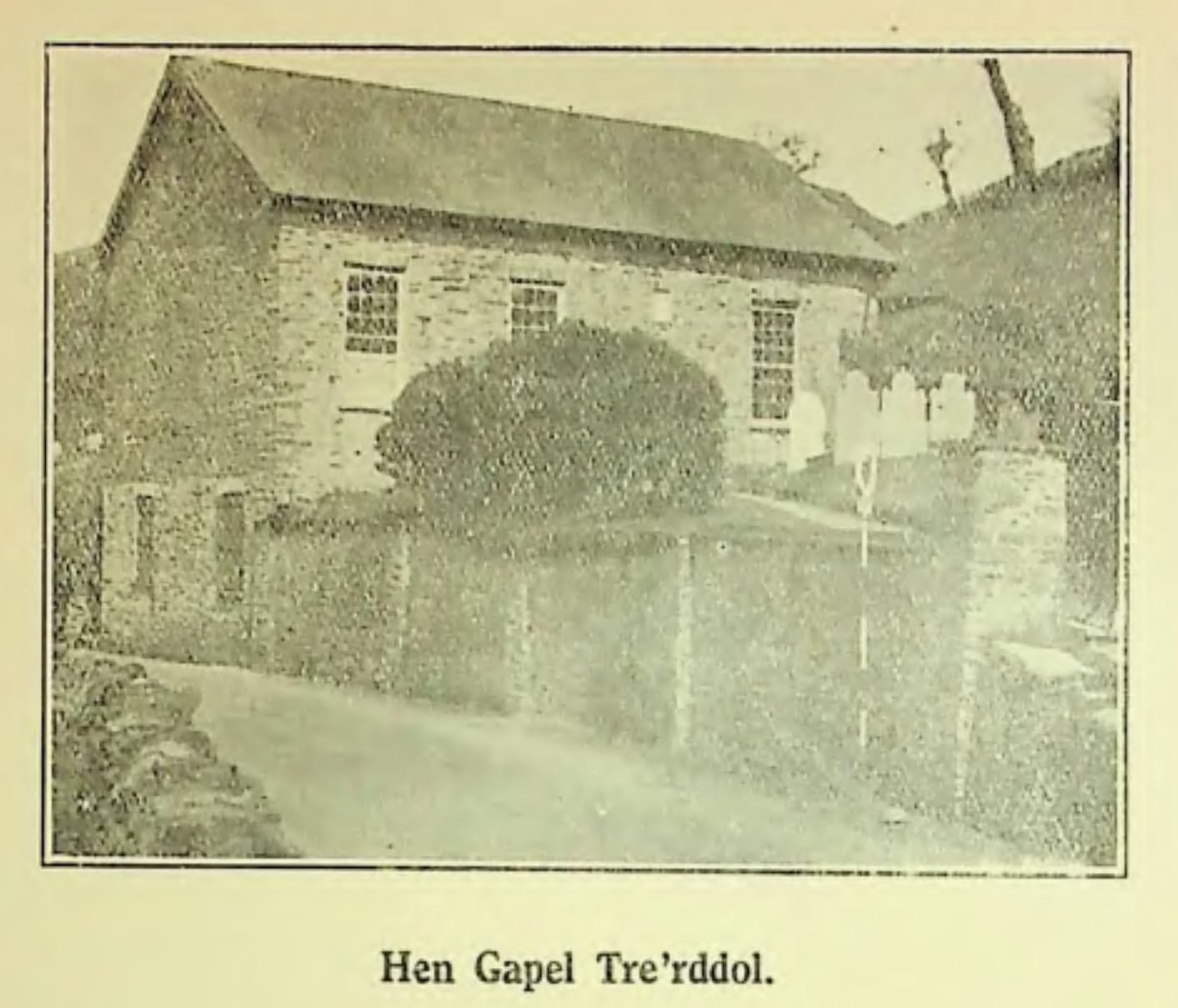
Unknown photographer, Hen Gapel Tre'rddol, 1930. Public domain.
Woe to those at ease in Zion and those secure on Mount Samaria, the distinguished ones of the foremost nation, to whom the house of Israel comes.
Summary
Humphrey Jones came home from America and began a revival in north Cardiganshire. David Morgan, a local minister, joined him that autumn.
- Jones was born in October 1832.
- Jones went to America in 1854, after the Wesleyans turned him down.
- Morgan was made a minister at Trefin in May 1857.
- The Welsh papers first wrote of the revival on 19 February 1859, J. J. Morgan says.
The Texts of the Revival
Three more verses stand in the record of the revival beside the text of the Sunday at Ysbyty.
So because you are lukewarm—neither hot nor cold—I am about to vomit you out of My mouth!Jones preached on it on his second evening at Pontrhydygroes, and Morgan walked home unable to sleep.
Above all, fear the LORD and serve Him faithfully with all your heart; consider what great things He has done for you.Evan Harris could only repeat these words when the Cardiganshire figures were read at Llangeitho.
Then the wise will shine like the brightness of the heavens, and those who lead many to righteousness will shine like the stars forever and ever.These words were cut on the stone over Morgan's grave at Ysbyty Ystwyth.
The Returns of the Revival
Three returns give the additions in one county, one denomination's chapels and one town.
The Calvinistic Methodists of Cardiganshire received the most candidates of the three.
| Return | Its dates | What it counted |
|---|---|---|
| The Calvinistic Methodists of Cardiganshire, read at Llangeitho | From 31 December 1858 to 30 June 1859 | The churches received 6200 candidates. |
| Eighty-two Calvinistic Methodist places of worship in Merioneth | Within the year | The chapels added 4048 members. |
| A correspondent at Holyhead, for five denominations | To 28 January 1860 | The churches admitted 1149 converts. |
From Tre'r-ddol to Ysbyty Ystwyth
The first autumn ran from a homecoming in June to the parting of the two preachers in November.
Jones reached Tre'r-ddol towards the end of June and visited his old neighbours one by one, praying with them at their hearths.
By the end of August a mission at Ystumtuen had a hundred converts, J. J. Morgan writes.
David Morgan lived near the Wesleyan chapel at Pontrhydygroes and went to hear him.
He sought Jones out at his lodging the same night and talked with him for hours.
On Sunday 3 October Jones preached on Amos 6:1 at the Calvinistic Methodist chapel at Ysbyty Ystwyth, and no one seemed moved.
In the church meeting after the sermon an elder, John Jones of Penllyn, said it was hard for a man to cry Amen when the ministry condemned him. Then the whole church bowed and wept.
Morgan woke about four on the Wednesday morning after, he said, “remembering everything of a religious nature that I had ever learnt or heard.”
In the middle of November the two parted.
The Objections of the Time
The doubts came from the revival's onlookers and from a friendly minister.
Phillips heard most often that it was a man-made revival and mere excitement.
Others objected that women and children were its subjects.
A Wesleyan minister wrote to him that he acknowledged the hand of God in the revival and yet dreaded “experiments to get up a revival.”
The Breakdown at Aberystwyth
The revival's first preacher failed at Aberystwyth in the months after his parting from Morgan.
Jones began at the Queen Street Wesleyan Chapel in Aberystwyth on 19 December.
He would neither preach nor let anyone else preach, he soon stopped the singing, and he refused to receive the converts into the church.
He foretold that the Holy Ghost would descend in visible form in the chapel at eleven on a certain morning.
Early the next June the leaders concluded that his mind had lost its balance.
J. J. Morgan, writing fifty years later, says that when nothing happened Jones wept aloud and fled to his rooms.
Phillips wrote the following year that Jones had been laid aside by “physical debility, mental depression, and a change of views.”
He returned to America in 1871 and died at Chilton, Wisconsin, on 8 May 1895.
Morgan's Two Years
The revival's second preacher carried it on after Jones broke down.
For two years Morgan travelled through every part of Wales, the Dictionary of Welsh Biography says, often holding three or four services in a day.
His son writes that the gift of memory left him as suddenly as it came, in less than two years.
One of the hardest trials of his life, his son writes, was to find crowds still following him after the power had gone.
He died in 1883.
How the Key Verse Was Taught
Matthew Henry, John Wesley, Adam Clarke and Albert Barnes each read Amos 6:1.
Matthew Henry (1662 to 1714)
Commentary on the Whole Bible
Matthew Henry set the verse in the history of Amos's day.
“The house of Israel came to them, that is, was divided into those kingdoms, of which Zion and Samaria were the mother cities. Those that were at ease were the princes and rulers, the great men, that were chief of the nations, chief of those two kingdoms, and to whom, having their residence in Zion and Samaria, the whole house of Israel applied for judgment.”
on Amos 6:1Puritan
John Wesley (1703 to 1791)
Explanatory Notes upon the Old Testament, on Amos 6:1
John Wesley named whom the prophet had in mind.
“That neither fear nor believe the threatened judgments of God.”
Evangelical
Adam Clarke (1762 to 1832)
Commentary on the Bible, on Amos 6:1
Adam Clarke gave the verse a second reading, one for any hearer.
“Those that are at ease may mean those who have no concern about the threatened judgments, and who have no deep concern for the salvation of their own souls.”
Methodist
Albert Barnes (1798 to 1870)
Notes, Explanatory and Practical, on the Old and New Testaments, on Amos 6:1
Albert Barnes read the verse as a word for any comfortable people.
“It is that luxury and ease, which sensualize the soul, and make it dull, stupid, hard-hearted. By one earnest, passing word, the prophet warns his own land, that present sinful ease ends in future woe.”
Presbyterian
Adam Clarke, Albert Barnes
In Their Own Words
The two preachers spoke of their work and of its end.
David Morgan of Ysbyty (1814 to 1883)
Saying in another place, in J. J. Morgan, The '59 Revival in Wales
Deep roots
“The converts are striking deep roots below, and bringing forth fruits above.”
Welsh Calvinistic
About this saying1 paragraph
Morgan gave this answer in another chapel, when the crowds were thinner; his son printed it in 1909.
David Morgan of Ysbyty
Saying to the deacons in Anglesey, in J. J. Morgan, The '59 Revival in Wales, chapter Eventide, pages 188 to 189
The locks shaven
“I am well aware, brethren, that my locks have been shaven off; but, believe me, I never placed my head on the lap of Delilah, as far as I know.”
Welsh Calvinistic
About this saying1 paragraph
Morgan spoke these words in a vestry, among men who remembered the power of his first visit; they were printed in 1909.
David Morgan of Ysbyty
Saying to a friend, in J. J. Morgan, The '59 Revival in Wales, chapter Eventide
In bonds
“I am an ambassador in bonds, praying often that my chain may be lengthened again.”
Welsh Calvinistic
About this saying1 paragraph
Morgan said this sadly, long after the revival had passed; his son printed it in 1909.
Humphrey Rowland Jones (1832 to 1895)
Letter to a young minister, in Thomas Phillips, The Welsh Revival: Its Origin and Development, pages 9 to 10
Two things in preaching
“I try to aim at two things in studying and preaching: one is, not to say anything to show off myself; another is, not to say anything to amuse the people.”
Welsh Wesleyan
About this saying1 paragraph
Jones gave a younger preacher his rules for the pulpit, and they were in print by 1860.
David Morgan of Ysbyty, Humphrey Rowland Jones
Where Historians Disagree
The two first histories differ on the count, the origin and the lasting fruit.
How many were added to the churches?2 paragraphs
Phillips wrote in his history that at least fifty thousand people had taken on them the yoke of Christ in Wales in the past year, and said himself that no exact number could be had.
J. J. Morgan gave in 1909 an increase of 37,724 communicants to the Calvinistic Methodists, naming no return for it, and a harvest not far short of a hundred thousand.
Where did the revival begin?2 paragraphs
J. J. Morgan traced it directly to the movement that stirred the United States before Jones came home.
Phillips, the nearer witness, names earlier stirrings at Penmaen-mawr in 1858 and at Trevecca the winter before.
Did the converts stand?2 paragraphs
Phillips put the relapses at one in twenty in the forty places he visited in Cardiganshire.
J. J. Morgan conceded sad and numerous relapses and a reaction in the 1860s.
Books to Read Next
The Welsh Revival: Its Origin and Development
Thomas Phillips · 1860
Phillips wrote while the revival was still running and prints the returns of the counties.
Free at the Internet ArchiveThe '59 Revival in Wales
J. J. Morgan · 1909
J. J. Morgan writes his father's life with help from his father's diary.
Free at the Internet ArchiveWhat the Revival Left
Forty-five years later W. T. Stead began his book on the next Welsh revival with the words “I am a child of the revival of 1859-60.”
Sources
Scripture is the Berean Standard Bible.
- The Holy Bible, Berean Standard Bible (read 2026)
- Thomas Phillips, The Welsh Revival: Its Origin and Development (London: James Nisbet, 1860)
- J. J. Morgan, The '59 Revival in Wales: Some Incidents in the Life and Work of David Morgan, Ysbytty (Mold: J. J. Morgan, 1909)
- Idwal Lewis, "Jones, Humphrey Rowland", Dictionary of Welsh Biography (1959), with E. D. Jones's correction (1997)
- Gildas Tibbott, "Morgan, David", Dictionary of Welsh Biography (1959)
- W. T. Stead and G. Campbell Morgan, The Welsh Revival (Boston: Pilgrim Press, 1905), From the Author to the Reader.
- Matthew Henry, Commentary on the Whole Bible (1710)
- John Wesley, Explanatory Notes upon the Old Testament, on Amos 6:1 (1765)
- Adam Clarke, Commentary on the Bible, on Amos 6:1 (1832)
- Albert Barnes, Notes, Explanatory and Practical, on the Old and New Testaments, on Amos 6:1.
Keep Studying
People and groups9