
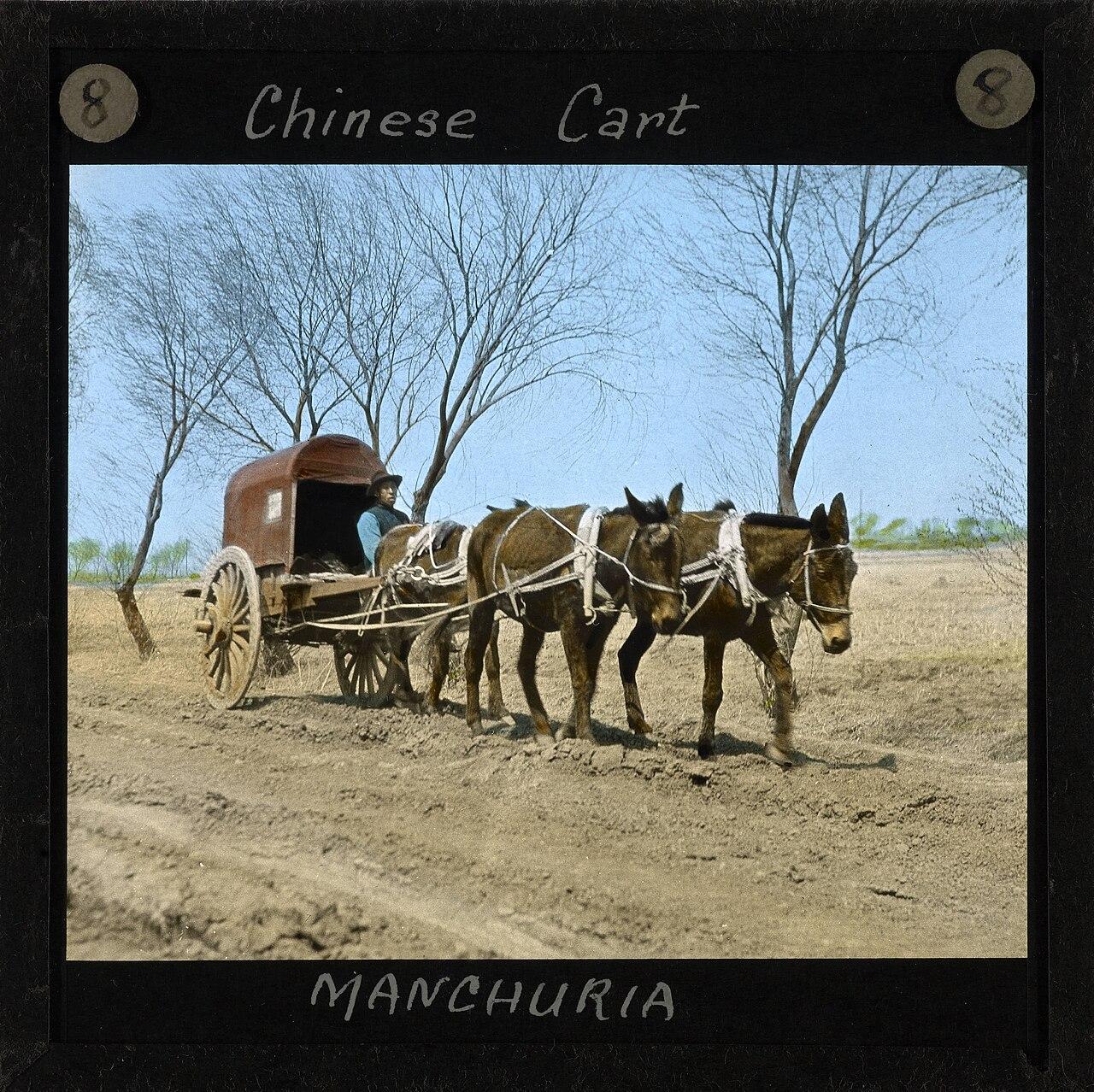
Chinese Cart, Manchuria, 1882 to 1936. Public domain.
Ontario, Honan and Manchuria, 1859 to 1936 · Person · Featured Study
Jonathan Goforth
He preached in North China and Manchuria, and his meetings from 1906 to 1908 brought public confession of sin.
Boxer swords struck him twice in July 1900, and eight years later he called the revival at his own station the mightiest he had seen.
For My name will be great among the nations, from where the sun rises to where it sets. In every place, incense and pure offerings will be presented in My name, because My name will be great among the nations,” says the LORD of Hosts.
- Born
- 10 February 1859
- Died
- 1936, in Toronto, on Daniel Bays's account alone (probable)
- Family
- father: Francis Goforth; mother: Jane Goforth, born Bates; wife: Florence Rosalind Bell-Smith; son: Paul; daughter: Helen; daughter: Ruth; son: Wallace; son: Fred
- Places
- Thorndale, Toronto, Changte, Hsintien, Mukden, Szepingkai
Summary
Jonathan Goforth grew up on a farm in Ontario and trained at Knox College, Toronto. He married Rosalind Bell-Smith in 1887. They sailed for China the next year to begin a new mission in the north of Honan.
- A Canadian handbook of 1912 says he chose missions after hearing George Leslie Mackay of Formosa preach.
- Hudson Taylor told the young couple that they must "go forward on your knees."
- Daniel Bays judges that he helped make revivalism a major part of Protestant missions in China.
The Texts He Leaned On
A promise for every place stands over the revival at his own station, and a command about a brother stands over the quarrel he ended.
The question of this life is what made a Canadian Presbyterian a leader of revival in China. A Canadian handbook, his wife Rosalind's book of 1921 and his own By My Spirit are the witnesses.
leave your gift there before the altar. First go and be reconciled to your brother; then come and offer your gift.He obeyed this command when he ended a quarrel with a fellow missionary before he toured the out-stations.
The Life in Order
The early years stand on a Canadian handbook and his wife's book, and the later ones on his own By My Spirit.
Six years passed between his arrival in China and the opening of Changte.
- 10 February 1859He was born near Thorndale, OntarioMorgan, 1912
- Winter of 1883As a student at Knox College he heard Moody's meetings in TorontoBy My Spirit, chapter I
- October 1887He married Rosalind Bell-Smith and was appointed to North HonanMorgan; Rosalind Goforth
- March 1888He and his wife reached ChinaRosalind Goforth
- After six yearsThe presbytery let him open ChangteRosalind Goforth
- 28 June 1900The Goforths fled ChangteRosalind Goforth
- July 1900He was wounded at Hsintien in the flightRosalind Goforth
- Autumn of 1906His tour of the out-stations brought confessionBy My Spirit, chapter II
- Summer of 1907He visited the revival in KoreaBy My Spirit, chapter VI
- February 1908He held meetings at Liaoyang and MukdenBy My Spirit, chapter III
- Autumn of 1908The meetings at Changte ran past their eight daysBy My Spirit, chapter VI
- 1936He died, by Bays's account in TorontoBays, 1998
Each step of the life stands with its witness.
July 1900, Autumn of 1906, Summer of 1907, February 1908, Autumn of 1908, 1936
From Thorndale to Changte
A farm boy from Ontario waited six years for a city in Honan and nearly died leaving it.
Morgan's handbook of 1912 names his parents as Francis and Jane Goforth of Thorndale, Ontario, and his schools as Ingersoll Grammar School and Knox College, Toronto. It adds that the alumni of Knox College supported him in China from 1888.
In October 1887 the Canadian Presbyterian Church appointed him to open a field in northern Honan, and the Goforths landed in March 1888. Hudson Taylor wrote to them that his mission had tried for ten years to enter the province.
For six years the door to Changte stayed closed, because the mission's two stations needed every worker it had. When leave came he set out the next morning, and within three days he had thirty-five offers of property. Rosalind joined him there a year later with their three children.
When the Boxer rising reached Honan in 1900, the family left Changte with four children, in a party of five men, six women and five children. At Hsintien a mob kept them in their inn through the night, and as their carts passed the city gate the next morning armed men attacked. A sword struck his neck with its blunt edge, a second cut entered the bone of his skull, and a club felled him, yet he lived. The party went on by boat to Hankow and Shanghai.
He returned to China in the autumn of 1901, and By My Spirit has him back at Changte in the spring of 1902. Reports of the Welsh revival and Finney's Autobiography stirred him. In the autumn of 1906 he toured the out-stations, and one of them more than doubled its members the next year.
In the summer of 1907 he went to Korea with R. P. MacKay, his church's Foreign Mission Secretary, and on the way home Mukden and Liaoyang asked him to return. Daniel Bays writes that from then on he was an evangelist and revivalist rather than a settled missionary, active into the 1930s, chiefly in Manchuria. His death in Toronto in 1936 rests on Bays alone.
In Their Own Words
Four lines from By My Spirit on method, a quarrel, Korea and Pentecost.
Jonathan Goforth (1859 to 1936)
By My Spirit, "The Beginning of the Movement in Manchuria", chapter III
I had no method
“But I had no method. I did not know how to conduct a Revival. I could deliver an address and let the people pray, but that was all.”
Presbyterian missionary
About this saying1 paragraph
He wrote this of going to Manchuria in February 1908.
Jonathan Goforth
By My Spirit, chapter II, "A Season of Intensive Preparation"
I can't go with you
“Then came the final word, ‘If you don't straighten this thing out before you go on that trip, you must expect to fail. I can't go with you.’”
Presbyterian missionary
About this saying1 paragraph
He heard these words in the autumn of 1906, while a quarrel with another missionary stood unsettled.
Jonathan Goforth
By My Spirit, chapter II, "A Season of Intensive Preparation"
Setting the world aflame
“Korea made me feel, as it did many others, that this was God's plan for setting the world aflame.”
Presbyterian missionary
About this saying1 paragraph
He wrote this of his visit to Pyongyang in 1907.
Jonathan Goforth
By My Spirit, chapter I
Pentecost was normal Christianity
“But though we speak of the manifestations at Pentecost as being abnormal, yet we maintain that Pentecost was normal Christianity.”
Presbyterian missionary
About this saying1 paragraph
His wife says he wrote this opening chapter himself, and the book was printed in 1929.
The People Around Him
The witnesses name his parents, his wife, his children, his teachers in mission and a Chinese friend.
Rosalind Goforth shared his field and told its story.
| Person | Tie to Goforth | The witness |
|---|---|---|
| Francis and Jane Goforth | His parents | Morgan, 1912 |
| Florence Rosalind Bell-Smith | His wife and fellow missionary from 1887 | Rosalind Goforth, 1921 |
| Paul, Helen, Ruth and Wallace | Their children, named by their mother | Rosalind Goforth |
| Fred Goforth | Their son, who typed By My Spirit | Rosalind Goforth's foreword |
| George Leslie Mackay | The missionary to Formosa whose preaching turned him to missions | Morgan, 1912 |
| Hudson Taylor | The head of the China Inland Mission, who wrote to them in 1888 | Rosalind Goforth |
| R. P. MacKay | His church's Foreign Mission Secretary, who took him to Korea in 1907 | By My Spirit, chapter II |
| Wang Ee | A friend and convert at Takwanchwang who confessed at Changte in 1908 | By My Spirit, chapter VI |
R. P. MacKay, Wang Ee
The Places of His Life
His life runs from Ontario to North Honan and then to Manchuria.
Changte was his station from the 1890s through the revival there.
| Place | What the witnesses say | The witness |
|---|---|---|
| Thorndale, Ontario | He was born near it. | Morgan, 1912 |
| Toronto | He trained at Knox College and heard Moody there in 1883. | Morgan; By My Spirit |
| Changte, Honan | He opened it after six years and saw revival there in 1908. | Rosalind Goforth; By My Spirit |
| Hsintien, Honan | Armed men attacked the fleeing party there in July 1900. | Rosalind Goforth |
| Pyongyang, Korea | He saw the Korean revival there in 1907. | By My Spirit |
| Mukden and Liaoyang | Their churches asked him to come in 1908. | By My Spirit |
| Szepingkai, Manchuria | He was ill there when he dictated his book. | Rosalind Goforth's foreword |
The Revival at His Own Station
The meetings at Changte met him among people who knew his faults.
Goforth writes that people in Manchuria asked whether the same power would come in Honan, where his faults were known. The church at Changte seated six hundred, so the Chinese leaders raised a mat pavilion in the yard, and the schools closed for the meetings. They were planned for eight days and ran longer, and he counts seven times when the brokenness of the people kept him from giving his address.
His friend Wang Ee of Takwanchwang came on the fourth day and said he had no sin. On the sixth morning he confessed that after the rising he had claimed six mules where the Boxers took three and six hundred bushels of wheat where they took three hundred. He pledged the money to a church in his village, and Goforth writes, "And he kept his word."
How the Key Verse Was Taught
The Didache, Augustine and Matthew Henry read the promise of a pure offering in every place.
Didache (died 100)
The Didache, Chapter 14
The Didache joined the verse to confession and to peace between brothers before the Lord's Supper.
“But every Lord's day do ye gather yourselves together, and break bread, and give thanksgiving after having confessed your transgressions, that your sacrifice may be pure. But let no one that is at variance with his fellow come together with you, until they be reconciled, that your sacrifice may not be profaned. For this is that which was spoken by the Lord: In every place and time offer to me a pure sacrifice; for I am a great King, saith the Lord, and my name is wonderful among the nations.”
on Malachi 1:11 to 14Patristic
Augustine of Hippo (died 430)
LETTER 185:5
Augustine read the verse as a sign of the church spread through the whole world.
“Whether betrayers of the divine books ordained Caecilian, I do not know; I did not see; I heard it from his enemies; it's not declared to me by the law of God, or by the preaching of the prophets, or by the holy psalms, or by the apostles of Christ or by Christ's words. But the testimonies of the entire Scripture proclaim with one voice that the church, with which the sect of Donatus is not in communion, is indeed spread throughout the entire world. ‘In your seed shall all the nations of the earth be blessed,’ said the law of God. ‘From the rising of the sun even to the going down, there is offered to my name a clean offering, for my name is great among the Gentiles,’ said God through the prophet.”
on Malachi 1:11Patristic
Matthew Henry (1662 to 1714)
Commentary on the Whole Bible
Matthew Henry read it as God's answer to a faithless priesthood.
“It might be said, ‘If these are not the worshippers whom God will accept, then he has no worshippers.’ As if he must make the best of their service, or else he would have no service done him; and then what will he do for his great name? But let him alone for that; though Israel be not faithful, be not gathered, yet God will be glorious.”
on Malachi 1:11Puritan
What the Witnesses Leave Open
Readers differ on whether his meetings were a work of the Spirit or of emotion, and on what his book can prove.
The Spirit's work or emotionJonathan Goforth; Daniel Bays
Goforth writes that some called his work mere emotionalism, and he answers with letters of missionaries in Manchuria in 1908. One of them wrote that the outbursts of grief at first displeased him, until he judged that the Spirit of God was at work.
Daniel Bays, writing in 1998, says Goforth was admired by many and disliked by some for his emotionalism.
What By My Spirit can proveRosalind Goforth's foreword
Rosalind Goforth writes that the book was dictated in great pain at Szepingkai, typed by their son Fred, and read back to his father for correction. She says no attempt was made at literary style, and that only the first and last chapters were written by Goforth himself.
It cites church figures for 1927, so it was set down more than twenty years after the tour of 1906. The Internet Archive copy carries no date or publisher.
Books to Read Next
By My Spirit
Jonathan Goforth · dictated in Manchuria; the copy read is undated
It is his own account of the revivals, with his wife's foreword on how it was written.
Read By My Spirit free at the Internet ArchiveHow I Know God Answers Prayer
Rosalind Goforth · 1921
His wife wrote it to tell their first years in Honan and their flight from the Boxers.
Read Rosalind Goforth free at the Internet ArchiveWhat Goforth Left
Goforth left his own record of the revivals in By My Spirit. Bays counts him the foremost missionary revivalist in China in the early twentieth century.
Sources
Scripture is the Berean Standard Bible.
- The Holy Bible, Berean Standard Bible (read 2026)
- Henry James Morgan, ed., The Canadian Men and Women of the Time, second edition (Toronto: William Briggs, 1912), entry Goforth, Rev. Jonathan.
- Rosalind Goforth, How I Know God Answers Prayer: The Personal Testimony of One Life-Time (New York and London: Harper and Brothers, 1921)
- Jonathan Goforth, By My Spirit, with a foreword by Rosalind Goforth, an unpaginated transcription with no date or publisher.
- Daniel H. Bays, "Goforth, Jonathan and Rosalind (Bell-Smith)", in Gerald H. Anderson, ed., Biographical Dictionary of Christian Missions (New York: Macmillan Reference USA, 1998), page 247.
- The Didache, chapter 14, on Malachi 1:11.
- Augustine of Hippo, Letter 185, section 5, on Malachi 1:11.
- Matthew Henry, Commentary on the Whole Bible (1710), on Malachi 1:11.
Keep Studying
People and groups4
Church history7
Values1