
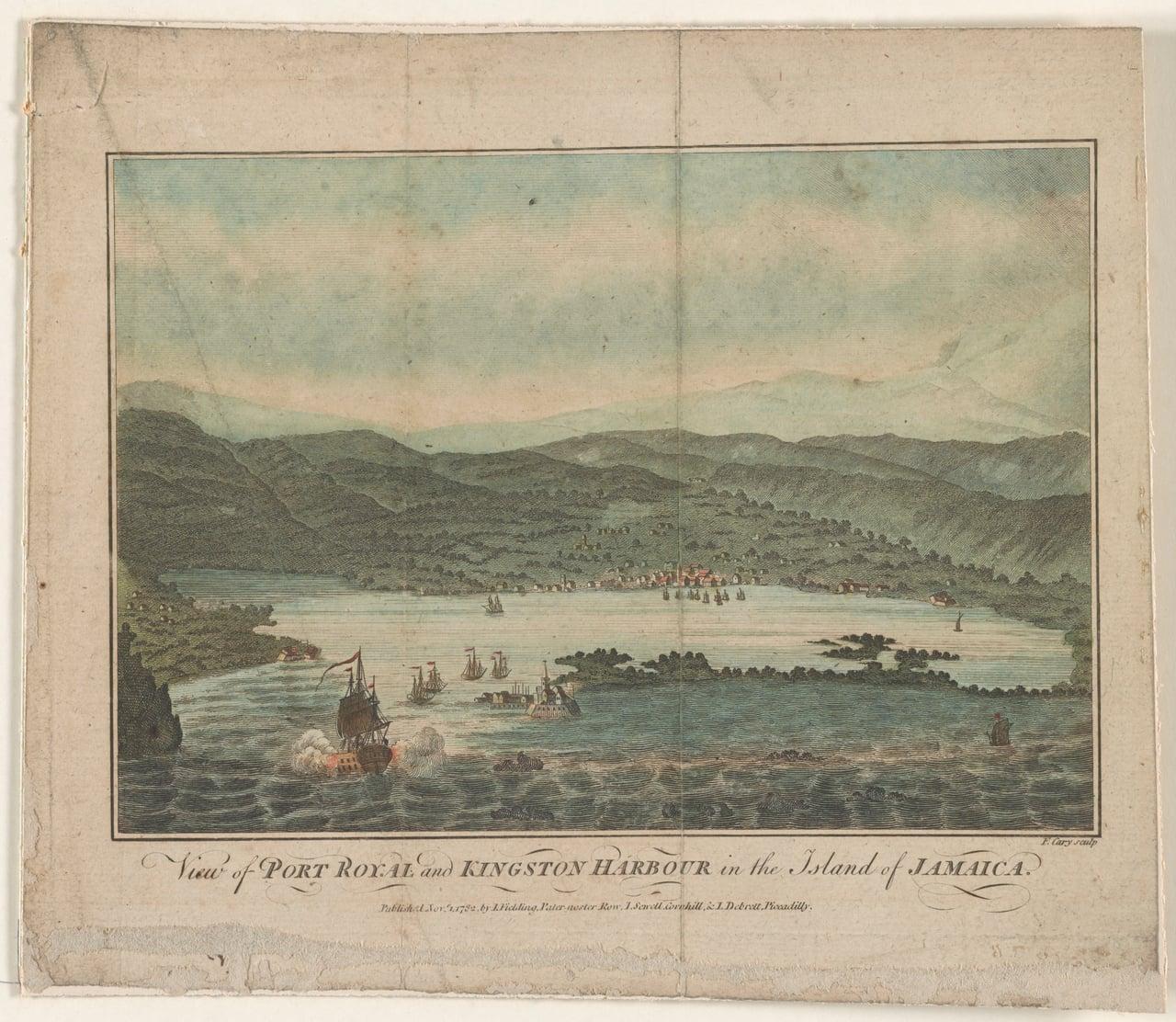
View of Port Royal and Kingston Harbour in the Island of Jamaica, P. Cary, 1782. Public domain.
Georgia and Jamaica, about 1750 to 1793 · Person · Featured Study
George Liele
He was a Baptist preacher, and the pastor of the church he gathered in Jamaica.
A freed slave from Georgia began to preach at Kingston in 1784, nine years before William Carey landed in India.
Do not be amazed that I said, ‘You must be born again.’
- Born
- about 1750, by his own guess in 1791 that he was about forty (proposed)
- Died
- not recorded in the letters of 1791 to 1793 (proposed)
- Family
- wife: ; son: ; son: ; son: ; daughter:
- Places
- Virginia, Savannah, Kingston, Spanish Town
Summary
George Liele was born in Virginia and was called George Sharp after his owner. The Baptist minister Matthew Moore baptized him in Georgia. His owner, Henry Sharp, set him free. When the British army left Savannah, he went to Jamaica bound to work off a debt. His answers to John Rippon of London are the record of his life.
- By December 1791 he counted four hundred people baptized by him in Jamaica.
- He kept a team of horses and wagons with his sons and took no pay from the church.
- He took no slave into the church without a few lines from the owner.
The Texts of His Hearers
A Savannah letter names the verse that turned Andrew Bryan, and a Kingston visitor borrowed the words of Pilate.
The question of this life is what the letters tell of a black preacher in Georgia and Jamaica in the years of the American war. Some are Liele's own answers, and some are from men who knew him. Rippon put more than fifty questions to him, and he printed the answers beside letters from Savannah and Kingston.
Then Pilate said to the chief priests and the crowds, “I find no basis for a charge against this man.”George Gibbs Bailey of Bristol borrowed Pilate's words in 1793 to say he had found no fault in Liele.
The Life in Order
Every date of the life comes from a letter printed by Rippon.
The record runs from his conversion in Georgia to his letters from Kingston.
- About 1750, by his own guessBirth in VirginiaLiele, Kingston, 18 December 1791
- About two years before the warConversion under Matthew MooreLiele, 18 December 1791
- After his baptismThree years of preaching near SavannahLiele, 18 December 1791
- Before his departureThe baptism of Andrew Bryan at the Tybee RiverClarke, 19 July 1790
- At the British evacuation of SavannahPassage to Jamaica, bound to Colonel KirklandLiele, 18 December 1791
- About September 1784First preaching at Kingston, in a small private houseLiele, 18 December 1791
- 18 December 1791Nigh three hundred and fifty members in the churchLiele, 18 December 1791
- 18 May 1792The church covenant copied out for LondonLiele, Kingston, 18 May 1792
- 12 January 1793The meeting-house roofed, and near five hundred baptizedLiele, Kingston, 12 January 1793
Each step of the life stands with the letter that gives it.
18 December 1791, 18 May 1792, 12 January 1793
From Savannah to Kingston
His own answers carry the life, and his friends' letters fill in what he left out.
Liele wrote that he was born in Virginia. His father's name was Liele and his mother's Nancy, and he could learn little of them. As a boy he lived in several parts of America, and at last he settled in Georgia. There his owner Henry Sharp was a deacon of the church Matthew Moore served.
One Sunday afternoon he stood to hear Matthew Moore, and he wrote that the sermon showed him his good works could not save him. After five or six months of conviction he found relief in prayer, and Moore baptized him.
He began by reading hymns to the slaves on his own plantation and explaining them. The white brethren called him at a quarterly meeting to preach before the congregation, and the church licensed him as a probationer. He preached at Brunton land and at Yamacraw, half a mile from Savannah.
Sharp freed him some years before he was killed as an officer in the king's service. Some who resented the freedom threw Liele into prison, and he was released when he showed his papers. When the British left Savannah he went with Colonel Kirkland to Jamaica as an indentured servant, for money he owed him.
Governor Campbell employed him for two years. When the debt to Kirkland was paid, he received a certificate of freedom for himself and his family. He began to preach in Kingston and formed a church with four brethren from America.
His letter of December 1791 counts about fifteen hundred hearers across the island. He started a free school for the children of free people and slaves.
The church bought three acres at the east end of Kingston and began a brick meeting-house. Stephen Cooke, a Kingston man who wrote to Rippon, judged that one hundred and fifty pounds from England would finish it.
In Their Own Words
Three passages of his letters from Kingston, and one of his answers on his conversion.
George Liele
Letter to John Rippon, Kingston, 18 December 1791, The Baptist Annual Register, 1790 to 1793, pages 332 to 337
Give me a work
“I requested of my Lord and Master to give me a work, I did not care how mean it was, only to try and see how good I would do it.”
Baptist
About this saying1 paragraph
He told Rippon in December 1791 what he asked of Christ at his conversion in Georgia.
George Liele
Letter to John Rippon, Kingston, 18 December 1791, The Baptist Annual Register, 1790 to 1793, pages 332 to 337
All freely
“I receive nothing for my services; I preach, baptize, administer the Lord's Supper, and travel from one place to another to publish the gospel, and to settle church affairs, all freely.”
Baptist
About this saying1 paragraph
In his letter of December 1791 he described his work as pastor of the church at Kingston.
George Liele
Letter to John Rippon, Kingston, 18 May 1792, The Baptist Annual Register, 1790 to 1793, pages 339 to 344
The covenant read once a month
“the chiefest part of our society are poor illiterate slaves, some living on sugar estates, some on mountains, pens, and other settlements, that have no learning, no not to know so much as a letter in the book; but the reading this covenant once a month, when all are met together from the different parts of the island, keeps them in mind of the commandments of God.”
Baptist
About this saying1 paragraph
Sending the church covenant to Rippon in May 1792, he said why it was read aloud.
George Liele
Letter to John Rippon, Kingston, 12 January 1793, The Baptist Annual Register, 1790 to 1793, page 542
The poor Ethiopian Baptists
“My brethren and sisters in general, most affectionately give their Christian love to you, and all the dear lovers of Jesus Christ in your church at London, and beg that they, and all the other churches, will remember the poor Ethiopian Baptists of Jamaica in their prayers”
Baptist
About this saying1 paragraph
He closed his letter of January 1793 with this request for the London church.
The People Around Him
The letters name his minister, his master, his creditor, his converts and the men who vouched for him.
Most of what is known of him comes through Rippon's correspondents.
| Person | Tie to Liele | The witness |
|---|---|---|
| Matthew Moore | The Baptist minister of Burke County who converted and baptized him | Liele's answers, with Rippon's note |
| Henry Sharp | His owner, a deacon of Moore's church, who freed him and died in the king's service | The account of 1791 printed by Rippon |
| Colonel Kirkland | He lent Liele money, took him to Jamaica as an indentured servant and commended him to the governor | Liele's answers |
| Andrew Bryan | Liele baptized him at the Tybee River, and he later led the black church at Savannah | Clarke's letter of 1790 |
| David George | A member of the Savannah church who preached in Nova Scotia | Liele's answers |
| Thomas Nichols Swigle | Deacon, schoolmaster and Liele's principal helper at Kingston | Swigle, Kingston, 12 April 1793 |
| Stephen Cooke | A Kingston man who described Liele's work and character to Rippon | Cooke, Kingston, 26 November 1791 |
| John Rippon | The London Baptist minister who wrote the questions and printed the answers | The Baptist Annual Register, 1790 to 1793 |
Stephen Cooke, John Rippon
The Places of His Life
His life runs from Virginia to the plantations near Savannah and then to Jamaica.
His preaching moved from the Savannah River to the towns of Jamaica.
| Place | What the letters say | The witness |
|---|---|---|
| Virginia | He was born there. | Liele, 1791 |
| Burke County, Georgia | Matthew Moore ministered there and baptized him. | Rippon's note to the letter of 1791 |
| Brunton land and Yamacraw | He preached at both places before he sailed. | Liele, 1791 |
| Tybee River | He baptized Andrew Bryan there before he sailed. | Clarke, 1790 |
| Kingston | He preached there from about September 1784 and built the meeting-house at the east end of the town. | Liele, 1791 to 1793 |
| Spanish Town | He baptized in its river and bought land there for a burying ground and meeting-house. | Liele, 1791 and 1793 |
How the Key Verse Was Taught
Hilary of Poitiers, John Chrysostom and Matthew Henry read the word to Nicodemus.
Hilary of Poitiers (died 367)
ON THE TRINITY 12.56
Hilary of Poitiers confessed in his work On the Trinity that he held the new birth without understanding it.
“For in Thy spiritual things I am dull, as Thy Only-begotten says, ‘Marvel not that I said unto thee, ye must be born anew. The Spirit breathes where it will, and thou hearest the voice of it; but dost not know whence it comes or whither it goes. So is every one who is born of water and of the Holy Spirit.’ Though I hold a belief in my regeneration, I hold it in ignorance; I possess the reality, though I comprehend it not.”
on John 3:7 to 8Patristic
John Chrysostom (died 407)
Homilies on the Gospel of John, Homily 24
John Chrysostom, preaching on the first saying of the new birth at John 3:3, joined it to right doctrine.
“Unless thou art born again and receivest the right doctrines, thou art wandering somewhere without, and art far from the Kingdom of heaven.”
Patristic
Matthew Henry (1662 to 1714)
Commentary on the Whole Bible
Matthew Henry rested the need of the new birth on the authority of the One who spoke it.
“He who is the great Lawgiver, whose will is a law,--he who is the great Mediator of the new covenant, and has full power to settle the terms of our reconciliation to God and happiness in him,--he who is the great Physician of souls, knows their case, and what is necessary to their cure,--he hath said, You must be born again.”
on John 3:7Puritan
What the Letters Leave Open
Readers of the letters differ on who planted the church at Savannah and on the rule he kept with owners.
The planting of the Savannah churchJoseph Cook; Jonathan Clarke
Joseph Cook of the Euhaw in South Carolina wrote in September 1790 that Brother George had planted "the first Baptist Church in Savannah, and another in Jamaica".
Clarke's letter from Savannah says that Andrew Bryan began to exhort his hearers eight or nine months after Liele sailed, and that his church grew under persecution after that. On Clarke's account Liele was the preacher who converted and baptized its first leader, and Bryan gathered the church.
The owners' lettersLiele; Stephen Cooke
Liele wrote that the church received no one without a few lines from the owner on his good behaviour. Stephen Cooke judged this wise, since the Methodists had admitted slaves without their owners' leave and raised many enemies.
Liele asked for a bell so that owners would know the hour of meeting and be satisfied that their servants came home in time. The rule let the church meet with the owners' consent, and it left each slave's place in the church in the owner's hands.
His age and his deathLiele
Liele wrote in 1791 that he could not tell his age and supposed himself about forty, so the year 1750 is his own guess. The letters Rippon printed in 1793 give no word of his later years.
Books to Read Next
The Journal of Negro History, volume 1
Carter G. Woodson, editor · 1916
It reprints the letters of Liele, Clarke, Cooke and Swigle from Rippon's Register in plain type.
Read the volume free at the Internet ArchiveThe Baptist Annual Register for 1790, 1791, 1792 and part of 1793
John Rippon · 1793
This is the first printing of the letters, set in the type of its day.
Read Rippon free at the Internet ArchiveWhat George Liele Left
Liele left a church at Kingston, a convert who led the church at Savannah, and the answers he wrote for Rippon. Thomas Nichols Swigle, his deacon, wrote in April 1793 that he hoped to see Jamaica become a Christian country.
Sources
Scripture is the Berean Standard Bible.
- The Holy Bible, Berean Standard Bible (read 2026)
- Letters showing the rise and progress of the early Negro churches of Georgia and the West-Indies, The Journal of Negro History, volume 1 (1916), pages 69 to 92, reprinting John Rippon, The Baptist Annual Register, 1790 to 1793, pages 332 to 344 and 540 to 542.
- John Rippon, The Baptist Annual Register for 1790, 1791, 1792 and part of 1793 (London, 1793)
- John Clark Marshman, The Life and Times of Carey, Marshman and Ward, volume 1 (1859), page 61, on the landing at Calcutta.
- Hilary of Poitiers, On the Trinity 12.56, on John 3:7.
- John Chrysostom, Homilies on the Gospel of John, homily 24, on John 3:3.
- Matthew Henry, Commentary on the Whole Bible, on John 3:7.