
Two detective stories against idols · Greek addition to Daniel, c. 2nd-1st century BC
Bel and the Dragon
Daniel proves that a god who eats dinner every night has priests with a trapdoor.
- 1Chapter
- 42Verses
- c. 200-100 BCEWritten
Original language: Greek (Susanna and Bel originally); Hebrew/Aramaic substrate for Prayer of Azariah
King James Version Apocrypha (1769 standardized text) · public domain
Read Bel and the Dragon
King James Version + Apocrypha (standardized 1769 text), eBible.org USFX edition of the Crosswire/eBible KJV — Public Domain — One of the three Additions to Daniel.
Featured studies on this book
— the deep dives, each its own page
Plain answers first
What this book is
Bel and the Dragon is a single chapter attached to the Greek Daniel, printed in some Bibles as Daniel chapter 14. It holds two short stories and a third scene, all making one point: the gods of Babylon are not alive.
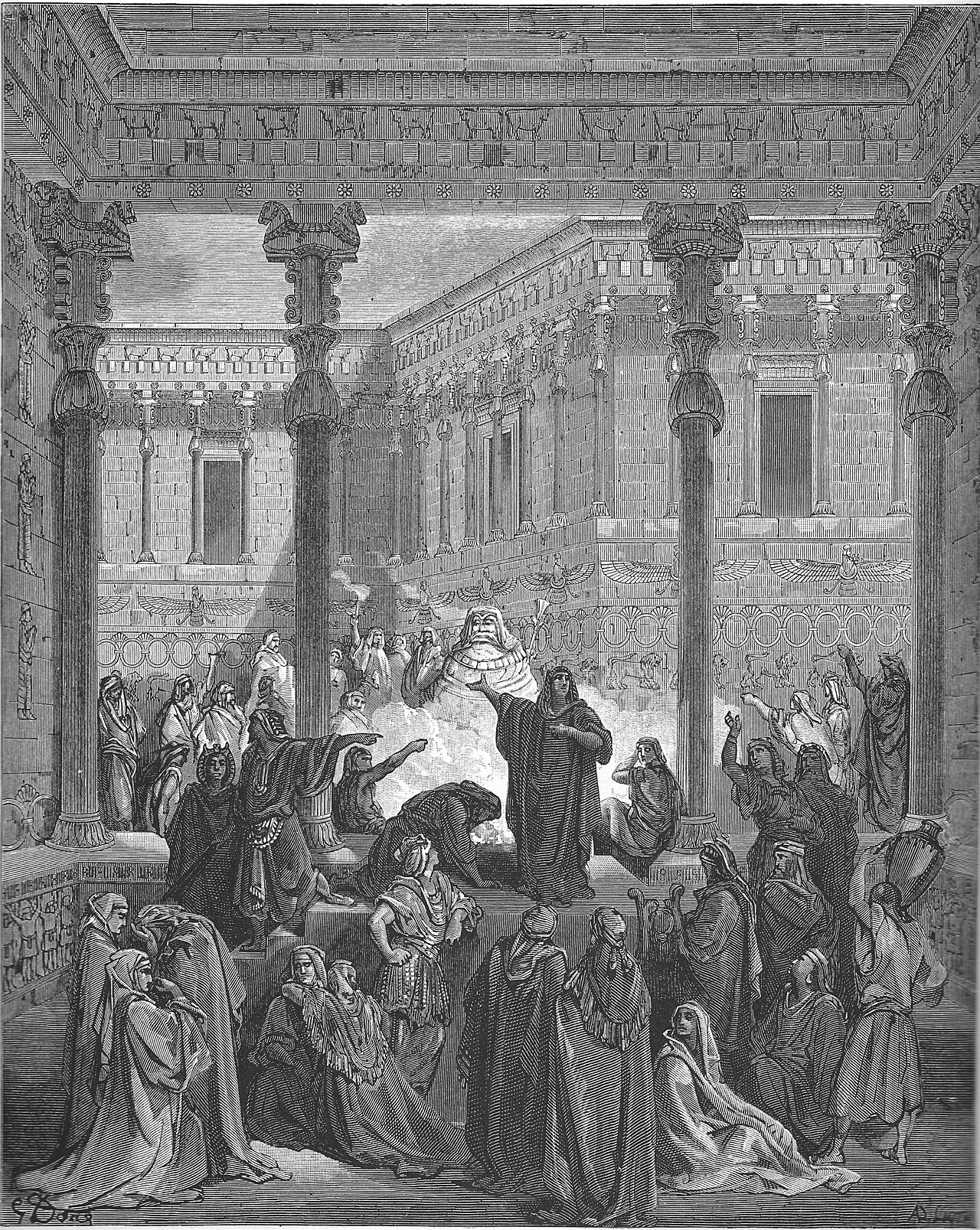
In the first, the king asks Daniel why he will not worship Bel, since the idol clearly eats the food set before it every night. Daniel says it is clay and brass and has never eaten anything. The temple is sealed, but Daniel quietly scatters ashes across the floor. In the morning the food is gone, the seal is intact, and the ashes are covered with the footprints of the priests, their wives, and their children, who have been coming in through a hidden door.
In the second, the king points to a living serpent, or dragon, that the Babylonians worship, and asks whether Daniel can call that one lifeless. Daniel asks permission and kills it without a sword, feeding it cakes made of pitch, fat, and hair until it bursts.
The crowd turns on Daniel and he is thrown to lions again, this time for six days. In the middle of it, the prophet Habakkuk is carrying stew to reapers in Judea when an angel lifts him by the hair and sets him down in Babylon to feed Daniel, then carries him home.
The piece is usually dated to the second or first century BC and comes to us in Greek.
Why a student of the 66 should still open it
Why read it: and how
This is Isaiah 44 and Jeremiah 10 turned into a story a child can follow. Those chapters argue that a man cuts a tree, burns half of it for warmth, and bows to the other half. Bel and the Dragon simply shows it, and lets you laugh. Behind the humor is the same claim that runs through the whole Bible: the living God is not fed by us, does not depend on us, and cannot be handled. It also preserves an early tradition of Habakkuk as a prophet with a story attached, which is worth knowing when you read his book.
One chapter, one sitting. Read Isaiah 44:9-20 first so you can hear what the story is dramatizing. Read it lightly, the way it was written. And keep the frame straight: it is a witness to how Jews under foreign rule mocked idolatry and kept their nerve, not an addition to the historical record of Daniel's life.
The canon question, honestly
Why it stands outside the 66
This chapter is not in the Hebrew and Aramaic Daniel. It survives only in the Greek versions, and Jerome again marked it as absent from the Hebrew when he included it in Latin. The Reformers moved it to the apocrypha with the other additions. Rome affirmed it at Trent, and Orthodox churches read it. Christians have also long noticed that its tone is different from the rest of Daniel: it is broader, more playful, closer to folk tale than to the visions of Daniel 7-12. That difference is part of why the church's judgment about it went the way it did.
Doors into the text
Key moments
Verses 1-9. The king points to the nightly offerings as proof Bel is alive; Daniel laughs and takes the challenge.
Verses 10-19. The sealed temple, the secret door, and footprints of men, women, and children in the ash.
Verses 23-27. A living creature worshipped as a god is killed with a recipe, not a sword.
Verses 28-32. The crowd forces the king's hand and Daniel is thrown in for six days, seven lions waiting.
Verses 33-39. An angel moves the prophet from a field in Judea to the lions' den and back with a bowl of stew.
Verse 41. He pulls Daniel out and declares there is no other god beside the God of Daniel.
Plainly told
The story it tells
The god who eats dinner
The Babylonian king asks Daniel why he won’t worship Bel, since the idol clearly eats the food set before it every night. Daniel says it is only clay and brass under a coat of gold, and has never eaten anything.
Ashes on the floor
The king seals the temple himself. Before the doors close, Daniel quietly scatters ashes across the floor where no one is watching. In the morning the food is gone and the seal is unbroken, but the ashes are covered with the footprints of the priests, their wives, and their children, who have been slipping in through a hidden trapdoor for years.
The living dragon
The king points to a serpent the Babylonians worship as a living god and dares Daniel to call this one lifeless too. Daniel kills it without a weapon, feeding it cakes of pitch, fat, and hair until it bursts.
Thrown to the lions again
The furious crowd forces the king’s hand, and Daniel is thrown into the lions’ den a second time, for six days, with seven lions waiting.
Habakkuk carried by the hair
In Judea, the prophet Habakkuk is carrying stew to reapers when an angel lifts him by the hair and sets him down in the den to feed Daniel, then carries him home the same way.
The king’s confession
The king pulls Daniel out unharmed and declares there is no god beside the God of Daniel: the same pattern Nebuchadnezzar’s confession follows earlier in the canonical Daniel.
Dates hedged where scholarship hedges
Where it sits in history
- c. 2nd–1st century BC
Bel and the Dragon circulates as one of the “Additions to Daniel,” in the same family as Susanna and the Song of the Three Children, before being folded into the Greek text.
- c. AD 400
Jerome notes it too is absent from the Hebrew Bible even as he carries it into his Latin translation of Daniel.
- 1546
The Council of Trent affirms it as canonical Scripture, printed as Daniel chapter 14.
- 1571
Article VI of the Thirty-Nine Articles places “Of Bel and the Dragon” among the books read for the example of life, not for doctrine.
- 1672
The Synod of Jerusalem reaffirms Eastern Orthodoxy’s reception of the piece as part of Daniel.
The disagreement is old: here it is plainly
Where the traditions stand
Like Susanna, Bel and the Dragon has no Hebrew or Aramaic form behind it that anyone in antiquity ever produced. Jerome names it in the same breath as Susanna and the Song of the Three Children when he lists what the Hebrews do not have in Daniel: “the fables of Bel and the Dragon” is his own phrase for it, even as he translated it into Latin regardless.
Readers across centuries, on every side of the canon question, have also noticed that its tone sits apart from the rest of Daniel. Where Daniel 7–12 is dense apocalyptic vision, this is broad, almost comic folk tale: a hidden trapdoor, a monster fed to bursting on cake. That difference in register is part of why it was judged differently even by churches that valued it highly.
The Reformers set it among the apocrypha for the same reason as Susanna: no Hebrew original, read for instruction rather than doctrine. Rome and the Eastern churches folded it into Daniel itself, as chapter 14, at the same moment they settled Susanna’s status.
As with the other Additions, the question was never whether the piece teaches something true about idols (everyone has agreed it does) but which canon list a church inherited.
| Tradition | Where this book stands |
|---|---|
| jewish | not canonical; Hebrew original (if any) lost |
| anglican | apocryphal — read for example of life and instruction of manners |
| catholic | canonical (deuterocanonical; Daniel 3, 13, 14 in Vulgate) |
| protestant | non-canonical; retained in Luther's 1534 Apocrypha |
| eastern orthodox | canonical (anagignoskomena) |
| oriental orthodox | canonical |
2 threads into the 66
Its connections into Scripture
The Song of the Three Young Men — a responsive creation hymn sung from within the furnace ("Bless the Lord, all works of the Lord") — structurally and thematically parallels Psalm 148's universal call to creation to praise the Creator. The Song's refrain-based structure and its expansion of the furnace narrative into a liturgical theology of creation made it one of the earliest Christian canticles (the Benedicite).
Susanna's vindication turns on Daniel's separate cross-examination of the two witnesses, who contradict each other on which tree the alleged offense occurred under. The principle — careful testing of two or three witnesses — is Torah (Deut 19:15) sharpened into forensic wisdom narrative, and it surfaces in Jesus' church-discipline instruction: "every charge may be established by the evidence of two or three witnesses" (Matt 18:16).
Reception history, never our confession
What the church has made of it
The story is Isaiah 44:9–20 and Jeremiah 10:1–16 turned into a plot a child can follow. Those chapters argue that a craftsman cuts a tree, burns half for warmth, and bows to the other half carved into a god; Bel and the Dragon simply shows the fraud being run and lets the reader watch it get caught. Its idol-mocking sits in the same tradition later New Testament writers draw on when they insist idols are nothing (Acts 17:29; 1 Corinthians 8:4; 1 John 5:21), a shared theme, not a textual borrowing.
The piece also preserves an early tradition about the prophet Habakkuk, whose own three-chapter book gives no narrative at all. Its opening line, in the Old Greek, names him “Habakkuk, son of Jeshua, of the tribe of Levi”, a detail found nowhere in the canonical Book of Habakkuk, and part of a wider body of legendary material Second Temple Judaism built up around otherwise-silent prophets.
Printed in the King James Bible’s Apocrypha section as its own short book, it has always been read more as satire than sermon: closer in spirit to a folk tale mocking a fraud than to prophecy, which is exactly the register it seems to have been written in.
The voices
What the teachers have said
“the Story of Susanna and the Hymn of the Three Children, and the fables of Bel and the Dragon, which are not contained in the Hebrew Bible”
“the Church doth read for example of life and instruction of manners; but yet doth it not apply them to establish any doctrine”
Every claim above rests on these
Where this comes from
- Bruce M. Metzger, An Introduction to the Apocrypha (Oxford, 1957)
- David A. deSilva, Introducing the Apocrypha: Message, Context, and Significance (Baker Academic)
- R. H. Charles, ed., The Apocrypha and Pseudepigrapha of the Old Testament, vol. 1: Apocrypha (Oxford, 1913)