
Psalms 21:4
in Psalms 21He asked You for life, and You granted it— length of days, forever and ever.
BSB
The same verse in ASV and KJV ▾
ASV
He asked life of thee, thou gavest it him, Even length of days for ever and ever.
KJV
He asked life of thee, and thou gavest it him, even length of days for ever and ever.
⋯
This verse in Psalms 21
Commentary
12 notes on this verse"He asked life of Thee, and Thou gavest him length of days for ever and ever;" indicating that it is the Father of all who imparts continuance for ever and ever on those who are saved. For life does not arise from us, nor from our own nature; but it is bestowed according to the grace of God.
This site's exposition
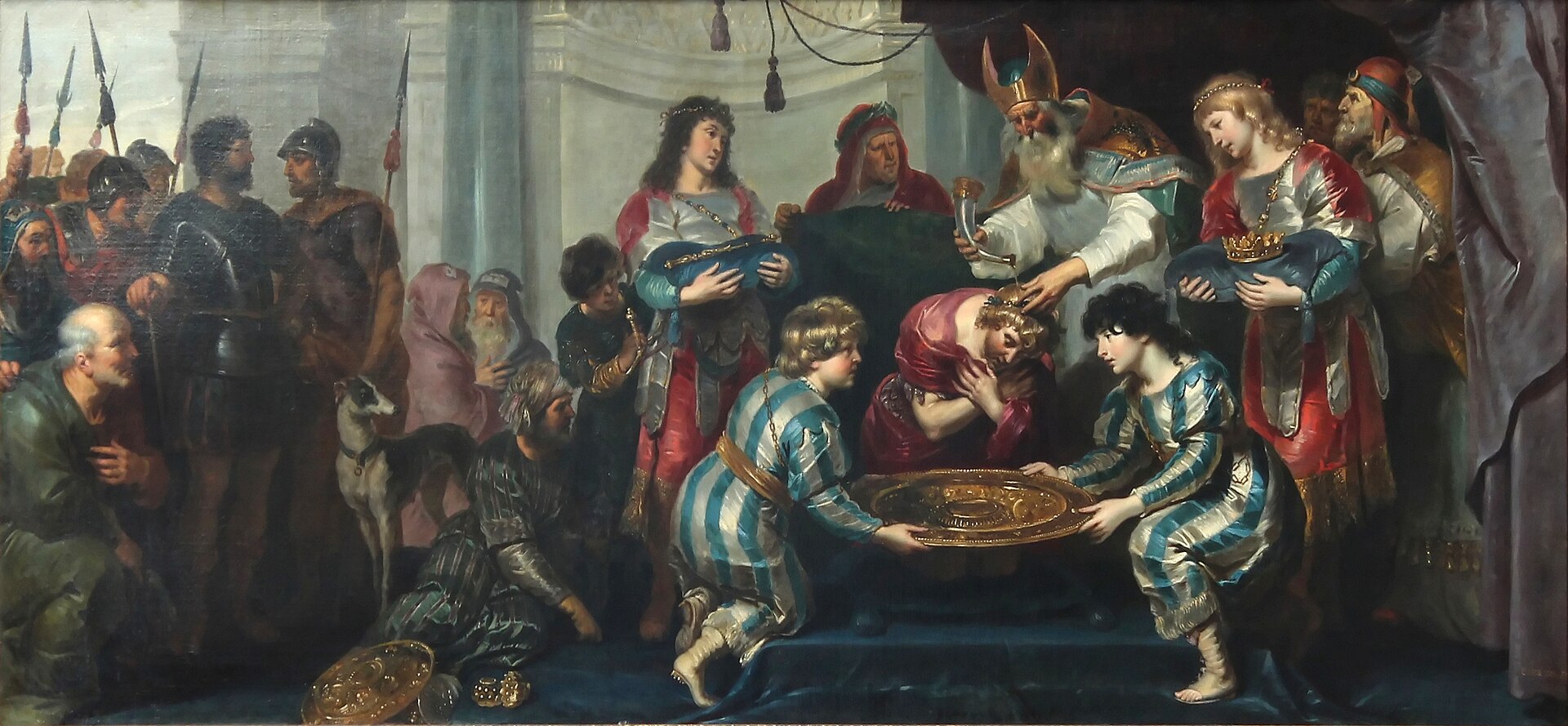
a crown of pure gold
on Psalms 21:3-4
God meets the king with rich blessings and crowns him with pure gold. The king asked for life and was given length of days, forever and ever, which Delitzsch found too long for any human reign. Gill reads it of Christ.
The record, by era
The Church Fathers2 voices
"He asked life; and You gave Him:" He asked a resurrection, saying, "Father, glorify Your Son;" [John 17:1] and You gave it Him, "Length of days for ever and ever" [Psalm 21:4]. The prolonged ages of this world which the Church was to have, and after them an eternity, world without end.
He sought life; he lived as a man. Having been limited in life, in death he received length of days not just to old age but to eternity.
The Medieval Church1 voice
Next he shows how the petition of his lips is fulfilled: hence he says, "He asked life of you," when he asked you for the resurrection: Ps. 40: "But you, O Lord, have mercy on me, and raise me up, and I will repay them." …
The Puritans and the Awakening2 voices
But this was more eminently fulfilled in Christ, who asked of his father, life, or to be saved from death, Heb. v, 7, though with submission to his will: but his father, though he saw it necessary to take away his temporal life, yet instantly gave him another, far more noble, even the perfect possession of an everlasting life both in his soul and body, at his right hand.
He was dead, indeed, that we might live through him; but he is alive, and lives for evermore, and of the increase of his government and peace there shall be no end; and because he thus lives we shall thus live also.
5 more voices on this verse
The Puritans and the Awakening1 voice
He asked life of thee, and thou gavest it him,....
The Nineteenth Century4 voices
"He asked life of thee, and thou gavest it him, even length of days for ever and ever." The first words may suit King David, but the length of days for ever and ever can only refer to the King Messiah. Jesus, as man, prayed for resurrection and he received it, and now possesses it in immortality. He died once, but being raised from the dead he dieth no more. "Because I live, ye shall live also, " is the delightful intimation which the Saviour gives us, that we are partakers of his eternal life.
A commentator
Jamieson, Fausset & Brown1802–1910
Commentary Critical and Explanatory on the Whole Bible (1871)
proposed
The glory and blessedness of the king as head of his line, including Christ, as well as in being God's specially selected servant, exceeded that of all others.
He asked life of thee - This verse has caused some interpreters to understand the Psalm of Hezekiah’s sickness, recovery, and the promised addition to his life of fifteen years; but it may be more literally understood of the Messiah, of whom David was the type, and in several respects the representative.
A commentator
Albert Barnes1798–1870
Notes, Explanatory and Practical, on the Old and New Testaments (1832-1869)
proposed
He asked life of thee - An expression similar to this occurs in Psa 61:5-6, “For thou, O God, hast heard my vows;...Thou wilt prolong the king’s life, and his years to many generations.” The expression in both cases implies that there had been a prayer for “life,” as if life were in danger. The expression itself would be applicable to a time of sickness, or to danger of any kind, and here it is used doubtless in reference to the exposure of life in going into battle, or in going forth to war. In this apprehended peril he prayed that God would defend him. He earnestly sought protection as he went forth to the perils of war. And thou gavest it him - Thou didst hear and answer his prayer. He was saved from danger. Even length of days forever and ever - Thou didst grant him more than he asked. He sought life for himself; thou bast not only granted that, but hast granted to him the assurance that he should live in his posterity to all generations. The idea is, that there would be an indefinite contination of his race. His posterity would occupy his throne, and there would be no end to his reign thus prolonged. Beyond all his petitions and his hopes, God bad given the assurance that his reign would be permanent and enduring. We cannot suppose that he understood this as if it were a promise made to him personally, that “he” would live and would occupy the throne forever; but the natural interpretation is that which would refer it to his posterity, and to the perpetuity of the reign of his family or descendants. A similar promise occurs elsewhere: 2Sa 7:13, 2Sa 7:16; compare the notes at Psa 18:50. It is by no means an uncommon thing that God gives us more than we asked in our prayers. The offering of prayer is not only the means of securing the blessing which we asked, but also often of securing much more important blessings which we did not ask. […]
The words behind it
9 Hebrew wordsEvery Hebrew word of this verse in the order it stands, with what it means and the door to its own study. The last column counts the times a word stands in the whole Bible: the rarer the word, the more the places it appears belong together.
| Hebrew | Sound | Meaning | Word study | In the Bible |
|---|---|---|---|---|
| חַיִּ֤ים׀ | chaiyim | life | H2416 → | 498 times |
| שָׁאַ֣ל | shaal | he asked | H7592 → | 171 times |
| מִ֭מְּךָ | mimekha | from you | H4480 → | 1188 times |
| נָתַ֣תָּה | natatah | you gave [it] | H5414 → | 2011 times |
| לּ֑וֹ | lo | to him | ||
| אֹ֥רֶךְ | ʾorekh | length of | H753 → | 95 times |
| יָ֝מִ֗ים | yamim | days | H3117 → | 2304 times |
| עוֹלָ֥ם | olam | forever | H5769 → | 438 times |
| וָעֶֽד׃ | vaed | and ever | H5703 → | 49 times |
חַיִּ֤ים׀life
chaiyimH2416 →498 times
שָׁאַ֣לhe asked
shaalH7592 →171 times
מִ֭מְּךָfrom you
mimekhaH4480 →1188 times
נָתַ֣תָּהyou gave [it]
natatahH5414 →2011 times
לּ֑וֹto him
lo
אֹ֥רֶךְlength of
ʾorekhH753 →95 times
יָ֝מִ֗יםdays
yamimH3117 →2304 times
עוֹלָ֥םforever
olamH5769 →438 times
וָעֶֽד׃and ever
vaedH5703 →49 times
A shaded row is a word that stands 400 times or fewer in the Bible.
The walk
8 stopsEach card is a verse this one points to, and under it the verses that one points to in turn. Where several paths arrive at the same place, that place is listed first: the text keeps returning to it.
Through
Revelation 1:18the Living One. I was dead, and behold, now I am alive forever and ever! And I hold the keys of Death and of Hades.
it leads to
- Romans 6:9
For we know that since Christ was raised from the dead, He cannot die again; death no longer has dominion over Him.
- Hebrews 7:25
Therefore He is able to save completely those who draw near to God through Him, since He always lives to intercede for them.
- Romans 14:8–9
If we live, we live to the Lord, and if we die, we die to the Lord. So whether we live or die, we belong to the Lord.
- Psalms 68:20
Our God is a God of deliverance; the Lord GOD is our rescuer from death.
- Revelation 3:7
To the angel of the church in Philadelphia write: These are the words of the One who is holy and true, who holds the key of David. What He opens no one can shut,…
- Romans 6:9
Through
Psalms 91:16With long life I will satisfy him and show him My salvation.”
it leads to
- Proverbs 3:2
for they will add length to your days, years and peace to your life.
- Proverbs 3:16
Long life is in her right hand; in her left hand are riches and honor.
- Psalms 50:23
He who sacrifices a thank offering honors Me, and to him who rights his way, I will show the salvation of God.”
- Proverbs 3:2
About Psalms
This page draws on 13 works. Open the list of works
This page draws on Adam Clarke, Commentary on the Bible; Albert Barnes, Notes, Explanatory and Practical, on the Old and New Testaments (1832-1869); Arnobius the Younger, COMMENTARY ON PSALM 21; Augustine of Hippo, Exposition on Psalm 21; Charles Spurgeon, The Treasury of David, Vol. 1; Franz Delitzsch, Biblical Commentary on the Psalms; Irenaeus, AGAINST HERESIES 2:34.3; Jamieson, Fausset & Brown, Commentary Critical and Explanatory on the Whole Bible; John Gill, Exposition of the Old Testament; John Gill, Exposition of the Old Testament (1748-1763); John Wesley, Explanatory Notes upon the Old Testament; Matthew Henry, Commentary on the Whole Bible and Thomas Aquinas, Exposition on the Psalms of David.