
Psalms 21:3
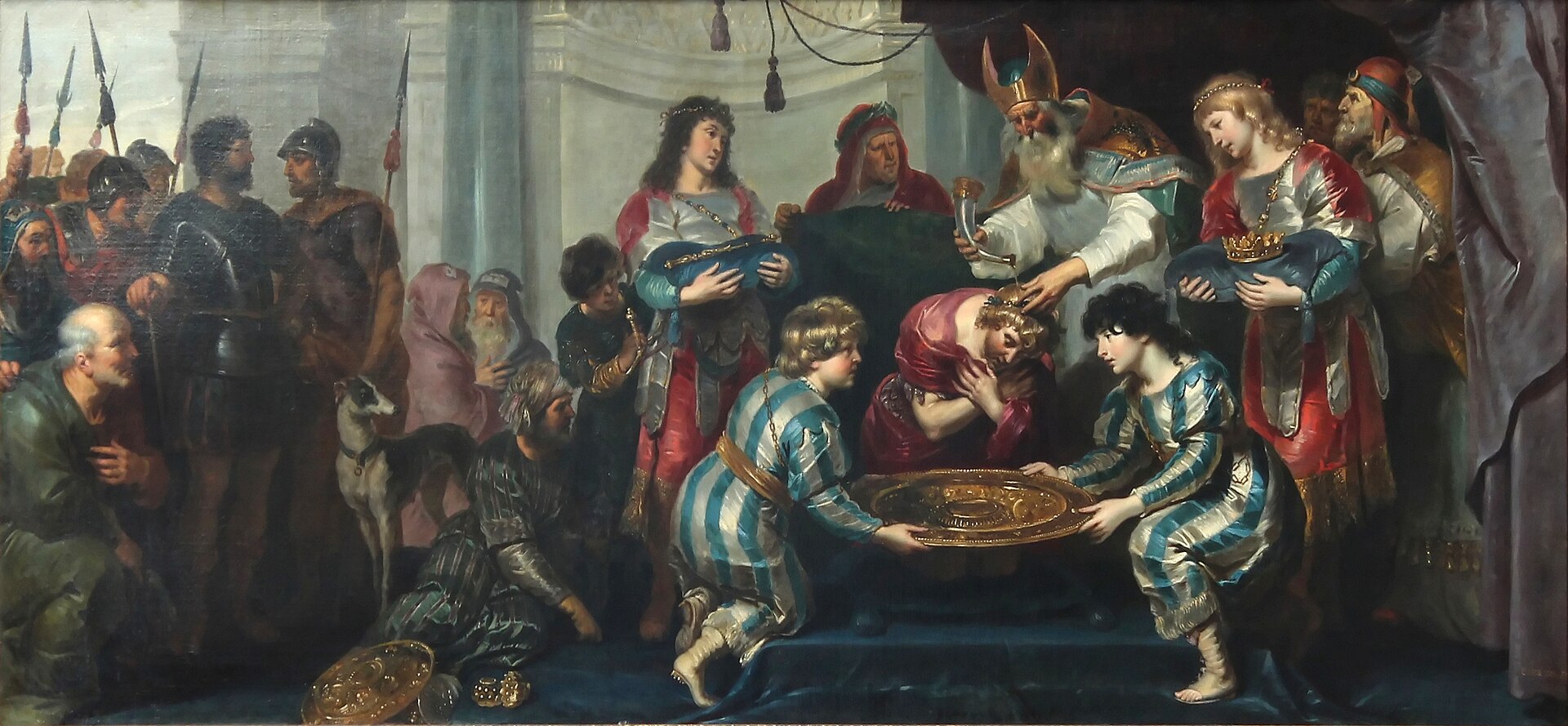
in Psalms 21For You welcomed him with rich blessings; You placed on his head a crown of pure gold.
BSB
The same verse in ASV and KJV ▾
ASV
For thou meetest him with the blessings of goodness: Thou settest a crown of fine gold on his head.
KJV
For thou preventest him with the blessings of goodness: thou settest a crown of pure gold on his head.
⋯
This verse in Psalms 21
Commentary
16 notes on this verseThe crown of the Lord is the church gathered from the various nations, about which Paul in the person of the believers says, "My joy and my crown."
This site's exposition
a crown of pure gold
on Psalms 21:3-4
God meets the king with rich blessings and crowns him with pure gold. The king asked for life and was given length of days, forever and ever, which Delitzsch found too long for any human reign. Gill reads it of Christ.
The record, by era
The Church Fathers4 voices
"For You have presented Him with the blessings of sweetness" [Psalm 21:3]. Because He had first quaffed the blessing of Your sweetness, the gall of our sins did not hurt Him. " Diapsalma. You have set a crown of precious stone on His Head." At the beginning of His discoursing precious stones were brought, and compassed Him about; His disciples, from whom the commencement of His preaching should be made.
A commentator
Augustine of HippoAGAINST TWO LETTERS OF THE PELAGIANS 2:21 · Written before 430.
proposed
May God by all means turn away this folly of making ourselves first in His gifts, Himself last,—because "His mercy shall prevent me." And it is He to whom is faithfully and truthfully sung, "For Thou hast prevented him with the blessings of sweetness." And what is here more fitly understood than that very desire of good of which we are speaking? For good begins then to be longed for when it has begun to grow sweet. But when good is done by the fear of penalty, not by the love of righteousness good is not yet well done. Nor is that done in the heart which seems to be done in the act when a man would rather not do it if he could evade it with impunity. Therefore the "blessing of sweetness" is God's grace, by which is caused in us that what He prescribes to us delights us, and we desire it,—that is, we love it; in which if God does not precede us, not only is it not perfected, but it is not even begun, from us. For, if without Him we are able to do nothing actually, we are able neither to begin nor to perfect,—because to begin, it is said "His mercy shall prevent me;" to finish, it is said, "His mercy shall follow me."
He indicates that humanity is ever adorned with the anticipatory grace of the Godhead, because no one offers anything to God first unless what is good is granted by a heavenly gift.
Christ is the crown of the rational nature.
The Medieval Church1 voice
"For." Here he sets forth the things in which the desire is fulfilled. And first he speaks of the fulfillment of the desire of the heart. Second, of the fulfillment of the desire of prayer, which is the same as the desire of the lips, …
9 more voices on this verse
The Puritans and the Awakening2 voices
For thou preventest him with the blessings of goodness,....
Nothing indeed prevented Christ, but to mankind never was any favour more preventing than our redemption by Christ and all the blessed fruits of his mediation.
The Nineteenth Century7 voices
A commentator
Charles Spurgeon1834–1892
The Metropolitan Tabernacle Pulpit, Sermon No. 3329: “Goodness Going Before” (lightly modernized text, CCEL edition) · Written before 1892.
OUR text is one of many instances of the way in which words change their meanings. The word, "prevent," as we now use it, has a very different meaning from that which it had when our translators used it. It now signifies to get before one, to stop up his path, to prevent his going a certain way, just as the angel "prevented" Balaam, standing with his sword drawn in his hand that he might not pass that way.
"For thou preventest him with the blessings of goodness." The word prevent formerly signified to precede or go before, and assuredly Jehovah preceded his Son with blessings. Before he died saints were saved by the anticipated merit of his death, before he came believers saw his day and were glad, and he himself had his delights with the sons of men. The Father is so willing to give blessings through his Son, that instead of his being constrained to bestow his grace, he outstrips the Mediatorial march of mercy.
A commentator
Jamieson, Fausset & Brown1802–1910
Commentary Critical and Explanatory on the Whole Bible (1871)
proposed
preventest--literally, "to meet here in good sense," or "friendship" (Ps 59:10; compare opposite, Ps 17:13). blessings of goodness--which confer happiness. crown of pure gold--a figure for the highest royal prosperity.
quarantine:debris (2026-07-29) — starts-lowercase
"For thou preventest him with the blessings of goodness." The word prevent formerly signified to precede or go before, and assuredly Jehovah preceded his Son with blessings. Before he died saints were saved by the anticipated merit of his death, before he came believers saw his day and were glad, and he himself had his delights with the sons of men. The Father is so willing to give blessings through his Son, that instead of his being constrained to bestow his grace, he outstrips the Mediatorial march of mercy. "I say not that I will pray the Father for you, for the Father himself loveth you." Before Jesus calls the Father answers, and while he is yet speaking he hears. Mercies may be bought with blood, but they are also freely given. The love of Jehovah is not caused by the Redeemer's sacrifice, but that love, with its blessings of goodness, preceded the great atonement, and provided it for our salvation. Reader, it will be a happy thing for thee if, like thy Lord, thou canst see both providence and grace preceding thee, forestalling thy needs, and preparing thy path. Mercy, in the case of many of us, ran before our desires and prayers, and it ever outruns our endeavours and expectancies, and even our hopes are left to lag behind. Prevenient grace deserves a song; we may make one out of this sentence; let us try. All our mercies are to be viewed as "blessings;" gifts of a blessed God, meant to make us blessed; they are "blessings of goodness, "not of merit, but of free favour; and they come to us in a preventing way, a way of prudent foresight, such as only preventing love could have arranged. In this light the verse is itself a sonnet! "Thou settest a crown of pure gold on his head." Jesus wore the thorn-crown, but now wears the glory-crown. It is a "crown, " indicating royal nature, imperial power, deserved honour, glorious conquest, and divine government.
A commentator
Charles Spurgeon1834–1892
The Metropolitan Tabernacle Pulpit, Sermon No. 3329: “Goodness Going Before” (lightly modernized text, CCEL edition) · Written before 1892.
proposed
OUR text is one of many instances of the way in which words change their meanings. The word, "prevent," as we now use it, has a very different meaning from that which it had when our translators used it. It now signifies to get before one, to stop up his path, to prevent his going a certain way, just as the angel "prevented" Balaam, standing with his sword drawn in his hand that he might not pass that way. This is only the modern use of the word, but the real and ancient use of it was simply, "to go before." "You go before Him with the blessings of goodness." That is the real meaning of the word—and when we speak of, "preventing Grace," we do not intend to describe the Grace that keeps us from sin, but the Grace which goes before our actually believing in Christ—"prevenient Grace," as we are accustomed to call it theologically—Grace which comes to us while as yet we are not conscious of its power, or have no desire towards it. The meaning of the text, then, is not that Christ was prevented, or hindered from doing anything that He wished to do, by God's goodness, but that God's goodness went before, preceded, heralded Him. That word, "preceded," has taken in our language in the present age the force and meaning which the word, "prevent," had at the time of the translation of our authorized version of the Bible, so that now we should say, instead, "You precede Him, got before Him with the blessings of Your goodness." I shall take the text on this occasion, then, in two ways. First, noticing its application to our Lord Jesus Christ, personally, and then its application to Him mystically—that is to say, to every believing soul that is truly in Him. First, then— I. ITS APPLICATION TO OUR LORD JESUS CHRIST PERSONALLY. It is quite certain that God did precede Him with the blessings of goodness.
Thou preventest him - To prevent, from prcevenio, literally signifies to go before. Hence that prayer in the communion service of our public Liturgy, “Prevent us, O Lord, in all our doings, with thy most gracious favor!” That is, “Go before us in thy mercy, make our way plain, and enable us to perform what is right in thy sight!” And this sense of prevent is a literal version of the original word תקדמנו tekademennu. “For thou shalt go before him with the blessings of goodness.” Our ancestors used God before in this sense. So in Henry V.’s speech to the French herald previously to the battle of Agincourt: - “Go therefore; tell thy master, here I am. My ransom is this frail and worthless trunk; My army, but a weak and sickly guard: Yet, God before, tell him we will come on, Though France himself, and such another neighbor, Stand in our way.” A crown of pure gold - Probably alluding to the crown of the king of Rabbah, which, on the taking of the city, David took and put on his own head. See the history, 2Sa 12:26-30 (note).
A commentator
Albert Barnes1798–1870
Notes, Explanatory and Practical, on the Old and New Testaments (1832-1869)
proposed
For thou preventest him - Thou goest before him; thou dost anticipate him. See Psa 17:13, margin. Our word “prevent” is now most commonly used in the sense of “hinder, stop, or intercept.” This is not the original meaning of the English word; and the word is never used in this sense in the Bible. The English word, when our translation was made, meant to “go before,” to “anticipate,” and this is the uniform meaning of it in our English version, as it is the meaning of the original. See the notes at Job 3:12. Compare Psa 59:10; Psa 79:8; Psa 88:13; Psa 95:2; Psa 119:147-148; Amo 9:10; see the notes at 1Th 4:15. The meaning here is, that God had “anticipated” him, or his desires. He had gone before him. He had designed the blessing even before it was asked. With the blessings of goodness - Blessings “indicating” goodness on his part; blessings adapted to promote the “good” or the welfare of him on whom they were bestowed. Perhaps the meaning here is, not only that they were “good,” but they “seemed” to be good; they were not “blessings in disguise,” or blessings as the result of previous calamity and trial, but blessings where there was no trial - no shadow - no appearance of disappointment. Thou settest a crown of pure gold on his head - This does not refer to the time of his coronation, or the period when he was crowned a king, but it refers to the victory which he had achieved, and by which he had been made truly a king. He was crowned with triumph; he was shown to be a king; the victory was like making him a king, or setting a crown of pure gold upon his head. He was now a conqueror, and was indeed a king.
The words behind it
8 Hebrew wordsEvery Hebrew word of this verse in the order it stands, with what it means and the door to its own study. The last column counts the times a word stands in the whole Bible: the rarer the word, the more the places it appears belong together.
| Hebrew | Sound | Meaning | Word study | In the Bible |
|---|---|---|---|---|
| כִּֽי־ | ki- | for | H3588 → | 4482 times |
| תְ֭קַדְּמֶנּוּ | tekaddemenu | you meet him | H6923 → | 26 times |
| בִּרְכ֣וֹת | birkhot | blessings of | H1293 → | 69 times |
| ט֑וֹב | tov | good thing[s] | H2896 → | 538 times |
| תָּשִׁ֥ית | tashit | you set | H7896 → | 83 times |
| לְ֝רֹאשׁ֗וֹ | lerosho | to head his | H7218 → | 599 times |
| עֲטֶ֣רֶת | ʾateret | a crown of | H5850 → | |
| פָּֽז׃ | paz | pure gold | H6337 → | 9 times |
כִּֽי־for
ki-H3588 →4482 times
תְ֭קַדְּמֶנּוּyou meet him
tekaddemenuH6923 →26 times
בִּרְכ֣וֹתblessings of
birkhotH1293 →69 times
ט֑וֹבgood thing[s]
tovH2896 →538 times
תָּשִׁ֥יתyou set
tashitH7896 →83 times
לְ֝רֹאשׁ֗וֹto head his
leroshoH7218 →599 times
עֲטֶ֣רֶתa crown of
ʾateretH5850 →
פָּֽז׃pure gold
pazH6337 →9 times
A shaded row is a word that stands 400 times or fewer in the Bible.
The walk
8 stopsEach card is a verse this one points to, and under it the verses that one points to in turn. Where several paths arrive at the same place, that place is listed first: the text keeps returning to it.
Through
Psalms 31:19How great is Your goodness which You have laid up for those who fear You, which You have bestowed before the sons of men on those who take refuge in You!
it leads to
- 1 Corinthians 2:9
Rather, as it is written: “No eye has seen, no ear has heard, no heart has imagined, what God has prepared for those who love Him.”
- Isaiah 64:4
From ancient times no one has heard, no ear has perceived, no eye has seen any God besides You, who acts on behalf of those who wait for Him.
- Lamentations 3:23–25
They are new every morning; great is Your faithfulness!
- 1 Peter 1:4–5
and into an inheritance that is imperishable, undefiled, and unfading, reserved in heaven for you,
- Colossians 3:2–4
Set your minds on things above, not on earthly things.
- 1 Corinthians 2:9
Through
Ephesians 1:3Blessed be the God and Father of our Lord Jesus Christ, who has blessed us in Christ with every spiritual blessing in the heavenly realms.
it leads to
- 1 Peter 1:3
Blessed be the God and Father of our Lord Jesus Christ! By His great mercy He has given us new birth into a living hope through the resurrection of Jesus Christ from the dead,
- 2 Corinthians 1:3
Blessed be the God and Father of our Lord Jesus Christ, the Father of compassion and the God of all comfort,
- Ephesians 2:6
And God raised us up with Christ and seated us with Him in the heavenly realms in Christ Jesus,
- 1 Peter 1:3
About Psalms
This page draws on 15 works. Open the list of works
This page draws on Adam Clarke, Commentary on the Bible; Albert Barnes, Notes, Explanatory and Practical, on the Old and New Testaments (1832-1869); Augustine of Hippo, Exposition on Psalm 21; Augustine of Hippo, AGAINST TWO LETTERS OF THE PELAGIANS 2:21; Cassiodorus, EXPLANATION OF THE PSALMS 21:4; Charles Spurgeon, The Metropolitan Tabernacle Pulpit, Sermon No. 3329: “Goodness Going Before” (lightly modernized text, CCEL edition); Charles Spurgeon, The Treasury of David, Vol. 1; Evagrius Ponticus, NOTES ON THE PSALMS; Franz Delitzsch, Biblical Commentary on the Psalms; Jamieson, Fausset & Brown, Commentary Critical and Explanatory on the Whole Bible; Jerome, BRIEF COMMENTARY ON PSALM 21; John Gill, Exposition of the Old Testament; John Gill, Exposition of the Old Testament (1748-1763); Matthew Henry, Commentary on the Whole Bible and Thomas Aquinas, Exposition on the Psalms of David.