
Zechariahchapter 5
11 verses · Zechariah · 520 to 518 BC · The Twelve
“To build a house for it in the land of Shinar,” he told me. “And when it is ready, the basket will be set there on its pedestal.”
Introduction
Zechariah, The Twelve, Zechariah Overview.
Zechariah saw these two visions in the same night as the others, and they turn from the temple to the life of the town around it. His hearers were rebuilding a house for God in a community where some cheated in trade and swore falsely in court. The chapter shows what God does with such sin in the land He has chosen. Listen for the size of the scroll and the two sins it names. Listen also for where the basket is carried and what is to be built for it there.
Context
- Who
- A community learning that a rebuilt temple does not automatically make an honest town
- What
- Two visions: a huge flying scroll that carries a curse against thieves and false swearers, and a woman called Wickedness shut in a measuring basket and carried away to Babylonia.
- Where
- The land of Judah, and in the vision the land of Shinar, which is Babylonia.
- When
- The night of 15 February 519 BC.
- Why
- To show that God would purge the land of theft, perjury and wickedness as surely as He would rebuild His house.
Historical context
A scroll flies through the air, thirty feet by fifteen, the size of a public proclamation blown up to billboard scale, and by some readings the same proportions as the porch of Solomon's temple. It is written on both sides and it is a curse going out over the whole land against thieves and against those who swear falsely.
Show the rest of the historical context, 4 more paragraphs
Those two sins are not random. Theft and perjury are the two crimes that destroy a small community's ability to function: you cannot trade if goods disappear and you cannot hold court if oaths mean nothing. The curse enters the thief's house and consumes it, timber and stones.
The next vision is an ephah, a standard dry-measure basket, the container a merchant used to sell grain. Honest weights and measures were a repeated demand in Israel's law, and shaving a measure was the most ordinary form of commercial fraud there was.
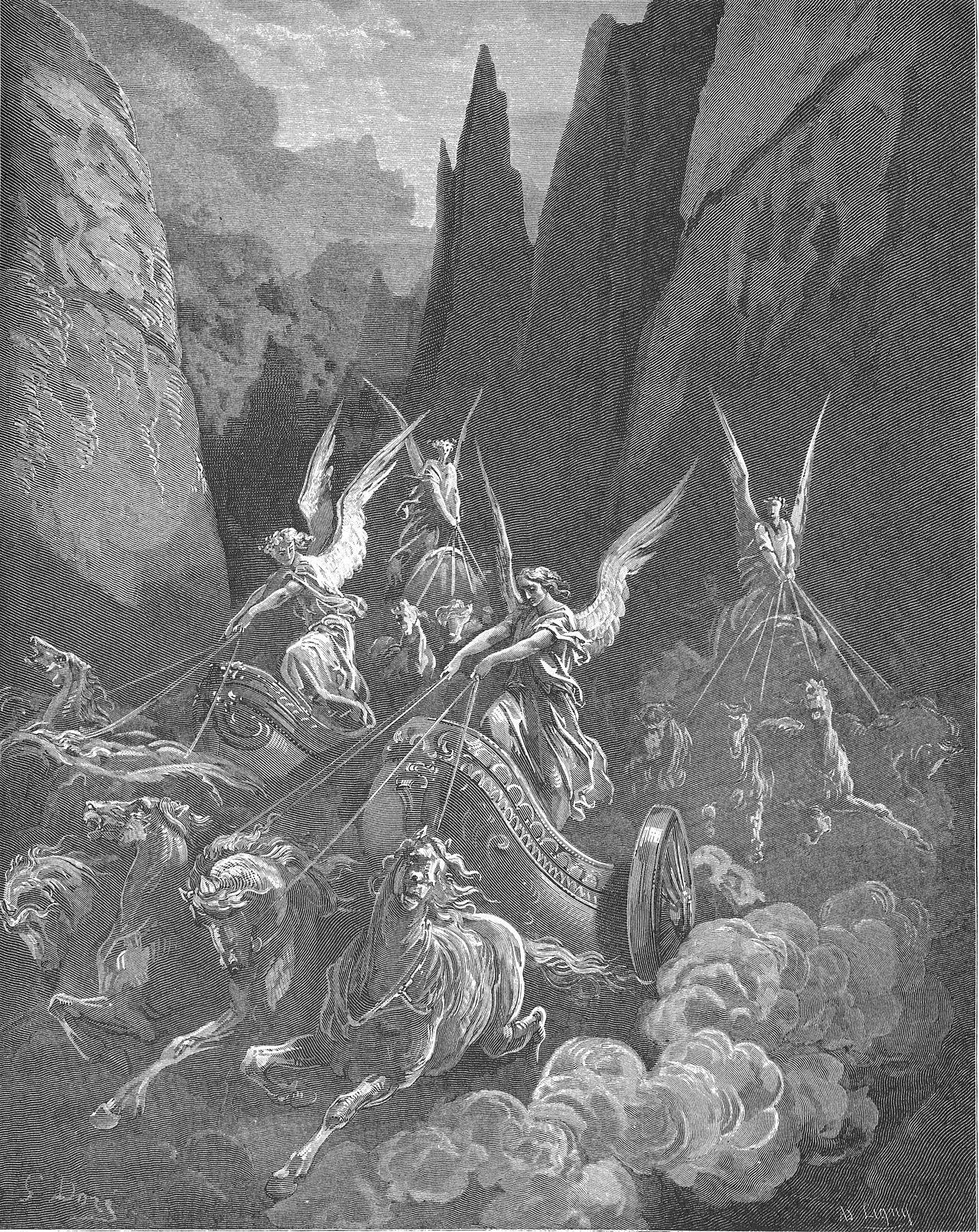
Inside the basket sits a woman named Wickedness, and a heavy lead weight is thrown over the opening to seal her in. Two women with wings like a stork carry the basket away to the land of Shinar, Babylon, to build it a house and set it on its own base, like an idol in a temple.
That last image is the point. Wickedness is not destroyed here; it is deported and given a shrine in Babylon, where it belongs, and removed from the land of God's people.
Significance
The returnees' temptation was to think that finishing the building was the whole assignment. These two visions say the land itself has to be cleaned out, the cheating in the market as much as the idolatry on the hills.
Show the rest of the significance, 1 more paragraph
The comfort in it is that the removal is God's work, carried out over their heads. They did not have to carry the basket. They had to stop opening it.
This chapter in Jewish lifeWhat this chapter is in Jewish life and reading.
What is done
The site's own table in src/lib/hebraic/readings.ts, probed for this lane, printed no weekly portion and no Haftarah from this chapter, and no festival reading for the book. That table carries the Haftarah of each of the fifty-four weekly portions and the books read whole at the feasts. It carries nothing for the special Sabbaths, the festival days or the fast days, so this card names no public reading of chapter 5 and leaves that question to a source that holds those readings.
How it is read
Rashi is the one commentator on this chapter whose English the corpus carries. He is quoted from The Judaica Press complete Tanach with Rashi, translated by A. J. Rosenberg, which Sefaria reports as CC-BY, and every quotation is held to fifty words or fewer.
The flying scroll carries two readings in one note. Rashi reports that the Sages read it as doubled and written with the Torah, and drew from it the measure of the world, as stated in Eruvin 21a. He then gives the simple meaning. "According to the simple meaning of the chapter, it was a scroll of retribution", like the scroll Ezekiel saw (Rashi on Zechariah 5:1:1).
The curse is the revenge for a false oath (Rashi on Zechariah 5:3:1). Rashi sets the scroll's measure against the Temple. It comes out from before the Shechinah, sized "as the measure of the entrance to the Temple court and the Temple, through which it shall emerge" (Rashi on Zechariah 5:3:2).
The woman in the ephah he reads as a way of life. She is "the character of the way of wickedness, [the way] in which the wicked deport themselves". The wicked are punished inside the very measure they meted out, "a measure for a measure" (Rashi on Zechariah 5:8:1). The stork of the ninth verse he identifies from Hullin 63a (Rashi on Zechariah 5:9:2).
The corpus carries 11 further notes on this chapter without an English text, each marked linked because Sefaria holds no English version of the ref. They stand cited and unquoted here. Ibn Ezra on Zechariah is cited at 5:1:1, 5:2:1, 5:4:1, 5:5:1, 5:7:1 and 5:10:1. Radak on Zechariah is cited at 5:1:1, 5:2:1 and 5:10:1. Metzudat David on Zechariah is cited at 5:2:1. Rashi on Zechariah is cited at 5:4:1.
What the rabbis say
The corpus carries 40 rabbinic locators on this chapter and the text of none, so each is cited and linked here and none is quoted. The verse numbers are the corpus's own.
At 5:1 it holds Vayikra Rabbah 6:3, Yalkut Shimoni on Torah 471:4 and Yalkut Shimoni on Torah 941:6. At 5:2 it holds Bereshit Rabbati, Parashat Bereshit 57, Ein Yaakov, Eiruvin 2:7 and Ein Yaakov, Gittin 5:29. It also holds Eruvin 21a:17 and Gittin 60a:16 there. At 5:4 it holds Bamidbar Rabbah 7:5, Ein Yaakov (Glick Edition), Shevuot 6:1 and Ein Yaakov, Shevuot 6:2. It also holds Jerusalem Talmud Shevuot 6:5:3, Midrash Lekach Tov, Leviticus 14:4:2 and Midrash Tanchuma Buber, Metzora 10:2 there.
It also holds Midrash Tanchuma, Metzora 4:1, Pesikta Rabbati 22:1 and Pirkei DeRabbi Eliezer 38:14 there. It also holds Shevuot 39a:5, Tanna DeBei Eliyahu Rabbah 26:1 and Yalkut Shimoni on Torah 294:1 there. At 5:8 it holds Ein Yaakov (Glick Edition), Yoma 7:2, Ein Yaakov, Sanhedrin 7:15 and Ein Yaakov, Yoma 7:2. It also holds Sanhedrin 64a:7, Yoma 69b:10 and Yoma 69b:9 there. At 5:9 it holds Ein Yaakov (Glick Edition), Kiddushin 2:2, Ein Yaakov (Glick Edition), Sanhedrin 3:2 and Ein Yaakov, Kiddushin 2:2.
It also holds Ein Yaakov, Sanhedrin 3:3, Kiddushin 49b:6 and Sanhedrin 24a:14 there. It also holds Shemot Rabbah 25:2 and Tanna DeBei Eliyahu Rabbah 25:1 there. At 5:11 it holds Avot DeRabbi Natan 28:1, Midrash Lekach Tov on Ruth 2:14:1 and Ruth Rabbah (Lerner) 5:5:1. It also holds Ruth Rabbah 5:5 there. At 5:16 it holds Mekhilta DeRabbi Shimon Ben Yochai 18:22 and Midrash Aggadah, Exodus 22:23:2.
What each of them teaches is a saying of the rabbis, and is reported as theirs wherever this site quotes one. The quotations wait on a fetch that carries the text.
Sources: Rashi, Rashi on Zechariah 5:1:1 to 5:9:2, The Judaica Press complete Tanach with Rashi, translated by A. J. Rosenberg, reported CC-BY; Ibn Ezra, Ibn Ezra on Zechariah 5:1:1, 5:2:1, 5:4:1, 5:5:1, 5:7:1 and 5:10:1, cited by ref because the corpus carries no text it may quote; Radak, Radak on Zechariah 5:1:1, 5:2:1 and 5:10:1, cited by ref because the corpus carries no text it may quote; Metzudat David, Metzudat David on Zechariah 5:2:1, cited by ref because the corpus carries no text it may quote; Rashi, Rashi on Zechariah 5:4:1, cited by ref because the corpus carries no text it may quote; The Sefaria corpus, scripts/data/sources/sefaria/zechariah/5.json, the 40 Talmud and Midrash locators of this chapter; The site's own files, src/lib/hebraic/readings.ts, probed for this lane through haftarahUsesForChapter("zechariah", 5) and festivalReadingForBook("zechariah").
The heads below are this chapter's scenes. The numbered points under each are its verses.
A flying scroll that lodges in the thief's house
Zechariah 5:1-2
saw before me a flying scroll: The prophet lifts his eyes to see an unrolled scroll flying like a bird, its size given at once, twenty cubits by ten. Keil notes those are the exact dimensions of the holy place before the temple's porch, the curse measured to the very sanctuary it protects.
Zechariah 5:1
“As the previous visions intimated God's favor in restoring the Jewish state, so this vision announces judgment, intimating that God, notwithstanding His favor, did not approve of their sins. Being written on both sides, "on this and on that side" (Zec 5:3) [VATABLUS] connects it with the two tables of the law (Ex 32:15), and implies its comprehensiveness.”
Jamieson, Fausset & Brown · Commentary Critical and Explanatory on the Whole Bible (1871)reformed
Henry reckoned the scroll at ten yards by five. Barnes noted that twenty cubits by ten matches a measure of the tabernacle, as the lampstand of the vision before it followed the tabernacle lampstand.
Zechariah 5:2
“And he - (the interpreting angel) said unto me It cannot be without meaning, that the dimensions of the roll should be those of the tabernacle , as the last vision was that of the candlestick, after the likeness of the candlestick therein. The explanations of this correspondence do not exclude each other.”
Zechariah 5:3-4
The scroll is “the curse that is going out”. Theft wrongs a neighbor and the perjurer “swears falsely by My name”, which Henry takes as both tables of the law. The curse will “enter the house of the thief” and “destroy it, down to its timbers and stones”.
Zechariah 5:3
“Over the face of the whole earth - primarily land, since the perjured persons, upon whom the curse was to fall Zec 5:4, were those who swore falsely by the name of God: and this was in Judah only. The reference to the two tables of the law also confines it primarily to those who were under the law. Yet, since the moral law abides under the Gospel, ultimately these visions related to the Christian Church, which was to be spread over the whole earth.”
2 more voices on this verse
Zechariah 5:3
“But two sorts of sinners are here specified as the objects of this curse:-- (1.) Thieves; it is for every one that steals, that by fraud or force takes that which is not his own, especially that robs God and converts to his own use what was devoted to God and his honour, which was a sin much complained of among the Jews at this time, Mal. iii.”
Matthew Henry · Commentary on the Whole Bible (1707-1721)puritan
Zechariah 5:3
“From this place . . . from this place (repeated twice, as "the house" is repeated in Zec 5:4) [MAURER]; so "hence" is used, Ge 37:17 (or, "on this and on that side," that is, on every side) [HENDERSON]. None can escape, sin where he may: for God from one side to the other shall call all without exception to judgment [CALVIN].”
Jamieson, Fausset & Brown · Commentary Critical and Explanatory on the Whole Bible (1871)reformed
the house of the thief: The curse settles in the house of the thief and the perjurer and brings it down to its timbers and stones. Henry saw the ruins as lasting witnesses against theft and perjury, sins that ruin whole houses. Clarke read the house as Babylon, whose king plundered the land.
Zechariah 5:4
“Into the house of him - Babylon, the house or city of Nebuchadnezzar, who was a public plunderer, and a most glaring idolater.”
Adam Clarke · Commentary on the Bible (1810-1826)evangelical
1 more voice on this verse
Zechariah 5:4
“While they were in their strength and beauty they supported, sorely against their will, the sinner's pride and security; but, when they are consumed, their ruins will, to their satisfaction, be standing monuments of God's justice and lasting witnesses of the sinner's injustice. Note, Sin is the ruin of houses and families, especially the sins of injury and perjury.”
Matthew Henry · Commentary on the Whole Bible (1707-1721)puritan
The ephah, the woman named Wickedness, and a house in Shinar
Zechariah 5:5-6
Then the angel who was speaking with me came forward: The angel announces a second vision: “A measuring basket is going forth”, the ephah. He names it plainly, “This is their iniquity in all the land”. Gill notes that a household measure becomes the sign, so the vision reaches common dealing as well as the great crimes of the scroll.
Zechariah 5:5
“And he gives him this account of it: I see a flying roll, and as near as he can guess by his eye it is twenty cubits long (that is, ten yards) and ten cubits broad, that is, five yards. The scriptures of the Old Testament and the New are rolls, in which God has written to us the great things of his law and gospel. Christ is the Master of the rolls.”
Matthew Henry · Commentary on the Whole Bible (1707-1721)puritan
The measuring basket is an ephah, which Gill put at over seven gallons of grain. Wesley read the basket as their iniquity in all the land, filling until the wrath of the LORD was poured out. Jamieson, Fausset and Brown gave “their eye” as the Hebrew.
Zechariah 5:6
“This is an ephah that goeth forth - This, among the Jews, was the ordinary measure of grain. The woman in the ephah is supposed to represent Judea, which shall be visited for its sins; the talent of lead on the ephah, within which the woman was enclosed, the wrath of God, bending down this culprit nation, in the measure of its sins; for the angel said, “This is wickedness;” that is, the woman represents the mass of iniquity of this nation.”
Adam Clarke · Commentary on the Bible (1810-1826)evangelical
3 more voices on this verse
Zechariah 5:6
“And I said, What is it?.... After he had lifted up his eyes and seen it, he desires to know both what it was, and what was the meaning of it: and he said, This is an ephah that goeth forth; which was a measure much in use with the Jews, Exo 16:36 it is the same with the "bath", and held above seven wine gallons.”
Zechariah 5:6
“Goeth forth - Out of the temple. Their resemblance - This is an emblem of this people everywhere. Thus there is limited time and measure for them, while they sin, and are filling the ephah with their sins, they will find that the ephah of wrath is filled up also, to be poured out upon them.”
John Wesley · Explanatory Notes upon the Old Testament (1765)evangelical
Zechariah 5:6
“This is their resemblance--literally, "eye" (compare Eze 1:4, 5, 16). HENGSTENBERG translates, "Their (the people's) eye" was all directed to evil. But English Version is better.”
Jamieson, Fausset & Brown · Commentary Critical and Explanatory on the Whole Bible (1871)reformed
Zechariah 5:7-8
the cover of lead was raised: When “the cover of lead was raised”, there was “a woman sitting inside the basket”, and the angel named her: “This is Wickedness”. He “shoved her down into the basket, pushing down the lead cover”. Wickedness is held down, and the verses following carry it out of the land.
Zechariah 5:7
“And, behold, there was lifted up a talent of lead,.... By the angel; since he is afterwards said to cast it upon the mouth of the "ephah". A cicar, or talent of silver, with the Jews, was equal to three thousand shekels, as may be gathered from Exo 38:24 and weighed a hundred and twenty five pounds (a); or, as others, a hundred and twenty (b), and, according to the more exact account of Dr. Arbuthnot, a hundred and thirteen pounds, ten ounces, one pennyweight, and ten and two seventh grains of our Troy weight.”
1 more voice on this verse
Zechariah 5:7
“And behold there was lifted up a talent of lead - the heaviest Hebrew weight, elsewhere of gold or silver; the golden talent weighing, 1,300,000 grains; the silver, 660,000; here, being lead, it is obviously an undefined mass, though circular , corresponding to the Ephah. The Ephah too was the largest Hebrew measure, whose compass cannot now, with certainty, be ascertained . Both probably were, in the vision, ideal. Theodoret: “Holy Scripture calleth the punishment of sin, lead, as being by nature heavy.”
Gill read the woman in the basket as Wickedness given a body, the wicked of all the land gathered into one figure. Barnes quoted Ribera, who pictured her head still above the opening, the basket yet to be filled. The lead cover holds her down.
Zechariah 5:8
“And cast her into the midst of the Ephah - As yet then the measure was not full. Ribera: “She had the lower part within the Ephah, but the upper, especially the head, without. Though the Jews had slain the prophets and done many grievous things, the greatest sin of all remained to be done.”
Zechariah 5:9-11
two women approaching, with the wind in their wings: Two women “with the wind in their wings”, wings like a stork's, “lifted up the basket between heaven and earth”. They carry it off to “build a house for it in the land of Shinar”. Shinar is the plain of Genesis eleven, the ground of the tower.
Zechariah 5:9
“The "stork" has long and wide wings, for which reason it is specified; also it is a migratory bird. The "wind" helps the rapid motion of the wings. The being "lifted up between heaven and earth" implies open execution of the judgment before the eyes of all.”
Jamieson, Fausset & Brown · Commentary Critical and Explanatory on the Whole Bible (1871)reformed
2 more voices on this verse
Zechariah 5:9
“There came out - From the same place whence the ephah came. Their wings - They had wings, like the wings of storks, large and strong, and flew before the wind with great swiftness. The judgments came thus flying, and so bore away with them those that were incorrigible.”
John Wesley · Explanatory Notes upon the Old Testament (1765)evangelical
Zechariah 5:9
“There came out two women - It may be that there may be no symbol herein, but that he names women because it was a woman who was so carried; yet their wings were the wings of an unclean bird, strong, powerful, borne by a force not their own; with their will, since they flew; beyond their will, since the wind was in their wings; rapidly, inexorably, irresistibly, they flew and bore the Ephah between heaven and earth. No earthly power could reach or rescue it. God would not.”
The question points ahead to the house built for the basket in verse 11. Jamieson, Fausset and Brown noted that the stork has wide wings, and that the basket was lifted up between heaven and earth in open view. Barnes saw it carried beyond any earthly rescue.
Zechariah 5:10
“Then said I to the angel that talked with me;.... This the prophet said after he had seen the "ephah" come forth; the woman, wickedness, cast into it, and the talent of lead upon her; and the two women lifting up the ephah between heaven and earth: Whither do these bear the ephah? he neither asks what the ephah signified, nor who were the women that bore it, but only whither they bore it.”
Shinar is the old name of the land of Babylon, where Genesis 11:2 settles the builders of Babel. Barnes heard in it the first empire against the LORD. Jamieson, Fausset and Brown read the verse as Wickedness removed from the land to dwell for good in its own house.
Zechariah 5:11
“To build it an house in the land of Shinar - The name of Shinar, though strictly Babylonia, carries back to an older power than the world-empire of Babylon; which now too was destroyed. “In the land of Shinar” Gen 11:2 was that first attempt to array a world-empire against God, ere mankind was ye dispersed. And so it is the apter symbol of the antitheist or anti-Christian world, which by violence, art, falsehood, sophistry, wars against the truth.”
2 more voices on this verse
Zechariah 5:11
“To build - Not in mercy, but in judgment. Of Shinar - Of Babylon whither many of the Jews fled, and others of them were forced by the Romans. Set there - There they shall be confined without hope of release.”
John Wesley · Explanatory Notes upon the Old Testament (1765)evangelical
Zechariah 5:11
"Wickedness" being cast out of Judah, shall for ever dwell with the antichristian apostates (of whom Babylon is the type), who shall reap the fruit of it, which they deserve.
Jamieson, Fausset & Brown · Commentary Critical and Explanatory on the Whole Bible (1871)reformed
Keep studying
Sources for this chapter
The summary
Jamieson, Fausset & Brown, Commentary Critical and Explanatory; John Calvin, Commentaries; John Wesley, Notes on the Old Testament and Matthew Henry, Complete Commentary.
The exposition
Adam Clarke, Commentary on the Bible; Albert Barnes, Notes, Explanatory and Practical, on the Old and New Testaments (1832-1869); Carl Friedrich Keil, The Twelve Minor Prophets; Edward Bouverie Pusey, The Minor Prophets: A Commentary; Jamieson, Fausset & Brown, Commentary Critical and Explanatory on the Whole Bible; John Gill; John Wesley, Explanatory Notes upon the Old Testament and Matthew Henry, Commentary on the Whole Bible.