
Psalm 91
16 verses · Psalm of trust
For He will command His angels concerning you to guard you in all your ways.
Introduction
Author unstated, the Shelter, Book 4: The LORD reigns, Poetry, Psalms Overview.
This psalm carries no title in the Hebrew, and it stands just after the prayer of Moses that opens the fourth book of the Psalter. It was written for people who lived close to sudden death: sickness that spread through a town, raiders on the road, wild animals in the hills. The writer names every one of those dangers. He speaks first of God, then to a listener, and at the end God speaks for Himself. Listen for those changes of voice, and for the one condition the promises rest on, a life spent near God.
Context
- Who
- Worshippers who lived with those four dangers and had neighbours who used charms against them
- What
- A psalm of trust that names the dangers of daily life and the shelter God gives the one who lives near Him.
- Where
- A household in Judah, within reach of plague, ambush, wild animals and night travel
- When
- Undated, since the Hebrew gives it no title; it stands in the fourth book of the Psalter, after the prayer of Moses.
- Why
- To give a person facing sudden danger a place to stand, in God's own promise.
Historical context
The Hebrew text gives this psalm no heading, so it names neither an author nor an occasion. The snare of the fowler in verse 3 was ordinary equipment: a bird catcher propped a net over baited ground and pulled a cord from a hiding place, and the bird never saw the trap until it closed. The four dangers of verses 5 and 6 are arranged around the clock, terror by night, an arrow by day, pestilence in the darkness and a calamity at noon. Epidemic disease was the great killer of ancient towns, and it arrived without a cause anyone could see. The angels of verses 11 and 12 describe an escort, like the servants a man of rank sent ahead and alongside him on a bad road, and the psalm says the escort is heavenly and commanded.
Significance
To people one bad season from famine and one bad night from raiders, the psalm named the dangers plainly and then named a shelter that was a person. The last three verses change speakers, and a first hearer would have noticed it. After thirteen verses about God, God speaks, and He gives the reason for the rescue as love and the knowledge of His name.
This chapter in Jewish lifeWhat this chapter is in Jewish life and reading.
How it is read
Rashi hears Moses speaking in this psalm and reads its shelter as the wings of the Shechinah. On the first line he glosses the one who dwells in the covert of the Most High as the one "who takes shelter in the covert of the wings of the Shechinah" (Rashi on Psalms 91:1:1, Rashi on Psalms, The Judaica Press complete Tanach with Rashi, translated by A. J. Rosenberg, CC-BY).
He names the speaker on the next line, where he writes that "Moses, our teacher, hereby persuades people to take shelter in the wings of the Shechinah" (Rashi on Psalms 91:1:2, same edition). The promise of verse 2 is then read as a testimony given so that others will learn it, and Rashi has the psalmist say that he declares the Lord his shelter "and all will learn from me" (Rashi on Psalms 91:2:1, same edition).
Ibn Ezra comments on eight verses of this chapter, at verses 2, 3, 8, 11, 13, 14, 15 and 16. Sefaria holds no English version of those comments, so the corpus carries their references alone and they are cited here and read at the link (Ibn Ezra on Psalms 91:2:1 and the seven references beside it).
What the rabbis say
The classical reading of the dangers in verses 5 to 7 is a reading about demons, and Rashi carries it. He glosses the arrow that flies by day as "the demon that flies like an arrow" (Rashi on Psalms 91:5:2, same edition), and the pestilence and the destruction of verse 6 as "names of demons; one destroys at night, and one destroys at noon" (Rashi on Psalms 91:6:1, same edition). On verse 7 he has a thousand demons stationed at the left hand of the one who trusts, held back from doing harm (Rashi on Psalms 91:7:2, same edition).
The corpus records forty places where the Midrash and the Talmud cite this psalm, thirty two under Midrash and eight under Talmud, and it carries the locator for each one with no text. The Babylonian Talmud cites verse 6 at Pesachim 111b:8, verse 7 at Berakhot 6a:4, verse 10 at Berakhot 55b:5, verse 11 at Chagigah 16a:17 and verse 13 at Sanhedrin 95a:2. Midrash Tehillim treats this psalm at 91:2, 91:3 and 91:6, and the Jerusalem Talmud cites the first verse at Eruvin 10:11:6. The site reports where the rabbis cite the verse and reports no saying, because the locator carries none.
Sources: Rashi, Rashi on Psalms 91, in The Judaica Press complete Tanach with Rashi, translated by A. J. Rosenberg, CC-BY; Ibn Ezra, Ibn Ezra on Psalms 91, cited by reference; Sefaria holds no English version; The Midrash and the Talmud, the forty locators on Psalms 91 in scripts/data/sources/sefaria/psalms/91.json.
Psalms 91:1-2
the shelter of the Most High: Two pictures open the psalm, the shelter of the Most High and the shadow of the Almighty. The Hebrew verb behind abide means to lodge for the night, so the shelter is where the man stays. Verse 2 makes it one man's confession to the LORD.
Psalms 91:1
“He that dwelleth in the secret place of the most High. The blessings here promised are not for all believers, but for those who live in close fellowship with God. Every child of God looks towards the inner sanctuary and the mercyseat, yet all do not dwell in the most holy place; they run to it at times, and enjoy occasional approaches, but they do not habitually reside in the mysterious presence.”
Charles Spurgeon · The Treasury of David, Vol. 4 (1874)Particular Baptist
2 more voices on this verseWhat preachers and commentators have said about this verse, in their own words.
Psalms 91:1
“It is the character of a true believer that he dwells in the secret place of the Most High; he is at home in God, returns to God, and reposes in him as his rest; he acquaints himself with inward religion, and makes heart-work of the service of God, worships within the veil, and loves to be alone with God, to converse with him in solitude.”
Matthew Henry · Commentary on the Whole Bible (1707-1721)puritan
Psalms 91:1
The praise of a song, by David himself. First we ought to know this: that from the eighty-eighth psalm up to the hundredth—that is, eleven psalms—have no title in the Hebrew; and that they belong, as we treated most recently in the previous psalm, to the same person to whom that one belongs as well which is headed with this title: "A prayer of Moses, the man of God."
Jerome · written before 420 · Homily 68, on Psalm 90 (Alternate Series)patristic
my refuge and my fortress: The singer answers verse 1 in his own voice and gives God four titles in one breath: refuge, fortress, my God, the One he trusts. A refuge is a place to run to, and a fortress is a place that holds under siege. Trust makes both of them his.
Psalms 91:2
“I will say of the Lord, He is my refuge and my fortress. To take up a general truth and make it our own by personal faith is the highest wisdom. It is but poor comfort to say 'the Lord is a refuge, 'but to say he is my refuge, is the essence of consolation. Those who believe should also speak—"I will say ", for such bold avowals honour God and lead others to seek the same confidence.”
Charles Spurgeon · The Treasury of David, Vol. 4 (1874)Particular Baptist
1 more voice on this verse
Psalms 91:2
“He shall say to the Lord: You are my upholder and my refuge, my God. For many enemies pursue me: therefore you are my refuge. I will hope in him. He did not say, "I hope"; but, "I will hope." For as long as we sin, we do not hope: if we cease to sin, we hope.”
Jerome · written before 420 · Homily 20, on Psalm 90patristic
Psalms 91:3-4
the snare of the fowler: is a trap a bird never sees, and the plague is a sickness a body cannot fight. Verse 4 answers with feathers to cover and wings to hide under, and names God's faithfulness as the shield. Jesus takes up the same picture at Matthew 23:37.
Psalms 91:3
“Surely he shall deliver thee from the snare of the fowler,.... These are the words of the psalmist, either speaking to himself, for the encouragement of his own faith and trust in the Lord; or to the man that dwells in the secret place, and under the shadow of the most High; which latter seems most agreeable; though Cocceius thinks they are the words of God in one of his Persons, speaking of another divine Person that should deliver such that trust in him: the Targum makes them to be the words of David to Solomon his son.”
1 more voice on this verse
Psalms 91:3
“For he himself will free me from the snare of the hunters. There are many hunters in this world, who try to hunt down our soul. Indeed even that giant Nimrod was a great hunter in the sight of the Lord: and Esau was a hunter, because he was a sinner; and nowhere in the holy Scriptures do we find any holy hunter. Fishermen we find to be holy. For he himself will free me from the snare of the hunters.”
Jerome · written before 420 · Homily 20, on Psalm 90patristic
His faithfulness is a shield and rampart: He covers you as a bird covers her young, with feathers above and wings for refuge. His faithfulness is then a shield and a rampart, a soldier's armour. Both pictures cover you.
Psalms 91:4
“He shall cover thee with thy feathers, and under his wings shalt thou trust. A wonderful expression! Had it been invented by an uninspired man it would have verged upon blasphemy, for who should dare to apply such words to the Infinite Jehovah? But as he himself authorised, yea, dictated the language, we have here a transcendent condescension, such as it becomes us to admire and adore. Doth the Lord speak of his feathers, as though he likened himself to a bird?”
Charles Spurgeon · The Treasury of David, Vol. 4 (1874)Particular Baptist
3 more voices on this verse
Psalms 91:4
With His shoulders He shall overshadow you. Who shall overshadow? Surely the God of heaven, as a hen her chicks, and as an eagle its nest. Hence also in the song of Deuteronomy it is said that He carried the people of Israel upon His shoulders, and protected them as an eagle. It can also be understood of the Savior, that upon His cross He protected us with His wings. And under His feathers you shall hope. "All the day long I have stretched forth my hands to a people that did not believe and that contradicted me."
Jerome · written before 420 · Homily 68, on Psalm 90 (Alternate Series)patristic
Psalms 91:4
“To this the great God is pleased to compare his care of his people, who are helpless as the chickens, and easily made a prey of, but are invited to trust under the shadow of the wings of the divine promise and providence, which is the periphrasis of a proselyte to the true religion, that he has come to trust under the wings of the God of Israel, Ruth ii.”
Matthew Henry · Commentary on the Whole Bible (1707-1721)puritan
Psalms 91:4
“For the first figure compare De 32:11; Mt 23:37. buckler--literally, "surrounding"--that is, a kind of shield covering all over.”
Jamieson, Fausset & Brown · Commentary Critical and Explanatory on the Whole Bible (1871)reformed
Psalms 91:5-6
the terror of the night: Four dangers are named across two verses, terror and pestilence in the dark, the arrow and the noon calamity in the light. John Gill read the fourfold list as a covering of the whole day and night. The verse takes away the fear of all four.
Psalms 91:5
“Thou shalt not be afraid for the terror by night. Such frail creatures are we that both by night and by day we are in danger, and so sinful are we that in either season we may be readily carried away by fear; the promise before us secures the favourite of heaven both from danger and from the fear of it.”
Charles Spurgeon · The Treasury of David, Vol. 4 (1874)Particular Baptist
1 more voice on this verse
Psalms 91:5
“By night - When evil accidents are most terrible and least avoidable. Arrow - The pestilence, or any such destructive calamity; such are frequently called God's arrows.”
John Wesley · Explanatory Notes upon the Old Testament (1765)evangelical
the pestilence that stalks in the darkness: Pestilence stalks, the verb of a walker moving about unseen, and the calamity destroys at noon, when the sun is fullest. The two halves set the hidden killer beside the open one. Neither hour is left without cover.
Psalms 91:6
“Nor for the pestilence that walketh in darkness. It is shrouded in mystery as to its cause and cure, it marches on, unseen of men, slaying with hidden weapons, like an enemy stabbing in the dark, yet those who dwell in God are not afraid of it.”
Charles Spurgeon · The Treasury of David, Vol. 4 (1874)Particular Baptist
1 more voice on this verse
Psalms 91:6
“Of the assault and the noonday demon. It is better said in Greek, ἀπὸ συμπτώματος (apo symptōmatos). Symptosis means either an occurrence, that is, when we do not expect it, and something new happens. Or it is called symptoma, when many fall at the same time. See therefore what he says. Although many have been led astray, nevertheless you, who are holy, are not to be led astray. I give an example, so that the simpler ones may be able to understand what is said.”
Jerome · written before 420 · Homily 20, on Psalm 90patristic
Psalms 91:7-8
a thousand may fall: Ten thousand fall on the right hand and a thousand at the side, and the harm stops short of the one addressed. Verse 8 puts him in the place of a witness, watching the punishment of the wicked. Verses 1 and 9 hold the condition, a man dwelling there.
Psalms 91:7
“A thousand shall fall at thy side and ten thousand at thy right hand. So terribly may the plague rage among men that the bills of mortality may become very heavy and continue to grow ten times heavier still, yet shall such as this Psalm speaks of survive the scythe of death. It shall not come nigh thee. It shall be so near as to be at thy side, and yet not nigh enough to touch thee; like a fire it shall burn all around, yet shall not the smell of it pass upon thee.”
Charles Spurgeon · The Treasury of David, Vol. 4 (1874)Particular Baptist
1 more voice on this verse
Psalms 91:7
“A thousand shall fall at your side, and ten thousand at your right hand. "At your side" and "at your right hand." He did not say, "at your left," because the just man has no left, just as it is written in the Gospel: "Whoever shall strike you on the right cheek, offer him the other also." He did not say, "offer the left"; since indeed the lambs shall stand at the right, and the kids at the left. A thousand shall fall at your side, and ten thousand at your right hand.”
Jerome · written before 420 · Homily 68, on Psalm 90 (Alternate Series)patristic
witness the punishment of the wicked: You will see it with your own eyes, standing clear while the punishment of the wicked falls. The word for punishment is a payment the wicked have earned. Your part is to witness it.
Psalms 91:8
“Only with thine eyes shalt thou behold and see the reward of the wicked. The sight shall reveal both the justice and the mercy of God; in them that perish the severity of God will be manifest, and in the believer's escape the richness of divine goodness will be apparent. Joshua and Caleb verified this promise. The Puritan preachers during the plague of London must have been much impressed with this verse as they came out of their hiding places to proclaim mercy and judgment to the dissolute age which was so sorely visited with the pest.”
Charles Spurgeon · The Treasury of David, Vol. 4 (1874)Particular Baptist
1 more voice on this verse
Psalms 91:8
“Nevertheless with your eyes you shall consider, and you shall see the retribution of sinners. You shall see the corpses of the dead, and you shall marvel at the majesty of the Lord and Savior. And you shall see the retribution of sinners. The ruin of sinners is their destruction. What he says is this: You who have made the Lord your refuge look with your eyes, secure, upon the retribution of the heretics, since you have guarded yourself from their traditions.”
Jerome · written before 420 · Homily 68, on Psalm 90 (Alternate Series)patristic
Psalms 91:9-10
made the LORD your dwelling—: The condition is stated again, a man who has made the LORD his dwelling. Verse 10 widens it from the person to the tent, where no evil will befall him and no plague comes near. John Wesley read the promise as spoken to that man.
Psalms 91:9
“These things have been said in the person of the Lord to the just man; but now the person is changed, and out of the contemplation of the just man an answer is made to the Lord: For you, O Lord, are my hope. For he who says these things is the just man. You have made the Most High your refuge. Again the person is changed: and for this reason the psalms are obscure, because very often the persons are changed.”
Jerome · written before 420 · Homily 68, on Psalm 90 (Alternate Series)patristic
1 more voice on this verse
Psalms 91:9
“Before expounding these verses I cannot refrain from recording a personal incident illustrating their power to soothe the heart, when they are applied by the Holy Spirit. In the year 1854, when I had scarcely been in London twelve months, the neighbourhood in which I laboured was visited by Asiatic cholera, and my congregation suffered from its inroads. Family after family summoned me to the bedside of the smitten, and almost every day I was called to visit the grave.”
Charles Spurgeon · The Treasury of David, Vol. 4 (1874)Particular Baptist
no plague will approach your tent: The tent carries the promise past the man to his household, the place where he eats and sleeps. The Hebrew for plague here is a stroke or blow, the word Exodus 11:1 uses for the last plague on Egypt. He dwells in God, and God guards his dwelling.
Psalms 91:10
“There shall no evil befall thee - The Chaldee Paraphrase has, “The Lord of the world answered and said, ‘There shall no evil befall thee,’” etc. The sentiment, however, is that the psalmist could assure such an one, from his own personal experience, that he would be safe. He had himself made Yahweh his refuge, and he could speak with confidence of the safety of doing so. This, of course, is to be understood as a general truth, in accordance with what has been said above.”
Psalms 91:11-12
command His angels concerning you: The tempter quoted both verses to Jesus at Matthew 4:6, stopping before the clause to guard you in all your ways. The angels lift a man in their hands and keep his foot off the stone, and they do it along those ways. Jesus answered from Deuteronomy 6:16.
Psalms 91:11
“For He has given His angels charge concerning you, that they may keep you in all your ways. In their hands they shall carry you, lest ever you dash your foot against a stone. If ever the heretics interpret certain things from the Scriptures against us, we ought not to be disturbed: because the devil too used this testimony against the Lord and Savior, saying, "If you are the Son of God, cast yourself down; for it is written that He has given His angels charge concerning you," and the rest.”
Jerome · written before 420 · Homily 68, on Psalm 90 (Alternate Series)patristic
2 more voices on this verse
Psalms 91:11
“For he shall give his angels charge over thee. Not one guardian angel, as some fondly dream, but all the angels are here alluded to. They are the bodyguard of the princes of the blood imperial of heaven, and they have received commission from their Lord and ours to watch carefully over all the interests of the faithful. When men have a charge they become doubly careful, and therefore the angels are represented as bidden by God himself to see to it that the elect are secured.”
Charles Spurgeon · The Treasury of David, Vol. 4 (1874)Particular Baptist
Psalms 91:11
“The charge is to keep thee in all thy ways; here is a limitation of the promise: They shall keep thee in thy ways, that is, "as long as thou keepest in the way of thy duty;" those that go out of that way put themselves out of God's protection. This word the devil left out when he quoted the promise to enforce a temptation, knowing how much it made against him.”
Matthew Henry · Commentary on the Whole Bible (1707-1721)puritan
Cross references
Psalms 91:11
- Quoted inLuke 4:10“For it is written: ‘He will command His angels concerning You to guard You carefully;”
the tempter cites 'He shall give his angels charge over thee'
- Quoted inMatthew 4:6“If You are the Son of God,” he said, “throw Yourself down. For it is written: ‘He will command His angels concerning You, and they will lift You up in their hands, so that You will not strike Your foot against a stone.’”
the tempter cites 'He shall give his angels charge over thee' ('it is written')
ConnectionsMatthew 4:6
strike your foot against a stone: They lift you up in their hands, as a nurse lifts a child over a stone. The danger named is small, a foot striking a stone in your ways. His care for you reaches that far.
Psalms 91:12
“They, that is the angels, God's own angels, shall cheerfully become our servants. They shall bear thee up in their hands; as nurses carry little children, with careful love, so shall those glorious spirits bear up each individual believer. Lest thou dash thy foot against a stone; even minor ills they ward off. It is most desirable that we should not stumble, but as the way is rough, it is most gracious on the Lord's part to send his servants to bear us up above the loose pebbles.”
Charles Spurgeon · The Treasury of David, Vol. 4 (1874)Particular Baptist
tread on the lion and cobra: The man treads on a lion and cobra and tramples a young lion and a serpent. Two of the four are lions and two are serpents, the last of them tannin in Hebrew, a monster of land or sea. Spurgeon read it as authority over the worst a creature brings.
Psalms 91:13
“Thou shalt tread upon the lion and adder. Over force and fraud shalt thou march victoriously; bold opponents and treacherous adversaries shall alike be trodden down. When our shoes are iron and brass lions and adders are easily enough crushed beneath our heel. The young lion and the dragon shalt thou trample under feet. The strongest foe in power, and the most mysterious in cunning, shall be conquered by the man of God. Not only from stones in the way, but from serpents also, shall we be safe.”
Charles Spurgeon · The Treasury of David, Vol. 4 (1874)Particular Baptist
1 more voice on this verse
Psalms 91:13
“Truly the devil, like a devil, interprets concerning the Savior what is not concerning the Savior. For if the whole psalm is about the Savior, as you interpret it, O devil, then it is about him too what is said: I will protect him, because he has known my name. That is, I the Father will protect my Son. Let me interpret it, devil, as you understand it. Let us see whether the sense holds. I will protect him, because he has known my name: that is, I the Father my Son.”
Jerome · written before 420 · Homily 20, on Psalm 90patristic
Psalms 91:14-16
God speaks for Himself in the last three verses, after thirteen spoken about Him. The reason given is love and the knowledge of His name. Deliverance, an answer, His presence in trouble, honor and long life are all promised to the man who calls.
Psalms 91:14
“Here we have the Lord himself speaking of his own chosen one. Because he hath set his love upon me, therefore will I deliver him. Not because he deserves to be thus kept, but because with all his imperfections he does love his God; therefore not the angels of God only, but the God of angels himself will come to his rescue in all perilous times, and will effectually deliver him.”
Charles Spurgeon · The Treasury of David, Vol. 4 (1874)Particular Baptist
1 more voice on this verse
Psalms 91:14
“Many think that to Christ, as Mediator, these promises do primarily belong ( Isa. xlix. 2 ), not because to him the devil applied one of these promises ( Matt. iv. 6 ), but because to him they are very applicable, and, coming through him, they are more sweet and sure to all believers.”
Matthew Henry · Commentary on the Whole Bible (1707-1721)puritan
I will be with him in trouble: The verse runs in order: he calls, God answers, God stands with him, God delivers and honors him. Trouble is assumed, and the promise is what God does inside it. His company comes before the way out.
Psalms 91:15
“He shall call upon me, and I will answer him. He will have need to pray, he will be led to pray aright and the answer shall surely come. Saints are first called of God and then they call upon God; such calls as theirs always obtain answers. Not without prayer will the blessing come to the most favoured, but by means of prayer they shall receive all good things. I will be with him in trouble, or "I am with him in trouble." Heirs of heaven are conscious of a special divine presence in times of severe trial.”
Charles Spurgeon · The Treasury of David, Vol. 4 (1874)Particular Baptist
Satisfy means filled to the full, so long life is given as a meal a man finishes content. The last thing promised is sight, that God will show him His salvation. The psalm ends in sight.
Psalms 91:16
“With long life will I satisfy him. The man described in this Psalm fills out the measure of his days, and whether he dies young or old he is quite satisfied with life, and is content to leave it. He shall rise from life's banquet as a man who has had enough, and would not have more even if he could. And shew him my salvation. The full sight of divine grace shall be his closing vision. He shall look from Amana and Lebanon.”
Charles Spurgeon · The Treasury of David, Vol. 4 (1874)Particular Baptist
How this psalm is built
The form: A psalm of promises held out to the believer who lives in close fellowship with God rather than to every believer alike, as Spurgeon classes it.
The patterns in this chapter
| Device | What it does | Where to see it |
|---|---|---|
| The speaker changes three times | Verse 1 speaks about the man in the third person, verse 2 is his own confession, verses 3 to 13 address him directly as you, and verses 14 to 16 are God speaking of him. Spurgeon marks the last turn where it happens: at verse 14 the Lord Himself begins to speak of His own chosen one.Charles Spurgeon, The Treasury of David, Vol. 4, 1874, on Psalm 91:14. | Psalm 91:1, Psalm 91:2, Psalm 91:3, Psalm 91:14 |
| The four dangers set around the clock | Verses 5 and 6 name terror by night, the arrow that flies by day, the pestilence that stalks in darkness and the calamity that destroys at noon. John Gill reads the fourfold list as a covering of the whole day and night, so that nothing in the round of hours is left outside the promise.John Gill, Exposition of the Old Testament, 1763, on Psalm 91:5. | Psalm 91:5, Psalm 91:6 |
| The four beasts trodden down | Verse 13 names a lion, a cobra, a young lion and a serpent, two of them cats and two of them snakes. Matthew Henry reads the pair through the titles Scripture gives the enemy, a roaring lion and the old serpent, and sends the verse on to Romans 16:20.Matthew Henry, Commentary on the Whole Bible, 1710, on Psalm 91:13. | Psalm 91:13 |
| The condition stated, then stated again | Verse 1 opens on the man who dwells in the shelter of the Most High, and verse 9 says the same thing again in the second person, because you have made the LORD your dwelling. Everything promised between them and after them rests on that one clause. Adam Clarke reads verse 9 as the ground of all that follows it.Adam Clarke, Commentary on the Bible, 1832, on Psalm 91:9. | Psalm 91:1, Psalm 91:9 |
In the New Testament
9 more paragraphs on the patterns
The best known use of this psalm is a misuse of it. The tempter quotes verses 11 and 12 to Jesus at Matthew 4:6 and Luke 4:10, and he stops the quotation before the clause to guard you in all your ways. Matthew Henry names the omission and what it costs: the charge is to keep a man in his ways, so those who go out of the way of duty put themselves out of the protection. Jesus answers from Deuteronomy 6:16 rather than by disputing the psalm.
The debated point
How far the promises reach is the psalm's open question, and the positions are held by named men. Spurgeon holds that the blessings are not for all believers but for those who live in close fellowship with God, so the psalm describes a habit and its reward. Matthew Henry reports the reading that takes the promises as belonging first to Christ as Mediator, on the ground that they are applicable to Him and come more sure to believers through Him, and he allows both readings to stand. Adam Clarke takes the plainest line, that a man who has made the LORD his portion may expect this protection for his soul, his body, his household and his property. The site holds the question open at the tier the sources give it, since no one of the three settles the other two.
Where the pictures come from
The wings of verse 4 stand over Ruth 2:12, where a proselyte is said to have come to trust under the wings of the God of Israel, and Jesus takes the same picture up over Jerusalem at Matthew 23:37. The treading of verse 13 is echoed at Romans 16:20, where the God of peace crushes Satan under the feet of His people.
In the Psalter
The psalm follows the prayer of Moses in Psalm 90 and stands with the untitled run that reaches Psalm 100. Jerome counts that run at eleven psalms and reads them as belonging with the titled prayer before them, which is one ancient answer to a psalm whose author the Hebrew text does not name.
The door
The temptation in the wilderness is where the misquotation of verses 11 and 12 is handled whole, with the three temptations in their order and the answers Jesus gives from Deuteronomy.
Keep studying
Sources for this chapter
The summary
Jamieson, Fausset & Brown, Commentary Critical and Explanatory; John Calvin, Commentaries; John Wesley, Notes on the Old Testament and Matthew Henry, Complete Commentary.
The form and classifications
Charles Spurgeon, The Treasury of David, Vol. 4, 1874, on Psalm 91:1; Jerome, Homily 68, on Psalm 90 (Alternate Series), c. 420 and Matthew Henry, Commentary on the Whole Bible, 1710, on Psalm 91:1.
The exposition
Albert Barnes, Notes on the Book of Psalms; Charles Spurgeon, The Treasury of David; Franz Delitzsch, Biblical Commentary on the Psalms; John Gill, Exposition of the Old Testament; John Wesley, Explanatory Notes upon the Old Testament and Matthew Henry, Commentary on the Whole Bible.
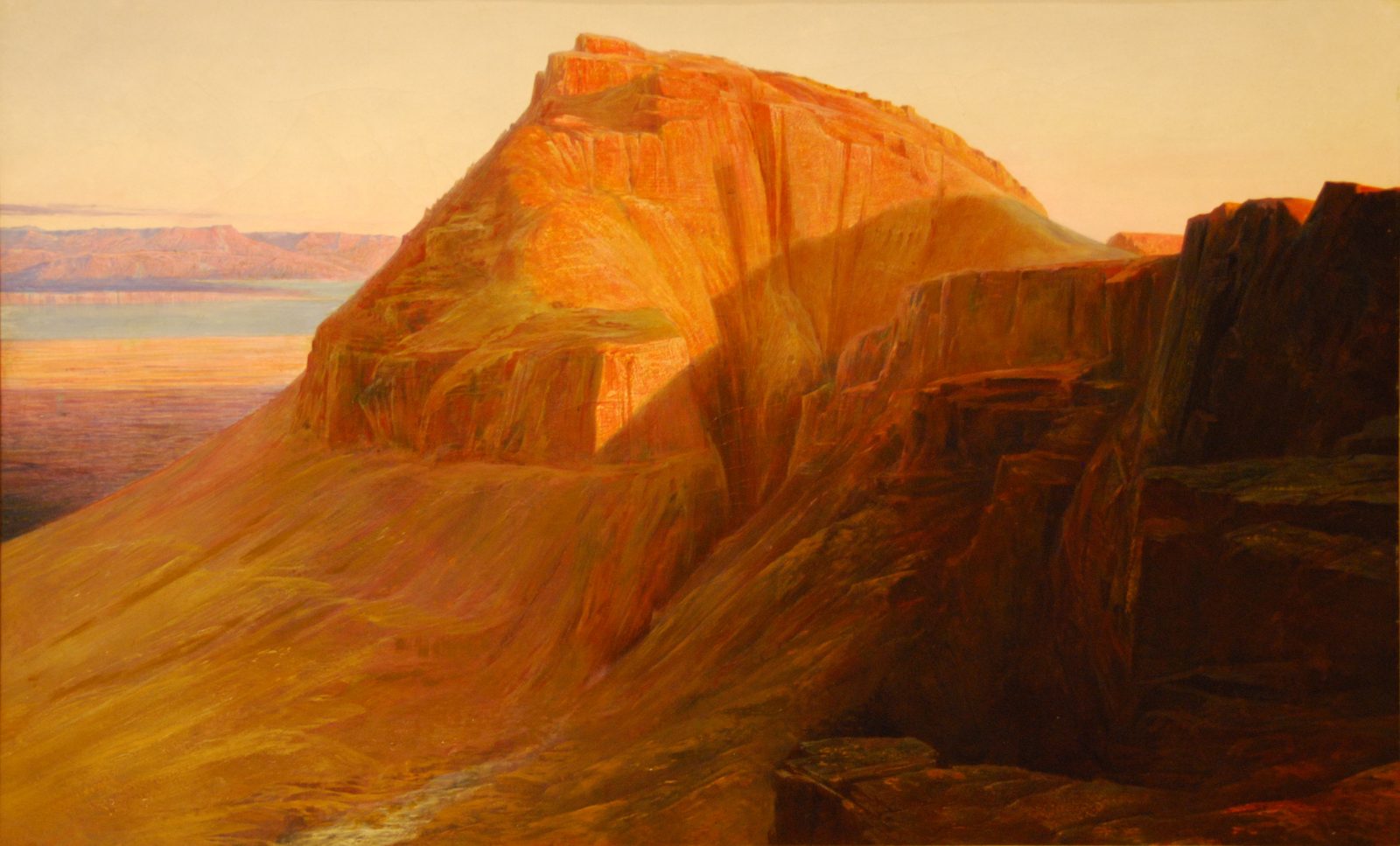
The painting
Masada on the Dead Sea. Edward Lear, 1858. Wikimedia Commons. Public domain.