
Psalm 75
10 verses · Thanksgiving psalm
“All the horns of the wicked I will cut off, but the horns of the righteous will be exalted.”
Introduction
Asaph, the Cup in God's Hand, Book 3: The crisis of the throne, Poetry, Psalms Overview.
Headed for Asaph and set to a named tune, this psalm is a song of thanks sung before the rescue it celebrates has come. In the middle of it God Himself speaks, and He claims the right to choose the time when He will judge. The psalm uses two pictures every Israelite knew, the horn of an animal raised in pride and a cup poured at a feast for each guest to drain. Listen for who is speaking in each part, and for where the singer says honour comes from.
Context
- Who
- A congregation being told that the lifting up of a man is God's to give and God's to take away
- What
- A song of thanks in which God Himself speaks and claims the time of judgment as His own.
- Where
- The worshipping assembly of Israel.
- When
- The date is unstated and the psalm names no event.
- Why
- To teach that God alone raises one man up and brings another down.
Historical context
The heading sets the psalm for the choirmaster to a tune called Do Not Destroy and names Asaph, and the psalm stands third among his eleven. It gives no date and names no event. A first hearer knew its two pictures. A horn is an animal's strength showing, so a lifted horn was a man putting his own strength on display, and Hannah's song has the LORD lifting the horn at 1 Samuel 2:1. The cup belonged at a feast, where the master handed out the portions of meat and drink and each guest took the cup he was given, and the wine of this cup is mixed with spices that make it strong.
Significance
The psalm gave a congregation a way to give thanks before anything visible had changed, on the ground that God's Name was near, with the speech at its centre coming from God. It told them that promotion comes from no direction on the map, and that God alone brings one down and exalts another, keeping the time of the cup in His own hand.
This chapter in Jewish lifeWhat this chapter is in Jewish life and reading.
How it is read
Rashi reads the heading's phrase al tashcheth, do not destroy, as spoken over Israel (Rashi on Psalms 75:1:1). The thanks of verse 2 he takes as covering both halves of a life, the good and the evil alike, with God's name always near in the mouth (Rashi on Psalms 75:2:1). The festive day of verse 3 he reads as Israel's own festival, kept without obscenity or levity, where the day's own event is turned into praise (Rashi on Psalms 75:3:1 and 75:3:2). The melting earth of verse 4 he sets at Sinai. The condition of creation, as he reports it, was that if Israel did not accept the Torah the world would return to void. The pillars were established when Israel said they would do and hear (Rashi on Psalms 75:4:1 and 75:4:2). The lifting of the horn in verse 7 belongs to God alone. Rashi rules out the east, the west and the trading caravan of the desert, and leaves the raising and lowering of men to God (Rashi on Psalms 75:7:1 and 75:8:2). The horns cut off at the end are the horns of Esau, read with the vengeance on Edom at Ezekiel 29:14 (Rashi on Psalms 75:11:1 and 75:11:2). Ibn Ezra and Radak stand in the corpus on this psalm by reference alone. Rashi is quoted here from the Judaica Press complete Tanach with Rashi, translated by A. J. Rosenberg, under CC-BY.
What the rabbis say
The corpus records forty places where the Midrash and the Talmud draw on this psalm, cited here by reference. Midrash Tehillim treats it at 75:1, 75:2 and 75:3. Verse 11, the horns of the wicked, is drawn into the Babylonian Talmud at Megillah 17b:18 and into Eikhah Rabbah 2:6, Aggadat Bereshit 57:1 and Midrash Shmuel 5:17. Verse 9, the cup with its foaming wine, stands in the Jerusalem Talmud at Pesachim 10:1:7 and in Midrash Tanchuma Buber, Vayera 18:1. Verse 4, on the pillars of the earth, is read at Bereshit Rabbah 66:2, at Midrash Tanchuma, Bereshit 1:8 and in the Mekhilta DeRabbi Yishmael, Tractate Shirah 9:19. Verse 8, on the God who judges, is carried into Bereshit Rabbah 68:4 and Midrash Tanchuma, Ki Tisa 5:1 and 5:3.
Sources: Rashi, Rashi on Psalms 75:1 to 75:11, the Judaica Press complete Tanach with Rashi, translated by A. J. Rosenberg, CC-BY, 1040 to 1105; Midrash Tehillim, 75:1, 75:2 and 75:3, cited by reference; Babylonian Talmud, Megillah 17b:18, cited by reference; Jerusalem Talmud, Pesachim 10:1:7, cited by reference; Bereshit Rabbah, 66:2 and 68:4, cited by reference; The Sefaria corpus, scripts/data/sources/sefaria/psalms/75.json, fetched 2026-09-19, 2026.
for Your Name is near: The thanks is doubled, said once and then said again, before anything is asked for. The reason given is that God's Name is near, so his presence is treated as a fact already in hand. The whole people declare the wondrous works.
Psalms 75:1
“Unto thee, O God, do we give thanks. Not to ourselves, for we were helpless, but to Elohim who heard our cry, and replied to the taunt of our foes. Never let us neglect thanksgiving, or we may fear that another time our prayers will remain unanswered. As the smiling flowers gratefully reflect in their lovely colours the various constituents of the solar ray, so should gratitude spring up in our hearts after the smiles of God's providence. Unto thee do we give thanks. We should praise God again and again. Stinted gratitude is ingratitude.”
Charles Spurgeon · The Treasury of David, Vol. 3 (1872)Particular Baptist
2 more voices on this verseWhat preachers and commentators have said about this verse, in their own words.
Psalms 75:1
“The repetition serves the more forcibly to express his strong affection and his ardent zeal in singing the praises of God. The verbs in the Hebrew are in the past tense; but the subject of the psalm requires that they should be translated into the future; which may be done in perfect consistency with the idiom of the Hebrew language.”
John Calvin · Commentaries (1554)reformed
Psalms 75:1
“For the end, do not corrupt, a psalm of Asaph, a song. In the Hebrew it does not have "for the end," but has "to the victor." And the Seventy translators did not err greatly, since victory is something perfected. Well did he say, For the end, do not corrupt. This phrase is interpreted in many ways. David says even to one of his friends: "Do not corrupt him" — that is, Saul. See what he says.”
Jerome · written before 420 · Homily 8, on Psalm 74patristic
Psalms 75:2-3
God himself speaks from here through verse 5. The Hebrew word for the time is mo'ed, an appointed time, so the judging waits on a date God sets. The earth and its dwellers quake while he holds up its pillars, and Selah marks a pause in the singing.
Psalms 75:2
“When I shall receive the congregation I will judge uprightly. This is generally believed to be the voice of God, who will, when he accepts his people, mount his judgment seat and avenge their cause in righteousness. It is rendered by some, "I will take a set time; "and by others, "I will seize the moment." He determines the period of interposition, and when that arrives swift are his blows and sure are his deliverances. God sends no delegated judge, but sits himself upon the throne. O Lord, let thy set time come for grace.”
Charles Spurgeon · The Treasury of David, Vol. 3 (1872)Particular Baptist
2 more voices on this verse
Psalms 75:2
“When I shall have taken the congregation. The Hebrew verb yd, yaäd, signifies to appoint a place or day, and the noun mvd, moed, derived from it, which is here used, signifies both holy assemblies, or a congregation of the faithful assembled together in the name of the Lord, and festival, or appointed solemn days.”
John Calvin · Commentaries (1554)reformed
Psalms 75:2
“This agrees with David's resolutions, Ps. ci. Herein David was a type of Christ, who with the breath of his mouth shall slay the wicked, but shall exalt with honour the horn of the righteous, Ps. cxii.”
Matthew Henry · Commentary on the Whole Bible (1707-1721)puritan
it is I who bear up its pillars: Spurgeon read the quaking earth as a land in anarchy, where the proud and the wicked rule. God answers that He Himself bears up its pillars. While the pillars stand, the house outlasts the storm.
Psalms 75:3
“The earth and all the inhabitants thereof are dissolved. When anarchy is abroad, and tyrants are in power, everything is unloosed, dissolution threatens all things, the solid mountains of government melt as wax; but even then the Lord upholds and sustains the right. I bear up the pillars of it. Hence, there is no real cause for fear. While the pillars stand, and stand they must for God upholds them, the house will brave out the storm.”
Charles Spurgeon · The Treasury of David, Vol. 3 (1872)Particular Baptist
1 more voice on this verse
Psalms 75:3
“But Christ bore up the pillars of it; he saved the whole world from utter ruin by saving his people from their sins, and into his hand the administration of the kingdom of Providence is committed, for he upholds all things by the word of his power, Heb. i.”
Matthew Henry · Commentary on the Whole Bible (1707-1721)puritan
Psalms 75:4-5
I say to the proud: The warning goes to the proud and to the wicked: keep the boasting down and keep the horn down. A horn on an animal is its strength showing, and Hannah's horn is lifted by the LORD at 1 Samuel 2:1. The neck that will not bend is the second picture.
Psalms 75:4
“I said unto the fools, Deal not foolishly. The Lord bids the boasters boast not, and commands the mad oppressors to stay their folly. How calm is he, how quiet are his words, yet how divine the rebuke. If the wicked were not insane, they would even now hear in their consciences the still small voice bidding them cease from evil, and forbear their pride. And to the wicked, Lift not up the horn. He bids the ungodly stay their haughtiness.”
Charles Spurgeon · The Treasury of David, Vol. 3 (1872)Particular Baptist
1 more voice on this verse
Psalms 75:4
“Here the writer speaks in view of God's declaration, warning the wicked. Lift . . . up the horn--to exalt power, here, of the wicked himself--that is, to be arrogant or self-elated.”
Jamieson, Fausset & Brown · Commentary Critical and Explanatory on the Whole Bible (1871)reformed
Augustine heard in the lifted horn a proud man who boasts of his good and lays the blame for his evil on God. Spurgeon pictured the outstretched neck as insolence that invites the axe. Both warnings come before God judges in verse 7.
Psalms 75:5
“Lift not up your horn on high. For their abounding pride there is a double rebuke. A word from God soon abases the lofty. Would to God that all proud men would obey the word here given them; for, if they do not, he will take effectual means to secure obedience, and then woe will come upon them, such as shall break their horns and roll their glory in the mire for ever. Speak not with a stiff neck. Impudence before God is madness. The outstretched neck of insolent pride is sure to provoke his axe.”
Charles Spurgeon · The Treasury of David, Vol. 3 (1872)Particular Baptist
Psalms 75:6-8
exaltation comes neither from east: No direction on the map supplies the lifting up, and God is the one who judges, bringing one down and exalting another. The cup in the LORD's hand holds foaming wine, and the wicked drink it to the dregs. The same cup stands at Isaiah 51:17 and Revelation 14:10.
Psalms 75:6
“For promotion cometh neither from the east, nor from the west, nor from the south. There is a God, and a providence, and things happen not by chance. Though deliverance be hopeless from all points of the compass, yet God can work it for his people; and though judgment come neither from the rising or the setting of the sun, nor from the wilderness of mountains, yet come it will, for the Lord reigneth.”
Charles Spurgeon · The Treasury of David, Vol. 3 (1872)Particular Baptist
1 more voice on this verse
Psalms 75:6
“We see strange revolutions in states and kingdoms, and are surprised at the sudden disgrace of some and elevation of others; we are all full of such changes, when they happen; but here we are directed to look at the author of them, and are taught where the original of power is, and whence promotion comes. Whence comes preferment to kingdoms, to the sovereignty of them?”
Matthew Henry · Commentary on the Whole Bible (1707-1721)puritan
He brings down one and exalts another: Verse 6 ruled out east, west and the desert. Barnes said exaltation comes from God alone, whatever a people's numbers, skill or alliances. Augustine saw God bring down the proud Pharisee and exalt the humble tax collector.
Psalms 75:7
“But God is the judge. Even now he is actually judging. His seat is not vacant; his authority is not abdicated; the Lord reigneth evermore. He putteth down one, and setteth up another. Empires rise and fall at his bidding. A dungeon here, and there a throne, his will assigns. Assyria yields to Babylon, and Babylon to the Medes. Kings are but puppets in his hand; they serve his purpose when they rise and when they fall.”
Charles Spurgeon · The Treasury of David, Vol. 3 (1872)Particular Baptist
drink it down to the dregs: Wesley pictured the LORD as the master of a feast who pours each guest a cup. The spices, he said, make the foaming wine stronger. Jamieson, Fausset and Brown gave the close literally: the wicked shall surely drain the dregs.
Psalms 75:8
“For in the hand of the Lord there is a cup. The punishment of the wicked is prepared, God himself holds it in readiness; he has collected and concocted woes most dread, and in the chalice of his wrath he holds it. They scoffed his feast of love; they shall be dragged to his table of justice, and made to drink their due deserts. And the wine is red. The retribution is terrible, it is blood for blood, foaming vengeance for foaming malice. The very colour of divine wrath is terrible; what must the taste be?”
Charles Spurgeon · The Treasury of David, Vol. 3 (1872)Particular Baptist
2 more voices on this verse
Psalms 75:8
“The sufferings of Christ are called a cup, Matt. xx. The judgments of God upon sinners are the cup of the Lord's right hand, Hab. ii. The wine is red, denoting the wrath of God, which is infused into the judgments executed on sinners, and is the wormwood and the gall in the affliction and the misery.”
Matthew Henry · Commentary on the Whole Bible (1707-1721)puritan
Psalms 75:8
“For - God is here compared to the master of a feast, who then used to distribute portions of meat and drink to the several guests. Red - Such as the best wine of Judea was. Mixture - The wine is mingled not with water, but with strengthening and intoxicating ingredients.”
John Wesley · Explanatory Notes upon the Old Testament (1765)evangelical
Psalms 75:9-10
sing praise to the God of Jacob: The vow answers the opening thanks: he will keep proclaiming and singing to the God of Jacob. Then God speaks again, cutting off the horns of the wicked and lifting the horns of the righteous. The horn of verse 4 is settled here.
Psalms 75:9
“But I will declare for ever. Thus will the saints occupy themselves with rehearsing Jehovah's praises, while their foes are drunken with the wine of wrath. They shall chant while the others roar in anguish, and justly so, for the former Psalm informed us that such had been the case on earth, —"thine enemies roar in the sanctuary, "—the place where the chosen praised the Lord. I will sing praises to the God of Jacob. The covenant God, who delivered Jacob from a thousand afflictions, our soul shall magnify.”
Charles Spurgeon · The Treasury of David, Vol. 3 (1872)Particular Baptist
Barnes heard a ruler speaking, stating the terms on which he would judge the wicked. Spurgeon noted that horns were then worn as a mark of rank, so the picture is plain as well as figurative. The proud lose their horns, and the righteous are exalted.
Psalms 75:10
“All the horns of the wicked also will I cut off. Power and liberty being restored to Israel, she begins again to execute justice, by abasing the godless who had gloried in the reign of oppression. Their power and pomp are to be smitten down. Men wore horns in those days as a part of their state, and these, both literally and figuratively, were to be lopped off; fir since God abhors the proud, his church will not tolerate them any longer. But the horns of the righteous shall be exalted.”
Charles Spurgeon · The Treasury of David, Vol. 3 (1872)Particular Baptist
How this psalm is built
The form: A thanksgiving, the thank offering put into words by a man who asked and was answered, as Gunkel classes it.
The patterns in this chapter
| Device | What it does | Where to see it |
|---|---|---|
| The horn lifted and the horn cut off | A horn is an animal's strength showing, and the word stands four times in this psalm. God tells the proud and the wicked at verses 4 and 5 to keep the horn down. At verse 10 He cuts off the horns of the wicked and lifts the horns of the righteous. Spurgeon notes that men wore horns in those days as part of their state, and reads the cutting off both literally and figuratively.Charles Spurgeon, The Treasury of David, Vol. 3, 1872, on Psalm 75:10. | Psalm 75:4, Psalm 75:5, Psalm 75:10 |
| God's own voice at the middle and at the close | Verses 2 to 5 are spoken by God in the first person, and verse 10 returns to that voice for the last word. Between them the psalm speaks about God at verses 6 to 8, and the singer makes his vow at verse 9. Spurgeon says the speech is generally believed to be the voice of God, who sends no delegated judge and sits Himself upon the throne.Charles Spurgeon, The Treasury of David, Vol. 3, 1872, on Psalm 75:2. | Psalm 75:2, Psalm 75:5, Psalm 75:9, Psalm 75:10 |
| The thanks said twice before anything is asked | Verse 1 gives thanks, gives thanks again, and puts the reason in one clause, that God's Name is near. Calvin holds that the repetition expresses strong affection and ardent zeal in singing the praises of God. Spurgeon puts the rule plainly, that stinted gratitude is ingratitude.John Calvin, Commentaries, 1554, on Psalm 75:1. | Psalm 75:1 |
| The three directions that supply nothing | Verse 6 names the east, the west and the desert, and verse 7 supplies the answer that God is the judge who brings one down and exalts another. Spurgeon reads the line as a denial of chance, since deliverance may look hopeless from every point of the compass and still come. Henry uses the same verses to ask where the preferment of kingdoms comes from.Charles Spurgeon, The Treasury of David, Vol. 3, 1872, on Psalm 75:6. | Psalm 75:6, Psalm 75:7 |
In the New Testament
6 more paragraphs on the patterns
This lane's material carries no New Testament quotation of Psalm 75. The psalm's cup runs on into the prophets and into Revelation. Verse 8 says the cup is in the hand of the LORD, full of foaming wine mixed with spices, and that all the wicked of the earth drink it down to the dregs.
Jeremiah 25:15 has the LORD hand the prophet that cup and send him to make the nations drink it. Revelation 14:10 has the worshipper of the beast drink the wine of God's anger, poured undiluted into the cup of His wrath. The two later texts name who drinks, and the psalm names no nation. Henry reads the cup as the judgments of God upon sinners and sets it beside the cup of Christ's sufferings at Matthew 20.
Inside the psalm
The thanks of verse 1 is answered by the vow of verse 9, where the singer says he will proclaim and sing forever. The horn goes down at verses 4 and 5 and is settled at verse 10, cut off for the wicked and lifted for the righteous. The hand that holds the pillars steady at verse 3 is the hand that pours the cup at verse 8.
Where it stands in the Psalter
Spurgeon reads Psalm 75 against Psalm 74, since the enemies roared in the sanctuary there and the saints sing here in the same place. Psalm 74 asks how long and gets no answer inside itself, and Psalm 75 opens with God naming the time as His to choose. The two stand together in the eleven psalms of Asaph.
Keep studying
People and groups1
Sources for this chapter
The summary
Jamieson, Fausset & Brown, Commentary Critical and Explanatory; John Calvin, Commentaries; John Wesley, Notes on the Old Testament and Matthew Henry, Complete Commentary.
The form and classifications
Hermann Gunkel, Einleitung in die Psalmen, 1933, as set out for students in C. Hassell Bullock, Encountering the Book of Psalms, 2001; the type this site publishes for Psalm 75; Jamieson, Fausset and Brown, Commentary Critical and Explanatory on the Whole Bible, 1871, on Psalm 75:4 to 8 and John Calvin, Commentaries, 1554, on Psalm 75:1.
The exposition
Albert Barnes; Augustine of Hippo, Exposition on Psalm 75; Charles Spurgeon; Franz Delitzsch, Biblical Commentary on the Psalms; Jamieson, Fausset & Brown, Commentary Critical and Explanatory on the Whole Bible; John Gill, Exposition of the Old Testament; John Wesley, Explanatory Notes upon the Old Testament and Matthew Henry, Commentary on the Whole Bible.
The painting
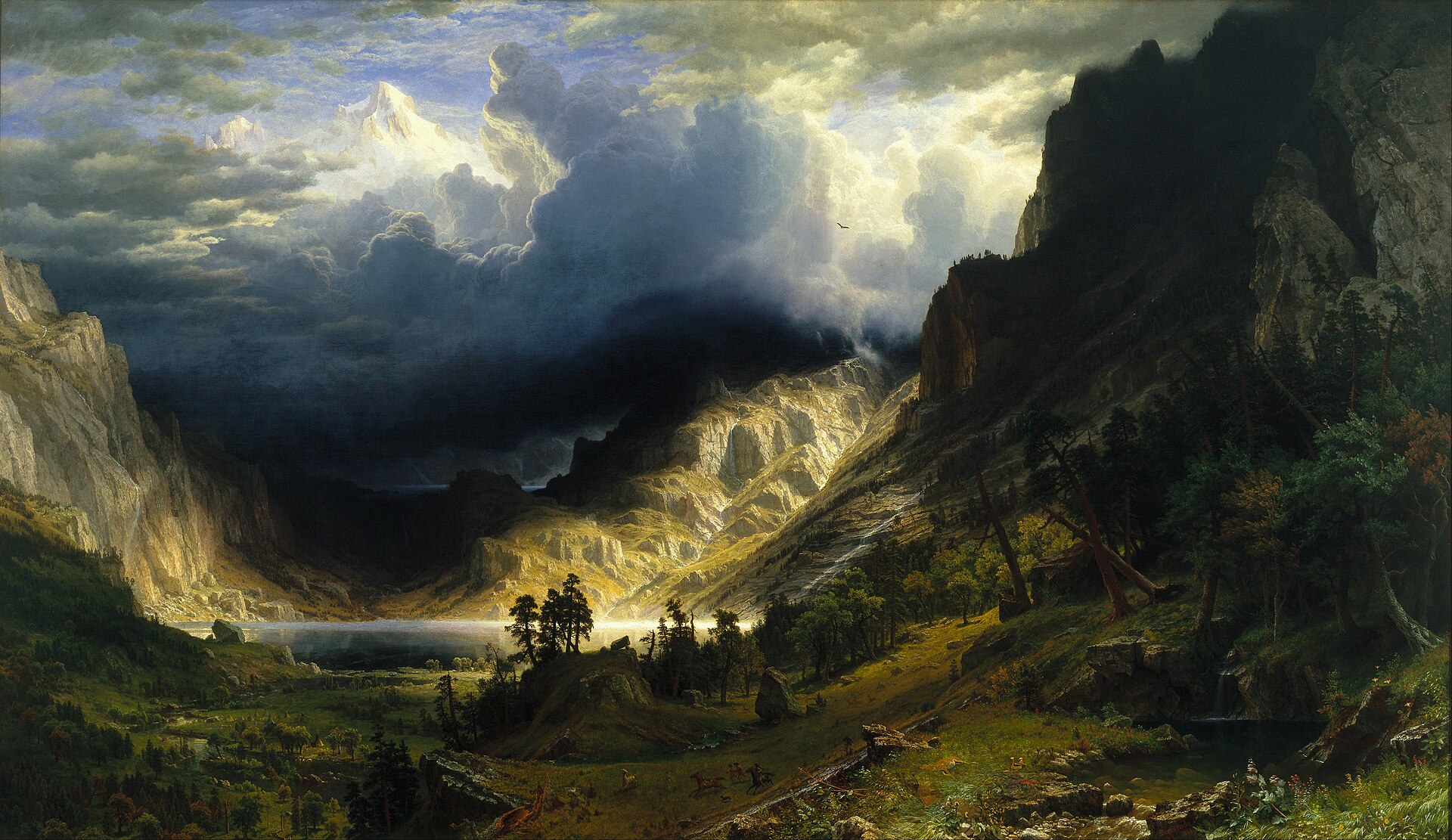
A Storm in the Rocky Mountains, Mt. Rosalie. Albert Bierstadt, 1866. Wikimedia Commons. Public domain.