
Psalm 66
20 verses · Thanksgiving psalm
I will enter Your house with burnt offerings; I will fulfill my vows to You—
Introduction
Author unstated, the Vow Paid, Book 2: The Elohistic Psalter, Poetry, Psalms Overview.
No writer is named in this psalm's heading, and the congregation sang it as its own. It belongs to the day a worshipper paid the vow he had made in trouble, bringing costly offerings to the temple and telling what God had done. The first half is the whole nation's story, calling the earth to watch what God did at the sea. Halfway through, one voice takes over and tells his own rescue as part of that same story. Listen for that change from many voices to one, and for the honest condition he names about being heard.
Context
- Who
- A congregation watching one of their own pay up in public
- What
- A thanksgiving in which the nation praises God for its history and one worshipper tells how God answered him.
- Where
- The temple courts, as a man brings the animals he promised during a crisis
- When
- The date is unstated, and the heading names no writer.
- Why
- To lead a worshipper paying a vow to tell his own rescue as part of God's work for His people.
Historical context
The heading names no author and marks the psalm for the choirmaster, so the congregation sang it as its own. A burnt offering was consumed entirely on the altar, and this man brings rams, bulls and goats together, the scale of payment a household of means made after a very bad year. Refined like silver describes real metallurgy, ore heated in a crucible until the dross could be skimmed off and the surface came up bright. Men riding over our heads is a battlefield line, and going through fire and water pairs the burning of a captured town with a flooded crossing, with the sea turned to dry land and the river crossed on foot standing behind the whole picture. Halfway through, the psalm changes from we to I, because at a thank offering the congregation recited the nation's story and then the man who had made the vow told his own while the meal was eaten.
Significance
The nation retells the crossing of the sea, and then one man says God did that for him, so first hearers were taught to read their own rescue as the same story continuing. The honesty at the end carried weight too, since the testimony includes its condition, that a heart holding on to iniquity would not have been heard.
This chapter in Jewish lifeWhat this chapter is in Jewish life and reading.
How it is read
Rashi reads this psalm from inside the exile. The call to the peoples in verse 8 he takes as a claim made by a people still scattered. God "kept our soul alive in exile, and you cannot annihilate us" (Rashi on Psalms 66:8:1). The testing of verse 10 is therefore the exile itself (Rashi on Psalms 66:10:1). The trap of verse 11 is "a narrow place, like in a prison" (Rashi on Psalms 66:11:1). The man God caused to ride at the head of Israel is "the kings of all the heathen nations" (Rashi on Psalms 66:12:1). That reading sets the vows of verse 13 in the future rather than the past. The singer will come to God's house "when You build the Temple", and pay there the vows that were vowed in exile (Rashi on Psalms 66:13:1). Earlier in the psalm Rashi keeps the history plain. The sea turned into dry land is the Sea of Reeds (Rashi on Psalms 66:6:1). Those who fear God in verse 16 he identifies as the proselytes who had become converted (Rashi on Psalms 66:16:1). Sefaria holds no English version of Ibn Ezra or Radak on this psalm, so their comments stand in the corpus by reference alone. Rashi is quoted here from the Judaica Press complete Tanach with Rashi, translated by A. J. Rosenberg, under CC-BY.
What the rabbis say
The corpus records forty places where the Midrash and the Talmud draw on this psalm, cited here by reference. Verse 1 is read at Bereshit Rabbah 13:6 and Devarim Rabbah 7:7. Verse 3, on the deeds that make enemies cringe, stands at Bereshit Rabbah 32:2 and 32:3, at Esther Rabbah 10:15 and at Midrash Tanchuma Buber, Beshalach 2:1. Verse 12, on going through fire and water, is carried into the Babylonian Talmud at Berakhot 6b:25 and Bava Metzia 75b:9, and into Bereshit Rabbah 44:21. Verse 13, on coming into the house with burnt offerings, stands in the Babylonian Talmud at Chagigah 7a:15. Verse 20, on the prayer God did not turn away, is read in the Babylonian Talmud at Berakhot 5a:15. Midrash Tehillim cites the psalm's verses at 121:1 and 143:2.
Sources: Rashi, Rashi on Psalms 66:2 to 66:20, the Judaica Press complete Tanach with Rashi, translated by A. J. Rosenberg, CC-BY, 1040 to 1105; Babylonian Talmud, Berakhot 5a:15 and 6b:25, Bava Metzia 75b:9 and Chagigah 7a:15, cited by reference; Bereshit Rabbah, 13:6, 32:2, 32:3 and 44:21, cited by reference; Midrash Tehillim, 121:1 and 143:2, cited by reference; The Sefaria corpus, scripts/data/sources/sefaria/psalms/66.json, fetched 2026-09-19, 2026.
Psalms 66:1-4
Make a joyful noise to God: The summons goes to all the earth before the psalm names one deliverance. Gill reads the verb behind cower, kachash, as a feigned submission, enemies who cringe without yielding the heart. Every command here asks for a sound that is heard.
Psalms 66:1
“Make a joyful noise unto God. "In Zion, "where the more instructed saints were accustomed to profound meditation, the song was silent unto God, and was accepted of him; but in the great popular assemblies a joyful noise was more appropriate and natural, and it would be equally acceptable. If praise is to be wide spread, it must be vocal; exulting sounds stir the soul and cause a sacred contagion of thanksgiving. Composers of tunes for the congregation should see to it that their airs are cheerful; we need not so much noise, as joyful noise.”
Charles Spurgeon · The Treasury of David, Vol. 3 (1872)Particular Baptist
1 more voice on this verseWhat preachers and commentators have said about this verse, in their own words.
Psalms 66:1
“I prefer taking the Hebrew word signifying praise to be in the accusative case; rendering the words literally, make a glory his praise. And by this I understand him to mean, not as some do, that we should glory exclusively in his praises, but simply, that we highly exalt his praises, that they may be glorious.”
John Calvin · Commentaries (1554)reformed
make His praise glorious: The verse asks for praise worthy of the glory of His name. Charles Spurgeon reads make His praise glorious as praise that rises with grandeur and solemnity before God. The joyful noise of verse 1 becomes a song.
Psalms 66:2
“Sing forth the honour of his name. The noise is to be modulated with tune and time, and fashioned into singing, for we adore the God of order and harmony. The honour of God should be our subject, and to honour him our object when we sing. To give glory to God is but to restore to him his own. It is our glory to be able to give God glory; and all our true glory should be ascribed unto God, for it is his glory. "All worship be to God only, "should be the motto of all true believers.”
Charles Spurgeon · The Treasury of David, Vol. 3 (1872)Particular Baptist
3 more voices on this verse
Psalms 66:2
“In praising God we must do it so as to glorify him, and that must be the scope and drift of all our praises. Reckon it your greatest glory to praise God, so some. It is the highest honour the creature is capable of to be to the Creator for a name and a praise.”
Matthew Henry · Commentary on the Whole Bible (1707-1721)puritan
Psalms 66:2
“Sing forth the honor of his name - That is, Celebrate in appropriate praise the honor due to his name. Make that honor known in connection with songs. Make his praise glorious - literally, “place honor, his praise;” that is, Give him honor; give him praise. The meaning is, Set forth his praise with songs - with music - with shouts; - that will be the appropriate expression of the praise which is due to him.”
Psalms 66:2
“The honor of his name - Let his glorious and merciful acts be the subject of your songs.”
Adam Clarke · Commentary on the Bible (1810-1826)evangelical
Say to God turns the song toward God Himself. Charles Spurgeon warns that praise must be directed to the Lord or it is whistling to the wind. Adam Clarke finds the enemies who cower in Pharaoh, who promised again and again to let the people go and broke his word.
Psalms 66:3
“There is an implied contrast drawn between the voluntary homage which they yield, as attracted by the sweet influences of grace, and that slavish obedience which is wrung reluctantly from the unbeliever. The Hebrew word here used for to lie, signifies to yield such a submission as is constrained, and not free or cordial, as Psalm 18:45.”
John Calvin · Commentaries (1554)reformed
1 more voice on this verse
Psalms 66:3
“Subjection extorted by fear is seldom sincere, and therefore force is no proper means of propagating religion, nor can there be much joy of such proselytes to the church as will in the end be found liars unto it, Deut. xxxiii.”
Matthew Henry · Commentary on the Whole Bible (1707-1721)puritan
All the earth bows down: Verse 3 has enemies who cower; verse 4 has all the earth bowing down to sing. Charles Spurgeon sees the worship of fear joined by the singing of love. Albert Barnes sets it beside Romans 14:11, where every knee bows.
Psalms 66:4
“All the earth shall worship thee, and shall sing unto thee. All men must even now prostrate themselves before thee, but a time will come when they shall do this cheerfully; to the worship of fear shall be added the singing of love. What a change shall have taken place when singing shall displace sighing, and music shall thrust out misery! They shall sing to thy name. The nature and works of God will be the theme of earth's universal song, and he himself shall be the object of the joyful adoration of our emancipated race.”
Charles Spurgeon · The Treasury of David, Vol. 3 (1872)Particular Baptist
1 more voice on this verse
Psalms 66:4
“All the earth shall worship thee,.... The Messiah, who is equal with God; the Creator of men; the Redeemer of his people; the Head of the church, and King of saints; their Lord, and therefore to be worshipped; with internal worship, in the exercise of faith, hope, and love; and with external worship, in the word and ordinances, by prayer and praise, public and private.”
Psalms 66:5-7
Come and see the works of God: He turned the sea into dry land. Delitzsch reads the there of verse 6 as a later Israel standing where its fathers stood, claiming their rejoicing as its own. Verse 7 turns the recital into warning: His eyes watch the nations, and the rebellious are told not to exalt themselves.
Psalms 66:5
“Come and see the works of God,.... Of the Messiah, God manifest in the flesh; those divine works which he did when here on earth; his miraculous works, which were proofs of his deity and Messiahship; his preaching the Gospel, in so divine a manner as never man did; his works of obedience to the law, which were pure and perfect; the everlasting righteousness he wrought out for the justification of his people; and the great work of redemption and salvation finished by him, which none but God could ever have effected.”
1 more voice on this verse
Psalms 66:5
“Come and see the works of God. Such glorious events, as the cleaving of the Red Sea and the overthrow of Pharaoh, are standing wonders, and throughout all time a voice sounds forth concerning them—"Come and see." Even till the close of all things, the marvellous works of God at the Red Sea will be the subject of meditation and praise; for, standing on the sea of glass mingled with fire, the triumphal armies of heaven sing the song of Moses, the servant of God, and the song of the Lamb.”
Charles Spurgeon · The Treasury of David, Vol. 3 (1872)Particular Baptist
they passed through the waters on foot: The waters here are literally a river, Albert Barnes notes, and he reads the Jordan crossing beside the sea turned into dry land. Both crossings stand in one verse. Sea and river end in the same rejoicing.
Psalms 66:6
“He turned the sea into dry land,.... The Red sea, or sea of Zuph, as the Targum; by causing a strong east wind to blow, which made it dry, so that the children of Israel passed through it on dry ground, Exo 14:21. Or, "he turneth" (y); for though the allusion is to the making the Red sea dry land, when the Israelites passed through it; yet it refers to something to be done in the times of Christ and the Gospel dispensation.”
His eyes watch the nations: Albert Barnes renders the first clause literally as "ruling by his power forever," a rule that continues in every generation. Charles Spurgeon links the watching eyes to the Lord who looked out of the cloud on the Egyptians at the sea. The same eye now marks every conspiracy.
Psalms 66:7
“He ruleth by his power forever,.... Christ is the Ruler in Israel, King over his holy hill of Zion; who must reign till all enemies are put under his feet. He rules in the kingdom of nature and providence by his power, and does whatsoever he pleases; nor can any stay his hand.”
Psalms 66:8-9
Bless our God, O peoples: The psalm turns from the crossing at the sea to the present, God keeping life in the body and the foot from slipping. Henry reads that keeping as continuous, held moment by moment. Verse 8 calls for praise loud enough to be heard.
Psalms 66:8
“O bless our God, ye people,.... In all countries, that know the Lord and fear him; ascribe blessing, and honour and glory, to Christ our God, on account of his works, actions, perfections, kingdom and power; and because of the destruction of those who are rebels to his government; and make the voice of his praise to be heard; far and near, in psalms, and hymns, and spiritual songs; by shoutings, and loud acclamations of joy; see Rev 19:5; where Christ is called our God, and a like exhortation is made as here.”
keeps our feet from slipping: Charles Spurgeon counts two gifts in the verse, lives preserved and feet kept from slipping. Living and standing is the saint's condition, he says. The God who led the people through the waters on foot keeps their feet now.
Psalms 66:9
“Which holdeth our soul in life - Margin, as in Hebrew, putteth. That is, He has put (or placed) us in a state of safety. The word rendered “in life” means literally “among the living.” The word soul here is equivalent to us - ourselves; and the idea is, that he keeps us among the living.”
Psalms 66:10-12
You have refined us like silver: Both verbs of verse 10 belong to a metalworker: bachan, to test metal, and tsaraph, to melt it down. What follows is what the testing was, the net, the burden on the back, men riding overhead, fire and water. The way out ran through all of it.
Psalms 66:10
“For thou, O God, hast proved us,.... And by the experiment found them to be true and faithful; to have the truth of grace, and the root of the matter in them; not reprobate silver, or their grace counterfeit grace; but of the right kind, solid and substantial; thou hast tried us as silver is tried; in a furnace, where it is put and melted by the refiner, and purified from the dross that attends it. So the Targum, "thou hast purified us as the silversmith purifieth the silver;'' or tries it by melting and purifying it.”
1 more voice on this verse
Psalms 66:10
“For thou, O God, hast proved us. He proved his Israel with sore trials. David had his temptations. All the saints must go to the proving house; God had one Son without sin, but he never had a son without trial. Why ought we to complain if we are subjected to the rule which is common to all the family, and from which so much benefit has flowed to them? The Lord himself proves us, who then shall raise a question as to the wisdom and the love which are displayed in the operation?”
Charles Spurgeon · The Treasury of David, Vol. 3 (1872)Particular Baptist
You led us into the net: God is the subject of both verbs: He led them into the net and laid the burdens on their backs. Charles Spurgeon finds the one comfort there, that God Himself had brought them into the net. Adam Clarke hears Pharaoh's word, entangled.
Psalms 66:11
“Thou broughtest us into the net. The people of God in the olden time were often enclosed by the power of their enemies, like fishes or birds entangled in a net; there seemed no way of escape for them. The only comfort was that God himself had brought them there, but even this was not readily available, since they knew that he had led them there in anger as a punishment for their transgressions; Israel in Egypt was much like a bird in the fowler's net. Thou laidest affliction upon our loins.”
Charles Spurgeon · The Treasury of David, Vol. 3 (1872)Particular Baptist
4 more voices on this verse
Psalms 66:11
"Thou hast laid tribulations on our back:" "Thou hast set men over our heads" (ver. 11). All these things the Church hath suffered in sundry and divers persecutions: She hath suffered this in Her individual members, even now doth suffer it. For there is not one, that in this life could say that he was exempt from these trials. Therefore there are set even men over our heads: we endure those whom we would not, we suffer for our betters those whom we know to be worse.
Augustine of Hippo · written before 430 · Exposition on Psalm 66patristic
Psalms 66:11
“We went through both, that is, afflictions of different kinds; the end of one trouble was the beginning of another; when we had got clear of one sort of dangers we found ourselves involved in dangers of another sort. Such may be the troubles of the best of God's saints, but he has promised, When thou passest through the waters, through the fire, I will be with thee, Isa. xliii.”
Matthew Henry · Commentary on the Whole Bible (1707-1721)puritan
Psalms 66:11
“Thou broughtest us into the net - This refers well to the case of the Israelites, when, in their departure from Egypt, pursued by the Egyptians, having the Red Sea before them, and no method of escape, Pharaoh said, “The wilderness hath shut them in, - they are entangled;” comparing their state to that of a wild beast in a net. Affliction upon our loins - Perhaps this alludes to that sharp pain in the back and loins which is generally felt on the apprehension of sudden and destructive danger.”
Adam Clarke · Commentary on the Bible (1810-1826)evangelical
Psalms 66:11
“Thou broughtest us into the net - That is, Thou hast suffered or permitted us to be brought into the net; thou hast suffered us to be taken captive, as beasts are caught in a snare. See the notes at Psa 9:15. The allusion here is to the efforts made by their enemies to take them, as hunters lay gins, or spread nets, to capture wild beasts. The idea here is, that those enemies had been successful; God had suffered them to fall into their hands.”
You let men ride over our heads: John Gill notes that the Hebrew for men is singular, a frail mortal man riding over the heads of God's people. The fire and water finish the testing of verse 10, where God refined His people like silver. Abundance is where the way ends.
Psalms 66:12
“Thou hast caused men to ride over our heads,.... Jarchi and Kimchi interpret it of the kings and nations of the world ruling over Israel; and may very well design the Heathen powers and antichristian states tyrannizing over Christian people. The word in the original text is singular, "a man" (c), a frail mortal man; and may be understood of the man of sin and son of perdition; who rides upon the heads of men, exalts himself above all that is called God, and has exercised dominion over the saints in a most lawless and tyrannical manner.”
1 more voice on this verse
Psalms 66:12
And although the entrance is "straight and narrow," once inside we see a vast and limitless space, greater than any other anywhere. We have been told of these things by eyewitnesses and heirs. They speak of their trials and distresses: "You have placed afflictions before us," but then they add, "You brought us out into a spacious place"—and, "You gave us space in our distress."
Athanasius of Alexandria · written before 373 · Festal Letters 9patristic
Psalms 66:13-15
I will enter Your house with burnt offerings: The voice narrows from the congregation to one worshiper. He enters the house with burnt offerings and pays vows his lips spoke when he was in distress. Spurgeon marks the abundance of it, fatlings and rams and bulls and goats brought together.
the vows that my lips promised: Albert Barnes says the Hebrew verb behind promised means to open the mouth wide, vows poured out from a full heart in distress. Adam Clarke observes how often vows spoken in distress are forgotten. Here the lips pay what they promised.
Psalms 66:14
“Which my lips have uttered,.... Or "opened" (e); publicly and distinctly declared, and from which there is no going back; see Jdg 11:33; and my mouth hath spoken when I was in trouble; this refers to the time when the people of God were under antichristian tyranny and bondage; and when they vowed and promised, that, if the Lord would deliver them, they would give him all praise and glory. (e) פצו "aperuerunt", Pagninus, Montanus, Vatablus, Gejerus.”
the fragrant smoke of rams: Albert Barnes takes the fragrant smoke of rams as smoke rising from the altar the way incense rose in the house of God. The verse names the herd and the flock together. Augustine read the burnt offerings of fatlings as love kept in the marrow.
Psalms 66:15
“I will offer unto thee burnt sacrifices of fatlings,.... Of the fattest of the flock; that is, of the best; such as Abel offered, Gen 4:4; with the incense of rams; or "rams with incense" (f); the Targum is, "with sweet incense, the sacrifice of rams;'' Kimchi interprets it of incense of the fat of rams.”
Psalms 66:16-20
Come and listen, all you who fear God: Come and listen answers the come and see of verse 5. Sight was offered to the whole earth; the testimony is offered to those who fear God. Verse 18 names the condition the answer rests on, a heart that does not keep hold of iniquity.
Psalms 66:16
“With these he unites his public thanks, inviting those who fear God (Ps 60:4; 61:5, His true worshippers) to hear. He vindicates his sincerity, inasmuch as God would not hear hypocrites, but had heard him.”
Jamieson, Fausset & Brown · Commentary Critical and Explanatory on the Whole Bible (1871)reformed
praised Him with my tongue: The Hebrew reads exaltation was under his tongue, which Jamieson, Fausset and Brown take as praise stored and ready, so that honoring God was habitual. Charles Spurgeon yokes prayer and praise like the horses of Pharaoh's chariot. Both were in his mouth at once.
Psalms 66:17
“I cried unto him with my mouth, and he was extolled with my tongue. It is well when prayer and praise go together, like the horses in Pharaoh's chariot. Some cry who do not sing, and some sing who do not cry: both together are best. Since the Lord's answers so frequently follow close at the heels of our petitions, and even overtake them, it becomes us to let our grateful praises keep pace with our humble prayers.”
Charles Spurgeon · The Treasury of David, Vol. 3 (1872)Particular Baptist
If I had cherished iniquity: Albert Barnes explains cherished iniquity in the heart as iniquity loved and kept. Charles Spurgeon pictures the heart gazing on it without aversion. Here the Lord listened and heard the sound of the prayer.
Psalms 66:18
“If I regard iniquity in my heart. If, having seen it to be there, I continue to gaze upon it without aversion; if I cherish it, have a side glance of love toward it, excuse it, and palliate it; The Lord will not hear me. How can he? Can I desire him to connive at my sin, and accept me while I wilfully cling to any evil way? Nothing hinders prayer like iniquity harboured in the breast; as with Cain, so with us, sin lieth at the door, and blocks the passage.”
Charles Spurgeon · The Treasury of David, Vol. 3 (1872)Particular Baptist
But God has surely heard: Verse 18 set a condition, and verse 19 answers it: God has surely heard. Albert Barnes reasons that the hearing proved the heart sincere. The prayer God attended to is the evidence of the heart.
Psalms 66:19
“But verily God hath heard me. Sure sign this that the petitioner was no secret lover of sin. The answer to his prayer was a fresh assurance that his heart was sincere before the Lord. See how sure the psalmist is that he has been heard; it is with him no hope, surmise, or fancy, but he seals it with a verily. Facts are blessed things when they reveal both God's heart as loving, and our own heart as sincere. He hath attended to the voice of my prayer.”
Charles Spurgeon · The Treasury of David, Vol. 3 (1872)Particular Baptist
withheld from me His loving devotion!: Blessed be God closes the psalm on the prayer heard and the loving devotion kept. Matthew Henry reads the loving devotion as the source of the prayer's answer. The mercy sent the deliverance, he says.
Psalms 66:20
“Blessed be God, which hath not turned away my prayer,.... Has not been angry against it, shut it out, or covered himself with a cloud that it might not pass through, which sometimes saints have complained of, Psa 80:4; but graciously heard and received it; nor his mercy from me; for that endures for ever, and is from everlasting to everlasting on them that fear the Lord, Psa 103:17; all which require thankfulness and praise, which is here given.”
1 more voice on this verse
Psalms 66:20
“This he adds by way of correction: "It was not my prayer that fetched the deliverance, but his mercy that sent it." Therefore God does not turn away our prayer, because he does not turn away his own mercy, for that is the foundation of our hopes and the fountain of our comforts, and therefore ought to be the matter of our praises.”
Matthew Henry · Commentary on the Whole Bible (1707-1721)puritan
How this psalm is built
The form: A thanksgiving, the song of a man who asked and was answered, telling the congregation what happened, as Gunkel classes it.
The patterns in this chapter
| Device | What it does | Where to see it |
|---|---|---|
| Come and see, then come and listen | Verse 5 calls the whole earth to come and see the works of God, and verse 16 calls those who fear God to come and hear what He has done for one man. Spurgeon sets the pair together and says that hearing is faith's seeing, since they saw how terrible God was and heard how gracious He was.Charles Spurgeon, The Treasury of David, Vol. 3, 1872, on Psalm 66:16. | Psalm 66:5, Psalm 66:16 |
| The metalworker's two verbs | Verse 10 uses the word for testing metal and the word for melting it down. Gill reads the trial as the refiner's furnace, where silver is melted and purified from the dross, and takes the outcome as grace proved solid rather than counterfeit.John Gill, Exposition of the Old Testament, 1748 to 1763, on Psalm 66:10. | Psalm 66:10, Psalm 66:11, Psalm 66:12 |
| The turn from we to I | Verses 1 to 12 are the congregation speaking, and verse 13 changes to one voice bringing his own offerings. Spurgeon reads the change as necessary, since the best public form must fail to meet each case, so the man records his own mercies with his own pen.Charles Spurgeon, The Treasury of David, Vol. 3, 1872, on Psalm 66:13. | Psalm 66:13, Psalm 66:16 |
| The offerings named one kind at a time | Verse 15 lists fatlings, the smoke of rams, bulls and goats rather than saying sacrifices once. Gill reads the fatlings as the fattest of the flock, which is to say the best, the kind of offering Abel brought.John Gill, Exposition of the Old Testament, 1748 to 1763, on Psalm 66:15. | Psalm 66:13, Psalm 66:15 |
In the New Testament
5 more paragraphs on the patterns
Psalm 66 is not quoted in the New Testament. Its recital looks back to Exodus 14, and its testing language runs on into every later passage about refining silver. Theodoret of Cyrus notes that the tense of verse 6 is changed in one Greek version, the past spoken as future, so that the crossing reads as something still to happen.
Inside the psalm
The pattern is a matched pair of summons. The whole earth is called to see at verse 5, and those who fear God are called to hear at verse 16. What the earth sees is the public act at the sea, and what the congregation hears is what God did for one man's soul. Spurgeon keeps both and says that hearing is faith's seeing.
Where it stands in the Psalter
Verse 18 names the condition the whole testimony rests on. If the man had cherished iniquity in his heart, the Lord would not have listened. Spurgeon reads the answered prayer of verse 19 as fresh assurance that the heart was sincere, so the psalm ends with evidence rather than with a claim.
Keep studying
Sources for this chapter
The summary
Jamieson, Fausset & Brown, Commentary Critical and Explanatory; John Calvin, Commentaries; John Wesley, Notes on the Old Testament and Matthew Henry, Complete Commentary.
The form and classifications
Charles Spurgeon, The Treasury of David, Vol. 3, 1872, on Psalm 66:1; Hermann Gunkel, Einleitung in die Psalmen, 1933, as set out for students in C. Hassell Bullock, Encountering the Book of Psalms, 2001; the type this site publishes for Psalm 66 and Jamieson, Fausset and Brown, Commentary Critical and Explanatory on the Whole Bible, 1871, on Psalm 66:16 to 20.
The exposition
Adam Clarke, Commentary on the Bible; Albert Barnes; Augustine of Hippo, Exposition on Psalm 66; Charles Spurgeon; Franz Delitzsch, Biblical Commentary on the Psalms; Jamieson, Fausset & Brown, Commentary Critical and Explanatory on the Whole Bible; John Gill; John Wesley, Explanatory Notes upon the Old Testament and Matthew Henry, Commentary on the Whole Bible.
The painting
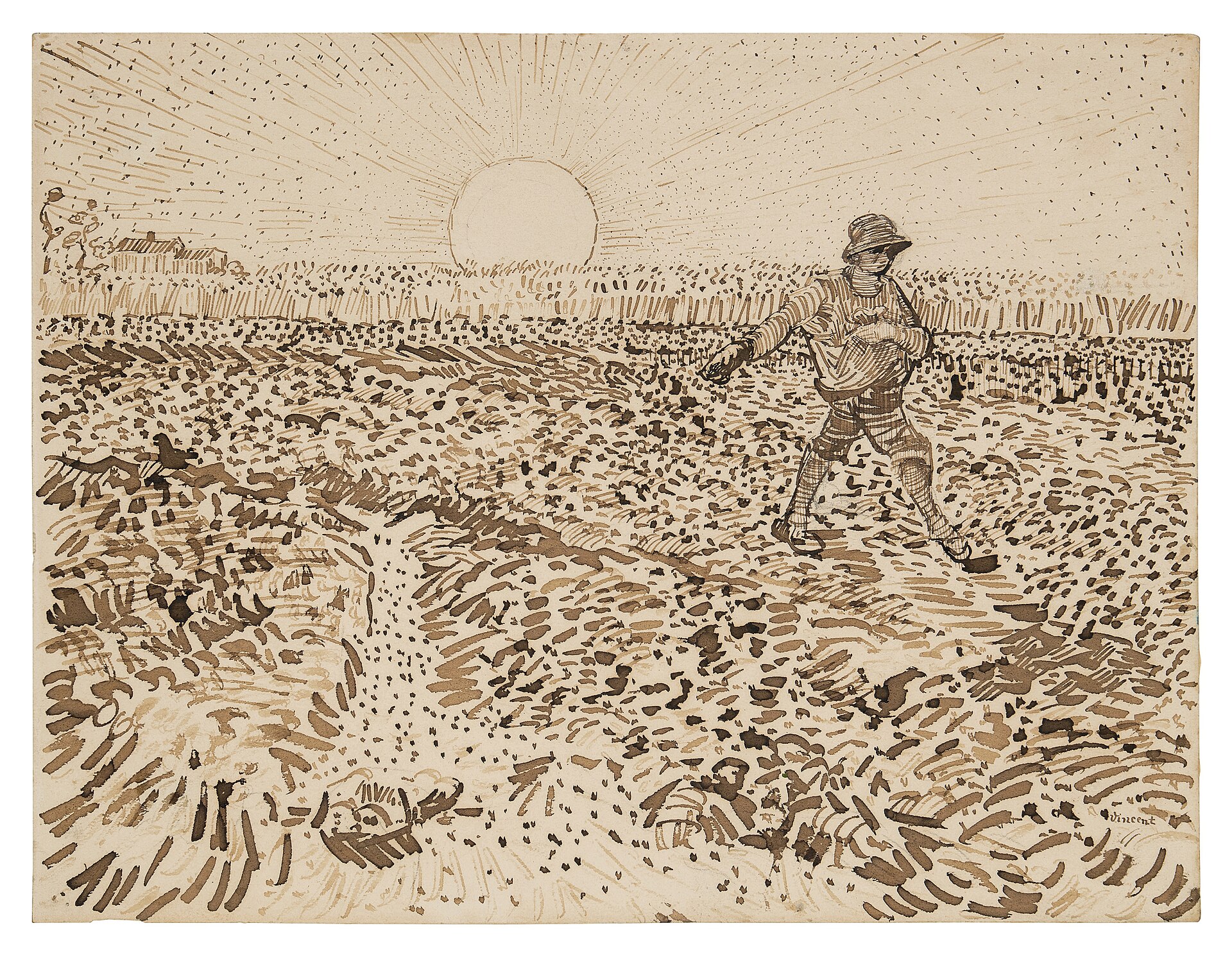
Sower with Setting Sun. Vincent van Gogh, mid July 1888. Sotheby's, New York, 18 November 2025, lot 4. Public domain.