
Psalm 62
12 verses · Psalm of trust
Rest in God alone, O my soul, for my hope comes from Him.
Introduction
David, Trust in God Alone, Book 2: The Elohistic Psalter, Poetry, Psalms Overview.
David gave this psalm to Jeduthun, one of the three men he set over the music of the sanctuary, so a trained choir sang it in public worship. It is a psalm of settled trust, spoken first to himself and then to the people standing near him. He has been pushed and lied about by men who smile in public, and he answers by weighing everything a person might lean on. Listen for the small word that opens line after line and carries the argument, and for the two things he says he has heard from God.
Context
- Who
- Worshippers deciding where to put their weight
- What
- A psalm of trust that weighs every other support a person might lean on and finds God the only one that holds.
- Where
- The sanctuary, in the hearing of people leaning on money and on powerful patrons
- When
- The monarchy, in Israel's public worship. Date unstated; attributed to David, c. 1000 BC, and set for the Jeduthun choir
- Why
- To teach a people to put their whole weight on God rather than on money, force or powerful men.
Historical context
The heading gives the psalm to David and marks it for Jeduthun, one of three men David appointed over the music of the sanctuary, beside Asaph and Heman. A psalm marked for Jeduthun most likely names the choir that performed it or the style they used. One small Hebrew word, carrying the sense of only or surely, opens six of the psalm's verses like a drumbeat, and the repetition is the argument. A leaning wall was a common sight in a Judean village, mudbrick on a stone footing that tilted when winter runoff washed out the base and then came down all at once. Weighing men in the scales is a market image, since trade ran on balance scales with stone weights, and the psalm puts high and low on the pan together and finds the beam stays level.
Significance
People in that world were tempted by two things, getting rich by squeezing others and attaching themselves to someone powerful, and the song weighs both and finds nothing there. What it leaves standing is a pair of facts said to be heard once and twice, that power belongs to God and that loving devotion belongs to Him, and first hearers were being told the two arrive together.
This chapter in Jewish lifeWhat this chapter is in Jewish life and reading.
How it is read
Rashi takes the heading's word Jeduthun two ways at once. He gives the plain sense first, "The name of a musical instrument". Then he gives the reading of the Midrash Aggadah, which hears in the word "the ordinances ... and laws that are decreed upon Israel by their enemies" (Rashi on Psalms 62:1:1). That double move is the shape of his commentary on this psalm. The waiting soul of verse 2 he reads by the wording of Psalm 37:7 (Rashi on Psalms 62:2:1). The promise that the singer will not falter greatly he passes to the Midrash, which takes the word greatly of Gehinnom (Rashi on Psalms 62:3:1, citing Midrash Tehillim 62:2). The plotters of verse 4 he compares to a leaning wall "which is ready to fall upon the sons of men" (Rashi on Psalms 62:4:2). On the last two verses, where God speaks once and the psalmist hears two things, Rashi names both: that God has strength to repay a man according to his deed, and that God has kindness. He draws the pair from the second commandment, and reports that "our Sages interpreted it as referring to [the maxim that] 'Remember' and 'Keep' were stated in a single utterance" (Rashi on Psalms 62:12:1). The kindness, he adds, is that God repays a man not according to the whole of his deed but part of it (Rashi on Psalms 62:13:1). Sefaria holds no English version of Ibn Ezra or Radak on this psalm, so their comments stand in the corpus by reference alone. Rashi is quoted here from the Judaica Press complete Tanach with Rashi, translated by A. J. Rosenberg, under CC-BY.
What the rabbis say
The corpus records forty places where the Midrash and the Talmud draw on this psalm, cited here by reference. Midrash Tehillim treats it at 62:1 to 62:4, and cites its verses again at 1:4, 30:4, 65:1 and 89:1. Verse 12, the one utterance heard as two, is carried into the Mekhilta DeRabbi Shimon Ben Yochai at 19:25, 20:1 and 20:8, and into Bamidbar Rabbah 11:7. It also stands in the Jerusalem Talmud at Nedarim 3:2:5 and Shevuot 3:8:6. Verse 13, on the repaying of a man according to his deed, is drawn into the Babylonian Talmud at Rosh Hashanah 17b:3 and into the Jerusalem Talmud at Peah 1:1:55, Kiddushin 1:9:3 and Sanhedrin 10:1:5. Verse 10, on the weighing of men in a scale, stands at Pesikta DeRav Kahana 23:8, Pesikta Rabbati 40:1, Bamidbar Rabbah 16:23 and Pirkei DeRabbi Eliezer 16:8.
Sources: Rashi, Rashi on Psalms 62:1 to 62:13, the Judaica Press complete Tanach with Rashi, translated by A. J. Rosenberg, CC-BY, 1040 to 1105; Midrash Tehillim, 62:1 to 62:4, cited by reference; Babylonian Talmud, Rosh Hashanah 17b:3 and Sanhedrin 109a:13, cited by reference; Jerusalem Talmud, Nedarim 3:2:5, Shevuot 3:8:6, Peah 1:1:55 and Kiddushin 1:9:3, cited by reference; Mekhilta DeRabbi Shimon Ben Yochai, 19:25, 20:1 and 20:8, cited by reference; The Sefaria corpus, scripts/data/sources/sefaria/psalms/62.json, fetched 2026-09-19, 2026.
Psalms 62:1-2
In God alone my soul finds rest: renders a Hebrew word for silence, the soul gone quiet before God. The confession stands before any complaint, and its lines come back as a refrain at verse 6. God alone is the rock, the salvation and the fortress.
Psalms 62:1
“Truly, or verily, or only. The last is probably the most prominent sense here. That faith alone is true which rests on God alone, that confidence which relies but partly on the Lord is vain confidence. If we Anglicized the word by our word verily, as some do, we should have here a striking reminder of our blessed Lord's frequent use of that adverb. My soul waiteth upon God. My inmost self draws near in reverent obedience to God. I am no hypocrite or mere posture maker.”
Charles Spurgeon · The Treasury of David, Vol. 3 (1872)Particular Baptist
1 more voice on this verseWhat preachers and commentators have said about this verse, in their own words.
Psalms 62:1
“Waiting is the room where my character is formed and my faith is forged. Waiting is the ground upon which my trust is tested and my commitment is challenged.”
Dr. Rob Reimer · The Waiting Room (Renewal International blog) (2018)Christian and Missionary Alliance
He alone is my rock: Charles Spurgeon hears in the rock the caves where David hid. Salvation follows as the plain word, and he takes the pairing as proof that God alone is a real refuge.
Psalms 62:2
“He only is my rock and my salvation. Sometimes a metaphor may be more full of meaning and more suggestive than literal speech: hence the use of the figure of a rock, the very mention of which would awaken grateful memories in the psalmists's mind. David had often lain concealed in rocky caverns, and here he compares his God to such a secure refuge; and, indeed, declares him to be his only real protection, all-sufficient in himself and never failing.”
Charles Spurgeon · The Treasury of David, Vol. 3 (1872)Particular Baptist
1 more voice on this verse
Psalms 62:2
"For he is my God and my savior; he is my protector, I shall be moved no more." The Son, who is from God, is our God. He is also Savior of the human race, who supports our weakness, who corrects the disturbance that springs up in our souls from temptations. "I shall be moved no more." Humanly he confesses his disturbance. "More." For it is impossible that there should not be some disturbance from temptations in the human soul.
Basil of Caesarea · written before 379 · Homilies on the Psalms 21:2patristic
Psalms 62:3-4
How long will you threaten: The complaint comes as a question put to the attackers themselves. Barnes reads the leaning wall and the tottering fence as how the enemies see him, ready to fall at a push. They bless with the mouth and keep the curse inside.
Psalms 62:3
"How long do you rush in upon a person? You all kill, as if you were tearing down a leaning wall and a tottering fence." Again the homily speaks out against the depraved ministers of the devil, charging them with a lack of moderation in the snares they lay. Certainly, people are weak animals; but you rush on, not content with the first attack, but you attack a second and a third time, until you subdue the soul that has fallen beside you to such an extent that it is very similar to a leaning wall and a tottering fence.
Basil of Caesarea · written before 379 · Homilies on the Psalms 21:3patristic
2 more voices on this verse
Psalms 62:3
“Their destruction will come; as a tottering wall they already are feeble and failing. bowing wall shall ye be--better supply "are." Some propose to apply these phrases to describe the condition of "a man"--that is, the pious suffer: thus, "Will ye slay him," &c.; but the other is a good sense.”
Jamieson, Fausset & Brown · Commentary Critical and Explanatory on the Whole Bible (1871)reformed
Psalms 62:3
“How long will ye imagine mischief against a man?.... Against a good man, as the Targum; or against any Israelite, as Kimchi; or rather he means himself, a single man, a weak man, and an innocent one; which aggravated their sin, in devising his hurt, and contriving ways to take away his life, as did Saul and his courtiers; and, Absalom, and those that were with him. R.”
with their mouths they bless: Albert Barnes sees Absalom in the lies, a son who won the people with a blessing in his mouth and a curse inwardly. The lofty perch is the king's high rank.
Psalms 62:4
"But they have thought to cast away my price; they ran in thirst: they blessed with their mouth but cursed with their heart." The price of [humanity's redemption] is the blood of Christ: "You have been bought," it is said, "with a price; do not become the slaves of people." The soldiers of Satan planned, therefore, to make this price useless to us, leading again into slavery those who had once been freed. "They ran in thirst." He is speaking of the eager plots of the demons, because they run against us, thirsting for our destruction.
Basil of Caesarea · written before 379 · Homilies on the Psalms 21:3patristic
1 more voice on this verse
Psalms 62:4
“They only consult to cast him down from his excellency,.... Either from the excellency of God, from his greatness, and from his height, as Kimchi; or from his grace, as the Arabic version: that is, they consulted to discourage him from looking to God, his rock and fortress, and from trusting in him; or rather, from his own excellency, from what high estate of dignity and honour he was advanced to, or designed for, namely his kingly office.”
Psalms 62:5-8
Rest in God alone: What was a confession at verse 1 comes back at verse 5 as an order to his own soul. Spurgeon marks the turn at verse 8, where the man who said He alone now says O people, and hands the posture to the congregation. Pour out your hearts before Him.
Psalms 62:5
“My soul, wait thou only upon God. When we have already practised a virtue, it is yet needful that we bind ourselves to a continuance in it. The soul is apt to be dragged away from its anchorage, or is readily tempted to add a second confidence to the one sole and sure ground of reliance; we must, therefore, stir ourselves up to maintain the holy position which we were at first able to assume. Be still silent, O my soul! submit thyself completely, trust immovably, wait patiently.”
Charles Spurgeon · The Treasury of David, Vol. 3 (1872)Particular Baptist
1 more voice on this verse
Psalms 62:5
“His salvation was the principal matter of his expectation; let him have that from God, and he expects no more. His salvation being from God, all his other expectations are from him. "If God will save my soul, as to every thing else let him do what he pleases with me, and I will acquiesce in his disposals, knowing they shall all turn to my salvation, " Phil. i.”
Matthew Henry · Commentary on the Whole Bible (1707-1721)puritan
I will not be shaken: The refrain returns with God alone as rock, salvation and fortress. Charles Spurgeon notes that an adverb qualified the promise in verse 2, and here it stands absolute: the man will not be shaken at all. A living faith grows, he says.
Psalms 62:6
“He only is my rock and my salvation. Alone, and without other help, God is the foundation and completion of my safety. We cannot too often hear the toll of that great bell only; let it ring the death knell of all carnal reliances, and lead us to cast ourselves on the bare arm of God. He is my defence. Not my defender only, but my actual protection. I am secure, because he is faithful. I shall not be moved—not even in the least degree. See how his confidence grows.”
Charles Spurgeon · The Treasury of David, Vol. 3 (1872)Particular Baptist
and my honor rest on God: Charles Spurgeon hears two pictures in the titles. God is a rock when the soul flees to Him for refuge and a strong rock when it stands firm against the foe.
Psalms 62:7
“In God is my salvation and my glory. Wherein should we glory but in him who saves us? Our honour may well be left with him who secures our souls. To find all in God, and to glory that it is so, is one of the sure marks of an enlightened soul. The rock of my strength, and my refuge, is in God. He multiplies titles, for he would render much honour to the Lord, whom he had tried, and proved to be a faithful God under so many aspects.”
Charles Spurgeon · The Treasury of David, Vol. 3 (1872)Particular Baptist
1 more voice on this verse
Psalms 62:7
"In God is my salvation and my glory; he is the God of my help, and my hope is in God." Blessed is one who exults in none of the lofty things of life but regards God as his glory: who holds Christ as his boast; who is able to say, according to the apostle, "But as for me, God forbid that I should glory except in the cross of Christ."
Basil of Caesarea · written before 379 · Homilies on the Psalms 21:4patristic
pour out your hearts before Him: Matthew Henry hears in pour out the drink offering poured before the Lord. Here it is the heart, poured out in prayer. The call to trust at all times goes to all the people.
Psalms 62:8
“Trust in him at all times. Faith is an abiding duty, a perpetual privilege. We should trust when we can see, as well as when we are utterly in the dark. Adversity is a fit season for faith; but prosperity is not less so. God at all times deserves our confidence. We at all times need to place our confidence in him. A day without trust in God is a day of wrath, even if it be a day of mirth. Lean ever, ye saints, on him, on whom the world leans. Ye people, pour out your heart before him.”
Charles Spurgeon · The Treasury of David, Vol. 3 (1872)Particular Baptist
2 more voices on this verse
Psalms 62:8
“Since the psalmist is conscious of the use of sincere hope in God, he invites the people to a zeal equal to his own, saying, "Trust in him, all you people; pour out your hearts before him." It is impossible for us to become capable of divine grace unless we have driven out the evil passions that have preoccupied our souls. I know doctors who do not give the salutary medicines before they have drained out by means of an emetic the matter that was causing the sickness, which the intemperate had stored up in themselves through a bad diet.”
Basil of Caesarea · written before 379 · Homilies on the Psalms 21:4patristic
Psalms 62:8
“The expression seems to allude to the pouring out of the drink-offerings before the Lord. When we make a penitent confession of sin our hearts are therein poured out before God, 1 Sam. vii. But here it is meant of prayer, which, if it be as it should be, is the pouring out of the heart before God.”
Matthew Henry · Commentary on the Whole Bible (1707-1721)puritan
Psalms 62:9-10
Lowborn men are but a vapor: Both ends of the scale are weighed together, the lowborn a vapor and the exalted a lie. On the balance they go up, weighing nothing. Calvin reads verse 10 as spoken to God's own people, warned off extortion and stolen goods and off setting the heart on their own increase.
Psalms 62:9
“Of the two, men of high degree are mentioned as the more deceiving; for they are a lie, which denotes not only vanity, but iniquity. We are not so apt to depend upon men of low degree as upon the king and the captain of the host, who, by the figure they make, tempt us to trust in them, and so, when they fail us, prove a lie.”
Matthew Henry · Commentary on the Whole Bible (1707-1721)puritan
2 more voices on this verse
Psalms 62:9
“Surely men of low degree are vanity. Here the word is only again; men of low degree are only vanity, nothing more. They are many and enthusiastic, but they are not to be depended on; they are mobile as the waves of the sea, ready to be driven to and fro by any and every wind; they cry "Hosanna" today, and "Crucify him" tomorrow. The instability of popular applause is a proverb; as well build a house with smoke as find comfort in the adulation of the multitude.”
Charles Spurgeon · The Treasury of David, Vol. 3 (1872)Particular Baptist
Psalms 62:9
“Surely men of low degree are vanity,.... Or "sons of Adam" (i); of the earthly man; of fallen Adam; one of his immediate sons was called Hebel, "vanity"; and it is true of all his sons; but here it designs only one sort of them; such as are poor and low in the world; mean men, as the phrase is rendered in Isa 2:9; See Gill on Psa 49:2; these are subject to sinful vanity; their thoughts are vain, their affections vain, their minds vain, their conversation vain, sinful, foolish, fallacious, and inconstant.”
If your riches increase: Augustine of Hippo takes increase as flow. Riches that flow make a river, and the heart set on them is carried away. The warning covers honest increase as well as stolen goods.
Psalms 62:10
“Trust not in oppression, and become not vain in robbery. Wealth ill gotten is the trust only of fools, for the deadly pest lies in it; it is full of canker, it reeks with God's curse.”
Charles Spurgeon · The Treasury of David, Vol. 3 (1872)Particular Baptist
1 more voice on this verse
Psalms 62:10
“Not only are oppression and robbery, which are wicked means of wealth, no grounds of boasting; but even wealth, increasing lawfully, ought not to engross the heart.”
Jamieson, Fausset & Brown · Commentary Critical and Explanatory on the Whole Bible (1871)reformed
Psalms 62:11-12
God has spoken once: and the psalmist heard twice, which Henry reads as the Hebrew mark of a settled thing, the figure at Genesis 41:32. Power belongs to God, and loving devotion belongs to Him too. He repays each man according to his deeds.
Psalms 62:11
“God hath spoken once. So immutable is God that he need not speak twice, as though he had changed; so infallible, that one utterance suffices, for he cannot err; so omnipotent, that his solitary word achieves all his designs. We speak often and say nothing; God speaks once and utters eternal verities. All our speaking may yet end in sound; but he speaks, and it is done; he commands, and it stands fast. Twice have I heard this. Our meditative soul should hear the echo of God's voice again and again.”
Charles Spurgeon · The Treasury of David, Vol. 3 (1872)Particular Baptist
1 more voice on this verse
Psalms 62:11
“Spoken - Frequently, both immediately as at Sinai, and by his holy prophets, from time to time. That - That power is God's prerogative; and consequently all creatures, either against or without him, are poor impotent things.”
John Wesley · Explanatory Notes upon the Old Testament (1765)evangelical
repay each man according to his deeds: Charles Spurgeon notes that repayment according to deeds sounds like justice. He reads it as loving devotion, God graciously rewarding the poor, imperfect works of His people.
Psalms 62:12
“Also unto thee, O Lord, belongeth mercy. This tender attribute sweetens the grand thought of his power: the divine strength will not crush us, but will be used for our good. God is so full of mercy that it belongs to him, as if all the mercy in the universe came from God, and still was claimed by him as his possession. His mercy, like his power, endureth for ever, and is ever present in him, ready to be revealed, For thou renderest to every man according to his work.”
Charles Spurgeon · The Treasury of David, Vol. 3 (1872)Particular Baptist
1 more voice on this verse
Psalms 62:12
“Renderest - And this as he is obliged to do by his holy nature, so is he able to do it, being omnipotent, and willing to do it to the godly (which was the only thing that might be doubted, because of their manifold miscarriages) because he is merciful and gracious.”
John Wesley · Explanatory Notes upon the Old Testament (1765)evangelical
How this psalm is built
The form: A psalm of quiet confidence grown out of the lament, spoken to God in the second person and then to the people, as Gunkel classes it.
The patterns in this chapter
| Device | What it does | Where to see it |
|---|---|---|
| The word only, tolled through the psalm | One Hebrew word opens verses 1, 2, 4, 5, 6 and 9, and it carries the sense of only. Spurgeon calls it a great bell whose toll rings the death knell of all carnal reliances. The same word that makes God the one refuge makes men of low degree only vanity.Charles Spurgeon, The Treasury of David, Vol. 3, 1872, on Psalm 62:1 and 62:6. | Psalm 62:1, Psalm 62:2, Psalm 62:5, Psalm 62:6, Psalm 62:9 |
| The confession said twice, first as fact and then as order | Verses 1 and 2 state that the soul finds rest in God alone, and verses 5 and 6 say the same words as a command the man gives his own soul. Spurgeon reads the second saying as the binding of a practised virtue, since the soul is apt to be dragged away from its anchorage.Charles Spurgeon, The Treasury of David, Vol. 3, 1872, on Psalm 62:5. | Psalm 62:1, Psalm 62:2, Psalm 62:5, Psalm 62:6 |
| The two ranks of men set on one scale | Verse 9 weighs the lowborn and the exalted together and finds both lighter than a breath. Henry reads the men of high degree as the more deceiving of the two, because the figure they cut tempts a man to trust them, so that they prove a lie when they fail him.Matthew Henry, Commentary on the Whole Bible, 1710, on Psalm 62:9. | Psalm 62:9, Psalm 62:10 |
| The turn from my soul to O people | Verses 1 to 7 are one man speaking of himself, and verse 8 hands the same posture to everyone listening, trust in Him at all times and pour out your hearts before Him. Henry reads the pouring out as the language of the drink offering carried into prayer.Matthew Henry, Commentary on the Whole Bible, 1710, on Psalm 62:8. | Psalm 62:8 |
In the New Testament
5 more paragraphs on the patterns
The last line of the psalm is carried into the New Testament twice. Romans 2:6 says that God will repay each one according to his deeds, and Matthew 16:27 says the Son of Man will repay each one according to what he has done. Both take verse 12 as the rule of the judgment, and neither softens it.
Inside the psalm
Power and loving devotion are stated in one breath at verses 11 and 12. Spurgeon reads the second as sweetening the first, so that divine strength is used for our good. The repayment named in the same verse is the working of both together. Henry reads the once and twice of verse 11 as the Hebrew mark of a settled thing, the figure Joseph gives Pharaoh at Genesis 41:32.
Where it stands in the Psalter
Psalm 39, the other Jeduthun psalm, sets a guard on the mouth in the presence of the wicked. Psalm 62 sets the same silence before God instead. Both stand in the Davidic collections, and reading them together shows the one word doing different work in each.
Keep studying
Studies5
Sources for this chapter
The summary
Jamieson, Fausset & Brown, Commentary Critical and Explanatory; John Calvin, Commentaries; John Wesley, Notes on the Old Testament and Matthew Henry, Complete Commentary.
The form and classifications
Charles Spurgeon and Hermann Gunkel, Einleitung in die Psalmen, 1933, as set out for students in C. Hassell Bullock, Encountering the Book of Psalms, 2001; the type this site publishes for Psalm 62, named there among the psalms of quiet confidence.
The exposition
Albert Barnes; Alexander Maclaren, The Psalms, Expositor's Bible; Augustine of Hippo, Sermon 25A.2; Charles Spurgeon; Franz Delitzsch, Biblical Commentary on the Psalms; Jamieson, Fausset & Brown, Commentary Critical and Explanatory on the Whole Bible; John Calvin, Commentary on the Book of Psalms; John Gill, Exposition of the Old Testament and Matthew Henry, Commentary on the Whole Bible.
The painting
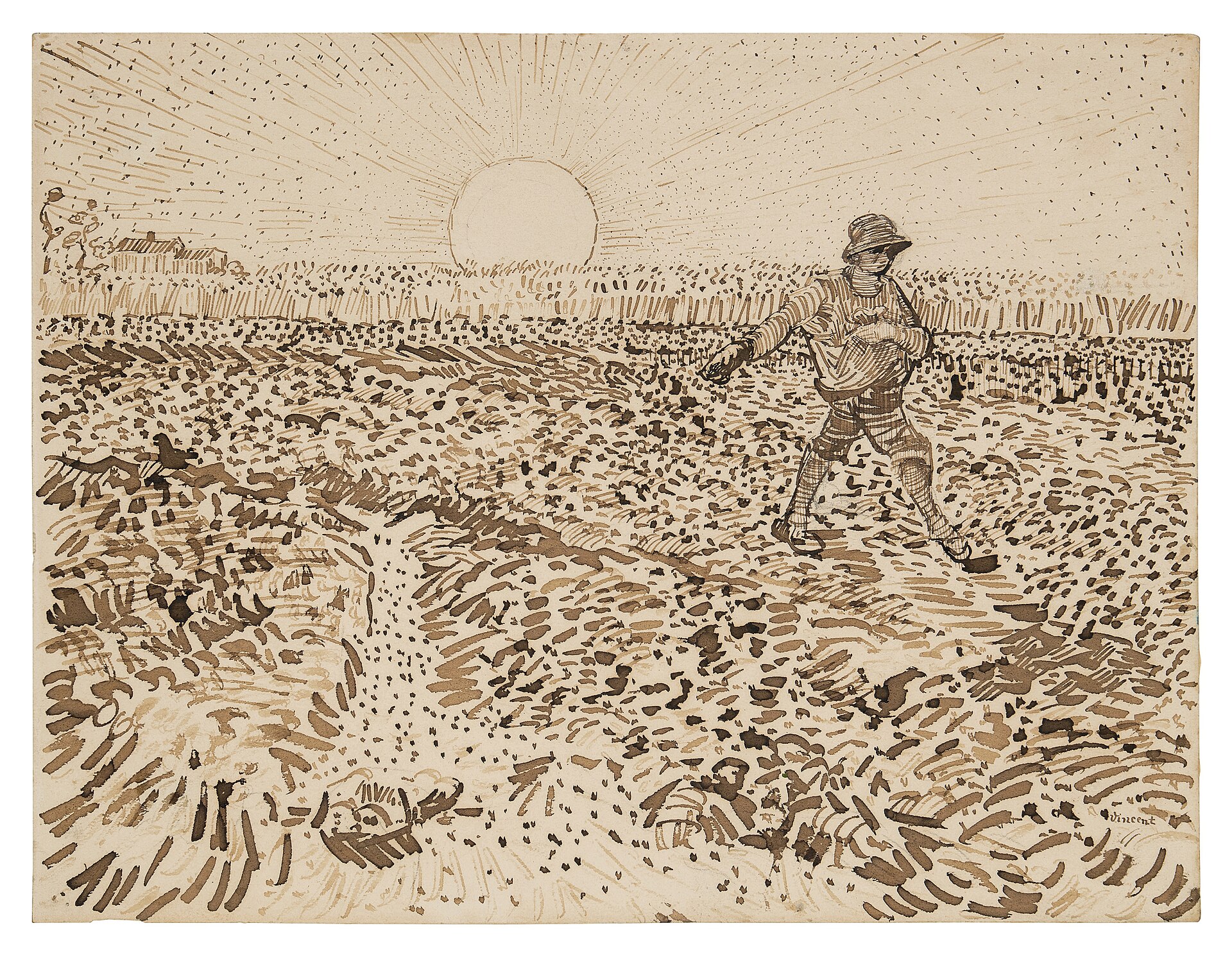
Sower with Setting Sun. Vincent van Gogh, mid July 1888. Sotheby's, New York, 18 November 2025, lot 4. Public domain.