
Psalm 58
11 verses · Imprecatory psalm
Do you indeed speak justly, O rulers? Do you judge uprightly, O sons of men?
Introduction
David, the Judge of Judges, Book 2: The Elohistic Psalter, Poetry, Psalms Overview.
David wrote this about judges who sold their verdicts in the city gate, where Israel heard its cases in public. When the elders took bribes, an ordinary man had no higher court to appeal to. The psalm is for people who have lost to a rigged court. Listen for the pictures drawn from snakes, lions and running water, and for the blunt curses handed up to God to carry out. It ends by naming the one court that cannot be bought.
Context
- Who
- Ordinary Israelites who had lost a case to a bribe
- What
- An imprecatory psalm against corrupt judges, asking God to break their power and judge the earth.
- Where
- The benched chambers of a city gate, where cases were heard in public
- When
- The monarchy, about 1000 BC by the superscription, which names no event.
- Why
- To hand an unjust verdict to the Judge above every judge.
Historical context
The heading gives the psalm to David and sets it to the tune named in Psalm 57, and the subject is the conduct of judges. Cases were heard at the city gate, where the elders sat in chambers built into the gateway and the whole town could listen, and excavated gate complexes at Dan, Gezer and Beersheba carry those stone benches. When the elders were corrupt there was no appeal above them. The opening line addresses either the human judges who bore God's authority in court or a company of spiritual rulers of the kind Psalm 82 puts on trial, and both readings are ancient. Snake charming in verses 4 and 5 was a working trade across Egypt and the Levant. Israel had no police force and no higher court, so handing the sentence upward was the lawful alternative to taking a knife to the man yourself.
Significance
To a farmer who had lost his field to a bribed elder, the psalm said that God judges the judges, and that there is a reward for the righteous after the case is over.
This chapter in Jewish lifeWhat this chapter is in Jewish life and reading.
How it is read
This is one of the psalms that ask God to break the teeth of the wicked, and this site carries the Christian question about such psalms at /featured/the-imprecatory-psalms. Rashi sets the psalm at a particular night, when David took Saul's spear and water jug from the camp and then called out to Abner from a distance, at Rashi on Psalms 58:2:2, and he reads the opening question as David asking the king's officers why they never spoke the plain truth about him. He reads the estranged wicked of the fourth line back to the womb, citing Esau:
The wicked become estranged [even] from the womb From their mother’s womb they become strange to the Holy One, blessed be He, in the way that Esau did (Gen. 25:22): “And the children moved violently against each other in her womb.” (Rashi on Psalms 58:4:1)
The image a Christian reader will not have met is the one Rashi gives for the deaf cobra:
like a deaf cobra that closes its ear When the snake ages, it becomes deaf in one ear, and closes the other ear with dust so that it should not hear the incantation of the charmer, adjuring it not to cause injury. (Rashi on Psalms 58:5:2)
He reads the arrows of the eighth line as God's own, at Rashi on Psalms 58:8:2, and the end of the psalm as the moment people conclude that the righteous were paid after all, at Rashi on Psalms 58:12:1. Ibn Ezra stands on this chapter at Ibn Ezra on Psalms 58:7:1 and 58:11:1 and Radak at Radak on Psalms 58:1:1 and 58:11:1, and Sefaria holds no English version of those references, so this card cites them without quotation.
What the rabbis say
The corpus records 40 places where the rabbinic literature takes up a line of this psalm, 32 of them in the Midrash. Bereshit Rabbah takes it up at Bereshit Rabbah 63:6, 68:4 and 51:1, Midrash Sekhel Tov at Midrash Sekhel Tov, Bereshit 25:34:10, Shemot 4:3:2 and Bereshit 49:27:54 and Midrash Tanchuma Buber at Midrash Tanchuma Buber, Ki Teitzei 4:1, Vayera 17:1 and Matot 6:1. The Midrash on the Psalms treats it at Midrash Tehillim 58:1. The Talmud takes up lines of the psalm at Chullin 89a:10, Jerusalem Talmud Berakhot 1:6:10, Jerusalem Talmud Yoma 8:4:2, Jerusalem Talmud Avodah Zarah 1:1:4, Introductions to Amoraic Literature, Part II (Notes and Interpretations for Chapters of the Talmud), Pesachim, Chapter I 17, Jerusalem Talmud Moed Katan 1:4:2, Moed Katan 6b:14 and Avot DeRabbi Natan 29:2.
Sources: Rashi, Rashi on Psalms, in The Judaica Press complete Tanach with Rashi, translated by A. J. Rosenberg, under a CC-BY licence; Ibn Ezra, Ibn Ezra on Psalms, cited at Ibn Ezra on Psalms 58:7:1 and 58:11:1; Radak, Radak on Psalms, cited at Radak on Psalms 58:1:1 and 58:11:1; Midrash Tehillim, the Midrash on the Psalms, cited at Midrash Tehillim 58:1; The Talmud, cited at Chullin 89a:10, Jerusalem Talmud Berakhot 1:6:10, Jerusalem Talmud Yoma 8:4:2, Jerusalem Talmud Avodah Zarah 1:1:4, Introductions to Amoraic Literature, Part II (Notes and Interpretations for Chapters of the Talmud), Pesachim, Chapter I 17, Jerusalem Talmud Moed Katan 1:4:2, Moed Katan 6b:14 and Avot DeRabbi Natan 29:2; MannaFest, the imprecatory psalms, at /featured/the-imprecatory-psalms, 2026; MannaFest, the Sefaria corpus at scripts/data/sources/sefaria/psalms/58.json, fetched 2026-09-19, 2026.
Psalms 58:1-2
Do you indeed speak justly, O rulers?: Verse 1 puts two questions to the men who judge, whether they speak justly and judge uprightly. Verse 2 answers both: in their hearts they devise injustice, and their hands mete out violence. Psalm 82:2 puts the same charge to judges.
Psalms 58:1
“Do ye indeed speak righteousness, O congregation?.... Of the mighty, as in Psa 82:1; the judges of the land, who were many, and therefore called a congregation, as it is necessary they should; for, being many, they are not so easily bribed; and besides, one may see that in a cause which another does not.”
2 more voices on this verseWhat preachers and commentators have said about this verse, in their own words.
Psalms 58:1
“Do ye indeed speak righteousness, O congregation? The enemies of David were a numerous and united band, and because they so unanimously condemned the persecuted one, they were apt to take it for granted that their verdict was a right one. "What everybody says must be true, "is a lying proverb based upon the presumption which comes of large combinations. Have we not all agreed to hound the man to the death, and who dare hint that so many great ones can be mistaken?”
Charles Spurgeon · The Treasury of David, Vol. 3 (1872)Particular Baptist
Psalms 58:1
“O congregation--literally, "Oh, dumb"; the word used is never translated "congregation." "Are ye dumb? ye should speak righteousness," may be the translation.”
Jamieson, Fausset & Brown · Commentary Critical and Explanatory on the Whole Bible (1871)reformed
you mete out violence on the earth: The judges' wrong starts in the heart and passes through their hands. Mete out renders a Hebrew word for weighing, a judge with scales, and Wesley read it as wrong done under a pretence of exact justice. The scale they held was turned.
Psalms 58:2
“Yea, in heart ye work wickedness. Down deep in your very souls ye hold a rehearsal of the injustice ye intend to practise, and when your opportunity arrives, ye wreak vengeance with a gusto; your hearts are in your wicked work, and your hands are therefore ready enough. Those very men who sat as judges, and pretended to so much indignation at the faults imputed to their victim, were in their hearts perpetrating all manner of evil. Ye weigh the violence of your hands in the earth. They were deliberate sinners, cold, calculating villains.”
Charles Spurgeon · The Treasury of David, Vol. 3 (1872)Particular Baptist
3 more voices on this verse
Psalms 58:2
“And what was their wickedness? It follows, " You weigh the violence of your hands in the earth " (or in the land ), "the peace of which you are appointed to be the conservators of." They did all the violence and injury they could, either to enrich or avenge themselves, and they weighed it; that is, 1.”
Matthew Henry · Commentary on the Whole Bible (1707-1721)puritan
Psalms 58:2
“This they did not design; but weigh . . . violence--or give decisions of violence. Weigh is a figure to express the acts of judges. in the earth--publicly.”
Jamieson, Fausset & Brown · Commentary Critical and Explanatory on the Whole Bible (1871)reformed
Psalms 58:2
“Hands - He intimates that they did great wrong under the pretense of justice, and while they seemed exactly to weigh the true proportion between the actions and the recompenses allotted to them, they turned the scale; and pronounced an unjust sentence. Land - Or, in this land, where God is present, and where you have righteous laws to govern you.”
John Wesley · Explanatory Notes upon the Old Testament (1765)evangelical
Psalms 58:3-5
The wicked are estranged from the womb: Verse 3 dates the corruption from the womb and the straying from birth. Verses 4 and 5 turn it into venom and then deafness, a cobra that shuts its ears against the charmer's tune. The charmer's skill meets a shut ear.
Psalms 58:3
“The wicked are estranged from the womb. It is small wonder that some men persecute the righteous seed of the woman, since all of them are of the serpent's brood, and enmity is set between them. No sooner born than alienated from God—what a condition to be found in! Do we so early leave the right track? Do we at the same moment begin to be men and commence to be sinners? They go astray as soon as they be born, speaking lies. Every observer may see how very soon infants act lies.”
Charles Spurgeon · The Treasury of David, Vol. 3 (1872)Particular Baptist
2 more voices on this verse
Psalms 58:3
“Estranged - From God, and from all goodness. Their very natures are corrupt, even from their birth: they are the wicked offspring of sinful parents. Astray - By actual sins, from their childhood, as soon as ever they were capable of the exercise of reason.”
John Wesley · Explanatory Notes upon the Old Testament (1765)evangelical
Psalms 58:3
“No sooner can they speak than they speak to God's dishonour; tongue-sins are some of the first of our actual transgressions. Their poison (that is, their ill-will, and the spite they bore to goodness and all good men, particularly to David) was like the poison of a serpent, innate, venomous, and very mischievous, and that which they can never be cured of.”
Matthew Henry · Commentary on the Whole Bible (1707-1721)puritan
like a cobra that shuts its ears: Their venom is in their words, and the deafness is chosen. Charles Spurgeon held that the poison under a man's tongue harms a nobler nature than a viper can reach. Gregory of Nazianzus applied the stopped ears to anyone who refuses the healing word of wisdom.
Psalms 58:4
“We hide away our sin, cloaking it over in the depth of our soul, like some festering and malignant disease, as if by escaping human notice we could escape the mighty eye of God and justice. Or else we make excuses for our sins by devising pleas in defense of our falls or by tightly closing our ears. Like the snake that stops its ears, we are obstinate in refusing to hear the voice of the charmer and be treated with the medicines of wisdom, by which spiritual sickness is healed.”
Gregory of Nazianzus · written before 390 · In Defense of His Flight to Pontus, Oration 2:20patristic
1 more voice on this verse
Psalms 58:4
“Their poison is like the poison of a serpent. Is man also a poisonous reptile? Yes, and his venom is even as that of a serpent. The viper has but death for the body in his fangs; but unregenerate man carries poison under his tongue, destructive to the nobler nature. They are like the deaf adder that stoppeth her ear.”
Charles Spurgeon · The Treasury of David, Vol. 3 (1872)Particular Baptist
the charmer who skillfully weaves his spell: The charmer is skilled and still fails, because the fault lies in the ear. Charles Spurgeon applied the verse to preachers, holding no argument or appeal wins such men and only the power of God can open the ear. Verse 6 turns from the ear to the teeth.
Psalms 58:5
“Which will not hearken to the voice of charmers, charming never so wisely. Ungodly men are not to be won to right by arguments the most logical, or appeals the most pathetic. Try all your arts, ye preachers of the word! Lay yourselves out to meet the prejudices and tastes of sinners, and ye shall yet have to cry, "Who hath believed our report?" It is not in your music, but in the sinner's ear that the cause of failure lies, and it is only the power of God that can remove it.”
Charles Spurgeon · The Treasury of David, Vol. 3 (1872)Particular Baptist
Psalms 58:6-8
O God, shatter their teeth in their mouths: Verse 6 disarms the mouth, the teeth shattered and the fangs pulled, which is where verses 4 and 5 put the venom. Verse 7 asks for the bow to fail as well. The two pictures of verse 8 both ask that these men never come to anything.
Psalms 58:6
“Break their teeth, O God, in their mouth. If they have no capacity for good, at least deprive them of their ability for evil. Treat them as the snake charmers do their serpents, extract their fangs, break their teeth. The Lord can do this, and he will. He will not suffer the malice of the wicked to triumph, he will deal them such a blow as shall disable them from mischief. Break out the great teeth of the young lions, O Lord.”
Charles Spurgeon · The Treasury of David, Vol. 3 (1872)Particular Baptist
May they vanish like water that runs off: Water poured on dry ground runs off and is gone. Matthew Henry set the verse beside the floods of Psalm 18:4 and Psalm 124, the proud waters that threaten to go over a man. Faith sees what they will be, he wrote, and stops fearing what they are.
Psalms 58:7
“The term for preparing a bow applied to arrows (Ps 64:3). let them . . . pieces--literally, "as if they cut themselves off"--that is, become blunted and of no avail. Other figures of this utter ruin; the last denoting rapidity.”
Jamieson, Fausset & Brown · Commentary Critical and Explanatory on the Whole Bible (1871)reformed
1 more voice on this verse
Psalms 58:7
“Such shall the floods of ungodly men be, which sometimes make us afraid ( Ps. xviii. 4 ); so shall the proud waters be reduced, which threaten to go over our soul, Ps. cxxiv. Let us by faith then see what they shall be and then we shall not fear what they are.”
Matthew Henry · Commentary on the Whole Bible (1707-1721)puritan
Like a slug that dissolves in its slime: The creature melts as it moves. John Gill notes its Hebrew name comes from the wet path it leaves, which the Targum marks, until its moisture is spent and it dies. Charles Spurgeon read the picture as men wearing out their own strength as they go.
Psalms 58:8
“As a snail which melteth, let every one of them pass away. As the snail makes its own way by its slime, and so dissolves as it goes, or as its shell is often found empty, as though the inhabitant had melted away, so shall the malicious eat out their own strength while they proceed upon their malevolent designs, and shall themselves disappear. To destroy himself by envy and chagrin is the portion of the ill disposed. Like the untimely birth of a woman, that they may not see the sun.”
Charles Spurgeon · The Treasury of David, Vol. 3 (1872)Particular Baptist
2 more voices on this verse
Psalms 58:8
“As a snail which melteth, let everyone of them pass away,.... As a snail when it comes out of its shell liquefies, drops its moisture, and with it makes a "path", from whence it has its name שבלול, in the Hebrew language; and so the Targum here, "as the snail moistens its way;'' which moistness it gradually exhausts, and melts away, and dies: so the psalmist prays that everyone of his enemies might die in like manner.”
Psalms 58:8
“We may, in faith, pray against the designs of the church's enemies, as the prophet does ( Hos. ix. 14 , Give them, O Lord! what wilt thou give them? Give them a miscarrying womb and dry breasts ), which explains this prayer of the psalmist.”
Matthew Henry · Commentary on the Whole Bible (1707-1721)puritan
Psalms 58:9-11
Before your pots can feel the burning thorns—: Verse 9 sets the judgment before the pot has even felt the thorns under it. Verse 10 has the righteous rejoicing, their feet washed in the blood of the wicked, the same picture as Psalm 68:23. Verse 11 answers verse 1: God judges the earth.
Psalms 58:9
“Before your pots can feel the thorns. So sudden is the overthrow of the wicked, so great a failure is their life, that they never see joy. Their pot is put upon the hook to prepare a feast of joy, and the fuel is placed beneath, but before the thorns are lit, before any heat can be brought to bear upon the pot, yea, even as soon as the fuel has touched the cooking vessel, a storm comes and sweeps all away; the pot is overturned, the fuel is scattered far and wide.”
Charles Spurgeon · The Treasury of David, Vol. 3 (1872)Particular Baptist
1 more voice on this verse
Psalms 58:9
“Before your pots can feel the thorns,.... Which is soon done; for as dry thorns make a great blaze, so they give a quick heat; the pots soon feel them, or the water in them soon receives heat from them. From imprecations the psalmist proceeds to prophesy, and foretells the sudden destruction of wicked men, which would be before a pot could be heated with a blaze of thorns.”
they will wash their feet in the blood of the wicked: The picture is a battlefield after a great slaughter. Matthew Henry set it beside Psalm 68:23 and compared the relief of the saints to a weary traveller having his feet washed. Charles Spurgeon held that the righteous take no hand in the vengeance and rejoice to see justice done.
Psalms 58:10
“He shall wash his feet in the blood of the wicked; that is, there shall be abundance of bloodshed ( Ps. lxviii. 23 ), and it shall be as great a refreshment to the saints to see God glorified in the ruin of sinners as it is to a weary traveller to have his feet washed.”
Matthew Henry · Commentary on the Whole Bible (1707-1721)puritan
2 more voices on this verse
Psalms 58:10
“The righteous shall rejoice when he seeth the vengeance. He will have no hand in meting out, neither will he rejoice in the spirit of revenge, but his righteous soul shall acquiesce in the judgments of God, and he shall rejoice to see justice triumphant. There is nothing in Scripture of that sympathy with God's enemies which modern traitors are so fond of parading as the finest species of benevolence. We shall at the last say, "Amen, "to the condemnation of the wicked, and feel no disposition to question the ways of God with the impenitent.”
Charles Spurgeon · The Treasury of David, Vol. 3 (1872)Particular Baptist
Psalms 58:10
“Rejoice - For the blessed effects of it; the vindication of God's honour, and the deliverance of himself and of all good men. Wash - There shall be so great a slaughter of his enemies that he might, if he pleased, wash his feet in their blood.”
John Wesley · Explanatory Notes upon the Old Testament (1765)evangelical
The last word goes to God as judge. The psalm opened on judges who judged unjustly, and Charles Spurgeon held that every man, however ignorant, will be made to say this line. Hippolytus of Rome drew from it that God oversees all that is done among men.
Psalms 58:11
“But since there is a time when the righteous shall rejoice, and sinners shall meet the end foretold for them, we must with all reason fully acknowledge and declare that God is inspector and overseer of all that is done among men, and judges all who dwell upon earth. It is proper further to inquire whether the prophecy in hand, which quite corresponds and fits in with those preceding it, may describe the end.”
Hippolytus of Rome · written before 235 · Fragments from Commentaries on Various Books of Scripture - On Psalm LVIII. 11patristic
2 more voices on this verse
Psalms 58:11
“So that a man shall say. Every man however ignorant shall be compelled to say, Verily, in very deed, assuredly, there is a reward for the righteous. If nothing else be true this is. The godly are not after all forsaken and given over to their enemies; the wicked are not to have the best of it, truth and goodness are recompensed in the long run. Verily he is a God that judgeth in the earth.”
Charles Spurgeon · The Treasury of David, Vol. 3 (1872)Particular Baptist
Psalms 58:11
“He is a God (so we read it), not a weak man, not an angel, not a mere name, not (as the atheists suggest) a creature of men's fear and fancy, not a deified hero, not the sun and moon, as idolaters imagined, but a God, a self-existent perfect Being; he it is that judges the earth; his favour therefore let us seek, from whom every man's judgment proceeds, and to him let all judgment be referred.”
Matthew Henry · Commentary on the Whole Bible (1707-1721)puritan
How this psalm is built
The form: An imprecatory psalm in the form of a court case brought against the court, as Barnes classes it.
The patterns in this chapter
| Device | What it does | Where to see it |
|---|---|---|
| The two questions and their answer | Verse 1 asks the rulers whether they speak justly and whether they judge uprightly. Verse 2 answers both charges at once, that they devise injustice in the heart and mete out violence with the hands. The site's exposition note records that Psalm 82:2 puts the same charge to judges in the same form.Albert Barnes, Notes, Explanatory and Practical, on the Old and New Testaments, 1832 to 1869, on Psalm 58:1. | Psalm 58:1, Psalm 58:2 |
| The venom and the shut ear | Verses 4 and 5 turn one picture twice. The men have the venom of a snake, and then they are a cobra that stops its ears against the charmer however skilful the tune. The poison and the deafness belong to the same animal, so the psalm says both what they do and why nothing reaches them.Charles Spurgeon, The Treasury of David, Vol. 2, 1870, on Psalm 58:4. | Psalm 58:4, Psalm 58:5 |
| The catalogue of undoing | Verses 6 to 8 ask for six things in order: teeth shattered, fangs torn out, water that runs off, arrows blunted, a slug that dissolves, and a stillborn child that never sees the sun. The site's exposition note reads verse 6 as disarming the mouth where verses 4 and 5 put the venom, and verse 7 as taking the bow as well.John Gill, Exposition of the Old Testament, 1748 to 1763, on Psalm 58:6. | Psalm 58:6, Psalm 58:7, Psalm 58:8 |
| The question answered at the close | The psalm opens by asking whether the rulers judge uprightly and closes at verse 11 with men saying that there is surely a God who judges the earth. The last line answers the first, and the judging is moved from the gate to God.Matthew Henry, Commentary on the Whole Bible, 1710, on Psalm 58:11. | Psalm 58:1, Psalm 58:11 |
The psalm's pattern is the removal of a capacity rather than of a life. Teeth, fangs, arrows and a future are each asked for in turn, and the men themselves are left to God.
9 more paragraphs on the patterns
The debate
Who is addressed in verse 1 is the psalm's open question, and both answers are ancient. One reading takes the word for the human judges who bore God's authority in court, which is how Barnes and Gill read it, and the charges that follow are courtroom charges. The other reading takes it of a company of spiritual rulers of the kind Psalm 82 puts on trial, and reads the psalm as addressed above the human bench. The Hebrew is genuinely hard, the charges work under either reading, and the site names both rather than deciding.
The second debate is what a Christian does with verses 6 to 8. The church has answered in three ways. The curses are read as prophecy rather than petition, or as the lawful alternative to private revenge in a society with no police and no higher court. The third reading takes them as prayers for the end of evil rather than for the ruin of persons. The psalm itself supplies the ground for the second, since the sentence is handed upward at every point and the righteous in verse 10 do nothing but see.
Where it points
The site's exposition notes record two places. The charge of verse 1 and 2 stands again at Psalm 82:2, where judges are asked the same question. The picture at verse 10 of feet washed in blood stands at Psalm 68:23.
Where it stands
It belongs with Psalms 35, 69, 109 and 137, the psalms the church has grouped as imprecatory, and with Psalm 82, which puts the same charge to the same kind of defendant.
The imprecatory pattern
The psalm moves from a charge to a sentence asked of God to a verdict other people will see. Verses 1 and 2 put the charge to the judges, verses 3 to 5 describe them, and verses 6 to 9 ask God to break their power in a run of pictures. Verses 10 and 11 give the result, that men will say there is a God who judges the earth. The man praying hands the sentence to God and keeps his own hand out of it. Charles Spurgeon holds that the righteous man will have no hand in meting out the vengeance and will rejoice to see justice done (The Treasury of David, Vol. 3, 1872, on Psalm 58:10).
Keep studying
Sources for this chapter
The summary
Jamieson, Fausset & Brown, Commentary Critical and Explanatory; John Calvin, Commentaries; John Wesley, Notes on the Old Testament and Matthew Henry, Complete Commentary.
The form and classifications
Albert Barnes, Notes, Explanatory and Practical, on the Old and New Testaments, 1832 to 1869, on Psalm 58:1 and John Gill, Exposition of the Old Testament, 1748 to 1763, on Psalm 58:1.
The exposition
Albert Barnes, Notes on the Book of Psalms; Charles Spurgeon, The Treasury of David; Franz Delitzsch, Biblical Commentary on the Psalms; Gregory of Nazianzus, In Defense of His Flight to Pontus, Oration 2; Hippolytus of Rome, Fragments from Commentaries, On Psalm 58; Jamieson, Fausset and Brown, Commentary Critical and Explanatory on the Whole Bible; John Gill, Exposition of the Old Testament; John Wesley, Explanatory Notes upon the Old Testament and Matthew Henry, Commentary on the Whole Bible.
The painting
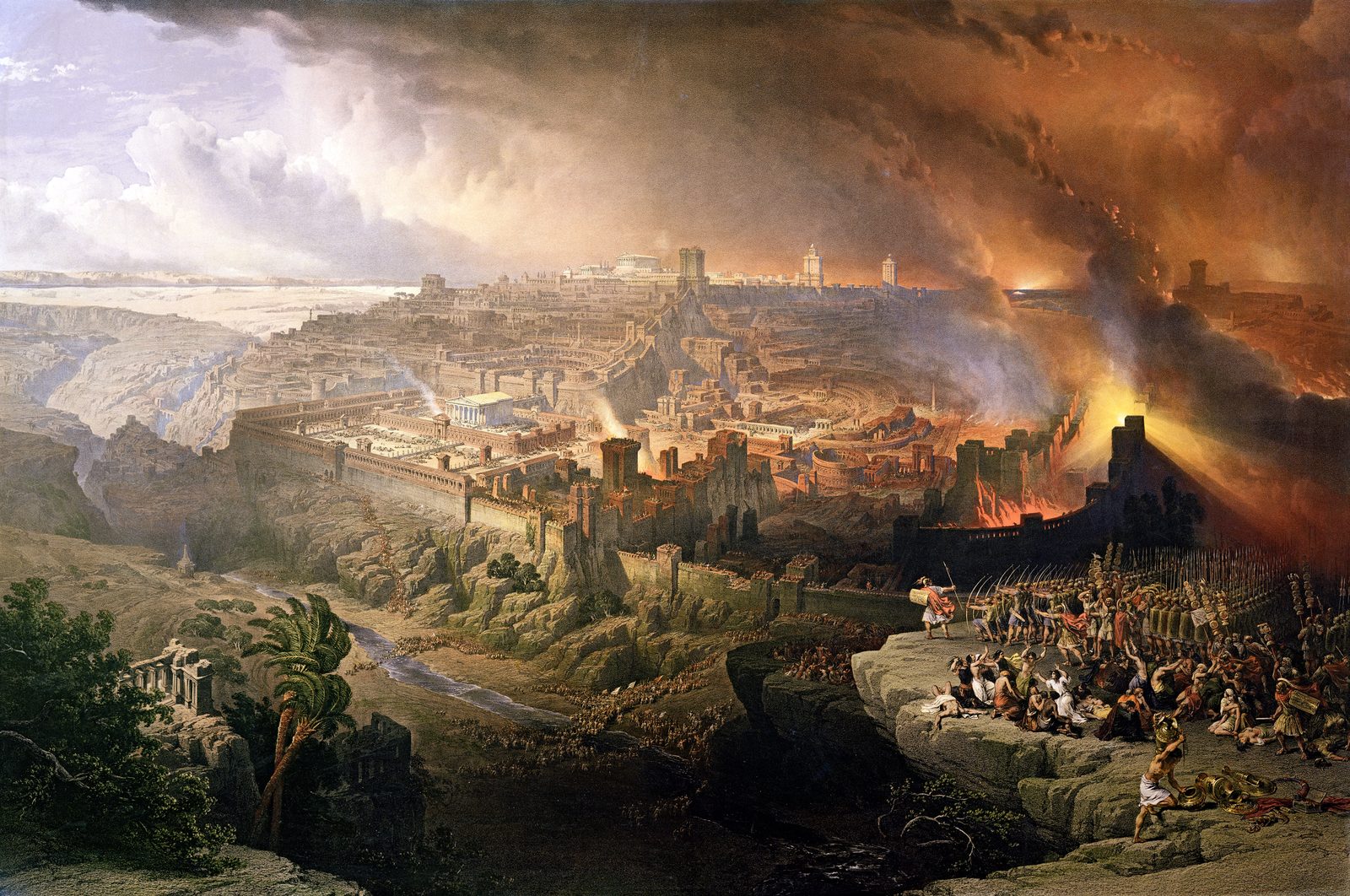
The Siege and Destruction of Jerusalem by the Romans Under the Command of Titus, A.D. 70. David Roberts, 1850. Wikimedia Commons. Public domain.