
Psalm 48
14 verses · Hymn of praise
Beautiful in loftiness, the joy of all the earth, like the peaks of Zaphon is Mount Zion, the city of the great King.
Introduction
The sons of Korah, the Song of Zion, Book 2: The Elohistic Psalter, Poetry, Psalms Overview.
The sons of Korah wrote this after an alliance of kings came against Jerusalem and withdrew. It closes a run of three psalms, beginning at Psalm 46, that celebrate God's presence in the city. The singers had grown up on stories of what God did for their fathers, and now they had seen something like it for themselves. Listen for the moment the enemy kings see the city and flee, and for the walk around the walls at the end. The psalm asks each generation to count what it has seen and tell the next.
Context
- Who
- Israelites inspecting the city they had just watched survive
- What
- A song of Zion praising God for the city He defended when enemy kings came against it.
- Where
- Jerusalem, walked and counted by its own citizens after an attack
- When
- The monarchy, after an attack on Jerusalem, with the date unstated.
- Why
- To have a generation that saw a deliverance tell it to the next one.
Historical context
The heading gives the psalm to the sons of Korah, and it closes the run of Korahite songs that begins at Psalm 46. It describes a coalition of kings arriving at the city, looking at it, and leaving, and it keeps the event undated. The old city sat on a ridge with deep valleys on two sides, so an attacking force had one practical approach to it. Sieges were expensive, and a hard target was often abandoned. The ships of Tarshish in verse 7 were the largest deep-water merchant vessels that world knew, and the east wind that wrecks them is the sirocco off the desert. Counting towers and checking ramparts was ordinary work after an attack, and the psalm turns that inspection into a teaching route for fathers and children.
Significance
As we have heard, so we have seen is the hinge of the psalm. The generation singing it had the old stories at second hand and had now watched one happen in front of them. A man who had walked the walls with his children had something to hand them that a story alone would not carry.
This chapter in Jewish lifeWhat this chapter is in Jewish life and reading.
How it is read
The corpus carries four commentators in English on this chapter, which makes it the fullest in the range. Malbim sets the psalm at a particular storm:
This psalm is founded on the great storm that occurred at that time which shattered mountains and broke rocks. (Malbim on Psalms 48:1:1)
Rashi reads the assembled kings of the fifth line as the war of Gog and Magog:
the kings have assembled to wage war against it in the wars of Gog and Magog. (Rashi on Psalms 48:5:1)
He explains the joy of the whole earth by the north side of the altar, where the sin offering and the guilt offering were killed and the man who brought one went away forgiven, at Rashi on Psalms 48:3:2. Radak reads the city's palaces against the palaces of every other city:
God is in its palaces – The palaces of other cities are strongly built and elevated to take shelter in. (Radak on Psalms 48:4:1)
The strength of Jerusalem's palaces, he goes on, is that God is known in them and is himself a stronghold to all who shelter in him, at Radak on Psalms 48:4:1.
Metzudat David reads the greatness of the second line as a greatness that begins when God settles his presence in Jerusalem, at Metzudat David on Psalms 48:2:1, and Rashi reads it as a thing still to come, at Rashi on Psalms 48:2:1. A Christian reader meets this psalm as a song about the city of God. The Jewish reading holds it to the city on the ground and to a deliverance still ahead of it. Ibn Ezra stands at Ibn Ezra on Psalms 48:1:1, 48:7:1 and 48:9:1 and Radak also at Radak on Psalms 48:7:1. Sefaria holds no English version of those references, so this card cites them without quotation.
What the rabbis say
The corpus records 40 places where the rabbinic literature takes up a line of this psalm, 36 of them in the Midrash. Rashi carries one of the odder ones at Rashi on Psalms 48:3:1, where a second reading of the psalm's word for a fair branch takes it as a bride, on the ground that the coastal cities used a Greek word for one, and he cites the tractate Rosh Hashanah for it. The Midrash on the Psalms treats the psalm at Midrash Tehillim 48:1, 48:3, 48:4 and 48:5, Midrash Sekhel Tov at Midrash Sekhel Tov, Shemot 15:15:1, Shemot 15:14:2, Shemot 15:15:4, Bereshit 41:6:2 and Bereshit 34:10:3 and Bereshit Rabbah at Bereshit Rabbah 87:5, 93:2, 43:2 and 48:11. The Talmud takes up lines of the psalm at Avot DeRabbi Natan 1:8, Jerusalem Talmud Maaser Sheni 1:1:21, Eruvin 54a:15 and Jerusalem Talmud Megillah 2:4:5.
Sources: Rashi, Rashi on Psalms, in The Judaica Press complete Tanach with Rashi, translated by A. J. Rosenberg, under a CC-BY licence; Malbim, Malbim on Psalms 48:1:1, quoted under the licence the corpus records for it; Radak, Radak on Psalms 48:4:1, quoted under the licence the corpus records for it; Metzudat David, Metzudat David on Psalms 48:2:1, quoted under the licence the corpus records for it; Ibn Ezra, Ibn Ezra on Psalms, cited at Ibn Ezra on Psalms 48:1:1, 48:7:1 and 48:9:1; Midrash Tehillim, the Midrash on the Psalms, cited at Midrash Tehillim 48:1, 48:3, 48:4 and 48:5; The Talmud, cited at Avot DeRabbi Natan 1:8, Jerusalem Talmud Maaser Sheni 1:1:21, Eruvin 54a:15 and Jerusalem Talmud Megillah 2:4:5; MannaFest, the Sefaria corpus at scripts/data/sources/sefaria/psalms/48.json, fetched 2026-09-19, 2026.
Psalms 48:1-3
Great is the LORD: , and the praise belongs to the city where He dwells, His holy mountain. Mount Zion is the city of the great King, the joy of all the earth. God is in her citadels, shown to be a fortress.
Psalms 48:1
“He is everywhere great and powerful, but our narrow mind cannot take in the greatness of his divine power and grace. The closer our knowledge gets to God, the more wonderful his majesty appears to be.”
Ambrose of Milan · written before 397 · Commentaries on the Twelve Davidic Psalms, On Psalm 48patristic
2 more voices on this verseWhat preachers and commentators have said about this verse, in their own words.
Psalms 48:1
“His wonderful goodness and righteousness shine forth in the government of the whole world, so that there is no part of it void of his praise, but we are everywhere furnished with abundant matter for praising him. Here, however, the inspired poet celebrates the glory of God which is manifested in the protection of the Church.”
John Calvin · Commentaries (1554)reformed
Psalms 48:1
“Great is the Lord. How great Jehovah is essentially none can conceive; but we can all see that he is great in the deliverance of his people, great in their esteem who are delivered, and great in the hearts of those enemies whom he scatters by their own fears. Instead of the mad cry of Ephesus, "Great is Diana, "we bear the reasonable, demonstrable, self evident testimony, "Great is Jehovah." There is none great in the church but the Lord.”
Charles Spurgeon · The Treasury of David, Vol. 2 (1870)Particular Baptist
the city of the great King: Jesus quoted the city of the great King at Matthew 5:35, where swearing by Jerusalem is swearing by God, as Henry noted. Barnes gave the Hebrew behind loftiness as height, the mountain rising in the sight of the kings. Clarke took all the earth as the whole land.
Psalms 48:2
“The joy - This is spoken prophetically, because the joyful doctrine of the gospel was to go from thence to all nations. The city - Of God, who justly calls himself a great king.”
John Wesley · Explanatory Notes upon the Old Testament (1765)evangelical
2 more voices on this verse
Psalms 48:2
“Truly the Lord is called great. For consider, he has poured exaltation and joy over all the orb of this earth where previously the land produced the most dreadful growth of sin; he has made joyful the earth that once abounded in sorrow, tears and groans. Now our conscience is set free from sin and can rejoice. Before this it was unhappy, it was drowned in the whirlpool of its own sin; but now, through the goodness and kindness of Christ, it is absolved from all error.”
Ambrose of Milan · written before 397 · Commentaries on the Twelve Davidic Psalms, On Psalm 48patristic
Psalms 48:2
“The situation must needs be every way agreeable, when Infinite Wisdom chose it for the place of the sanctuary; and that which made it beautiful was that it was the mountain of holiness, for there is a beauty in holiness.”
Matthew Henry · Commentary on the Whole Bible (1707-1721)puritan
God is in her citadels: Barnes traced citadels to a verb for lifting up. Wesley held that God, known there by long experience, guarded the king's palace and the temple, and so the whole city. Clarke tied the fortress to the kings who fled in the verses after it.
Psalms 48:3
“God is known in her palaces for a refuge. We worship no unknown God. We know him as our refuge in distress, we delight in him as such, and run to him in every time of need. We know nothing else as our refuge. Though we are made kings, and our houses are palaces, yet we have no confidence in ourselves, but trust in the Lord Protector, whose well known power is our bulwark.”
Charles Spurgeon · The Treasury of David, Vol. 2 (1870)Particular Baptist
1 more voice on this verse
Psalms 48:3
“Known - By long experience. Palaces - Possibly he may point at the king's palace and the temple, which was the palace of the king of heaven; which two palaces God did in a singular manner protect, and by protecting them, protected the whole city and people.”
John Wesley · Explanatory Notes upon the Old Testament (1765)evangelical
Psalms 48:4-6
For behold, the kings assembled: names a deliverance the psalm never dates or locates. They saw the city, were astounded, and fled in terror. What took hold of them there was anguish like a woman in labor.
Psalms 48:4
“The kings were assembled, they passed by together. They came and they went. No sooner together than scattered. They came one way and fled twenty ways. Boastful the gathering hosts with their royal leaders, despairing the fugitive bands with their astonished captains. They came like foam on the angry sea, like foam they melted away. This was so remarkable that the psalmist puts in a note of exclamation, Lo! What! have they so suddenly fled! Even thus shall the haters of the church vanish from the field.”
Charles Spurgeon · The Treasury of David, Vol. 2 (1870)Particular Baptist
2 more voices on this verse
Psalms 48:4
“The kings - Either those kings confederate against Jehoshaphat, 2 Chron. xx, 1, or the Assyrian princes; whom they vain- gloriously called kings, Isaiah x, 8.”
John Wesley · Explanatory Notes upon the Old Testament (1765)evangelical
Psalms 48:4
“For--The reason is given. Though the kings (perhaps of Moab and Ammon, compare Ps 83:3-5) combined, a conviction of God's presence with His people, evinced by the unusual courage with which the prophets (compare 2Ch 20:12-20) had inspired them, seized on their minds, and smitten with sudden and intense alarm, they fled astonished.”
Jamieson, Fausset & Brown · Commentary Critical and Explanatory on the Whole Bible (1871)reformed
They saw and were astounded: What the kings saw is read three ways. Gill cites Aben Ezra for the city or the power of God, and Jarchi for God Himself going out to fight. Henry held that the sight of Jerusalem recalled what they had heard of God's presence there.
Psalms 48:5
“They saw it, and so they marvelled. They came, they saw, but they did not conquer. There was no veni, vidi, vici for them. No sooner did they perceive that the Lord was in the Holy City, than they took to their heels. Before the Lord came to blows with them, they were faint hearted, and beat a retreat. They were troubled and hasted away. The troublers were troubled. Their haste in coming was nothing to their hurry in going. Panic seized them, horses were not fleet enough; they would have borrowed the wings of the wind.”
Charles Spurgeon · The Treasury of David, Vol. 2 (1870)Particular Baptist
1 more voice on this verse
Psalms 48:5
“It was well enough fortified indeed both by nature and art; but its bulwarks that were mostly to be relied upon were the special presence of God in it, the beauty of holiness he had put upon it, and the promises he had made concerning it.”
Matthew Henry · Commentary on the Whole Bible (1707-1721)puritan
anguish like a woman in labor: Spurgeon fixed on there, the city where the kings who assembled in verse 4 hoped to triumph. Henry set the woman in labor beside 1 Thessalonians 5:3, her anguish sudden and sure, and held God can put terror into His strongest foes. Barnes found the figure in Jeremiah.
Psalms 48:6
“Fear took hold upon them there. They were in Giant Despair's grip. Where they hoped to triumph, there they quivered with dismay. They did not take the city, but fear took hold on them. And pain, as of a woman in travail. They were as much overcome as a woman whose fright causes premature delivery; or, as full of pain as a poor mother in her pangs—a strong expression, commonly employed by Orientals to set forth the extremity of anguish.”
Charles Spurgeon · The Treasury of David, Vol. 2 (1870)Particular Baptist
1 more voice on this verse
Psalms 48:6
“Note, God can dispirit the stoutest of his church's enemies, and soon put those in pain that live at ease. The fright they were in upon the sight of Jerusalem is here compared to the throes of a woman in travail, which are sharp and grievous, which sometimes come suddenly ( 1 Thess. v. 3 ), which cannot be avoided, and which are effects of sin and the curse.”
Matthew Henry · Commentary on the Whole Bible (1707-1721)puritan
Psalms 48:7-8
You wrecked the ships of Tarshish: , and a wind from the east did it. Those were the long-distance trading ships of the age. So we have seen is the answer to what they had heard, and God will establish the city forever.
Psalms 48:7
“Thou breakest the ships of Tarshish with an east wind. As easily as vessels are driven to shipwreck, dost thou overturn the most powerful adversaries; or it may mean the strength of some nations lies in their ships, whose wooden walls are soon broken; but our strength is in our God, and therefore, it fails not; or there may be another meaning, though thou art our defence, yet thou takest vengeance on our inventions, and while thou dost preserve us, yet our ships, our comforts, our earthly ambitions, are taken from us that we may look alone to thee.”
Charles Spurgeon · The Treasury of David, Vol. 2 (1870)Particular Baptist
As we have heard: Spurgeon noted the two names, the LORD of Hosts for power and sovereignty, then the city's God for covenant nearness. Augustine put it as promise heard and performance seen. Henry and Clarke found establish her forever kept in the church after Jerusalem fell.
Psalms 48:8
“As we have heard, so have we seen in the city of the Lord of hosts, in the city of our God. Our father's stories are reproduced before our very eyes. We heard the promise, and we have seen the fulfilment. The records of Zion, wonderful as they are, are proved to be truthful, because present facts are in perfect harmony therewith. Note how the Lord is first spoken of as Lord of hosts, a name of power and sovereignty, and then as our God, a name of covenant relation and condescension.”
Charles Spurgeon · The Treasury of David, Vol. 2 (1870)Particular Baptist
2 more voices on this verse
Psalms 48:8
“Let our hope of the stability and perpetuity of the church be hereby encouraged. "From what we have seen, compared with what we have heard, in the city of our God, we may conclude that God will establish it for ever." This was not fulfilled in Jerusalem (that city was long since destroyed, and all its glory laid in the dust), but has its accomplishment in the gospel church.”
Matthew Henry · Commentary on the Whole Bible (1707-1721)puritan
Psalms 48:8
“Outside the city, we have heard. Inside the city, we have seen. God is the eternal light of this city. The light of day shines there without the sun we know in this world, and of the moon there is no need. The foundation of this city belongs not to time but to eternity.”
Ambrose of Milan · written before 397 · Commentaries on the Twelve Davidic Psalms, On Psalm 48patristic
Psalms 48:9-11
Within Your temple, O God: , the worshippers turn from the deliverance to His loving devotion. His name and His praise reach the ends of the earth, and His right hand is full of righteousness. Zion and the daughters of Judah are glad at His judgments.
Psalms 48:9
“God's true temple is the body of Christ, and in that body lies the purification of all our sins. Truly, that flesh is God's temple, and in it there is no contagion of sin. On the contrary, it was itself the sacrifice that takes away the sin of all the world. That flesh is indeed God's temple, and in it shone God's image.”
Ambrose of Milan · written before 397 · Commentaries on the Twelve Davidic Psalms, On Psalm 48patristic
3 more voices on this verse
Psalms 48:9
WHO were these people who declared to the Lord that they had thought of His loving kindness in the midst of His Temple? According to the title of the Psalm, they were the sons of Korah. And who were the sons of Korah? They were the singers in the house of the Lord, those who took the principal part in sounding forth the praises of Jehovah. I think it is suggestive that they did not say, "We have sung of Your loving kindness." They had done that and it was their constant employment, but they said, "We have thought."
Charles Spurgeon · written before 1892 · The Metropolitan Tabernacle Pulpit, Sermon No. 2783: “A Worthy Theme for Thought” (lightly modernized text, CCEL edition)Particular Baptist
Psalms 48:9
“We have thought of thy lovingkindness, O God,.... Jarchi interprets it, "we have waited for thy lovingkindness"; to see thy salvation; and some, as Ben Melech observes, explain it of hope and expectation; as if the sense was, "we have hoped for thy lovingkindness"; so the Syriac version renders it, and the word used has the signification of tarrying, 1Sa 14:9. God has his set time to favour his Zion, and till that time comes it is right in them to be hoping, expecting, and waiting for it.”
Psalms 48:9
“All the streams of mercy that flow down to us must be traced up to the fountain of God's lovingkindness. It is not owing to any merit of ours, but purely to his mercy, and the peculiar favour he bears to his people.”
Matthew Henry · Commentary on the Whole Bible (1707-1721)puritan
Your name, O God: Barnes and Clarke read the likeness as reach, so that wherever His name is known on the earth it is praised. Henry tied the name to the deliverance of the city, seen by the nations around. Chrysostom took the right hand full of righteousness to mean abundance.
Psalms 48:10
“According to thy name, O God, so is thy praise unto the ends of the earth. Great fame is due to his great name. The glory of Jehovah's exploits overleaps the boundaries of earth; angels behold with wonder, and from every star delighted intelligences proclaim his fame beyond the ends of the earth. What if men are silent, yet the woods, and seas, and mountains, with all their countless tribes, and all the unseen spirits that walk them, are full of the divine praise.”
Charles Spurgeon · The Treasury of David, Vol. 2 (1870)Particular Baptist
1 more voice on this verse
Psalms 48:10
“So - Thou art acknowledged to be such an one as thou hast affirmed thyself to be in thy Word, God Almighty, or All- sufficient, the Lord of hosts, and a strong tower to all that trust in thee. Righteousness - Of righteous actions; by which thou discoverest thy holiness.”
John Wesley · Explanatory Notes upon the Old Testament (1765)evangelical
the daughters of Judah rejoice: Barnes gave two readings of the daughters of Judah, the smaller towns around the mother city or the women of Judah. Spurgeon held both, the towns joining Zion's song and the women, who suffer most in war, glad that the spoilers fled. Augustine read the judgments as a winnowing.
Psalms 48:11
“Let mount Zion rejoice. As the first of the cities of Judah, and the main object of the enemies' attack, let her lead the song. Let the daughters of Judah be glad, let the smaller towns join the chorus, for they join in the common victory. Let the women, who fare worst in the havoc of war, be among the gladdest of the glad, now that the spoilers have fled. All the church, and each individual member, should rejoice in the Lord, and magnify his name. Because of thy judgments.”
Charles Spurgeon · The Treasury of David, Vol. 2 (1870)Particular Baptist
Psalms 48:12-14
March around Zion, encircle her: March around Zion and count her towers and ramparts. The circuit is ordered so that you may tell the next generation, and verse 13 adds her citadels. Even till death He will be our guide, and this God is our God forever.
Psalms 48:12
“Walk about Zion; often beat her bounds, even as Israel marched around Jericho. With leisurely and careful inspection survey her. And go round about her. Encircle her again and again with loving perambulations. We cannot too frequently or too deeply consider the origin, privileges, history, security, and glory of the church. Some subjects deserve but a passing thought; this is worthy of the most patient consideration. Tell the towers thereof. See if any of them have crumbled, or have been demolished. Is the church of God what she was in doctrine, in strength and in beauty?”
Charles Spurgeon · The Treasury of David, Vol. 2 (1870)Particular Baptist
3 more voices on this verse
Psalms 48:12
“Those who have wisely surrounded Zion and embraced it spiritually climb up onto its towers. There they tell of it to those not able to ascend its turrets.… Always the insidious foe has his eye on it, to see if he can approach and capture it. For Satan has his armies, and with them he lays siege to souls. He has siege engines that he moves up close to the walls so as to take its towers by force. But you, says the psalm, must preach from the towers.… Preach, proclaim, without intermission, without end.”
Ambrose of Milan · written before 397 · Commentaries on the Twelve Davidic Psalms, On Psalm 48patristic
Psalms 48:12
“Some think this refers to the ceremony of the triumph; let those who are employed in that solemnity walk round the walls (as they did, Neh. xii. 31 ), singing and praising God.”
Matthew Henry · Commentary on the Whole Bible (1707-1721)puritan
Psalms 48:12
“The call to survey Zion, or the Church, as a fortified city, is designed to suggest "how well our God secures His fold." This security is perpetual, and its pledge is His guidance through this life.”
Jamieson, Fausset & Brown · Commentary Critical and Explanatory on the Whole Bible (1871)reformed
consider her ramparts: Barnes gave the Hebrew behind consider as set your heart, and the word for ramparts first meant an army, then a trench and its wall. Henry recalled the march around the walls, singing praise to God, in Nehemiah 12:31. Theodoret held that each generation must tell the next.
Psalms 48:13
“Mark ye well her bulwarks. Consider most attentively how strong are her ramparts, how safely her inhabitants are entrenched behind successive lines of defence. The security of the people of God is not a doctrine to be kept in the background, it may be safely taught, and frequently pondered; only to base hearts will that glorious truth prove harmful; the sons of perdition make a stumbling stone even of the Lord Jesus himself, it is little wonder that they pervert the truth of God concerning the final perseverance of the saints.”
Charles Spurgeon · The Treasury of David, Vol. 2 (1870)Particular Baptist
this God is our God: This is the word the tour of Zion in verse 13 hands to the next generation. Spurgeon called it a good reason to preserve a record of what God has done, and Henry a truth to tell the generation following. Clarke held that God stays their portion even in death.
Psalms 48:14
“For this God is our God for ever and ever. A good reason for preserving a record of all that he has wrought. Israel will not change her God so as to wish to forget, nor will the Lord change so as to make the past mere history. He will be the covenant God of his people world without end. There is no other God, we wish for no other, we would have no other even if there were.”
Charles Spurgeon · The Treasury of David, Vol. 2 (1870)Particular Baptist
1 more voice on this verse
Psalms 48:14
“Tell this to the generation following; transmit this truth as a sacred deposit to your posterity, That this God, who has now done such great things for us, is our God for ever and ever; he is constant and unchangeable in his love to us and care for us.”
Matthew Henry · Commentary on the Whole Bible (1707-1721)puritan
How this psalm is built
The form: A song of Zion, sung after enemy kings looked at the city and left, as Spurgeon classes it.
The patterns in this chapter
| Device | What it does | Where to see it |
|---|---|---|
| The city named from its first line to its last | Verse 1 praises the LORD in the city of our God, His holy mountain, and verse 14 ends with this God as our God forever who will be our guide even till death. Everything between them is said about the place, and Spurgeon reads the elevation of the city as the point of the description rather than the scenery.Charles Spurgeon, The Treasury of David, Vol. 2, 1870, on Psalm 48:2. | Psalm 48:1, Psalm 48:14 |
| What was heard and what was seen | Verse 8 sets the two against each other in one line, as we have heard, so we have seen. The site's exposition note for verses 7 and 8 reads the seeing as the answer to the hearing, and the psalm places the sentence directly after the kings flee and the ships of Tarshish break.Franz Delitzsch, Biblical Commentary on the Psalms, cited in this site's exposition note on Psalm 48:7 to 8. | Psalm 48:8 |
| The inspection of the walls | Verses 12 and 13 give six commands in a row, to march around, to encircle, to count the towers, to consider the ramparts, to tour the citadels, and to tell the next generation. Jamieson, Fausset and Brown read the survey as designed to show how well our God secures His fold, and Clarke reads it as an order to count the towers that fortify the temple.Jamieson, Fausset and Brown, Commentary Critical and Explanatory on the Whole Bible, 1871, on Psalm 48:12. | Psalm 48:12, Psalm 48:13 |
The psalm's own pattern is a pair of movements outward. The kings come to the city and go away from it, and the worshippers go out from the temple and come back with something to tell. The second movement is the psalm's answer to the first.
8 more paragraphs on the patterns
The New Testament's use
Verse 2 calls Zion the city of the great King, and that is the phrase Jesus uses of Jerusalem at Matthew 5:35 in the teaching about oaths. The site's chapter summary records the place. The psalm is not otherwise quoted, and its picture of a city God keeps carries forward into the city that comes down at Revelation 21.
Where it points
Henry reads the circuit of verse 12 with the walk around the walls at Nehemiah 12:31, where the singers went in procession on the wall. The site's exposition note for verses 7 and 8 takes the wrecking of the ships as God sinking the largest thing on the water. Israel was never a sea power, so the picture is one it borrowed.
The debate
What the phrase at verse 2 means has been argued since the commentators began. Clarke reads the Hebrew of verse 2 as the land rather than the whole earth, since Zion was the joy of Judah. Wesley keeps the wider sense and reads it forward to the gospel going out from the place. Both readings are old, and the site carries them together.
Where it stands
Psalm 48 finishes what Psalm 46 began. Psalm 46 said that God is within her and she will not be moved, and Psalm 48 sends a man out with his children to count what is still standing.
Keep studying
Sources for this chapter
The summary
Jamieson, Fausset & Brown, Commentary Critical and Explanatory; John Calvin, Commentaries; John Wesley, Notes on the Old Testament and Matthew Henry, Complete Commentary.
The form and classifications
Charles Spurgeon, The Treasury of David, Vol. 2, 1870, on Psalm 48:2.
The exposition
Adam Clarke, Commentary on the Bible; Albert Barnes; Augustine of Hippo, Exposition on Psalm 48; Charles Spurgeon, The Treasury of David; Franz Delitzsch, Biblical Commentary on the Psalms; John Chrysostom, Commentary on the Psalms; John Gill, Exposition of the Old Testament; John Wesley, Explanatory Notes upon the Old Testament; Matthew Henry, Commentary on the Whole Bible and Theodoret of Cyrus, Commentary on the Psalms.
The painting
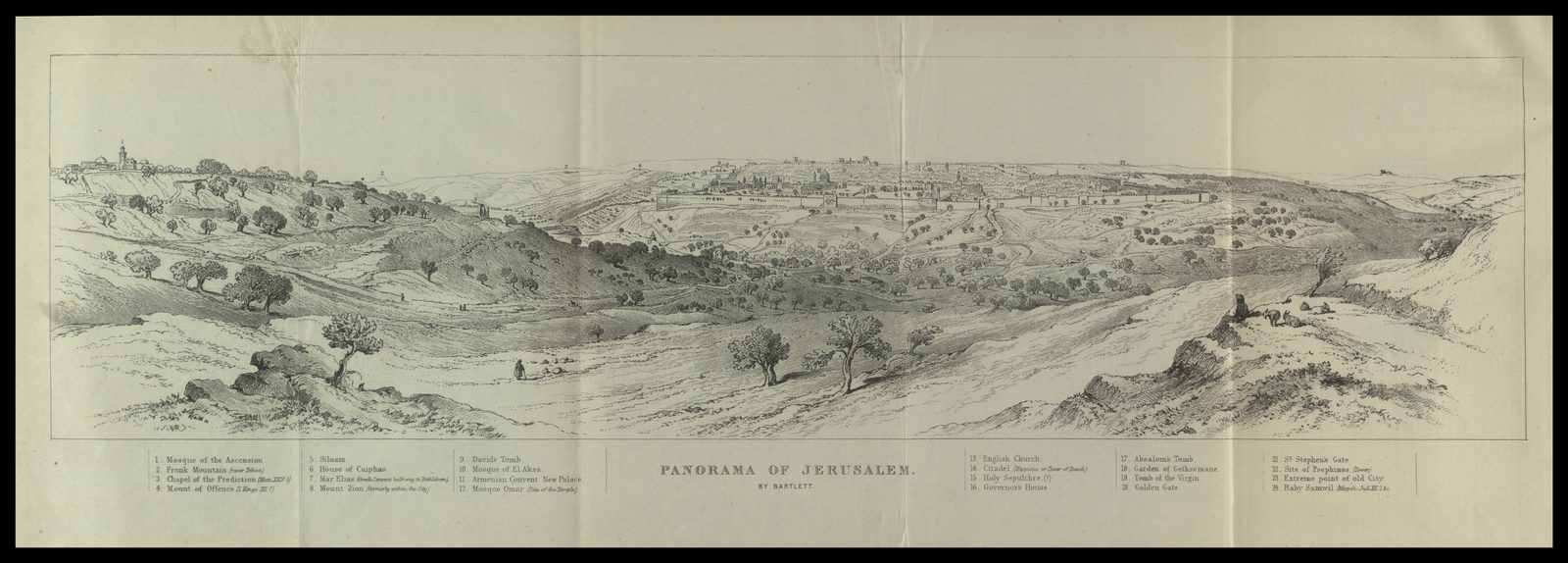
Panorama of Jerusalem. William Henry Bartlett, not stated on the file page. Wikimedia Commons. Public domain.