
Psalm 46
11 verses · Hymn of praise
God is within her; she will not be moved. God will help her when morning dawns.
Introduction
The sons of Korah, the City of God, Book 2: The Elohistic Psalter, Poetry, Psalms Overview.
The sons of Korah wrote this for the temple singers, and many readers set it in the days when an Assyrian army stood outside Jerusalem. It is a song about a city under threat that stays calm. The world it pictures is shaking and roaring, and the city at its centre has its own quiet stream. Listen for the refrain, sung twice, which names who is with the people and where their safety lies. The best known command near the end was spoken first to the warring nations.
Context
- Who
- Israelites inside a walled city while an empire's army stood outside it
- What
- A song of confidence in God as the refuge of His city while the earth and the nations are in uproar.
- Where
- Jerusalem, a walled city on a ridge in the Judean highlands, with its water supply and its walls both in view
- When
- The monarchy, with the date unstated; many readers connect it with Jerusalem's deliverance from Sennacherib in 701 BC.
- Why
- To steady a people under threat with the fact that the LORD of Hosts is with them.
Historical context
The heading gives the psalm to the sons of Korah, the Levite guild that sang in the sanctuary, and sets it according to Alamoth, which is most likely a direction for a high vocal range. The psalm carries no date and names no king, and the deliverance of Jerusalem from Sennacherib in 701 BC is the event most often proposed for it. The city in the psalm has a river running through it, and Jerusalem had none. Its one spring, the Gihon, rose in the valley outside the wall, and Hezekiah cut a tunnel more than 1,700 feet through rock to carry that water inside. A besieged city with water inside could wait an army out. Armies of that world broke and burned the gear of a defeated enemy so it could not be used again, which is the scene of verse 9.
Significance
For people who could hear an army outside the wall, the refrain was the whole argument. The LORD of Hosts is with us, and the God of Jacob is our fortress, said twice. Be still and know that I am God was heard first as a command to the raging nations of verse 6, and the comfort a worshipper took from it came from the fact that the command was God's to give.
This chapter in Jewish lifeWhat this chapter is in Jewish life and reading.
How it is read
Rashi reads this psalm forward rather than back. The shaking of the earth in its third line he puts in the age to come, and he ties it to the miracle the sons of Korah had already seen, at Rashi on Psalms 46:3:1, where the singers who stood in the air while the ground swallowed the rest of their family tell Israel that a like deliverance is coming. The river whose streams make the city glad he names in four words:
the river of Paradise. (Rashi on Psalms 46:5:2)
The morning of the sixth line he reads the same way:
as morning approaches at the end of the redemption. (Rashi on Psalms 46:6:1)
The end of the psalm he reads as words spoken to the nations about Jerusalem, at Rashi on Psalms 46:11:1 and Rashi on Psalms 46:11:2. A Christian reader knows this psalm as a psalm of present refuge. The Jewish reading here keeps the refuge and sets it at the end of the exile. This site's study row for the chapter carries the Targum's reading of the psalm's refrain beside it. Ibn Ezra stands on this chapter at Ibn Ezra on Psalms 46:1:1, 46:2:1, 46:3:1, 46:6:1, 46:8:1, 46:9:1 and 46:12:1, Radak at Radak on Psalms 46:2:1 and 46:12:1 and Metzudat David at Metzudat David on Psalms 46:8:1. Sefaria holds no English version of those references, so this card cites them without quotation.
What the rabbis say
The corpus records 22 places where the rabbinic literature takes up a line of this psalm, 18 of them in the Midrash. The Midrash on the Psalms treats it at Midrash Tehillim 46:1, 46:2 and 62:2, Bereshit Rabbati at Bereshit Rabbati, Parashat Bereshit 28 and Parashat Bereshit 82 and Midrash Sekhel Tov at Midrash Sekhel Tov, Bereshit 38:3:1 and Bereshit 46:7:3. The Talmud takes up lines of the psalm at Sanhedrin 92b:1, Berakhot 7b:10, Jerusalem Talmud Berakhot 5:1:5 and Tractate Kallah Rabbati 3:19. Each is a locator, so the saying stands at its reference and is read there.
Sources: Rashi, Rashi on Psalms, in The Judaica Press complete Tanach with Rashi, translated by A. J. Rosenberg, under a CC-BY licence; Ibn Ezra, Ibn Ezra on Psalms, cited at Ibn Ezra on Psalms 46:1:1, 46:2:1, 46:3:1, 46:6:1, 46:8:1, 46:9:1 and 46:12:1; Radak, Radak on Psalms, cited at Radak on Psalms 46:2:1 and 46:12:1; Metzudat David, Metzudat David on Psalms, cited at Metzudat David on Psalms 46:8:1; Midrash Tehillim, the Midrash on the Psalms, cited at Midrash Tehillim 46:1, 46:2 and 62:2; The Talmud, cited at Sanhedrin 92b:1, Berakhot 7b:10, Jerusalem Talmud Berakhot 5:1:5 and Tractate Kallah Rabbati 3:19; MannaFest, the chapter study of Psalm 46, at /read/psalms/46, 2026; MannaFest, the Sefaria corpus at scripts/data/sources/sefaria/psalms/46.json, fetched 2026-09-19, 2026.
Psalms 46:1-3
ever-present help in times of trouble: is what the psalm calls God in its first line. The worst it can picture follows, the earth shaken and the mountains thrown into the depths of the sea. Therefore we will not fear is the answer it gives.
Psalms 46:1
“Do not flee what you do not need to flee, and do not have recourse to him to whom it is unnecessary. But one thing you must flee: sin; and one refuge from evil must be sought: God. Do not trust in princes; do not be exalted in the uncertainty of wealth; do not be proud of bodily strength; do not pursue the splendor of human glory. None of these things saves you; all are transient, all are deceptive. There is one refuge, God.… God is the true aid for the righteous.”
Basil of Caesarea · written before 379 · Homilies on the Psalms 18:1-2 (Ps 46)patristic
2 more voices on this verseWhat preachers and commentators have said about this verse, in their own words.
Psalms 46:1
“God is our refuge and strength. Not our armies, or our fortresses. Israel's boast is in Jehovah, the only living and true God. Others vaunt their impregnable castles, placed on inaccessible rocks, and secured with gates of iron, but God is a far better refuge from distress than all these: and when the time comes to carry the war into the enemy's territories, the Lord stands his people in better stead than all the valour of legions or the boasted strength of chariot and horse.”
Charles Spurgeon · The Treasury of David, Vol. 2 (1870)Particular Baptist
Psalms 46:1
“He is a help, to do all that for us which we need, a present help, a help found (so the word is), one whom we have found to be so, a help on which we may write Probatum est--It is tried, as Christ is called a tried stone, Isa. xxviii.”
Matthew Henry · Commentary on the Whole Bible (1707-1721)puritan
Therefore we will not fear: Spurgeon found the therefore as firm as a proof, the refusal to fear drawn from God as refuge and strength in verse 1. Barnes gave the Hebrew as the earth changing, its structure moved or lost. Clarke read the mountains as kings and kingdoms in political upheaval.
their waters roar and foam: Barnes gave the Hebrew word behind foam as boiling, the sea lashed in a storm. Clarke took the waters as peoples in uproar and the mountains as rulers who quake. The nations rage in verse 6.
Psalms 46:3
“Though the waters thereof roar and be troubled. When all things are excited to fury, and reveal their utmost power to disturb, faith smiles serenely. She is not afraid of noise, nor even of real force, she knows that the Lord stilleth the raging of the sea, and holdeth the waves in the hollow of his hand. Though the mountains shake with the swelling thereof. Alps and Andes may tremble, but faith rests on a firmer basis, and is not to be moved by swelling seas.”
Charles Spurgeon · The Treasury of David, Vol. 2 (1870)Particular Baptist
Psalms 46:4-5
There is a river: answers the roaring waters of verse 3 with quiet water inside the city. Jerusalem stood on no river, and Gill and Henry read the streams as God's presence in the place where He dwells. God is within her, and she will not be moved.
Psalms 46:4
“A river - This may design the gracious presence, and blessing of the Lord, which is frequently described under the name of waters. Make glad - Shall not barely preserve it from danger, but give great occasion for rejoicing and thanksgiving. The city - Jerusalem, the place where God's holy tabernacle is settled.”
John Wesley · Explanatory Notes upon the Old Testament (1765)evangelical
2 more voices on this verse
Psalms 46:4
“There is a river. Divine grace like a smoothly flowing, fertilising, full, and never failing river, yields refreshment and consolation to believers. This is the river of the water of life, of which the church above as well as the church below partakes evermore. It is no boisterous ocean, but a placid stream, it is not stayed in its course by earthquakes or crumbling mountains, it follows its serene course without disturbance. Happy are they who know from their own experience that there is such a river of God.”
Charles Spurgeon · The Treasury of David, Vol. 2 (1870)Particular Baptist
Psalms 46:4
“Some give the definition that a city is an established community, administered according to law. And the definition that has been handed down of the city is in harmony with the celestial city, Jerusalem above. For there it is a community of the first-born who have been enrolled in heaven, and this is established because of the unchanging manner of life of the saints, and it is administered according to the heavenly law. Therefore, it is not the privilege of human nature to learn the arrangement of that city and all its adornment.”
Basil of Caesarea · written before 379 · Homilies on the Psalms 18:4 (Ps 46)patristic
when morning dawns: Help comes at the first hour of trouble. Clarke saw God resisting the attack from within the city at its onset, as the morning scatters darkness, and Barnes heard Jerusalem before Sennacherib. Chrysostom called this help ever ready.
Psalms 46:5
“God is in the midst of her. His help is therefore sure and near. Is she besieged, then he is himself besieged within her, and we may be certain that he will break forth upon his adversaries. How near is the Lord to the distresses of his saints, since he sojourns in their midst!”
Charles Spurgeon · The Treasury of David, Vol. 2 (1870)Particular Baptist
1 more voice on this verse
Psalms 46:5
“By his resurrection at dawn, the Lord confers on us wonderful and heavenly helps. His resurrection dispelled the night and poured on us the light of day. As Scripture says, "Rise, O sleeper; arise from the dead, and Christ shall enlighten you." Consider here a mystery. Christ suffered in the evening, and according to the Old Law, the lamb is slain at evening. … In the evening of this world, when the light is failing, he is killed. All this world would have been shrouded by even greater and more horrid darkness only that Christ came to us from heaven.”
Ambrose of Milan · written before 397 · Commentary on Twelve Psalms 46:14patristic
Psalms 46:6-7
Nations rage, kingdoms crumble: , and one lift of God's voice melts the earth. Barnes found in that voice the same ground as the confidence of verse 1, and the threat has moved from the shaking earth to armies. The God of Jacob is our fortress.
The LORD of Hosts: Barnes took the LORD of Hosts as the God who commands every host in heaven and on earth. He found the Hebrew phrase is with us again in Isaiah 7:14 and 8:8, where it describes the Messiah. Clarke recalled the God who helped Jacob in his trouble.
Psalms 46:7
Our protector, he says, is not another God besides him who was handed down by the prophets. But [he is] the God of Jacob, who spoke in an oracle to his servant, "I am the God of Abraham, the God of Isaac and the God of Jacob."
Basil of Caesarea · written before 379 · Homilies on the Psalms 18:6 (Ps 46)patristic
1 more voice on this verse
Psalms 46:7
“The Lord of hosts is with us. This is the reason for all Zion's security, and for the overthrow of her foes. The Lord rules the angels, the stars, the elements, and all the hosts of heaven; and the heaven of heavens are under his sway. The armies of men though they know it not are made to subserve his will.”
Charles Spurgeon · The Treasury of David, Vol. 2 (1870)Particular Baptist
Psalms 46:8-9
Come, see the works of the LORD: turns the reader to what the raging of verse 6 came to. He breaks the bow, shatters the spear, and burns the shields in the fire, so the weapons are destroyed. Henry set this peace beside the plowshares of Isaiah 2:4.
Psalms 46:8
“Come, behold the works of the Lord. The joyful citizens of Jerusalem are invited to go forth and view the remains of their enemies, that they may mark the prowess of Jehovah and the spoil which his right hand hath won for his people. It were well if we also carefully noted the providential dealings of our covenant God, and were quick to perceive his hand in the battles of his church. Whenever we read history is should be with this verse sounding in our ears.”
Charles Spurgeon · The Treasury of David, Vol. 2 (1870)Particular Baptist
1 more voice on this verse
Psalms 46:8
“Just as … great distances make the perception of visible objects dim, but a nearer approach offers a clear knowledge of the objects seen, so also in the case of objects of contemplation in the mind, he who has not drawn near to God is not able to see his works with the pure eyes of his mind.”
Basil of Caesarea · written before 379 · Homilies on the Psalms 18:7 (Ps 46)patristic
He makes wars to cease: Augustine saw the nations still at war in his day and held that wars cease already in the wheat, and wait among the tares. Barnes tied the peace on the earth to the fall of the Assyrian army. Evagrius read the bow, spear and shields as wicked thoughts.
Psalms 46:9
“He maketh wars to cease unto the end of the earth. His voice quiets the tumult of war, and calls for the silence of peace. However remote and barbarous the tribe, he awes the people into rest. He crushes the great powers till they cannot provoke strife again; he gives his people profound repose. He breaketh the bow, the sender of swift winged death he renders useless. And cutteth the spear in sunder —the lance of the mighty man he shivers.”
Charles Spurgeon · The Treasury of David, Vol. 2 (1870)Particular Baptist
1 more voice on this verse
Psalms 46:9
“He it is who routs all the enemy when he wishes and brings peace to the earth to the degree he wants.… He is the God who does away with the enemy with their own weapons when he wishes.”
Diodorus of Tarsus · written before 390 · Commentary on Psalm 46patristic
Psalms 46:10-11
Be still and know is God's command to the nations. Jamieson, Fausset and Brown read it as an order to the kingdoms that rage in verse 6 to cease. His answer is that He will be exalted over the earth, and the refrain of verse 7 closes the psalm.
Psalms 46:10
“Be still, and know that I am God. Hold off your hands, ye enemies! Sit down and wait in patience, ye believers! Acknowledge that Jehovah is God, ye who feel the terrors of his wrath! Adore him, and him only, ye who partake in the protection of his grace. Since none can worthily proclaim his nature, let "expressive silence muse his praise." The boasts of the ungodly and the timorous forebodings of the saints should certainly be hushed by a sight of what the Lord has done in past ages. I will be exalted among the heathen.”
Charles Spurgeon · The Treasury of David, Vol. 2 (1870)Particular Baptist
3 more voices on this verse
Psalms 46:10
“Be still - Stir no more against my people. God - The only true and almighty God; your gods are but dumb and impotent idols. Exalted - I will make myself glorious by my great and wonderful works.”
John Wesley · Explanatory Notes upon the Old Testament (1765)evangelical
Psalms 46:10
“It is not possible to know him if one has not become still and purified one's mind.”
Origen of Alexandria · written before 253 · Commentary on the Gospel of John 19:17patristic
Psalms 46:10
“We may, in singing it, apply it either to our spiritual enemies, and be more than conquerors over them, or to the public enemies of Christ's kingdom in the world and their threatening insults, endeavouring to preserve a holy security and serenity of mind when they seem most formidable.”
Matthew Henry · Commentary on the Whole Bible (1707-1721)puritan
the God of Jacob: The refrain of verse 7 returns after God's word to the nations in verse 10. Barnes made it the result of the whole psalm, for the LORD of Hosts had saved His city and nation in time of danger. Clarke read the Selah as a mark of truth well tried.
Psalms 46:11
“The Lord of hosts is with us; the God of Jacob is our refuge. See Gill on Psa 46:7. The Targum paraphrases it, "the Word of the Lord of hosts", as in Psa 46:7; and the same words are here repeated, to comfort those that were fearful and unbelieving, with which the church then comforted herself. Selah; on this word; see Gill on Psa 3:2.”
2 more voices on this verse
Psalms 46:11
“The Lord of hosts is with us; the God of Jacob is our refuge. It was meet to sing this twice over. It is a truth of which no believer wearies, it is a fact too often forgotten, it is a precious privilege which cannot be too often considered. Reader, is the Lord on thy side? Is Emmanuel, God with us, thy Redeemer? Is there a covenant between thee and God as between God and Jacob? If so, thrice happy art thou.”
Charles Spurgeon · The Treasury of David, Vol. 2 (1870)Particular Baptist
Psalms 46:11
“This sovereign Lord is with us, sides with us, acts with us, and has promised he will never leave us. Hosts may be against us, but we need not fear them if the Lord of hosts be with us. (2.) They are under the protection of a God in covenant, who not only is able to help them, but is engaged in honour and faithfulness to help them.”
Matthew Henry · Commentary on the Whole Bible (1707-1721)puritan
How this psalm is built
The form: A song of confidence that names God as the refuge, and neither the walls nor the armies, as Spurgeon classes it.
The patterns in this chapter
| Device | What it does | Where to see it |
|---|---|---|
| The line sung twice | Verse 7 and verse 11 carry the same sentence, that the LORD of Hosts is with us and the God of Jacob is our fortress, and each of them is followed by Selah. Spurgeon holds that the repetition is deliberate, since it was meet to sing this twice over, and that it is a truth of which no believer wearies.Charles Spurgeon, The Treasury of David, Vol. 2, 1870, on Psalm 46:11. | Psalm 46:7, Psalm 46:11 |
| The two waters set against each other | Verse 3 has waters that roar and foam and mountains that quake in the surge. Verse 4 has a river whose streams delight the city of God. Spurgeon reads the second water against the first, as no boisterous ocean but a quiet flow that yields refreshment. Clarke records the Chaldee reading of the same river as peoples brought to the worship of the true God.Charles Spurgeon, The Treasury of David, Vol. 2, 1870, on Psalm 46:4. | Psalm 46:3, Psalm 46:4 |
| The command to the nations at verse 10 | The psalm speaks about God for nine verses, then God speaks for Himself in verse 10 and tells the hearer to be still and know that He is God. Jamieson, Fausset and Brown read the order as spoken to the kingdoms that rage in verse 6, and Wesley reads it the same way, as a command to stir no more against God's people.Jamieson, Fausset and Brown, Commentary Critical and Explanatory on the Whole Bible, 1871, on Psalm 46:10. | Psalm 46:10 |
The psalm's own movement is from noise to silence. Verse 3 has the sea roaring, verse 6 has the nations raging, and verse 10 has one voice telling both to stop. Between them stands the quiet water of verse 4, and around them stands the refrain.
8 more paragraphs on the patterns
Where it points
Henry sets the breaking of the bow and the burning of the shields in verse 9 beside the beating of swords into plowshares at Isaiah 2:4. Jamieson, Fausset and Brown read the river of verse 4 with Psalm 36:8 and with the river of Revelation 22:1. Bonaventure had already read the same stream as the Spirit coming forth from the throne of God and of the Lamb.
The New Testament's use
The psalm is not quoted in the New Testament. Its claim that God is within the city carries forward in the name Immanuel, God with us, and Spurgeon reads the refrain in exactly that light. Its river returns at Revelation 22:1, where the water comes from the throne.
The debate
Whether the psalm was written for a particular deliverance is open. The contents fit the night Sennacherib's army withdrew from Jerusalem in 701 BC, and many readers have taken that as the occasion. The psalm names no king, no army and no year, so the site records the connection as a fit and leaves the text to stand without it.
Where it stands
The psalm stands first in a run of three by the sons of Korah. Psalm 47 takes up the kingship over all the earth that verse 10 claims, and Psalm 48 walks the walls of the city that verse 4 names. Gill and Clarke both record the Targum at the refrain, where the line reads that the Word of the LORD of Hosts is with us.
Keep studying
People and groups1
Sources for this chapter
The summary
Jamieson, Fausset & Brown, Commentary Critical and Explanatory; John Calvin, Commentaries; John Wesley, Notes on the Old Testament and Matthew Henry, Complete Commentary.
The form and classifications
Charles Spurgeon, The Treasury of David, Vol. 2, 1870, on Psalm 46:1.
The exposition
Adam Clarke, Commentary on the Bible; Albert Barnes; Alexander Maclaren, The Psalms, Expositor's Bible; Augustine of Hippo, Exposition on Psalm 46; Charles Spurgeon, The Treasury of David; Evagrius Ponticus, Notes on the Psalms; Franz Delitzsch, Biblical Commentary on the Psalms; Jamieson, Fausset & Brown, Commentary Critical and Explanatory on the Whole Bible; John Chrysostom, Commentary on the Psalms; John Gill, Exposition of the Old Testament and Matthew Henry, Commentary on the Whole Bible.
The painting
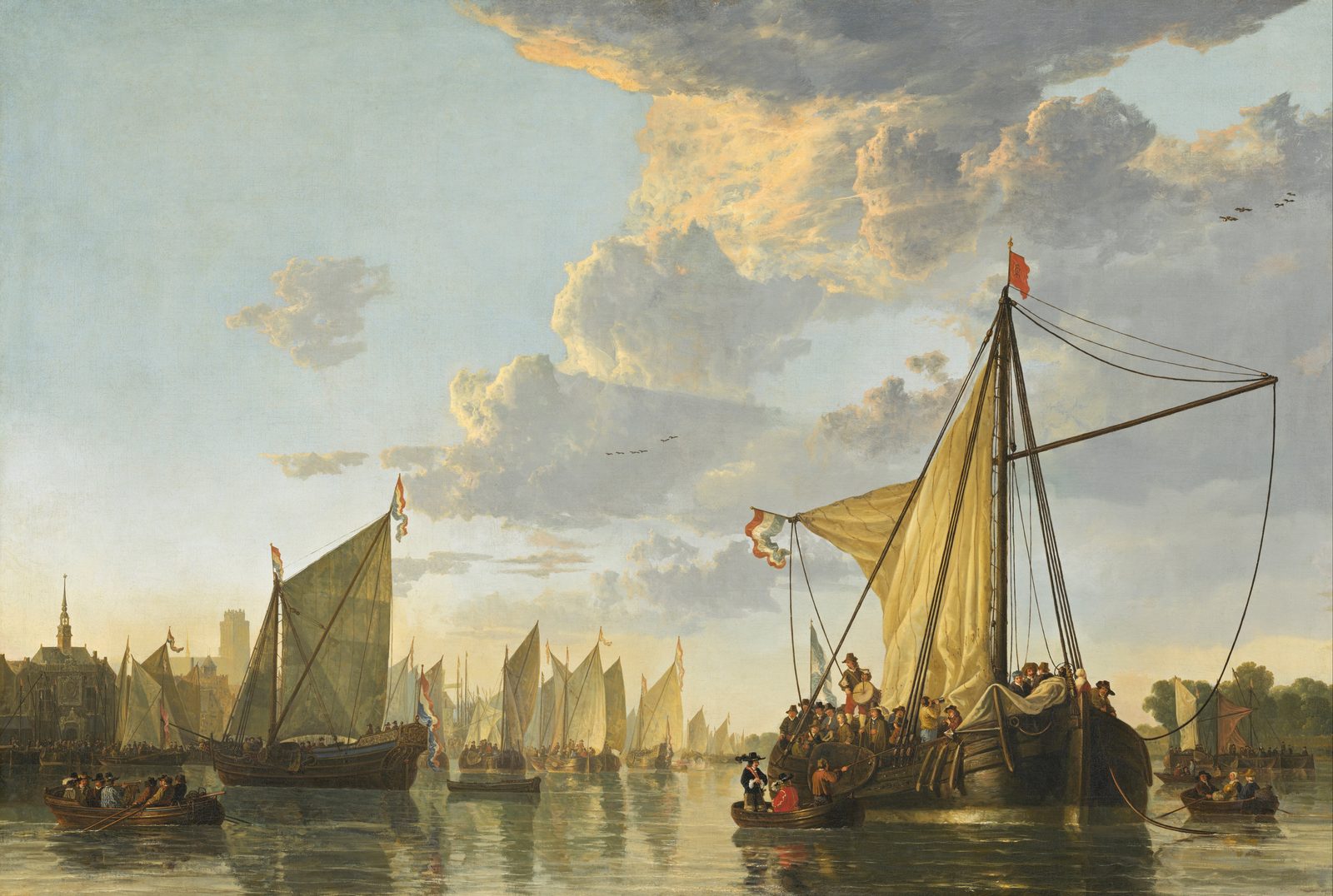
The Maas at Dordrecht. Aelbert Cuyp, circa 1650. Wikimedia Commons. Public domain.