
Psalm 43
5 verses · Psalm of lament
Why are you downcast, O my soul? Why the unease within me? Put your hope in God, for I will yet praise Him, my Savior and my God.
Introduction
Author unstated, the Plea for Light, Book 2: The Elohistic Psalter, Poetry, Psalms Overview.
This short psalm carries no heading of its own, and many Hebrew manuscripts join it to Psalm 42 as the close of one poem. The same singer is still far from the sanctuary, now pressed by a people who deal falsely with him. Here the complaint becomes a request for a guide home. Listen for the appeal made in the language of a law court, and for the road he asks to be led on, which ends at the altar where he once served. The refrain returns a third and last time.
Context
- Who
- Israelites away from the sanctuary and under pressure from a people not their own
- What
- The close of the poem begun in Psalm 42, turning its lament into a request to be led back to the altar.
- Where
- Far from Jerusalem, looking toward the holy mountain and the altar there.
- When
- The date is unstated, since the psalm carries no superscription.
- Why
- To ask God for vindication and for guidance home to worship Him again.
Historical context
The psalm has no title of its own, which is unusual in Book Two and is the main evidence that it belongs with Psalm 42. It shares that psalm's refrain, its question to God and its vocabulary, and many Hebrew manuscripts join the two. Vindicate me and plead my case at verse 1 are the words of a legal appeal, and the other party is a nation that is not faithful, so the writer is under a foreign jurisdiction. The holy mountain of verse 3 is Zion and the dwelling is the sanctuary on it, so the request is for a route home to a specific address. For a Levitical singer the altar and the harp of verse 4 were his work as well as his worship, so the psalm's destination is the writer's own post.
Significance
For the first hearers the psalm completed what Psalm 42 had left open. It supplied a destination and a guide, and it put worship at the end of the request. The man is still asking at the close, and the last thing he says is the instruction he has now given himself three times.
This chapter in Jewish lifeWhat this chapter is in Jewish life and reading.
How it is read
The corpus holds six English comments of Rashi on this psalm, and the shortest of them carries the most weight. He reads the light and the truth the psalmist asks God to send as two persons:
Send Your light and Your truth The King Messiah, who is compared to light, as it is stated (below 132:17): “I have set up a lamp for my anointed,” and Elijah the prophet, who is true, a faithful prophet. (Rashi on Psalms 43:3:1)
That is a messianic reading held by the commentator this corpus carries most fully, and a Christian reader meets in it a Jewish expectation of an anointed king and a returning Elijah rather than a denial that either is coming. The two traditions part over who the anointed one is and whether he has come. Rashi reads the unkind nation of the first line as a nation named rather than as an enemy in general, giving it as Ishmael at Rashi on Psalms 43:1:2, and the thanksgiving of the last line as thanks for a return from exile at Rashi on Psalms 43:4:2. This chapter is the one place in this range where the corpus carries all five commentators. Ibn Ezra stands at Ibn Ezra on Psalms 43:1:1, 43:2:1, 43:3:1, 43:4:1 and 43:5:1, Radak at Radak on Psalms 43:1:1, 43:2:1, 43:3:1 and 43:5:1, Malbim at Malbim on Psalms 43:1:1, 43:2:1, 43:4:1 and 43:5:1 and Metzudat David at Metzudat David on Psalms 43:1:1, 43:2:1, 43:3:1, 43:4:1 and 43:5:1. Sefaria holds no English version of those references, so this card cites them and quotes none of them.
What the rabbis say
The corpus records 11 places where the rabbinic literature takes up a line of this psalm, 11 of them in the Midrash, and all but one of them hang on the third line, the line about the light and the truth. The Midrash on the Psalms treats it at Midrash Tehillim 27:1 and 42:5, Pesikta DeRav Kahana at Pesikta DeRav Kahana 5:4 and Shemot Rabbah at Shemot Rabbah 15:14. Each is a locator, so the saying stands at its reference and is read there.
Sources: Rashi, Rashi on Psalms, in The Judaica Press complete Tanach with Rashi, translated by A. J. Rosenberg, under a CC-BY licence; Ibn Ezra, Ibn Ezra on Psalms, cited at Ibn Ezra on Psalms 43:1:1, 43:2:1, 43:3:1, 43:4:1 and 43:5:1; Radak, Radak on Psalms, cited at Radak on Psalms 43:1:1, 43:2:1, 43:3:1 and 43:5:1; Malbim, Malbim on Psalms, cited at Malbim on Psalms 43:1:1, 43:2:1, 43:4:1 and 43:5:1; Metzudat David, Metzudat David on Psalms, cited at Metzudat David on Psalms 43:1:1, 43:2:1, 43:3:1, 43:4:1 and 43:5:1; Midrash Tehillim, the Midrash on the Psalms, cited at Midrash Tehillim 27:1 and 42:5; MannaFest, the Sefaria corpus at scripts/data/sources/sefaria/psalms/43.json, fetched 2026-09-19, 2026.
Psalms 43:1-4
plead my case against: The psalm opens in court language: Vindicate me, O God, plead my case against an ungodly nation. Light and truth are asked as guides to the holy mountain, and to the place where God dwells. The altar and the harp stand at the end.
Psalms 43:1
“There were those that had injured him; against them he is plaintiff, and exhibits his complaint to him who is the avenger of wrong, praying for justice for himself and upon them. Who his enemies were with whom he had this struggle. Here was a sinful body of men, whom he calls an ungodly or unmerciful nation.”
Matthew Henry · Commentary on the Whole Bible (1707-1721)puritan
1 more voice on this verseWhat preachers and commentators have said about this verse, in their own words.
Psalms 43:1
“Judge me, O God. Others are unable to understand my motives, and unwilling to give me a just verdict. My heart is clear as to intent and therefore I bring my case before thee, content that thou wilt impartially weigh my character, and right my wrongs.”
Charles Spurgeon · The Treasury of David, Vol. 2 (1870)Particular Baptist
Why have You rejected me?: The God of refuge seems to have rejected his own, and the walk in sorrow of 42:9 returns. Barnes notes the Hebrew for rejected implies loathing. Spurgeon called the opening For the sinew of prayer, an argument laid before God.
Psalms 43:2
“God of my strength--by covenant relation my stronghold (Ps 18:1). cast me off--in scorn. because--or, "in," that is, in such circumstances of oppression.”
Jamieson, Fausset & Brown · Commentary Critical and Explanatory on the Whole Bible (1871)reformed
Send out Your light and Your truth: Jamieson, Fausset and Brown read light and truth as messengers sent to lead him to the holy place of worship. Barnes took light as God's favour and truth as His faithfulness. Augustine found both names fulfilled in Christ.
Psalms 43:3
“Send out - That is, actually discover them. Truth - Thy favour, or the light of thy countenance, and the truth of thy promises made to me; or the true-light, the illumination of thy spirit, and the direction of thy gracious providence, whereby I may be led in the right way, to thy holy hill. Hill - Of Zion, the place of God's presence and worship.”
John Wesley · Explanatory Notes upon the Old Testament (1765)evangelical
2 more voices on this verse
Psalms 43:3
“O send out thy light and thy truth. The joy of thy presence and the faithfulness of thy heart; let both of these be manifest to me. Reveal my true character by thy light, and reward me according to thy truthful promise.”
Charles Spurgeon · The Treasury of David, Vol. 2 (1870)Particular Baptist
Psalms 43:3
“O send out thy light and thy truth,.... By light is meant, not the law, as Arama; but rather, as some Jewish (p) interpreters understand it, the Messiah, the sun of righteousness, and light of the world; who is the author of all light, natural, spiritual, and eternal; and whose coming into the world is often signified by being sent into it. The Spirit of God also is the enlightener of men, both at first conversion and afterwards, and is sent down into their hearts as a comforter of them, by being the Spirit of adoption.”
my greatest joy: Spurgeon notes that the altar of God, ahead of his own house, would be the first place he would go. Henry and Barnes give the Hebrew for greatest joy as the gladness of his joy. Barnes saw God as the source of all his joy.
Psalms 43:4
“Then will I go unto the altar of God. If David might but be favoured with such a deliverance as would permit his return, it would not be his own house or heritage which would be his first resort, but to the altar of God his willing feet should conduct him. His whole heart would go as sacrifice to the altar, he himself counting it his greatest happiness to be permitted to lie as a burnt offering wholly dedicated to the Lord. With what exultation should believers draw near unto Christ, who is the antitype of the altar!”
Charles Spurgeon · The Treasury of David, Vol. 2 (1870)Particular Baptist
1 more voice on this verse
Psalms 43:4
“Those that come unto God must come to him as their exceeding joy, not only as their future bliss, but as their present joy, and that not a common, but an exceeding joy, far exceeding all the joys of sense and time. The phrase, in the original, is very emphatic-- unto God the gladness of my joy, or of my triumph.”
Matthew Henry · Commentary on the Whole Bible (1707-1721)puritan
Why are you downcast: The refrain returns a third time and closes the poem. The soul is questioned, then commanded: put your hope in God. The word yet carries the promise of praise while the trouble still stands, and the psalm ends on my Savior and my God.
Psalms 43:5
“Why art thou cast down, O my soul? If God be thine, why this dejection? If he uplifts thee, why art thou so near the ground? The dew of love is falling, O withering heart, revive. And why art thou disquieted within me? What cause is there to break the repose of thy heart? Wherefore indulge unreasonable sorrows, which benefit no one, fret thyself, and dishonour thy God? Why overburden thyself with forebodings? Hope in God, or wait for God. There is need of patience, but there is ground for hope. The Lord cannot but avenge his own elect.”
Charles Spurgeon · The Treasury of David, Vol. 2 (1870)Particular Baptist
1 more voice on this verse
Psalms 43:5
“From this it is clear that both psalms have the same meaning. Those using them encourage themselves to have stronger hope, overcome the feeling of discouragement and await the salvation from God that will doubtless be given them.”
Theodoret of Cyrus · written before 458 · Commentary on the Psalms 43:5patristic
How this psalm is built
The form: The third movement of the poem begun in Psalm 42, carrying its refrain to a close, as Delitzsch classes it.
The patterns in this chapter
| Device | What it does | Where to see it |
|---|---|---|
| The refrain, arriving for the third and last time | Verse 5 repeats the question and the command of Psalm 42:5 and 42:11 word for word, and this is where the poem stops. The third saying is the only one with nothing after it, so the poem ends by putting the instruction last rather than by answering the question.Franz Delitzsch, Biblical Commentary on the Psalms, on Psalm 43:5. | Psalm 43:5, Psalm 42:5, Psalm 42:11 |
| The courtroom words at the front | Verse 1 opens with two legal verbs, vindicate me and plead my case, and names the other party, an ungodly nation and deceitful and unjust men. The psalm begins as a lawsuit and ends at an altar, which is the distance it travels in five verses.Matthew Henry, Commentary on the Whole Bible, 1710, on Psalm 43:1 to 5. | Psalm 43:1 |
| Light and truth, sent out as two guides | Verse 3 asks God to send out His light and His truth and to let them lead him, and gives them a destination, the holy mountain and the place where God dwells. The two are treated as messengers with a task rather than as qualities, which is why the verse became a processional prayer in Christian worship.Charles Spurgeon, The Treasury of David, Vol. 2, 1870, on Psalm 43:3. | Psalm 43:3 |
| Why have You rejected me, taken straight from the psalm before | Verse 2 asks why God has rejected him and why he must walk in sorrow because of the enemy's oppression, which is the question of Psalm 42:9 asked again in almost the same words. The repetition is one of the strongest signs that the two psalms are one poem.Albert Barnes, Notes on the Book of Psalms, 1832 to 1869, on Psalm 43:2. | Psalm 43:2, Psalm 42:9 |
The liturgical use and the pattern
6 more paragraphs on the patterns
Verse 3 became the church's introit, the prayer said at the approach to the altar, and it kept that place in the Latin liturgy for centuries. The psalm's own sentence is a request for light and truth to lead the writer to a place, which is what a processional prayer is for.
The refrain binds the poem. It stands at 42:5, 42:11 and 43:5, and each time it has the same two parts, a question put to the soul and an order given to it. A student should read the three occurrences together before reading either psalm alone.
Verse 2 and Psalm 42:9 are the same complaint in different words, God my refuge here and God my Rock there, and both ask why. The repetition is the poem's way of saying that the second movement did not settle anything.
The altar of verse 4 is the answer to the thirst of Psalm 42:2, where the question was when he would come and appear in God's presence. The poem asks the question in its first movement and names the place in its third.
The debated concept
The psalm's want of a superscription is the evidence in the standing question of whether it is part of Psalm 42. Franz Delitzsch holds that the missing title is evidence rather than an accident, since Book Two titles almost every psalm, and Charles Spurgeon treats the two as a single composition throughout his notes. Against that stands the Masoretic tradition, which has kept them apart, and the fact that the psalm has its own shape, an appeal, a complaint, a request, a destination and the refrain. The question is settled by neither side and the reading of the psalm changes little either way.
Keep studying
Sources for this chapter
The summary
Jamieson, Fausset & Brown, Commentary Critical and Explanatory; John Calvin, Commentaries; John Wesley, Notes on the Old Testament and Matthew Henry, Complete Commentary.
The form and classifications
Albert Barnes, Notes on the Book of Psalms, 1832 to 1869, on Psalm 43; Charles Spurgeon, The Treasury of David, Vol. 2, 1870, on Psalm 43; Franz Delitzsch, Biblical Commentary on the Psalms, on Psalm 43 and Matthew Henry, Commentary on the Whole Bible, 1710, on Psalm 43.
The exposition
Albert Barnes, Notes, Explanatory and Practical, on the Old and New Testaments; Augustine of Hippo, Exposition on Psalm 43; Charles Spurgeon, The Treasury of David; Franz Delitzsch, Biblical Commentary on the Psalms; Jamieson, Fausset & Brown, Commentary Critical and Explanatory on the Whole Bible and Matthew Henry, Commentary on the Whole Bible.
The painting
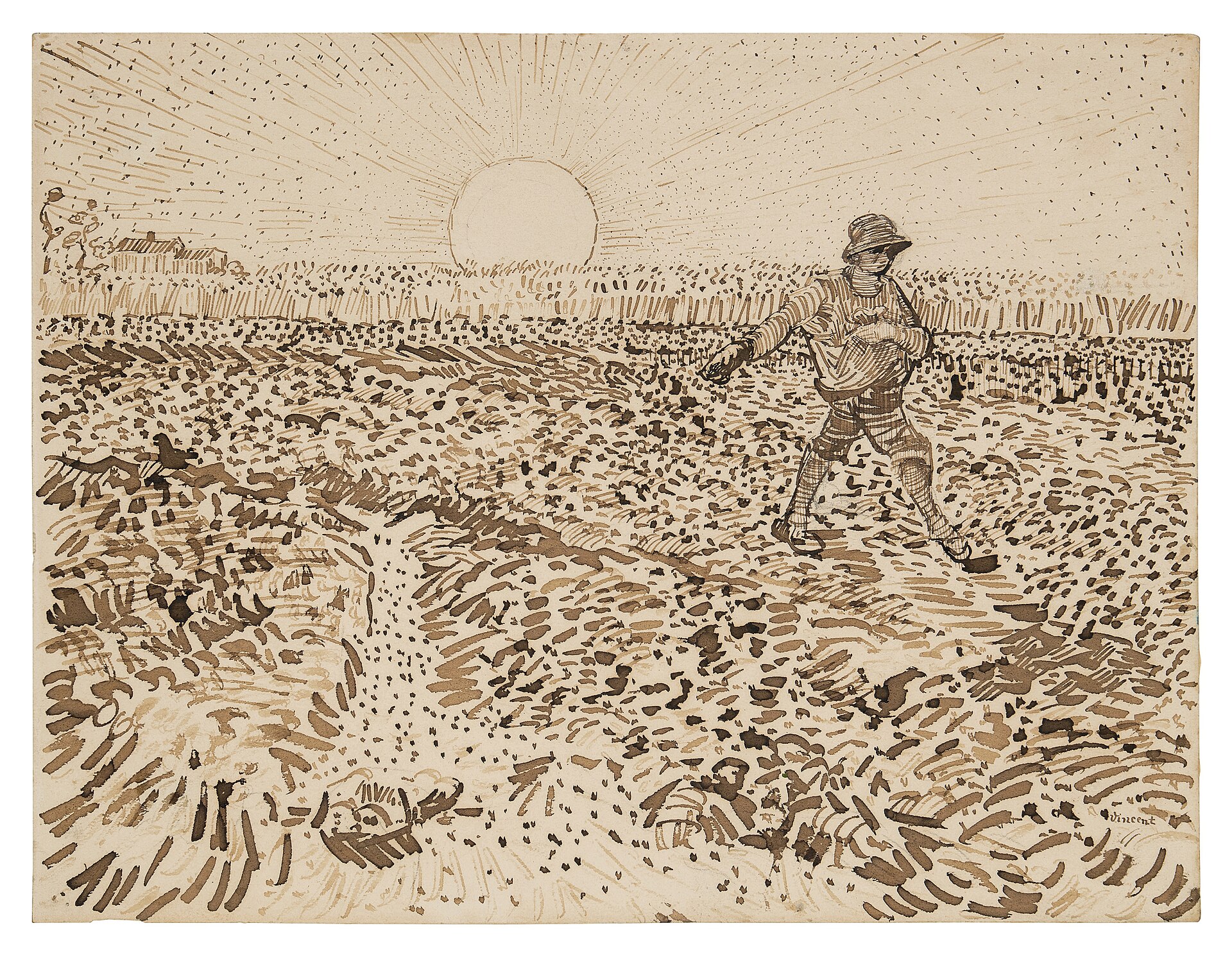
Sower with Setting Sun. Vincent van Gogh, mid July 1888. Sotheby's, New York, 18 November 2025, lot 4. Public domain.