
Psalm 26
12 verses · Lament
Vindicate me, O LORD! For I have walked with integrity; I have trusted in the LORD without wavering.
Introduction
David, the Accused Man's Plea, Book 1: The book of David, Poetry, Psalms Overview.
This psalm is the prayer of an accused man who takes his case to God. David is named in its heading, and the psalm reads as the answer of someone charged with a wrong he did not commit. Israel had a public way to declare innocence, washing the hands in view of witnesses, and the psalm draws on that rite and on the worship at the altar. Listen for the courtroom words, the requests to be examined and tested, and for the company he says he has kept away from. He claims innocence of this one charge, and he still asks for mercy in the same breath.
Context
- Who
- Israelites who had seen the rite of washing the hands to declare innocence
- What
- The prayer of an accused man who asks God to examine him and clear him of the charge.
- Where
- The sanctuary courtyard, where a worshipper washes and walks around the altar
- When
- The reign of David, about 1010 to 970 BC by the superscription.
- Why
- To give an innocent man a place to take a slander he could not disprove.
Historical context
Washing the hands in innocence and going about the altar, in verse 6, describes two acts anyone watching could read. When a body was found in open country and no killer could be named, the elders of the nearest town washed their hands over a sacrificed heifer and declared in public that their hands had not shed this blood. Going about the altar pictures a worshipper moving around it in procession while telling aloud what God has done. The examination asked for in verse 2 uses the vocabulary of metal testing, the assayer's words for proving a sample. A bribe in the right hand is justice bought at the gate, which the Law names again and again because it was the standard way the powerful won.
Significance
The psalm is the answer of a man innocent of the charge in front of him, and he asks for redemption and mercy in the same breath as he asks to be vindicated. That distinction mattered in Israel. There was somewhere to take a slander you could not disprove, and a rite that made your answer visible: the hands washed, the altar circled and the story told aloud where God's glory resides.
This chapter in Jewish lifeWhat this chapter is in Jewish life and reading.
How it is read
The psalm opens by asking God to judge, and Rashi sets that request against another psalm where David asks God to hold back from judging. He is quoted here from the Judaica Press Tanach with Rashi. His answer is a distinction between two courts. "When You judge the wicked, judge me, for compared to the wicked, I am a righteous man, but when You judge the righteous, do not bring me into judgment" (Rashi on Psalms 26:1:1). That single note is the safest key a reader can carry into any psalm where a man claims to be innocent. The claim is made against a particular company rather than against the whole measure of God.
Rashi keeps the rest short. The hypocrites of the fourth verse are men "who go into hidden places to do their deeds in the dark". David's answer is that he is not in the habit of entering their assembly (Rashi on Psalms 26:4:1 and 26:4:2). The washing of the hands in the sixth verse he reads as a claim about the source of what is offered. "There is no robbery in my fulfillment of the commandments" (Rashi on Psalms 26:6:1). At the twelfth verse he glosses the standing place as a straight path (Rashi on Psalms 26:12:1).
The seventh verse carries the note a Christian reader should mark, because it names a practice. The psalm speaks of proclaiming all God's wonders, and Rashi identifies what is meant. It "refers to Hallel, which contains mention of the past, mention of Gog and Magog, mention of the Messianic era, and mention of the future" (Rashi on Psalms 26:7:2). The Hallel is the block of psalms said as one unit at the appointed feasts, and the site sets out what it is and when it was sung at /featured/the-hallel. Rashi is reading this verse as pointing at that liturgy, and he treats the Hallel as a set that holds the whole of history, from what has happened to what is still promised.
Ibn Ezra, Radak and Metzudat David comment across this chapter, and the corpus carries their refs without English text. Ibn Ezra stands here cited and unquoted at Ibn Ezra on Psalms 26:1:1 to 26:12:1, and Radak at Radak on Psalms 26:2:1, 26:3:1, 26:5:1, 26:8:1, 26:9:1 and 26:11:1. Metzudat David stands at Metzudat David on Psalms 26:9:1. Their comments on this chapter wait on a fetch that carries the text.
What the rabbis say
The corpus carries forty locators on this psalm and the text of none, so each is cited and linked here rather than quoted. Six are Talmudic. They stand at Sanhedrin 107a:2 on the second verse, Avot DeRabbi Natan 21:1 on the fifth, and Berakhot 15a:2 on the sixth. Three more stand at Megillah 29a:8 on the eighth verse, Jerusalem Talmud Sanhedrin 6:10:3 on the ninth, and Sanhedrin 89b:12 on the eleventh.
Midrash Tehillim carries thirteen. At the first verse stand 26:1 and 26:2. On the second stand 26:3, 17:6 and 18:25. On the fourth and fifth stand 53:2 and 26:5. The eighth verse carries the largest cluster, at 26:6, 116:1, 25:3 and 61:3, and two more stand at 26:7 on the ninth verse and 26:8 on the tenth.
The eighth verse, where the psalmist loves the house where God's glory dwells, carries the next heaviest weight. Beside Midrash Tehillim there stand on it Ein Yaakov, Megillah 4:8 in the Glick Edition, and two entries of Midrash Tanchuma on Pekudei at 2:1 and 2:3. On the sixth verse the corpus carries Pesikta DeRav Kahana 27:5, Shemot Rabbah 38:4, Vayikra Rabbah 30:5, and Ein Yaakov, Berakhot 2:5 in the Glick Edition with Berakhot 2:6.
The rest are scattered. On the second verse stand Bamidbar Rabbah 18:21, Bereshit Rabbati on Lech Lecha 31, Midrash Tanchuma, Korach 12:1, and an entry of Learning to Read Midrash on David's heart after his sin. On the fourth stand Aggadat Bereshit 25:2 and Tanna DeBei Eliyahu Rabbah 12:1. On the fifth stand Bamidbar Rabbah 15:21 and Midrash Tanchuma, Beha'alotcha 14:1. On the eleventh stand Midrash Tannaim on Deuteronomy 18:13:6, Sifrei Devarim 173:3, and Ein Yaakov, Sanhedrin 10:7 in the Glick Edition with Sanhedrin 10:9. One closes the chapter, at Aggadat Bereshit 69:1 on the twelfth verse. What each of them teaches is a saying of the rabbis, and is reported as theirs wherever this site quotes one. The quotations wait on a fetch that carries the text.
Sources: Rashi, Rashi on Psalms 26:1:1 to 26:12:1, the Judaica Press complete Tanach with Rashi, translated by A. J. Rosenberg; Ibn Ezra, Ibn Ezra on Psalms 26:1:1 to 26:12:1, cited by ref because the corpus carries no English text; Radak, Radak on Psalms 26:2:1, 26:3:1, 26:5:1, 26:8:1, 26:9:1 and 26:11:1, cited by ref because the corpus carries no English text; Metzudat David, Metzudat David on Psalms 26:9:1, cited by ref because the corpus carries no English text; MannaFest, the Hallel, at /featured/the-hallel; The Sefaria corpus, scripts/data/sources/sefaria/psalms/26.json, the 6 Talmud and 34 Midrash locators of this chapter.
I have walked with integrity: David asks the LORD to try him, and names his heart and mind as the ground of the trial. Gill and Henry read walked with integrity as sincerity of purpose, a single loyalty to God. His confidence rests on the loving devotion kept before his eyes.
Psalms 26:1
“Judge--decide on my case; the appeal of innocence. in mine integrity--freedom from blemish (compare Ps 25:21). His confidence of perseverance results from trust in God's sustaining grace.”
Jamieson, Fausset & Brown · Commentary Critical and Explanatory on the Whole Bible (1871)reformed
2 more voices on this verseWhat preachers and commentators have said about this verse, in their own words.
Psalms 26:1
“Or thus: he cannot justify himself against the charge of sin; he owns his iniquity is great and he is undone if God, in his infinite mercy, do not forgive him; but he can justify himself against the charge of hypocrisy, and has reason to hope that, according to the tenour of the covenant of grace, he is one of those that may expect to find favour with God.”
Matthew Henry · Commentary on the Whole Bible (1707-1721)puritan
Psalms 26:1
“Judge me, O Jehovah. A solemn appeal to the just tribunal of the heart searching God, warranted by the circumstances of the writer, so far as regarded the particular offences with which he was wrongly charged. Worried and worn out by the injustice of men, the innocent spirit flies from its false accusers to the throne of Eternal Right. He had need have a clear case who dares to carry his suit into the King's Bench of heaven.”
Charles Spurgeon · The Treasury of David, Vol. 1 (1869)Particular Baptist
Psalms 26:2
If need be, we will not only partake of the blessings of life but bear its appointed sorrows as a trial to our souls. For in this way is divine Scripture accustomed to speak of human afflictions, by which, as gold is tried in the fire, so the human spirit is tried and is found to be worthy either of condemnation or of praise.… We are therefore prepared and are ready to say, "Try me, O Lord, and prove me; purge my reins and my heart."
Origen of Alexandria · written before 253 · Against Celsus 8:56patristic
1 more voice on this verse
Psalms 26:2
“There are three modes of trial here challenged, which are said in the original to refer to trial by touch, trial by smell, and trial by fire. The psalmist was so clear from the charge laid against him, that he submitted himself unconditionally to any form of examination which the Lord might see fit to employ. Examine me, O Lord. Look me through and through; make a minute survey; put me to the question, cross examine my evidence. And prove me.”
Charles Spurgeon · The Treasury of David, Vol. 1 (1869)Particular Baptist
Psalms 26:3
“For thy lovingkindness is before mine eyes. An object of memory and a ground of hope. A sense of mercy received sets a fair prospect before the faithful mind in its gloomiest condition, for it yields visions of mercies yet to come, visions not visionary but real. Dwell, dear reader, upon that celestial word lovingkindness. It has a heavenly savour. Is it not an unmatchable word, unexcelled, unrivalled?”
Charles Spurgeon · The Treasury of David, Vol. 1 (1869)Particular Baptist
1 more voice on this verse
Psalms 26:3
“He seeks justice so that he may tell of mercy.”
Jerome · written before 420 · Brief Commentary on Psalms 25[26]patristic
sit with deceitful men: David names the company he refuses, deceitful men and hypocrites who hide their intent. The mob of evildoers is wickedness gathered as a body. Barnes reads the hatred of verse 5 as aimed at that assembly.
Psalms 26:4
“So far from being himself an open offender against the laws of God, the psalmist had not even associated with the lovers of evil. He had kept aloof from the men of Belial. A man is known by his company, and if we have kept ourselves apart from the wicked, it will always be evidence in our favour should our character be impugned. He who was never in the parish is not likely to have stolen the corn. He who never went to sea is clearly not the man who scuttled the ship.”
Charles Spurgeon · The Treasury of David, Vol. 1 (1869)Particular Baptist
1 more voice on this verse
Psalms 26:4
“In all this David was a type of Christ, who, though he received sinners and ate with them, to instruct them and do them good, yet, otherwise, was holy, harmless, undefiled, and separate from sinners, particularly from the Pharisees, those dissemblers.”
Matthew Henry · Commentary on the Whole Bible (1707-1721)puritan
Psalms 26:5
“I have hated the congregation of evildoers,.... That do harm to the persons, characters, or properties of men; and who meet together in bodies, to consult and form schemes to do mischief, and have their assemblies to encourage each other in it; these, their works and actions, the psalmist hated, though not their persons; and showed his displicency at them, and dislike and disapprobation of them, by absenting from them; see Jer 15:17; and will not sit with the wicked; ungodly and unrighteous men, sons of Belial; for with such what fellowship and concord can there be?”
1 more voice on this verse
Psalms 26:5
“I have hated the congregation of evil doers. A severe sentence, but not too severe. A man who does not hate evil terribly, does not love good heartily. Men, as men, we must always love, for they are our neighbours, and therefore to be loved as ourselves; but evil doers, as such, are traitors to the Great King, and no loyal subject can love traitors. What God hates we must hate.”
Charles Spurgeon · The Treasury of David, Vol. 1 (1869)Particular Baptist
wash my hands in innocence: Washing before the altar is priestly work, commanded at the laver in Exodus 30:17 to 21. David takes the picture for himself and goes about the altar with a voice of thanksgiving. He loves the house where God's glory resides.
Psalms 26:6
“You have seen the deacon who gives to the priest water to wash, and to the presbyters who stand around God's altar. He gave it not at all because of bodily defilement; it is not that, for we did not enter the church at first with defiled bodies. But the washing of hands is a symbol that you ought to be pure from all sinful and unlawful deeds; for since the hands are a symbol of action, by washing them, it is evident, we represent the purity and blamelessness of our conduct.”
Cyril of Jerusalem · written before 386 · Mystagogical Lectures 5:2patristic
2 more voices on this verse
Psalms 26:6
I will wash mine hands in innocency. He would publicly avow himself to be altogether clear of the accusations laid against him, and if any fault in other matters could be truthfully alleged against him, he would for the future abstain from it. The washing of the hands is a significant action to set forth our having no connection with a deed, as we still say, "I wash my hands of the whole business."
Charles Spurgeon · The Treasury of David, Vol. 1 (1869)Particular Baptist
Psalms 26:6
“Compass - Approach to thine altar with my sacrifices: which I could not do with any comfort, if I were conscious of those crimes, whereof mine enemies accuse me.”
John Wesley · Explanatory Notes upon the Old Testament (1765)evangelical
Psalms 26:7
“That I may publish with the voice of thanksgiving. David was so far instructed that he does not mention the typical offering, but discerns the spiritual offering which was intended thereby, not the groans of bullocks, but songs of gratitude the spiritual worshipper presents. To sound abroad the worthy praises of the God of all grace should be the everyday business of a pardoned sinner. Let men slander us as they will, let us not defraud the Lord of his praises; let dogs bark, but let us like the moon shine on. And tell of all thy wondrous works.”
Charles Spurgeon · The Treasury of David, Vol. 1 (1869)Particular Baptist
Psalms 26:8
“Lord, I have loved the habitation of thy house. Into the abodes of sin he would not enter, but the house of God he had long loved, and loved it still. We were sad children if we did not love our Father's dwelling place. Though we own no sacred buildings, yet the church of the living God is the house of God, and true Christians delight in her ordinances, services, and assemblies. O that all our days were Sabbaths! And the place where thine honour dwelleth.”
Charles Spurgeon · The Treasury of David, Vol. 1 (1869)Particular Baptist
1 more voice on this verse
Psalms 26:8
“House - Thy sanctuary and worship. honour - Thy glorious and gracious presence.”
John Wesley · Explanatory Notes upon the Old Testament (1765)evangelical
take my soul away with sinners: David prays that he will not be swept away with sinners and men of bloodshed when God separates the two. Verse 10 names their trade, wicked schemes in the hand and bribes in the right hand. The law had already forbidden the bribe at Exodus 23:8.
Psalms 26:9
“Gather not my soul with sinners. Lord, when, like fruit, I must be gathered, put me not in the same basket with the best of sinners, much less with the worst of them. The company of sinners is so distasteful to us here, that we cannot endure the thought of being bound up in the same bundle with them to all eternity. Our comfort is, that the Great Husbandman discerns the tares from the wheat, and will find a separate place for distinct characters.”
Charles Spurgeon · The Treasury of David, Vol. 1 (1869)Particular Baptist
Psalms 26:10
“In whose hands is mischief,.... Every abominable wickedness; as idolatry, adultery, murder, &c. the word signifies and is sometimes used for mischief conceived in the mind, artificially devised and contrived there; here mischief committed, the hand being the instrument of action, and intends whatever is prejudicial to the person, character, and properties of men; and their right hand is full of bribes; whereby the eyes of judges are blinded, the words of the righteous perverted, men's persons respected, and judgment wrested, Deu 16:19.”
1 more voice on this verse
Psalms 26:10
“In whose hands is mischief. They have both hands full of it, plotting it and carrying it out. And their right hand, with which they are most dexterous, is full of bribes; like thieves who would steal with impunity, they carry a sop for the dogs of justice. He who gives bribes is every way as guilty as the man who takes them, and in the matter of our parliamentary elections the rich villain who give the bribe is by far the worse.”
Charles Spurgeon · The Treasury of David, Vol. 1 (1869)Particular Baptist
I will walk with integrity: The claim of verse 1 returns, now with a plea for redemption and mercy beside it. Level ground is firm footing, and David's feet stand on it. Verse 12 answers the fear of verse 9: his place is in the congregations, and there he blesses the LORD.
Psalms 26:11
“Here is the lover of godliness entering his personal protest against unrighteous gain. He is a Nonconformist, and is ready to stand alone in his Nonconformity. Like a live fish, he swims against the stream. Trusting in God, the psalmist resolves that the plain way of righteousness shall be his choice, and those who will, may prefer the tortuous paths of violence and deceit. Yet, he is by no means a boaster, or a self righteous vaunter of his own strength, for he cries for redemption and pleads for mercy.”
Charles Spurgeon · The Treasury of David, Vol. 1 (1869)Particular Baptist
1 more voice on this verse
Psalms 26:11
“The learned Amyraldus, in his argument of his psalm, suggests that David is here, by the spirit of prophecy, carried out to speak of himself as a type of Christ, of whom what he here says of his spotless innocence, was fully and eminently true, and of him only, and to him we may apply it in singing this psalm. "We are complete in him." Devout Appeals.”
Matthew Henry · Commentary on the Whole Bible (1707-1721)puritan
Psalms 26:12
“The song began in the minor, but it has now reached the major key. Saints often sing themselves into happiness. The even place upon which our foot stands is the sure, covenant faithfulness, eternal promise and immutable oath of the Lord of Hosts; there is no fear of falling from this solid basis, or of its being removed from under us. Established in Christ Jesus, by being vitally united to him, we have nothing left to occupy our thoughts but the praises of our God.”
Charles Spurgeon · The Treasury of David, Vol. 1 (1869)Particular Baptist
1 more voice on this verse
Psalms 26:12
“Standeth - I stand upon a sure and solid foundation, being under the protection of God's promise, and his almighty and watchful providence. Congregations - I will not only privately, but in the assemblies of thy people celebrate thy praise.”
John Wesley · Explanatory Notes upon the Old Testament (1765)evangelical
How this psalm is built
The form: A solemn appeal to the tribunal of the heart searching God, as Spurgeon classes it.
The patterns in this chapter
| Device | What it does | Where to see it |
|---|---|---|
| The integrity stated at both ends | Verse 1 opens with a man who has walked with integrity, and verse 11 returns to the same walk as his settled purpose. Jamieson, Fausset and Brown read the word as freedom from blemish and trace the confidence of verse 1 to trust in God's sustaining grace. Spurgeon reads the return at verse 11 as a claim held without boasting, since the man who makes it asks in the same breath for redemption and for mercy.Charles Spurgeon, The Treasury of David, Vol. 1, 1869, on Psalm 26:11. | Psalm 26:1, Psalm 26:11 |
| The three tests asked for | Verse 2 asks three things in a row: test me, try me, examine my heart and mind. Spurgeon reports that the three words in the original are said to name trial by touch, trial by smell and trial by fire, and that the psalmist submits to whichever form God may choose. Cassiodorus reads the request as a plea for improvement, since God's testing makes a man conscious of his sin and brings him to repentance.Charles Spurgeon, The Treasury of David, Vol. 1, 1869, on Psalm 26:2. | Psalm 26:2 |
| The company he refuses, named in four kinds | Verses 4 and 5 list the company one kind at a time: deceitful men, hypocrites, the mob of evildoers, the wicked. Adam Clarke reads the first two as men of lies and hidden ones, the secret plotters in the state. Spurgeon takes the whole list as evidence a man may bring when his character is attacked, on the ground that a man is known by his company. John Gill adds that the psalmist dislikes their works rather than their persons, and shows it by staying away.Adam Clarke, Commentary on the Bible, 1832, on Psalm 26:4. | Psalm 26:4, Psalm 26:5 |
| The prayer spoken to the LORD as judge | The psalm speaks to God from its first word to its last, and that first word asks Him to act as judge. Spurgeon reads the opening as an appeal carried from false accusers to the throne of Eternal Right, and warns that a man needs a clear case before he brings a suit into the King's Bench of heaven. Jamieson, Fausset and Brown put the same thing in four words, the appeal of innocence.Charles Spurgeon, The Treasury of David, Vol. 1, 1869, on Psalm 26:1. | Psalm 26:1, Psalm 26:2, Psalm 26:11 |
The structure
The psalm is framed by one word. A man who has walked with integrity in verse 1 returns to that walk in verse 11, and the claim is stated at both ends. Inside the frame stand three asked tests at verse 2, a list of the company refused at verses 4 and 5, and a pair of hands at each pole of the psalm: hands washed in innocence at verse 6, and right hands full of bribes at verse 10. The devices above carry each of these with the holder who reads it.
3 more paragraphs on the patterns
Where it stands in the Psalter
Psalm 26 follows Psalm 25 and takes up its last subject. Jamieson, Fausset and Brown compare the integrity of verse 1 with Psalm 25:21, where integrity and uprightness are asked to preserve a man who waits for God. Psalm 25 closes on that word and Psalm 26 opens on it, so a reader taking the two in order watches one psalm's plea become the next psalm's claim.
The law behind verse 10
Albert Barnes names Exodus 23:8, Deuteronomy 10:17, 2 Kings 16:8 and Proverbs 6:35 for the word rendered bribes, which means a gift offered to a judge to buy a verdict. John Gill adds Deuteronomy 16:19, where a gift blinds the eyes of judges and twists the words of the righteous, and sends the reader to Jeremiah 15:17 for a prophet who sat alone rather than among merrymakers, which is the practice of verses 4 and 5 in another man's life.
The reading of the psalm as Christ's
Matthew Henry reports the older messianic reading and names its holder: Amyraldus took David here to be carried by the spirit of prophecy to speak of himself as a type of Christ, of whom the spotless innocence was fully true and of him only. Henry himself keeps both, reading David's separation from the men of falsehood as a type of one who received sinners and ate with them to do them good and yet stood apart from them. Adam Clarke notes at verse 6 that Pilate washed his hands to protest his innocence of the death of Christ.
Keep studying
Sources for this chapter
The summary
Jamieson, Fausset & Brown, Commentary Critical and Explanatory; John Calvin, Commentaries; John Wesley, Notes on the Old Testament and Matthew Henry, Complete Commentary.
The form and classifications
Adam Clarke, Commentary on the Bible, 1832, on Psalm 26:1; Charles Spurgeon, The Treasury of David, Vol. 1, 1869, on Psalm 26:1 and Matthew Henry, Commentary on the Whole Bible, 1710, on Psalm 26:1.
The exposition
Albert Barnes, Notes on the Book of Psalms; Charles Spurgeon, The Treasury of David; Franz Delitzsch, Biblical Commentary on the Psalms; John Gill, Exposition of the Old Testament and Matthew Henry, Commentary on the Whole Bible.
The painting
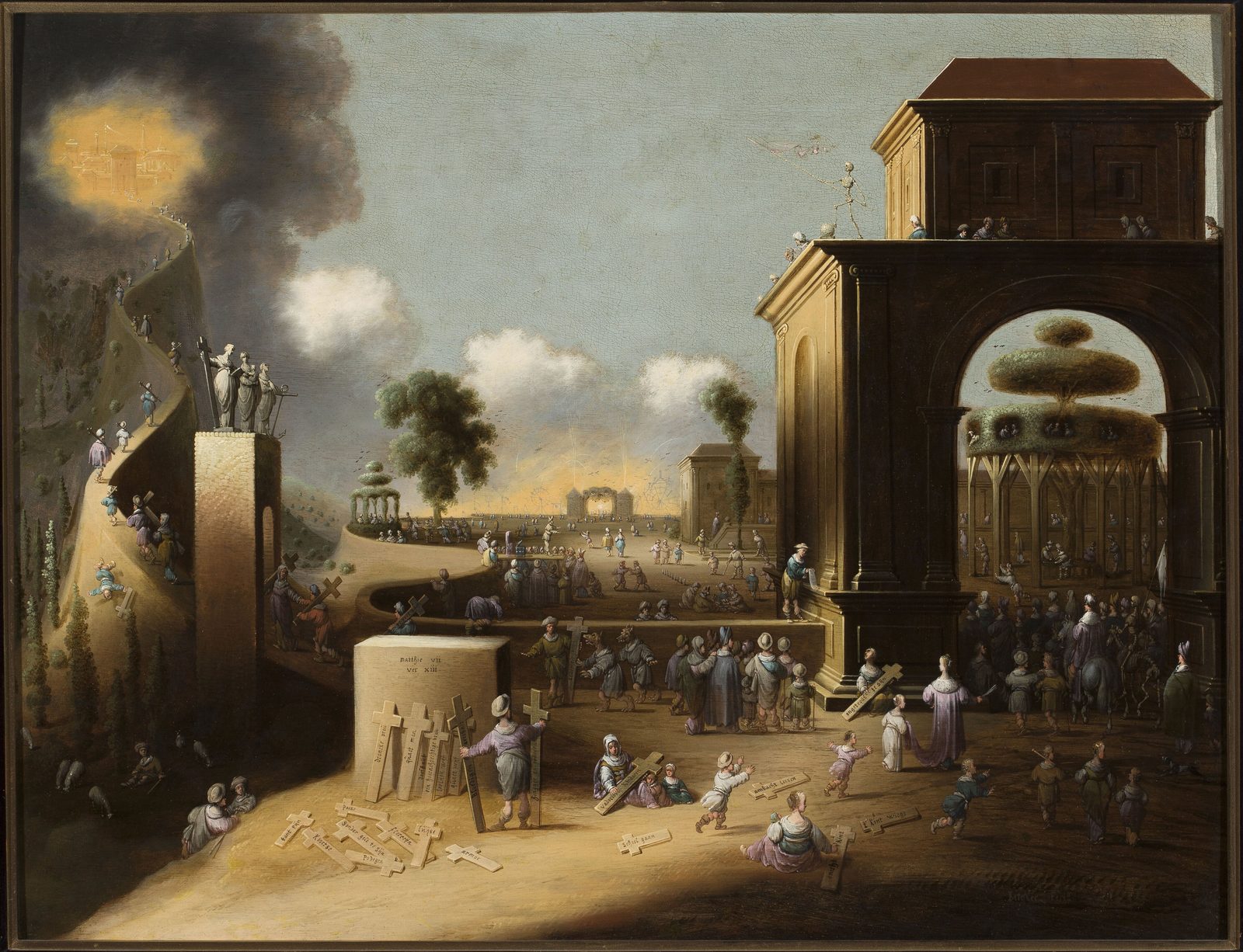
Narrow Road of Virtue and Wide Road of Sin. Jan Micker, not stated on the file page. National Museum in Warsaw. Public domain.