
Psalm 146
10 verses · Hallelujah psalm of praise
Hallelujah! Praise the LORD, O my soul.
Introduction
Author unstated, the Helper of the Helpless, Book 5: The return and the great Hallelujah, Poetry, Psalms Overview.
The Psalter's closing run of five praise psalms begins here, each opening and closing with Hallelujah. Its writer is not named. It was sung by a people who had watched rulers rise and fall and who knew how little a prince's promise could carry. Listen for the contrast between human rulers, whose plans end with their breath, and the Creator of all things, who stays true for all time. Then listen for the list of people He cares for, the ones no court would speak for.
Context
- Who
- Israelites who had watched kings and governors come and go while they stayed poor
- Where
- A congregation that had learned the hard way what a change of rulers is worth
- When
- The second temple, in the closing Hallelujah psalms of the Psalter. The Hebrew names no author; the Septuagint heads it of Haggai and Zechariah, a heading the Hebrew lacks, which would place its use after 520 BC
Historical context
The last five psalms all open and close with the same shout, praise the LORD, and were sung as a set to finish the book. This is the first of them, and the only voice in it is one person speaking to his own soul. The Hebrew gives the psalm no author, and the Greek gives it two, Haggai and Zechariah, the prophets of the rebuilding, a heading that looks like an inference drawn from the closing line about the LORD reigning in Zion. The warning about princes is about death: when a ruler's spirit departs he returns to the ground, and on that very day his plans perish. Every ancient kingdom ran on one man's projects, and the next man erased the last man's name from the monuments. Justice for the oppressed, food for the hungry, and protection for the foreigner, the fatherless and the widow were legal categories out of the Law of Moses, the people with no man to speak for them in court.
Significance
People living under Persian and then Greek administration were tempted to pin everything on the next official, and the song tells them to look elsewhere. It tells them to look for evidence of God in whether the widow down the street is upheld.
This chapter in Jewish lifeWhat this chapter is in Jewish life and reading.
What is done
Psalm 146 opens the final Hallel, which the book's structure file and the site's page at /featured/the-hallel both give as Psalms 146 to 150, five psalms that open and close with Hallelujah and stand as the doxology of the whole Psalter. Radak, writing on the psalm before it, gives the same grouping from inside the Jewish tradition: these six psalms to the end of the book are all praises, and the last five begin and end with Hallelujah. Ibn Ezra reads the opening call as addressed first to Israel and then by the poet to himself (Ibn Ezra on Psalms 146:1:1, Sefaria Community Translation, CC0), so the psalm is a congregation's psalm and a single voice's at once.
How it is read
The psalm's warning against trusting in princes is where the classical commentary works. Ibn Ezra reports the reading that a man has no true salvation to give, and sets his own beside it: what seems right in his eyes is that a man "is unable to save himself" (Ibn Ezra on Psalms 146:3:1, Sefaria Community Translation, CC0). Radak agrees that salvation belongs to God alone and then says God works it through people, naming Cyrus as the man through whom the return from Babylon came, and holding that the future redemption will come the same way through the kings of the nations. Rashi reads the blessing on the man whose help is the God of Jacob against the promise made to Jacob at Bethel, and gives the reason for the psalm's praise: God made heaven, earth and sea, so He can guard a man at sea as well as on dry land, where a mortal king can guard only the land. Ibn Ezra presses the warning into daily life and says a man should not lean on another man, nor on a physician, but should lean on God in prayer while the man or the physician serves as the means. On the ninth verse, where the LORD watches over the sojourner, Ibn Ezra reads the word for those God guards as converts, who have no aid because they come from another nation. Metzudat David comments on two verses with no English version in the corpus and stands as a citation, at Metzudat David on Psalms 146:2:1. Malbim carries no entry at all for this chapter.
What the rabbis say
The corpus records forty locators on this chapter, thirty-two Midrash and eight Talmud. The opening Hallelujah is taken up at Midrash Tehillim 146:1 and Midrash Tehillim 113:3. The warning against trusting in princes is taken up at Devarim Rabbah 5:9, Shemot Rabbah 18:8 and Midrash Tehillim 118:11. The return of a man's breath to the earth is taken up at Pirkei DeRabbi Eliezer 15:4, Midrash Tehillim 146:2 and Avot DeRabbi Natan 32:3. The help of the God of Jacob is taken up at Bereshit Rabbah 91:1, Jerusalem Talmud Berakhot 9:1:22 and Jerusalem Talmud Avodah Zarah 3:1:18. The opening of the eyes of the blind is taken up at Berakhot 12a:25 and Midrash Tehillim 146:4, and the watching over the sojourner at Bamidbar Rabbah 8:2, Midrash Tehillim 146:5 and Tractate Gerim 4:3. Each is a locator without text in the corpus.
Sources: Ibn Ezra, Ibn Ezra on Psalms 146:1:1, 146:3:1, 146:4:2, 146:5:1, 146:6:1, 146:8:1 and 146:9:1, Sefaria Community Translation, CC0; Radak, Radak on Psalms 146:1:1, 146:3:1, 146:7:1 and 146:7:2, Sefaria Community Translation, CC0; Radak on Psalms 145:1:1 for the grouping of the last six; Rashi, Rashi on Psalms 146:5:1, 146:6:1 and 146:10:1, the Judaica Press complete Tanach with Rashi, translated by A. J. Rosenberg, CC-BY; Metzudat David, Metzudat David on Psalms 146:2:1, cited only, no English version in the corpus; Midrash, Midrash Tehillim 146:1, 146:2, 146:4, 146:5, 113:3 and 118:11, Devarim Rabbah 5:9, Shemot Rabbah 18:8, Pirkei DeRabbi Eliezer 15:4, Bereshit Rabbah 91:1, Bamidbar Rabbah 8:2, Pesikta Rabbati 20:1; Babylonian Talmud, Berakhot 12a:25, Avot DeRabbi Natan 32:3 and 16:2, Tractate Gerim 4:3; Jerusalem Talmud, Berakhot 9:1:22, 1:5:15 and 4:1:5, Avodah Zarah 3:1:18; MannaFest, the final Hallel, at /featured/the-hallel and in src/components/book/dossier-content/psalms-structure.ts, 2026.
Psalms 146:1-2
Praise the LORD, O my soul: Hallelujah opens this psalm and closes it, and each of the four psalms after it wears the same frame. The soul answers with a vow: praise to the LORD for a whole life, and songs to God as long as he has being. The vow claims nothing past that.
Psalms 146:1
“Praise the Lord, O my soul. He did not say, praise the body, but, praise, O my soul; not that he condemned the body, but he condemned the works of the flesh. Praise the Lord, O my soul. The soul exhorts itself. Just as if David were to say, Praise the Lord, O David; so too the soul itself says to itself, Praise the Lord, O my soul.”
Jerome · written before 420 · Homily 55, on Psalm 145patristic
1 more voice on this verseWhat preachers and commentators have said about this verse, in their own words.
Psalms 146:1
“Praise ye the Lord, or, Hallelujah. It is saddening to remember how this majestic word has been trailed in the mire of late. Its irreverent use is an aggravated instance of taking the name of Jehovah our God in vain. Let us hope that it has been done in ignorance by the ruder sort; but great responsibility lies with leaders who countenance and even copy this blasphemy. With holy awe let us pronounce the word hallelujah, and by it summon ourselves and all others to adore the God of the whole earth.”
Charles Spurgeon · The Treasury of David, Vol. 7 (1885)Particular Baptist
while I have my being: Adam Clarke took the Hebrew beodi as a word of continuance, and he stretched it to an existence without end. Augustine told his hearers the praise of God continues after this life and grows fuller in the house never left. Jerome marked the future tense of the vow to praise.
Psalms 146:2
“I will praise the Lord in my life. See what it says: it exhorts itself, and it itself answers. What does it say? It says to me, Praise the Lord, O my soul: I myself answer, I will praise the Lord in my life. At present I cannot praise, I am weighed down by sins. As often as I open my lips in the praises of God, so often does the consciousness of my sins glue them shut. I will praise the Lord in my life. Beautifully he said, I will praise, not I praise.”
Jerome · written before 420 · Homily 55, on Psalm 145patristic
Psalms 146:3-4
Put not your trust in princes: Princes cannot save. The psalm gives the ground: the prince's spirit departs, he goes back to the ground, and his plans perish that same day. Matthew Henry sets one Son of Man against them, the man in whom help is found, while every other is as mortal as the ground.
Psalms 146:3
“Put not your trust in princes,.... Not in foreign princes, in alliances and confederacies with them; nor in any at home. David did not desire his people to put their trust in him, nor in his nobles and courtiers; but in the Lord Christ, who, as he is the object of praise, is also the proper object of trust.”
1 more voice on this verse
Psalms 146:3
“There is indeed a Son of man in whom there is help, in whom there is salvation, and who will not fail those that trust in him. But all other sons of men are like the man they are sprung of, who, being in honour, did not abide.”
Matthew Henry · Commentary on the Whole Bible (1707-1721)puritan
on that very day his plans perish: Matthew Henry read the ground as the man's, the earth he was taken from and must return to under the sentence of Genesis 3. Spurgeon marked how little it takes: a breath. Eusebius saw the verse fulfilled when Maximin fell and the sons who shared his honours fell with him.
Psalms 146:4
“His breath goeth forth, he returneth to his earth. His breath goes from his body, and his body goes to the grave. His spirit goes one way, and his body another. High as he stood, the want of a little air brings him down to the ground, and lays him under it. Man who comes from the earth returns to the earth: it is the mother and sister of his body, and he must needs lie among Ins kindred as soon as the spirit which was his life has made its exit.”
Charles Spurgeon · The Treasury of David, Vol. 7 (1885)Particular Baptist
1 more voice on this verse
Psalms 146:4
“His breath goeth forth,.... That is, the breath of a son of man, of any and everyone of the princes; it goes forth continually, and is drawn in again as long as a man lives; but at death it goes forth, and returns no more till the resurrection: the breath which the Lord breathed into man, and which is in his nostrils while he lives, and is very precarious.”
Psalms 146:5-6
whose help is the God of Jacob: The help that makes a man blessed is the God of Jacob, and the psalm gives his credential: Maker of heaven and earth. The Hebrew of the closing clause reads keeping faithfulness forever, set against the prince whose plans perish in a day. A maker outlasts what he made.
Psalms 146:5
“Blessed is he whose helper is the God of Jacob. These trust in chariots, and these in horses: but we will call upon the name of the Lord our God. They have more helpers: but they are princes, but they are men, but they collapse. We have one, who is able to save. His hope is in the Lord his God. Let us see what the three young men say in the Babylonian furnace, when Nebuchadnezzar summons them, and compels them to worship Bel: what do they answer Nebuchadnezzar?”
Jerome · written before 420 · Homily 55, on Psalm 145patristic
1 more voice on this verse
Psalms 146:5
“Happy is he that hath the God of Jacob for his help. Heaped up is his happiness. He has happiness indeed: the true and the real delight is with him. The God of Jacob is the God of the covenant, the God of wrestling prayer, the God of the tried believer; he is the only living and true God. The God of Jacob is Jehovah, who appeared unto Moses, and led the tribes of Jacob out of Egypt, and through the wilderness. Those are happy who trust him, for they shall never be ashamed or confounded.”
Charles Spurgeon · The Treasury of David, Vol. 7 (1885)Particular Baptist
He remains faithful forever: Spurgeon took comfort that the Maker of heaven made the sea, the deep and dark things as well as the bright. Jerome reasoned that He can deliver the man He made. John Wesley gave the faithfulness two grounds: He lives forever to fulfil His promises, and His faithfulness is eternal.
Psalms 146:6
“For ever - Both because he liveth forever to fulfil his promises, and because he is eternally faithful.”
John Wesley · Explanatory Notes upon the Old Testament (1765)evangelical
1 more voice on this verse
Psalms 146:6
“It is very applicable to Christ, by whom God made the world, and without whom was not any thing made that was made. It is a great support to faith that the Redeemer of the world is the same that was the Creator of it, and therefore has a good-will to it, a perfect knowledge of its case, and power to help it.”
Matthew Henry · Commentary on the Whole Bible (1707-1721)puritan
Psalms 146:7-8
He executes justice for the oppressed: Six works fill these verses: He executes justice, gives food, sets prisoners free, opens blind eyes, lifts the weighed down, and loves the righteous. Spurgeon marks the opening of blind eyes as work Jesus did: the blind receive sight at Matthew 11:5. Every one of the six is a deed.
Psalms 146:7
“He executeth judgment for them that suffer wrong. Even if it comes late, do not despair: coming he shall come, and shall save. He executeth judgment for them that suffer wrong. Let this alone be in our conscience, that we suffer unjustly. Let us hold this in our conscience, that we do not suffer on account of our sins, and that we do not do that of which we are accused. He giveth food to the hungry. And according to the letter it is profitable; and even if it be understood simply, it edifies the hearer.”
Jerome · written before 420 · Homily 55, on Psalm 145patristic
1 more voice on this verse
Psalms 146:7
“Which executeth judgment for the oppressed. He is a swift and impartial administrator of justice. Our King surpasses all earthly princes because he pays no deference to rank or wealth, and is never the respecter of persons. He is the friend of the down trodden, the avenger of the persecuted, the champion of the helpless. Safely may we trust our cause with such a Judge if it be a just one: happy are we to be under such a Ruler. Are we "evil entreated"? Are our rights denied us? Are we slandered?”
Charles Spurgeon · The Treasury of David, Vol. 7 (1885)Particular Baptist
the LORD opens the eyes of the blind: John Cassian noted that the Greek reads the Lord makes the blind wise. Augustine took that wording as the key to the whole list, so the fetters and the falls are those of the soul. Albert Barnes let the words cover both bodily and mental blindness.
Psalms 146:8
“The Lord openeth the eyes of the blind. Jesus did this very frequently, and hereby proved himself to be Jehovah. He who made the eye can open it, and when he does so it is to his glory. How often is the mental eye closed in moral night! And who can remove this dreary effect of the fall but the Almighty God This miracle of grace he has performed in myriads of cases, and it is in each case a theme for loftiest praise. The Lord raiseth them that are bowed down.”
Charles Spurgeon · The Treasury of David, Vol. 7 (1885)Particular Baptist
1 more voice on this verse
Psalms 146:8
“The Lord enlighteneth the blind. See what it says. If he were speaking of these blind men, he ought to have said, The Lord enlighteneth the blind. But he did not say this: but according to the Hebrew and Greek truth, what did he say? The Lord maketh the blind wise. If he were speaking of these eyes of the flesh, he ought to have said, The Lord enlighteneth the blind: but now indeed he says, The Lord maketh the blind wise. If ye were blind, he says, ye should have no sin.”
Jerome · written before 420 · Homily 55, on Psalm 145patristic
The LORD protects foreigners: The three, the foreigner, the fatherless and the widow, are the three with no family standing to protect them. Deuteronomy 10:18 names the three: the LORD does justice for the fatherless, keeps the widow, and loves the foreigner with food and clothing. The LORD frustrates the ways of the wicked.
Psalms 146:9
“The Lord keepeth the strangers: he will take up the orphan and the widow. And according to the letter it is profitable. He will take up the orphan and the widow. O martyr, you who are held fast to shed your blood for me, do not be anxious about your children, do not be anxious about your wife: they have me in your place. Let us speak also according to the spirit. He will take up the orphan and the widow. He will take up the orphan, who had lost God his father through sins.”
Jerome · written before 420 · Homily 55, on Psalm 145patristic
1 more voice on this verse
Psalms 146:9
“The Lord preserveth the strangers. Many monarchs hunted aliens down, or transported them from place to place, or left them as outlaws unworthy of the rights of man; but Jehovah made special laws for their shelter within his domain. In this country the stranger was, a little while ago, looked upon as a vagabond, —a kind of wild beast to be avoided if not to be assaulted; and even to this day there are prejudices against foreigners which are contrary to our holy religion.”
Charles Spurgeon · The Treasury of David, Vol. 7 (1885)Particular Baptist
The LORD reigns forever: A reign with no end answers the prince whose plans died in a day. The psalm names whose reign it is, Zion's own God, and stretches it to all generations. Matthew Henry reads Zion's King as Christ on the holy hill.
Psalms 146:10
“The Lord shall reign for ever. Jehovah is King, and his kingdom can never come to an end. Neither does he die, nor abdicate, nor lose his crown by force. Glory be to his name, his throne is never in jeopardy. As the Lord ever liveth, so he ever reigneth. Even thy God, O Zion, unto all generations. Zion's God, the God of his worshipping people, is he who in every age shall reign.”
Charles Spurgeon · The Treasury of David, Vol. 7 (1885)Particular Baptist
1 more voice on this verse
Psalms 146:10
“Let this encourage us to trust in God at all times that the Lord shall reign for ever, in spite of all the malignity of the powers of darkness, even thy God, O Zion! unto all generations. Christ is set King on the holy hill of Zion, and his kingdom shall continue in an endless glory.”
Matthew Henry · Commentary on the Whole Bible (1707-1721)puritan
How this psalm is built
The form: The first of the five closing Hallelujah psalms, where the broad river of the book ends in a cataract of praise, as Spurgeon classes it.
The patterns in this chapter
| Device | What it does | Where to see it |
|---|---|---|
| Hallelujah at both ends | The psalm opens on the word and closes on it, which is the mark of the five psalms that end the Psalter. Spurgeon calls the whole run a cataract of praise after the broad river of the book. Barnes reads the opening call as addressed to all people and the second line as the singer turning it on himself, praise the LORD, O my soul.Albert Barnes, Notes, Explanatory and Practical, on the Old and New Testaments, 1832 to 1869, on Psalm 146:1. | Psalm 146:1, Psalm 146:10 |
| While I live, while I have my being | Verse 2 says the same thing twice with two different measures of a life. Spurgeon reads it as a man who knows this mortal life will find its end in death and resolves to praise for the whole of what is left. Clarke calls it the true feeling of a heart overpowered by a sense of God's goodness.Charles Spurgeon, The Treasury of David, Vol. 7, 1885, on Psalm 146:2. | Psalm 146:2 |
| The prince and the Maker, set against each other | Verses 3 and 4 describe a ruler whose spirit departs, who returns to the ground, and whose plans perish on that very day. Verses 5 and 6 describe the Maker of heaven and earth and the sea, who remains faithful forever. The two pictures are set side by side and the whole psalm turns on the difference between them.Matthew Henry, Commentary on the Whole Bible, 1710, on Psalm 146:4. | Psalm 146:3, Psalm 146:4, Psalm 146:6 |
| What God does, item by item | Verses 7 to 9 list eight acts in a row. Justice for the oppressed, food for the hungry, prisoners set free, the eyes of the blind opened. The bowed down lifted up, the righteous loved, foreigners protected, the fatherless and the widow sustained. Every category in the list is one the Law of Moses names, and the last three are the people with no one to speak for them in court.Albert Barnes, Notes, Explanatory and Practical, on the Old and New Testaments, 1832 to 1869, on Psalm 146:5. | Psalm 146:7, Psalm 146:8, Psalm 146:9 |
The structure
7 more paragraphs on the patterns
Ten verses in three moves. Verses 1 and 2 are the resolve, verses 3 and 4 are the warning, verses 5 to 10 are the blessing and its grounds. The pivot is the word blessed at verse 5, which turns the psalm from what not to trust to who is happy, and the grounds run straight from there to the last line.
The prophecy and the New Testament's use
No New Testament writer quotes Psalm 146. Its list at verses 7 and 8 is the list Jesus reads out of Isaiah in the synagogue at Nazareth and claims at Luke 4:18. That list is good news to the poor, freedom for the prisoners, sight for the blind, release for the oppressed. It is also the answer He sends back to John the Baptist at Matthew 11:5. The psalm and the prophet describe the same works, and the Gospels present them as done.
The debate
Who wrote the psalm and when is open, and the evidence is in the versions rather than in the text. Jerome's position is the careful one: the Septuagint heads it of Haggai and Zechariah, the Hebrew carries no such heading, and the ascription looks like an inference drawn from the psalm's closing line about Zion. Clarke argues from the content instead, reading the warning about princes against the revoked edict of a Persian king. Both readings place the psalm after the exile, and neither rests on anything the Hebrew text itself says.
Where it sits
Read the five closing psalms as one piece. Psalm 146 is the individual voice and Psalm 147 is the rebuilt city. Psalm 148 is the whole creation, Psalm 149 is the assembly of the godly, and Psalm 150 is the orchestra and every breathing thing.
Keep studying
Words8
Subjects1
Sources for this chapter
The summary
Jamieson, Fausset & Brown, Commentary Critical and Explanatory; John Calvin, Commentaries; John Wesley, Notes on the Old Testament and Matthew Henry, Complete Commentary.
The form and classifications
Adam Clarke, Commentary on the Bible, 1832, on Psalm 146:3; Charles Spurgeon, The Treasury of David, Vol. 7, 1885, on Psalm 147:1 and Jerome, Homily 56, on Psalm 146, on Psalm 146:1.
The exposition
Adam Clarke, Commentary on the Bible; Albert Barnes; Augustine of Hippo; Charles Spurgeon, The Treasury of David; Eusebius of Caesarea, ECCLESIASTICAL HISTORY 9:11; Franz Delitzsch, Biblical Commentary on the Psalms; Jerome, Homily 55, on Psalm 145; John Cassian, CONFERENCE 3:15; John Gill, Exposition of the Old Testament; John Wesley, Explanatory Notes upon the Old Testament and Matthew Henry, Commentary on the Whole Bible.
The painting
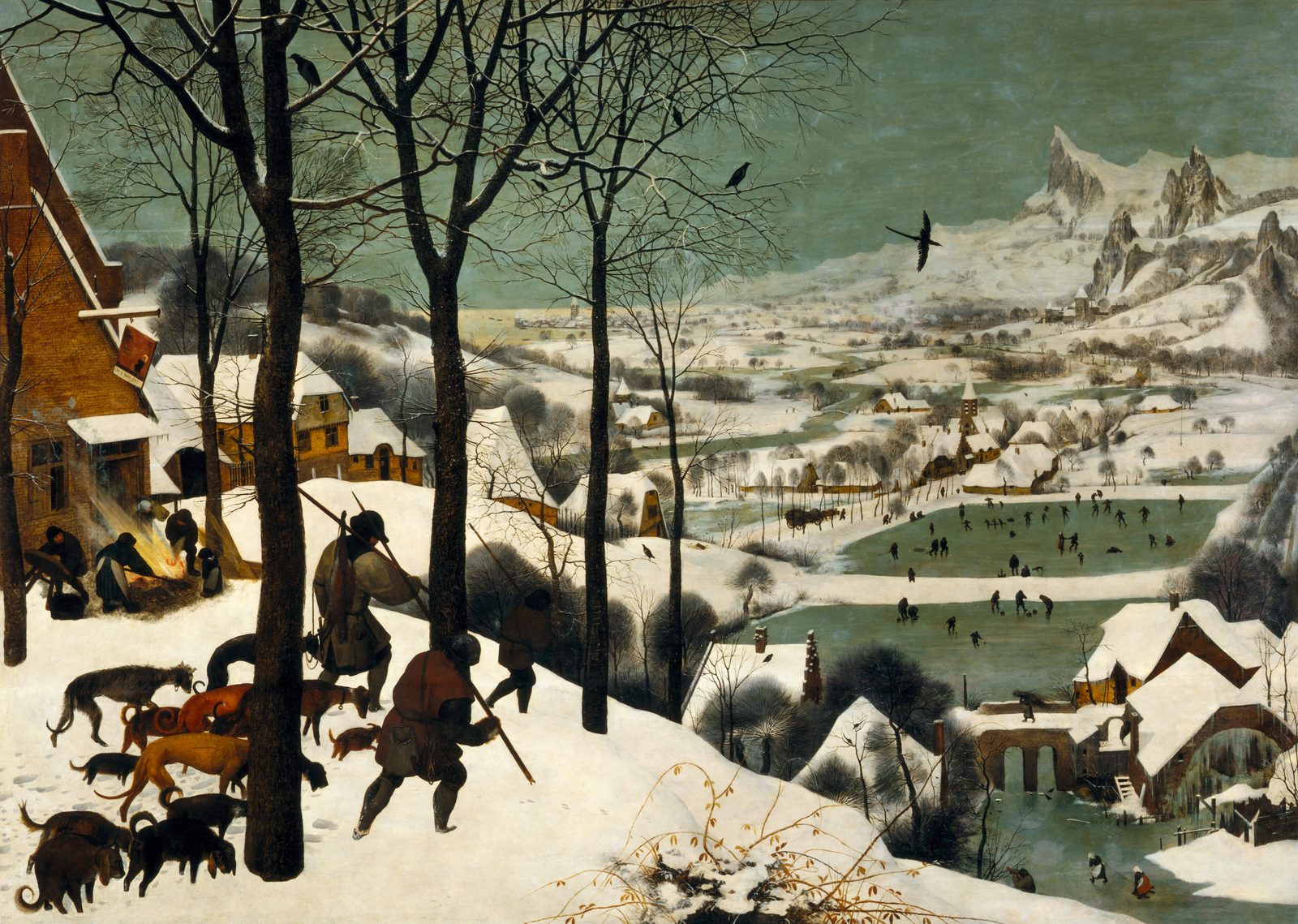
The Hunters in the Snow. Pieter Brueghel the Elder, 1565. Wikimedia Commons. Public domain.