
Psalm 13
6 verses · Individual lament
How long, O LORD? Will You forget me forever? How long will You hide Your face from me?
Introduction
David, How Long, Book 1: The book of David, Poetry, Psalms Overview.
David wrote this short prayer out of a trouble that had gone on too long. It is a lament, the form Israel used to bring a complaint to God inside the covenant. In six verses it moves from protest to petition to trust, and the circumstances stay the same the whole way. Listen for the repeated question at the start and for the single turn near the end, where the speaker decides where he will stand. Read it as leave to ask God hard questions and as a pattern for how such asking ends.
Context
- Who
- Israelites whose trouble had outlasted their patience
- What
- A short lament that moves from asking how long, to asking for an answer, to trusting and singing.
- Where
- Israel in David's reign; the psalm names no place.
- When
- The reign of David, about 1010 to 970 BC by the superscription.
- Why
- To give a sufferer words for a long delay and a way to reach trust before the trouble lifts.
Historical context
How long opens four lines in a row, which is the form of an ancient complaint prayer, and Mesopotamian laments carry versions of the same question. What differs here is the relationship the question is asked inside, since this God has bound Himself by covenant, so the question appeals to a promise. Hiding the face is court language, since a king's face turned toward a man meant favour, access and protection, and a face turned away meant the loss of standing at court. Giving light to the eyes at verse 3 comes from watching people die, since the eyes of the dying go dull and bright eyes meant strength and life. The last verse moves toward the sanctuary, where a worshipper who vowed a song in trouble came back to sing it in public when the trouble lifted, often with a thank offering.
Significance
The psalm gave Israel the complaint and the road out of it in six verses, and it treats the delay as long and the fear of enemies as real. The turn comes on one clause, that the singer has trusted in God's loving devotion. The circumstances stand where they stood, and he chooses where to stand while it is still dark.
This chapter in Jewish lifeWhat this chapter is in Jewish life and reading.
How it is read
This is the thinnest chapter of the first thirty in the corpus, and the row says so rather than filling the gap. Sefaria holds English text for two comments of Rashi on this psalm and for nothing else. Ibn Ezra, Radak, Malbim and Metzudat David all comment on every verse, and their entries carry the ref without the text. They stand here cited and unquoted at Ibn Ezra on Psalms 13:1:1 to 13:6:1 and at Radak on Psalms 13:1:1 to 13:5:1. Two more stand at Malbim on Psalms 13:1:1 to 13:6:1 and at Metzudat David on Psalms 13:2:1 to 13:6:1. Malbim is the one commentator of the corpus who wrote in the modern period, and this chapter is one of the few in the first thirty where he stands in it at all.
Rashi's two comments are worth the whole chapter. He is quoted here from the Judaica Press Tanach with Rashi. The psalm asks how long four times over, and Rashi counts the four. They correspond "to the four kingdoms", which he names as Babylon, Persia, Greece and Edom, "and it is stated concerning all Israel" (Rashi on Psalms 13:2:1). That single note moves the psalm from one man's night to the whole length of the exile, and gives a Christian reader the shape of the Jewish reading of history in one line. The four kingdoms are the succession of empires over Israel, and Edom in Rashi's usage stands for the power of his own day. The site reports the identification as Rashi's rather than as the sense of the verse.
The second comment is a plain gloss with a long reach. At the fourth verse David asks that he may not sleep the sleep of death, and Rashi notes that "death is called sleep", proving it from Jeremiah (Rashi on Psalms 13:4:1). The New Testament uses the same figure of speech, and the site sets that use beside this note where the two touch.
What the rabbis say
The corpus carries twenty-nine locators on this psalm and the text of none, so each is cited and linked here rather than quoted. Only one is Talmudic, at Pesachim 119a:3 on the heading.
Midrash Tehillim carries nine. They stand at 13:1 on the first verse, at 13:2, 13:3, 7:19 and 119:24 on the second, at 13:4 and 13:5 on the third, at 13:6 on the fourth and 13:7 on the fifth. The second verse carries the heaviest weight in the whole chapter. Beside Midrash Tehillim there stand on it Aggadat Bereshit 32:3, Bamidbar Rabbah 16:22, Yalkut Shimoni on Torah 743:18, and an entry of Otzar Midrashim on Psalm 118. Two entries of Midrash Lekach Tov stand on the same verse, on Exodus 16:28:2 and Numbers 14:11:1.
Three entries of Midrash Tanchuma stand on the second verse, at Sh'lach 12:1 and at Sh'lach 23:1 and the appendix to Sh'lach 8:4 in the Buber recension. On the third verse the corpus carries Aggadat Bereshit 36:1, and on the fourth Midrash Tanchuma, Shoftim 11:1 with Yalkut Shimoni on Torah 76:10. On the sixth it carries Kohelet Rabbah 7:1:4, Midrash Shmuel 23:8, Midrash Tanchuma, Terumah 5:3, and an entry of Otzar Midrashim from the alphabet of Rabbi Akiba. Three more stand later in the chapter, at Ein Yaakov, Khagigah 2:6 in the Glick Edition, Shemot Rabbah 3:8 and Pesikta Rabbati 37:1. What each of them teaches is a saying of the rabbis, and is reported as theirs wherever this site quotes one. The quotations wait on a fetch that carries the text.
Sources: Rashi, Rashi on Psalms 13:2:1 and 13:4:1, the Judaica Press complete Tanach with Rashi, translated by A. J. Rosenberg; Ibn Ezra, Ibn Ezra on Psalms 13:1:1 to 13:6:1, cited by ref because the corpus carries no English text; Radak, Radak on Psalms 13:1:1 to 13:5:1, cited by ref because the corpus carries no English text; Malbim, Malbim on Psalms 13:1:1 to 13:6:1, cited by ref because the corpus carries no English text; Metzudat David, Metzudat David on Psalms 13:2:1 to 13:6:1, cited by ref because the corpus carries no English text; The Sefaria corpus, scripts/data/sources/sefaria/psalms/13.json, the 1 Talmud and 28 Midrash locators of this chapter.
Psalms 13:1-2
How long, O LORD?: is asked four times in two verses. The four are being forgotten, the face of God hidden, a soul wrestling with sorrow each day, and an enemy on top. Spurgeon read that fourfold cry as intense desire for deliverance and great anguish of heart.
Psalms 13:1
THIS is a very short Psalm, there are only six verses in it, but what a change there is between the beginning and the end of it! The first two verses are dolorous to the deepest degree, but the last verse is joyful to the highest degree. David begins many of his Psalms sighing and ends them singing, so that I do not wonder that Peter Moulin says, "One would think that those Psalms had been composed by two men of a contrary humor." If I were asked, "Are there two men here, or is there only one?"
Charles Spurgeon · written before 1892 · The Metropolitan Tabernacle Pulpit, Sermon No. 2310: “Howling Changed To Singing” (lightly modernized text, CCEL edition)Particular Baptist
must I wrestle in my soul: Spurgeon found in the Hebrew behind this wrestling the laying up of counsels, plans turned over day after day with sorrow in the heart. Clarke read the wrestling as ways of deliverance framed each day while the enemy dominates. Each plan came to nothing.
Psalms 13:2
"How long shall I take counsel, in my soul, having sorrow in my heart daily?"There is in the original the idea of "laying up" counsels in his heart, as if his devices had become innumerable but unavailing. Herein we have often been like David, for we have considered and reconsidered day after day, but have not discovered the happy device by which to escape from our trouble. Such store is a sad sore. Ruminating upon trouble is bitter work.
Charles Spurgeon · The Treasury of David, Vol. 1 (1869)Particular Baptist
Psalms 13:3-4
Consider me and respond: The complaint turns to prayer at verse 3, where the psalmist asks God to consider him and respond. Give light to my eyes is the prayer of a man near death, whose enemy would claim to have overcome him. Gill reads the plea as resting on God's honour.
Psalms 13:3
“Is God a light to enlighten the eyes of the body or the eyes of the intellect? The prophet says of the latter, "Enlighten my eyes lest I sleep in death." I think it is clear to everyone that we would not say that God performs the work of the sun and assigns to another the task of enlightening the eyes of those who will not sleep in death. God, therefore, enlightens the mind of those whom he judges to be worthy of personal enlightenment.”
Origen of Alexandria · written before 253 · Commentary on the Gospel of John 13:135-37patristic
2 more voices on this verse
Psalms 13:3
“But now prayer lifteth up her voice, like the watchman who proclaims the daybreak. Now will the tide turn, and the weeper shall dry his eyes. The mercy-seat is the life of hope and the death of despair. The gloomy thought of God's having forsaken him is still upon the psalmist's soul, and he therefore cries, "Consider and hear me." He remembers at once the root of his woe, and cries aloud that it may be removed. The final absence of God is Tophet's fire, and his temporary absence brings his people into the very suburbs of hell.”
Charles Spurgeon · The Treasury of David, Vol. 1 (1869)Particular Baptist
Psalms 13:3
“We should never allow ourselves to make any complaints but what are fit to be offered up to God and what drive us to our knees. What his petitions are: Consider my case, hear my complaints, and enlighten my eyes, that is, (1.) "Strengthen my faith;" for faith is the eye of the soul, with which it sees above, and sees through, the things of sense.”
Matthew Henry · Commentary on the Whole Bible (1707-1721)puritan
lest my enemy say: The lest of verse 3 runs on here, so the sleep of death the psalmist fears would give the enemy cause to boast. Augustine set Job beside the verse, troubled by the foe and never moved. Spurgeon made the enemy's arrogance an argument in prayer.
Psalms 13:4
“Another plea is urged in the fourth verse, and it is one which the tried believer may handle well when on his knees. We make use of our arch-enemy for once, and compel him, like Samson, to grind in our mill while we use his cruel arrogance as an argument in prayer. It is not the Lord's will that the great enemy of our souls should overcome his children. This would dishonour God, and cause the evil one to boast.”
Charles Spurgeon · The Treasury of David, Vol. 1 (1869)Particular Baptist
Psalms 13:5-6
trusted in Your loving devotion: The psalm turns at the word but, with the enemy of verse 4 still in place. Henry read the trust in God's mercy as filling the heart with joy in His salvation, the heart that had grieved daily now rejoicing. Verse 6 sings for good already shown.
Psalms 13:5
“His faith in God's mercy filled his heart with joy in his salvation; for joy and peace come by believing, Rom. xv. Believing, you rejoice, 1 Pet. i. Having put his trust in the mercy of God, he is fully assured of salvation, and that his heart, which was now daily grieving, should rejoice in that salvation.”
Matthew Henry · Commentary on the Whole Bible (1707-1721)puritan
1 more voice on this verse
Psalms 13:5
“What a change is here! Lo, the rain is over and gone, and the time of the singing of birds is come. The mercy-seat has so refreshed the poor weeper, that he clears his throat for a song. If we have mourned with him, let us now dance with him.”
Charles Spurgeon · The Treasury of David, Vol. 1 (1869)Particular Baptist
I will sing to the LORD: Barnes explained the Hebrew gamal as dealing kindly. Spurgeon heard it answer verse 1, the heart that feared the LORD would forget it forever now singing of His good. Wesley held that the psalmist could sing of salvation still to come as already given, sure of it.
Psalms 13:6
“The Psalm closes with a sentence which is a refutation of the charge of forgetfulness which David had uttered in the first verse, "He hath dealt bountifully with me." So shall it be with us if we wait awhile. The complaint which in our haste we utter shall be joyfully retracted, and we shall witness that the Lord hath dealt bountifully with us.”
Charles Spurgeon · The Treasury of David, Vol. 1 (1869)Particular Baptist
1 more voice on this verse
Psalms 13:6
“I will sing - It is a common thing for David and other prophets to speak of future deliverances as if they were already come, that so they may signify both the infallible certainty of the thing, and their firm assurance thereof.”
John Wesley · Explanatory Notes upon the Old Testament (1765)evangelical
How this psalm is built
The form: A short lament that opens in complaint and closes in song, as Spurgeon classes it.
The patterns in this chapter
| Device | What it does | Where to see it |
|---|---|---|
| How long, asked four times | Adam Clarke counts the Hebrew phrase ad anah four times across the first two verses and reads the repetition as great dejection joined to earnestness of soul. Charles Spurgeon reads the same four as intense desire for deliverance and great anguish of heart, with some impatience mingled in. The four things asked about are being forgotten, the face of God hidden, a soul wrestling with sorrow each day, and an enemy who dominates.Adam Clarke, Commentary on the Bible, 1832, on Psalm 13:1. | Psalm 13:1, Psalm 13:2 |
| The turn at the word but | Verse 4 ends with foes who rejoice at a fall and verse 5 opens with the word but. The enemy stands where he stood. Matthew Henry reads the trust in God's mercy as what filled the heart with joy in His salvation, so that a heart which had grieved daily came to rejoice.Matthew Henry, Commentary on the Whole Bible, 1710, on Psalm 13:5. | Psalm 13:4, Psalm 13:5 |
| The charge of verse 1 answered by the song of verse 6 | Charles Spurgeon reads the closing sentence as a refutation of the charge of forgetfulness which David had uttered in the first verse. The psalm opens by asking whether God will forget forever and closes by saying that He has been good to me, and the two lines stand at the two ends of six verses.Charles Spurgeon, The Treasury of David, Vol. 1, 1869, on Psalm 13:6. | Psalm 13:1, Psalm 13:6 |
| The heading, to the Overseer | Young's Literal Translation renders the heading To the Overseer. A Psalm of David. This site's published table of the heading terms reads the direction to the man over the temple music as a mark of public worship rather than private prayer, and counts it over fifty-five psalms. The one letter lamed before David's name carries authorship in the traditional reading and can also be read as for David or as belonging to the collection of David.This site's published structure of the Psalter, src/components/book/dossier-content/psalms-structure.ts, the superscription terms table. | Psalm 13:1 |
Where it sits
This site's published type of Psalm 13 is lament and trust, the largest kind in the Psalter, and the same type covers the psalms on either side of it. Psalm 12 cries for help because the faithful have vanished from among men, and Psalm 14 has the LORD look down from heaven on the sons of men to see if any understand, if any seek God. Psalm 13 is the smallest of the three and it carries the whole shape of a lament inside six verses, address, complaint, petition, and the vow of praise.
2 more paragraphs on the patterns
The debate over the complaint
The commentators divide over what to call the four questions. Matthew Henry reads them as David construing God's dealing as unkindness, which he calls his infirmity, since David thought God had forgotten His promises and His covenant and the former loving kindness He had shown. Charles Spurgeon grants that some impatience is mingled in and holds that this makes the psalm the truer portrait of our own experience, since desire is not easily kept from degenerating into impatience. Augustine of Hippo reads the questions of the soul rather than of the circumstances, taking the hidden face as God withholding the knowledge of Himself from a mind whose eye is still impure. Theodoret of Cyrus holds that the psalm was uttered after the sin, on the ground that the psalmist rests his case at verse 5 on mercy rather than on his own righteousness.
The eyes that are given light
The prayer of verse 3 asks God to give light to my eyes, and the early readers took the eyes for the eyes of the mind. Origen of Alexandria argues that God enlightens the mind of those He judges worthy of personal enlightenment, since the work of lighting the body's eyes belongs to the sun. Eusebius of Caesarea reads the face of God as a power that confers gifts, so that a spirit turned away from it lives in shadow. Gregory of Nazianzus puts the line in his oration on baptism and applies it to a man still unenlightened.
Keep studying
Sources for this chapter
The summary
Jamieson, Fausset & Brown, Commentary Critical and Explanatory; John Calvin, Commentaries; John Wesley, Notes on the Old Testament and Matthew Henry, Complete Commentary.
The form and classifications
Charles Spurgeon, The Metropolitan Tabernacle Pulpit, Sermon No. 2310, Howling Changed To Singing, 1893, on Psalm 13; Theodoret of Cyrus, Commentary on the Psalms 13:4, 458 and This site's published structure of the Psalter, src/components/book/dossier-content/psalms-structure.ts, the psalm types table.
The exposition
Adam Clarke, Commentary on the Bible; Albert Barnes; Augustine of Hippo, Exposition on Psalm 13; Charles Spurgeon, The Treasury of David; Franz Delitzsch, Biblical Commentary on the Psalms; John Gill, Exposition of the Old Testament; John Wesley, Explanatory Notes upon the Old Testament and Matthew Henry, Commentary on the Whole Bible.
The painting
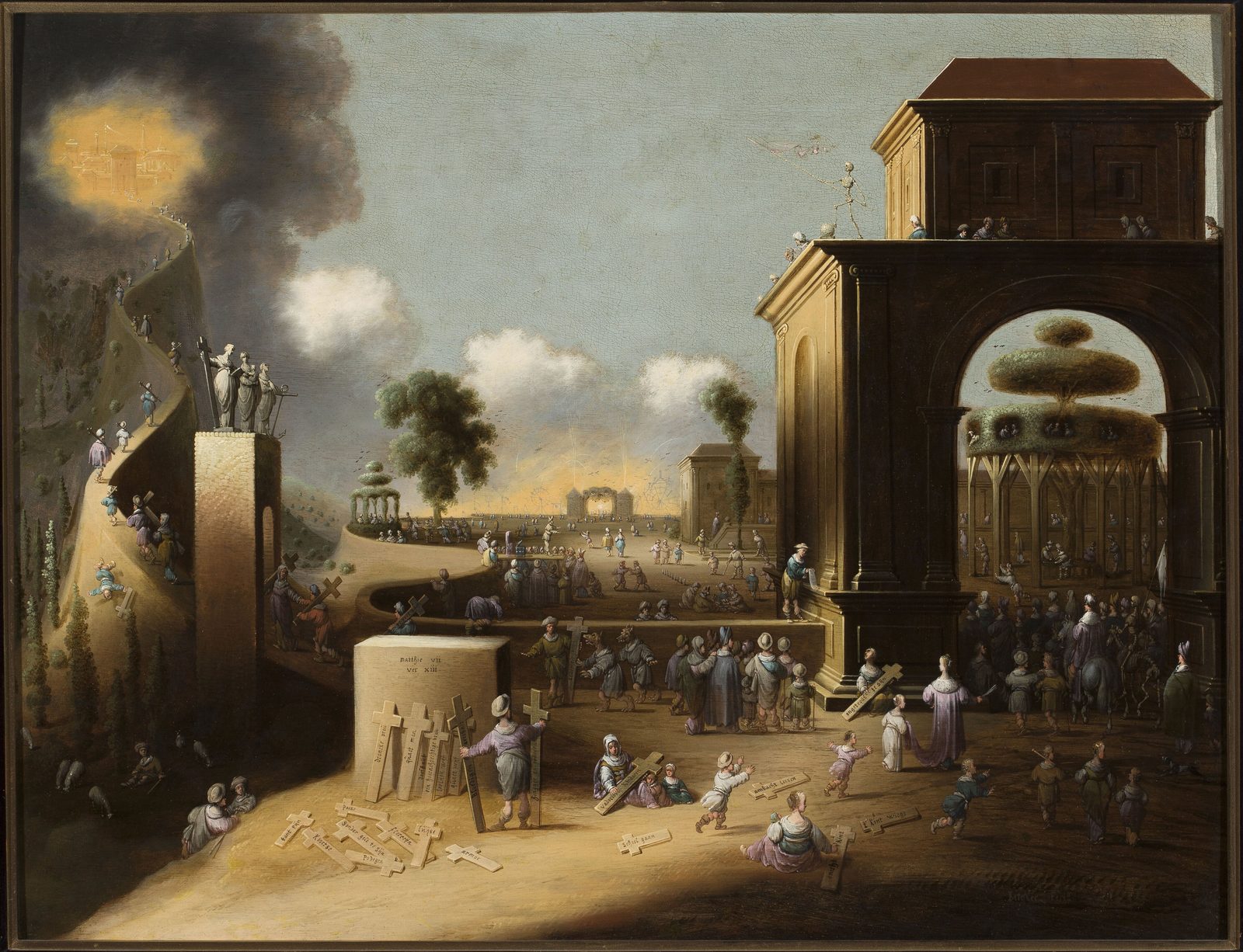
Narrow Road of Virtue and Wide Road of Sin. Jan Micker, not stated on the file page. National Museum in Warsaw. Public domain.