
Psalm 127
5 verses · Song of Ascents, wisdom psalm
Unless the LORD builds the house, its builders labor in vain; unless the LORD protects the city, its watchmen stand guard in vain.
Introduction
Solomon, the House the LORD Builds, Book 5: The return and the great Hallelujah, Poetry, Psalms Overview.
Solomon, the king who built the temple and his own palace, is named in the heading, and this is the only one of the fifteen Songs of Ascents that carries his name. The psalm speaks to people who worked from dawn to dark and still feared for the future. It takes three ordinary labours, building, keeping watch and earning bread, and then the gift of children, and places each one in the hand of God. Listen for the word vain, and for the scene at the city gate that closes it.
Context
- Who
- Israelites who worked from dawn to dark and still worried about the future
- What
- A wisdom psalm on building, guarding, working and children, each as the LORD's gift.
- Where
- A house under construction, a city wall at night and a family home in Israel.
- When
- The reign of Solomon, about 970 to 930 BC by the superscription.
- Why
- To take the credit for a household's labour and its future and give it to the LORD.
Historical context
The heading assigns this psalm to Solomon, David's son and the king who built the temple and the palace complex in Jerusalem, and it is the only psalm of the fifteen that carries his name. Three jobs are named in order, builder, watchman and worker. Building a house meant quarrying and hauling stone and roofing with beams, brush and packed earth, which was months of heavy labour by the whole household. A watchman on a city wall paced all night and called the hours. A quiver held a fixed number and a man went out with what he had. The open space inside the city gate was the courtroom, and a man with grown sons standing behind him could not be quietly cheated there.
Significance
In a pilgrim collection sung on the way to the temple, this psalm takes the whole ordinary week and gives the credit for it to God, who gives to His beloved while they sleep. It was an argument against believing that the working was what kept the house standing, and Israelites worked hard.
This chapter in Jewish lifeWhat this chapter is in Jewish life and reading.
What is done
Psalm 127 is the eighth of the fifteen Songs of Ascents and the one psalm of the collection that carries Solomon's name, as the book's structure file records. It is sung within the collection, whose setting this site takes from Mishnah Middot 2:5 and Mishnah Sukkah 5:4 at /featured/psalms-of-ascent. Rashi's reading turns the psalm toward the study of Torah, and the household blessing of its second half has been heard in Jewish teaching as a blessing on disciples as much as on children.
How it is read
Rashi reads the psalm as David speaking to Solomon, seeing by the holy spirit that his son would build the Temple and would marry Pharaoh's daughter on the same day, and warning him that a house God does not want is built in vain. From the second verse on he reads the psalm as being about Torah. The bread of toil belongs to the craftsmen who rise early and stay late, while God gives sustenance "to him who banishes his sleep from his eyes in order to engage in the Torah" (Rashi on Psalms 127:2:2, the Judaica Press complete Tanach with Rashi, translated by A. J. Rosenberg, CC-BY). The sons of the third verse he reads as disciples, "the disciples whom he sets up, who are to him like sons" (Rashi on Psalms 127:3:2), and the arrows of the fourth as the disciples a man raises in his youth. The enemies in the gate he reads as scholars of Torah who defeat one another in halakhah and so appear as enemies. Ibn Ezra, Radak and Metzudat David comment on the psalm and stand here as citations, at Ibn Ezra on Psalms 127:1:1, Radak on Psalms 127:1:1 and Metzudat David on Psalms 127:1:1, because the corpus holds no English version of theirs on this chapter under a licence permitting quotation.
What the rabbis say
The corpus records forty locators on this chapter, twenty-nine Midrash and eleven Talmud. The builders who labour in vain are taken up at Midrash Tehillim 127:1, Eikhah Rabbah, Petichta 2, Pesikta DeRav Kahana 15:5, Shir HaShirim Rabbah 1:1:10, Yoma 19b:14 and Jerusalem Talmud Chagigah 1:7:2-4. The bread of toil is taken up at Ketubot 62a:6 and Yoma 77a:6. The heritage of sons is taken up at Bamidbar Rabbah 3:8, Kohelet Rabbah 10:7:1, Niddah 71a:2 and Niddah 71a:4, and the arrows in the hand of a warrior at Kiddushin 30b:1, Avot DeRabbi Natan 23:4, Sifrei Devarim 34:1 and Shemot Rabbah 30:8. The corpus carries these as locators without text.
Sources: Rashi, Rashi on Psalms 127:1:1, 127:2:2, 127:3:2, 127:4:2 and 127:5:2, the Judaica Press complete Tanach with Rashi, translated by A. J. Rosenberg, CC-BY; Ibn Ezra, Ibn Ezra on Psalms 127:1:1, cited only, no English version in the corpus; Radak, Radak on Psalms 127:1:1, cited only; Metzudat David, Metzudat David on Psalms 127:1:1, cited only; Midrash, Midrash Tehillim 127:1, Eikhah Rabbah, Petichta 2, Pesikta DeRav Kahana 15:5, Shir HaShirim Rabbah 1:1:10, Bamidbar Rabbah 3:8, Kohelet Rabbah 10:7:1, Sifrei Devarim 34:1, Shemot Rabbah 30:8; Babylonian Talmud, Yoma 19b:14 and 77a:6, Ketubot 62a:6, Niddah 71a:2 and 71a:4, Kiddushin 30b:1, Avot DeRabbi Natan 23:4; Jerusalem Talmud, Chagigah 1:7:2-4, Yoma 1:4:2; MannaFest, the Songs of Ascents, at /featured/psalms-of-ascent; the collections of the Psalter, src/components/book/dossier-content/psalms-structure.ts, 2026.
Psalms 127:1-2
Unless the LORD builds the house: The word for vain stands three times in these two verses. The builder builds and the watchman keeps guard, and both labor for nothing unless the LORD is in the work. The verb under his watching means to be sleepless, and the next line gives sleep to the LORD's beloved.
Psalms 127:1
“Except the Lord build the house, they labour in vain that build it. The word vain is the keynote here, and we hear it ring out clearly three times. Men desiring to build know that they must labour, and accordingly they put forth all their skill and strength; but let them remember that if Jehovah is not with them their designs will prove failures.”
Charles Spurgeon · The Treasury of David, Vol. 7 (1885)Particular Baptist
He gives sleep to His beloved: Toiling here is the Hebrew word for painful labor. Henry read the verse through Solomon, whom Nathan named Jedidiah, beloved of the LORD, at 2 Samuel 12:25. Absalom rose early for the throne, and the LORD gave His beloved sleep and the kingdom.
Psalms 127:2
“It is vain for you to rise up early, to sit up late, to eat the bread of sorrows. Because the Lord is mainly to be rested in, all carking care is mere vanity and vexation of spirit. We are bound to be diligent, for this the Lord blesses; we ought not to be anxious, for that dishonours the Lord, and can never secure his favour. Some deny themselves needful rest; the morning sees them rise before they are rested, the evening sees them toiling long after the curfew has tolled the knell of parting day.”
Charles Spurgeon · The Treasury of David, Vol. 7 (1885)Particular Baptist
Psalms 127:3-5
a heritage from the LORD: Children are called a heritage, the word for an inherited estate. Spurgeon read the arrows as sons who fly where the father cannot go, and Gill the quiver as the case the arrows are kept in. A full quiver meets the enemies at the gate.
Psalms 127:3
“Lo, children are an heritage of the Lord. This points to another mode of building up a house, namely, by leaving descendants to keep our name and family alive upon the earth. Without this what is a man's purpose in accumulating wealth! To what purpose does he build a house if he has none in his household to hold the house after him? What boots it that he is the possessor of broad acres if he has no heir? Yet in this matter a main is powerless without the Lord.”
Charles Spurgeon · The Treasury of David, Vol. 7 (1885)Particular Baptist
2 more voices on this verse
Psalms 127:3
“Children - The chief of these blessings. Heritage - Only from God's blessing, even as an inheritance is not the fruit of a man's own labour, but the gift of God.”
John Wesley · Explanatory Notes upon the Old Testament (1765)evangelical
Psalms 127:3
“Observe here, Children of the youth are arrows in the hand, which, with prudence, may be directed aright to the mark, God's glory and the service of their generation; but afterwards, when they have gone abroad into the world, they are arrows out of the hand; it is too late to bend them then.”
Matthew Henry · Commentary on the Whole Bible (1707-1721)puritan
children born in one’s youth: The Hebrew reads sons of youth. The same word for youth returns at Psalm 129:1, where Israel was persecuted from youth. Clarke read it as children of young parents, stronger and longer lived, and Barnes as sons in their prime, like arrows in a warrior's hand.
Psalms 127:4
“As arrows are in the hand of a mighty man; so are children of the youth. Children born to men in their early days, by God's blessing become the comfort of their riper years. A man of war is glad of weapons which may fly where he cannot: good sons are their father's arrows speeding to hit the mark which their sires aim at. What wonders a good man can accomplish if he has affectionate children to second his desires, and lend themselves to his designs!”
Charles Spurgeon · The Treasury of David, Vol. 7 (1885)Particular Baptist
when he confronts the enemies at the gate: The Hebrew verbs are plural: the man with a full quiver confronts his enemies at the gate with his children beside him. The gate was the town's court, where Boaz sat down at Ruth 4:1 to settle the redemption. Jamieson, Fausset and Brown saw children as arrows in lawsuits.
Psalms 127:5
“Happy is the man that hath his quiver full of them,.... That is, his house full of them; called a quiver, referring to arrows before mentioned, this being the case in which they are put up: to have many children was always reckoned a great temporal blessing and happiness; see Job 1:2. The Septuagint, Vulgate Latin, Ethiopic, and Arabic versions, render it, "that fills his desire" has as many as he desires or wishes for: the Targum, "who fills his school of them:'' so Jarchi interprets the children, of the disciples of the wise men.”
1 more voice on this verse
Psalms 127:5
“Happy is the man that hath his quiver full of them. Those who have no children bewail the fact; those who have few children see them soon gone, and the house is silent, and their life has lost a charm; those who have many gracious children are upon the whole the happiest. Of course a large number of children means a large number of trials; but when these are met by faith in the Lord it also means a mass of love, and a multitude of joys.”
Charles Spurgeon · The Treasury of David, Vol. 7 (1885)Particular Baptist
How this psalm is built
The form: A song of the ascents of Solomon, the one psalm of the collection that carries his name, as superscription classes it.
The patterns in this chapter
| Device | What it does | Where to see it |
|---|---|---|
| Vain, three times in two verses | The word for vain stands three times across verses 1 and 2, over the builders, over the watchmen and over the man who rises early and stays up late. Each time the work itself is real and competent, and each time the result is nothing without the LORD in it.Matthew Henry, Commentary on the Whole Bible, 1710, on Psalm 127:1. | Psalm 127:1, Psalm 127:2 |
| The sleepless watchman and the given sleep | The verb behind the watchman's standing guard in verse 1 means to be sleepless. The very next line says the LORD gives sleep to His beloved, so the psalm sets a man who cannot sleep beside a man who is given sleep, in two consecutive verses.Adam Clarke, Commentary on the Bible, 1832, on Psalm 127:2. | Psalm 127:1, Psalm 127:2 |
| The arrows and the quiver | Verse 4 calls children born in a man's youth arrows in the hand of a warrior, and verse 5 calls the man with a full quiver blessed. Charles Spurgeon read the arrows as sons who fly where the father cannot go, and John Gill took the quiver as the case the arrows are carried in.Charles Spurgeon, The Treasury of David, Vol. 7, 1885, on Psalm 127:4. | Psalm 127:4, Psalm 127:5 |
The structure
12 more paragraphs on the patterns
Five verses in two halves that look unrelated until the word house is followed through both. Verses 1 and 2 are the negative rule, with the word for vain standing three times, over the builders, over the watchmen and over the man who rises early and stays up late. Verses 3 to 5 are the positive statement, children as a heritage, arrows in the hand, a full quiver.
The verb behind the watchman's standing guard in verse 1 means to be sleepless. The very next line gives sleep to the LORD's beloved, so a man who cannot sleep stands beside a man who is given sleep in two consecutive verses.
Across the canon
Psalm 128 is joined to this psalm by one word. The Hebrew for blessed closes Psalm 127:5 and opens Psalm 128:1, and Charles Spurgeon called it the catch word that ties the two songs together.
The watchman of verse 1 returns at Psalm 130:6, where the soul waits more than watchmen wait for the morning. Here his sleeplessness is useless without God, and there it is the measure of a right hope.
The vanity of labour in verses 1 and 2 stands in the same tradition as Ecclesiastes, which is also given to Solomon. Both put the word vain over work that is honest, skilled and finished.
In the New Testament
No New Testament writer quotes this psalm.
What is debated
Whether the two halves were always one psalm is argued. They share the word house and nothing else on the surface, and some readers take verses 1 and 2 and verses 3 to 5 as two wisdom sayings joined by that catchword. Against that stands the argument itself, which runs straight through: what a man secures by effort is vain, and what outlasts him is given. The superscription treats the five verses as one psalm and the collection has always carried them so.
The Songs of Ascents
Psalm 127 is the eighth of the fifteen songs of ascents and the only one whose heading names Solomon. Albert Barnes records the reading that takes the title Songs of Degrees from an ascent of thought in these psalms (Notes on the Book of Psalms, on Psalm 124:2). On that reading a line takes up the words of the line before and carries them one step further. Here verse 1 says in vain twice, of the builders and of the watchmen, and verse 2 takes it up a third time for the one who rises early and stays up late. The psalm ends on Blessed is the man, and Psalm 128 opens on Blessed are all who fear the LORD. The two songs are joined by the word that ends one and begins the other.
Keep studying
Sources for this chapter
The summary
Jamieson, Fausset & Brown, Commentary Critical and Explanatory; John Calvin, Commentaries; John Wesley, Notes on the Old Testament and Matthew Henry, Complete Commentary.
The form and classifications
John Gill, Exposition of the Old Testament (1748 to 1763), on Psalm 127:3; Matthew Henry, Commentary on the Whole Bible, 1710, on Psalm 127:1 and The psalm's own superscription, Young's Literal Translation, Psalm 127:1, as the site's store carries it.
The exposition
Adam Clarke, Commentary on the Bible; Albert Barnes, Notes on the Book of Psalms; Charles Spurgeon, The Treasury of David; Jamieson, Fausset & Brown, Commentary Critical and Explanatory on the Whole Bible; John Gill, Exposition of the Old Testament and Matthew Henry, Commentary on the Whole Bible.
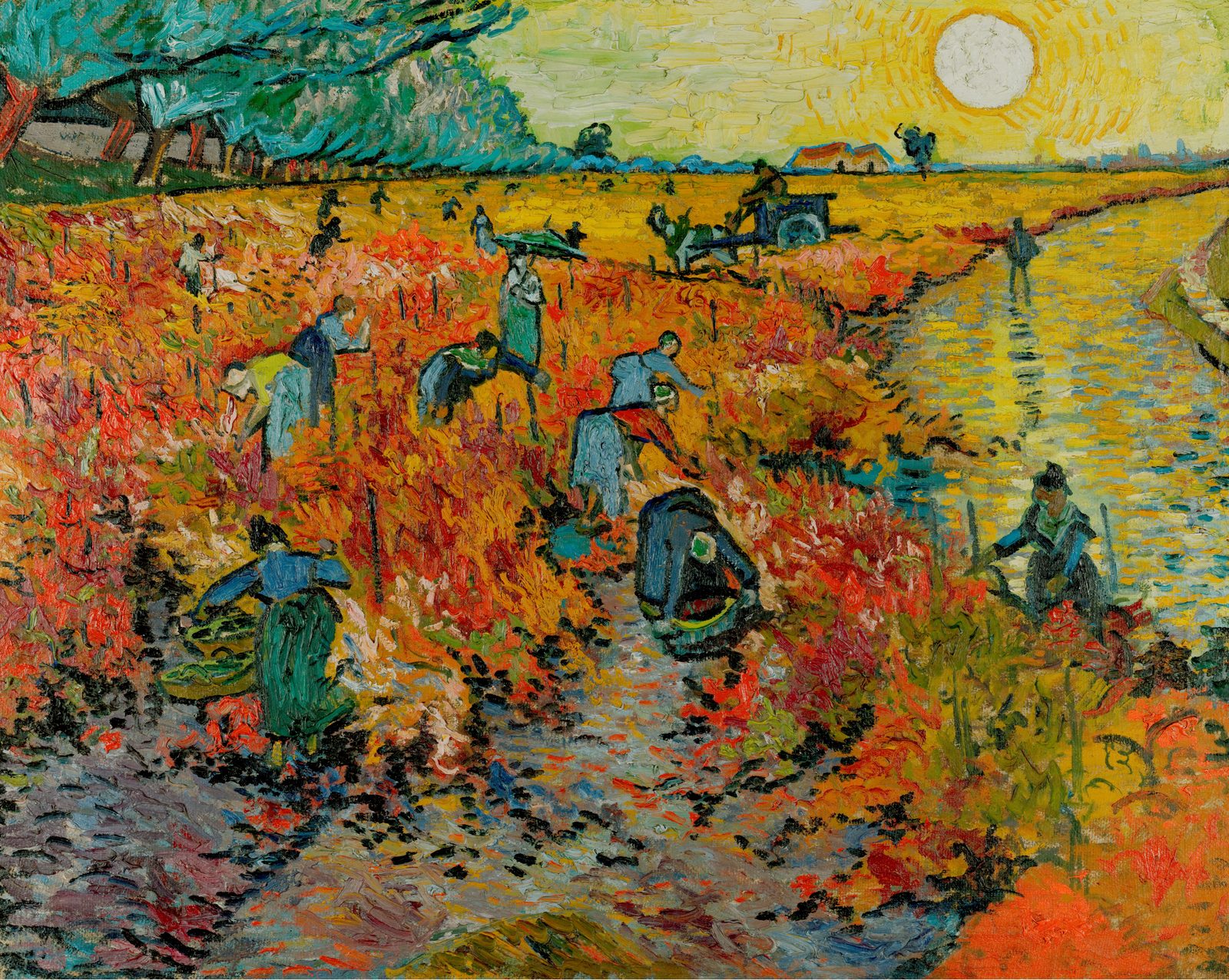
The painting
The Red Vineyard at Arles. Vincent van Gogh, 4 November 1888. Pushkin Museum, Moscow. Public domain.