
Psalm 122
9 verses · Song of Ascents, song of Zion
where the tribes go up, the tribes of the LORD, as a testimony for Israel, to give thanks to the name of the LORD.
Introduction
David, the Peace of Jerusalem, Book 5: The return and the great Hallelujah, Poetry, Psalms Overview.
David, who made Jerusalem his capital and brought the ark into it, is named as the writer of this song of arrival. It was sung by pilgrims who had walked for days and now stood inside the city at last. The song moves from the joy of the invitation to the city itself and then to a prayer for it. Listen for the word peace, which is part of the city's own name, and for the reasons the singer gives for praying it.
Context
- Who
- Israelites standing inside the city for the first time that year
- What
- A song of arrival sung inside the gates of Jerusalem, ending in a prayer for the city's peace.
- Where
- The gates of Jerusalem, at the moment the walking stops
- When
- The reign of David, about 1010 to 970 BC by the superscription.
- Why
- To bind the pilgrim's own good to the good of the city and the house of the LORD in it.
Historical context
The heading assigns this psalm to David, who was king in Jerusalem and the man who brought the ark to it. The moment it captures is arrival, the pilgrim's feet standing inside the gates after days on the road. Ancient cities were dense by necessity, since a wall was expensive and everything crowded inside it, and that compactness is used as a picture of the nation packed in around one sanctuary. The tribes came up to give thanks as the Law said, three times a year. Thrones of judgment stood there too, since the king's court heard the cases that local elders could not settle, so a pilgrim arriving saw both the altar and the bench. The city's own name carries the word for peace inside it.
Significance
For farmers who spent the year in scattered villages, this was the week when Israel looked like one nation, and the song says that out loud. It also ties one man's wellbeing to a place, so whatever happens to the city happens to everyone who sang it.
This chapter in Jewish lifeWhat this chapter is in Jewish life and reading.
What is done
Psalm 122 is the third of the fifteen Songs of Ascents and the first of them to carry David's name. Its subject is the pilgrimage itself, and the classical commentators read it against the three festivals at which Israel went up. Ibn Ezra describes Jerusalem on those days as "a city into which all her children gathered from the surrounding area in a time of fear" (Ibn Ezra on Psalms 122:3:1, translated by Rabbi Mike Feuer, Jerusalem Anthology, CC-BY). The prayer for the peace of Jerusalem in this psalm is the line Jewish practice has kept nearest to hand, and Radak writes it as the prayer of the exile: the peace of Jerusalem "is the ingathering of the exiles" (Radak on Psalms 122:6:1, Feuer translation, CC-BY).
How it is read
Rashi reads the opening as David overhearing the people wish him dead so that Solomon might reign and build the Temple, and being glad of the wish because of what it wanted. He takes the built-up city as the city once Solomon builds the Temple in it, "with the Shechinah, the Temple, the Ark, and the altar" (Rashi on Psalms 122:3:1). Ibn Ezra sets out three positions on when the psalm was said, that David composed it for the Temple yet to be built, that it belongs to the house David built in Zion, and that it belongs to a third house still to come (Ibn Ezra on Psalms 122:1:1). Malbim reads the whole psalm as praise of Jerusalem under one figure, the nation as one body and the city as its heart and brain, "the vessel which prepares the whole body to receive the Divine Presence" (Malbim on Psalms 122:1:1). On the prayer for peace he takes the peace of the city to rest on the peace of its own people with each other.
What the rabbis say
Rashi hands on the saying that there are two Jerusalems: "There is a Jerusalem in heaven, and the Jerusalem on earth is destined to be like it" (Rashi on Psalms 122:3:2, citing Ta'anit 5a). He also passes on the reading that the divine name in the fourth verse stands as testimony that Israel who came out of Egypt were the sons of their own fathers, and that the letters of the name were added to the tribal names to say so. The corpus records forty locators on this chapter, thirty Midrash and ten Talmud. The rejoicing of the first verse is taken up at Devarim Rabbah 5:3 and Jerusalem Talmud Berakhot 2:1:18, the standing feet of the second at Makkot 10a:22, the joined city of the third at Jerusalem Talmud Chagigah 3:6:3, and the prayer for peace at Devarim Rabbah 5:15, Megillah 17b:19 and Midrash Tehillim 121:1.
Sources: Rashi, Rashi on Psalms 122:1:1, 122:3:1, 122:3:2, 122:4:2 and 122:5:1, the Judaica Press complete Tanach with Rashi, translated by A. J. Rosenberg, CC-BY; Ibn Ezra, Ibn Ezra on Psalms 122:1:1 and 122:3:1, translated by Rabbi Mike Feuer, Jerusalem Anthology, CC-BY; Malbim, Malbim on Psalms 122:1:1 and 122:6:1, Feuer translation, Jerusalem Anthology, CC-BY; Radak, Radak on Psalms 122:6:1, Feuer translation, Jerusalem Anthology, CC-BY; Metzudat David, Metzudat David on Psalms 122:5:1, cited only; Babylonian Talmud, Ta'anit 5a, as Rashi cites it; Makkot 10a:22, Megillah 17b:19, Kiddushin 70b:12, Berakhot 64a:14; Jerusalem Talmud, Berakhot 2:1:18, Chagigah 3:6:3, Bikkurim 3:2:4; Midrash, Devarim Rabbah 5:3 and 5:15, Midrash Tehillim 121:1, Bereshit Rabbah 79:7, Eikhah Rabbah 1:52; MannaFest, the Songs of Ascents, at /featured/psalms-of-ascent, 2026.
Psalms 122:1-2
I was glad when they said: The gladness comes at the call to the house of the LORD, before a step is taken. By verse 2 the feet are already standing inside the gates, and the city is addressed directly, O Jerusalem. The word of verse 1 has become the place he stands.
Psalms 122:1
“I was glad when they said unto me, Let us go into the house of the Lord. Good children are pleased to go home, and glad to hear their brothers and sisters call them thither. David's heart was in the worship of God, and he was delighted when he found others inviting him to go where his desires had already gone: it helps the ardour of the most ardent to hear others inviting them to a holy duty. The word was not "go, "but "let us go"; hence the ear of the Psalmist found a double joy in it.”
Charles Spurgeon · The Treasury of David, Vol. 6 (1882)Particular Baptist
standing in your gates: Charles Spurgeon allows that the pilgrims, still on the road, spoke as if their feet already stood in the gates of Jerusalem. Adam Clarke hears exiles home from Chaldea, standing in the city again. Either way the feet stand in Jerusalem.
Psalms 122:2
“Our feet shall stand within thy gates, O Jerusalem; or, better, "our feet are standing." The words imply present and joyous standing within the walls of the city of peace; or perhaps the pilgrims felt so sure of getting there that they antedated the joy, and spoke as if they were already there, though they were as yet only on the road. If we are within the church we may well triumph in the fact. While our feet are standing in Jerusalem our lips may well be singing.”
Charles Spurgeon · The Treasury of David, Vol. 6 (1882)Particular Baptist
2 more voices on this verse
Psalms 122:2
“These are the feet that David washes in spirit when he teaches you how to keep them unsoiled, saying, "Our feet have been standing in your courts, O Jerusalem." Certainly, here "feet" is to be understood not as of the body but as of the soul. For how could a person on earth have his physical feet in heaven?”
Ambrose of Milan · written before 397 · Concerning Virginity 9:59patristic
Psalms 122:2
“Though the city was divided into the higher and lower town, yet the Jebusites being driven out, and it being entirely in the possession of God's people, it is said to be compact together. It was a type of the gospel-church, which is compact together in holy love and Christian communion, so that it is all as one city.”
Matthew Henry · Commentary on the Whole Bible (1707-1721)puritan
a city united together: The verb behind united together is chabar, to join. The picture is Jerusalem built close, its houses standing wall to wall. Matthew Henry reads the houses as strengthening and supporting one another, and the joined city as a figure of the church.
Psalms 122:3
“Jerusalem is builded as a city that is compact together. David saw in vision the city built; no more a waste, or a mere collection of tents, or a city upon paper, commenced but not completed. God's mercy to the Israelitish nation allowed of peace and plenty, sufficient for the uprise and perfecting of its capital: that City flourished in happy times, even as the church is only built up when all the people of God are prospering. Thanks be to God, Jerusalem is builded: the Lord by his glorious appearing has built up Zion.”
Charles Spurgeon · The Treasury of David, Vol. 6 (1882)Particular Baptist
Psalms 122:4-5
where the tribes go up: The tribes went up under a command. Deuteronomy 16:16 sets three appearances a year, at Unleavened Bread, Weeks and Tabernacles, and the verse calls that going up a testimony. The city held the thrones of judgment of the house of David, so thanks and justice were given in one place.
Psalms 122:4
“Whither the tribes go up, the tribes of the Lord,.... The twelve tribes of Israel; the males of them went up three times a year to Jerusalem to worship, at the feasts of passover, pentecost, and tabernacles; and was typical of the church of Christ, where the worship of God is carried on, his word preached, and ordinances administered; and whither saints go and attend for their own profit and the glory of God; this is the city of our solemnities, Isa 33:20; unto the testimony of Israel; the ark of the testimony a symbol of the divine Presence.”
2 more voices on this verse
Psalms 122:4
“Whither the tribes go up, the tribes of the Lord. When there is unity within there will be gatherings from without: the tribes go up to a compact centre. Note that Israel was one people, but yet it was in a sense divided by the mere surface distinction of tribes; and this may be a lesson to us that all Christendom is essentially one, though from various causes we are divided into tribes.”
Charles Spurgeon · The Treasury of David, Vol. 6 (1882)Particular Baptist
Psalms 122:4
“Unto - Unto the ark, called the testimony, because of the tables of the covenant laid up in it, which are called God's testimony, and the tables of the testimony. And this is called the testimony of, or to Israel, because it was given by God to them. Give thanks - To worship God; this one eminent part thereof being put for all the rest.”
John Wesley · Explanatory Notes upon the Old Testament (1765)evangelical
the thrones of judgment stand: The verb behind stand is yashav, to sit down as a judge does, so the thrones of judgment sit in Jerusalem. Jamieson, Fausset and Brown let the thrones stand for the men on them, David's sons. Absalom wanted that judgment seat at 2 Samuel 15:4.
Psalms 122:5
“For there are set thrones of judgment,.... In Jerusalem as the Targum; here were courts of judicature, and thrones for the judges to sit upon, to execute judgment and justice to the people; the thrones of the house of David; the Targum is, "thrones in the house of the sanctuary, for the kings of the house of David;'' who might sit there, as the Jews say, when others might not.”
2 more voices on this verse
Psalms 122:5
“For there are set thrones of judgment. If discontented with the petty judgments of their village lords, the people could bring their hard matters to the royal seat, and the beloved King would be sure to decide aright; for the judgment thrones were The thrones of the house of David. We who come to the church and its public worship are charmed to come to the throne of God, and to the throne of the reigning Saviour.”
Charles Spurgeon · The Treasury of David, Vol. 6 (1882)Particular Baptist
Psalms 122:5
“Observe, What a goodly sight it was to see the testimony of Israel and the thrones of judgment such near neighbours, and they are good neighbours, which may greatly befriend one another. Let the testimony of Israel direct the thrones of judgment, and the thrones of judgment protect the testimony of Israel.”
Matthew Henry · Commentary on the Whole Bible (1707-1721)puritan
Psalms 122:6-7
Pray for the peace of Jerusalem: The psalm commands a prayer for the peace of Jerusalem. The verb behind prosper at verse 6 is shalah, to be secure, so what is asked for Jerusalem returns on those who love her. Verse 7 splits the prayer in two, peace inside the walls and prosperity inside the fortresses.
Psalms 122:6
Pray for the peace of Jerusalem. Peace was her name, pray that her condition may verify her Title — Abode of Peace, peace be to thee. Here was a most sufficient reason for rejoicing at the thought of going up to the house of the Lord, since that sacred shrine stood in the centre of an area of peace: well might Israel pray that such peace should be continued. In a church peace is to be desired, expected, promoted, and enjoyed. If we may not say "Peace at any price, "yet we may certainly cry "Peace at the highest price."
Charles Spurgeon · The Treasury of David, Vol. 6 (1882)Particular Baptist
peace within your walls: John Gill reads verse 7 as the words given to those who pray for the peace of Jerusalem in verse 6. The word for walls is chel, a rampart, and fortresses renders armon, a citadel named for its height. Both words name strongholds.
Psalms 122:7
“Peace be within thy walls,.... The word say might be supplied; for this, with the following, seem to be petitions the psalmist puts into the mouths of those he desires to pray for Jerusalem's peace; and he directs them to pray in this manner, to take with them such words as these, and pray to the Lord.”
1 more voice on this verse
Psalms 122:7
“Peace be within thy walls. See how the poet personifies the church, and speaks to it: his heart is with Zion, and therefore his conversation runs in that direction. A second time is the sweet favour of peace earnestly sought after: "There is none like it, give it me." Walls were needed to keep out the foe, but it was asked of the Lord that those walls might prove sufficient for her security. May the munitions of rock so securely defend the city of God that no intruder may ever enter within her enclosure. May her ramparts repose in safety.”
Charles Spurgeon · The Treasury of David, Vol. 6 (1882)Particular Baptist
Psalms 122:8-9
For the sake of my brothers: Two reasons are given for the same prayer. Matthew Henry takes the brothers and friends of verse 8 as fellow worshippers, companions in the worship of God. Verse 9 names the house of the LORD our God, the place the psalm set out for.
Psalms 122:8
“For my brethren and companions' sakes, I will now say, Peace be within thee. It is to the advantage of all Israel that there should be peace in Jerusalem. It is for the good of every Christian, yea, of every man, that there should be peace and prosperity in the church. Here our humanity and our common philanthropy assist our religious prayer. By a flourishing church our children, our neighbours, our fellow countrymen are likely to be blest.”
Charles Spurgeon · The Treasury of David, Vol. 6 (1882)Particular Baptist
1 more voice on this verse
Psalms 122:8
“For my brethren and companions' sakes,.... Who were regenerated by the spirit of God; adopted into his family, and children of the same father; stood in the same relation to Christ the firstborn, and members of the same church; and so brethren: partners in the same blessings and promises of the covenant; partakers of the same grace; joined together in religious worship; shared in the same joys and griefs; travellers together to the same heavenly country, and entitled to the same glory and happiness.”
I will seek your prosperity: Charles Spurgeon traces an order across the psalm: love for Jerusalem at verse 6, then the seeking of its prosperity. Adam Clarke sets beside it Jeremiah 29:7, where the exiles are told to seek the prosperity of the city of their exile. They were to pray for it as well.
Psalms 122:9
“Because of the house of the Lord our God I will seek thy good. He prays for Jerusalem because of Zion. How the church salts and savours all around it. The presence of Jehovah, our God, endears to us every place wherein he reveals his glory. Well may we seek her good within whose walls there dwells God who alone is good. We are to live for God's cause, and to be ready to die for it.”
Charles Spurgeon · The Treasury of David, Vol. 6 (1882)Particular Baptist
How this psalm is built
The form: A song of the ascents of David, in which the gladness begins at the invitation and ends in a charge to pray for Jerusalem, as Spurgeon classes it.
The patterns in this chapter
| Device | What it does | Where to see it |
|---|---|---|
| The word that becomes a place | Verse 1 is a sentence spoken to the singer, let us go to the house of the LORD, and the gladness comes at the words before a step is taken. By verse 2 the feet are already standing inside the gates and the city is addressed directly. What was said in verse 1 has become the ground he stands on.Franz Delitzsch, Biblical Commentary on the Psalms, on Psalm 122:2. | Psalm 122:1, Psalm 122:2 |
| Jerusalem named in every part | The psalm speaks to the city itself from verse 2 onward, your gates, your walls, your fortresses, peace be within you. The name Jerusalem carries the word for peace inside it, and the prayer of verse 6 plays on that.John Gill, Exposition of the Old Testament (1748 to 1763), on Psalm 122:6. | Psalm 122:2, Psalm 122:6, Psalm 122:8 |
| Two reasons for one prayer | Verses 8 and 9 give the same prayer twice with a different reason each time. The first is for the sake of my brothers and friends, whom Matthew Henry takes as fellow worshippers. The second is for the sake of the house of the LORD our God, which is the place the psalm set out for in verse 1.Matthew Henry, Commentary on the Whole Bible, 1710, on Psalm 122:8. | Psalm 122:8, Psalm 122:9 |
The structure
12 more paragraphs on the patterns
Nine verses in three movements. Verses 1 and 2 are the arrival. Verses 3 to 5 describe the city and give its two claims, the tribes going up and the thrones of judgment. Verses 6 to 9 are the charge to pray, with the same prayer given three times and two reasons attached to it at the end.
The psalm addresses the city itself from verse 2 onward, your gates, your walls, your fortresses, peace be within you. That direct address is what holds the last half together.
Across the canon
Deuteronomy 16:16 is the law behind verse 4. It sets three appearances a year and verse 4 calls that going up a testimony for Israel.
The thrones of the house of David at verse 5 tie the psalm to Psalm 132, the one royal psalm of the collection. There the LORD swears to set one of David's descendants on his throne. Read together, the two psalms give the city its two claims, the ark David brought up and the throne he was promised.
The closing word is taken up twice more in the collection. Psalm 125 and Psalm 128 both end peace be upon Israel, so the charge given here is answered as a last line elsewhere.
In the New Testament
No New Testament writer quotes this psalm. Matthew 19:28 promises the twelve that they will sit on twelve thrones judging the twelve tribes of Israel. That takes up the thrones of judgment of verse 5 and puts them in the renewal of all things. Galatians 6:16 pronounces peace and mercy on the Israel of God, which is the psalm's own prayer in Paul's hands.
What is debated
Whether the psalm is David's own work is argued. The superscription assigns it to him, and the store's Young's Literal Translation carries that heading. Against it stands verse 5, which speaks of the thrones of the house of David as a settled institution, which reads more naturally from a later hand. The common middle position takes the collection as gathered after the exile around older songs, this one among them, and it leaves the superscription standing. Nothing in the psalm decides the question.
The Songs of Ascents
Psalm 122 is the third of the fifteen songs of ascents, and it is the song of arrival, sung once the walking has stopped at the gates. Albert Barnes records the reading that takes the title Songs of Degrees from an ascent of thought in these psalms (Notes on the Book of Psalms, on Psalm 124:2). On that reading a line takes up the words of the line before and carries them one step further. Here verse 2 ends on O Jerusalem and verse 3 opens on Jerusalem, and the peace asked for Jerusalem in verse 6 is taken up again in verse 7 and once more in verse 8. Jerome reads the fifteen songs as one climb (Homily 46, on the last Song of Ascents). He counts this psalm as the third step, the gladness at the words said to the pilgrim. That psalm is Psalm 133 in his numbering and Psalm 134 in the Berean.
Keep studying
People and groups1
Sources for this chapter
The summary
Jamieson, Fausset & Brown, Commentary Critical and Explanatory; John Calvin, Commentaries; John Wesley, Notes on the Old Testament and Matthew Henry, Complete Commentary.
The form and classifications
Albert Barnes, Notes, Explanatory and Practical, on the Old and New Testaments (1832 to 1869), on Psalm 122:4; Charles Spurgeon, The Treasury of David, Vol. 6, 1882, on Psalm 122:6 and Matthew Henry, Commentary on the Whole Bible, 1710, on Psalm 122:3.
The exposition
Adam Clarke, Commentary on the Bible; Albert Barnes, Notes on the Book of Psalms; Charles Spurgeon, The Treasury of David; Franz Delitzsch, Biblical Commentary on the Psalms; Jamieson, Fausset & Brown, Commentary Critical and Explanatory on the Whole Bible; John Gill, Exposition of the Old Testament and Matthew Henry, Commentary on the Whole Bible.
The painting
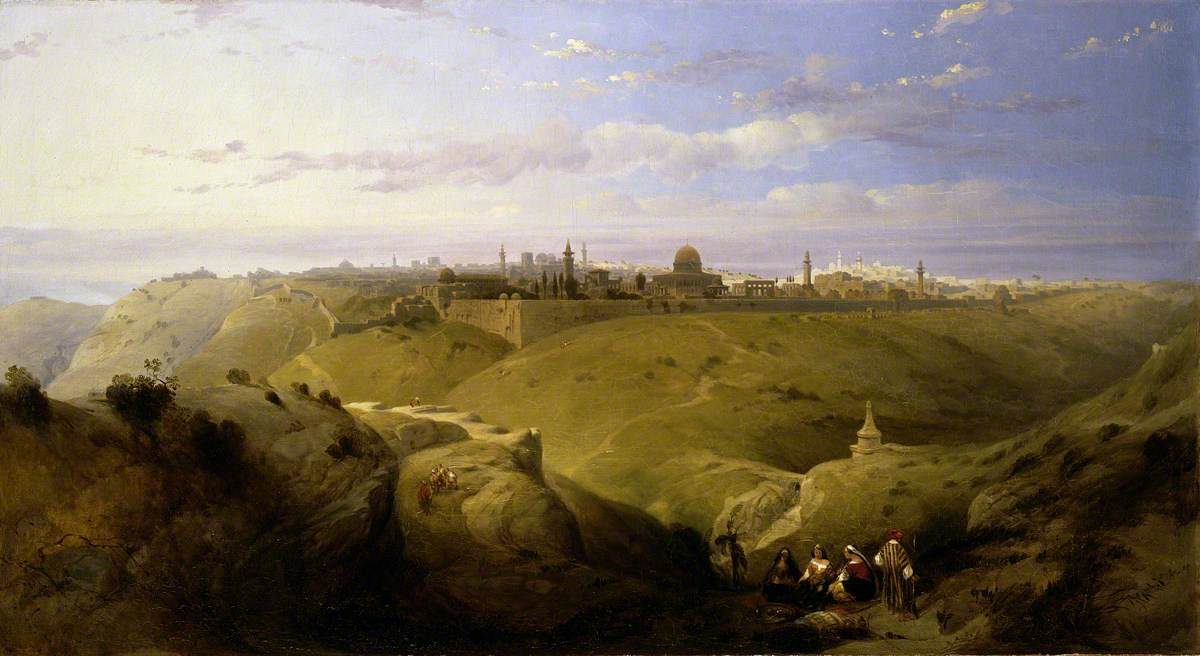
Jerusalem from the Mount of Olives with Pilgrims Entering from the River Jordan. David Roberts, 1842. Art UK. Public domain.