
Psalms 122:2
in Psalms 122Our feet are standing in your gates, O Jerusalem.
BSB
The same verse in ASV and KJV ▾
ASV
Our feet are standing Within thy gates, O Jerusalem,
KJV
Our feet shall stand within thy gates, O Jerusalem.
⋯
This verse in Psalms 122
Commentary
10 notes on this verseThese are the feet that David washes in spirit when he teaches you how to keep them unsoiled, saying, "Our feet have been standing in your courts, O Jerusalem." Certainly, here "feet" is to be understood not as of the body but as of the soul. For how could a person on earth have his physical feet in heaven?
This site's exposition
I was glad when they said
on Psalms 122:1-2
The gladness comes at the call to the house of the LORD, before a step is taken. By verse 2 the feet are already standing inside the gates, and the city is addressed directly, O Jerusalem. The word spoken in verse 1 has become the place he stands.
The record, by era
The Church Fathers1 voice
"Our feet were standing in the courts of Jerusalem" (ver. 2) ...Consider what thou wilt be there; and although thou art as yet on the road, place this before thine eyes, as if thou wert already standing, as if thou wert already rejoicing without ceasing among the Angels; as if that which is written were realized in thee: "Blessed are they that dwell in Thy house; they will be alway praising Thee." "Our feet stood in the courts of Jerusalem." What Jerusalem? This earthly Jerusalem also is wont to be called by the name: though this Jerusalem is but the shadow of that. And what great thing is it to stand in this Jerusalem, since this Jerusalem hath not been able to stand, but hath been turned into a ruin? Doth then the Holy Spirit pronounce this, out of the kindled heart of the loving Psalmist, as a great thing? Is not it that Jerusalem, unto whom the Lord said, "O Jerusalem, Jerusalem, thou that killest the Prophets," etc. What great thing then did he desire; to stand among those who slew the Prophets, and stoned them that were sent unto them? God forbid that he should think of that Jerusalem, who so loveth, who so burneth, who so longeth to reach that Jerusalem, "our Mother," of which the Apostle saith, that She is "eternal in the Heavens."
The Puritans and the Awakening3 voices
Note, (1.) It is the will of God that we should worship him in concert, that many should join together to wait upon him in public ordinances. We ought to worship God in our own houses, but that is not enough; we must go into the house of the Lord, to pay our homage to him there, and not forsake the assembling of ourselves together.
Though the city was divided into the higher and lower town, yet the Jebusites being driven out, and it being entirely in the possession of God's people, it is said to be compact together. It was a type of the gospel-church, which is compact together in holy love and Christian communion, so that it is all as one city.
Our feet shall stand within thy gates, O Jerusalem.
The Nineteenth Century1 voice
Our feet shall stand within thy gates, O Jerusalem; or, better, "our feet are standing." The words imply present and joyous standing within the walls of the city of peace; or perhaps the pilgrims felt so sure of getting there that they antedated the joy, and spoke as if they were already there, though they were as yet only on the road. If we are within the church we may well triumph in the fact. While our feet are standing in Jerusalem our lips may well be singing.
3 more voices on this verse
The Nineteenth Century3 voices
Our feet shall stand within thy gates, O Jerusalem; or, better, "our feet are standing." The words imply present and joyous standing within the walls of the city of peace; or perhaps the pilgrims felt so sure of getting there that they antedated the joy, and spoke as if they were already there, though they were as yet only on the road. If we are within the church we may well triumph in the fact. While our feet are standing in Jerusalem our lips may well be singing. Outside the gates all is danger, and one day all will be destruction; but within the gates all is safely, seclusion, serenity, salvation, and glory. The gates are opened that we may pass in, and they are only shut that our enemies may not follow us. The Lord loveth the gates of Zion, and so do we when we are enclosed within them. What a choice favour, to be a citizen of the New Jerusalem! Why are we so greatly favoured? Many feet are running the downward road, or kicking against the pricks, or held by snares, or sliding to an awful fall; but our feet, through grace divine, are "standing"—an honourable posture, "within thy gates, O Jerusalem"—an honourable position, and there shall they stand for ever—an honourable future.
Our feet shad stand - For seventy years we have been exiled from our own land; our heart was in Jerusalem, but our feet were in Chaldea. Now God has turned our captivity, and our feet shall shortly stand within the gates of Jerusalem. What a transition from misery to happiness! and what a subject for rejoicing!
A commentator
Albert Barnes1798–1870
Notes, Explanatory and Practical, on the Old and New Testaments (1832-1869)
proposed
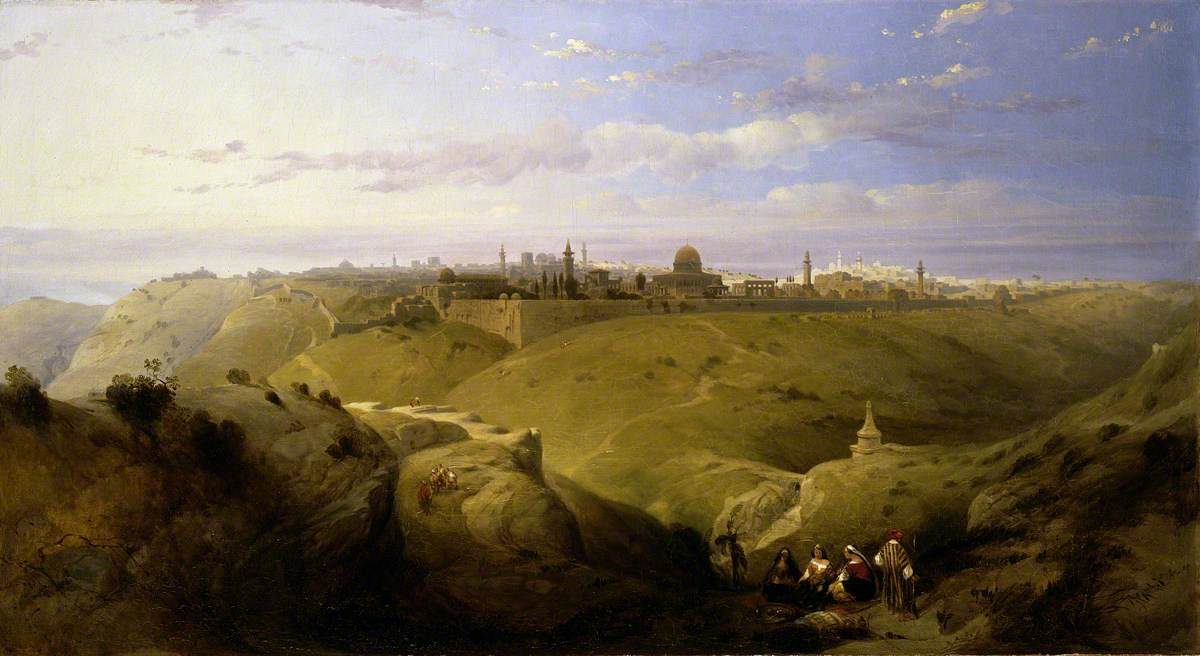
Our feet shall stand within thy gates, O Jerusalem - We shall enter the sacred city. It appears now in full view before us - its walls, its palaces, its sacred places. We shall not stand and gaze upon it at a distance; we shall not merely be charmed with its beauty as we approach it; we shall accomplish the object of our desire, and enter within its walls and gates. So the believer approaches heaven - the New Jerusalem above. he will not merely admire its exterior, and look upon it at a distance; but he will enter in. He draws nearer and nearer to it, and as he approaches it when he is dying, its beauty becomes the more charming to his view, and the joy of his heart increases as he now feels the assurance that he will “stand within its gates:” that he will enter there, and dwell there forever. So said Dr. Payson, when approaching the end of life: “The celestial city is full in my view. Its glories beam upon me, its breezes fan me, its odors are wafted to me, its sounds strike upon my ears, and its spirit is breathed into my heart. Nothing separates me from it but the river of death, which now appears but as an insignificant rill, that may be crossed at a single step, whenever God shall give permission. The Sun of Righteousness has been gradually drawing nearer and nearer, appearing larger and brighter as he approached, and now he fills the whole hemisphere - pouring forth a flood of glory, in which I seem to float like an insect in the beams of the sun; exulting, yet almost trembling, while I gaze on this excessive brightness, and wondering with unutterable wonder why God should deign thus to shine upon a sinful worm.” Works, i. 407. See also the exquisite description of the glories of heaven, familiar to all, as described by Bunyan, as the Christian pilgrims were about to cross the river of death.
How the passage was read
What the Jewish commentators add
Our feet were standing in battle everywhere because of the gates of Jerusalem, where they were engaged in Torah.
3 more on this passage, in their own words ▾
I rejoiced when they said to me I heard people saying, “When will that old man die, and his son Solomon reign and build the Temple, and we shall go up on the festival pilgrimages?” And I am happy.
The built-up Jerusalem When my son Solomon builds the Temple within it [Jerusalem], it will be built with the Shechinah, the Temple, the Ark, and the altar.
The song that is said on the ascents from the abyss. I rejoiced when they were saying to me, "To the Holy Temple of Adonai let us go!"
This section is reception history: how the passage was read and kept in the Jewish tradition. Where a reading parts from an essential of the Christian faith, the section says so at that point.
Texts and citation data: Sefaria; each excerpt follows its version’s licence. 1 further source is cited on this chapter that carry no English text this site may quote or only restate the verse.
The words behind it
5 Hebrew wordsEvery Hebrew word of this verse in the order it stands, with what it means and the door to its own study. The last column counts the times a word stands in the whole Bible: the rarer the word, the more the places it appears belong together.
| Hebrew | Sound | Meaning | Word study | In the Bible |
|---|---|---|---|---|
| עֹ֭מְדוֹת | ʾomedot | standing | H5975 → | 521 times |
| הָי֣וּ | hayu | they were | H1961 → | 3559 times |
| רַגְלֵ֑ינוּ | ragleinu | feet our | H7272 → | 247 times |
| בִּ֝שְׁעָרַ֗יִךְ | bisharayikh | in gates your | H8179 → | 374 times |
| יְרוּשָׁלִָֽם׃ | yerushalim | O Jerusalem | H3389 → | 643 times |
עֹ֭מְדוֹתstanding
ʾomedotH5975 →521 times
הָי֣וּthey were
hayuH1961 →3559 times
רַגְלֵ֑ינוּfeet our
ragleinuH7272 →247 times
בִּ֝שְׁעָרַ֗יִךְin gates your
bisharayikhH8179 →374 times
יְרוּשָׁלִָֽם׃O Jerusalem
yerushalimH3389 →643 times
A shaded row is a word that stands 400 times or fewer in the Bible.
The walk
8 stopsEach card is a verse this one points to, and under it the verses that one points to in turn. Where several paths arrive at the same place, that place is listed first: the text keeps returning to it.
Through
Psalms 100:4Enter His gates with thanksgiving and His courts with praise; give thanks to Him and bless His name.
it leads to
- Colossians 3:16–17
Let the word of Christ richly dwell within you as you teach and admonish one another with all wisdom, and as you sing psalms, hymns, and spiritual songs with gratitude in your hearts to…
- Hebrews 13:15
Through Jesus, therefore, let us continually offer to God a sacrifice of praise, the fruit of lips that confess His name.
- 1 Chronicles 29:13
Now therefore, our God, we give You thanks, and we praise Your glorious name.
- Psalms 103:1–2
Bless the LORD, O my soul; all that is within me, bless His holy name.
- Psalms 116:17–19
I will offer to You a sacrifice of thanksgiving and call on the name of the LORD.
- Colossians 3:16–17
Through
Exodus 20:24You are to make for Me an altar of earth, and sacrifice on it your burnt offerings and peace offerings, your sheep and goats and cattle. In every place where I cause My name…
it leads to
- Deuteronomy 12:5
Instead, you must seek the place the LORD your God will choose from among all your tribes to establish as a dwelling for His Name, and there you must go.
- Psalms 132:13–14
For the LORD has chosen Zion; He has desired it for His home:
- 2 Chronicles 6:6
But now I have chosen Jerusalem for My Name to be there, and I have chosen David to be over My people Israel.’
- Deuteronomy 12:5
About Psalms
Who and where
1 name in this verse with a page on the site.
This page draws on 9 works. Open the list of works
This page draws on Adam Clarke, Commentary on the Bible; Albert Barnes, Notes, Explanatory and Practical, on the Old and New Testaments (1832-1869); Ambrose of Milan, Concerning Virginity 9:59; Augustine of Hippo, Exposition on Psalm 122; Charles Spurgeon, The Treasury of David; Charles Spurgeon, The Treasury of David, Vol. 6; Franz Delitzsch, Biblical Commentary on the Psalms; John Gill, Exposition of the Old Testament (1748-1763) and Matthew Henry, Commentary on the Whole Bible.