
Psalm 10
18 verses · Acrostic psalm of lament
But You have regarded trouble and grief; You see to repay it by Your hand. The victim entrusts himself to You; You are the helper of the fatherless.
Introduction
Author unstated, the Acrostic of Lament, Book 1: The book of David, Poetry, Psalms Overview.
This psalm has no heading and no named writer, and in Hebrew it finishes the alphabet that Psalm 9 began. Psalm 9 thanked God for defeating nations, and this psalm asks why He seems to stand far off while a powerful neighbour preys on the poor. It gives a long, exact portrait of a man who has decided no one will call him to account. It was prayed by people with no clan strong enough to defend them. Listen for the questions that open it, for what the oppressor says in his heart, and for the plain answer that closes it.
Context
- Who
- Israelites who had watched a powerful neighbour take what he wanted and keep it
- Where
- An Israelite village or town where a local strongman preys on the poor and nobody stops him
- When
- Date unstated; the psalm is joined to Psalm 9 by the alphabet and in the old Greek version. No superscription; the alphabetic link to Psalm 9 places it with the same period and hand
Historical context
The trouble in this psalm is a neighbour rather than an army. The village economy ran on debt, since a bad harvest meant borrowing seed grain. A creditor with patience and no conscience could absorb the land around him a loan at a time and stay inside the law while he did it. The hunting language of verses 8 to 10 is exact. Lions in that country waited in cover near a watering track, and human hunters used a weighted mesh net drawn over game driven toward it. Small farming hamlets had no wall, no gate and no garrison, which is why Israel's law names the fatherless, the widow and the stranger again and again. The creed quoted at verses 6, 11 and 13 is the working assumption of a man who has noticed that nothing has happened to him yet.
Significance
The opening question is the honest complaint of people watching the wrong side win, and Israel's songbook printed it rather than tidying it away. The answer it gives is a title rather than an explanation. The LORD is King forever and ever, He has heard the desire of the humble, and He vindicates the fatherless and the oppressed.
This chapter in Jewish lifeWhat this chapter is in Jewish life and reading.
How it is read
Radak opens this psalm by saying what it is for, and the answer explains a great deal about how the Psalter is used in Jewish life. He is quoted here from the Finch translation of 1919, which is public domain. He holds that David did not write it for one occasion. It is "rather a prayer which anyone who is in trouble by reason of an enemy might use" (Radak on Psalms 10:1:1). He then explains the psalm's own question. When help comes to the poor, it is as though God were near; when the enemy prevails, it is as though God were far off and hiding his eyes. Radak also reads the chapter at the level of the nations, and takes it to include the persecution of Israel in their own land.
Rashi is quoted from the Judaica Press Tanach with Rashi, and he reads the same chapter with one nation in view. At the eighth verse he glosses the lurking eyes in seven words: "The eyes of Esau lurk for Israel" (Rashi on Psalms 10:8:1). At the fifteenth he names the arm to be broken as Esau (Rashi on Psalms 10:15:1). At the sixteenth he dates the kingship of God to the moment "after the nations perish from His land" (Rashi on Psalms 10:16:1). At the eighteenth he reads the orphan of the verse as Israel (Rashi on Psalms 10:18:1). A Christian reader should see the reading for what it is. Rashi is a commentator writing under Christian rule in medieval France, and Esau in his pages is a standing name for the power that oppresses. The site reports the identification as Rashi's own and holds it apart from the plain sense of the verse.
The portrait of the wicked man is where the commentators do their finest work. Rashi has him boasting that he achieves everything his soul desires, and praising himself for blasphemy in the belief that he will still have peace (Rashi on Psalms 10:3:1 and 10:3:2). The man's whole theology stands in one sentence Rashi puts in his mouth. "The Holy One, blessed be He, will not seek anything that I may do because there is no judgment" (Rashi on Psalms 10:4:2). Radak reads the sixth verse as the same settled confidence, that "I shall never be moved from my greatness" (Radak on Psalms 10:6:1). At the eleventh he takes the wicked man's words two ways, either that God has forgotten, or that God hides his face and "is unwilling ever to see it" (Radak on Psalms 10:11:1).
Radak's note on the ninth verse is a small piece of field observation. He sets the lion in his den beside a fowler who stands back from his own net so the bird will not see him, with the cords in his hand. He then describes a third method, where the robber posts unarmed men on the road as decoys while the armed men wait at a distance (Radak on Psalms 10:9:1). Rashi describes the same crouch from the inside: the lurker "makes himself small in order to be inconspicuous" (Rashi on Psalms 10:10:1). Radak closes the psalm on the hearing of the seventeenth verse, and offers the reading that God heard the desire of the meek before they spoke it (Radak on Psalms 10:17:1). This psalm and the one before it form a single alphabetic acrostic, and the site treats that shape at /featured/the-acrostic-psalms.
What the rabbis say
The corpus carries forty locators on this psalm and the text of none, so each is cited and linked here rather than quoted. Ten are Talmudic, and they spread across the chapter. They stand at Bava Kamma 94a:5 on the third verse, Nedarim 22b:2 on the fourth, Berakhot 7b:18 on the fifth, and Sanhedrin 43a:23 on the eighth. They continue at Bava Metzia 83b:5 on the ninth verse, Tractate Soferim 7:3 on the tenth, Megillah 17b:15 on the fifteenth, Berakhot 31a:17 on the seventeenth, and Yoma 9a:4 later in the chapter. One more stands in the Jerusalem Talmud at Berakhot 2:4:10 on the fifteenth verse.
Midrash Tehillim carries eight, at 10:1 on the first verse, 10:3 and 121:1 on the second, 10:6 on the tenth, and 10:7 on the eleventh. Three more stand at 17:8 on the twelfth verse, 10:8 on the thirteenth and 143:1 on the fourteenth. Seven entries of Ein Yaakov stand across the chapter. In the Glick Edition they are Bava Kama 9:1, Nedarim 3:4, Berakhot 1:38, Bava Metzia 7:2 and Megillah 2:2, and beside them stand Nedarim 3:5, Megillah 1:8 and Rosh Hashanah 4:6.
The remaining midrashic locators are scattered. On the first verse the corpus carries Bamidbar Rabbah 11:7 and Bereshit Rabbah 49:10. On the twelfth it carries Bereshit Rabbah 75:1 and Vayikra Rabbah 14:3, and on the thirteenth Bereshit Rabbah 26:6. On the fourteenth it carries Aggadat Bereshit 84:3 and Esther Rabbah 3:5. On the sixteenth it carries Bamidbar Rabbah 3:4 and Eikhah Rabbah 1:50, with Devarim Rabbah 2:1 on the seventeenth. Three more stand at Midrash Sekhel Tov on Genesis 31:36:3, Bereshit Rabbati on Vayeshev 9, and Midrash Tanchuma Buber, Toldot 9:1, with Midrash Lekach Tov on Leviticus 8:36:3. What each of them teaches is a saying of the rabbis, and is reported as theirs wherever this site quotes one. The quotations wait on a fetch that carries the text.
Sources: Rashi, Rashi on Psalms 10:1:1 to 10:18:1, the Judaica Press complete Tanach with Rashi, translated by A. J. Rosenberg; Radak, Radak on Psalms 10:1:1 to 10:17:1, R. David Kimhi on the first book of Psalms, translated by R. G. Finch, London, 1919; MannaFest, the acrostic psalms, at /featured/the-acrostic-psalms; The Sefaria corpus, scripts/data/sources/sefaria/psalms/10.json, the 10 Talmud and 30 Midrash locators of this chapter.
Psalms 10:1-3
do You stand far off?: The psalm opens with a complaint, that God stands far off while the wicked pursue the needy. Pride is the motive the psalm names, and the prayer asks that the schemes the wicked devise catch them instead. Blessing goes to the greedy and reviling to the LORD.
Psalms 10:1
“Why standest thou afar off, O Lord?.... This psalm begins with a complaint which proceeds on two general heads; the one is with respect to God, his distance from his people, and desertion of them in times of trouble, in this verse; and the other is with respect to the wicked in some following ones.”
1 more voice on this verseWhat preachers and commentators have said about this verse, in their own words.
Psalms 10:1
“To the tearful eye of the sufferer the Lord seemed to stand still, as if he calmly looked on, and did not sympathize with his afflicted one. Nay, more, the Lord appeared to be afar off, no longer "a very present help in trouble, " but an inaccessible mountain, into which no man would be able to climb. The presence of God is the joy of his people, but any suspicion of his absence is distracting beyond measure. Let us, then, ever remember that the Lord is nigh us.”
Charles Spurgeon · The Treasury of David, Vol. 1 (1869)Particular Baptist
In pride the wicked pursue the needy: Pursue renders a verb meaning to burn, so the wicked hunt the needy in hot pursuit, as Laban did Jacob at Genesis 31:36. The second line can pray that the wicked be caught in their own schemes, or say the needy are caught. The Berean reads a prayer.
Psalms 10:2
“The wicked in his pride doth persecute the poor,.... The "poor" is the good and gracious man, who is commonly poor in this world's things, and is sensibly poor in spirit, or sensible of his spiritual poverty; or he is so called because "afflicted", as the word signifies; and he is afflicted because he is poor: these two characters generally go together.”
1 more voice on this verse
Psalms 10:2
“The second verse contains the formal indictment against the wicked: "The wicked in his pride doth persecute the poor." The accusation divides itself into two distinct charges, —pride and tyranny; the one the root and cause of the other. The second sentence is the humble petition of the oppressed: "Let them be taken in the devices that they have imagined." The prayer is reasonable, just, and natural. Even our enemies themselves being judges, it is but right that men should be done by as they wished to do to others.”
Charles Spurgeon · The Treasury of David, Vol. 1 (1869)Particular Baptist
boasts in the cravings of his heart: The second line is hard in Hebrew. It may mean that he blesses the greedy, or that the greedy man blesses himself and reviles the LORD. Barak, to bless, stands for cursing God at Job 1:5 and 1 Kings 21:10, and some read it so here.
Psalms 10:3
“For the wicked boasteth of his heart’s desire - Margin, as in Hebrew, soul’s. The main idea in this verse seems to be that he is a boaster - a man who makes some proclamation about himself as being superior to others, and who, in that proportion, looks with disdain or contempt on others.”
2 more voices on this verse
Psalms 10:3
“Ephraim said, I have become rich, I have found me out substance, Hos. xii. "Now, Lord, is it for thy glory to suffer a sinful man thus to pretend to the sovereignty and felicity of a God?" (2.) He proudly contradicts the judgment of God, which, we are sure, is according to truth; for he blesses the covetous, whom the Lord abhors.”
Matthew Henry · Commentary on the Whole Bible (1707-1721)puritan
Psalms 10:3
The indictment being read, and the petition presented, the evidence is now heard upon the first count. The evidence is very full and conclusive upon the matter of pride, and no jury could hesitate to give a verdict against the prisoner at the bar. Let us, however, hear the witnesses one by one. The first testifies that he is a boaster. "For the wicked boasteth of his heart's desire."
Charles Spurgeon · The Treasury of David, Vol. 1 (1869)Particular Baptist
Psalms 10:4-6
the wicked man does not seek Him: Pride is what keeps the wicked man from seeking God. His own schemes have no God in them, an atheism of practice in a man who leaves God out of every calculation. God's lofty judgments are far from him, and he says he will not be moved.
Psalms 10:4
“The proud boastings and lewd blessings of the wicked have been received in evidence against him, and now his own face confirms the accusation, and his empty closet cries aloud against him. "The wicked, through the pride of his countenance, will not seek after God." Proud hearts breed proud looks and stiff knees. It is an admirable arrangement that the heart is often written on the countenance, just as the motion of the wheels of a clock find their record on its face. A brazen face and a broken heart never go together.”
Charles Spurgeon · The Treasury of David, Vol. 1 (1869)Particular Baptist
1 more voice on this verse
Psalms 10:4
“The face expresses the self-conceit, whose fruit is practical atheism (Ps 14:1). Such is his confidence in the permanence of his way or course of life, that he disregards God's providential government (out of sight, because he will not look, Isa 26:11), sneers at his enemies, and boasts perpetual freedom from evil.”
Jamieson, Fausset & Brown · Commentary Critical and Explanatory on the Whole Bible (1871)reformed
He is secure in his ways: The Hebrew verb for secure carries the sense of standing firm, so his ways prosper at all times. God's judgments are on high, above his sight, and he never reckons with them. Sneers is literally puffs, a breath of contempt.
Psalms 10:5
"His ways are always grievous." To himself they are hard. Men go a rough road when they go to hell. God has hedged-up the way of sin: O what folly to leap these hedges and fall among the thorns! To others, also, his ways cause much sorrow and vexation; but what cares he? He sits like the idol god upon his monstrous car, utterly regardless of the crowds who are crushed as he rolls along. "Thy judgments are far above out of his sight:"he looks high, but not high enough. As God is forgotten, so are his judgments.
Charles Spurgeon · The Treasury of David, Vol. 1 (1869)Particular Baptist
1 more voice on this verse
Psalms 10:5
“His ways are always grievous - His paths; his manner of life; his conduct toward God; his dealings with men. The word rendered “are grievious,” יחילוּ yāchiylû - has been variously rendered. The Latin Vulgate renders it, “His ways are defiled.” So the Septuagint. Coverdale renders it, “His ways are always filthy.” Prof. Alexander, “His ways are firm.” So DeWette, “Es gelingen seine Wege.” Horsley, “His ways are confident.” This variety in the interpretation arises from the ambiguity of the original word - חול chûl.”
The same Hebrew words are said in trust at Psalm 16:8. Here it is a boast. At Psalm 30:6 and 7 David recalls saying it in his prosperity, until God hid His face and he was dismayed.
Psalms 10:6
“The testimony of the sixth verse concludes the evidence against the prisoner upon the first charge of pride, and certainly it is conclusive in the highest degree. The present witness has been prying into the secret chambers of the heart, and has come to tell us what he has heard. "He hath said in his heart, I shall not be moved: for I shall never be in adversity." O impertinence runs to seed! The man thinks himself immutable, and omnipotent too, for he, he is never to be in adversity. He counts himself a privileged man.”
Charles Spurgeon · The Treasury of David, Vol. 1 (1869)Particular Baptist
1 more voice on this verse
Psalms 10:6
“So bold is the person who does not look on God or recognize his judgment that he does not consider within himself his own audacious wicked deeds, believing that he will rejoice forever in his prosperity. His mouth swells up with blasphemies and irreverence. At length, the arrogant one blares out with fierce confidence countless blasphemies and curses, asserting that there is no God, nor does he look down on us, nor will he judge.”
Eusebius of Caesarea · written before 339 · Commentary on Psalms 10:27-31patristic
Psalms 10:7-11
His mouth is full of cursing: The mouth comes first, full of cursing, deceit and violence, with trouble and malice under the tongue. The hands follow the mouth: he waits like a lion in a thicket and catches the lowly in his net. He tells himself God has forgotten and never sees.
Psalms 10:7
“Let us now hear the witnesses in court. Let the wretch speak for himself, for out of his own mouth he will be condemned. "His mouth is full of cursing and deceit and fraud." There is not only a little evil there, but his mouth is full of it. A three-headed serpent hath stowed away its coils and venom within the den of its black mouth. There is cursing which he spits against both God and men, deceit with which he entraps the unwary, and fraud by which, even in his common dealings, he robs his neighbours.”
Charles Spurgeon · The Treasury of David, Vol. 1 (1869)Particular Baptist
1 more voice on this verse
Psalms 10:7
“The malignity and deceit (Ps 140:3) of such are followed by acts combining cunning, fraud, and violence (compare Pr 1:11, 18), aptly illustrated by the habits of the lion, and of hunters taking their prey. "Poor," in Ps 10:8, 10, 14, represents a word peculiar to this Psalm, meaning the sad or sorrowful; in Ps 10:9, as usual, it means the pious or meek sufferer.”
Jamieson, Fausset & Brown · Commentary Critical and Explanatory on the Whole Bible (1871)reformed
Cross references
Psalms 10:7
- Quoted inRomans 3:14“Their mouths are full of cursing and bitterness.”
'Whose mouth is full of cursing and bitterness' (sin catena)
He lies in wait near the villages: The wicked man lies in wait near villages that have no walls, the settlements of Leviticus 25:31. Helpless is chelekah, a rare word found only in this psalm. It returns in verse 14, where the Berean renders the same word victim.
Psalms 10:8
“Despite the bragging of this base wretch, it seems that he is as cowardly as he is cruel. "He sitteth in the lurking places of the villages: in the secret places doth he murder the innocent: his eyes are privily set against the poor." He acts the part of the highwayman, who springs upon the unsuspecting traveller in some desolate part of the road. There are always bad men lying in wait for the saints. This is a land of robbers and thieves; let us travel well armed, for every bush conceals an enemy.”
Charles Spurgeon · The Treasury of David, Vol. 1 (1869)Particular Baptist
2 more voices on this verse
Psalms 10:8
“And lastly, against the devil: 'God is not before his eyes, he sits in ambush with the rich.' Unhappy the rich, with whom the devil sits.”
Jerome · written before 420 · Homily 4, on Psalm 9patristic
Psalms 10:8
“He sitteth in the lurking places of the villages,.... Which were by the wayside, where thieves and robbers harboured, and out of which they came, and robbed passengers as they came by. The word (f) signifies "palaces" or "courts": and so it is rendered by the Chaldee paraphrase and Syriac version; and so the allusion is not to mean thieves and robbers, but to persons of note and figure. Hence the Septuagint and Vulgate Latin, Arabic, and Ethiopic versions, render it, "he sitteth in lurking places with the rich"; and may be fitly applied to the pope and his cardinals.”
like a lion in a thicket: The verse draws two pictures, a lion crouched in its thicket and a hunter who drags his net. Psalm 17:12 uses the lion in ambush for David's enemies. Psalm 9:15 has already shown the nations caught in the net they hid.
Psalms 10:9
“The picture becomes blacker, for here is the cunning of the lion, and of the huntsman, as well as the stealthiness of the robber. Surely there are some men who come up to the very letter of this description. With watching, perversion, slander, whispering, and false swearing, they ruin the character of the righteous, and murder the innocent; or, with legal quibbles, mortgages, bonds, writs, and the like, they catch the poor, and draw them into a net. Chrysostom was peculiarly severe upon this last phase of cruelty, but assuredly not more so than was richly merited.”
Charles Spurgeon · The Treasury of David, Vol. 1 (1869)Particular Baptist
1 more voice on this verse
Psalms 10:9
“He lieth in wait secretly - Margin, in the secret places. See the note at Psa 10:8. The object here is merely to illustrate the thought in the previous verse, by an allusion to a lion and a hunter. As a lion in his den - As a lion crouches down in his den, ready to spring upon his prey. That is, the lion is concealed, but is on the look out, and when his prey passes near his den, he suddenly springs upon it and secures it. So it is with the wicked man. He carefully lays his plans.”
They are crushed and beaten down: In Hebrew hapless is one written word that the scribes' marginal reading splits into two, a band of the crushed. The Berean follows the written word. The lion of verse 9 is still in view, crushing the lowly and oppressed who fall prey to his strength.
Psalms 10:10
"He croucheth and humbleth himself, that the poor may fall by his strong ones." Seeming humility is often armour-bearer to malice. The lion crouches that he may leap with the greater force, and bring down his strong limbs upon his prey. When a wolf was old, and had tasted human blood, the old Saxon cried, "Ware, wolf!" and we may cry, "Ware fox!" They who crouch to our feet are longing to make us fall. Be very careful of fawners; for friendship and flattery are deadly enemies.
Charles Spurgeon · The Treasury of David, Vol. 1 (1869)Particular Baptist
2 more voices on this verse
Psalms 10:10
“It intimates, likewise, that they cover their malicious designs with the pretence of meekness and humility, and kindness to those they design the greatest mischief to; they seem to humble themselves to take cognizance of the poor, and concern themselves in their concernments, when it is in order to make them fall, to make a prey of them.”
Matthew Henry · Commentary on the Whole Bible (1707-1721)puritan
Psalms 10:10
“He croucheth - Of the scoffing, mocking, insulting, and insidious conduct of Sanballat, Tobiah, and Geshem, the fourth and sixth chapters of Nehemiah give abundant proof; and possibly the allusion is to them. The lion squats down and gathers himself together, that he may make the greater spring.”
Adam Clarke · Commentary on the Bible (1810-1826)evangelical
He says to himself occurs at verses 6, 11 and 13, three sayings of the heart. The one praying asked in verse 1 why God hides, and the wicked man reads that same hiding as proof that God never sees. Verse 14 answers him.
Psalms 10:11
“As upon the former count, so upon this one; a witness is forthcoming, who has been listening at the keyhole of the heart. Speak up, friend, and let us hear your story. "He hath said in his heart, God hath forgotten: he hideth his face; he will never see it." This cruel man comforts himself with the idea that God is blind, or, at least, forgetful: a fond and foolish fancy, indeed. Men doubt Omniscience when they persecute the saints. If we had a sense of God's presence with us, it would be impossible for us to ill-treat his children.”
Charles Spurgeon · The Treasury of David, Vol. 1 (1869)Particular Baptist
1 more voice on this verse
Psalms 10:11
“He hath said in his heart, God hath forgotten - That is, this is his practical, habitual feeling. He acts as if God had forgotten, or as if God takes no knowledge of what is occurring in the earth. Compare Psa 10:6. He hideth his face - God has hidden his face; that is, he does not look on what is occurring. He will never see it - That is, he will never see what is done.”
Psalms 10:12-15
Arise, O LORD!: The prayer breaks in, Arise, O LORD. The wicked man told himself God would never call him to account, and verse 14 answers that God has regarded trouble and grief. He will repay it by His hand, and the one praying asks God to break the arm of the wicked.
Psalms 10:12
“With what bold language will faith address its God! and yet what unbelief is mingled with our strongest confidence. Fearlessly the Lord is stirred up to arise and lift up his hand, yet timidly he is begged not to forget the humble; as if Jehovah could ever be forgetful of his saints. This verse is the incessant cry of the Church, and she will never refrain therefrom until her Lord shall come in his glory to avenge her of all her adversaries.”
Charles Spurgeon · The Treasury of David, Vol. 1 (1869)Particular Baptist
1 more voice on this verse
Psalms 10:12
“Through these words he asks that whenever the forbearance and kindness of God are being set in motion, and he is stirred to judgment against the wicked, in which judgment the uplifted hand of God, he will judge each one. With the figure of the lifted hand he indicates the power of divine judgment that seems to rest on and humble one until he sets in place justice against the wicked. When, however, he begins to exercise his power, giving to each one according to his merit, then he is said to be exalted.”
Eusebius of Caesarea · written before 339 · Commentary on Psalms 10:33-35patristic
the wicked man renounced God?: Renounced is na'ats, rendered reviles in verse 3. Call to account is darash, used of God at Psalm 9:12 and again in the prayer of verse 15. The wicked man denies the very thing the two psalms say God does.
Psalms 10:13
“In these verses the description of the wicked is condensed, and the evil of his character traced to its source, viz., atheistical ideas with regard to the government of the world. We may at once perceive that this is intended to be another urgent plea with the Lord to show his power, and reveal his justice. When the wicked call God's righteousness in question, we may well beg him to teach them terrible things in righteousness. In verse 13, the hope of the infidel and his heart-wishes are laid bare.”
Charles Spurgeon · The Treasury of David, Vol. 1 (1869)Particular Baptist
You are the helper of the fatherless: Verse 14 opens with resh, one of the four closing letters of the acrostic in verses 12 to 17. You have regarded answers the boast of verse 11 that God never sees, since both Hebrew verbs mean to see. Exodus 22:22 to 24 warns that God hears the fatherless.
Psalms 10:14
“GOD is the poor man's Friend. The poor man, in his helplessness and despair, leaves his case in the hands of God and God undertakes to care for him. In the days of David—and I suppose, in this respect, the world has but little improved—the poor man was the victim of almost everybody's cruelty and sometimes he was very shamefully oppressed. If he sought redress for his wrongs, he generally only increased them, for he was regarded as a rebel against the existing order of things.”
Charles Spurgeon · written before 1892 · The Metropolitan Tabernacle Pulpit, Sermon No. 3059: “The Poor Man's Friend” (lightly modernized text, CCEL edition)Particular Baptist
Break the arm of the wicked: Verse 15 opens with shin, the next letter of the acrostic. The arm stands for power, and a broken arm is power ended, as at Job 38:15 and Ezekiel 30:21. Call him to account is darash again, the demand the wicked man said in verse 13 would never come.
Psalms 10:15
“Break thou the arm of the wicked - The arm is the instrument by which we effect a purpose, and especially in wielding a sword or a spear, as in battle; and if the arm is broken, we are powerless. The psalmist, therefore, prays that God would render the wicked, in this respect, powerless. And the evil man - Of all the evil, or the wicked. In regard to the prayer here, see the note at Psa 5:10. Seek out his wickedness until thou find none - Until it is all punished; until there has been a full recompense.”
1 more voice on this verse
Psalms 10:15
“In this verse we hear again the burden of the psalmist's prayer: "Break thou the arm of the wicked and the evil man." Let the sinner lose his power to sin; stop the tyrant, arrest the oppressor, weaken the loins of the mighty, and dash in pieces the terrible. They deny thy justice: let them feel it to the full. Indeed, they shall feel it; for God shall hunt the sinner for ever: so long as there is a grain of sin in him it shall be sought out and punished.”
Charles Spurgeon · The Treasury of David, Vol. 1 (1869)Particular Baptist
Psalms 10:16-18
The LORD is King forever: The psalm answers its opening question with a throne: the LORD is King forever, and the nations perish from His land. The desire of the humble has been heard, and He will strengthen their hearts and vindicate the fatherless and oppressed.
Psalms 10:16
“The Lord is King for ever and ever,.... Christ was King from everlasting, and during the Old Testament dispensation he was promised and prophesied of as King; and he had a kingdom when he was here on earth, though not of this world; nor was it with observation.”
2 more voices on this verse
Psalms 10:16
“The Psalm ends with a song of thanksgiving to the great and everlasting King, because he has granted the desire of his humble and oppressed people, has defended the fatherless, and punished the heathen who trampled upon his poor and afflicted children. Let us learn that we are sure to speed well, if we carry our complaint to the King of kings. Rights will be vindicated, and wrongs redressed, at his throne. His government neglects not the interests of the needy, nor does it tolerate oppression in the mighty.”
Charles Spurgeon · The Treasury of David, Vol. 1 (1869)Particular Baptist
Psalms 10:16
“Therefore his peoples case is never desperate, seeing he ever lives to help them. The heathen - The Canaanites; whom God, as king of the world, expelled, and gave their land to his people. By which great example he confirms his faith and hope for the future.”
John Wesley · Explanatory Notes upon the Old Testament (1765)evangelical
the desire of the humble: Verse 17 opens with tav, the last letter of the alphabet, so the acrostic that began at Psalm 9:1 ends here. The humble are the helpless of verses 8 to 12. The LORD who seemed far off in verse 1 has heard them and will incline His ear.
Psalms 10:17
“NOTICE at the outset, the logic of this verse. It is very simple, very forcible, very accurate logic. It runs thus—"You have"—"You will." "Lord, You have heard the desire of the humble: You will prepare their heart." When you know that the Lord God is immutable, "the same yesterday, today and forever," you may conclude without mistake that what He has done, He is prepared to do again.”
3 more voices on this verse
Psalms 10:17
“Lord, thou hast heard the desire of the humble,.... See Psa 10:12; for the coming of Christ's kingdom, and that the kingdoms of this world may become his; for the destruction of antichrist, and for the avenging the blood of the saints.”
Psalms 10:17
The Lord has heard the desires of the poor.… They have suffered misfortune and endured affliction in this life, but he who is king of the ages and judge will vindicate them "lest people boast on the earth."
Eusebius of Caesarea · written before 339 · Commentary on Psalms 10:38-39patristic
Psalms 10:17
“Lord, thou hast heard the desire of the humble - Their desire or their prayer that thou wouldst interpose in their behalf in the time of danger, and rescue them. Compare Psa 6:8-9. The word “humble” here refers to those who were poor, downtrodden, oppressed; and the original reference is, doubtless, to the psalmist himself, and to his friends. He was so certain that God would interpose, he had such assurance that his prayer would he answered, that his mind was perfectly calm.”
to vindicate the fatherless and oppressed: Men of the earth renders enosh, the frail man of Psalm 9:20, so both psalms end with man shown to be mortal. The fatherless of verse 14 are vindicated, and the men who struck terror do so no more. The two psalms close on one lesson.
Psalms 10:18
“That the man of the earth may no more oppress - I believe the Hebrew will be better translated thus: “That he may not add any more to drive away the wretched man from the land.” Destroy the influence of the tyrant; and let him not have it again in his power to add even one additional act of oppression to those which he has already committed.”
Adam Clarke · Commentary on the Bible (1810-1826)evangelical
1 more voice on this verse
Psalms 10:18
“First, He is but a man of the earth, a man out of the earth (so the word is), sprung out of the earth, and therefore mean, and weak, and hastening to the earth again. Why then should we be afraid of the fury of the oppressor when he is but man that shall die, a son of man that shall be as grass?”
Matthew Henry · Commentary on the Whole Bible (1707-1721)puritan
How this psalm is built
The form: A lament, and the complaining half of the alphabet begun in Psalm 9, as Psalter classes it.
The patterns in this chapter
| Device | What it does | Where to see it |
|---|---|---|
| The alphabet finished from Lamed to Taw | Psalm 10 takes up the alphabet that Psalm 9 began, from Lamed, the twelfth letter, to Taw, the last. Counted over the store's own tagged Hebrew, Lamed opens verse 1, and Qof, Resh, Shin and Taw open verses 12, 14, 15 and 17 in their order. Verses 3 to 11, where the psalm describes the oppressor, hold no letter of the scheme in its place. An alphabetic pattern served memory and made a claim of completeness, the subject covered from the first letter to the last. This site's published structure of the Psalter reads the two psalms as one acrostic, which is why the Greek and Latin traditions count them as one.This site's published structure of the Psalter, src/components/book/dossier-content/psalms-structure.ts, the key psalms table. | Psalm 10:1, Psalm 10:12, Psalm 10:17 |
| The wicked man quoted in his own heart | Three times the psalm stops describing the man and lets him speak to himself, at verses 6, 11 and 13. Charles Spurgeon treats each of the three as a witness who has been listening at the keyhole of the heart and has come into court to report what was said in the secret chambers. The three sentences are the charge in the man's own words, that he will not be moved, that God has forgotten, and that he will never be called to account.Charles Spurgeon, The Treasury of David, Vol. 1, 1869, on Psalm 10:11. | Psalm 10:6, Psalm 10:11, Psalm 10:13 |
| The ambush drawn three times over | Verses 8 to 10 say one thing in three pictures, the man waiting near the villages, the lion crouched in a thicket, the hunter drawing his net over the lowly. Jamieson, Fausset and Brown read the lines as cunning, fraud and violence together, illustrated by the habits of the lion and by the work of hunters taking their prey.Jamieson, Fausset and Brown, Commentary Critical and Explanatory on the Whole Bible, 1871, on Psalm 10:8. | Psalm 10:8, Psalm 10:9, Psalm 10:10 |
| What the mouth holds and what lies under the tongue | Verse 7 names the contents one at a time, cursing, deceit and violence in the mouth, trouble and malice under the tongue. Charles Spurgeon takes the first three together as a three-headed serpent that has stowed away its coils and venom within the den of a black mouth, and reads the fullness of the mouth as the measure of the man.Charles Spurgeon, The Treasury of David, Vol. 1, 1869, on Psalm 10:7. | Psalm 10:7 |
| Two words for the man who is hunted | The English keeps one register for the victim and the Hebrew keeps two. Jamieson, Fausset and Brown record that the word behind the victim in verses 8, 10 and 14 is peculiar to this psalm and carries the sense of the sad or the sorrowful, while verse 9 uses the usual word for the pious or meek sufferer. The psalm therefore describes the same man twice, once by what has happened to him and once by what he is.Jamieson, Fausset and Brown, Commentary Critical and Explanatory on the Whole Bible, 1871, on Psalm 10:7. | Psalm 10:8, Psalm 10:9, Psalm 10:14 |
| Two commands at the turn | Verse 12 turns from the man to God and puts two imperatives side by side, Arise, O LORD, and Lift up Your hand, O God. Charles Spurgeon marks the mixture inside the one verse, that faith stirs up the Lord fearlessly and then asks Him timidly to keep the helpless in mind.Charles Spurgeon, The Treasury of David, Vol. 1, 1869, on Psalm 10:12. | Psalm 10:12 |
| The question at the door and the throne at the close | Verse 1 asks why the LORD stands far off and hides in times of trouble. Verses 16 to 18 answer with the LORD as King forever and ever, who has heard the desire of the humble and will incline His ear to vindicate the fatherless and oppressed. Charles Spurgeon reads the close as a song of thanksgiving to the great and everlasting King, granted because the desire of His humble and oppressed people has been heard.Charles Spurgeon, The Treasury of David, Vol. 1, 1869, on Psalm 10:16. | Psalm 10:1, Psalm 10:16, Psalm 10:18 |
In the New Testament
6 more paragraphs on the patterns
Paul quotes verse 7 at Romans 3:14, inside the chain of texts he assembles at Romans 3:10 to 18. The psalm says of the wicked man that his mouth is full of cursing, deceit, and violence, and the apostle's line reads that their mouths are full of cursing and bitterness. The portrait of one man in the psalm becomes in Paul's hands a charge laid against Jews and Greeks alike, and he states the purpose of the whole chain at Romans 3:19, that every mouth may be silenced and the whole world held accountable to God. The man who said in his heart that he would never be called to account is answered by an apostle who says the account is already open.
What is debated
The first question is whether this is a psalm or the second half of one. The Greek and Latin traditions number Psalms 9 and 10 as a single psalm, and this site's published table of the acrostics gives the ground for it, that one alphabet runs across both. The Hebrew text keeps the two apart and gives Psalm 10 its own number. Each reading has to carry what the other rests on, the one alphabet running across the pair, and the plain change of mood between thanksgiving for a judgment that has fallen and complaint that judgment is withheld.
The second question is what verse 15 asks for when it says, Break the arm of the wicked and evildoer. Charles Spurgeon reads the prayer as a request that the sinner lose his power to sin, that the tyrant be stopped and the oppressor arrested. Albert Barnes reads the arm as the instrument by which a purpose is carried out, so that the prayer asks God to render the wicked man powerless. Adam Clarke takes the close of the psalm in the same direction and renders verse 18 as a prayer that the oppressor add no more to the driving away of the wretched man from the land, which makes the request one against the tyrant's power rather than against his life. Matthew Henry puts the ground under all three by reading verse 18 of the oppressor as a man of the earth, sprung out of the earth, weak and hastening back to it.
The occasion the commentators look for
The psalm names no event, and the commentators who look for one differ. Adam Clarke reads the crouching of verse 10 against the conduct of Sanballat, Tobiah and Geshem in Nehemiah 4 and 6, where mockery and ambush were used against a work in progress. John Wesley reads verse 16, that the nations perish from His land, of the Canaanites whom God expelled as King of the world, giving their land to His people, and takes that past act as the ground of hope for what is asked here. Both readings agree on the use the psalm puts its history to, which is to argue from a judgment already carried out to a judgment still wanted.
Key words
The words this chapter repeats, each one a lemma of the store’s tagged Hebrew however the chapter inflects it, with the verses it stands in. The grammar words are struck out, and the eight terms the psalm says the word of God by stand in the figure above the patterns rather than here. Every row opens that word’s own page.
| Word | Said | No.Strong’s | Meaning | Where it stands |
|---|---|---|---|---|
| חֵלְכָא | chêlᵉkâʼ | H2489 | helpless | 8, 14 |
| חָטַף | châṭaph | H2414 | to catch | 9 |
| מִסְתָּר | miçtâr | H4565 | hiding | 8, 9 |
| בַּל | bal | H1077 | not | 4, 6, 11, 15, 18 |
| מְזִמָּה | mᵉzimmâh | H4209 | plot | 2, 4 |
| נָאַץ | nâʼats | H5006 | to spurn | 3, 13 |
Show the next 12 words
| Word | Said | No.Strong’s | Meaning | Where it stands |
|---|---|---|---|---|
| עָנִי | ʻânîy | H6041 | afflicted | 2, 9 |
| יָתוֹם | yâthôwm | H3490 | orphan | 14, 18 |
| רָשָׁע | râshâʻ | H7563 | wicked | 2, 3, 4, 13, 15 |
| עָמָל | ʻâmâl | H5999 | trouble | 7, 14 |
| דָּרַשׁ | dârash | H1875 | to seek | 4, 13, 15 |
| לֵב | lêb | H3820 | heart | 6, 11, 13, 17 |
| דּוֹר | dôwr | H1755 | generation | 6 |
| אֵל | ʼêl | H410 | God | 11, 12 |
| יְהֹוָה | Yᵉhôvâh | H3068 | LORD | 1, 3, 12, 16, 17 |
| יָד | yâd | H3027 | hand | 12, 14 |
| אָמַר | ʼâmar | H559 | to say | 6, 11, 13 |
| אֱלֹהִים | ʼĕlôhîym | H430 | God | 4, 13 |
Keep studying
Sources for this chapter
The summary
Jamieson, Fausset & Brown, Commentary Critical and Explanatory; John Calvin, Commentaries; John Wesley, Notes on the Old Testament and Matthew Henry, Complete Commentary.
The form and classifications
Charles Spurgeon, The Treasury of David, Vol. 1, 1869, on Psalm 10:2; John Gill, Exposition of the Old Testament, 1748 to 1763, on Psalm 10:1 and This site's published structure of the Psalter, src/components/book/dossier-content/psalms-structure.ts, the kinds of psalm table and the acrostic table.
The exposition
Albert Barnes, Notes on the Book of Psalms; Charles Spurgeon, The Treasury of David; Franz Delitzsch, Biblical Commentary on the Psalms; John Gill, Exposition of the Old Testament and Matthew Henry, Commentary on the Whole Bible.
The painting
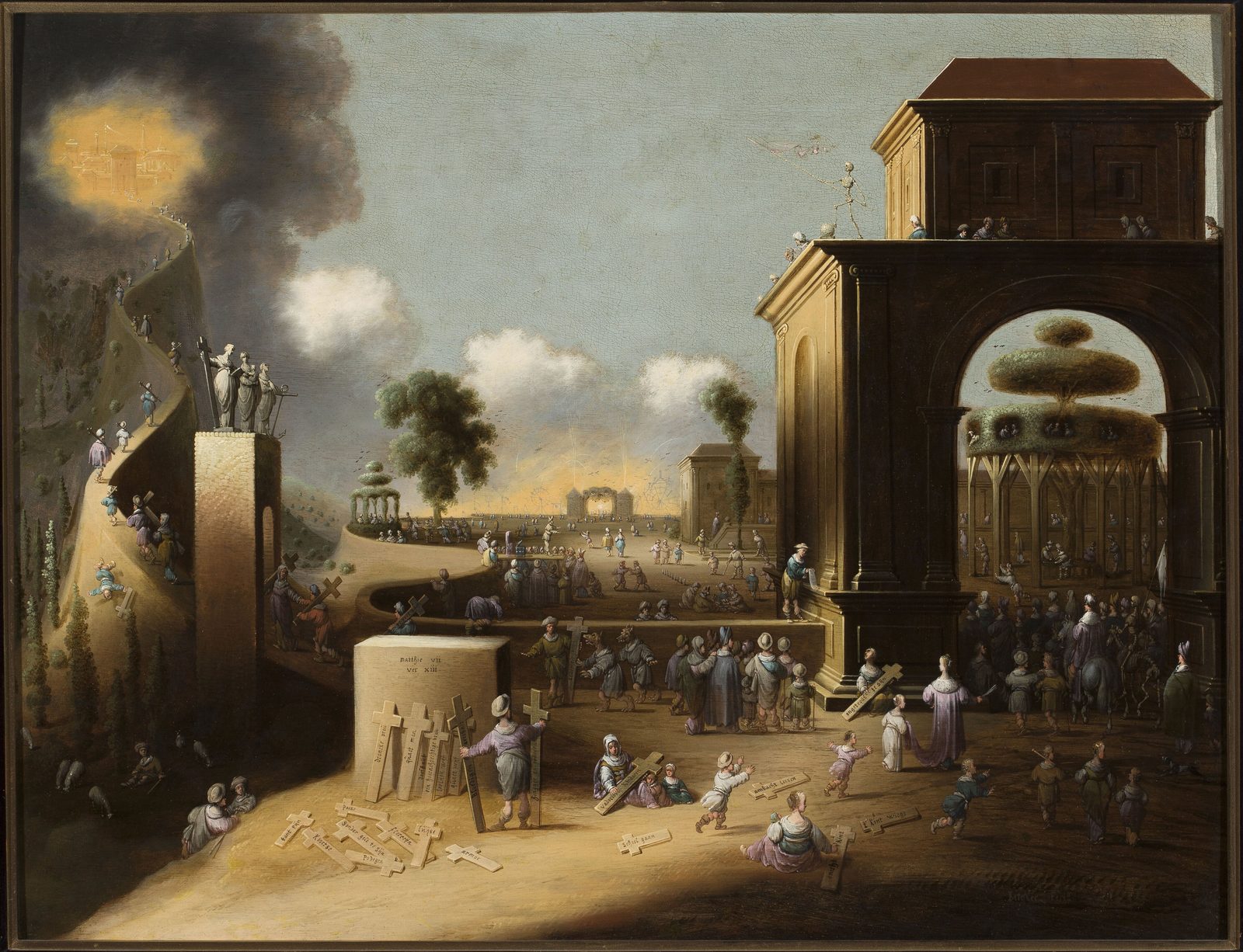
Narrow Road of Virtue and Wide Road of Sin. Jan Micker, not stated on the file page. National Museum in Warsaw. Public domain.