
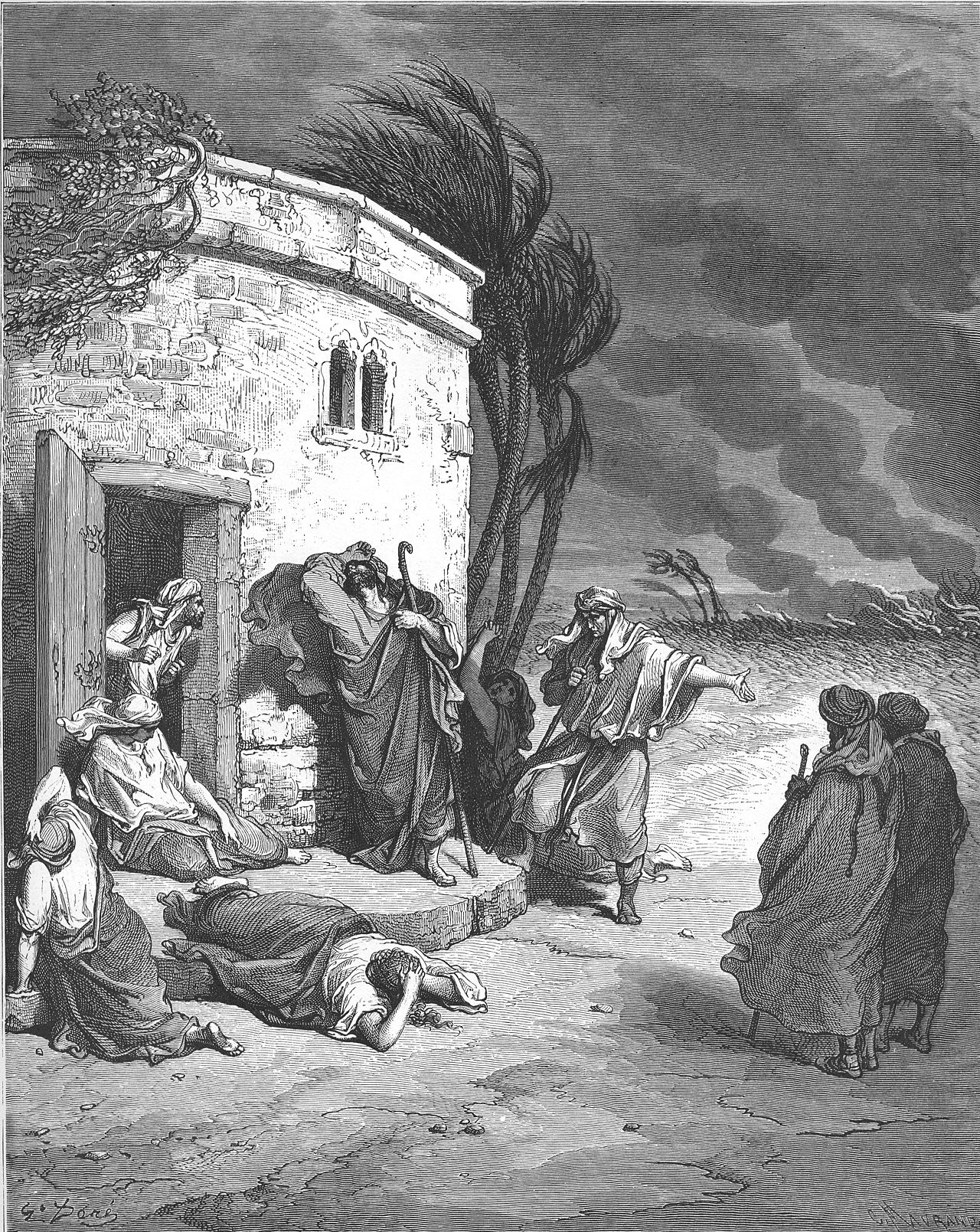
Jobchapter 8
22 verses · unknown · 10th century BC · Wisdom and poetry
Does papyrus grow where there is no marsh? Do reeds flourish without water?
Introduction
unknown, Wisdom and poetry, Job Overview.
Bildad, the second of Job's friends, speaks for the first time in this chapter. He is shorter and blunter than Eliphaz, and he rests his case on the wisdom of earlier generations. His hearers belonged to a world where knowledge passed from fathers to sons by memory and where the sayings of the elders settled arguments. Listen for the plants he describes and what each one is meant to say about Job. Listen also for the sentence he speaks about Job's children, and weigh it against what the reader knows from chapter 1.
Context
- Who
- Hearers raised to treat the sayings of the ancestors as settled truth
- What
- Bildad's first speech, defending God's justice, appealing to the teaching of the fathers, and promising Job restoration if he is upright.
- Where
- The ash heap outside Job's town; Bildad is a Shuhite, of a people traced to Shuah, a son of Abraham by Keturah.
- When
- After Job's reply to Eliphaz, as the second speech of the first round.
- Why
- To press the friends' case that God's justice explains every loss, this time on the authority of tradition.
Historical context
Bildad is called a Shuhite. Shuah was a son of Abraham by Keturah, and Assyrian records name a region called Suhu along the middle Euphrates, a real tribal area on the trade road, which fits a friend who could travel to Uz.
Show the rest of the historical context, 3 more paragraphs
His authority is different from Eliphaz's. Where Eliphaz cited a vision, Bildad cites the ancestors: enquire of the former age, and prepare yourself to search what their fathers found out, because we are of yesterday and know nothing, our days on earth a shadow. In a world where almost nobody could read and knowledge passed by memory down family lines, this was the strongest argument available. It is also, in this case, an argument that whatever the elders always said must be right.
His two plant pictures come straight out of the landscape. Papyrus and marsh reed grow tall and green but die faster than any grass the moment the water is cut off, an image drawn from the great reed beds of Egypt and Mesopotamia. And the flourishing garden plant whose roots wrap around a heap of stones looks unshakeable until the ground is cleared, and then the place says, 'I never saw you.'
The spider's web is the same idea at household scale: a man leans on his house and it will not stand. Every one of these images says that what looks solid is not, and every one of them is aimed at Job's estate, Job's children, and Job's reputation.
Significance
Bildad says the hardest sentence in the book: your children sinned, and God has handed them over to their transgression. He says it to a man who buried ten children in a single day, and he says it as a matter of doctrine.
Show the rest of the significance, 1 more paragraph
First hearers were meant to flinch. The book is showing what happens when a true principle, that God is just, is used as a tool to explain other people's graves.
This chapter in Jewish lifeWhat this chapter is in Jewish life and reading.
What is done
Job 8 has no place in the synagogue's cycle of readings on the site's own table. Probed for this lane, src/lib/hebraic/readings.ts printed parashot total 0 and haftarah uses total 0 for Job, and no festival reading. The same table holds 54 weekly portions and 6 festival readings in all.
The corpus shows where the chapter is met in study instead. Under the seventh verse it carries Midrash Tanchuma at Chayei Sara 6:1, 6:4 and 8:3 and at Eikev 3:1, with Midrash Tanchuma Buber at Chayei Sara 10:1 and Eikev 5:1. The same verse draws Kiddushin 40b:6 from the Talmud. Under the eleventh it carries Midrash Tanchuma, Beshalach 25:1.
How it is read
Malbim is quoted here from Malbim's Job, translated by Jeremy I. Pfeffer (Ktav, 2003), which Sefaria reports as CC-BY. He counts the chapter as the fourth oration of the book and the first speech of Bildad (Malbim on Job 8:1:1). He marks what is new in it. "The Shuite debater chooses a different approach, one he claims to have received as a tradition from his forefathers" (Malbim on Job 8:1:2).
Malbim then gives the shape of the argument. Bildad holds that the unwarranted suffering of the good and the unwarranted prosperity of the wicked will both be answered in the end. He illustrates it by comparing kinds of people to kinds of plants (Malbim on Job 8:10:1). At the close Malbim reads Bildad appealing to Job to accept this and to keep his faith and hope in God (Malbim on Job 8:21:1).
Rashi is quoted from The Judaica Press complete Tanach with Rashi, translated by A. J. Rosenberg, which Sefaria reports as CC-BY. He reads the mighty wind of Bildad's opening as Job's many words (Rashi on Job 8:2:1 and 8:2:2). Bildad's question about God and judgment he reads as an expression of wonder, from the vowel under the first letter (Rashi on Job 8:3:1).
Of Job's children Rashi says the transgression "became the agent to carry them off" (Rashi on Job 8:4:1). If Job seeks God, Rashi reads, God will arouse his merit and make his home complete (Rashi on Job 8:5:1 and 8:6:1). The seventh verse he reads as a small past set against an end that will increase greatly (Rashi on Job 8:7:1).
Rashi follows the plant image closely. Papyrus grows only where the marsh is wet, and he gives the Old French word for a marsh (Rashi on Job 8:11:1). Those who forget God prosper "when it goes well with him until his measure [of sin] is full" (Rashi on Job 8:13:1). Their confidence is then cut off (Rashi on Job 8:14:1).
Rashi calls the eighteenth verse elliptical and supplies the one who requites the wicked as its subject (Rashi on Job 8:18:1). He ends with Bildad's promise that God will not uphold the enemies harming Job "until He returns to grant you clemency" (Rashi on Job 8:20:1). The corpus carries three further notes on this chapter without an English text, each marked linked because Sefaria holds no English version of the ref. They stand cited and unquoted at Metzudat David on Job 8:9:1, 8:15:1 and 8:22:1.
What the rabbis say
The corpus carries thirty-five rabbinic locators on this chapter and the text of none, so each is cited here by ref alone. On the first verse it holds Avot DeRabbi Natan 37:13 and Kohelet Rabbah 7:2:4. On the sixth it holds Bereshit Rabbah 79:3 and Jerusalem Talmud Rosh Hashanah 1:3:4.
The seventh verse draws fifteen locators, the heaviest run in the chapter. The corpus holds Aggadat Bereshit 61:1, Devarim Rabbah 7:3, Kiddushin 40b:6 and Jerusalem Talmud Megillah 3:2:6. With them stand Ein Yaakov, Kiddushin 1:46 and Ein Yaakov (Glick Edition), Kiddushin 1:34. The six Tanchuma passages named above stand there too, with Otzar Midrashim, Pesikta, Pesikta Chadata 49, Pirkei DeRabbi Eliezer 35:1 and Shir HaShirim Rabbah 1:3:2.
On the tenth verse the corpus holds Ein Yaakov (Glick Edition), Taanit 1:41 and Midrash Tanchuma Buber, Appendix to Re'eh 1:1. On the eleventh, the papyrus, it holds Mekhilta DeRabbi Yishmael, Tractate Amalek 1:1 and Midrash Lekach Tov at Exodus 17:8:2 and Genesis 41:2:5. Midrash Sekhel Tov at Bereshit 41:2:3, Shemot 17:7:5 and Shemot 2:3:3 stands with them, and so do Midrash Tanchuma, Beshalach 25:1 and Yalkut Shimoni on Torah 261:22.
On the twelfth verse the corpus holds Midrash Aggadah, Numbers 1:9:1. On the sixteenth it holds Midrash Lekach Tov, Genesis 49:5:2 and Midrash Tehillim 37:2. On the nineteenth it holds Tractate Kallah Rabbati 8:9, and on the twentieth Aggadat Bereshit 28:1 and Pesikta Rabbati 42:1. What each of them teaches is a saying of the rabbis, and is reported as theirs wherever this site quotes one. The quotations wait on a fetch that carries the text.
Sources: Malbim, Malbim on Job 8:1:1 to 8:21:1, Malbim's Job, trans. Jeremy I. Pfeffer, Ktav, 2003, reported CC-BY; Rashi, Rashi on Job 8:2:1 to 8:20:1, The Judaica Press complete Tanach with Rashi, translated by A. J. Rosenberg, reported CC-BY; Metzudat David, Metzudat David on Job 8:9:1, 8:15:1 and 8:22:1, cited by ref because the corpus carries no English text; The Sefaria corpus, scripts/data/sources/sefaria/job/8.json, the 35 Talmud and Midrash locators of this chapter; The site's own files, src/lib/hebraic/readings.ts, printing no portion, no Haftarah and no festival reading for this book.
The heads below are this chapter's scenes. The numbered points under each are its verses.
Bildad: Doth God Pervert Justice?
Job 8:1-3
Then Bildad the Shuhite replied: Bildad the Shuhite opens the book's second speech by calling Job's words "a blustering wind," noise without substance. His question, "Does God pervert justice," states true doctrine. The question expects the answer no, a fixed premise from which Bildad will argue that Job's guilt must follow.
Job 8:1
“Then answered Bildad, the Shuhite, and said, How long wilt thou speak these things? and how long shall the breath of the words of thy mouth be multiplied? To the unrighteous the words of the righteous are ever grievous, and such as they hear spoken for edification, they bear as a burthen put upon them. As Bildad, the Shuhite, plainly indicates in his own case, when he says, How long wilt thou speak these things? For he that says how long, shews that he cannot any longer bear words of edification.”
Gregory the Dialogist · written before 604 · Morals on the Book of Job, Book VIIIpatristic
1 more voice on this verseWhat preachers and commentators have said about this verse, in their own words.
Job 8:1
“Bildad the Shuhite - Supposed to be a descendant of Shuah, one of the sons of Abraham, by Keturah, who dwelt in Arabia Deserta, called in Scripture the east country. See Gen 25:1, Gen 25:2, Gen 25:6.”
Adam Clarke · Commentary on the Bible (1810-1826)evangelical
The words of your mouth are a blustering wind: Bildad asks how long the words of Job's mouth will go on like a blustering wind. Henry notes how often a rebuke rests on a misreading of the man rebuked. The Syriac, Barnes reports, reads pride.
Job 8:2
“How long wilt thou speak these things? - Wilt thou still go on to charge God foolishly? Thy heavy affliction proves that thou art under his wrath; and his wrath, thus manifested, proves that it is for thy sins that he punisheth thee. Be like a strong wind? - The Arabic, with which the Syriac agrees, is (Syriac) rucholazomati, the spirit of pride. Wilt thou continue to breathe forth a tempest of words? This is more literal.”
Adam Clarke · Commentary on the Bible (1810-1826)evangelical
1 more voice on this verse
Job 8:2
“Thus (as Caryl observes) reproofs are often grounded upon mistakes. Men's meaning is not taken aright, and then they are gravely rebuked as if they were evil-doers.”
Matthew Henry · Commentary on the Whole Bible (1707-1721)puritan
Does God pervert justice?: Bildad says pervert twice, and Jamieson, Fausset and Brown hear the double question as a sting aimed at Job. Barnes notes that Job had never said in so many words that God perverts justice. Bildad is answering words Job never spoke.
Job 8:3
“Doth God pervert judgment? - That is, Does God afflict people unjustly? Does he show favor to the evil, and punish the good? Bildad here undoubtedly refers to Job, and supposes that he had brought this charge against God. But he had not done it in so many words. He had complained of the severity of his sufferings, and had indulged in irreverent language toward God. But he had not advanced the charge openly that God had perverted right. Bildad strenuously maintains that God would do right.”
1 more voice on this verse
Job 8:3
“The repetition of "pervert" gives an emphasis galling to Job (Job 34:12). "Wouldst thou have God," as thy words imply, "pervert judgment," by letting thy sins go unpunished?”
Jamieson, Fausset & Brown · Commentary Critical and Explanatory on the Whole Bible (1871)reformed
Job 8:4-7
When your children sinned against Him: True doctrine drives a false inference. "He gave them over to their rebellion" treats the deaths of Job's ten children in chapter 1 as evidence of their sin. Bildad's condition, "if you would earnestly seek God," is a bargain that assumes present guilt is the reason help has not come.
Job 8:4
“If thy children have sinned - I know thy children have been cut off by a terrible judgment; but was it not because by transgression they had filled up the measure of their iniquity? And he have cast them away - Has sent them off, says the Targum, to the place of their transgression - to that punishment due to their sins.”
Adam Clarke · Commentary on the Bible (1810-1826)evangelical
But if you would earnestly seek God: Earnestly seek is shachar, a verb Barnes ties to the dawn, and Gregory reads seek God at daybreak. Bildad's offer of mercy carries a sting. He assumes God gave the children over for their sin and spared Job to repent.
Job 8:5
“If thou wouldest seek unto God betimes - If thou wouldest do it now. If even on the supposition that your sons have thus perished, and that God has come out in judgment against your family, you would look to God, you might be restored to favor. The word rendered “seek betimes” (שׁחר shâchar) means literally to seek in the morning, to seek early; and then, to make it the first business. It is derived from the word meaning aurora (שׁחר shachar) and has reference to the early light of the morning, and hence, to an early seeking.”
if you are pure and upright: Bildad sets a condition the reader knows Job already meets. Job 1:1 calls him blameless and upright. Clarke draws out the logic behind it: a pure and upright man would have been restored long ago, so Job must be neither.
Job 8:6
“If thou wert pure and upright,.... By which he tacitly intimates that he was neither; though the character given of him is, that he was perfect and upright, feared God and eschewed evil, and which is confirmed by God himself, and even after he had been tried by sore afflictions. Bildad's meaning is, if he was pure in heart, and upright in his life and conversation, then things would be well with him.”
1 more voice on this verse
Job 8:6
“If thou wert pure and upright - Concerning thy guilt there can be no doubt; for if thou hadst been a holy man, and these calamities had occurred through accident, or merely by the malice of thy enemies, would not God, long ere this, have manifested his power and justice in thy behalf, punished thy enemies, and restored thee to affluence? The habitation of thy righteousness - Strongly ironical.”
Adam Clarke · Commentary on the Bible (1810-1826)evangelical
your latter days will flourish: Spurgeon reads the promise as part of Bildad's case that Job could not be upright, for the upright always flourish. The promise comes true at Job 42:12, when the LORD blesses Job's latter days more than his beginnings. Bildad's reasoning fails and his words stand.
Job 8:7
“Though thy beginning was small - On the supposition that the children of Job had been cut off, his family now was small. Yet Bildad says, that if he were to begin life again, even with so small a family, and in such depressed and trying circumstances, if he were a righteous man he might hope for returning prosperity. Yet thy latter end - From this, it is evident that Job was not now regarded as an old man. He would still have the prospect of living many years.”
1 more voice on this verse
Job 8:7
“THIS WAS the reasoning of Bildad the Shuhite. He wished to prove that Job could not possibly be an upright man, for if he were so, he here affirms that his prosperity would increase continually, or that if he fell into any trouble, God would awake for him, and make the habitation of his righteousness prosperous; and though his family were now all destroyed, and his wealth scattered to the winds, yet if he were an upright man, God would surely appear for him, and his latter end would greatly increase.”
Bildad: Ask the Former Age: the Rush Withers Without Water
Job 8:8-10
Please inquire of past generations: Bildad appeals to tradition as the court of final appeal: "Please inquire of past generations and consider the discoveries of their fathers". His clause "For we were born yesterday and know nothing" admits that his generation has no standing of its own and must borrow its wisdom.
Job 8:8
“Inquire - of the former age - לדור רישון ledor rishon, of the first age; of the patriarchs; the first generation of men that dwelt upon the earth: not of the age that was just past, as Mr. Peters and several others have imagined, in order to keep up the presumption of Job’s high antiquity. Bildad most evidently refers to an antiquity exceedingly remote.”
Adam Clarke · Commentary on the Bible (1810-1826)evangelical
1 more voice on this verse
Job 8:8
“It is only the prayer of the upright that is the acceptable and prevailing prayer, Prov. xv. (2.) He gives him good hopes that he shall yet again see good days, secretly suspecting, however, that he was not qualified to see them.”
Matthew Henry · Commentary on the Whole Bible (1707-1721)puritan
For we were born yesterday and know nothing: Bildad sets his short-lived generation beside the fathers, who lived for centuries and stored up what they saw, as Clarke reads it. Born yesterday, men know nothing. Their days on earth pass like a shadow, and Gregory draws the lesson that a brief life must learn from past generations.
Job 8:9
“For we are but of yesterday - That is, we are of short life. We have had but few opportunities of observation compared with those who have gone before us. There can be no doubt that Bildad here refers to the longevity of the antecedent ages compared with the age of man at the time when he lived; and the passage, therefore, is of importance in order to fix the date of the poem.”
Will they not teach you and tell you: Bildad trusts the fathers over any experience of Job's. Clarke reads understanding, literally heart, as the fruit of long and careful experience. Henry adds that words from a teacher's heart reach a learner's heart.
Job 8:10
“Shall not they teach thee - The results of human conduct, and the great principles on which God governs the world. And utter words out of their heart - Dr. Good renders this, “And well forth the sayings of their wisdom,” And supposes it means that the words of wisdom would proceed from them as water bubbles from a fountain. But this, I think, is a mere conceit.”
3 more voices on this verse
Job 8:10
“Shall not they teach thee, and tell thee, and utter words out of their heart? We must mark what he had said before, And the inspiration of the words of thy mouth is multiplied. But now when the fathers are brought to mind, he says, They shall utter words out of their heart. As though heretics abhorring the life of Holy Church said, 'Thou hast abundance of inspiration in thy mouth, in thy heart thou hast none of it.”
Gregory the Dialogist · written before 604 · Morals on the Book of Job, Book VIIIpatristic
Job 8:10
“Utter - Not partially, but sincerely, speaking their inward thoughts; not rashly, but from deep consideration; not by hearsay, but their own knowledge.”
John Wesley · Explanatory Notes upon the Old Testament (1765)evangelical
Job 8:10
“Shall not they teach thee - Wilt thou not treat their maxims with the utmost deference and respect? They utter words from their heart - what they say is the fruit of long and careful experience.”
Adam Clarke · Commentary on the Bible (1810-1826)evangelical
Job 8:11-15
Does papyrus grow where there is no marsh?: The poem on the wicked opens with papyrus, plants that flourish only where water stands and "dry up quicker than grass" once it is gone. The line "his security is in a spider’s web" names a structure built to look secure and unable to bear weight.
Job 8:11
“It and the flag, or bulrush, grow only in marshy places (such as are along the Nile). So the godless thrives only in external prosperity; there is in the hypocrite no inward stability; his prosperity is like the rapid growth of water plants.”
Jamieson, Fausset & Brown · Commentary Critical and Explanatory on the Whole Bible (1871)reformed
1 more voice on this verse
Job 8:11
“Can the rush - This passage has all the appearance of being a fragment of a poem handed down from ancient times. It is adduced by Bildad as an example of the views of the ancients, and, as the connection would seem to imply, as a specimen of the sentiments of those who lived before the life of man had been abridged. It was customary in the early ages of the world to communicate knowledge of all kinds by maxims, moral sayings, and proverbs; by apothegms and by poetry handed down from generation to generation.”
they dry up quicker than grass: Clarke notes that papyrus grows tall and full of water and still dries up quickly once the marsh is gone. Henry applies it as Bildad meant it, to the godless man whose best days already border on withering. The shoots dry up while still uncut.
Job 8:12
“Whilst it is yet in his greenness - We do not know enough of the natural history of this plant to be able to discern the strength of this allusion; but we learn from it that, although this plant be very succulent, and grow to a great size, yet it is short-lived, and speedily withers; and this we may suppose to be in the dry season, or on the retreat of the waters of the Nile. However, Soon Ripe, soon Rotten, is a maxim in horticulture.”
Adam Clarke · Commentary on the Bible (1810-1826)evangelical
1 more voice on this verse
Job 8:12
“Whilst it is yet in his greenness, and not cut down, it withereth before any other herb. So are the paths of all that forget God, and the hypocrite's hope shall perish. Now it is well added, Whilst it is yet in his flower, nor plucked with the hand, it withereth before any other herb. 'The rush in his flower' is the hypocrite in esteem. Now the rush springing up with sharp edges is not plucked with the hand, in that the hypocrite, having his feelings sharpened by presumption, disdains to be rebuked for his wickedness.”
Gregory the Dialogist · written before 604 · Morals on the Book of Job, Book VIIIpatristic
Such is the destiny of all who forget God: Barnes reads the line as part of the fathers' saying Bildad quotes, the moral drawn from the papyrus. Godless is the word the King James renders hypocrite, a man whose fear of God is a front. Bildad points it at Job.
Job 8:13
“So are the paths of all that forget God, and the hypocrite's hope shall perish. But as we have before said, who he is to whom Bildad likens 'a rush' or 'a flag,' he makes plain at the moment, where he adds, So are the paths of all that forget God, and the hypocrite's hope shall perish. For what does the hypocrite hope for from all his deeds, saving the observance of honour, the reputation of applause, to be feared by his betters, to be called a Saint by all men?”
Gregory the Dialogist · written before 604 · Morals on the Book of Job, Book VIIIpatristic
1 more voice on this verse
Job 8:13
“So are the paths of all that forget God - This is clearly a part of the quotation from the sayings of the ancients. The word “paths” here means ways, acts, doings. They who forget God are like the paper-reed. They seem to flourish, but they have nothing that is firm and substantial. As the paper-reed soon dies, as the flag withers away before any other herb, so it will be with the wicked, though apparently prosperous.”
His confidence is fragile: Barnes reports that some end Bildad's quotation of the fathers at verse 13 and others carry it to verse 19. The picture moves from papyrus to a spider's web. Clarke finds the confidence of the godless as fragile as that web.
Job 8:14
“Whose hope shall be cut off - Such persons, subdued by the strong habits of sin, hope on fruitlessly, till the last thread of the web of life is cut off from the beam; and then they find no more strength in their hope than is in the threads of the spider’s web. Mr. Good renders, Thus shall their support rot away. The foundation on which they trust is rotten, and by and by the whole superstructure of their confidence shall tumble into ruin.”
Adam Clarke · Commentary on the Bible (1810-1826)evangelical
1 more voice on this verse
Job 8:14
“His own folly shall not satisfy him, and whose trust shall be a spider's web. For it is infinite folly to labour painfully, and pant after the breath of applause, to apply one's self to the heavenly precepts with hard toil, but to aim at the reward of an earthly kind of recompense. For that I may so express myself, he that in return for the good that he practises looks for the applause of his fellowcreatures, is carrying an article of great worth to be sold at a mean price.”
Gregory the Dialogist · written before 604 · Morals on the Book of Job, Book VIIIpatristic
He leans on his web: Clarke describes a spider testing its web, leaning on one strand and pulling another to see if it holds. The Hebrew calls the web a house, as Barnes notes, the refuge the godless man builds for himself. It gives way under his weight.
Job 8:15
“He leaneth upon his house, but it shall not stand; he shall prop it, but it shall not rise up. As the house of our exterior life is the building which the body lives in, so the house of our thought is any thing whatever that the mind is centered in by affection. For every thing that we love, we as it were make our dwelling-place by reposing in it. Whence Paul, because he had fixed his heart in things above, being still upon earth indeed, yet a stranger to earth, said, Our conversation is in heaven.”
Gregory the Dialogist · written before 604 · Morals on the Book of Job, Book VIIIpatristic
Job 8:16-19
He is a well-watered plant in the sunshine: A second portrait follows the spider's web, "a well-watered plant in the sunshine", thriving before it is torn out. The line "yet others will spring from the dust" fills the wicked man's place. Bildad implies Job's place stands ready to be filled or restored by his response.
Job 8:16
“Branch - His children, who are here mentioned as additions not only to his comfort, but also to his strength and safety. Garden - A place where it is defended from those injuries to which the trees of the field are subject, and where, besides the advantages common to all trees, it hath peculiar helps from the art and industry of men.”
John Wesley · Explanatory Notes upon the Old Testament (1765)evangelical
1 more voice on this verse
Job 8:16
“It is seen moist before the sun cometh, and his produce issueth forth in his springing up. Oftentimes in Holy Writ the Lord is represented by the title of the Sun, as it is said by the Prophet, But unto you that fear My Name shall the Sun of righteousness arise.”
Gregory the Dialogist · written before 604 · Morals on the Book of Job, Book VIIIpatristic
His roots wrap around the rock heap: Barnes reports wide disagreement over this line, with Jerome reading roots packed over a heap of stones and Walton reading them over a spring. Either way the plant has grown deep and seems settled. The next verse tears it out.
Job 8:17
“His roots will be wrapped about the heap of rocks, and he will dwell among the stones. For what do we understand by the name of 'roots' save the hidden thoughts, which issue forth out of sight, but rise up in the display of works in open day? as it is also said by the Prophet concerning the seed of the Word, And the remnant that is escaped of the house of Judah shall again take root downward and bear fruit upward.”
Gregory the Dialogist · written before 604 · Morals on the Book of Job, Book VIIIpatristic
1 more voice on this verse
Job 8:17
“His roots are wrapped about the heap - There has been great diversity of opinion in the interpretation of this passage. Jerome renders it, “over the heap of stones his roots are condensed.” Walton, “super fontem - over a fountain.” The Septuagint, “he lies down (or sleeps, κοιμᾶται koimatai) on a heap of stones; and he lives in the midst of flint-stones.” According to some, the word rendered heap גל gal means a fountain; according to others, it means a heap or pile of stones; according to Dr. Good, it means a rock.”
If he is uprooted from his place: The place itself speaks, a figure Clarke calls prosopopoeia, giving a voice to a thing. At Job 7:10 Job said his place would remember him no more, and Bildad turns that picture on the wicked. The ground disowns the plant.
Job 8:18
“If He destroy him from his place, then He shall deny him, saying, I have not known thee. The hypocrite is 'destroyed from his place,' when he is parted from the applause of the present life, by death intervening. But the interior Witness 'denieth' him, thus destroyed, and asserts that He knows him not, in that in justly condemning the life of the pretender, 'Truth' knows him not, nor recognises the good works he has done, in that he never put them forth in a right purpose of mind.”
Gregory the Dialogist · written before 604 · Morals on the Book of Job, Book VIIIpatristic
1 more voice on this verse
Job 8:18
“If He (God) tear him away (properly, "to tear away rapidly and violently") from his place, "then it [the place personified] shall deny him" (Ps 103:16). The very soil is ashamed of the weeds lying withered on its surface, as though it never had been connected with them.”
Jamieson, Fausset & Brown · Commentary Critical and Explanatory on the Whole Bible (1871)reformed
Surely this is the joy of his way: Barnes and Clarke both hear sarcasm in the joy of his way. Jamieson, Fausset and Brown read the others that spring from the dust as a fresh crop of weeds among the stones. The plant is gone and others take its place.
Job 8:19
“Behold, this is the joy of his way - This is evidently sarcastic. “Lo! such is the joy of his course! He boasts of joy, as all hypocrites do, but his joy endures only for a little time. This is the end of it. He is cut down and removed, and the earth and the heavens disown him!” And out of the earth shall others grow - This image is still derived from the tree or plant.”
1 more voice on this verse
Job 8:19
“This then is his "joy" at the last. and out of the earth--others immediately, who take the place of the man thus punished; not godly men (Mt 3:9). For the place of the weeds is among stones, where the gardener wishes no plants. But, ungodly; a fresh crop of weeds always springs up in the place of those torn up: there is no end of hypocrites on earth [UMBREIT].”
Jamieson, Fausset & Brown · Commentary Critical and Explanatory on the Whole Bible (1871)reformed
Job 8:20-22
God does not reject the blameless: Bildad states the friends' creed: "God does not reject the blameless, nor will He strengthen the hand of evildoers". The reader carries from 1:1 the narrator's own word that Job is blameless, so Bildad's true doctrine collides with the case in front of him.
Job 8:20
Behold, God will not cast away a perfect man - This is another of the maxims of the ancients, which Bildad produces: “As sure as he will punish and root out the wicked, so surely will he defend and save the righteous.”
Adam Clarke · Commentary on the Bible (1810-1826)evangelical
1 more voice on this verse
Job 8:20
“Yet it may be, he will not be lifted up in this world: and therefore Bildad could not infer, that if Job was not restored to temporal prosperity, he was not a good man. Let us judge nothing before the time, but wait 'till the secrets of all hearts are revealed, and the present difficulties of providence solved, to universal and everlasting satisfaction.”
John Wesley · Explanatory Notes upon the Old Testament (1765)evangelical
He will yet fill your mouth with laughter: Clarke suggests reading the verse as a wish, and he finds Bildad less harsh than Eliphaz. Henry grants that God will fill the mouth of the blameless with laughter, in this life or the next. Bildad offers it on his own terms.
Job 8:21
“Till He fill thy mouth with laughing, and thy lips with shouting. For the 'mouth' of the righteous will then be 'filled with laughing' when the tears of their pilgrimage being done, their hearts shall be filled to the full with exulting in eternal joy. Concerning this laughing 'Truth' saith to His disciples, Verily, verily, I say unto you, that ye shall weep and lament, but the world shall rejoice; and ye shall be sorrowful, but your sorrow shall be turned into joy.”
Gregory the Dialogist · written before 604 · Morals on the Book of Job, Book VIIIpatristic
2 more voices on this verse
Job 8:21
“Till he fill thy mouth with laughing - Until he make thee completely happy. The word rendered “till” (עד ‛ad), is rendered by Dr. Good, “even yet.” Noyes, following Houbigant, DeWette, and Michaelis, proposes to change the pointing, and to read עד ‛ôd, instead of עד ‛ad - meaning, “while.” The verse is connected with that which follows, and the particle used here evidently means “while,” or “even yet” - and the whole passage means, “if you return to God, he will even yet fill you with joy, while those who hate you shall be clothed with shame.”
Job 8:21
“Now it is true that God will not cast away an upright man; he may be cast down for a time, but he shall not be cast away for ever. It is true that, if not in this world, yet in another, the mouth of the righteous shall be filled with rejoicing.”
Matthew Henry · Commentary on the Whole Bible (1707-1721)puritan
Your enemies will be clothed in shame: Henry suspects a sly edge in the tent of the wicked, for the tent that had just fallen was Job's own. He calls such reasoning unjust. At Job 42:7 it is the friends who are clothed in shame before God.
Job 8:22
“They that hate thee shall be clothed with shame - When they see your returning prosperity, and the evidences of the divine favor. They will then be ashamed that they regarded you as a hypocrite, and that they reproached you in your trials. And the dwelling-place of the wicked ... - The wicked shall be destroyed, and his family shall pass away. That is, God will favor the righteous, but punish the wicked. This opinion the friends of Job maintain all along, and by this they urge him to forsake his sins, repent, and return to God.”
2 more voices on this verse
Job 8:22
“Sin brings ruin on persons and families. Yet to argue (as Bildad, I doubt, slyly does) that because Job's family was sunk, and he himself at present seemed helpless, therefore he certainly was an ungodly wicked man, was neither just nor charitable, as long as there appeared no other evidence of his wickedness and ungodliness.”
Matthew Henry · Commentary on the Whole Bible (1707-1721)puritan
Job 8:22
“The haters of Job are the wicked. They shall be clothed with shame (Jer 3:25; 109:29), at the failure of their hope that Job would utterly perish, and because they, instead of him, come to naught.”
Jamieson, Fausset & Brown · Commentary Critical and Explanatory on the Whole Bible (1871)reformed
Keep studying
Sources for this chapter
The summary
Jamieson, Fausset & Brown, Commentary Critical and Explanatory; John Wesley, Notes on the Old Testament and Matthew Henry, Complete Commentary.
The exposition
Adam Clarke, Commentary on the Bible; Albert Barnes; Charles Spurgeon, The Metropolitan Tabernacle Pulpit; Franz Delitzsch, Biblical Commentary on the Book of Job; Gregory the Dialogist, Morals on the Book of Job; Jamieson, Fausset & Brown, Commentary Critical and Explanatory on the Whole Bible; John Gill, Exposition of the Old Testament and Matthew Henry, Commentary on the Whole Bible.