
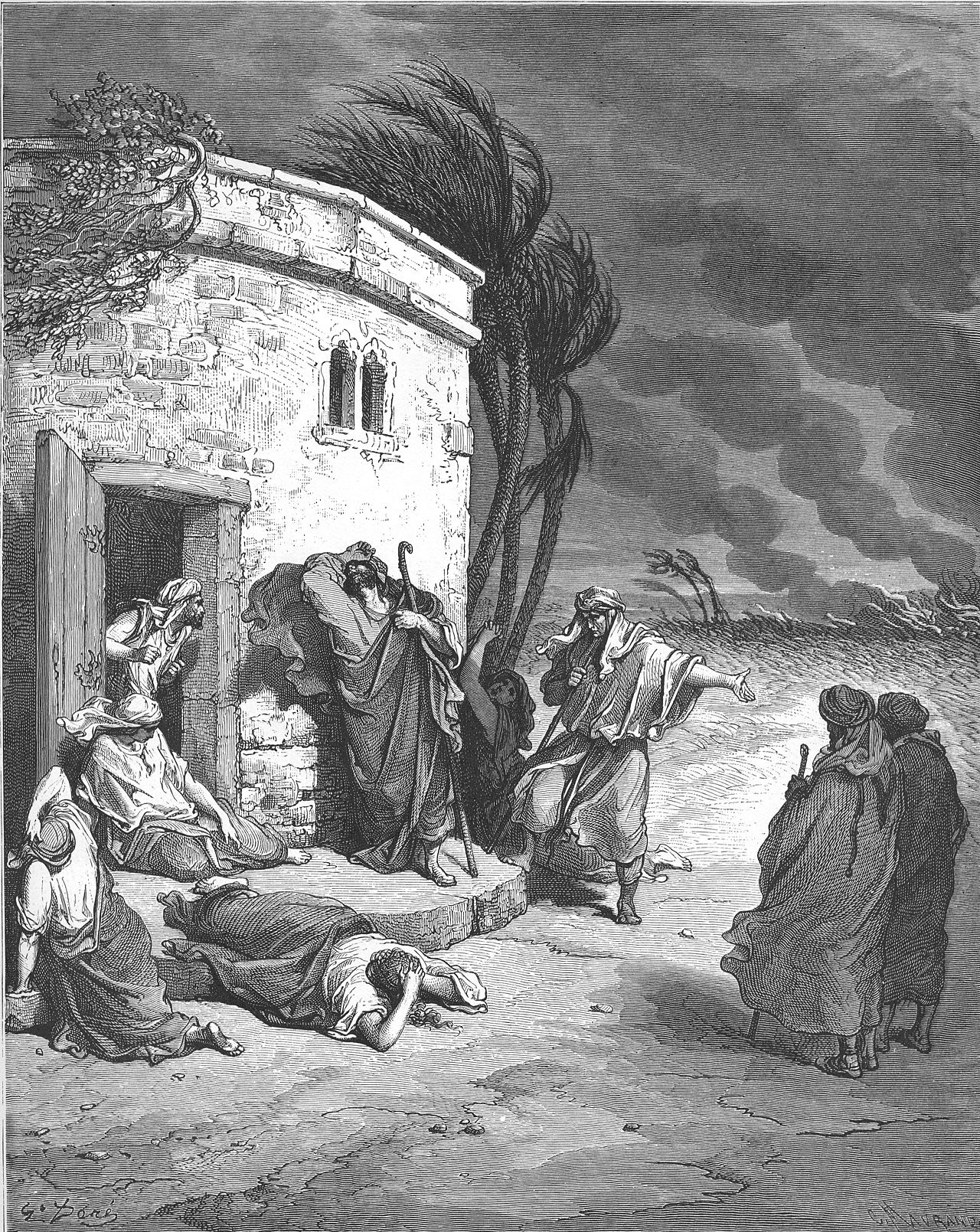
Jobchapter 5
27 verses · unknown · 10th century BC · Wisdom and poetry
For resentment kills a fool, and envy slays the simple.
Introduction
unknown, Wisdom and poetry, Job Overview.
Eliphaz continues the speech he began in chapter 4, and he moves from warning to promise. He speaks as a wise elder to a man he believes God is correcting. His images come from the farm and the household, familiar to people who lived by crops, flocks and large families. Listen for the one line of this chapter that the New Testament quotes, and notice who speaks it. Listen too for the long list of blessings at the close, and ask on what condition Eliphaz offers them. A speech can be true in its parts and still misjudge the man it addresses.
Context
- Who
- Hearers who knew the ordinary sorrows of farming, childlessness, and early death
- What
- The close of Eliphaz's first speech, urging Job to seek God, calling God's discipline a blessing, and promising restoration.
- Where
- The ash heap outside Job's town.
- When
- The second half of the first speech of the first round, in the patriarchal setting of the book.
- Why
- To press Job toward confession by setting out what God gives to those who accept His correction.
Historical context
'Man is born unto trouble, as the sparks fly upward' uses a Hebrew phrase that literally means 'the sons of flame', the embers that leap off a fire and are gone. Eliphaz's images are all farm and household: the fool taking root and his sons crushed in the gate with no rescuer, the hungry eating the harvest a rich man stored, the crop the thief swallows up.
Show the rest of the historical context, 3 more paragraphs
His closing section is the standard blessing list of that world, and it is worth reading as a picture of what security meant. Rescue in six troubles and seven; safety from famine and the sword; a covenant with the stones of the field, meaning ground cleared of rock and fit for the plough; peace with the wild animals that killed livestock and children; a tent found intact on return; descendants as many as the grass; and death at a ripe age, coming to the grave 'like as a shock of corn cometh in in his season', the sheaf carried in exactly when it is ready, the good death of a farmer.
Between the warnings sits a line hearers would have loved and later generations quoted often: God wounds and his hands make whole, he binds up. Eliphaz has hold of a genuine truth about discipline. He has simply decided in advance which category Job belongs in.
He also tells Job that appealing to the holy ones will get him nowhere, no member of the heavenly assembly will take his case. Hearers who remembered chapter 1 knew that the heavenly assembly was precisely where Job's case had been opened.
Significance
Read on its own, this is a beautiful and largely true speech about a God who disciplines in love and restores. Read in place, it is a man telling a bereaved father that his children died because of the family's sin, and that a quick confession will get the farm back.
Show the rest of the significance, 1 more paragraph
That gap between good theology and cruel counsel is the lesson the first hearers were meant to take. What is true in general can be a lie when aimed at a particular man.
This chapter in Jewish lifeWhat this chapter is in Jewish life and reading.
What is done
The close of Eliphaz's first speech is absent from the site's table of readings. The site's own table in src/lib/hebraic/readings.ts printed parashot total 0 and haftarah uses total 0 for Job, and no festival reading.
The corpus ties the chapter to study in the Talmud and in the Midrash on the Torah portions. Berakhot 5a:5 stands under the seventh verse, Bava Batra 68a:8 and 68b:1 under the tenth, and Nedarim 90a:2 under the twelfth. Midrash Tanchuma stands at Pekudei 3:10 and 3:16 on the ninth verse and at Chukat 9:1 on the thirteenth. Under the eighteenth verse the corpus carries three works on Esther.
How it is read
Rashi is quoted from The Judaica Press complete Tanach with Rashi, translated by A. J. Rosenberg, which Sefaria reports as CC-BY. He marks where the vision of the last chapter ends. "Up to here are words of prophecy" (Rashi on Job 5:1:1). From here Eliphaz returns to rebuke, and he tells Job that his anger harms him, "for had you remained silent, perhaps the Divine standard of clemency would return upon you" (Rashi on Job 5:2:1).
Malbim, quoted from Malbim's Job, translated by Jeremy I. Pfeffer (Ktav, 2003), which Sefaria reports as CC-BY, draws the same line in his own terms. Here Eliphaz gives "his reasoned as distinct from his prophetic reply" to Job. Malbim sums up the argument: "the prosperity of the wicked is a matter of chance and transient, whereas the hard-earned rewards of the righteous are lasting" (Malbim on Job 5:3:1).
Rashi reads Eliphaz's teaching on trouble as a teaching on sin. A plague does not come for nothing or spring from the ground (Rashi on Job 5:6:1). Man cannot help sinning and so receiving trouble, unlike the angels and spirits, who fly upward. Rashi notes that other editions word the line differently (Rashi on Job 5:7:1). Eliphaz says that in Job's place he would appeal to God with prayer and supplication (Rashi on Job 5:8:1).
Malbim says that Eliphaz brings two examples of God's work in the world (Malbim on Job 5:9:1). Rashi reads the first as rain, and places it on the land of Israel (Rashi on Job 5:10:1). By the rain God frustrates the crafty, "who intend to raise the prices and buy the fields of the poor for little grain" (Rashi on Job 5:11:1). Any counsel planned in haste is foolishness (Rashi on Job 5:13:1). The light of their wisdom turns to darkness (Rashi on Job 5:14:1).
On the troubles of the close the two commentators read differently. Rashi counts them one by one: famine, the sword, the tongue, plunder, and the beasts of the land, whom he takes for brigands. The corpus's notes reach a sixth, the stones of the field, which he reads as a kind of man (Rashi on Job 5:21:1 and 5:23:1). Malbim reads the verses as a lesson in hidden rescue. Being driven from home by famine or war may save a person from a worse danger (Malbim on Job 5:20:1).
Malbim draws the lesson from Niddah 31a. Two men set out to trade, and one cursed when a thorn stopped him, until he heard that his friend's ship had sunk. Malbim gives the Talmud's line: "Even a person for whom a miracle is performed is unaware of the miracle" (Malbim on Job 5:22:1). Rashi lists the dangers, and Malbim asks how a person would ever know he had been spared them.
The corpus carries one further note on this chapter without an English text, marked linked because Sefaria holds no English version of the ref. It stands cited and unquoted at Ibn Ezra on Job 5:18:1.
What the rabbis say
The corpus carries forty rabbinic locators on this chapter and the text of none, so each is cited here by ref. On the second verse it holds Midrash Tehillim 70:1. On the fifth it holds Esther Rabbah 10:9, Midrash Sekhel Tov, Bereshit 24:11:4 and Pesikta DeRav Kahana 8:2. On the seventh it holds Berakhot 5a:5 and Ein Yaakov (Glick Edition), Berakhot 1:14 and 1:16. On the ninth it holds Midrash Tanchuma, Pekudei 3:10 and 3:16 and Midrash Tehillim 117:1.
God's rule over the crafty draws the next run. On the tenth verse the corpus holds Bava Batra 68a:8 and 68b:1 and Bereshit Rabbah 13:4. On the eleventh it holds Bereshit Rabbah 13:9, Kohelet Rabbah 1:7:2 and Shemot Rabbah 25:8. On the twelfth it holds Nedarim 90a:2, Ein Yaakov (Glick Edition), Sanhedrin 3:7 and Ein Yaakov, Sanhedrin 3:9. On the thirteenth it holds Bamidbar Rabbah 19:9, Midrash Tanchuma Buber, Chukat 29:1 and Midrash Tanchuma, Chukat 9:1. On the fourteenth it holds Midrash Sekhel Tov, Bereshit 31:29:3, and on the fifteenth Midrash Tehillim 18:7.
The promise of rescue carries the rest. On the eighteenth verse the corpus holds Esther Rabbah 4:9, Midrash Lekach Tov on Esther 1:19:2 and Sifrei Aggadah on Esther, Midrash Abba Guryon 1:24. On the nineteenth it holds Aggadat Bereshit 69:1 and Bereshit Rabbah 75:8. On the twentieth it holds Aggadat Bereshit 3:1 and 69:2. On the twenty-first it holds Bereshit Rabbati, Parashat Toldot 30 and Ein Yaakov (Glick Edition), Gittin 5:14. On the twenty-second it holds Midrash Lekach Tov, Deuteronomy 28:3:1.
The last verses draw six. On the twenty-third the corpus holds Jerusalem Talmud Kilayim 8:4:3 and Midrash Lekach Tov, Genesis 31:44:1. On the twenty-fourth it holds Ein Yaakov (Glick Edition) at Shabbat 2:25 and Yevamot 6:6. On the twenty-sixth it holds Ein Yaakov (Glick Edition), Moed Katan 3:14 and Ein Yaakov, Moed Katan 3:30.
What each of them teaches is a saying of the rabbis, and is reported as theirs wherever this site quotes one. The quotations wait on a fetch that carries the text.
Sources: Rashi, Rashi on Job 5:1:1 to 5:24:1, The Judaica Press complete Tanach with Rashi, translated by A. J. Rosenberg, reported CC-BY; Malbim, Malbim on Job 5:3:1 to 5:22:1, Malbim's Job, trans. Jeremy I. Pfeffer, Ktav, 2003, reported CC-BY; Ibn Ezra, Ibn Ezra on Job 5:18:1, cited by ref because the corpus carries no English text; The Sefaria corpus, scripts/data/sources/sefaria/job/5.json, the 40 Talmud and Midrash locators of this chapter; The site's own files, src/lib/hebraic/readings.ts, printing no portion, no Haftarah and no festival reading for this book.
The heads below are this chapter's scenes. The numbered points under each are its verses.
Eliphaz: Man Is Born Unto Trouble
Job 5:1-3
To which of the holy ones: Eliphaz challenges Job to find a holy one who will take his side, framing an appeal to heaven as futile for a man under judgment. The proverb "For resentment kills a fool, and envy slays the simple" restates his doctrine that violent passions destroy a life.
Job 5:1
“Call now - The expressions used here, as Noyes has well observed, seem to be derived from the law, where the word “call” denotes the language of the complainant, and answer that of the defendant. According to this, the meaning of the words “call now” is, in jus voca: that is, call the Deity to account, or bring an action against him: or more properly, enter into an argument or litigation, as before a tribunal; see the notes at Isa 41:1, where similar language occurs.”
For resentment kills a fool: Barnes reads the resentment as God's wrath cutting off the wicked, and Matthew Henry reads it as the fool's own anger. Wesley hears the proverb aimed at Job, as if his grief were envy of the wicked and anger against God. Here the fool and the simple are the wicked.
Job 5:2
“For wrath killeth the foolish man, and envy slayeth the silly man. MORAL INTERPRETATION. Which same sentence would have been true, had it not been delivered against the patience of so great a man. But let us weigh well the thing that is said, though it be made to recoil by the virtue of his hearer, that we may shew how right the matter is, which is put forth, if it were not unjustly put forth against blessed Job; since it is written, But Thou, Lord, Judgest with tranquillity.”
Gregory the Dialogist · written before 604 · Morals on the Book of Job, Book Vpatristic
1 more voice on this verse
Job 5:2
“For wrath killeth the foolish man - Foolish, silly, and simple, are epithets given by Solomon to sinners and transgressors of all kinds. Such parallelisms have afforded a presumptive argument that Solomon was the author of this book. See the preface. The words of Eliphaz may be considered as a sort of maxim, which the wisdom and experience of ages had served to establish; viz., The wrath of God is manifested only against the wicked and impious; and if thou wert not such, God would not thus contend with thee.”
Adam Clarke · Commentary on the Bible (1810-1826)evangelical
I have seen a fool taking root: Eliphaz has seen a fool taking root and then his house suddenly cursed, and Barnes notes that he appeals to his own observation. Matthew Henry sees Job's own house drawn in the outline, settled in wealth and then suddenly ruined. Psalm 37:35 and 36 trace the same fall.
Job 5:3
“He seems here to parallel Job's case with that which is commonly the case of wicked people. Job had prospered for a time, seemed confirmed, and was secure in his prosperity; and it is common for foolish wicked men to do so: I have seen them taking root --planted, and, in their own and others' apprehension, fixed, and likely to continue.”
Matthew Henry · Commentary on the Whole Bible (1707-1721)puritan
1 more voice on this verse
Job 5:3
“I have seen the foolish - The wicked. To confirm the sentiment which he had just advanced, Eliphaz appeals to his own observation, and says that though the wicked for a time seem to be prosperous, yet he had observed that they were soon overtaken with calamity and cut down. He evidently means that prosperity was no evidence of the divine favor; but that when it had continued for a little time, and was then withdrawn, it was proof that the man who had been prospered was at heart a wicked man.”
Job 5:4-5
His sons are far from safety: Eliphaz presses the doctrine into the next generation, a charge that lands hard on a man who has just buried ten children. In "The hungry consume his harvest, taking it even from the thorns," a ruined estate is stripped bare, poverty following judgment as harvest follows planting.
Job 5:4
“His children are far from safety - His posterity shall not continue in prosperity. Ill gotten, ill spent; whatever is got by wrong must have God’s curse on it. They are crushed in the gate - The Targum says, They shall be bruised in the gate of hell, in the day of the great judgment.”
Adam Clarke · Commentary on the Bible (1810-1826)evangelical
1 more voice on this verse
Job 5:4
“Children - Whose greatness he designed in all his enterprizes, supposing his family would be established forever. Safely - Are exposed to dangers and calamities, and can neither preserve themselves, nor the inheritance which their fathers left them. There is no question but he glances here, at the death of Job's children.”
John Wesley · Explanatory Notes upon the Old Testament (1765)evangelical
The hungry consume his harvest: Jamieson, Fausset and Brown picture the hungry so eager they take the harvest even from the thorns. Wesley hears the Sabeans of Job 1:15, and Matthew Henry notes Eliphaz counts the loss of Job's wealth and sons as the punishment of sin. The LORD rebukes this reasoning at Job 42:7.
Job 5:5
“Harvest - Which they confidently expect to reap after all their cost and labour, but are sadly and suddenly disappointed. The hungry - The hungry Sabeans eat it up.”
John Wesley · Explanatory Notes upon the Old Testament (1765)evangelical
1 more voice on this verse
Job 5:5
“16 So the poor hath hope, and iniquity stoppeth her mouth. Eliphaz, having touched Job in a very tender part, in mentioning both the loss of his estate and the death of his children as the just punishment of his sin, that he might not drive him to despair, here begins to encourage him, and puts him in a way to make himself easy.”
Matthew Henry · Commentary on the Whole Bible (1707-1721)puritan
Job 5:6-7
distress does not spring from the dust: Eliphaz holds that suffering has a moral cause, since "distress does not spring from the dust, and trouble does not sprout from the ground". The next line, "Yet man is born to trouble as surely as sparks fly upward," states the rule so memorably it has outlived the argument.
Job 5:6
“We must not attribute our afflictions to fortune, for they are from God, nor our sins to fate, for they are from ourselves; so that, whatever trouble we are in, we must own that God sends it upon us and we procure it to ourselves: the former is a reason why we should be very patient, the latter why we should be very penitent, when we are afflicted.”
Matthew Henry · Commentary on the Whole Bible (1707-1721)puritan
Yet man is born to trouble: Clarke notes the Hebrew for trouble also means labour, the toil every man is born to. Jamieson, Fausset and Brown read distress as God's appointment for sin, springing from man himself and from nothing in the dust of verse 6. Matthew Henry adds sin and trouble rise together like sparks.
Job 5:7
“Man is born to labour, and the bird to flying. For 'man is born to labour,' in that he, who is furnished with the gift of reason, bethinks himself that it is wholly impossible for him to pass through this season of his pilgrimage without sorrowing. Hence when Paul was recounting his woes to his disciples, he justly added, For yourselves know that we are appointed thereto.”
Gregory the Dialogist · written before 604 · Morals on the Book of Job, Book VIpatristic
1 more voice on this verse
Job 5:7
“Yet--rather, "Truly," or, But affliction does not come from chance, but is the appointment of God for sin; that is, the original birth-sin of man. Eliphaz passes from the particular sin and consequent suffering of Job to the universal sin and suffering of mankind.”
Jamieson, Fausset & Brown · Commentary Critical and Explanatory on the Whole Bible (1871)reformed
Eliphaz: As for Me, I Would Seek Unto God
Job 5:8-9
I would appeal to God: Eliphaz now gives counsel any reader of the book could follow, "I would appeal to God and lay my cause before Him". Gill notes that words for God's unsearchable and wonderful works belong to the vocabulary the whirlwind speeches use in chapters 38 to 41.
Job 5:8
“I would seek unto God - Were I in your place, instead of wasting my time, and irritating my soul with useless complaints, I would apply to my Maker, and, if conscious of my innocence, would confidently commit my cause to him.”
Adam Clarke · Commentary on the Bible (1810-1826)evangelical
2 more voices on this verse
Job 5:8
“Wherefore I will entreat the Lord, and unto God would I make my address. Which doeth great things and unsearchable, marvellous things without number. As though he said in plain words, 'Him I petition, by Whom I know that these things are bestowed.' For if he imagined that he had them by himself, he would not need to make his prayer to God.”
Gregory the Dialogist · written before 604 · Morals on the Book of Job, Book VIpatristic
Job 5:8
“I would seek unto God - Our translators have omitted here the adversative particle אוּלם 'ûlâm but, yet, nevertheless, and have thus marred the connection. The meaning of Eliphaz, I take to be, “that since affliction is ordered by an intelligent Being, and does not spring out of the ground, therefore he would commit his cause to God, and look to him.” Jerome has well expressed it, Quam ob rem ego deprecabor Dominum.”
wonders without number: Barnes reads the praise as the reason Eliphaz gives for laying a cause before God. Didymus the Blind credits Eliphaz with a true knowledge of God as the One who does great things, ruler and maker of all. Job repeats this line almost word for word at Job 9:10.
Job 5:10-11
He gives rain to the earth: The hymn holds two workings of providence together, "He sets the lowly on high, so that mourners are lifted to safety". The God who governs the weather also raises and lowers men. The lifting of mourners stands as a general promise, which Eliphaz applies once he has assumed Job's repentance.
He sets the lowly on high: Barnes notes that Eliphaz passes here from the rain on the fields to God's dealings with people. Wesley reads the line as encouragement, for the God who sets the lowly on high can raise Job from his depths. Here Eliphaz offers Job hope.
Job 5:11
“Those whom proud men contrive to crush he raises from under their feet, and sets them in safety, Ps. xii. The lowly in heart, and those that mourn, he advances, comforts, and makes to dwell on high, in the munitions of rocks, Isa. xxxiii. Sion's mourners are the sealed ones, marked for safety, Ezek. ix.”
Matthew Henry · Commentary on the Whole Bible (1707-1721)puritan
Job 5:12-13
He thwarts the schemes of the crafty: The hymn turns to human schemes, then gives the one sentence of this book the New Testament quotes, "He catches the wise in their craftiness". Paul cites it at 1 Corinthians 3:19 as written Scripture, though God later says the friends did not speak what is right.
Job 5:12
“There is a supreme power that manages and overrules men who think themselves free and absolute, and fulfils its own purposes in spite of their projects. Observe, First, The froward, that walk contrary to God and the interests of his kingdom, are often very crafty; for they are the seed of the old serpent that was noted for his subtlety.”
Matthew Henry · Commentary on the Whole Bible (1707-1721)puritan
He catches the wise in their craftiness: Wesley takes the wise here as men wise to do evil, whose own schemes and plans God turns against them. Jamieson, Fausset and Brown point to Haman, hanged on the gallows he had prepared for Mordecai at Esther 7:10. The cunning are caught by their own craft.
Job 5:13
“Paul (1Co 3:19) quoted this clause with the formula establishing its inspiration, "it is written." He cites the exact Hebrew words, not as he usually does the Septuagint, Greek version (Ps 9:15). Haman was hanged on the gallows he prepared for Mordecai (Es 5:14; 7:10). the wise--that is, "the cunning." is carried headlong--Their scheme is precipitated before it is ripe.”
Jamieson, Fausset & Brown · Commentary Critical and Explanatory on the Whole Bible (1871)reformed
Cross references
Job 5:13
- Quoted in1 Corinthians 3:19For the wisdom of this world is foolishness in God’s sight. As it is written: “He catches the wise in their craftiness.”
'He taketh the wise in their own craftiness' ('it is written')
Job 5:14-16
They encounter darkness by day: The crafty "encounter darkness by day and grope at noon as in the night". Meanwhile God "saves the needy from the sword in their mouth and from the clutches of the powerful". The section closes with "So the poor have hope, and injustice shuts its mouth," the silencing of wrongdoing.
Job 5:14
“They meet with darkness in the day-time - Margin, “run into;” compare the notes at Isa 59:10. The sense is, that where there is really no obstacle to the accomplishment of an honest plan - any more than there is for a man to walk in the day-time - they become perplexed and embarrassed, as much as a man would be, should sudden darkness come around him at mid-day. The same sentiment occurs in Job 12:25.”
2 more voices on this verse
Job 5:14
“Meet - In plain things they run into gross mistakes, and chuse those courses which are worst for themselves. Darkness often notes misery, but here ignorance or error.”
John Wesley · Explanatory Notes upon the Old Testament (1765)evangelical
Job 5:14
They meet with darkness in the daytime - God confounds them and their measures; and, with all their cunning and dexterity, they are outwitted, and often act on their own projects, planned with care and skill, as if they had been the crudest conceptions of the most disordered minds. They act in noonday as if the sun were extinct, and their eyes put out. Thus does God “abate their pride, assuage their malice, and confound their devices.”
Adam Clarke · Commentary on the Bible (1810-1826)evangelical
He saves the needy from the sword in their mouth: Barnes notes that the phrase the sword in their mouth has been read in several ways. Matthew Henry takes it as the tongue of the crafty, which joins their hands and their swords against the needy. God stands as protector of the defenceless.
So the poor have hope: Clarke notes that the Hebrew for poor describes one worn thin and wasted. The mouth of injustice is the sword in the mouth of verse 15, and Jamieson, Fausset and Brown set its silence beside Psalm 107:42. The needy have hope in the God who saves them.
Job 5:16
“So the poor - דל dal, he who is made thin, who is wasted, extenuated; hath hope - he sees what God is accustomed to do, and he expects a repetition of gracious dealings in his own behalf; and because God deals thus with those who trust in him, therefore the mouth of impiety is stopped. Religion is kept alive in the earth, because of God’s signal interventions in behalf of the bodies and souls of his followers.”
Adam Clarke · Commentary on the Bible (1810-1826)evangelical
Eliphaz: Happy Is the Man Whom God Correcteth
Job 5:17-18
Blessed indeed is the man whom God corrects: The words "Blessed indeed is the man whom God corrects; so do not despise the discipline of the Almighty" stand beside Proverbs 3:11 and 12. The passages address different situations, and Eliphaz means his as a diagnosis of discipline for a fault yet to be confessed.
Job 5:17
“Nay, he is happy because he is afflicted; correction is an evidence of his sonship and a means of his sanctification; it mortifies his corruptions, weans his heart from the world, draws him nearer to God, brings him to his Bible, brings him to his knees, works him for, and so is working for him, a far more exceeding and eternal weight of glory.”
Matthew Henry · Commentary on the Whole Bible (1707-1721)puritan
For He wounds, but He also binds: Barnes takes the figure from binding up a wound, the way the Hebrews healed. Matthew Henry names it God's usual order, the wound first and the healing after, so the hands that strike are the hands that bind. Hosea 6:1 says the same.
Job 5:18
“All is well again; and he comforts them according to the time wherein he afflicted them. God's usual method is first to wound and then to heal, first to convince and then to comfort, first to humble and then to exalt; and (as Mr. Caryl observes) he never makes a wound too great, too deep, for his own cure.”
Matthew Henry · Commentary on the Whole Bible (1707-1721)puritan
1 more voice on this verse
Job 5:18
“For he maketh sore, and bindeth up - Thus nervously rendered by Coverdale, For though he make a wounde, he giveth a medicyne agayne; though he smyte, his honde maketh whole agayne.”
Adam Clarke · Commentary on the Bible (1810-1826)evangelical
Job 5:19-23
He will rescue you from six calamities: Eliphaz counts deliverance in a rising number, covering famine, battle, destruction and wild beasts. Clarke notes the six-and-seven pattern as a Hebrew idiom for completeness. The promise hangs on Job's repentance, the friends' whole method: a sweeping future blessing made to argue backward for a present hidden sin.
Job 5:19
“He shall deliver thee in six troubles, yea, in seven there shall no evil touch thee. For what is denoted by the number 'six,' which is followed by 'the seventh,' saving the labour and course of the present life? For God, finishing all things on the sixth day, created man, and God rested on the seventh day; and this same seventh day is without an evening, for there is no longer any end to close the rest that followeth.”
Gregory the Dialogist · written before 604 · Morals on the Book of Job, Book VIpatristic
2 more voices on this verse
Job 5:19
“He shall deliver thee in six troubles - Six is used here to denote an indefinite number, meaning that he would support in many troubles. This mode of speech is not uncommon among the Hebrews, where one number is mentioned, so that an extreme number may be immediately added. The method is, to mention a number within the limit, and then to add one more, meaning that in all instances the thing referred to would occur.”
Job 5:19
“This intimates that,as long as we are here in this world, we must expect a succession of troubles, that the clouds will return after the rain. After six troubles may come a seventh; after many, look for more; but out of them all will God deliver those that are his, 2 Tim. iii.”
Matthew Henry · Commentary on the Whole Bible (1707-1721)puritan
In famine He will redeem you from death: The Hebrew gives the sword hands, as Jamieson, Fausset and Brown note, a living agent reaching for its victim. Clarke reports that the Targum reads the verse as the famine of Egypt and the war with Amalek, from which God redeemed Israel. Famine and battle head the list of troubles.
Job 5:20
“In famine He shall redeem thee from death, and in war from the power of the sword. As the 'famine' of the flesh is the withdrawal of the support of the body, so the hunger of the soul is the silence of divine revelation. Hence it is rightly delivered by the Prophet, I will send a famine in the land, not a famine of bread, nor a thirst of water, but a famine of hearing the word of the Lord.”
Gregory the Dialogist · written before 604 · Morals on the Book of Job, Book VIpatristic
1 more voice on this verse
Job 5:20
In famine he shall redeem thee - The Chaldee, which understands this chapter as speaking of the troubles and deliverances of the Israelites in Egypt and the wilderness, renders this verse as follows: “In the famine of Egypt he redeemed thee from death; and in the war of Amalek, from the slaying of the sword.”
Adam Clarke · Commentary on the Bible (1810-1826)evangelical
You will be hidden from the scourge of the tongue: The scourge is a whip, as Barnes notes. Olympiodorus takes the scourge of the tongue as slander, and Eliphaz promises the man God corrects will be hidden from it. Didymus the Blind answers that many righteous people have been slandered, Joseph among them, so the promise holds only in part.
Job 5:21
“Thou shalt be hid from the scourge of the tongue - Margin, Or, “when the tongue scourgeth.” The word rendered “scourge” - שׁוט shôṭ - means properly a whip. It is used of God when he scourges people by calamities and punishments; Isa 10:26; Job 9:23. See the use of the verb שׁוּט shûṭ in Job 2:7. Here it is used to denote a slanderous tongue, as being that which inflicts a severe wound upon the reputation and peace of an individual.”
You will laugh at destruction and famine: Jamieson, Fausset and Brown note that Eliphaz promises laughter because destruction, famine and the beasts will stay away. Habakkuk 3:17 and 18 rejoice while the fig tree fails, and Matthew Henry sets Paul's taunt of death at 1 Corinthians 15:55 beside this verse. Faith can laugh in the famine itself.
Job 5:22
“At destruction and famine thou shalt laugh - This most forcibly expresses the strongest security, and confidence in that security. “In the desolation of Sihon, and in the famine of the desert, thou shalt laugh; and of the camps of Og, who is compared to a wild beast of the earth, thou shalt not be afraid.” - Targum.”
Adam Clarke · Commentary on the Bible (1810-1826)evangelical
1 more voice on this verse
Job 5:22
“Blessed Paul laughed at destruction when he said, O death! where is thy sting? when, in the name of all the saints, he defied all the calamities of this present time to separate us from the love of God, concluding that in all these things we are more than conquerors, Rom. viii.”
Matthew Henry · Commentary on the Whole Bible (1707-1721)puritan
you will have a covenant with the stones of the field: Barnes notes that the field stones and wild animals are pictured as enemies made to be at peace. Matthew Henry reads the covenant through Hosea 2:18, a reconciled God making peace between man and the creatures. Jamieson, Fausset and Brown look to Isaiah 65:25.
Job 5:23
“For thou shalt be in league with the stones of the field - In the Hebrew, “There shall be a covenant between thee and the stones of the field.” The sense is, they shall not harm thee. They are here spoken of as enemies that were made to be at peace, and that would not annoy or injure. It is to be remembered that this was spoken in Arabia, where rocks and stones abounded, and where traveling, from that cause, was difficult and dangerous.”
2 more voices on this verse
Job 5:23
“But with the stones of the countries shall be thy covenant. And the beasts of the earth shall be peacemakers to thee. The Churches of the nations are like separate countries in the world, which, while they be planted in one faith, are separated by a diversity of customs and of tongues. What then do we take the stones of the countries to mean but the Elect ones of the Church, to whom it is declared by the voice of him who was the first among the teachers, Ye also as lively stones are built up a spiritual house?”
Gregory the Dialogist · written before 604 · Morals on the Book of Job, Book VIpatristic
Job 5:23
“18 , I will make a covenant for them with the beasts of the field. This implies that while man is at enmity with his Maker the inferior creatures are at war with him; but tranquillus Deus tranquillat omnia--a reconciled God reconciles all things. Our covenant with God is a covenant with all the creatures that they shall do us no hurt but be ready to serve us and do us good.”
Matthew Henry · Commentary on the Whole Bible (1707-1721)puritan
Job 5:24-26
You will know that your tent is secure: Eliphaz promises that "your tent is secure," and a grave reached "like a sheaf of grain gathered in season". He offers it as the reward of repentance for a hidden sin. It comes true almost word for word at 42:12 to 17, after God rebukes his speech as wrong.
Job 5:24
“And thou shalt know that thy tabernacle shall be in peace. And thou shalt visit thy likeness, and shalt not sin. In holy Scripture full peace is described in one way, and peace in its beginning in another. For 'Truth' gave to His Disciples peace in its beginning, when He said, Peace I leave with you; My peace I give unto you. And Simeon desired to have perfect peace, when he besought saying, Now lettest Thou Thy servant depart in peace, according to Thy word.”
Gregory the Dialogist · written before 604 · Morals on the Book of Job, Book VIpatristic
1 more voice on this verse
Job 5:24
"Sin" does not agree with the context. The Hebrew word--"to miss" a mark, said of archers (Jud 20:16). The Hebrew for "habitation" primarily means "the fold for cattle"; and for "visit," often to "take an account of, to number." "Peace" is the common Eastern salutation; including inward and outward prosperity.
Jamieson, Fausset & Brown · Commentary Critical and Explanatory on the Whole Bible (1871)reformed
your descendants like the grass of the earth: Barnes notes that many descendants were counted a sign of God's favour. John Chrysostom calls the promise a severe blow, applied to Job as if he stood outside it. Job 42:13 gives Job seven sons and three daughters again.
like a sheaf of grain gathered in season: Eliphaz promises Job will go to the grave in full vigor, the reward to the righteous at Psalm 91:16, as Jamieson, Fausset and Brown note. Wesley reads full vigor as an old age that keeps its strength. The sheaf is cut only when ripe.
Job 5:26
“Thou shalt come to thy grave in fulness, like as a shock of corn cometh in in his season. For what is denoted by the name of the grave, saving a life of contemplation? which as it were buries us, dead to this world, in that it hides us in the interior world away from all earthly desires. For they being dead to the exterior life, were also buried by contemplation, to whom Paul said, For ye are dead, and your life is hid with Christ in God.”
Gregory the Dialogist · written before 604 · Morals on the Book of Job, Book VIpatristic
2 more voices on this verse
Job 5:26
“Eliphaz speaks from the Old Testament point of view, which made full years a reward of the righteous (Ps 91:16; Ex 20:12), and premature death the lot of the wicked (Ps 55:23). The righteous are immortal till their work is done.”
Jamieson, Fausset & Brown · Commentary Critical and Explanatory on the Whole Bible (1871)reformed
Job 5:26
“WE DO NOT BELIEVE all that Job’s friends said. They spoke very often as uninspired men, for we find them saying many things that are not true; and if we read the book of Job through, we might say with regard to them, “miserable comforters are ye all,” for they did not speak concerning God’s servant, Job, the thing that was right.”
we have investigated, and it is true!: Eliphaz closes, "we have investigated, and it is true," then adds "So hear it and know for yourself," presenting his speech as tested wisdom. The plural speaks for the received wisdom of his tradition, the long observation he takes as settled fact.
Job 5:27
“THUS closed a forcible speech by Eliphaz the Temanite—it may be called his "summing up." He virtually says, "What I have testified in the name of my friends is no dream of theirs. Upon this matter we are specialists and bear witness to truth which we have made the subject of research and experience. Lo this, we have searched it, so it is; hear it, and know you it for your good." By this declaration he sets forth his teaching with authority and presses it home.”
Keep studying
Sources for this chapter
The summary
Jamieson, Fausset & Brown, Commentary Critical and Explanatory; John Wesley, Notes on the Old Testament and Matthew Henry, Complete Commentary.
The exposition
A. B. Davidson, The Book of Job, Cambridge Bible; Adam Clarke, Commentary on the Bible; Albert Barnes; Didymus the Blind, Commentary on Job; Franz Delitzsch, Biblical Commentary on the Book of Job; Jamieson, Fausset & Brown, Commentary Critical and Explanatory on the Whole Bible; Jamieson, Fausset and Brown, Commentary Critical and Explanatory on the Whole Bible; John Chrysostom, Commentary on Job; John Gill, Exposition of the Old Testament; John Wesley, Explanatory Notes upon the Old Testament; Matthew Henry, Commentary on the Whole Bible and Olympiodorus of Alexandria, Commentary on Job.