
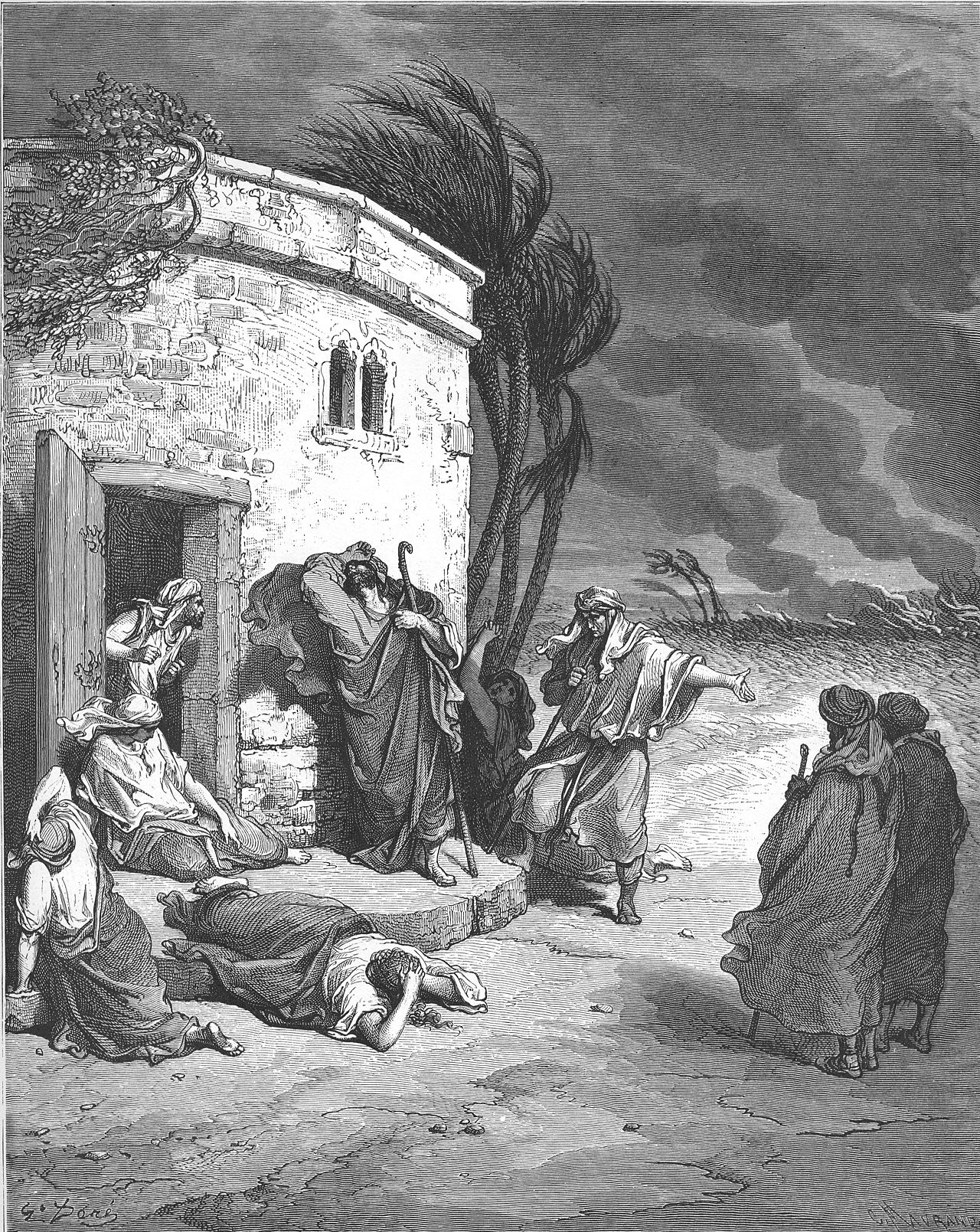
Jobchapter 3
26 verses · unknown · 10th century BC · Wisdom and poetry
After this, Job opened his mouth and cursed the day of his birth.
Introduction
unknown, Wisdom and poetry, Job Overview.
Job has sat in silence for seven days, and in this chapter he speaks for the first time since his losses. Here the book leaves prose and becomes poetry, and it stays poetry until the last chapter. The writer is unknown, and he gives the most honoured man in the book words of bitter lament. The first hearers had funerals, stillbirths and long illnesses of their own and knew this cry. Listen for what Job curses and for what he refrains from cursing. Listen also for the one question he repeats, because the whole debate that follows grows out of it.
Context
- Who
- Hearers who had wished they had never been born and had never dared say it aloud
- What
- Job's first speech, a lament in poetry in which he curses the day of his birth and asks why life is given to those in misery.
- Where
- The ash heap outside Job's town, before his three friends.
- When
- The eighth day, when the week of silent mourning ended, in the patriarchal setting of the book.
- Why
- To give voice to grief at its full weight and to raise the question the friends will try to answer.
Historical context
Job does not curse God, as the accuser predicted. He curses the day of his birth, a recognised form of lament in the ancient Near East, where days and nights were spoken of as if they were living things that could be blotted from the calendar. He asks that his birthday be struck out of the year and the night of his conception be counted among no months.
Show the rest of the historical context, 3 more paragraphs
One line reaches into a genuinely strange corner of that world. He calls on those 'who are ready to rouse Leviathan', professional cursers, men paid to lay a curse on a day, believed able to stir up the sea-dragon and swallow the light. Job is not endorsing the belief; he is saying, in the strongest language available, let the experts in ruining days come and ruin this one.
The pictures of death that follow are drawn from ordinary life and death in that culture. The stillborn buried without ceremony. Kings and counsellors who built ruined monuments for themselves, the mortuary tombs and mounds a ruler raised to outlast him. Prisoners no longer hearing the taskmaster's voice. The grave described as the one place where the small and the great are alike and the slave is free from his master.
'Why is light given to a man whose way is hid' is the question the whole book will answer, or refuse to answer. Job is not asking to die by his own hand, that never comes up. He is asking why life continues when its purpose has been taken away.
Significance
For the first hearers this was permission. The godliest man in the book, the one heaven itself commended, says out loud that he wishes he had never existed, and the book does not correct him, and God never rebukes him for it.
Show the rest of the significance, 1 more paragraph
That set the bar for Israel's own laments. Grief brought to God in raw words is not unbelief. The friends are about to treat it as unbelief, and they will be wrong.
This chapter in Jewish lifeWhat this chapter is in Jewish life and reading.
What is done
Job's curse on his birthday has no place in the site's table of synagogue readings. The site's own table in src/lib/hebraic/readings.ts printed parashot total 0 and haftarah uses total 0 for Job, and no festival reading.
The corpus shows the settings where the chapter is studied. On its first verse it carries Moed Katan 28b:23 and Midrash Lekach Tov on Lamentations, Introduction 1. Midrash named for Torah portions runs through the rest: Bereshit Rabbati at Parashat Vayeshev 51 and Parashat Vayetze 61, Midrash Tanchuma, Beshalach 11:5, and Midrash Tanchuma Buber, Miketz 12:1.
How it is read
Malbim's Job, translated by Jeremy I. Pfeffer (Ktav, 2003), which Sefaria reports as CC-BY, sets a heading over the chapter: "The First Oration - Job's Opening Speech" (Malbim on Job 3:1:1). Malbim reads the book as a series of numbered speeches, and the debate begins here.
Rashi is quoted from The Judaica Press complete Tanach with Rashi, translated by A. J. Rosenberg, which Sefaria reports as CC-BY. He reads the word that opens the speech as a raising of the voice, a cry (Rashi on Job 3:2:1). He reads Job's curse on the day as a wish that the day destined for his birth had been lost, so that he would never have been born (Rashi on Job 3:3:1). The darkness asked for is to come back every year, "when that day arrives" (Rashi on Job 3:4:1).
At the sixth verse Rashi sets two readings of one word side by side. His first is that the day shall not rejoice among the days. Another explanation is that it shall not join them, and Rashi adds that this second reading "does not appear in certain editions" (Rashi on Job 3:6:1). One reading takes away the day's joy, the other its place in the count of the year.
Rashi reads the middle of the chapter as Job standing again at his birth. He speaks "as though he were standing now on the day of his emergence from the womb" (Rashi on Job 3:11:1). The builders of ruins are those who seek fame by rebuilding ruined cities as a memorial to themselves, the princes and famous people Job would lie among. Rashi gives another option in the same note, that Job wishes he had been unknown, like a stillborn child (Rashi on Job 3:14:1). The two differ on whether Job wants the company of the great or no name at all.
The grave is read as a place of rest and of settled rank. The wicked there restrain the anger they once stirred up in the earth (Rashi on Job 3:17:1). Of small and great together, Rashi says "that greatness is perpetual greatness, and that humility is perpetual humility" (Rashi on Job 3:19:1). The one who gives light to the sufferer is the Holy One (Rashi on Job 3:20:1). The bitter in spirit long for death and rejoice if they find a grave (Rashi on Job 3:21:1 and 3:22:1).
The chapter's hardest note comes near the end. Rashi reads the man whose way is hidden as one whose good deeds were hidden from God. "All the good deeds that he performed were hidden from the Great Recompenser, and He did not look at them" (Rashi on Job 3:23:1). Rashi reports this as Job's complaint and does not answer it in the note.
The corpus carries two further notes on this chapter without an English text, each marked linked because Sefaria holds no English version of the ref. They stand cited and unquoted at Metzudat David on Job 3:15:1 and 3:18:1.
What the rabbis say
The corpus carries forty rabbinic locators on this chapter and the text of none, so each is cited here by ref. On the first verse it holds Moed Katan 28b:23 and Midrash Lekach Tov on Lamentations, Introduction 1. On the second it holds Avot DeRabbi Natan 37:13, Bereshit Rabbati, Parashat Vayeshev 51 and Midrash Lekach Tov, Exodus 15:21:2. On the third it holds Bereshit Rabbah 64:5, Ein Yaakov (Glick Edition), Sanhedrin 11:36 and Ein Yaakov, Niddah 2:7.
The curse on the day draws the next run. On the sixth verse the corpus holds Midrash Sekhel Tov at Bereshit 49:6:3 and Shemot 18:9:2. On the eighth it holds Bereshit Rabbah 79:7, Bereshit Rabbati, Parashat Vayetze 61 and Jerusalem Talmud Moed Katan 1:5:5. On the ninth it holds Pesachim 2b:2 and Otzar Midrashim, Baraita of Samuel HaKatan 1:10. On the tenth it holds Bekhorot 45a:18, Ein Yaakov, Bekhorot 7:3 and Vayikra Rabbah 14:4.
The wish for death at birth carries the middle. On the twelfth verse the corpus holds Yalkut Shimoni on Torah 33:1 and 110:6. On the thirteenth it holds Berakhot 57b:14 and Bereshit Rabbah 20:10 and 62:1. On the sixteenth it holds Mekhilta DeRabbi Yishmael, Tractate Shirah 1:23, Midrash Tanchuma, Beshalach 11:5 and Midrash Tehillim 8:3. On the seventeenth it holds Bamidbar Rabbah 8:9, Bereshit Rabbah 9:5 and Ein Yaakov (Glick Edition), Nedarim 3:2.
The close carries the rest. On the nineteenth verse the corpus holds Bava Metzia 85b:3 and Ein Yaakov (Glick Edition), Bava Metzia 7:13. On the twenty-first it holds Otzar Midrashim, Midrash 'As an Apple Tree Among the Trees of the Forest' 1:6. On the twenty-second it holds Berakhot 8a:14 and Ein Yaakov (Glick Edition), Berakhot 1:42. On the twenty-third it holds Aggadat Bereshit 62:3, and on the twenty-fourth Midrash Sekhel Tov, Shemot 9:33:7. On the twenty-fifth it holds Avot DeRabbi Natan 9:5 and Avot DeRabbi Natan, Recension B 17:1. On the twenty-sixth it holds Bereshit Rabbah 84:3 and Midrash Tanchuma Buber, Miketz 12:1.
What each of them teaches is a saying of the rabbis, and is reported as theirs wherever this site quotes one. The quotations wait on a fetch that carries the text.
Sources: Rashi, Rashi on Job 3:2:1 to 3:24:1, The Judaica Press complete Tanach with Rashi, translated by A. J. Rosenberg, reported CC-BY; Malbim, Malbim on Job 3:1:1, Malbim's Job, trans. Jeremy I. Pfeffer, Ktav, 2003, reported CC-BY; Metzudat David, Metzudat David on Job 3:15:1 and 3:18:1, cited by ref because the corpus carries no English text; The Sefaria corpus, scripts/data/sources/sefaria/job/3.json, the 40 Talmud and Midrash locators of this chapter; The site's own files, src/lib/hebraic/readings.ts, printing no portion, no Haftarah and no festival reading for this book.
The heads below are this chapter's scenes. The numbered points under each are its verses.
Job Curses the Day He Was Born
Job 3:1-2
cursed the day of his birth: Job "cursed the day of his birth" and never his God, holding the wager to the letter. Satan's challenges at 1:11 and 2:5 both aimed at a curse to God's face. Seven days of silence break into a lament that runs for thirty chapters and never crosses that line.
Job 3:1
“His curse was sinful, both because it was vain, being applied to a thing, which was not capable of blessing and cursing, and because it cast a blame upon God for bringing that day, and for giving him life on that day.”
John Wesley · Explanatory Notes upon the Old Testament (1765)evangelical
And this is what he said: Barnes notes the Hebrew verb is answered, used to open a speech where no question has come before. Jamieson, Fausset and Brown take Job as answering his own case, the night he was conceived and the day of his birth. Jeremiah curses the day of his birth at Jeremiah 20:14.
Job 3:2
“And Job spake - Margin, as in Hebrew, “answered.” The Hebrew word used here ענה ‛ânâh “to answer,” is often employed when one commences a discourse, even though no question had preceded. It is somewhat in the sense of replying to a subject, or of speaking in a case where a question might appropriately be asked; Isa. 14:l0 (Hebrew), Zec 3:4; Deu 26:5 (Hebrew), Deu 27:14 (Hebrew). The word “to answer” ἀποκρίνομαι apokrinomai is frequently used in this way in the New Testament; Mat 17:4, Mat 17:17; Mat 28:5; Mar 9:5; Mar 10:51, et al.”
Job 3:3-6
Job's curse runs backward through the words of creation, Genesis 1 spoken in reverse over a single day. Verse 5 piles up nearly every Hebrew word for darkness the language has. Gill notes the request cannot be granted, since the day has already passed into history and cannot be unmade.
Job 3:3
“Let the day perish - “Perish the day! O that there had never been such a day! Let it be blotted from the memory of man! There is something singularly bold, sublime, and “wild” in this exclamation. It is a burst of feeling where there had been long restraint, and where now it breaks forth in the most vehement and impassioned manner. The word “perish” here יאבד yo'bad expresses the “optative,” and indicates strong desire.”
May God above disregard it: Barnes notes that the Hebrew verb behind disregard means to seek out or inquire after. Jamieson, Fausset and Brown picture God declining to stoop from above and lift that day out of its darkness. Job asks that the day of his birth stay lost.
Job 3:4
“Darkness - I wish the sun had never risen upon that day, or, which is all one, that it had never been; and whensoever that day returns, I wish it may be black, and gloomy, and uncomfortable. Regard - From heaven, by causing the light of the sun which is in heaven to shine upon it.”
John Wesley · Explanatory Notes upon the Old Testament (1765)evangelical
1 more voice on this verse
Job 3:4
“Let that day be darkness - The meaning is exactly the same with our expression, “Let it be blotted out of the calendar.” However distinguished it may have been, as the birthday of a man once celebrated for his possessions, liberality, and piety, let it no longer be thus noted; as he who was thus celebrated is now the sport of adversity, the most impoverished, most afflicted, and most wretched of human beings.”
Adam Clarke · Commentary on the Bible (1810-1826)evangelical
May darkness and gloom reclaim it: The verb reclaim comes from the Hebrew root of the kinsman-redeemer, and Clarke reads it as darkness claiming the day as its kin. Barnes reads gloom as shadow and death, the deepest dark. Jamieson, Fausset and Brown hear sudden terror in the verb overwhelm, the day frightened by its blackness.
May it not appear among the days of the year: The Targum, as Clarke reports, asks that the night never be entered among the feasts of the year. Matthew Henry pictures a birthday kept in red letters like a king's, and Job asking that his day of birth be blotted out. Here the night is a person, barred from joy.
Job 3:6
“As for that night, let darkness seize upon it - I think the Targum has hit the sense of this whole verse: “Let darkness seize upon that night; let it not be reckoned among the annual festivals; in the number of the months of the calendar let it not be computed.” Some understand the word אפל ophel as signifying a dark storm; hence the Vulgate, tenebrosus turbo, “a dark whirlwind.” And hence Coverdale, Let the darck storme overcome that night, let it not be reckoned amonge the dayes off the yeare, nor counted in the monethes.”
Adam Clarke · Commentary on the Bible (1810-1826)evangelical
Job 3:7-10
may that night be barren: The curse turns to the night of his conception, asking that it be barren, with "no joyful voice" such as a birth-night would carry. Verse 8 calls on "those prepared to rouse Leviathan," which Delitzsch reads as professional cursers whose trade is stirring up the sea monster of chaos.
Barnes takes those who curse the day as a known class of men who pronounced curses. Jamieson, Fausset and Brown identify them as sorcerers who claimed by charms to curse a day, and Leviathan as the great serpent of Isaiah 27:1. Job wants their curse on that night.
Job 3:8
“But the Hebrew for "mourning" elsewhere always denotes an animal, whether it be the crocodile or some huge serpent (Isa 27:1), such as is meant by "leviathan." Therefore, the expression, "cursers of day," refers to magicians, who were believed to be able by charms to make a day one of evil omen.”
Jamieson, Fausset & Brown · Commentary Critical and Explanatory on the Whole Bible (1871)reformed
may it not see the breaking of dawn: Jamieson, Fausset and Brown translate the breaking of dawn as the eyelids of the morning. Arab poets called the sun the eye of day, and its first rays were the lids opening. Barnes notes that the word for the morning stars can also mean the twilight of evening.
Job 3:9
“Let the stars of the twilight thereof be dark - That is, be extinguished, so that it shall be total darkness - darkness not even relieved by a single star. The word here rendered “twilight” נשׁף nesheph means properly a breathing; and hence, the evening, when cooling breezes “blow,” or gently breathe. It is used however, to denote both the morning and the evening twilight, though here probably it means the latter. He wishes that the evening of that night, instead of being in any way illuminated, should “set in” with total darkness and continue so.”
did not shut the doors of the womb: Barnes reports Aben Ezra took God as the one who left the womb open, while Barnes himself refers the verse to the night Job cursed. Wesley reads it as poetry that credits the night with what was done in it. Here Job gives the reason for his curse.
Job 3:10
“Because it shut not up the doors - Here is the reason why he curses the day and the night in which he was conceived and born; because, had he never been brought into existence, he would never have seen trouble. It seems, however, very harsh that he should have wished the destruction of his mother, in order that his birth might have been prevented; and I rather think Job’s execration did not extend thus far.”
Adam Clarke · Commentary on the Bible (1810-1826)evangelical
2 more voices on this verse
Job 3:10
“It - The night or the day: to which those things are ascribed which were done by others in them, as is frequent in poetical writings. Womb - That it might never have brought me forth.”
John Wesley · Explanatory Notes upon the Old Testament (1765)evangelical
Job 3:10
“Is this Job, who was so much admired for his wisdom that unto him men gave ear, and kept silence at his counsel, and after his words they spoke not again? ch. xxix. Surely his wisdom failed him, (1.) When he took so much pains to express his desire that he had never been born, which, at the best was a vain wish, for it is impossible to make that which has been not to have been.”
Matthew Henry · Commentary on the Whole Bible (1707-1721)puritan
Job: Why Did I Not Die From the Womb?
Job 3:11-13
Why did I not perish at birth: The curse gives way to a second movement, asking why Job was let live past that day at all. "Why were there knees to receive me" recalls the custom, found by Gill and Clarke, of a newborn set on the father's knees. Job wishes the welcome itself undone.
Job 3:11
“Why died I not from the womb? - Why did I not die as soon as I was born? Why were any pains taken to keep me alive? The suggestion of this question leads Job in the following verses into the beautiful description, of what he would have been if he had then died. He complains, therefore, that any pains were taken by his friends to keep him alive, and that he was not suffered peacefully to expire.”
1 more voice on this verse
Job 3:11
“To desire to die that we may be with Christ, that we may be free from sin, and that we may be clothed upon with our house which is from heaven, is the effect and evidence of grace; but to desire to die only that we may be quiet in the grave, and delivered from the troubles of this life, savours of corruption.”
Matthew Henry · Commentary on the Whole Bible (1707-1721)puritan
Why were there knees to receive me: Barnes and Clarke place the knees in the lap of Job's mother. Barnes notes an infant left untended at birth would die as he came from the womb, so the knees and the breasts kept him alive. Job questions the very kindness that nursed him.
Job 3:12
“Why did the knees prevent me? - Why was I dandled on the knees? Why was I nourished by the breasts? In either of the above cases I had neither been received into a mother’s lap, nor hung upon a mother’s breasts.”
Adam Clarke · Commentary on the Bible (1810-1826)evangelical
I would be asleep and at rest: Jamieson, Fausset and Brown see a rising order in lying down, peace, sleep and rest. Scripture often calls death sleep, as at Psalm 13:3. Matthew Henry observes that the quiet Job wants in the grave was open to him in the submission he kept in chapters 1 and 2.
Job 3:13
“Then should I have been quiet; and had he kept his temper, his even easy temper still, which he was in as recorded in the two foregoing chapters, entirely resigned to the holy will of God and acquiescing in it, he might have been quiet now; his soul, at least, might have dwelt at ease, even when his body lay in pain, Ps. xxv.”
Matthew Henry · Commentary on the Whole Bible (1707-1721)puritan
Job 3:14-19
with kings and counselors of the earth: In Job's grave, kings lie beside a stillborn child, the greatest men he can name and the least death he can imagine at one rest. "There the wicked cease from raging, and there the weary find rest" is the chapter's most quoted line, a longing for an end to trouble.
Job 3:14
“Kings - I had then been as happy as the proudest monarchs, who after all their great achievements and enjoyments, go down into their graves. Built - Who to shew their wealth and power, or to leave behind them a glorious name, rebuilt ruined cities, or built new cities and palaces, in places where before there was mere solitude and wasteness.”
John Wesley · Explanatory Notes upon the Old Testament (1765)evangelical
2 more voices on this verse
Job 3:14
“With kings and counsellors of the earth - I believe this translation to be perfectly correct. The counsellors, יעצי yoatsey, I suppose to mean the privy council, or advisers of kings; those without whose advice kings seldom undertake wars, expeditions, etc. These mighty agitators of the world are at rest in their graves, after the lives of commotion which they have led among men: most of whom indeed have been the troublers of the peace of the globe.”
Adam Clarke · Commentary on the Bible (1810-1826)evangelical
Job 3:14
“The "for themselves" marks their selfishness. MICHAELIS explains it weakly of mausoleums, such as are found still, of stupendous proportions, in the ruins of Petra of Idumea.”
Jamieson, Fausset & Brown · Commentary Critical and Explanatory on the Whole Bible (1871)reformed
with princes who had gold: Clarke notes that such princes filled their houses with silver and left it all behind, keeping nothing but the grave. Barnes asks whether the line betrays a fondness for wealth in Job himself, the greatest man of the East. The grave keeps none of their gold.
Job 3:15
“Or with princes that had gold - That is, he would have been united with the rich and the great. Is there not here too also a slight evidence of the fondness for wealth, which might have been one of the errors of this good man? Would it not seem that such was his estimate of the importance of being esteemed rich, that he would count it an honor to be united with the affluent in death, rather than be subjected to a condition of poverty and want among the living?”
like a stillborn child: Barnes sets the stillborn child beside Psalm 58:8, where the same figure pictures a life that never sees the sun. John Chrysostom notes that Job compares himself to the lowest thing he can name, lest he seem proud. The verse returns to the wish of verse 11.
Job 3:16
“Or as a hidden untimely birth - An early miscarriage, which was scarcely perceptible by the parent herself; and in this case he had not been - he had never had the distinguishable form of a human being, whether male or female. As infants - Little ones; those farther advanced in maturity, but miscarried long before the time of birth.”
Adam Clarke · Commentary on the Bible (1810-1826)evangelical
There the wicked cease from raging: Barnes notes that readers often apply this verse to heaven, while Job speaks of the grave. Jamieson, Fausset and Brown take the wicked as the restless of Isaiah 57:20, and the weary as those whose strength is worn out. The raging and the weary both rest in the grave.
Job 3:17
“There the wicked cease - from “troubling.” In the grave - where kings and princes and infants lie. This verse is often applied to heaven, and the language is such as will express the condition of that blessed world. But as used by Job it had no such reference. It relates only to the grave. It is language which beautifully expresses the condition of the dead, and the “desirableness” even of an abode in the tomb. They who are there, are free from the vexations and annoyances to which people are exposed in this life.”
1 more voice on this verse
Job 3:17
“There the weary are at rest. Heaven is more than a rest to the souls of the saints, but the grave is a rest to their bodies. Their pilgrimage is a weary pilgrimage; sin and the world they are weary of; their services, sufferings, and expectations, they are wearied with; but in the grave they rest from all their labours, Rev. xiv.”
Matthew Henry · Commentary on the Whole Bible (1707-1721)puritan
The captives enjoy their ease: The oppressor is a taskmaster, as Wesley notes. Clarke hears the captives of forced labour, quiet together at last and beyond the voice that drove them. Wesley adds that Job speaks here only of rest from earthly trouble and leaves the state after death for later chapters.
Job 3:18
“The prisoners rest together - Those who were slaves, feeling all the troubles, and scarcely tasting any of the pleasures of life, are quiet in the grave together; and the voice of the oppressor, the hard, unrelenting task-master, which was more terrible than death, is heard no more. They are free from his exactions, and his mouth is silent in the dust. This may be a reference to the Egyptian bondage. The children of Israel cried by reason of their oppressors or task-masters.”
Adam Clarke · Commentary on the Bible (1810-1826)evangelical
1 more voice on this verse
Job 3:18
“The oppressor - Or, taskmaster, who urges and forces them to work by cruel threatenings and stripes. Job meddles not here with their eternal state after death, of which he speaks hereafter, but only their freedom from worldly troubles, which is the sole matter of his present discourse.”
John Wesley · Explanatory Notes upon the Old Testament (1765)evangelical
Both small and great are there: Barnes reads small and great as old and young, high and low, all levelled by death. In the grave the slave is freed from his master, and Matthew Henry and Wesley draw a lesson for masters to use their power gently. Every rank rests in the same grave.
Job 3:19
“The small and the great are there - The old and the young, the high and the low. Death levels all. It shows no respect to age; it spares none because they are vigorous, young, or beautiful. This sentiment has probably been expressed in various forms in all languages, for all people are made deeply sensible of its truth. The Classic reader will recall the ancient proverb, Mors sceptra ligonibus aequat, And the language of Horace: Aequae lege Necessitas Sortitur insignes et imos. Omne capax movet urna nomen.”
Job: The Thing I Feared Is Come Upon Me
Job 3:20-23
Why is light given to the miserable: The words "whom God has hedged in" return Satan's word from 1:10 in the opposite sense, the protection the accuser envied becoming the prison. Barnes notes that the echo is the reader's alone to see, since Job never heard the word that opened the case against him.
Job 3:20
“Light - The light of life. Bitter - Unto those to whom life itself is bitter and burdensome. Life is called light, because it is pleasant and serviceable for walking and working; and this light is said to be given us, because it would be lost, if it were not daily renewed to us by a fresh gift.”
John Wesley · Explanatory Notes upon the Old Testament (1765)evangelical
2 more voices on this verse
Job 3:20
“Wherefore is light given to him that is in misery? - The word “light” here is used undoubtedly to denote “life.” This verse commences a new part of Job’s complaint. It is that God keeps people alive who would prefer to die; that he furnishes them with the means of sustaining existence, and actually preserves them, when they would consider it an inestimable blessing to expire. Schultens remarks, on this part of the chapter, that the tone of Job’s complaint is considerably modified. He has given vent to his strong feelings, and the language here is more mild and gentle.”
Job 3:20
“Bitterness of soul, through spiritual grievances, makes life itself bitter. Why doth he give light? (so it is in the original): he means God, yet does not name him, though the devil had said, "He will curse thee to thy face;" but he tacitly reflects on the divine Providence as unjust and unkind in continuing life when the comforts of life are removed.”
Matthew Henry · Commentary on the Whole Bible (1707-1721)puritan
who long for death that does not come: Clarke notes that such sufferers long for death more than men who love gold long to strike it rich. Wesley observes that Job did nothing to hasten his own death and waited for his appointed time. He longs for death and leaves it with God.
Job 3:21
“Dig - Desire with as much earnestness as men dig for treasure: but it is observable, Job durst not do anything to hasten or procure his death: notwithstanding all his miseries, he was contented to wait all the days of his appointed time, 'till his change came, chap. xiv, 14.”
John Wesley · Explanatory Notes upon the Old Testament (1765)evangelical
who rejoice and greatly exult when they can find the grave?: Barnes notes that the Hebrew doubles the verb, so the miserable rejoice with joy when they find the grave. Clarke reports one manuscript that reads rejoice at the tomb, so the grave is the treasure of verse 21. Wesley calls such longing ungrateful to the Giver of life.
Job 3:22
“Which rejoice exceedingly - Literally, They rejoice with joy, and exult when they find the grave. There is a various reading here in one of Kennicott’s MSS., which gives a different sense. Instead of who rejoice, אלי גיל eley gil, with Joy, it has אלי גל eley gal, who rejoice at the Tomb, and exult when they find the grave.”
Adam Clarke · Commentary on the Bible (1810-1826)evangelical
Why is life given to a man whose way is hidden: Jamieson, Fausset and Brown picture a traveller who has lost his road and finds every exit closed, the figure of Hosea 2:6. Barnes reads the hidden way as a path Job cannot see, with no escape from his misery. Job asks why God keeps such a man alive.
Job 3:23
“Why is light given “to a man uhose way is hid?” That is, who does not know what way to take, and who sees no escape from the misery that surrounds him. Whom God hath hedged in - See Notes, Job 1:10. The meaning here is, that God had surrounded him as with a high wall or hedge, so that he could not move freely. Job asks with impatience, why light, that is, life, should be given to such a man? Why should he not be permitted to die?”
Job 3:24-26
I sigh when food is put before me: The chapter closes on grief, sighing in place of appetite and groans. His "I have no rest, for trouble has come" answers the security the hedge of 1:10 had given him. The words "what I dreaded has befallen me" show a dread his God-fearing life carried before the trouble came.
Job 3:24
“His griefs returned as duly as his meals, and affliction was his daily bread. Nay, so great was the extremity of his pain and anguish that he did not only sigh, but roar, and his roarings were poured out like the waters in a full and constant stream. Our Master was acquainted with grief, and we must expect to be so too.”
Matthew Henry · Commentary on the Whole Bible (1707-1721)puritan
1 more voice on this verse
Job 3:24
“For my sighing cometh - Some think that this refers to the ulcerated state of Job’s body, mouth, hands, etc. He longed for food, but was not able to lift it to his mouth with his hands, nor masticate it when brought thither. This is the sense in which Origen has taken the words. But perhaps it is most natural to suppose that he means his sighing took away all appetite, and served him in place of meat.”
Adam Clarke · Commentary on the Bible (1810-1826)evangelical
For the thing I feared has overtaken me: Barnes notes the Hebrew doubles the verb feared. Clarke and Wesley place the fear in years of ease, when he dreaded the death of his sons and loss of goods. Jamieson, Fausset and Brown place it within the trial, where each thing that overtook him made him dread the next.
Job 3:25
“For the thing that I greatly feared is come upon me, and that which I am afraid of is come unto me. The righteous therefore lament and fear, and torment themselves with bitter lamentations, because they dread to be given over, and though they rejoice in their own correction, the correction itself disturbs their fearful spirits, lest the evil, which they are undergoing should not be the merciful stroke of discipline, but the righteous visitation of vengeance. And the Psalmist reflecting thereupon says with justice, Who knoweth the power of Thine anger?”
Gregory the Dialogist · written before 604 · Morals on the Book of Job, Book Vpatristic
2 more voices on this verse
Job 3:25
“Feared - Even in the time of my prosperity, I was full of fears, considering the variety of God's providences, the changeableness of this vain world, God's justice, and the sinfulness of all mankind. And these fears of mine, were not in vain, but are justified by my present calamities.”
John Wesley · Explanatory Notes upon the Old Testament (1765)evangelical
Job 3:25
“He knew so much of the vanity of the world, and the troubles to which, of course, he was born, that he was not in safety, neither had he rest then. That which made his grief now the more grievous was that he was not conscious to himself of any great degree either of negligence or security in the day of his prosperity, which might provoke God thus to chastise him.”
Matthew Henry · Commentary on the Whole Bible (1707-1721)puritan
I am not at ease or quiet: Clarke reads the verse as questions, asking whether Job had ever been at ease, quiet or at rest before the trouble came. Jamieson, Fausset and Brown place it at the start of the trial, with no rest for Job from that day on. Both readings end in trouble.
Job 3:26
“I was not in safety - If this verse be read interrogatively, it will give a good and easy sense: Was I not in safety? Had I not rest? Was I not in comfort? Yet trouble came. It is well known that, previously to this attack of Satan, Job was in great prosperity and peace. Mr. Good translates, I had no peace; yea, I had no rest. Yea, I had no respite, as the trouble came on; and refers the whole to the quick succession of the series of heavy evils by which he was tried.”
Adam Clarke · Commentary on the Bible (1810-1826)evangelical
2 more voices on this verse
Job 3:26
“Quiet - I did not misbehave myself in prosperity, abusing it by presumption, and security, but I lived circumspectly, walking humbly with God, and working out my salvation with fear and trembling. Therefore in this sense also, his way was hid, he knew not why God contended with him.”
John Wesley · Explanatory Notes upon the Old Testament (1765)evangelical
Job 3:26
“I was not in safety . . . yet trouble came--referring, not to his former state, but to the beginning of his troubles. From that time I had no rest, there was no intermission of sorrows. "And" (not, "yet") a fresh trouble is coming, namely, my friends' suspicion of my being a hypocrite.”
Jamieson, Fausset & Brown · Commentary Critical and Explanatory on the Whole Bible (1871)reformed
Keep studying
Studies2
People and groups1
Sources for this chapter
The summary
Jamieson, Fausset & Brown, Commentary Critical and Explanatory; John Wesley, Notes on the Old Testament and Matthew Henry, Complete Commentary.
The exposition
Adam Clarke, Commentary on the Bible; Albert Barnes; Franz Delitzsch, Biblical Commentary on the Book of Job; Jamieson, Fausset & Brown, Commentary Critical and Explanatory on the Whole Bible; John Chrysostom, Commentary on Job; John Gill, Exposition of the Old Testament; John Wesley, Explanatory Notes upon the Old Testament and Matthew Henry, Commentary on the Whole Bible.