
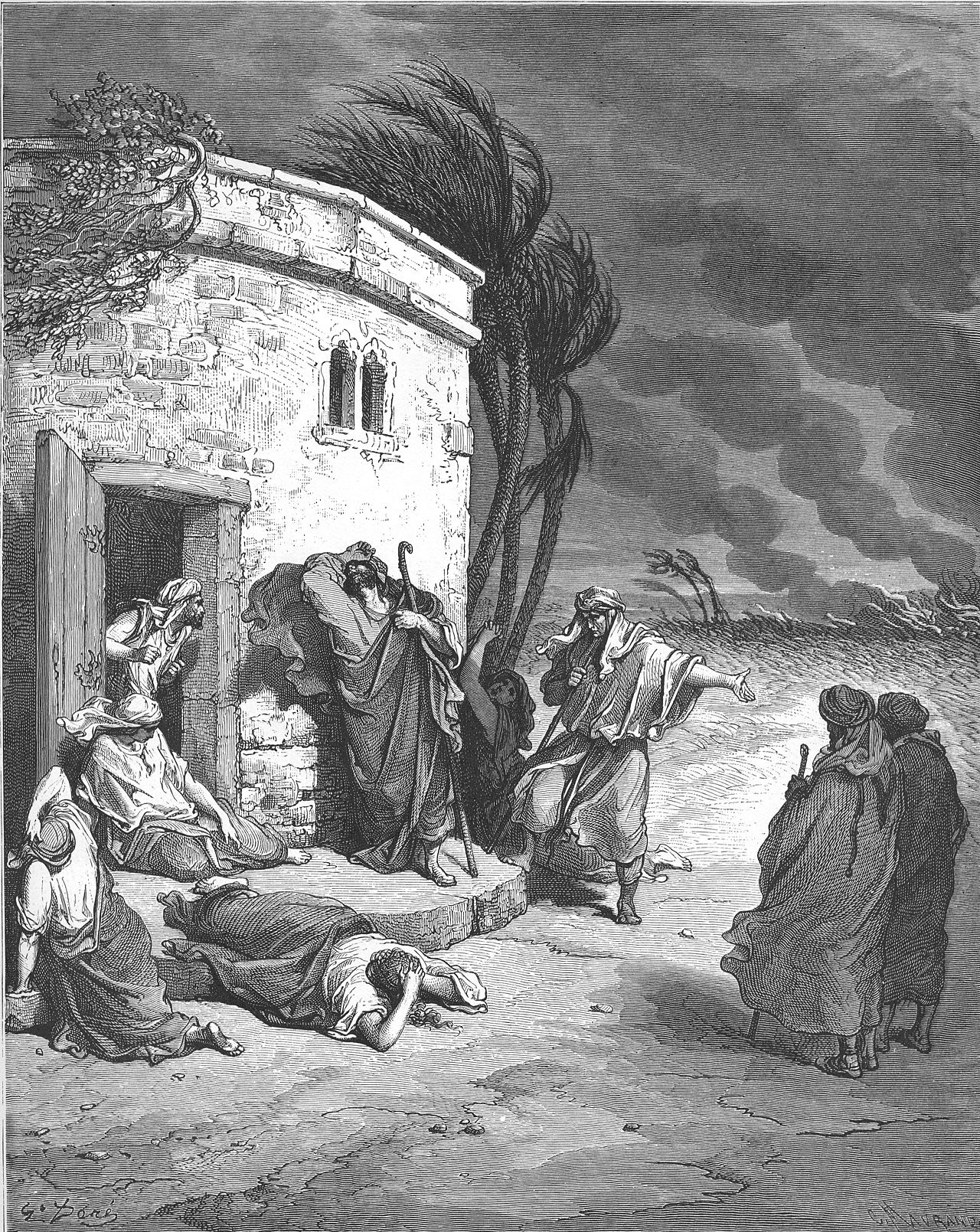
Jobchapter 30
31 verses · unknown · 10th century BC · Wisdom and poetry
Have I not wept for those in trouble? Has my soul not grieved for the needy?
Introduction
unknown, Wisdom and poetry, Job Overview.
This chapter is the second part of Job's closing speech, and it answers the first. Chapter 29 remembered his standing in the town, and this chapter sets his present state beside it. His hearers knew that bands of outcasts lived beyond the settled land, uncounted and despised. Listen for the word now, which turns the speech from the past to the present. Listen also for the move from his neighbours to his own body and then to God, who has stopped answering him. The book lets a righteous man say that aloud.
Context
- Who
- Hearers who knew there were people living outside the settlements whom nobody counted
- What
- Job's account of what he has become, mocked by outcasts, wasted in body and unanswered by God.
- Where
- The ash heap outside the town, with the wasteland and its outcasts in view.
- When
- The book sets Job in the age of the patriarchs, commonly placed about 2000 to 1800 BC, and it gives no date.
- Why
- To set his present ruin beside the honour of chapter 29 and to bring his complaint before God.
Historical context
The reversal is exact: 'but now they that are younger than I have me in derision, whose fathers I would have disdained to set with the dogs of my flock.' Sheepdogs were working animals, not pets, and they ranked at the bottom of the household; saying a man's father was not fit to keep company with them is as low as the insult goes.
Show the rest of the historical context, 3 more paragraphs
Then Job describes who these people are, and the description is a piece of social history. They are men driven out from among ordinary society, hungry and gaunt, fleeing into the wilderness and the wasteland. They gather saltwort by the bushes and juniper roots for food, real famine foods, the bitter marsh plants and woody roots people ate when nothing else was left. They live in the clefts of the valleys, in caves of the earth and among the rocks, and they bray in the bushes like animals. Bands of outcasts really did live in the badlands beyond the settled country, and every ancient community had them.
Job's point is that even these have him for a byword and spit in his face, because his cord, the tent-rope image for a man's strength and standing, has been loosed. They push away his feet and cast up their ways of destruction against him, the language of a siege ramp raised against a wall.
The last section is his body and his God. His bowels boil and do not rest; his skin is black and falls off him; his bones burn with heat. He is a brother to jackals and a companion to ostriches, the two creatures whose night cries the desert was known for, a wailing sound anyone who had camped out there had heard. His harp is turned to mourning and his pipe to the voice of them that weep. And he says the thing under all of it: I cry unto thee, and thou dost not hear me.
Significance
Chapters 29 and 30 are meant to be read as one fall. The man the nobles stood up for is now mocked by people who eat roots in caves, and the God he served will not answer the phone.
Show the rest of the significance, 1 more paragraph
For hearers the honesty was the gift. The Bible lets a righteous man say out loud that God is not answering, and does not edit the sentence out.
This chapter in Jewish lifeWhat this chapter is in Jewish life and reading.
What is done
This chapter has no place in the synagogue year. The site's own table in src/lib/hebraic/readings.ts printed parashot total 0 and haftarah uses total 0 for the book of Job, and no festival reading.
The corpus joins it to the study of the Torah portions through the Midrash arranged by them. Under the first verse it carries Midrash Tanchuma Buber, Vayera 30:1. Under the third verse it carries Midrash Tanchuma, Noach 11:4. Under the fourth verse it carries Midrash Tanchuma, Eikev 7:1. Under the eighth verse it carries Bereshit Rabbati, Parashat Vayeshev 19. Under the nineteenth verse it carries Midrash Tanchuma Buber, Vayishlach 8:2.
How it is read
Rashi and Malbim are the two commentators on this chapter whose English the corpus carries. Rashi is quoted from The Judaica Press complete Tanach with Rashi, translated by A. J. Rosenberg, which Sefaria reports as CC-BY. Malbim is quoted from Malbim's Job, trans. Jeremy I. Pfeffer. Ktav, 2003, which Sefaria reports as CC-BY. Malbim reads the chapter as Job's present misery and humiliation. "Even the outcasts and lowest dregs of society now look down on him." (Malbim on Job 30:1:1).
Rashi describes these men at length. Job had no need of their strength, since they were wicked and useless and trouble came because of them (Rashi on Job 30:2:1). Want and hunger kept them in solitude (Rashi on Job 30:3:1). In the deserts they ate salt-wort from the forest trees. Rashi names the herb as mallows and cites Kiddushin 66a, where mallows were brought up on golden tables (Rashi on Job 30:4:1). They were driven from the midst of the city (Rashi on Job 30:5:1). They lay in holes in a salty ground that splits and in the crevices of the rocks (Rashi on Job 30:6:1).
Rashi then turns to Job's fall. God untied the string of Job's bow, which Rashi takes as the weakening of his strength by the One who has the power to do it (Rashi on Job 30:11:1). Anyone now stands at his right hand as beside a simple person, since he is no longer esteemed in their sight (Rashi on Job 30:12:1). They come against him to shame him as through a wide breach in a fence (Rashi on Job 30:14:1). Worms pick his flesh off his bones (Rashi on Job 30:17:1). What the verse calls his garment changes layer after layer (Rashi on Job 30:18:1).
At the nineteenth verse Rashi gives two readings. In the first, the boils directed Job and taught him to sit in the mud, as he sat in the ashes of the second chapter. In the second, the verb means that it cast him, as the same root is used in Exodus 15:4 (Rashi on Job 30:19:1). At the twentieth verse Job stood to see, to keep silent and to understand, and no longer replied (Rashi on Job 30:20:1).
The last notes carry Job toward death. At the twenty-second verse Rashi reads the lifting as a lifting to the spirit of the demons (Rashi on Job 30:22:1). Job knew that God would return him to death, the meeting place of all the living, which Rashi names as the grave (Rashi on Job 30:23:1).
The corpus carries three further notes on this chapter without an English text, each marked linked because Sefaria holds no English version of the ref. They stand cited by ref and unquoted. Three stand at Metzudat David on Job 30:9:1, 30:10:1 and 30:21:1.
What the rabbis say
The corpus carries forty rabbinic locators on this chapter and the text of none, so each is cited and linked here rather than quoted. On the first verse it holds Aggadat Bereshit 28:2, Midrash Tanchuma Buber, Vayera 30:1, Pesikta Rabbati 38:1 and Pirkei DeRabbi Eliezer 21:10. On the second verse it holds Bereshit Rabbah 31:12.
On the third verse it holds Bereshit Rabbah 34:7, Eikhah Rabbah, Petichta 24, Jerusalem Talmud Taanit 1:6:10, Midrash Tanchuma, Noach 11:4 and Midrash Yelamdenu, Selections from Yalkut Talmud Torah 167:1. It also holds Midrash Yelamdenu, Selections from Yalkut Talmud Torah 33:3 and Yalkut Shimoni on Torah 55:2. On the fourth verse it holds Avodah Zarah 3b:14, Bamidbar Rabbah 11:2, Chagigah 12b:9, Ein Yaakov (Glick Edition), Khagigah 2:10, Ein Yaakov, Khagigah 2:3 and Midrash Tanchuma, Eikev 7:1. It also holds Pesikta DeRav Kahana 5:8, Pesikta Rabbati 15:1 and Pirkei DeRabbi Eliezer 30:6.
On the fifth verse it holds Avot DeRabbi Natan, Recension B 43:12. On the eighth verse it holds Bereshit Rabbah 26:7, Bereshit Rabbati, Parashat Vayeshev 19 and Yalkut Shimoni on Torah 47:1. On the ninth verse it holds Midrash Lekach Tov on Lamentations 3:14:1. On the fifteenth verse it holds Bamidbar Rabbah 10:2 and Eikhah Rabbah 2:1. On the nineteenth verse it holds Midrash Tanchuma Buber, Vayishlach 8:2. On the twenty-third verse it holds Pirkei DeRabbi Eliezer 20:9. On the twenty-fourth verse it holds Avodah Zarah 4a:7, Avodah Zarah 4a:8, Pesikta DeRav Kahana 16:7 and Pesikta Rabbati 33:1.
On the twenty-fifth verse it holds Devarim Rabbah 9:9, Midrash Lekach Tov, Genesis 26:5:8 and Pirkei DeRabbi Eliezer 25:8. On the twenty-sixth verse it holds Midrash Lekach Tov on Lamentations, Introduction 1. On the twenty-eighth verse it holds Jerusalem Talmud Taanit 3:6:2. On the thirty-first verse it holds Eikhah Rabbah, Petichta 33. What each of them teaches is a saying of the rabbis, and is reported as theirs wherever this site quotes one. The quotations wait on a fetch that carries the text.
Sources: Malbim, Malbim on Job 30:1:1, Malbim's Job, trans. Jeremy I. Pfeffer. Ktav, 2003, reported CC-BY; Rashi, Rashi on Job 30:2:1 to 30:24:1, The Judaica Press complete Tanach with Rashi, translated by A. J. Rosenberg, reported CC-BY; Metzudat David, Metzudat David on Job 30:9:1, 30:10:1 and 30:21:1, cited by ref because the corpus carries no English text; The Sefaria corpus, scripts/data/sources/sefaria/job/30.json, the 40 Talmud and Midrash locators of this chapter; The site's own files, src/lib/hebraic/readings.ts, printing no portion, no Haftarah and no festival reading for this book.
The heads below are this chapter's scenes. The numbered points under each are its verses.
Job: Now They That Are Younger Hold Me in Derision
Job 30:1-3
“But now they mock me, men younger than I am” opens the reversal. Henry reads the move from the princes falling silent in chapter 29 to these youths jeering as the same honor seen from its opposite end. The fathers were broken men, since “their vigor had left them”.
Job 30:1
“But now they that are younger than I - Margin, “of fewer days.” It is not probable that Job here refers to his three friends. It is not possible to determine their age with accuracy, but in Job 15:10, they claim that there were with them old and very aged men, much older than the father of Job. Though that place may possibly refer not to themselves but to those who held the same opinions with them, yet none of those who engaged in the discussion, except Ehhu Job 32:6, are represented as young men.”
2 more voices on this verseWhat preachers and commentators have said about this verse, in their own words.
Job 30:1
“Job here speaks of what he might have done, not of what he did: he was not of such a spirit as to set any of the children of men with the dogs of his flock; he knew the dignity of human nature better than to do so.”
Matthew Henry · Commentary on the Whole Bible (1707-1721)puritan
Job 30:1
They are not allowed to enter a house, but run about wild in the open air, living on offal and chance morsels (Ps 59:14, 15). Here again we are reminded of Jesus Christ (Ps 22:16). "Their fathers, my coevals, were so mean and famished that I would not have associated them with (not to say, set them over) my dogs in guarding my flock."
Jamieson, Fausset & Brown · Commentary Critical and Explanatory on the Whole Bible (1871)reformed
the strength of their hands: Clarke hears Job speaking of the fathers of the young mockers. Their vigor had left them, and the strength of their hands was of no use to Job. Jamieson, Fausset and Brown add that all Job now wants is sympathy.
Job 30:2
“If their fathers could be of no profit to me, much less the sons, who are feebler than their sires; and in whose case the hope of attaining old age is utterly gone, so puny are they (Job 5:26) [MAURER]. Even if they had "strength of hands," that could be now of no use to me, as all I want in my present affliction is sympathy.”
Jamieson, Fausset & Brown · Commentary Critical and Explanatory on the Whole Bible (1871)reformed
2 more voices on this verse
Job 30:2
“The young were not fit for labour, they were so lazy, and went about their work so awkwardly: Whereto might the strength of their hands profit me? The old were not to be advised with in the smallest matters, for in them was old age indeed, but their old age was perished, they were twice children.”
Matthew Henry · Commentary on the Whole Bible (1707-1721)puritan
Job 30:2
“The strength of their hands profit me - He is speaking here of the fathers of these young men. What was the strength of their hands to me? Their old age also has perished. The sense of which I believe to be this: I have never esteemed their strength even in their most vigorous youth, nor their conduct, nor their counsel even in old age. They were never good for any thing, either young or old. As their youth was without profit, so their old age was without honor. See Calmet.”
Adam Clarke · Commentary on the Bible (1810-1826)evangelical
they gnawed the dry land: Jamieson, Fausset and Brown give the Hebrew for gaunt as hard as rock, dried up with hunger. Job pictures the poorest desert tribes. Clarke calls it the extreme of want, when only the dry wasteland is left to search for food.
Job 30:3
“They were ready to starve, for they would not dig, and to beg they were ashamed. Had they been brought to necessity by the providence of God, their neighbours would have sought them out as proper objects of charity and would have relieved them; but, being brought into straits by their own slothfulness and wastefulness, nobody was forward to relieve them.”
Matthew Henry · Commentary on the Whole Bible (1707-1721)puritan
Job 30:4-6
They plucked mallow among the shrubs: “They plucked mallow among the shrubs, and the roots of the broom tree were their food”. Gill and Clarke read these as a bitter salt plant and a food of last resort. Banished “from among men” and “shouted down like thieves”, these fathers were treated as criminals.
Job 30:4
“Who cut up mallows by the bushes - מלוח malluach, which we translate mallows, comes from מלח melach, salt; some herb or shrub of a salt nature, sea-purslane, or the salsaria, salsola, or saltwort. Bochart says it is the ἁλιμος of the Greeks, and the halimus of the Romans. Some translate it nettles. The Syriac and Arabic omit the whole verse. The halimus, or atriplex halimus, grows near the sea in different countries, and is found in Spain, America, England, and Barbary.”
Adam Clarke · Commentary on the Bible (1810-1826)evangelical
shouted down like thieves: Jamieson, Fausset and Brown render the Hebrew as a cry is raised. When these men raided villages, the people shouted them away as they would thieves. Barnes says they were banished as outcasts.
Job 30:5
“They were driven forth from among men - As vagabonds and outcasts. They were regarded as unfit to live among the civilized and the orderly, and were expelled as nuisances. (They cried after them as after a thief.) - The inhabitants of the place where they lived drove them out with a loud outcry, as if they were thieves and robbers.”
in holes in the ground: Barnes reads the Hebrew behind slopes as a word for horror, so the wadis are dreadful places. Gill thinks Job has in view neighbors who lived in caves, the Horites. They hid among the rocks for fear and shame.
Job 30:6
“They are forced "to dwell." cliffs of the valleys--rather, "in the gloomy valleys"; literally, "in the gloom of the valleys," or wadies. To dwell in valleys is, in the East, a mark of wretchedness.”
Jamieson, Fausset & Brown · Commentary Critical and Explanatory on the Whole Bible (1871)reformed
Job 30:7-9
They cried out among the shrubs: Barnes reads the Hebrew verb behind “cried out among the shrubs” as the braying of animals. “A senseless and nameless brood” names men without lineage, who were “driven off the land”. “And now they mock me in song; I have become a byword among them” completes the reversal.
Job 30:7
“Among the bushes - Coverdale, “Upon the dry heath went they about crying.” The Hebrew word is the same which occurs in Job 30:4, and means bushes in general. They were heard in the shrubbery that grew in the desert. They brayed - ינהקו yinâhaqû. The Vulgate renders this, “They were concealed.” The Septuagint, “Amidst sweet sounds they cry out.” Noyes, “They utter their cries.” The Hebrew word properly means to “bray.” It occurs only here and in Job 6:5, where it is applied to the ass.”
A senseless and nameless brood: Barnes reads senseless as nabal, the fool, and nameless as men of no name. They had no lineage. This brood was driven off the land, and now its sons mock him in song at Job 30:9.
Job 30:8
“Children of fools - Children of nabal; children without a name; persons of no consideration, and descendants of such. Viler than the earth - Rather, driven out of the land; persons not fit for civil society.”
Adam Clarke · Commentary on the Bible (1810-1826)evangelical
1 more voice on this verse
Job 30:8
“The Horites in Mount Seir (Ge 14:6 with which compare Ge 36:20, 21; De 2:12, 22) were probably the aborigines, driven out by the tribe to which Job's ancestors belonged; their name means troglodytæ, or "dwellers in caves." To these Job alludes here (Job 30:1-8, and Ge 24:4-8, which compare together).”
Jamieson, Fausset & Brown · Commentary Critical and Explanatory on the Whole Bible (1871)reformed
they mock me in song: The men who mock him in song are the sons of the nameless brood of Job 30:8. Barnes hears Psalm 69:12, where a sufferer becomes the song of drunkards. Now even the lowest have a byword for him.
Job 30:9
“And now am I their song - See Job 17:6; compare Psa 69:12, “I was the song of the drunkards;” Lam 3:14, “I was a derision to all my people, and their song all the day.” The sense is, that they made Job and his calamities the subject of low jesting, and treated him with contempt. His name and sufferings would be introduced into their scurrilous songs to give them pith and point, and to show how much they despised him now. Yea, I am their by-word - See the notes at Job 17:6.”
Job 30:10-11
They abhor me and keep far from me: “They abhor me and keep far from me; they do not hesitate to spit in my face” describes contempt shown in the body. Spitting was the ancient world's most deliberate insult, as Gill notes from Numbers 12:14 and Deuteronomy 25:9.
Job 30:10
“They abhor me - Hebrew, They regard me as abominable. They flee far from me - Even such an impious and low born race now will have nothing to do with me. They would consider it no honor to be associated with me, but keep as far from me as possible. And spare not to spit in my face - Margin, “withhold not spittle from.” Noyes renders this “Before my face;” and so Luther Wemyss, Umbreit, and Prof. Lee. The Hebrew may mean either to spit in the face, or to spit “in the presence” of anyone.”
God has unstrung my bow: The unstrung bow answers Job 29:20, where his bow was renewed in his hand. Clarke records two readings. The written Hebrew has His cord, and the margin makes it Job's own, the reading the Berean follows.
Job 30:11
“Because he hath loosed my cord - According to this translation, the reference here is to God, and the sense is, that the reason why he was thus derided and contemned by such a worthless race was, that God had unloosened his cord. That is, God had rendered him incapable of vindicating himself, or of inflicting punishment. The figure, according to this interpretation, is taken from a bow, and Job means to say that his bow was relaxed, his vigor was gone, and they now felt that they might insult him with impunity.”
1 more voice on this verse
Job 30:11
“He--that is, "God"; antithetical to "they"; English Version here follows the marginal reading (Keri). my cord--image from a bow unstrung; opposed to Job 29:20. The text (Chetib), "His cord" or "reins" is better; "yea, each lets loose his reins" [UMBREIT].”
Jamieson, Fausset & Brown · Commentary Critical and Explanatory on the Whole Bible (1871)reformed
Job 30:12-14
The rabble arises at my right: “The rabble arises at my right”, the right hand being the place of an accuser in ancient legal custom, as Delitzsch notes from Psalm 109:6. These men without pity “build siege ramps against me” and “tear up my path”, “with no one to restrain them”.
Job 30:12
“Upon my right hand rise the youth - The word פרחח pirchach, which we translate youth, signifies properly buds, or the buttons of trees. Mr. Good has younglings. Younkers would be better, were it not too colloquial. They push away my feet - They trip up my heels, or they in effect trample me under their feet. They rush upon and overwhelm me. They are violently incensed against me.”
Adam Clarke · Commentary on the Bible (1810-1826)evangelical
They tear up my path: Barnes takes the image from war. They tear up the path before him, and they profit from his destruction like a rabble on a road of march. Clarke pictures a siege, with no one to restrain the enemy.
Job 30:13
“They mar my path - They break up all my plans. Perhaps here, also, the image is taken from war, and Job may represent himself as on a line of march, and he says that this rabble comes and breaks up his path altogether. They break down the bridges, and tear up the way, so that it is impossible to pass along. His plans of life were embarrassed by them, and they were to him a perpetual annoyance.”
as through a wide breach: Barnes gives the Hebrew simply as like a wide breach they came. He pictures enemies pouring through a gap broken in a wall, and Jamieson, Fausset and Brown compare Isaiah 30:13. The ruins are the crash of falling stone.
Job 30:14
“They came upon me as a wide breaking in - They storm me on every side. In the desolation they rolled themselves - When they had made the breach, they rolled in upon me as an irresistible torrent. There still appears to be an allusion to a besieged city: the sap, the breach, the storm, the flight, the pursuit, and the slaughter. See the following verse, Job 30:15 (note).”
Adam Clarke · Commentary on the Bible (1810-1826)evangelical
Job 30:15-16
Terrors are turned loose against me: “Terrors are turned loose against me” pictures fear as an active hunter. “And now my soul is poured out within me” describes grief as a liquid no vessel can hold. Gill reads the verb as the language of lament poured out in the Psalms, with Job's soul the thing emptied.
Job 30:15
“Terrors are turned upon me - As if they were all turned upon him, or made to converge toward him. Everything suited to produce terror seemed to have a direction given it toward him. Umbreit, and some others, however, suppose that God is here referred to, and that the meaning is,” God is turned against me terrors drive as a storm against me.” The Hebrew will bear either construction; but it is more emphatic and impressive to suppose it means that everything adapted to produce terror seemed to be turned against him.”
1 more voice on this verse
Job 30:15
“And still, which way soever he looked, they turned upon him; which way soever he fled, they pursued him. My soul (Heb., my principal one, my princess ); the soul is the principal part of the man; it is our glory; it is every way more excellent than the body, and therefore that which pursues the soul, and threatens that, should be most dreaded.”
Matthew Henry · Commentary on the Whole Bible (1707-1721)puritan
Job: My Harp Is Turned to Mourning
my soul is poured out within me: Barnes compares Psalm 42:4 and hears a soul dissolved in grief, with all its firmness gone. Henry says Job felt lost as water spilled on the ground. Days of affliction grip him now and will not let go.
Job 30:16
“And now my soul is poured out upon me - So in Psa 42:4, “I pour out my soul in me.” We say that one is dissolved in grief. The language is derived from the fact that the soul in grief seems to lose all firmness or consistence. The Arabs style a fearful person, one who has a watery heart, or whose heart melts away like water. Noyes.”
Job 30:17-18
Night pierces my bones: “Night pierces my bones, and my gnawing pains never rest” brings the bodily ruin back, the pain working hardest when no daylight distraction masks it. Clarke notes that the disease first named at 2:7 is still the subject many chapters later, still unrelieved.
Job 30:17
“My bones are pierced in me - The bones are often represented in the Scriptures as the seat of acute pain; Psa 6:2; Psa 22:14; Psa 31:10; Psa 38:3; Psa 42:10; Pro 14:30; compare Job 20:11. The meaning here is, that he had had shooting or piercing pains in the night, which disturbed and prevented his rest. It is mentioned as a special aggravation of his sufferings that they were “in the night” - a time when we expect repose. And my sinews take no rest - See the word here rendered sinews explained in the note at ver.”
2 more voices on this verse
Job 30:17
“In the night season my bone is pierced with pangs, and they that eat me sleep not. If we mark the history by itself, the case appears plain, because the body of the holy man, through the hollows of ulcers, a swarming multitude of worms was wounding. But if we dive into the mystery of the allegory, what are denoted by 'the bones,' but the strong ones severally in the body of Holy Church? Who, as it were, by their solidity hold together the members, while they bear with stedfastness the practices of those going weakly.”
Gregory the Dialogist · written before 604 · Morals on the Book of Job, Book XXpatristic
Job 30:17
“In the Hebrew, night is poetically personified, as in Job 3:3: "night pierceth my bones (so that they fall) from me" (not as English Version, "in me"; see Job 30:30). sinews--so the Arabic, "veins," akin to the Hebrew; rather, "gnawers" (see on Job 30:3), namely, my gnawing pains never cease.”
Jamieson, Fausset & Brown · Commentary Critical and Explanatory on the Whole Bible (1871)reformed
the collar of my tunic: Older versions add a word for disease, Barnes observes, which the Hebrew lacks. In the Berean, He is God, who grasps the garment with great force. Henry mentions a swelling that bound the throat like a collar.
Job 30:18
“Is my garment changed - There seem to be here plain allusions to the effect of his cruel disease; the whole body being enveloped with a kind of elephantine hide, formed by innumerable incrustations from the ulcerated surface. It bindeth me about - There is now a new kind of covering to my body, formed by the effects of this disease; and it is not a garment which I can cast off; it is as closely attached to me as the collar of my coat.”
Adam Clarke · Commentary on the Bible (1810-1826)evangelical
1 more voice on this verse
Job 30:18
“It would be noisome to describe what a condition poor Job was in for want of clean linen and good attendance, and what filthy rags all his clothes were. Some think that, among other diseases, Job was ill of a quinsy or swelling in his throat, and that it was this which bound him about like a stiff collar.”
Matthew Henry · Commentary on the Whole Bible (1707-1721)puritan
like dust and ashes: The phrase “like dust and ashes” stands in three places: Genesis 18:27, Job's ruin here, and his repentance at 42:6. Henry reads its return at the close as deliberate, the humility Job suffers here under affliction becoming humility freely offered in worship. Delitzsch notes that the image is Job's own.
Job 30:19
He hath cast me into the mire - That is, God has done it. In this book the name of God is often understood where the speaker seems to avoid it, in order that it may not be needlessly repeated. On the meaning of the expression here, see the notes at Job 9:31. And I am become like dust and ashes - Either in appearance, or I am regarded as being as worthless as the mire of the streets. Rosenmuller supposes it means, “I am more like a mass of inanimate matter than a living man.”
1 more voice on this verse
Job 30:19
“Instead of sweet smell, there shall be a stench, Isa. iii. We are but dust and ashes at the best, and our bodies are vile bodies; but we are apt to forget it, till God, by some sore disease, makes us sensibly to feel and own what we are. " I have become already like that dust and ashes into which I must shortly be resolved: wherever I go I carry my grave about with me." 4.”
Matthew Henry · Commentary on the Whole Bible (1707-1721)puritan
Job 30:20-23
I cry out to You for help: “I cry out to You for help, but You do not answer” opens the darkest address in Job's speeches, a charge of divine silence. “You have ruthlessly turned on me” goes further, and Barnes notes the book records it as Job's honest perception before he has heard the whirlwind.
Job 30:20
“I cry unto thee - I am persecuted by man, afflicted with sore disease, and apparently forsaken of God. I stand up - Or, as some translate, “I persevere, and thou lookest upon me.” Thou seest my desolate, afflicted state; but thine eye doth not affect thy heart. Thou leavest me unsupported to struggle with my adversities.”
Adam Clarke · Commentary on the Bible (1810-1826)evangelical
You have ruthlessly turned on me: Gill gives the Hebrew for turned as changed, so the God who once watched over him now opposes him with His strong hand. Henry calls the charge unjust and ungrateful. Hard thoughts of God were his sin at this time.
Job 30:21
“Thou art become cruel to me - Margin, turned to be. This language, applied to God, seems to be harsh and irreverent, and it may well be inquired whether the word cruel does not express an idea which Job did not intend. The Hebrew word אכזר 'akzâr, is from an obsolete root כזר - not found in Hebrew. The Arabic root, nearly the same as this, means to break with violence; to rout as an enemy; then to be enraged.”
You snatch me up into the wind: Clarke pictures chaff lifted and carried away. Aquinas reads the lift as a former prosperity raised high yet unstable, and the storm as its fall. Barnes says Coverdale took the verse the same way.
Job 30:22
“Thou liftest me up to the wind - Thou hast so completely stripped me of all my substance, that I am like chaff lifted up by the wind; or as a straw, the sport of every breeze; and at last carried totally away, being dissipated into particles by the continued agitation.”
Adam Clarke · Commentary on the Bible (1810-1826)evangelical
the place appointed for all the living: Clarke gives the place appointed as moed, the meeting place where all the living gather at death. Barnes hears despair, set against the hope of Job 19:25. Henry calls the grave a house for all the living.
Job 30:23
“I know that Thou wilt deliver me to death, where is the house appointed for all living. In the preceding part of this work the point was treated of, that before the Coming of the Lord even the righteous did descend to the abodes of hell, though they were kept not in woes but in rest.”
Gregory the Dialogist · written before 604 · Morals on the Book of Job, Book XXpatristic
3 more voices on this verse
Job 30:23
“For I know that thou wilt bring me to death - This is the language of despair. Occasionally Job seems to have had an assurance that his calamities would pass by, and that God would show himself to be his friend on earth (compare the notes at Job 19:25), and at other times he utters the language of despair. Such would be commonly the case with a good man afflicted as he was, and agitated with alternate hopes and fears. We are not to set these expressions down as contradictions.”
Job 30:23
“The grave is a house, a narrow, dark, cold, ill-furnished house, but it will be our residence, where we shall rest and be safe. It is our long home, our own home; for it is our mother's lap, and in it we are gathered to our fathers.”
Matthew Henry · Commentary on the Whole Bible (1707-1721)puritan
Job 30:23
“JOB suffered from a terrible sickness which filled him with pain both day and night. It is supposed that, in addition to his grievous eruptions upon the skin, he endured great difficulty in breathing. He says in the 18th verse, "By the great force of my disease is my garment changed: it binds me about as the collar of my coat." His clothes were soiled and clung to him. His skin was blackened and seemed to be tightened. He was like a man whose tunic strangles him—the collar of his garment seemed to be fast bound about his throat.”
Job 30:24-25
Yet no one stretches out his hand: Gill sets out more than one reading of verse 24 without deciding between them. Job asks whether he has not “wept for those in trouble” and “grieved for the needy”, claiming the care for others recorded in chapter 29. Henry notes that the friends never once grant him this.
Job 30:24
“He will not stretch out his hand to the grave - After all that has been said relative to the just translation and true meaning of this verse, is it not evident that it is in the mouth of Job a consolatory reflection? As if he said, Though I suffer here, I shall not suffer hereafter. Though he add stroke to stroke, so as to destroy my life, yet his displeasure shall not proceed beyond the grave. Though they cry in his destruction - Mr. Good translates: Surely there, in its ruin, is freedom.”
Adam Clarke · Commentary on the Bible (1810-1826)evangelical
3 more voices on this verse
Job 30:24
“To the grave - The hand of God's wrath will not follow me beyond death; I shall then be safe and easy: Tho' men cry in his destruction: tho' most men cry and are affrighted, while they are dying, while the body is sinking into destruction; yet I desire it, I have nothing to fear therein, since I know that my redeemer liveth.”
John Wesley · Explanatory Notes upon the Old Testament (1765)evangelical
Job 30:24
“Expressing Job's faith as to the state after death. Though one must go to the grave, yet He will no more afflict in the ruin of the body (so Hebrew for "grave") there, if one has cried to Him when being destroyed. The "stretching of His hand" to punish after death answers antithetically to the raising "the cry" of prayer in the second clause.”
Jamieson, Fausset & Brown · Commentary Critical and Explanatory on the Whole Bible (1871)reformed
Job 30:24
“Though men cry in his destruction (though, when they are dying, there is a great deal of agony and out-cry, many a sigh, and groan, and complaint), yet in the grave they feel nothing, they fear nothing, but all is quiet there.”
Matthew Henry · Commentary on the Whole Bible (1707-1721)puritan
Have I not wept for those: Wesley hears a conscience that clears him of hardness toward those in trouble. Henry reports another reading. The man who wept for the needy complains that he now finds no one to help him in his distress.
Job 30:25
“Did not I weep ... - Job here appeals to his former life, and says that it had been a characteristic of his life to manifest compassion to the afflicted and the poor. His object in doing this is, evidently, to show how remarkable it was that he was so much afflicted. “Did I deserve,” the sense is, “such a hard lot?”
2 more voices on this verse
Job 30:25
“Did not I - Have I now judgment without mercy, because I afforded no mercy to others in misery? No; my conscience acquits me from this inhumanity: I did mourn over others in their miseries.”
John Wesley · Explanatory Notes upon the Old Testament (1765)evangelical
Job 30:25
IN ENDEAVORING TO JUSTIFY the ways of God, Job's three friends came to the harsh conclusion that he would not have been so severely afflicted if he had not been a very great sinner. Among other accusations against the afflicted patriarch, Eliphaz the Temanite had the cruelty to lay this at his door, "Thou hast not given water to the weary to drink, and thou hast withholden bread from the hungry."
Job 30:26-28
when I hoped for good, evil came: “But when I hoped for good, evil came”, and “when I looked for light, darkness fell”, restating the reversal that opened the chapter. Behind “I am churning within” stands the Hebrew for boiling bowels, which Delitzsch reads as the inner heat of continual fever.
Job 30:26
“When I looked for good - When I supposed that respect would be shown me; or when I looked forward to an honored old age. I expected to be made happy and prosperous through life, as the result of my uprightness and benevolence; but, instead of that, calamity came and swept all my comforts away. He experienced the instability which most people are called to experience, and the divine dealings with him showed that no reliance could be placed on confident plans of happiness in this life.”
I am churning within: Barnes reads churning within as bowels that boil, the seat of feeling in Scripture. Henry says the sufferer counts his affliction by days. Days of affliction confront him without warning, yet days are soon numbered and finished.
Job 30:27
“My bowels boiled - Or rather, My bowels boil - for he refers to his present circumstances, and not to the past. It is clear that by this phrase he designs to describe deep affliction. The bowels, in the Scriptures, are represented as the seat of the affections. By this is meant the upper bowels, or the region of the heart and the lungs. The reason is, that deep emotions of the mind are felt there.”
I go about blackened: Jamieson, Fausset and Brown read blackened as the black skin of Job 30:30, as though dressed for mourning. Chrysostom says he stood up in the assembly and cried for help without shame. His distress left him unable to stay silent.
Job 30:28
“He walked out of the sun (so some) in dark shady places, as melancholy people use to do. If he went into the congregation, to join with them in solemn worship, instead of standing up calmly to desire their prayers, he stood up and cried aloud, through pain of body, or anguish of mind, like one half distracted.”
Matthew Henry · Commentary on the Whole Bible (1707-1721)puritan
1 more voice on this verse
Job 30:28
“I went mourning without the sun - חמה chammah, which we here translate the sun, comes from a root of the same letters, which signifies to hide, protect, etc., and may be translated, I went mourning without a protector or guardian; or, the word may be derived from חם cham, to be hot, and here it may signify fury, rage, anger; and thus it was understood by the Vulgate: Maerens incedebam, sine furore, I went mourning without anger; or, as Calmet translates, Je marchois tout triste, mais sans me laisser aller a l’emportement; “I walked in deep sadness, but did…”
Adam Clarke · Commentary on the Bible (1810-1826)evangelical
Job 30:29-31
I have become a brother of jackals: “I have become a brother of jackals, a companion of ostriches” names creatures of the waste as Job's nearest kin. Gill reads the Hebrew tannim as the jackals of the wilderness. Clarke reads “My skin grows black and peels” as the visible advance of the disease.
Job 30:29
“I was a brother to dragons, and a companion to ostriches. The term 'dragons' is used to denote the cruel spirits who plot our destruction, or those persons who in the Holy Church imitate those spirits by living corruptly. The ostrich has wings and cannot fly, for it shows as it were the appearance of flight but never mounts upward into the air. Thus all hypocrites are like ostriches, who while they pretend holiness, never practice the reality of holiness.”
Gregory the Dialogist · written before 604 · Morals on the Book of Job, Book XXpatristic
1 more voice on this verse
Job 30:29
"Dragon," Hebrew, tannim, usually means the crocodile; so perhaps here, its open jaws lifted towards heaven, and its noise making it seem as if it mourned over its fate [BOCHART].
Jamieson, Fausset & Brown · Commentary Critical and Explanatory on the Whole Bible (1871)reformed
my bones burn with fever: Henry explains the black skin as sores that scabbed over. Barnes, who suspects elephantiasis, reads the bones as the seat of pain. Gill says the fever that burned his bones dried up their marrow, and compares Lamentations 4:8.
Job 30:30
“My skin is black upon me,.... Either through deep melancholy, as may be observed in persons of such a disposition, through grief and trouble; or rather through the force of his disease, the burning ulcers and black scabs with which he was covered, as the Jews were through famine, in their captivity, Lam 4:8; and my bones are burnt with heat; with the heat of a burning fever; which not only made his inwards boil, but reached to his bones, and dried up the marrow of them.”
1 more voice on this verse
Job 30:30
“My skin is black - By continual exposure to the open air, and parching influence of the sun. My bones are burned with heat - A strong expression, to point out the raging fever that was continually preying upon his vitals.”
Adam Clarke · Commentary on the Bible (1810-1826)evangelical
My harp is tuned to mourning: Clarke names the instruments. The harp is the kinnor, and the flute is the uggab, a pipe of some kind. Both once sounded joy, and now the harp is tuned to mourning and the flute to weeping, as at Lamentations 5:15.
Keep studying
Sources for this chapter
The summary
Jamieson, Fausset & Brown, Commentary Critical and Explanatory; John Wesley, Notes on the Old Testament and Matthew Henry, Complete Commentary.
The exposition
Adam Clarke, Commentary on the Bible; Albert Barnes; Franz Delitzsch, Biblical Commentary on the Book of Job; Jamieson, Fausset & Brown, Commentary Critical and Explanatory on the Whole Bible; John Chrysostom, COMMENTARY ON JOB 30:26-29; John Gill; John Wesley, Explanatory Notes upon the Old Testament; Matthew Henry, Commentary on the Whole Bible and Thomas Aquinas, Commentary on Job.